http://www.newscientist.com/articleimages/dn14422/1-mud-springs-reveal-true-extent-of-san-andreas-fault.html
The link?
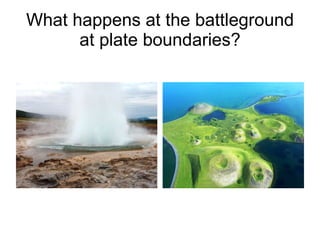
What happens at the battleground at plate boundaries?
Key Terms Fault:  Continental drift: Subduction Zone: Convergent: Divergent: Transform: Continental Crust: Oceanic Crust:
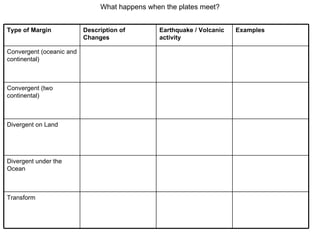
What happens when the plates meet? Type of Margin Description of Changes Earthquake / Volcanic activity Examples Convergent (oceanic and continental) Convergent (two continental) Divergent on Land Divergent under the Ocean Transform
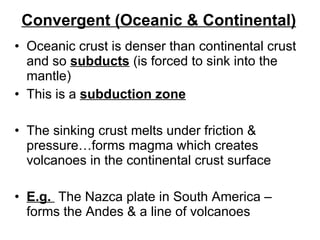
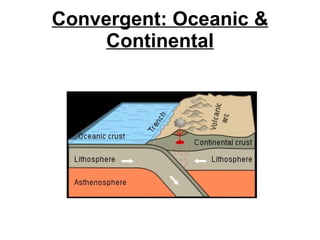
Convergent (Oceanic & Continental) Oceanic crust is denser than continental crust and so  subducts  (is forced to sink into the mantle) This is a  subduction zone The sinking crust melts under friction & pressure…forms magma which creates volcanoes in the continental crust surface E.g.  The Nazca plate in South America – forms the Andes & a line of volcanoes
Convergent: Oceanic & Continental
Convergent (Two Continental)
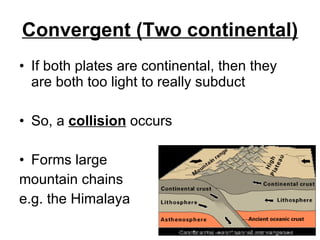
Convergent (Two continental) If both plates are continental, then they are both too light to really subduct So, a  collision  occurs Forms large mountain chains e.g. the Himalaya
Divergent on land


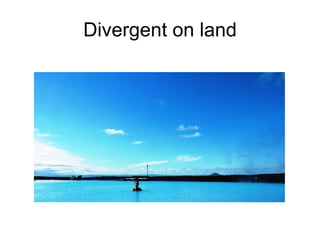
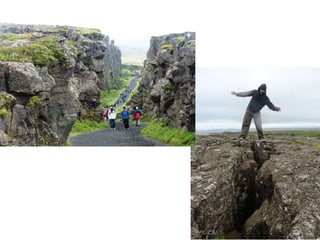
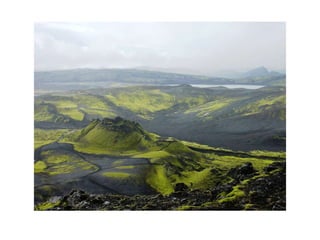
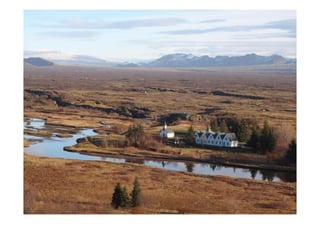
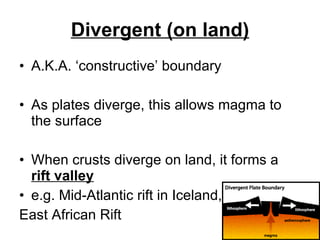
Divergent (on land) A.K.A. ‘constructive’ boundary As plates diverge, this allows magma to the surface When crusts diverge on land, it forms a  rift valley e.g. Mid-Atlantic rift in Iceland,  East African Rift
Divergent under the ocean When plates diverge under the ocean, magma rises to the surface to create new land The  Mid-Atlantic Ridge  is the biggest area of divergence As magma rises it cools, forming ridges of mountains / volcanoes and new land This is part of the recycling of oceanic crust
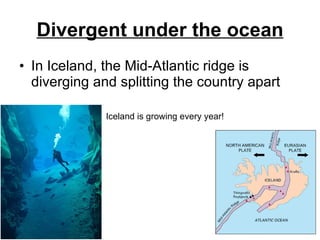
Divergent under the ocean In Iceland, the Mid-Atlantic ridge is diverging and splitting the country apart Iceland is growing every year!
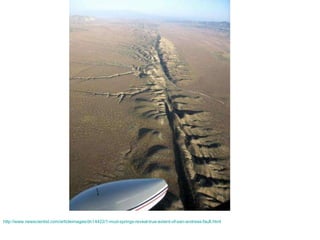
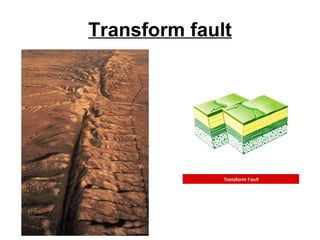
Transform Where plates slide past each other No real surface features Creates a lot of earthquakes as friction builds up then one plate jumps forward E.g. San Andreas Fault, California, USA
Transform fault
Hotspots Weak areas in the earth’s crust that are far from plate boundaries that allow magma to punch through to the surface E.g. Hawaii

What happens when the plates meet

  • 1.
  • 2.
  • 3.
    What happens atthe battleground at plate boundaries?
  • 4.
    Key Terms Fault: Continental drift: Subduction Zone: Convergent: Divergent: Transform: Continental Crust: Oceanic Crust:
  • 5.
    What happens whenthe plates meet? Type of Margin Description of Changes Earthquake / Volcanic activity Examples Convergent (oceanic and continental) Convergent (two continental) Divergent on Land Divergent under the Ocean Transform
  • 6.
    Convergent (Oceanic &Continental) Oceanic crust is denser than continental crust and so subducts (is forced to sink into the mantle) This is a subduction zone The sinking crust melts under friction & pressure…forms magma which creates volcanoes in the continental crust surface E.g. The Nazca plate in South America – forms the Andes & a line of volcanoes
  • 7.
  • 8.
  • 9.
    Convergent (Two continental)If both plates are continental, then they are both too light to really subduct So, a collision occurs Forms large mountain chains e.g. the Himalaya
  • 10.
  • 11.
  • 12.
  • 13.
  • 14.
  • 15.
    Divergent (on land)A.K.A. ‘constructive’ boundary As plates diverge, this allows magma to the surface When crusts diverge on land, it forms a rift valley e.g. Mid-Atlantic rift in Iceland, East African Rift
  • 16.
    Divergent under theocean When plates diverge under the ocean, magma rises to the surface to create new land The Mid-Atlantic Ridge is the biggest area of divergence As magma rises it cools, forming ridges of mountains / volcanoes and new land This is part of the recycling of oceanic crust
  • 17.
    Divergent under theocean In Iceland, the Mid-Atlantic ridge is diverging and splitting the country apart Iceland is growing every year!
  • 18.
    Transform Where platesslide past each other No real surface features Creates a lot of earthquakes as friction builds up then one plate jumps forward E.g. San Andreas Fault, California, USA
  • 19.
  • 20.
    Hotspots Weak areasin the earth’s crust that are far from plate boundaries that allow magma to punch through to the surface E.g. Hawaii

Editor's Notes

  • #3 Then use GE to show Pacific Ring of fire
  • #4 Click on photos for BBC clips and animations