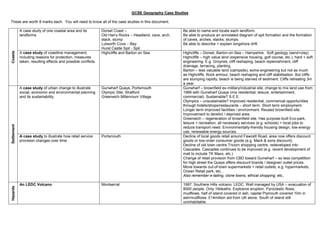
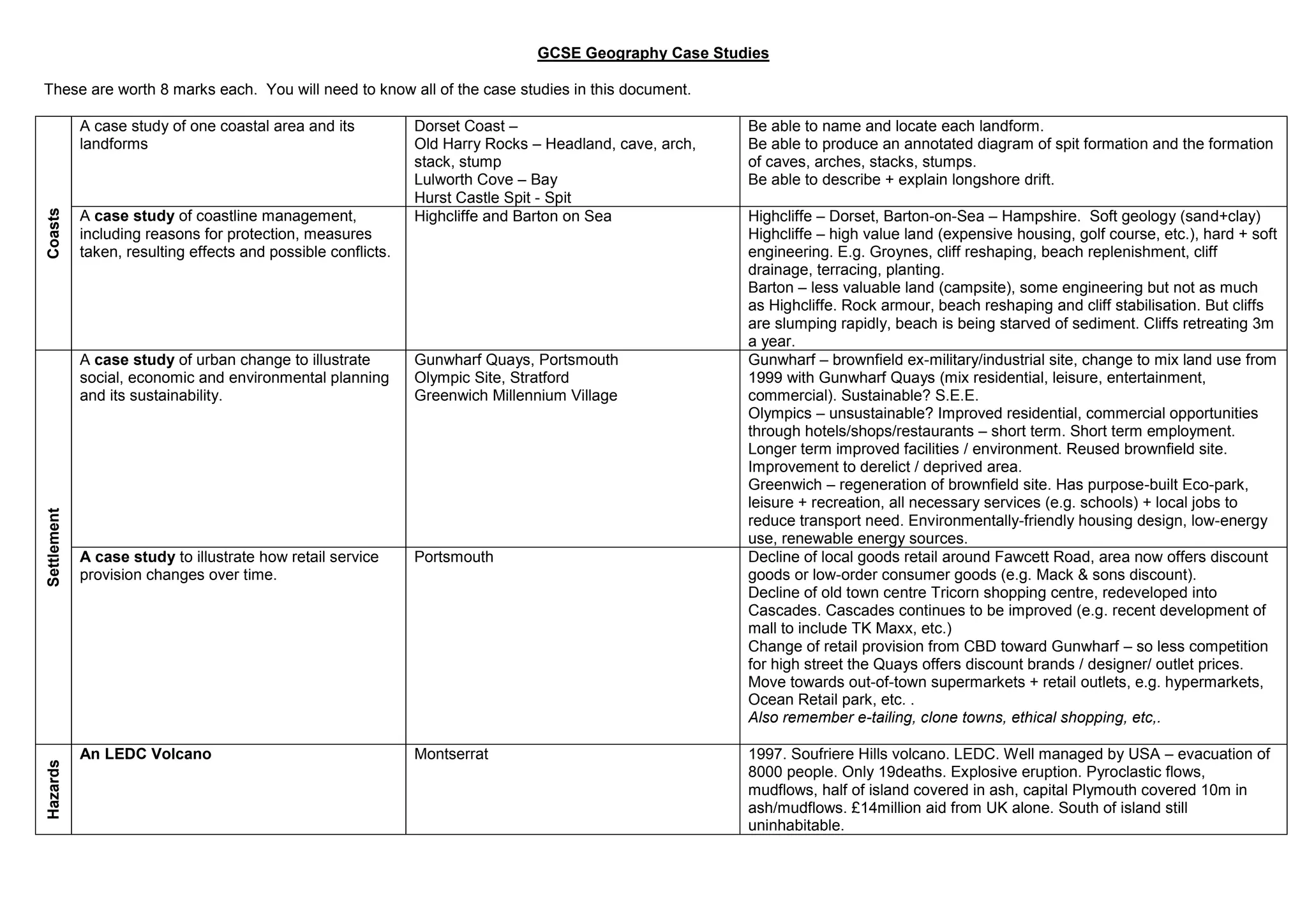
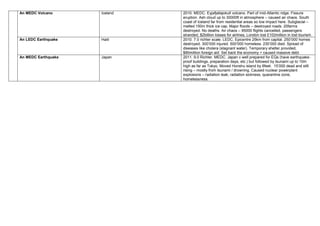
GCSE Geography Case Studies<br />These are worth 8 marks each.  You will need to know all of the case studies in this document.<br />CoastsA case study of one coastal area and its landformsDorset Coast – Old Harry Rocks – Headland, cave, arch, stack, stumpLulworth Cove – BayHurst Castle Spit - SpitBe able to name and locate each landform.Be able to produce an annotated diagram of spit formation and the formation of caves, arches, stacks, stumps.Be able to describe + explain longshore drift.A case study of coastline management, including reasons for protection, measures taken, resulting effects and possible conflicts. Highcliffe and Barton on SeaHighcliffe – Dorset, Barton-on-Sea – Hampshire.  Soft geology (sand+clay)Highcliffe – high value land (expensive housing, golf course, etc.), hard + soft engineering. E.g. Groynes, cliff reshaping, beach replenishment, cliff drainage, terracing, planting.Barton – less valuable land (campsite), some engineering but not as much as Highcliffe. Rock armour, beach reshaping and cliff stabilisation. But cliffs are slumping rapidly, beach is being starved of sediment. Cliffs retreating 3m a year.SettlementA case study of urban change to illustrate social, economic and environmental planning and its sustainability. Gunwharf Quays, PortsmouthOlympic Site, StratfordGreenwich Millennium VillageGunwharf – brownfield ex-military/industrial site, change to mix land use from 1999 with Gunwharf Quays (mix residential, leisure, entertainment, commercial). Sustainable? S.E.E.Olympics – unsustainable? Improved residential, commercial opportunities through hotels/shops/restaurants – short term. Short term employment. Longer term improved facilities / environment. Reused brownfield site. Improvement to derelict / deprived area.Greenwich – regeneration of brownfield site. Has purpose-built Eco-park, leisure + recreation, all necessary services (e.g. schools) + local jobs to reduce transport need. Environmentally-friendly housing design, low-energy use, renewable energy sources.A case study to illustrate how retail service provision changes over time. PortsmouthDecline of local goods retail around Fawcett Road, area now offers discount goods or low-order consumer goods (e.g. Mack & sons discount).Decline of old town centre Tricorn shopping centre, redeveloped into Cascades. Cascades continues to be improved (e.g. recent development of mall to include TK Maxx, etc.)Change of retail provision from CBD toward Gunwharf – so less competition for high street the Quays offers discount brands / designer/ outlet prices.Move towards out-of-town supermarkets + retail outlets, e.g. hypermarkets, Ocean Retail park, etc. . Also remember e-tailing, clone towns, ethical shopping, etc,.HazardsAn LEDC VolcanoMontserrat1997. Soufriere Hills volcano. LEDC. Well managed by USA – evacuation of 8000 people. Only 19deaths. Explosive eruption. Pyroclastic flows, mudflows, half of island covered in ash, capital Plymouth covered 10m in ash/mudflows. £14million aid from UK alone. South of island still uninhabitable.An MEDC VolcanoIceland2010. MEDC. Eyjafjallajokull volcano. Part of mid-Atlantic ridge. Fissure eruption. Ash cloud up to 30000ft in atmosphere – caused air chaos. South coast of Iceland far from residential areas so low impact here. Subglacial – melted 150m thick ice cap. Major floods – destroyed roads. 20farms destroyed. No deaths. Air chaos – 95000 flights cancelled, passengers stranded, $2billion losses for airlines, London lost £102million in lost tourism.An LEDC EarthquakeHaiti2010. 7.0 richter scale. LEDC. Epicentre 25km from capital. 250’000 homes destroyed. 300’000 injured. 500’000 homeless. 230’000 died. Spread of diseases like cholera (stagnant water). Temporary shelter provided, $80million foreign aid. Set back the economy + caused massive debt.An MEDC EarthquakeJapan2011. 9.0 Richter. MEDC. Japan v well prepared for EQs (have earthquake-proof buildings, preparation days, etc.) but followed by tsunami up to 10m high as far as Tokyo. Moved Honshu island by 6feet.  15’000 dead and still rising – mostly from tsunami / drowning. Caused nuclear powerplant explosions – radiation leak, radiation sickness, quarantine zone, homelessness. <br />
GCSE geography case studies

GCSE geography case studies

  • 1.
    GCSE Geography CaseStudies<br />These are worth 8 marks each. You will need to know all of the case studies in this document.<br />CoastsA case study of one coastal area and its landformsDorset Coast – Old Harry Rocks – Headland, cave, arch, stack, stumpLulworth Cove – BayHurst Castle Spit - SpitBe able to name and locate each landform.Be able to produce an annotated diagram of spit formation and the formation of caves, arches, stacks, stumps.Be able to describe + explain longshore drift.A case study of coastline management, including reasons for protection, measures taken, resulting effects and possible conflicts. Highcliffe and Barton on SeaHighcliffe – Dorset, Barton-on-Sea – Hampshire. Soft geology (sand+clay)Highcliffe – high value land (expensive housing, golf course, etc.), hard + soft engineering. E.g. Groynes, cliff reshaping, beach replenishment, cliff drainage, terracing, planting.Barton – less valuable land (campsite), some engineering but not as much as Highcliffe. Rock armour, beach reshaping and cliff stabilisation. But cliffs are slumping rapidly, beach is being starved of sediment. Cliffs retreating 3m a year.SettlementA case study of urban change to illustrate social, economic and environmental planning and its sustainability. Gunwharf Quays, PortsmouthOlympic Site, StratfordGreenwich Millennium VillageGunwharf – brownfield ex-military/industrial site, change to mix land use from 1999 with Gunwharf Quays (mix residential, leisure, entertainment, commercial). Sustainable? S.E.E.Olympics – unsustainable? Improved residential, commercial opportunities through hotels/shops/restaurants – short term. Short term employment. Longer term improved facilities / environment. Reused brownfield site. Improvement to derelict / deprived area.Greenwich – regeneration of brownfield site. Has purpose-built Eco-park, leisure + recreation, all necessary services (e.g. schools) + local jobs to reduce transport need. Environmentally-friendly housing design, low-energy use, renewable energy sources.A case study to illustrate how retail service provision changes over time. PortsmouthDecline of local goods retail around Fawcett Road, area now offers discount goods or low-order consumer goods (e.g. Mack & sons discount).Decline of old town centre Tricorn shopping centre, redeveloped into Cascades. Cascades continues to be improved (e.g. recent development of mall to include TK Maxx, etc.)Change of retail provision from CBD toward Gunwharf – so less competition for high street the Quays offers discount brands / designer/ outlet prices.Move towards out-of-town supermarkets + retail outlets, e.g. hypermarkets, Ocean Retail park, etc. . Also remember e-tailing, clone towns, ethical shopping, etc,.HazardsAn LEDC VolcanoMontserrat1997. Soufriere Hills volcano. LEDC. Well managed by USA – evacuation of 8000 people. Only 19deaths. Explosive eruption. Pyroclastic flows, mudflows, half of island covered in ash, capital Plymouth covered 10m in ash/mudflows. £14million aid from UK alone. South of island still uninhabitable.An MEDC VolcanoIceland2010. MEDC. Eyjafjallajokull volcano. Part of mid-Atlantic ridge. Fissure eruption. Ash cloud up to 30000ft in atmosphere – caused air chaos. South coast of Iceland far from residential areas so low impact here. Subglacial – melted 150m thick ice cap. Major floods – destroyed roads. 20farms destroyed. No deaths. Air chaos – 95000 flights cancelled, passengers stranded, $2billion losses for airlines, London lost £102million in lost tourism.An LEDC EarthquakeHaiti2010. 7.0 richter scale. LEDC. Epicentre 25km from capital. 250’000 homes destroyed. 300’000 injured. 500’000 homeless. 230’000 died. Spread of diseases like cholera (stagnant water). Temporary shelter provided, $80million foreign aid. Set back the economy + caused massive debt.An MEDC EarthquakeJapan2011. 9.0 Richter. MEDC. Japan v well prepared for EQs (have earthquake-proof buildings, preparation days, etc.) but followed by tsunami up to 10m high as far as Tokyo. Moved Honshu island by 6feet. 15’000 dead and still rising – mostly from tsunami / drowning. Caused nuclear powerplant explosions – radiation leak, radiation sickness, quarantine zone, homelessness. <br />