•Students will create an infographic using
piktochart listing at least 10 renaissance
painters and their famous painting.
The Renaissance
Chapter 17
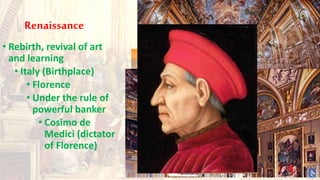
Renaissance
• Rebirth, revival of art
and learning
• Italy (Birthplace)
• Florence
• Under the rule of
powerful banker
• Cosimo de
Medici (dictator
of Florence)
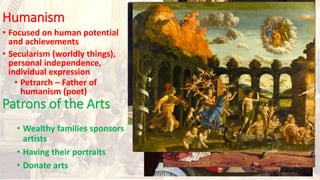
Humanism
• Focused on human potential
and achievements
• Secularism (worldly things),
personal independence,
individual expression
• Petrarch – Father of
humanism (poet)
Patrons of the Arts
• Wealthy families sponsors
artists
• Having their portraits
• Donate arts
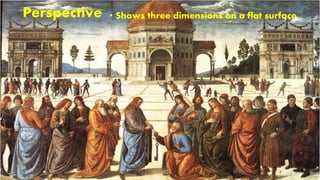
Perspective
• Shows three dimensions on a flat surface
Perspective • Shows three dimensions on a flat surface
Leonardo
Raphael
Michelangelo
Donatello
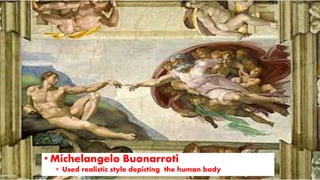
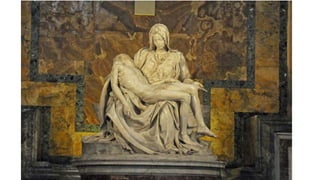
• Michelangelo Buonarroti
• Used realistic style depicting the human body
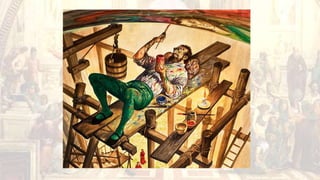
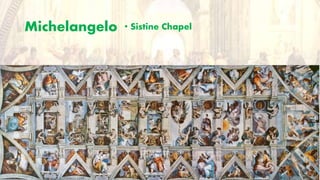
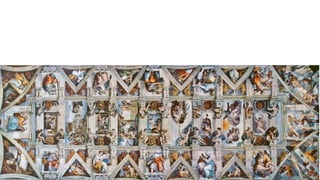
Michelangelo • Sistine Chapel
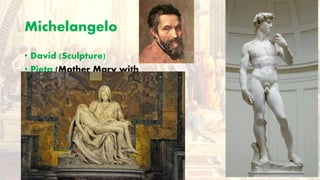
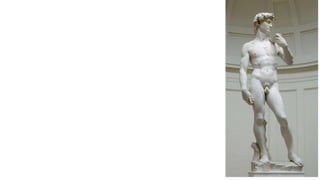
Michelangelo
• David (Sculpture)
• Pieta (Mother Mary with
jesus dying in her harms)
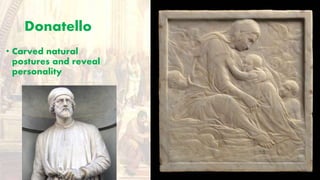
Donatello
• Carved natural
postures and reveal
personality
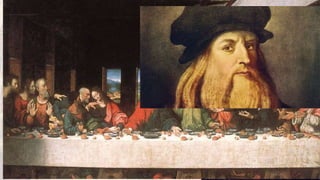
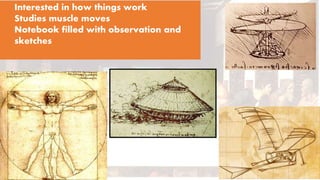
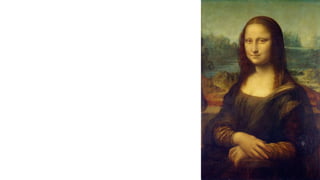
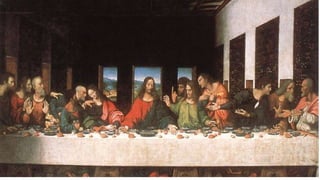
Leonardo da
Vinci
• Painter, sculptor, inventor,
and scientist
• Mona Lisa
• The Last Supper
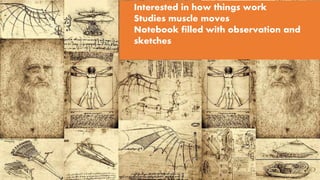
Interested in how things work
Studies muscle moves
Notebook filled with observation and
sketches
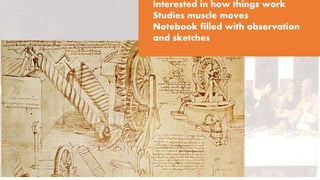
Interested in how things work
Studies muscle moves
Notebook filled with observation and
sketches
Interested in how things work
Studies muscle moves
Notebook filled with observation
and sketches
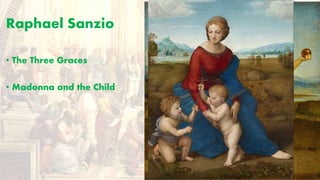
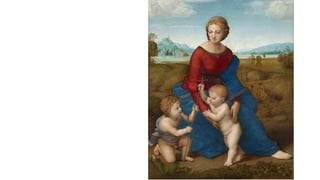
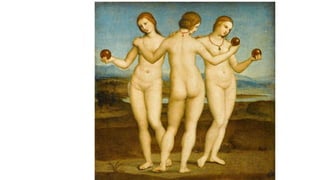
Raphael Sanzio
• The Three Graces
• Madonna and the Child
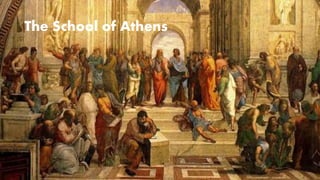
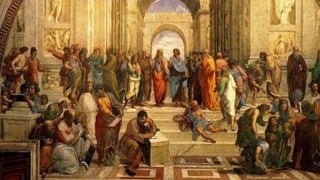
The School of Athens
MOVIE DAY
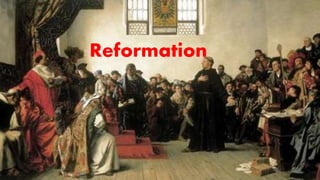
Reformation
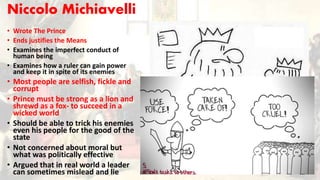
Niccolo Michiavelli
• Wrote The Prince
• Ends justifies the Means
• Examines the imperfect conduct of
human being
• Examines how a ruler can gain power
and keep it in spite of its enemies
• Most people are selfish, fickle and
corrupt
• Prince must be strong as a lion and
shrewd as a fox- to succeed in a
wicked world
• Should be able to trick his enemies
even his people for the good of the
state
• Not concerned about moral but
what was politically effective
• Argued that in real world a leader
can sometimes mislead and lie
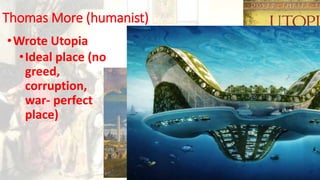
Thomas More (humanist)
•Wrote Utopia
•Ideal place (no
greed,
corruption,
war- perfect
place)
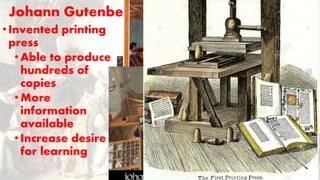
Johann Gutenberg
•Invented printing
press
•Able to produce
hundreds of
copies
•More
information
available
•Increase desire
for learning
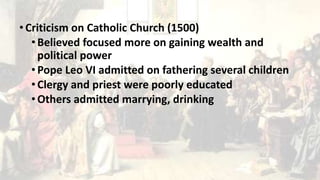
• Criticism on Catholic Church (1500)
• Believed focused more on gaining wealth and
political power
•Pope Leo VI admitted on fathering several children
• Clergy and priest were poorly educated
• Others admitted marrying, drinking
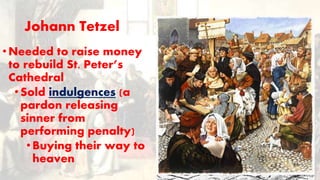
Johann Tetzel
•Needed to raise money
to rebuild St. Peter’s
Cathedral
•Sold indulgences (a
pardon releasing
sinner from
performing penalty)
• Buying their way to
heaven
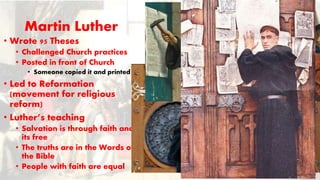
Martin Luther
• Wrote 95 Theses
• Challenged Church practices
• Posted in front of Church
• Someone copied it and printed it
• Led to Reformation
(movement for religious
reform)
• Luther’s teaching
• Salvation is through faith and
its free
• The truths are in the Words of
the Bible
• People with faith are equal
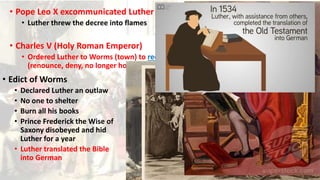
• Pope Leo X excommunicated Luther
• Luther threw the decree into flames
• Charles V (Holy Roman Emperor)
• Ordered Luther to Worms (town) to recant
(renounce, deny, no longer holds the belief)
• Edict of Worms
• Declared Luther an outlaw
• No one to shelter
• Burn all his books
• Prince Frederick the Wise of
Saxony disobeyed and hid
Luther for a year
• Luther translated the Bible
into German
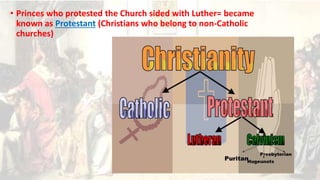
• Princes who protested the Church sided with Luther= became
known as Protestant (Christians who belong to non-Catholic
churches)
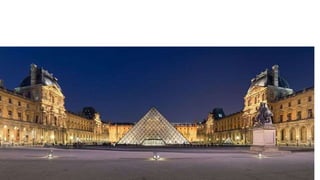
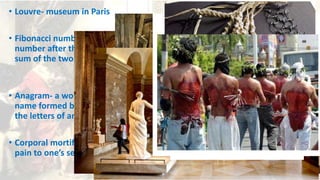
• Louvre- museum in Paris
• Fibonacci numbers - every
number after the first two is the
sum of the two preceding ones
• Anagram- a word, phrase, or
name formed by rearranging
the letters of another
• Corporal mortification – causing
pain to one’s self body
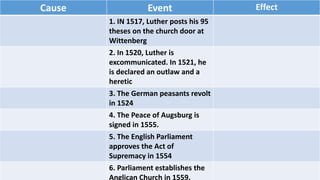
Cause Event Effect
1. IN 1517, Luther posts his 95
theses on the church door at
Wittenberg
2. In 1520, Luther is
excommunicated. In 1521, he
is declared an outlaw and a
heretic
3. The German peasants revolt
in 1524
4. The Peace of Augsburg is
signed in 1555.
5. The English Parliament
approves the Act of
Supremacy in 1554
6. Parliament establishes the
Anglican Church in 1559.
Constantine
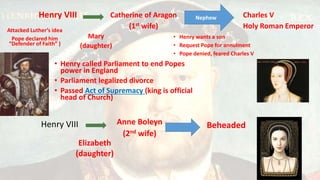
Catherine of Aragon
(1st wife)
Henry VIII
Charles V
Holy Roman Emperor
Anne Boleyn
(2nd wife)
Nephew
Mary
(daughter)
• Henry wants a son
• Request Pope for annulment
• Pope denied, feared Charles V
Attacked Luther’s idea
Pope declared him
“Defender of Faith” )
• Henry called Parliament to end Popes
power in England
• Parliament legalized divorce
• Passed Act of Supremacy (king is official
head of Church)
Henry VIII
Elizabeth
(daughter)
Beheaded
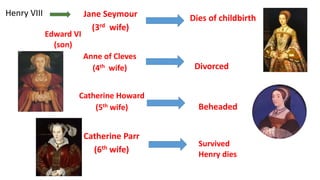
Jane Seymour
(3rd wife)
Henry VIII
Dies of childbirth
Anne of Cleves
(4th wife)
Catherine Parr
(6th wife)
Catherine Howard
(5th wife)
Edward VI
(son)
Beheaded
Divorced
Survived
Henry dies
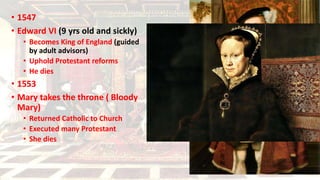
• 1547
• Edward VI (9 yrs old and sickly)
• Becomes King of England (guided
by adult advisors)
• Uphold Protestant reforms
• He dies
• 1553
• Mary takes the throne ( Bloody
Mary)
• Returned Catholic to Church
• Executed many Protestant
• She dies
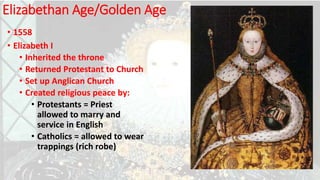
Elizabethan Age/Golden Age
• 1558
• Elizabeth I
• Inherited the throne
• Returned Protestant to Church
• Set up Anglican Church
• Created religious peace by:
• Protestants = Priest
allowed to marry and
service in English
• Catholics = allowed to wear
trappings (rich robe)
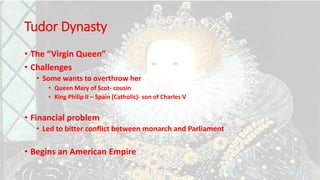
Tudor Dynasty
• The “Virgin Queen”
• Challenges
• Some wants to overthrow her
• Queen Mary of Scot- cousin
• King Philip II – Spain (Catholic)- son of Charles V
• Financial problem
• Led to bitter conflict between monarch and Parliament
• Begins an American Empire
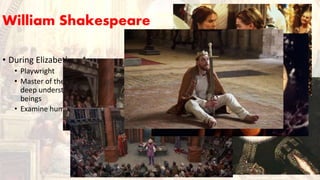
William Shakespeare
• During Elizabethan Age
• Playwright
• Master of the English language and
deep understanding of human
beings
• Examine human flaws
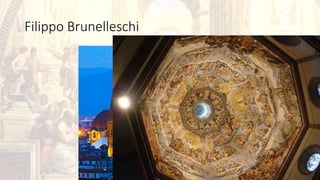
Filippo Brunelleschi

WH CH17 Renaissance

  • 1.
    •Students will createan infographic using piktochart listing at least 10 renaissance painters and their famous painting.
  • 2.
  • 4.
    Renaissance • Rebirth, revivalof art and learning • Italy (Birthplace) • Florence • Under the rule of powerful banker • Cosimo de Medici (dictator of Florence)
  • 5.
    Humanism • Focused onhuman potential and achievements • Secularism (worldly things), personal independence, individual expression • Petrarch – Father of humanism (poet) Patrons of the Arts • Wealthy families sponsors artists • Having their portraits • Donate arts
  • 6.
    Perspective • Shows threedimensions on a flat surface
  • 7.
    Perspective • Showsthree dimensions on a flat surface
  • 8.
  • 10.
    • Michelangelo Buonarroti •Used realistic style depicting the human body
  • 11.
  • 13.
    Michelangelo • David (Sculpture) •Pieta (Mother Mary with jesus dying in her harms)
  • 14.
  • 15.
    Leonardo da Vinci • Painter,sculptor, inventor, and scientist • Mona Lisa • The Last Supper
  • 16.
    Interested in howthings work Studies muscle moves Notebook filled with observation and sketches
  • 17.
    Interested in howthings work Studies muscle moves Notebook filled with observation and sketches
  • 18.
    Interested in howthings work Studies muscle moves Notebook filled with observation and sketches
  • 19.
    Raphael Sanzio • TheThree Graces • Madonna and the Child
  • 20.
  • 21.
  • 32.
  • 34.
    Niccolo Michiavelli • WroteThe Prince • Ends justifies the Means • Examines the imperfect conduct of human being • Examines how a ruler can gain power and keep it in spite of its enemies • Most people are selfish, fickle and corrupt • Prince must be strong as a lion and shrewd as a fox- to succeed in a wicked world • Should be able to trick his enemies even his people for the good of the state • Not concerned about moral but what was politically effective • Argued that in real world a leader can sometimes mislead and lie
  • 35.
    Thomas More (humanist) •WroteUtopia •Ideal place (no greed, corruption, war- perfect place)
  • 36.
    Johann Gutenberg •Invented printing press •Ableto produce hundreds of copies •More information available •Increase desire for learning
  • 37.
    • Criticism onCatholic Church (1500) • Believed focused more on gaining wealth and political power •Pope Leo VI admitted on fathering several children • Clergy and priest were poorly educated • Others admitted marrying, drinking
  • 38.
    Johann Tetzel •Needed toraise money to rebuild St. Peter’s Cathedral •Sold indulgences (a pardon releasing sinner from performing penalty) • Buying their way to heaven
  • 39.
    Martin Luther • Wrote95 Theses • Challenged Church practices • Posted in front of Church • Someone copied it and printed it • Led to Reformation (movement for religious reform) • Luther’s teaching • Salvation is through faith and its free • The truths are in the Words of the Bible • People with faith are equal
  • 40.
    • Pope LeoX excommunicated Luther • Luther threw the decree into flames • Charles V (Holy Roman Emperor) • Ordered Luther to Worms (town) to recant (renounce, deny, no longer holds the belief) • Edict of Worms • Declared Luther an outlaw • No one to shelter • Burn all his books • Prince Frederick the Wise of Saxony disobeyed and hid Luther for a year • Luther translated the Bible into German
  • 41.
    • Princes whoprotested the Church sided with Luther= became known as Protestant (Christians who belong to non-Catholic churches)
  • 42.
    • Louvre- museumin Paris • Fibonacci numbers - every number after the first two is the sum of the two preceding ones • Anagram- a word, phrase, or name formed by rearranging the letters of another • Corporal mortification – causing pain to one’s self body
  • 43.
    Cause Event Effect 1.IN 1517, Luther posts his 95 theses on the church door at Wittenberg 2. In 1520, Luther is excommunicated. In 1521, he is declared an outlaw and a heretic 3. The German peasants revolt in 1524 4. The Peace of Augsburg is signed in 1555. 5. The English Parliament approves the Act of Supremacy in 1554 6. Parliament establishes the Anglican Church in 1559.
  • 44.
  • 45.
    Catherine of Aragon (1stwife) Henry VIII Charles V Holy Roman Emperor Anne Boleyn (2nd wife) Nephew Mary (daughter) • Henry wants a son • Request Pope for annulment • Pope denied, feared Charles V Attacked Luther’s idea Pope declared him “Defender of Faith” ) • Henry called Parliament to end Popes power in England • Parliament legalized divorce • Passed Act of Supremacy (king is official head of Church) Henry VIII Elizabeth (daughter) Beheaded
  • 46.
    Jane Seymour (3rd wife) HenryVIII Dies of childbirth Anne of Cleves (4th wife) Catherine Parr (6th wife) Catherine Howard (5th wife) Edward VI (son) Beheaded Divorced Survived Henry dies
  • 47.
    • 1547 • EdwardVI (9 yrs old and sickly) • Becomes King of England (guided by adult advisors) • Uphold Protestant reforms • He dies • 1553 • Mary takes the throne ( Bloody Mary) • Returned Catholic to Church • Executed many Protestant • She dies
  • 48.
    Elizabethan Age/Golden Age •1558 • Elizabeth I • Inherited the throne • Returned Protestant to Church • Set up Anglican Church • Created religious peace by: • Protestants = Priest allowed to marry and service in English • Catholics = allowed to wear trappings (rich robe)
  • 49.
    Tudor Dynasty • The“Virgin Queen” • Challenges • Some wants to overthrow her • Queen Mary of Scot- cousin • King Philip II – Spain (Catholic)- son of Charles V • Financial problem • Led to bitter conflict between monarch and Parliament • Begins an American Empire
  • 50.
    William Shakespeare • DuringElizabethan Age • Playwright • Master of the English language and deep understanding of human beings • Examine human flaws
  • 51.

Editor's Notes

  • #5 Italy hoped to bring back culture of classical Greece and Rome, but instead they created something new First pic: Florence, Italy (Duomo) Second pic: Palazzo Medici
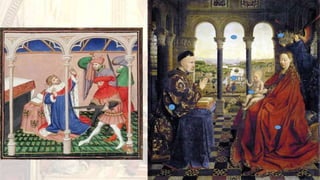
  • #6 Michael Pacher’s Wolfgang und der Teufel  As people started thinking about their faith and what they were told to believe they could see the corruption.  ANDREA MANTEGNA (1431-1506) 'The Triumph of the Virtues - Minerva Expelling the Vices from the Garden of Virtue', 1502 
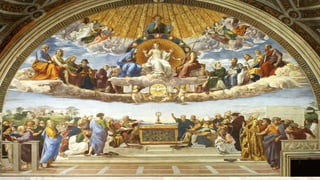
  • #7 Raphael marriage of the virgin St. Peter healing a cripple and raising Tabitha Disputation of the Holy Sacraments (Raphael) _ last pic
  • #8 Pietro Perugino = Jesus handing Peter the keys
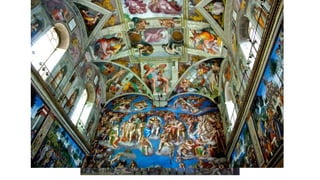
  • #11 Between 1508 and 1512, under the patronage of Pope Julius II, Michelangelo painted the chapel's ceiling, a project which changed the course of Western art and is regarded as one of the major artistic accomplishments of human civilization.[5][6] In a different climate after the Sack of Rome, he returned and between 1535 and 1541, painted The Last Judgment for Popes Clement VII and Paul III.[7] The fame of Michelangelo's paintings has drawn multitudes of visitors to the chapel ever since they were revealed five hundred years ago.
  • #13 The Last Judgment
  • #15 Marble. Madonna and child with angels, cherubs Donatello was one of the most innovative sculptors in the history of European sculpture. He carved this image in flattened relief (rilievo schiacciato), a technique, which he invented, in which a sculptor could create the illusion of volumetric forms set into deep, continuous space with the most subtle and shallow carving. The Madonna sits as if on the ground, to convey the idea of humility, but Donatello sets her in the clouds, so she also becomes Queen of Heaven. A feeling of weighty foreboding is expressed in the Madonna’s somber profile, which seems to look into the Christ Child’s tragic future.
  • #20 The three Graces The Madonna with the Christ Child and Saint John the Baptist is a 1506 painting by Raphael, now held in the Kunsthistorisches Museum in Vienna. It is also known as Madonna del prato (Madonna of the Meadow) or Madonna del Belvedere (after its long residence in the imperial collection in the Vienna Belvedere). The three figures in a calm green meadow are linked by looks and touching hands. The Virgin Mary is shown wearing a gold-bordered blue mantle set against a red dress and with her right leg lying along a diagonal. The blue symbolizes the church and the red Christ's death, with the Madonna the uniting of Mother Church with Christ's sacrifice. With her eyes fixed on Christ, her head is turned to the left and slightly inclined, and in her hands she holds up Christ, as he leans forward unsteadily to touch the miniature cross held by John. The poppy refers to Christ's passion, death and resurrection.
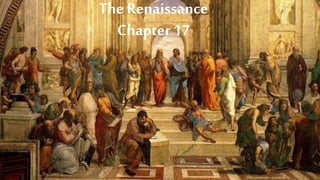
  • #21 The School of Athens represents all the greatest mathematicians, philosophers and scientists from classical antiquity gathered together sharing their ideas and learning from each other. These figures all lived at different times, but here they are gathered together under one roof.
  • #24 Raphael (Madonna and child
  • #30 Rapahel (three graces)
  • #35 State is sovereign, autonomous and non-religious Use a double standard of morality Favour despotic rule Maintain strong army Remain free from emotions
  • #40 Luther parents wanted him to be a lawyer. At age 21, he was struck by thunderstorm, thought he would die, prayed and cried out “Saint Anne, help me! I will become a monk!” So he became a monk. Even after becoming a monk, he always felt sinful until
  • #45 Constantine was the first Roman emperor to convert to Christianity.[notes 1] Although he lived most of his life as a pagan, he joined the Christian faith on his deathbed, being baptised by Eusebius. He played an influential role in the proclamation of the Edict of Milanin 313, which declared religious tolerance for Christianity in the Roman empire. He called the First Council of Nicaea in 325 that produced the statement of Christian belief known as the Nicene Creed. The Church of the Holy Sepulchre was built on his orders at the purported site of Jesus' tomb in Jerusalem and became the holiest place in Christendom. The Papal claim to temporal power in the High Middle Ages was based on the supposed Donation of Constantine. He is venerated as a saint by Eastern Orthodox and Byzantine Catholics. He has historically been referred to as the "First Christian Emperor," and he did heavily promote the Christian Church. Some modern scholars, however, debate his beliefs and even his comprehension of the Christian faith itself.
  • #50 Parliament urged her to marry, but she refused in the name of preserving her power
  • #52 Cathedral di Santa Maria del Friori- Florence