Minoans
Minoans
• Lived on Crete
• Large island on the edge
of Aegean Sea
• Did NOT speak Greek
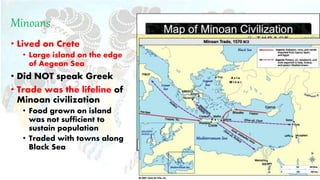
• Trade was the lifeline of
Minoan civilization
• Food grown on island
was not sufficient to
sustain population
• Traded with towns along
Black Sea
Minoans ( 2000-1400 BC)
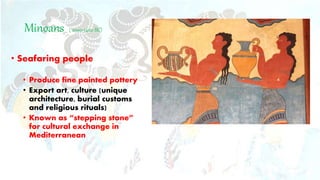
• Seafaring people
• Produce fine painted pottery
• Export art, culture (unique
architecture, burial customs
and religious rituals)
• Known as “stepping stone”
for cultural exchange in
Mediterranean
Minoan Art
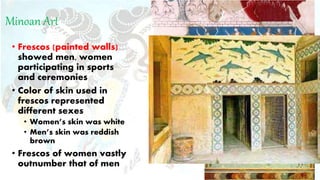
• Frescos (painted walls)
showed men, women
participating in sports
and ceremonies
• Color of skin used in
frescos represented
different sexes
• Women’s skin was white
• Men’s skin was reddish
brown
• Frescos of women vastly
outnumber that of men
Minoan Culture
• Men and women are thought
to have held at least equal
social status
• Based on frescos depicting men,
women playing the same sports
• Minoan culture was possibly
matriarchal
• Women shown seated on
thrones
• Women shown being saluted
by others
• Minoan art depicts no trace of
male rule
Knossos
• Minoan capital
• No fortification
• Ruled by King Minos
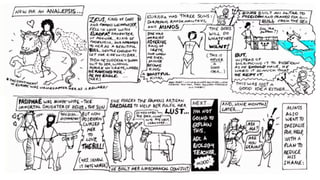
• Owned a (Minotaur)
• half-human, half bull
• Kept inside a labyrinth
(maze)
Minoan Religion
• Based on goddess worship
• Examples
• Fertility Goddess
• Mistress of Animals
• Protector of Cities
• Mistress of the Harvest
Potinija – mother goddess
End of Minoan Civilization
• Rise of iron production
led to decline in Minoan
trade after 1700 BC
• Volcano eruption at
Thera wiped out most of
Northern Crete
• Eruption caused huge tidal
wave
• Wave destroyed Minoan
navy
• Earthquake around 1600
BC destroyed many
palaces, incl. @ Knossos
• Mycenaeans invaded
around 1400 BC
Area of eruption’s
effect
Modern map of
Crete, Santorini
(formerly Thera)
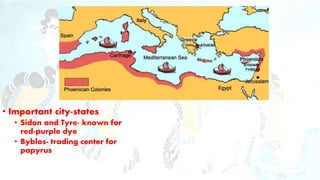
Phoenicians (1100BC)
• Important city-states
• Sidon and Tyre- known for
red-purple dye
• Byblos- trading center for
papyrus
• Writing:
• Phonetics- one sign was
used for one sound
• Alphabet (came from the
first two letters = aleph and
beth)
• Contribution to the world:
simplified alphabet-
learning accessible to more
people
• Phoenicians exchange
products and information
along with goods, ideas,
religious beliefs, art, way of
living- led to cultural
diffusion (spreading of
culture

WH Minoans

  • 1.
  • 2.
    Minoans • Lived onCrete • Large island on the edge of Aegean Sea • Did NOT speak Greek • Trade was the lifeline of Minoan civilization • Food grown on island was not sufficient to sustain population • Traded with towns along Black Sea
  • 3.
    Minoans ( 2000-1400BC) • Seafaring people • Produce fine painted pottery • Export art, culture (unique architecture, burial customs and religious rituals) • Known as “stepping stone” for cultural exchange in Mediterranean
  • 4.
    Minoan Art • Frescos(painted walls) showed men, women participating in sports and ceremonies • Color of skin used in frescos represented different sexes • Women’s skin was white • Men’s skin was reddish brown • Frescos of women vastly outnumber that of men
  • 5.
    Minoan Culture • Menand women are thought to have held at least equal social status • Based on frescos depicting men, women playing the same sports • Minoan culture was possibly matriarchal • Women shown seated on thrones • Women shown being saluted by others • Minoan art depicts no trace of male rule
  • 6.
    Knossos • Minoan capital •No fortification • Ruled by King Minos • Owned a (Minotaur) • half-human, half bull • Kept inside a labyrinth (maze)
  • 20.
    Minoan Religion • Basedon goddess worship • Examples • Fertility Goddess • Mistress of Animals • Protector of Cities • Mistress of the Harvest Potinija – mother goddess
  • 21.
    End of MinoanCivilization • Rise of iron production led to decline in Minoan trade after 1700 BC • Volcano eruption at Thera wiped out most of Northern Crete • Eruption caused huge tidal wave • Wave destroyed Minoan navy • Earthquake around 1600 BC destroyed many palaces, incl. @ Knossos • Mycenaeans invaded around 1400 BC Area of eruption’s effect Modern map of Crete, Santorini (formerly Thera)
  • 22.
  • 23.
    • Important city-states •Sidon and Tyre- known for red-purple dye • Byblos- trading center for papyrus
  • 24.
    • Writing: • Phonetics-one sign was used for one sound • Alphabet (came from the first two letters = aleph and beth) • Contribution to the world: simplified alphabet- learning accessible to more people
  • 25.
    • Phoenicians exchange productsand information along with goods, ideas, religious beliefs, art, way of living- led to cultural diffusion (spreading of culture