CHALLENGE
and
REFORMATION
1400-1600
• Protestant Reformation:
a religious movement of the 16th century
that began as an attempt to reform the
Roman Catholic Church and resulted in the
creation of Protestant churches
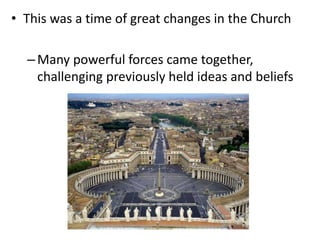
• This was a time of great changes in the Church
–Many powerful forces came together,
challenging previously held ideas and beliefs
• In the Fourteenth Century, a French pope
(Clement V) moved to Avignon, France
• Seven popes remained in France, under the rule
of the French king, for almost 70 years
• This time is known as the Avignon Papacy
• This was a problem because the Church was
meant to be universal (catholic), not tied to
one country’s rule
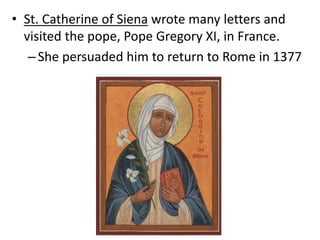
• St. Catherine of Siena wrote many letters and

visited the pope, Pope Gregory XI, in France.
–She persuaded him to return to Rome in 1377
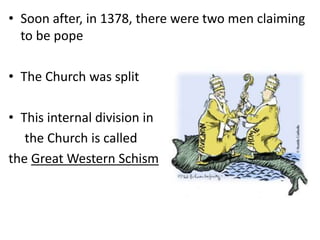
• Soon after, in 1378, there were two men claiming
to be pope
• The Church was split
• This internal division in
the Church is called
the Great Western Schism
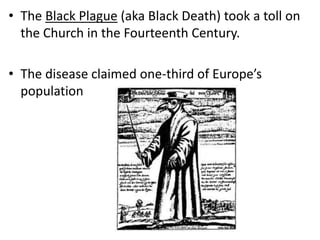
• The Black Plague (aka Black Death) took a toll on
the Church in the Fourteenth Century.
• The disease claimed one-third of Europe’s
population
The Renaissance
(16th Century)
• The word “Renaissance” means “rebirth”
• This was a time of renewed interest in the
cultures of ancient Greece and Rome
- This was reflected in education, art and
literature
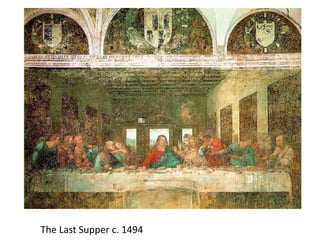
The Last Supper c. 1494
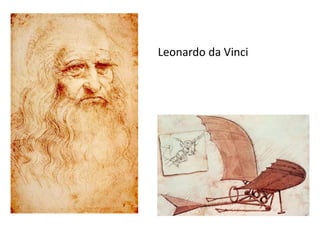
Leonardo da Vinci
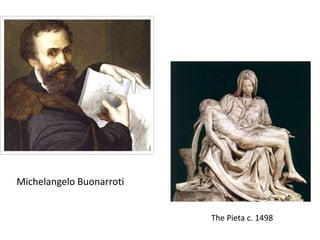
The Pieta c. 1498
Michelangelo Buonarroti
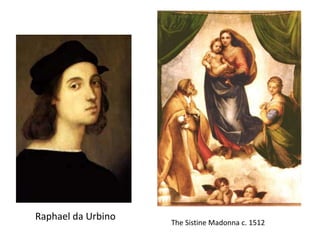
Raphael da Urbino
The Sistine Madonna c. 1512

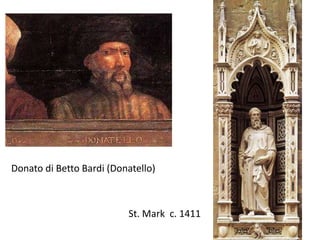
Donato di Betto Bardi (Donatello)
St. Mark c. 1411
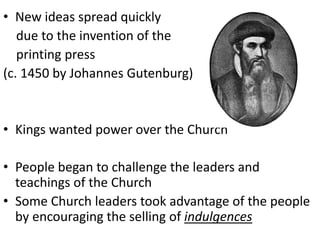
• New ideas spread quickly
due to the invention of the

printing press
(c. 1450 by Johannes Gutenburg)
• Kings wanted power over the Church
• People began to challenge the leaders and
teachings of the Church
• Some Church leaders took advantage of the people
by encouraging the selling of indulgences
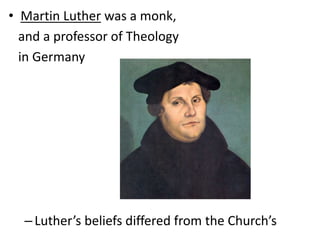
• Martin Luther was a monk,
and a professor of Theology
in Germany
–Luther’s beliefs differed from the Church’s
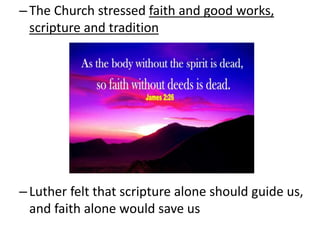
–The Church stressed faith and good works,
scripture and tradition
–Luther felt that scripture alone should guide us,
and faith alone would save us
* Luther did not accept the teaching authority of
the Church
• He also felt that there were certain wrongs in the
Church
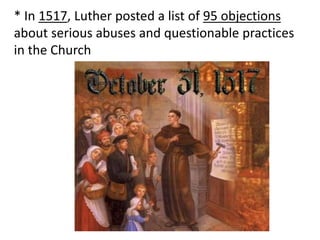
* In 1517, Luther posted a list of 95 objections
about serious abuses and questionable practices
in the Church
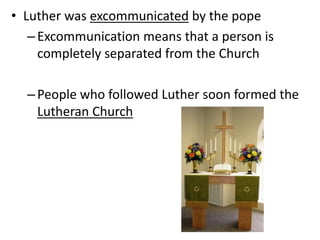
• Luther was excommunicated by the pope
–Excommunication means that a person is
completely separated from the Church
–People who followed Luther soon formed the
Lutheran Church
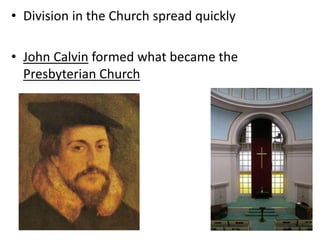
• Division in the Church spread quickly
• John Calvin formed what became the
Presbyterian Church
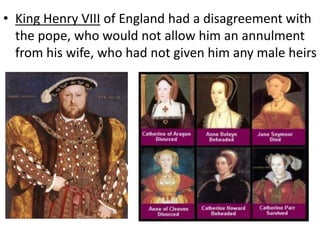
• King Henry VIII of England had a disagreement with
the pope, who would not allow him an annulment
from his wife, who had not given him any male heirs
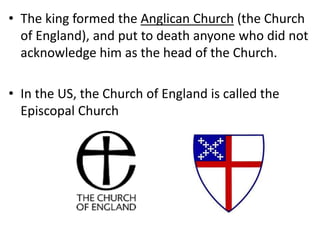
• The king formed the Anglican Church (the Church
of England), and put to death anyone who did not
acknowledge him as the head of the Church.
• In the US, the Church of England is called the
Episcopal Church
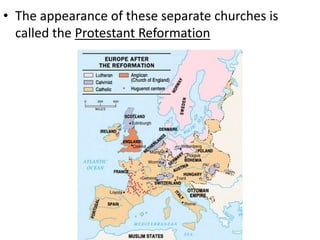
• The appearance of these separate churches is
called the Protestant Reformation
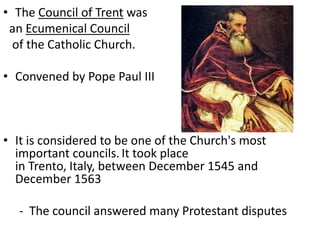
• The Council of Trent was
an Ecumenical Council
of the Catholic Church.
• Convened by Pope Paul III
• It is considered to be one of the Church's most
important councils. It took place
in Trento, Italy, between December 1545 and
December 1563
- The council answered many Protestant disputes
The Council of Trent:
–1545 – 1563
–Brought reform to the Catholic Church
–Formalized the Roman catechism
–Explained Catholic beliefs and traditions
–Stressed belief in the sacraments
–Deepened devotion to the Mass
–Affirmed which books to include in the bible (a
process begun in 367AD by Athanasius)
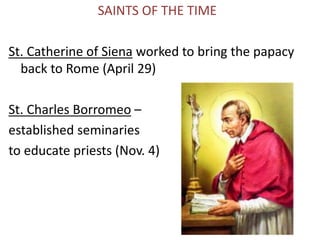
SAINTS OF THE TIME
St. Catherine of Siena worked to bring the papacy
back to Rome (April 29)
St. Charles Borromeo –
established seminaries
to educate priests (Nov. 4)
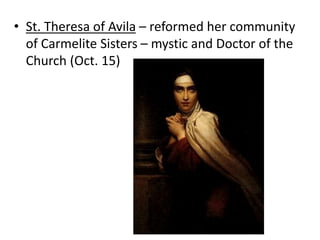
• St. Theresa of Avila – reformed her community
of Carmelite Sisters – mystic and Doctor of the
Church (Oct. 15)
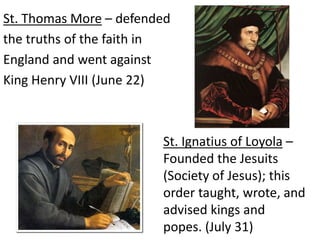
St. Thomas More – defended
the truths of the faith in
England and went against
King Henry VIII (June 22)
St. Ignatius of Loyola –
Founded the Jesuits
(Society of Jesus); this
order taught, wrote, and
advised kings and
popes. (July 31)
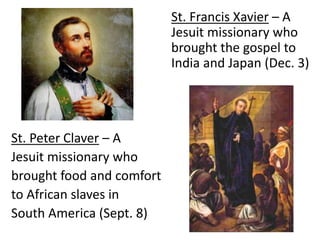
St. Francis Xavier – A
Jesuit missionary who
brought the gospel to
India and Japan (Dec. 3)
St. Peter Claver – A
Jesuit missionary who
brought food and comfort
to African slaves in
South America (Sept. 8)
Reformation relgrade8

Reformation relgrade8

  • 1.
  • 2.
    • Protestant Reformation: areligious movement of the 16th century that began as an attempt to reform the Roman Catholic Church and resulted in the creation of Protestant churches
  • 3.
    • This wasa time of great changes in the Church –Many powerful forces came together, challenging previously held ideas and beliefs
  • 4.
    • In theFourteenth Century, a French pope (Clement V) moved to Avignon, France • Seven popes remained in France, under the rule of the French king, for almost 70 years • This time is known as the Avignon Papacy • This was a problem because the Church was meant to be universal (catholic), not tied to one country’s rule
  • 5.
    • St. Catherineof Siena wrote many letters and visited the pope, Pope Gregory XI, in France. –She persuaded him to return to Rome in 1377
  • 6.
    • Soon after,in 1378, there were two men claiming to be pope • The Church was split • This internal division in the Church is called the Great Western Schism
  • 7.
    • The BlackPlague (aka Black Death) took a toll on the Church in the Fourteenth Century. • The disease claimed one-third of Europe’s population
  • 8.
    The Renaissance (16th Century) •The word “Renaissance” means “rebirth” • This was a time of renewed interest in the cultures of ancient Greece and Rome - This was reflected in education, art and literature
  • 9.
  • 10.
  • 11.
    The Pieta c.1498 Michelangelo Buonarroti
  • 12.
    Raphael da Urbino TheSistine Madonna c. 1512
  • 13.
    Donato di BettoBardi (Donatello) St. Mark c. 1411
  • 14.
    • New ideasspread quickly due to the invention of the printing press (c. 1450 by Johannes Gutenburg) • Kings wanted power over the Church • People began to challenge the leaders and teachings of the Church • Some Church leaders took advantage of the people by encouraging the selling of indulgences
  • 15.
    • Martin Lutherwas a monk, and a professor of Theology in Germany –Luther’s beliefs differed from the Church’s
  • 16.
    –The Church stressedfaith and good works, scripture and tradition –Luther felt that scripture alone should guide us, and faith alone would save us
  • 17.
    * Luther didnot accept the teaching authority of the Church • He also felt that there were certain wrongs in the Church
  • 18.
    * In 1517,Luther posted a list of 95 objections about serious abuses and questionable practices in the Church
  • 19.
    • Luther wasexcommunicated by the pope –Excommunication means that a person is completely separated from the Church –People who followed Luther soon formed the Lutheran Church
  • 20.
    • Division inthe Church spread quickly • John Calvin formed what became the Presbyterian Church
  • 21.
    • King HenryVIII of England had a disagreement with the pope, who would not allow him an annulment from his wife, who had not given him any male heirs
  • 22.
    • The kingformed the Anglican Church (the Church of England), and put to death anyone who did not acknowledge him as the head of the Church. • In the US, the Church of England is called the Episcopal Church
  • 23.
    • The appearanceof these separate churches is called the Protestant Reformation
  • 24.
    • The Councilof Trent was an Ecumenical Council of the Catholic Church. • Convened by Pope Paul III • It is considered to be one of the Church's most important councils. It took place in Trento, Italy, between December 1545 and December 1563 - The council answered many Protestant disputes
  • 25.
    The Council ofTrent: –1545 – 1563 –Brought reform to the Catholic Church –Formalized the Roman catechism –Explained Catholic beliefs and traditions –Stressed belief in the sacraments –Deepened devotion to the Mass –Affirmed which books to include in the bible (a process begun in 367AD by Athanasius)
  • 26.
    SAINTS OF THETIME St. Catherine of Siena worked to bring the papacy back to Rome (April 29) St. Charles Borromeo – established seminaries to educate priests (Nov. 4)
  • 27.
    • St. Theresaof Avila – reformed her community of Carmelite Sisters – mystic and Doctor of the Church (Oct. 15)
  • 28.
    St. Thomas More– defended the truths of the faith in England and went against King Henry VIII (June 22) St. Ignatius of Loyola – Founded the Jesuits (Society of Jesus); this order taught, wrote, and advised kings and popes. (July 31)
  • 29.
    St. Francis Xavier– A Jesuit missionary who brought the gospel to India and Japan (Dec. 3) St. Peter Claver – A Jesuit missionary who brought food and comfort to African slaves in South America (Sept. 8)