Enlightenment
Enlightenment=movementthatemphasize
reason,logicandindividualism
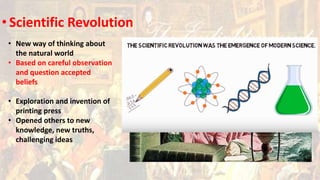
• Scientific Revolution
• New way of thinking about
the natural world
• Based on careful observation
and question accepted
beliefs
• Exploration and invention of
printing press
• Opened others to new
knowledge, new truths,
challenging ideas
•NicolasCopernicus
Heliocentric
Theory- sun-
centered (planets
revolve around the
sun)
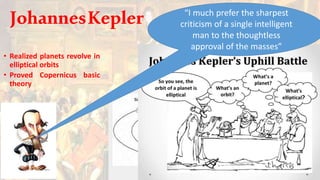
• Realized planets revolve in
elliptical orbits
• Proved Copernicus basic
theory
“I much prefer the sharpest
criticism of a single intelligent
man to the thoughtless
approval of the masses”
JohannesKepler
GalileoGalilei(1609)
• Built telescope (led to new
theories in astronomy)
• Announced Jupiter has four
moons and sun has dark
spots
• Moon has uneven surface
• Observations supported
Copernicus
“All truths are easy to
understand once they are
discovered; the point is to
discover them”
• ConflictwithChurch
• Newideasanddiscovermay
questionsChurchteachings
• Galileo was told to be quiet but
continued to do research
• Church summoned him to Rome
before the Inquisition
• 1633threatoftortureforced
Galileotorecanthisfindingabout
Copernicus(sun-centered)
• Has been house arrest until the
day he died (1642)
• 1992 Catholic Church
acknowledged his findings)
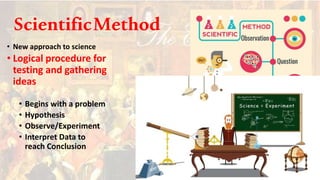
• New approach to science
• Logical procedure for
testing and gathering
ideas
• Begins with a problem
• Hypothesis
• Observe/Experiment
• Interpret Data to
reach Conclusion
ScientificMethod
• Encourage experiments to draw
conclusion- experimental
method
“Read not to contradict and confute:
nor to believe and take for granted;
nor to find talk and discourse; but to
weigh and consider.”
“KNOWLEDGE IS POWER”
FrancisBacon
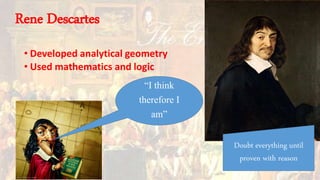
• Developed analytical geometry
• Used mathematics and logic
“I think
therefore I
am”
Doubt everything until
proven with reason
Rene Descartes
• All physical objects were
affected equally by the same
forces
• Same force applied to all
matters on earth and space
• The motion is the law of
gravitation
Live your life as an
exclamation rather than
an explanation
IsaacNewton
• Writespoetry,essay,drama,philosophy
• Ontolerance,reason,freedomof
religious,freedomofspeech
Voltaire(FrancoisMarieArouet)
“I do not agree with a
word you say but will
defend to the death
your right to say it.”
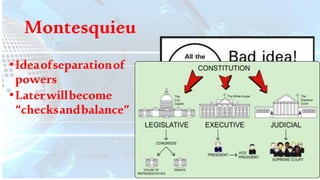
Montesquieu
•Ideaofseparationof
powers
•Laterwillbecome
“checksandbalance”
Rousseau
• “IdeaofDirectDemocracy–
governmentformedbythe
people
• Peoplegiveupsome
freedomforthecommon
good
“Man is born
free, and
everywhere he
is in chains”
• JohannSebastianBach-Germany
• GeorgeFriedrichHandel–England
Austria
• FranzJosephHaydn
• WolfgangAmadeusMozart
• LudwigvanBeethoven
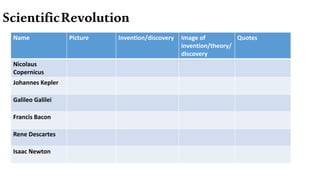
ScientificRevolution
Name Picture Invention/discovery Image of
invention/theory/
discovery
Quotes
Nicolaus
Copernicus
Johannes Kepler
Galileo Galilei
Francis Bacon
Rene Descartes
Isaac Newton
AgeofReason
Name Picture Theory/ Ideas Quotes
Voltaire
Montesquieu
Rousseau
Thomas Hobbes
John Locke
Music
Name Picture Famous piece Quotes
Johann Sebastian Bach
George Friedrich
Handel
Franz Joseph Haydn
Wolfgang Amadeus
Mozart
Ludwig van Beethoven
• Social critics known as Philosophes
• Core beliefs
• Reason- logic thinking
• Nature- natural is good and reasonable
• Happiness – seek happiness on earth
• Progress – humankind can improve
• Liberty -
• Zacharias Janseen-invented
microscope
• Evangelista Torricelli- developed
mercury barometer
• Gabriel Fahrenheit- first
thermometer to use mercury
(freezing at 32°
• Anders Celsius- used different
scale for mercury thermometer
(freezing at 0 °)
• Andres Vesalius- dissected human corpse, produced detailed anatomy
of human body
• Edward Jenner- vaccine for smallpox
• Robert Boyle
• Chemistry: explains how volume, temperature, and pressure of gas affect
each other
• Denis Diderot
• Large set of books where leading scholars contribute articles and essay-
Encyclopedia
Baroque- grand ornate design

WH CH 22 Enlightenment