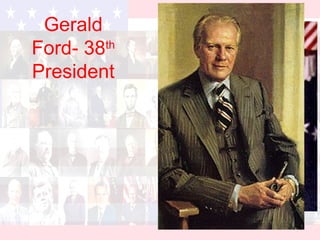
Gerald
Ford- 38th
President
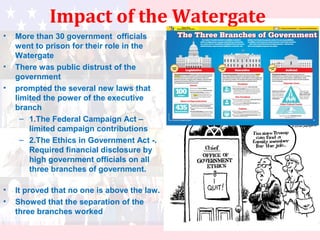
Impact of the Watergate
• More than 30 government officials
went to prison for their role in the
Watergate
• There was public distrust of the
government
• prompted the several new laws that
limited the power of the executive
branch
– 1.The Federal Campaign Act –
limited campaign contributions
– 2.The Ethics in Government Act -.
Required financial disclosure by
high government officials on all
three branches of government.
• It proved that no one is above the law.
• Showed that the separation of the
three branches worked
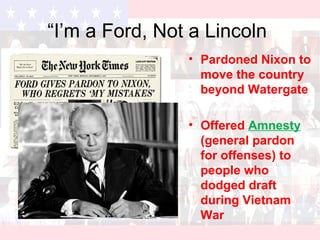
“I’m a Ford, Not a Lincoln
• Pardoned Nixon to
move the country
beyond Watergate
• Offered Amnesty
(general pardon
for offenses) to
people who
dodged draft
during Vietnam
War
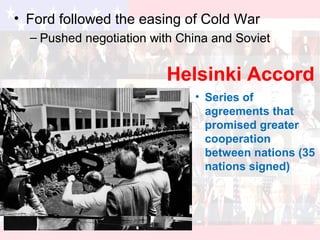
Helsinki Accord
• Ford followed the easing of Cold War
– Pushed negotiation with China and Soviet
• Series of
agreements that
promised greater
cooperation
between nations (35
nations signed)
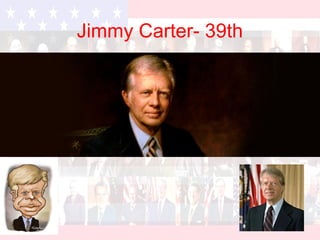
Jimmy Carter- 39th
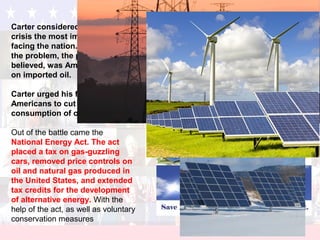
Carter considered the energy
crisis the most important issue
facing the nation. A large part of
the problem, the president
believed, was America’s reliance
on imported oil.
Carter urged his fellow
Americans to cut their
consumption of oil and gas.
Out of the battle came the
National Energy Act. The act
placed a tax on gas-guzzling
cars, removed price controls on
oil and natural gas produced in
the United States, and extended
tax credits for the development
of alternative energy. With the

help of the act, as well as voluntary
conservation measures
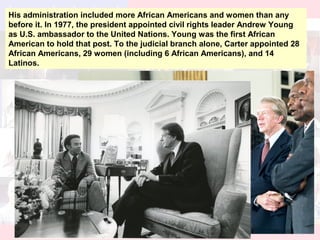
His administration included more African Americans and women than any
before it. In 1977, the president appointed civil rights leader Andrew Young

as U.S. ambassador to the United Nations. Young was the first African
American to hold that post. To the judicial branch alone, Carter appointed 28
African Americans, 29 women (including 6 African Americans), and 14
Latinos.
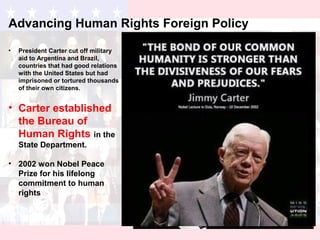
Advancing Human Rights Foreign Policy
• President Carter cut off military
aid to Argentina and Brazil,
countries that had good relations
with the United States but had
imprisoned or tortured thousands
of their own citizens.
• Carter established
the Bureau of
Human Rights in the
State Department.
• 2002 won Nobel Peace
Prize for his lifelong
commitment to human
rights
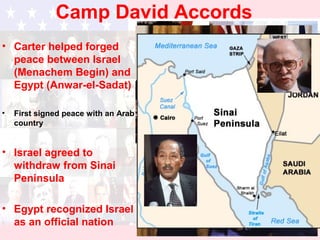
Camp David Accords
• Carter helped forged
peace between Israel
(Menachem Begin) and
Egypt (Anwar-el-Sadat)
• First signed peace with an Arab
country
• Israel agreed to
withdraw from Sinai
Peninsula
• Egypt recognized Israel
as an official nation
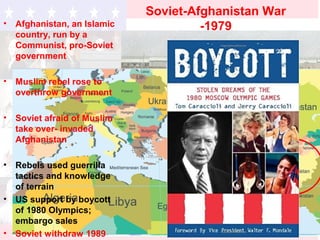
Soviet-Afghanistan War
-1979• Afghanistan, an Islamic
country, run by a
Communist, pro-Soviet
government
• Muslim rebel rose to
overthrow government
• Soviet afraid of Muslim
take over- invaded
Afghanistan
• Rebels used guerrilla
tactics and knowledge
of terrain
• US support by boycott
of 1980 Olympics;
embargo sales
• Soviet withdraw 1989
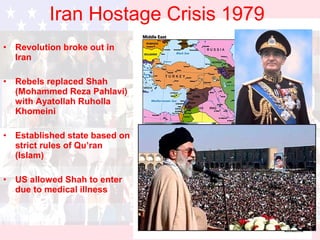
• Revolution broke out in
Iran
• Rebels replaced Shah
(Mohammed Reza Pahlavi)
with Ayatollah Ruholla
Khomeini
• Established state based on
strict rules of Qu’ran
(Islam)
• US allowed Shah to enter
due to medical illness
Iran Hostage Crisis 1979
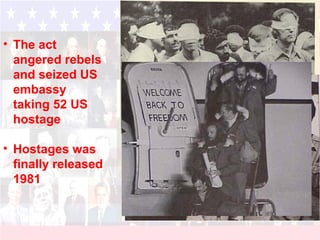
• The act
angered rebels
and seized US
embassy
taking 52 US
hostage
• Hostages was
finally released
1981
Environmental Concerns
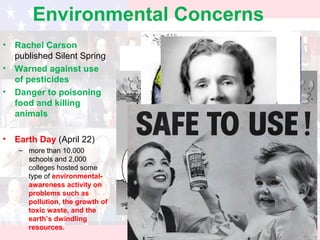
• Rachel Carson
published Silent Spring
• Warned against use
of pesticides
• Danger to poisoning
food and killing
animals
• Earth Day (April 22)
– more than 10,000
schools and 2,000
colleges hosted some
type of environmental-
awareness activity on
problems such as
pollution, the growth of
toxic waste, and the
earth’s dwindling
resources.
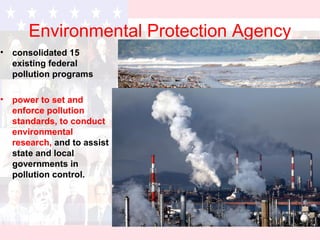
Environmental Protection Agency
• consolidated 15
existing federal
pollution programs
• power to set and
enforce pollution
standards, to conduct
environmental
research, and to assist
state and local
governments in
pollution control.
Three Mile Island
• America realized the drawbacks to its heavy dependence on foreign oil for energy, nuclear
power seemed to many to be an attractive alternative.
• Opponents of nuclear energy warned the public against the industry’s growth. They contended
that nuclear plants, and the wastes they produced, were potentially dangerous to humans and
their environment.
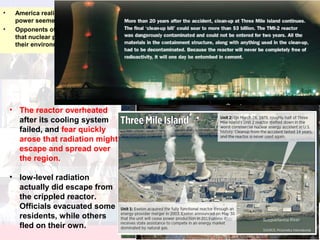
• The reactor overheated
after its cooling system
failed, and fear quickly
arose that radiation might
escape and spread over
the region.
• low-level radiation
actually did escape from
the crippled reactor.
Officials evacuated some
residents, while others
fled on their own.
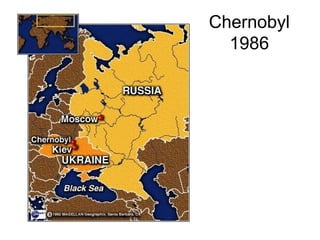
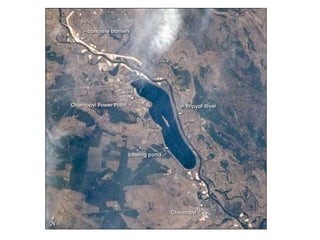
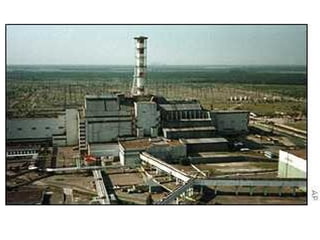
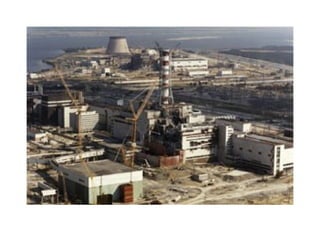
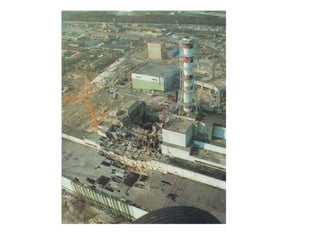
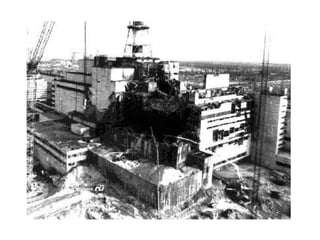
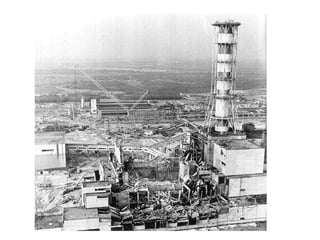
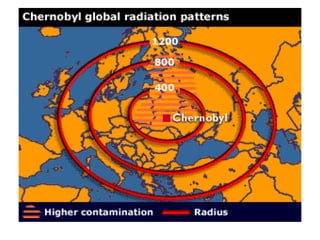
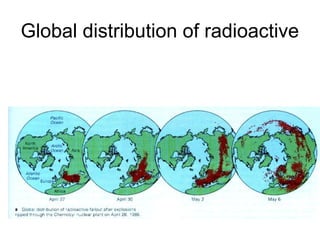
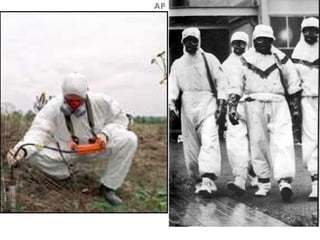
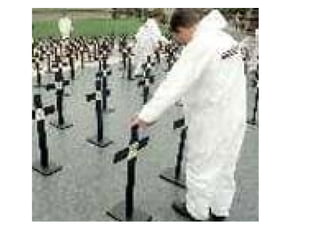
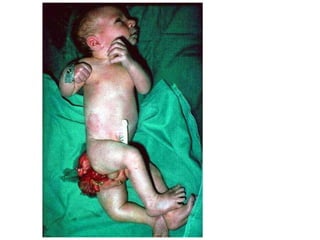
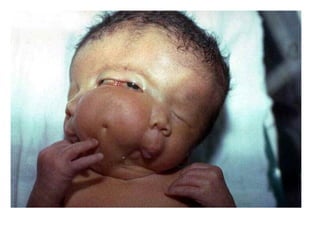
Chernobyl
1986
Global distribution of radioactive
US CH 32 Carter 2019

US CH 32 Carter 2019

  • 1.
  • 2.
    Impact of theWatergate • More than 30 government officials went to prison for their role in the Watergate • There was public distrust of the government • prompted the several new laws that limited the power of the executive branch – 1.The Federal Campaign Act – limited campaign contributions – 2.The Ethics in Government Act -. Required financial disclosure by high government officials on all three branches of government. • It proved that no one is above the law. • Showed that the separation of the three branches worked
  • 3.
    “I’m a Ford,Not a Lincoln • Pardoned Nixon to move the country beyond Watergate • Offered Amnesty (general pardon for offenses) to people who dodged draft during Vietnam War
  • 4.
    Helsinki Accord • Fordfollowed the easing of Cold War – Pushed negotiation with China and Soviet • Series of agreements that promised greater cooperation between nations (35 nations signed)
  • 5.
  • 6.
    Carter considered theenergy crisis the most important issue facing the nation. A large part of the problem, the president believed, was America’s reliance on imported oil. Carter urged his fellow Americans to cut their consumption of oil and gas. Out of the battle came the National Energy Act. The act placed a tax on gas-guzzling cars, removed price controls on oil and natural gas produced in the United States, and extended tax credits for the development of alternative energy. With the help of the act, as well as voluntary conservation measures
  • 7.
    His administration includedmore African Americans and women than any before it. In 1977, the president appointed civil rights leader Andrew Young as U.S. ambassador to the United Nations. Young was the first African American to hold that post. To the judicial branch alone, Carter appointed 28 African Americans, 29 women (including 6 African Americans), and 14 Latinos.
  • 8.
    Advancing Human RightsForeign Policy • President Carter cut off military aid to Argentina and Brazil, countries that had good relations with the United States but had imprisoned or tortured thousands of their own citizens. • Carter established the Bureau of Human Rights in the State Department. • 2002 won Nobel Peace Prize for his lifelong commitment to human rights
  • 9.
    Camp David Accords •Carter helped forged peace between Israel (Menachem Begin) and Egypt (Anwar-el-Sadat) • First signed peace with an Arab country • Israel agreed to withdraw from Sinai Peninsula • Egypt recognized Israel as an official nation
  • 10.
    Soviet-Afghanistan War -1979• Afghanistan,an Islamic country, run by a Communist, pro-Soviet government • Muslim rebel rose to overthrow government • Soviet afraid of Muslim take over- invaded Afghanistan • Rebels used guerrilla tactics and knowledge of terrain • US support by boycott of 1980 Olympics; embargo sales • Soviet withdraw 1989
  • 11.
    • Revolution brokeout in Iran • Rebels replaced Shah (Mohammed Reza Pahlavi) with Ayatollah Ruholla Khomeini • Established state based on strict rules of Qu’ran (Islam) • US allowed Shah to enter due to medical illness Iran Hostage Crisis 1979
  • 12.
    • The act angeredrebels and seized US embassy taking 52 US hostage • Hostages was finally released 1981
  • 13.
    Environmental Concerns • RachelCarson published Silent Spring • Warned against use of pesticides • Danger to poisoning food and killing animals • Earth Day (April 22) – more than 10,000 schools and 2,000 colleges hosted some type of environmental- awareness activity on problems such as pollution, the growth of toxic waste, and the earth’s dwindling resources.
  • 14.
    Environmental Protection Agency •consolidated 15 existing federal pollution programs • power to set and enforce pollution standards, to conduct environmental research, and to assist state and local governments in pollution control.
  • 15.
    Three Mile Island •America realized the drawbacks to its heavy dependence on foreign oil for energy, nuclear power seemed to many to be an attractive alternative. • Opponents of nuclear energy warned the public against the industry’s growth. They contended that nuclear plants, and the wastes they produced, were potentially dangerous to humans and their environment. • The reactor overheated after its cooling system failed, and fear quickly arose that radiation might escape and spread over the region. • low-level radiation actually did escape from the crippled reactor. Officials evacuated some residents, while others fled on their own.
  • 17.
  • 25.

Editor's Notes

  • #10 Egypt and Israel had been engaged in various military and diplomatic conflicts since the establishment of Israel in 1948, and tensions had been particularly high after the Six-Day War of 1967 and the Yom Kippur War of 1973. In addition, the Israelis had taken control of the Sinai Peninsula, which had been under Egyptian control, during the 1967 conflict. Six Say Warr- Egypt, Jordan and Syria fought against Israel- ended with Israel taking West Bank and Gaza Strip Carter helped forge peace between long-time enemies Israel and Egypt. In 1977, Egyptian president Anwar el-Sadat and Israeli prime minister Menachem Begin met in Jerusalem to discuss an overall peace between the two nations. In the summer of 1978, Carter seized on the peace initiative. Carter invited Sadat and Begin to Camp David, the presidential retreat in Maryland. After 12 days of intense negotiations, the three leaders reached an agreement that became known as the Camp David Accords. Under this first signed peace agreement with an Arab country, Israel agreed to withdraw from the Sinai Peninsula, which it had seized from Egypt during the Six-Day War in 1967. Egypt, in turn, formally recognized Israel’s right to exist. Still, many issues were left unresolved.
  • #11 Afghanistan, an Islamic country along the southern border of the Soviet Union, had been run by a Communist, pro-Soviet government for a number of years. However, a strong Muslim rebel group known as the mujahideen was intent on overthrowing the Afghan government. Fearing a rebel victory in Afghanistan, the Soviet Union sent troops to Afghanistan in late 1979. While the Soviets had superior weaponry, the rebels fought the Soviets to a stalemate by using guerrilla tactics and intimate knowledge of the country’s mountainous terrain. After suffering thousands of casualties, the last Soviet troops pulled out of Afghanistan in February 1989. Fighting between rival factions continued for years. By 2000, the Taliban, a radical Muslim faction, controlled 90 percent of Afghanistan.