Visual Studies Department
Lecture no:05
Topic: Ancient Egypt
Course code:GD-1071
Course name: History of Art I
Class: BS I
Teacher name: Miss Sidra
Kanwal
Class Timing: 11:30 am to 1 pm
10:00 am to 11:30 am
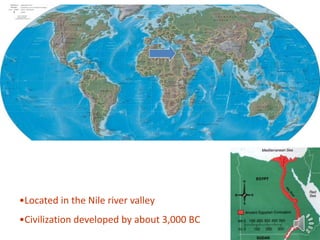
•Located in the Nile river valley
•Civilization developed by about 3,000 BC
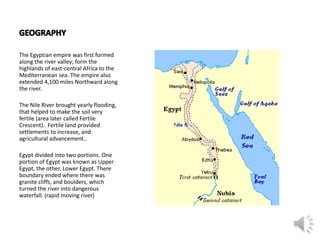
The Egyptian empire was first formed
along the river valley; form the
highlands of east-central Africa to the
Mediterranean sea. The empire also
extended 4,100 miles Northward along
the river.
The Nile River brought yearly flooding,
that helped to make the soil very
fertile (area later called Fertile
Crescent).. Fertile land provided
settlements to increase, and
agricultural advancement..
Egypt divided into two portions. One
portion of Egypt was known as Upper
Egypt, the other, Lower Egypt. There
boundary ended where there was
granite cliffs, and boulders, which
turned the river into dangerous
waterfall. (rapid moving river)
• The Nile river also provided a mode of
transportation for transport between
Upper and Lower Egypt. The prevailing
wind, helped to move ships North, and
encouraged trade between Upper and
Lower Egypt.
• Egypt was also surrounded by deserts (
Eastern and Western) which acted as
natural barriers against invaders, or
unwanted visitors.
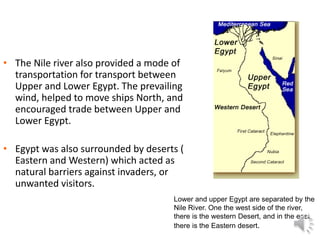
Lower and upper Egypt are separated by the
Nile River. One the west side of the river,
there is the western Desert, and in the east,
there is the Eastern desert.
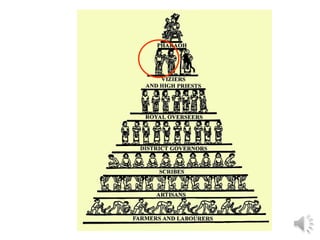
Important People
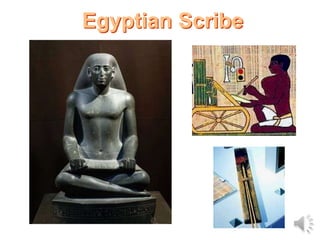
• Scribes had to know how to read and write. The writing system were
hieroglyphics. The Egyptian state was administered by scribes. These people
were able to preserve Egypt’s history, beliefs and ideas on ancient Egypt.
• Communities were made up of:
• Hunters and fishermen
• Soldiers
• Slaves
• Priests
• Artists and craftsmen
• Farmers
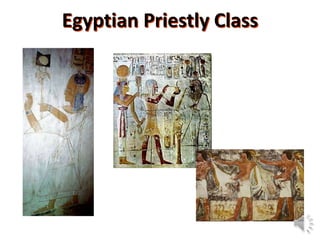
Egyptian Priestly Class
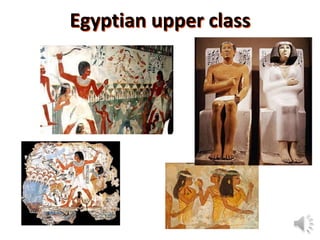
Egyptian upper class
Egyptian Scribe
Egyptian Culture
Religion and Life
• In Egypt it was believed, at the end of one’s life, they
had the possibility to go on to live another life. Many
customs were formed because of this idea of the afterlife,
and as a result, the Egyptian culture was born.
• Because of their convenient geographic location, nature
worked greatly in Egypt’s favor. The Nile helped Egyptians
greatly and allowed them to view life in an optimistic way.
When the Nile receded it left the earth wet and clay-like.
Egyptians took this substance and created numerous useful
and fanciful objects.
• Egyptians were polytheistic; in total they worshiped
over 2,000 gods and goddesses. Two of their most
important gods were Ra, the god of the sun, and Horus, the
god of light. To pay tribute to their major deities, the
Egyptians built enormous temples of worship.
Math:
- developed a written number system
- developed a sort of geometry which was
used after flooding to get all the property
back to the right people
- They used math to help them to develop
their extraordinary architecture
Medical Advancements:
- used minor surgery
- knew how to treat broken bones
- they could check the pulse
- knew how to treat fevers
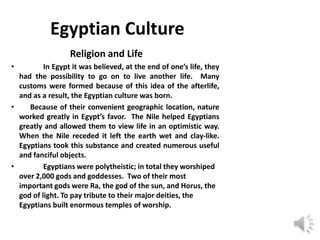
Developed the calendar:
- originally made so the Egyptians could
plan for the planting season
- they observed the star Sirius rise every
365 days and they based their calendar
on this
- the Egyptians broke up the 365 days
into twelve months , each with thirty days
(and five extra for holidays)
OLD KINGDOM
Fig. VI
Ancient Egyptian
calendar
MIDDLE KINGDOM
A canal from the Nile River to the Red
Sea
-this increased trade and transportation
Farming Improvements
which are banks that can control water,
were constructed improving irrigation
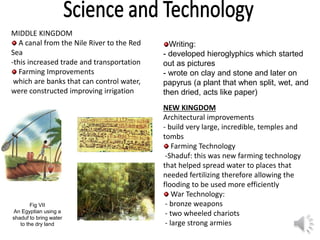
Writing:
- developed hieroglyphics which started
out as pictures
- wrote on clay and stone and later on
papyrus (a plant that when split, wet, and
then dried, acts like paper)
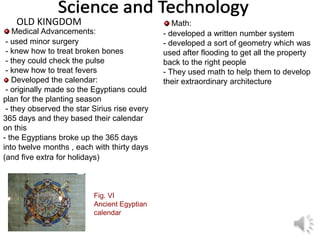
Fig VII
An Egyptian using a
shaduf to bring water
to the dry land
NEW KINGDOM
Architectural improvements
- build very large, incredible, temples and
tombs
Farming Technology
-Shaduf: this was new farming technology
that helped spread water to places that
needed fertilizing therefore allowing the
flooding to be used more efficiently
War Technology:
- bronze weapons
- two wheeled chariots
- large strong armies
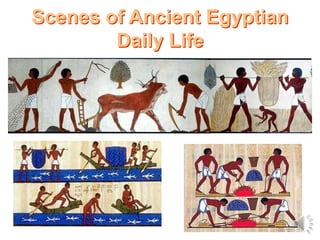
Scenes of Ancient Egyptian
Daily Life
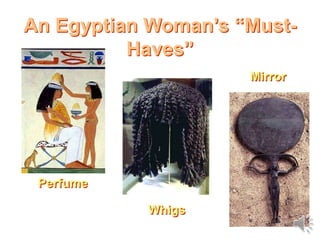
An Egyptian Woman’s “Must-
Haves”
Perfume
Whigs
Mirror

Egyptian Introduction (1).pptx

  • 1.
    Visual Studies Department Lectureno:05 Topic: Ancient Egypt Course code:GD-1071 Course name: History of Art I Class: BS I Teacher name: Miss Sidra Kanwal Class Timing: 11:30 am to 1 pm 10:00 am to 11:30 am
  • 2.
    •Located in theNile river valley •Civilization developed by about 3,000 BC
  • 3.
    The Egyptian empirewas first formed along the river valley; form the highlands of east-central Africa to the Mediterranean sea. The empire also extended 4,100 miles Northward along the river. The Nile River brought yearly flooding, that helped to make the soil very fertile (area later called Fertile Crescent).. Fertile land provided settlements to increase, and agricultural advancement.. Egypt divided into two portions. One portion of Egypt was known as Upper Egypt, the other, Lower Egypt. There boundary ended where there was granite cliffs, and boulders, which turned the river into dangerous waterfall. (rapid moving river)
  • 4.
    • The Nileriver also provided a mode of transportation for transport between Upper and Lower Egypt. The prevailing wind, helped to move ships North, and encouraged trade between Upper and Lower Egypt. • Egypt was also surrounded by deserts ( Eastern and Western) which acted as natural barriers against invaders, or unwanted visitors. Lower and upper Egypt are separated by the Nile River. One the west side of the river, there is the western Desert, and in the east, there is the Eastern desert.
  • 6.
    Important People • Scribeshad to know how to read and write. The writing system were hieroglyphics. The Egyptian state was administered by scribes. These people were able to preserve Egypt’s history, beliefs and ideas on ancient Egypt. • Communities were made up of: • Hunters and fishermen • Soldiers • Slaves • Priests • Artists and craftsmen • Farmers
  • 7.
  • 8.
  • 9.
  • 10.
    Egyptian Culture Religion andLife • In Egypt it was believed, at the end of one’s life, they had the possibility to go on to live another life. Many customs were formed because of this idea of the afterlife, and as a result, the Egyptian culture was born. • Because of their convenient geographic location, nature worked greatly in Egypt’s favor. The Nile helped Egyptians greatly and allowed them to view life in an optimistic way. When the Nile receded it left the earth wet and clay-like. Egyptians took this substance and created numerous useful and fanciful objects. • Egyptians were polytheistic; in total they worshiped over 2,000 gods and goddesses. Two of their most important gods were Ra, the god of the sun, and Horus, the god of light. To pay tribute to their major deities, the Egyptians built enormous temples of worship.
  • 11.
    Math: - developed awritten number system - developed a sort of geometry which was used after flooding to get all the property back to the right people - They used math to help them to develop their extraordinary architecture Medical Advancements: - used minor surgery - knew how to treat broken bones - they could check the pulse - knew how to treat fevers Developed the calendar: - originally made so the Egyptians could plan for the planting season - they observed the star Sirius rise every 365 days and they based their calendar on this - the Egyptians broke up the 365 days into twelve months , each with thirty days (and five extra for holidays) OLD KINGDOM Fig. VI Ancient Egyptian calendar
  • 12.
    MIDDLE KINGDOM A canalfrom the Nile River to the Red Sea -this increased trade and transportation Farming Improvements which are banks that can control water, were constructed improving irrigation Writing: - developed hieroglyphics which started out as pictures - wrote on clay and stone and later on papyrus (a plant that when split, wet, and then dried, acts like paper) Fig VII An Egyptian using a shaduf to bring water to the dry land NEW KINGDOM Architectural improvements - build very large, incredible, temples and tombs Farming Technology -Shaduf: this was new farming technology that helped spread water to places that needed fertilizing therefore allowing the flooding to be used more efficiently War Technology: - bronze weapons - two wheeled chariots - large strong armies
  • 13.
    Scenes of AncientEgyptian Daily Life
  • 14.
    An Egyptian Woman’s“Must- Haves” Perfume Whigs Mirror