Industrial Revolution Western Civilization Mr. Mike  Lecture 8
Agricultural Revolution
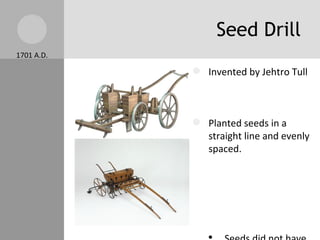
Seed Drill 1701 A.D. Invented by Jehtro Tull Planted seeds in a straight line and evenly spaced. Seeds did not have to fight over space to grow  Fewer seeds wasted.  Still used today. More seeds germinated so higher crops yield.
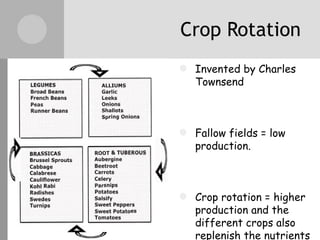
Crop Rotation Invented by Charles Townsend Fallow fields = low production. Crop rotation = higher production and the different crops also replenish the nutrients in the soil. Increased food for humans and animals.
Effects of Agricultural Revolution Increased Food Supplies  Healthier diets Longer life-span Population Increase Greater demand for food products Fewer farmers needed Workers now available to work in factories.
Textile Industry
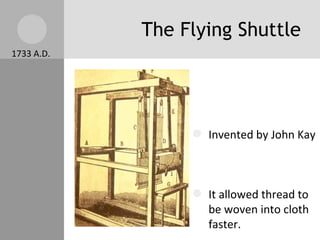
The Flying Shuttle Invented by John Kay  It allowed thread to be woven into cloth faster. It doubled the amount of cloth output per worker / per day. 1733 A.D.
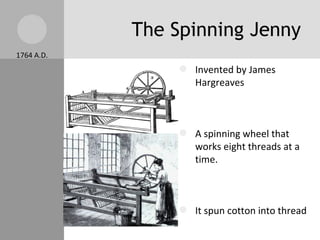
The Spinning Jenny Invented by James Hargreaves  A spinning wheel that works eight threads at a time. It spun cotton into thread There was a shortage of thread before the Spinning Jenny Made a way to produce large amounts of thread. 1764 A.D.
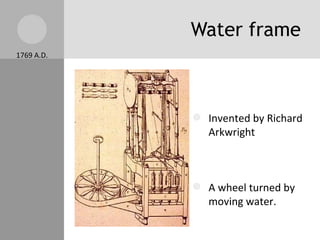
Water frame Invented by Richard Arkwright A wheel turned by moving water. Instead of human power, water power was used. It spun cotton into thread faster. 1769 A.D.
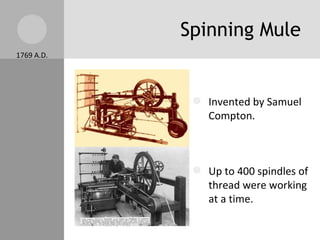
Spinning Mule Invented by Samuel Compton. Up to 400 spindles of thread were working at a time. The spinning mule made better thread. Thread production increased again.  Key element to a textile industry 1769 A.D.
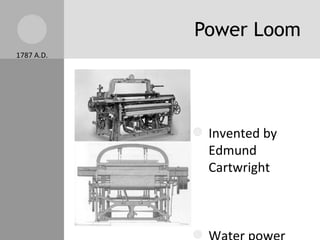
Power Loom Invented by Edmund Cartwright Water power Used moving water to weaving thread into cloth. 1787 A.D.
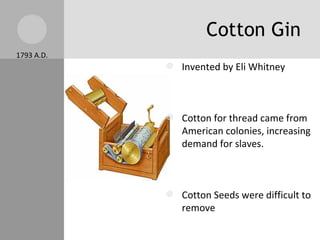
Cotton Gin 1793 A.D. Invented by Eli Whitney Cotton for thread came from American colonies, increasing demand for slaves. Cotton Seeds were difficult to remove Cotton gin removed seeds by machine instead of hand. The cotton gin increased production from 1.5 million pounds to 55 million pounds.
Steam Engines
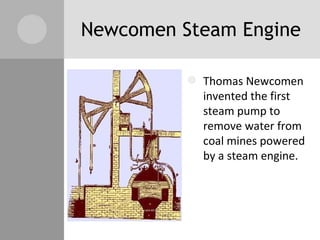
Newcomen Steam Engine Thomas Newcomen invented the first steam pump to remove water from coal mines powered by a steam engine.
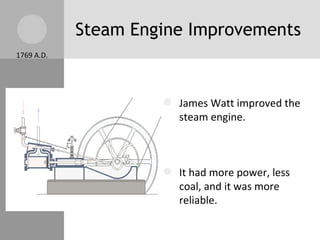
Steam Engine Improvements James Watt improved the steam engine. It had more power, less coal, and it was more reliable. It also enabled the development of a reciprocating engine, with upwards and downwards power strokes more suited to transmitting power to a wheel  1769 A.D.
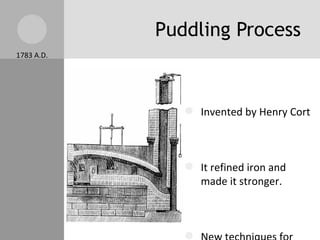
Puddling Process 1783 A.D. Invented by Henry Cort It refined iron and made it stronger. New techniques for making sheets of iron were developed. This enabled a great expansion of iron production around the world.
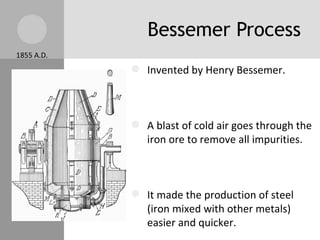
Bessemer Process 1855 A.D. Invented by Henry Bessemer. A blast of cold air goes through the iron ore to remove all impurities. It made the production of steel (iron mixed with other metals) easier and quicker. Steel was now stronger and more workable. It triggered the growth in other industries.
Machine tools
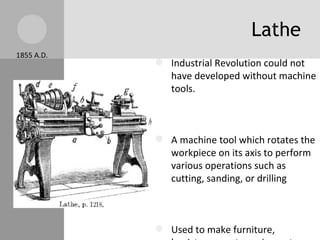
Lathe 1855 A.D. Industrial Revolution could not have developed without machine tools. A machine tool which rotates the workpiece on its axis to perform various operations such as cutting, sanding, or drilling Used to make furniture, banisters, sports equipment... Modern lathes can shape more materials: metals, plastics...
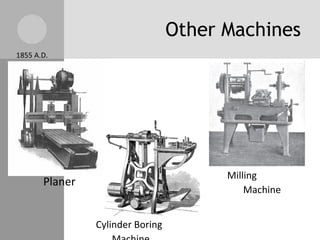
Other Machines 1855 A.D. Cylinder Boring Machine Planer  Milling Machine
Transportation
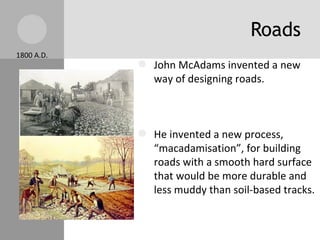
Roads John McAdams invented a new way of designing roads. He invented a new process, “macadamisation”, for building roads with a smooth hard surface that would be more durable and less muddy than soil-based tracks. Turnpikes were used as a toll. Companies paid to use the roads because they made traveling easier. 1800 A.D.
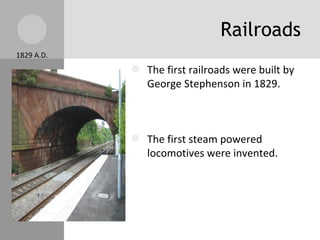
Railroads The first railroads were built by George Stephenson in 1829. The first steam powered locomotives were invented. The Rocket – 20 mph. In 1850, 5,000 miles of railroad tracks were built in Britain. Steel tracks replaced the iron tracks, and train speeds were up to 60 mph. Raw materials, factories, and workers were now closer together. 1829 A.D.
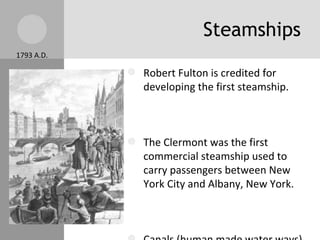
Steamships Robert Fulton is credited for developing the first steamship. The Clermont was the first commercial steamship used to carry passengers between New York City and Albany, New York. Canals (human made water ways) were created. By 1850, the network of canals reached 4,250 miles! 1793 A.D.
Communications
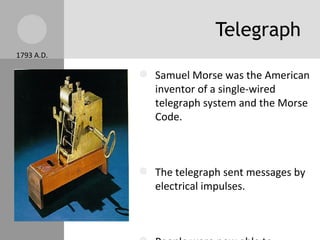
Telegraph Samuel Morse was the American inventor of a single-wired telegraph system and the Morse Code. The telegraph sent messages by electrical impulses. People were now able to communicate within seconds or minutes, instead of waiting days and weeks. 1793 A.D.
Systems
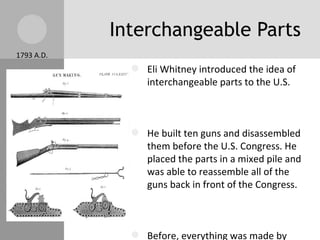
Interchangeable Parts 1793 A.D. Eli Whitney introduced the idea of interchangeable parts to the U.S. He built ten guns and disassembled them before the U.S. Congress. He placed the parts in a mixed pile and was able to reassemble all of the guns back in front of the Congress. Before, everything was made by hand, now parts were made by machines  Broken machines were now able to be fixed by replacing the broken parts.
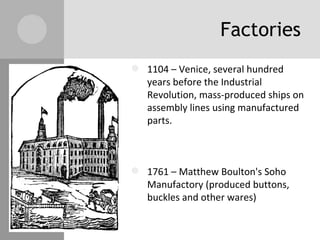
Factories 1104 – Venice, several hundred years before the Industrial Revolution, mass-produced ships on assembly lines using manufactured parts. 1761 – Matthew Boulton's Soho Manufactory (produced buttons, buckles and other wares) Cotton mills used inventions such as the steam engine and the power loom
Social effects
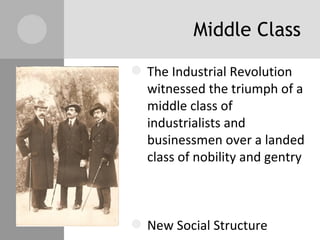
Middle Class The Industrial Revolution witnessed the triumph of a middle class of industrialists and businessmen over a landed class of nobility and gentry New Social Structure
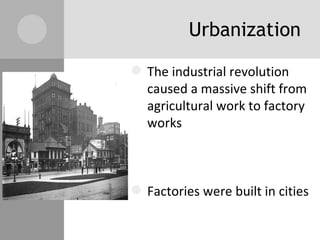
Urbanization The industrial revolution caused a massive shift from agricultural work to factory works  Factories were built in cities People began moving to cities for work
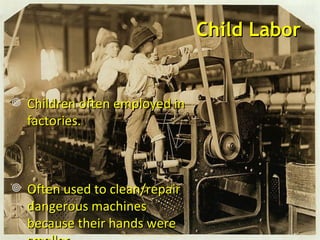
Child Labor Children often employed in factories.  Often used to clean/repair dangerous machines because their hands were smaller Abusive working conditions
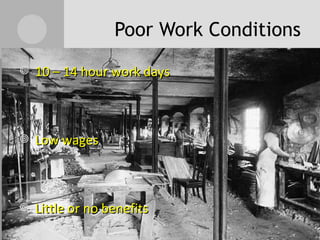
Poor Work Conditions 10 – 14 hour work days Low wages Little or no benefits Dangerous work conditions Dirty living conditions Physical abuse common at the workplace
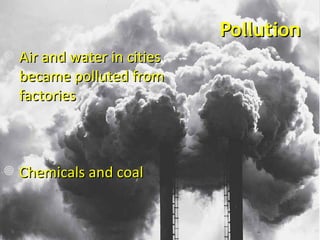
Pollution Air and water in cities became polluted from factories  Chemicals and coal

Western Civilization lecture 8

  • 1.
    Industrial Revolution WesternCivilization Mr. Mike Lecture 8
  • 2.
  • 3.
    Seed Drill 1701A.D. Invented by Jehtro Tull Planted seeds in a straight line and evenly spaced. Seeds did not have to fight over space to grow Fewer seeds wasted. Still used today. More seeds germinated so higher crops yield.
  • 4.
    Crop Rotation Inventedby Charles Townsend Fallow fields = low production. Crop rotation = higher production and the different crops also replenish the nutrients in the soil. Increased food for humans and animals.
  • 5.
    Effects of AgriculturalRevolution Increased Food Supplies Healthier diets Longer life-span Population Increase Greater demand for food products Fewer farmers needed Workers now available to work in factories.
  • 6.
  • 7.
    The Flying ShuttleInvented by John Kay It allowed thread to be woven into cloth faster. It doubled the amount of cloth output per worker / per day. 1733 A.D.
  • 8.
    The Spinning JennyInvented by James Hargreaves A spinning wheel that works eight threads at a time. It spun cotton into thread There was a shortage of thread before the Spinning Jenny Made a way to produce large amounts of thread. 1764 A.D.
  • 9.
    Water frame Inventedby Richard Arkwright A wheel turned by moving water. Instead of human power, water power was used. It spun cotton into thread faster. 1769 A.D.
  • 10.
    Spinning Mule Inventedby Samuel Compton. Up to 400 spindles of thread were working at a time. The spinning mule made better thread. Thread production increased again. Key element to a textile industry 1769 A.D.
  • 11.
    Power Loom Inventedby Edmund Cartwright Water power Used moving water to weaving thread into cloth. 1787 A.D.
  • 12.
    Cotton Gin 1793A.D. Invented by Eli Whitney Cotton for thread came from American colonies, increasing demand for slaves. Cotton Seeds were difficult to remove Cotton gin removed seeds by machine instead of hand. The cotton gin increased production from 1.5 million pounds to 55 million pounds.
  • 13.
  • 14.
    Newcomen Steam EngineThomas Newcomen invented the first steam pump to remove water from coal mines powered by a steam engine.
  • 15.
    Steam Engine ImprovementsJames Watt improved the steam engine. It had more power, less coal, and it was more reliable. It also enabled the development of a reciprocating engine, with upwards and downwards power strokes more suited to transmitting power to a wheel 1769 A.D.
  • 16.
    Puddling Process 1783A.D. Invented by Henry Cort It refined iron and made it stronger. New techniques for making sheets of iron were developed. This enabled a great expansion of iron production around the world.
  • 17.
    Bessemer Process 1855A.D. Invented by Henry Bessemer. A blast of cold air goes through the iron ore to remove all impurities. It made the production of steel (iron mixed with other metals) easier and quicker. Steel was now stronger and more workable. It triggered the growth in other industries.
  • 18.
  • 19.
    Lathe 1855 A.D.Industrial Revolution could not have developed without machine tools. A machine tool which rotates the workpiece on its axis to perform various operations such as cutting, sanding, or drilling Used to make furniture, banisters, sports equipment... Modern lathes can shape more materials: metals, plastics...
  • 20.
    Other Machines 1855A.D. Cylinder Boring Machine Planer Milling Machine
  • 21.
  • 22.
    Roads John McAdamsinvented a new way of designing roads. He invented a new process, “macadamisation”, for building roads with a smooth hard surface that would be more durable and less muddy than soil-based tracks. Turnpikes were used as a toll. Companies paid to use the roads because they made traveling easier. 1800 A.D.
  • 23.
    Railroads The firstrailroads were built by George Stephenson in 1829. The first steam powered locomotives were invented. The Rocket – 20 mph. In 1850, 5,000 miles of railroad tracks were built in Britain. Steel tracks replaced the iron tracks, and train speeds were up to 60 mph. Raw materials, factories, and workers were now closer together. 1829 A.D.
  • 24.
    Steamships Robert Fultonis credited for developing the first steamship. The Clermont was the first commercial steamship used to carry passengers between New York City and Albany, New York. Canals (human made water ways) were created. By 1850, the network of canals reached 4,250 miles! 1793 A.D.
  • 25.
  • 26.
    Telegraph Samuel Morsewas the American inventor of a single-wired telegraph system and the Morse Code. The telegraph sent messages by electrical impulses. People were now able to communicate within seconds or minutes, instead of waiting days and weeks. 1793 A.D.
  • 27.
  • 28.
    Interchangeable Parts 1793A.D. Eli Whitney introduced the idea of interchangeable parts to the U.S. He built ten guns and disassembled them before the U.S. Congress. He placed the parts in a mixed pile and was able to reassemble all of the guns back in front of the Congress. Before, everything was made by hand, now parts were made by machines Broken machines were now able to be fixed by replacing the broken parts.
  • 29.
    Factories 1104 –Venice, several hundred years before the Industrial Revolution, mass-produced ships on assembly lines using manufactured parts. 1761 – Matthew Boulton's Soho Manufactory (produced buttons, buckles and other wares) Cotton mills used inventions such as the steam engine and the power loom
  • 30.
  • 31.
    Middle Class TheIndustrial Revolution witnessed the triumph of a middle class of industrialists and businessmen over a landed class of nobility and gentry New Social Structure
  • 32.
    Urbanization The industrialrevolution caused a massive shift from agricultural work to factory works Factories were built in cities People began moving to cities for work
  • 33.
    Child Labor Childrenoften employed in factories. Often used to clean/repair dangerous machines because their hands were smaller Abusive working conditions
  • 34.
    Poor Work Conditions10 – 14 hour work days Low wages Little or no benefits Dangerous work conditions Dirty living conditions Physical abuse common at the workplace
  • 35.
    Pollution Air andwater in cities became polluted from factories Chemicals and coal