Western Civilization Mr. Mike Beard Revolutions
Revolutions The American Revolution  The French Revolution
The American Revolution Brittish Colonies Heavily Taxed   1764 – Brittish Prime Minister George Grenville passed the Sugar Act to tax sugar The Stamp Act placed a tax on printed materials The Quartering Act, which required Americans to house and feed British troops.
The American Revolution Taxation without Representation   Several colonial leaders convened the Stamp Act Congress in New York to petition Parliament and King George III to repeal the tax. Parliament bowed to public pressure and repealed the Stamp Act. But it also quietly passed the Declaratory Act, which stipulated that Parliament reserved the right to tax the colonies anytime it chose.
The American Revolution The Townshend Acts and Boston Massacre Townshend Acts – a series of taxes on lead, paints, and tea.  March 5, 1770, an angry mob clashed with several British troops. Five colonists died, and news of the Boston Massacre quickly spread throughout the colonies.
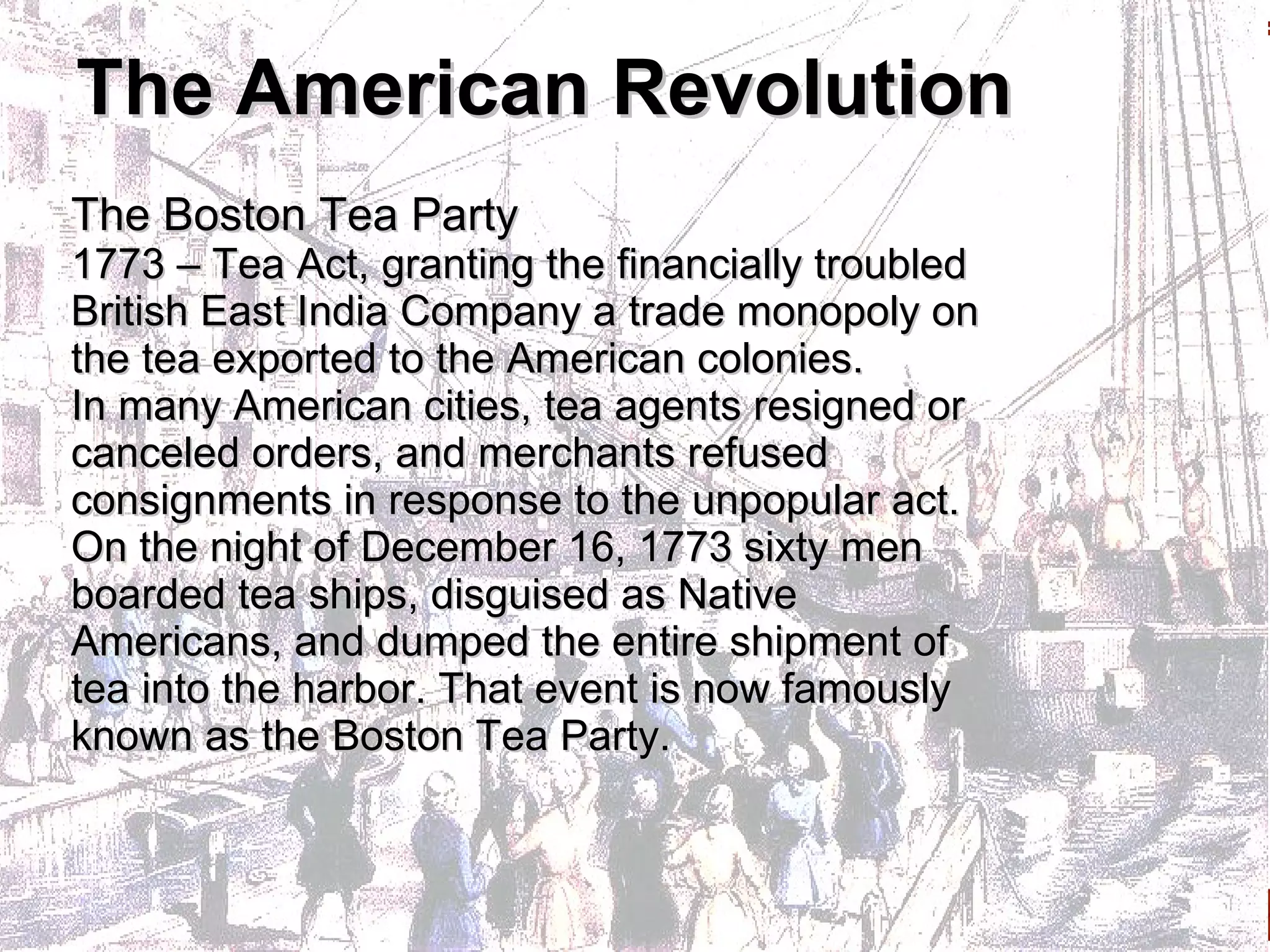
The American Revolution The Boston Tea Party 1773 – Tea Act, granting the financially troubled British East India Company a trade monopoly on the tea exported to the American colonies.  In many American cities, tea agents resigned or canceled orders, and merchants refused consignments in response to the unpopular act.  On the night of December 16, 1773 sixty men boarded tea ships, disguised as Native Americans, and dumped the entire shipment of tea into the harbor. That event is now famously known as the Boston Tea Party.
The American Revolution Coercive Acts 1774 – The Coercive Acts shut down Boston Harbor until the British East India Company had been fully reimbursed for the tea destroyed in the Boston Tea Party.  Americans throughout the colonies sent food and supplies to Boston via land to prevent death from hunger and cold in the bitter New England winter.
The American Revolution The First Continental Congress and Boycott 1774 – To protest the Intolerable (Coercive) Acts, prominent colonials gathered in Philadelphia at the First Continental Congress.  They once again petitioned Parliament, King George III, and the British people to repeal the acts and restore friendly relations.  Also instituted a boycott, or ban, of all British goods in the colonies.
The American Revolution Lexington, Concord, and the Second Continental Congress 1775 – The British occupation force in Boston marched to the nearby town of Concord, Massachusetts, to seize a colonial militia arsenal.  Militiamen of Lexington and Concord intercepted them and attacked. Thousands of militiamen from nearby colonies flocked to Boston to assist. Second Continental Congress issued the Olive Branch Petition, they professed their love and loyalty to King George III and begged him to address their grievances. The king rejected the petition and formally declared that the colonies were in a state of rebellion.
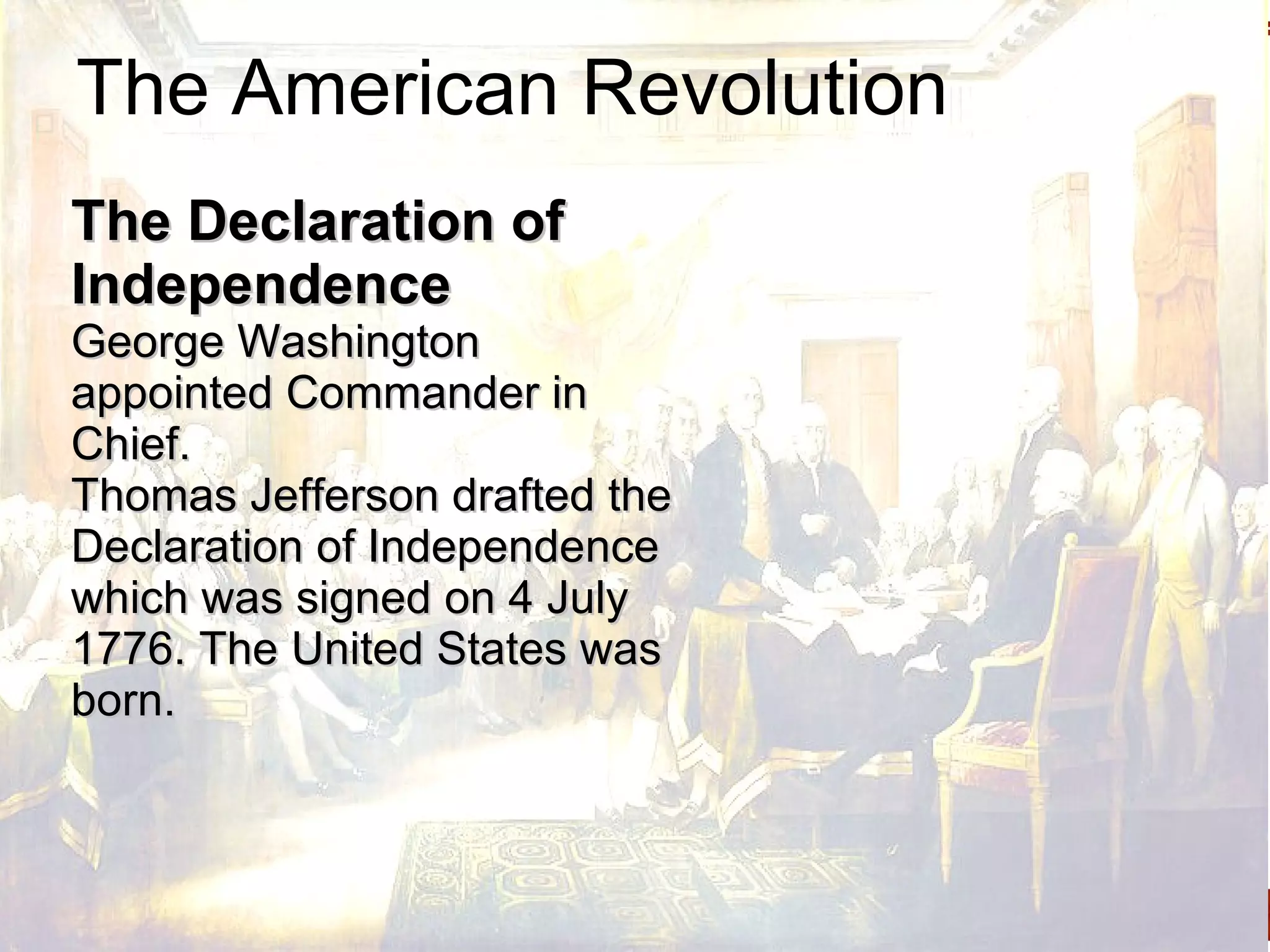
The American Revolution The Declaration of Independence George Washington appointed Commander in Chief.  Thomas Jefferson drafted the Declaration of Independence which was signed on 4 July 1776. The United States was born.
The American Revolution The Revolutionary War: 1775–1783 1775  Battle of Lexington 1776  Declaration of Independence 1777  Battle of Saratoga 1778  France and United States form Franco-American Alliance 1779  Spain enters war against Britain 1781  British forces under Cornwallis surrender to Washington at Yorktown 1783  Peace of Paris signed to end war
The French Revolution Unrest in France   Population Increase  Famine Enlightenment ideas that promote democracy and lower prestige of monarchy The Monarchy’s Financial Crisis Feudal Oppression  Popular View that the Parliaments and the Public represent the French nation more than the monarch
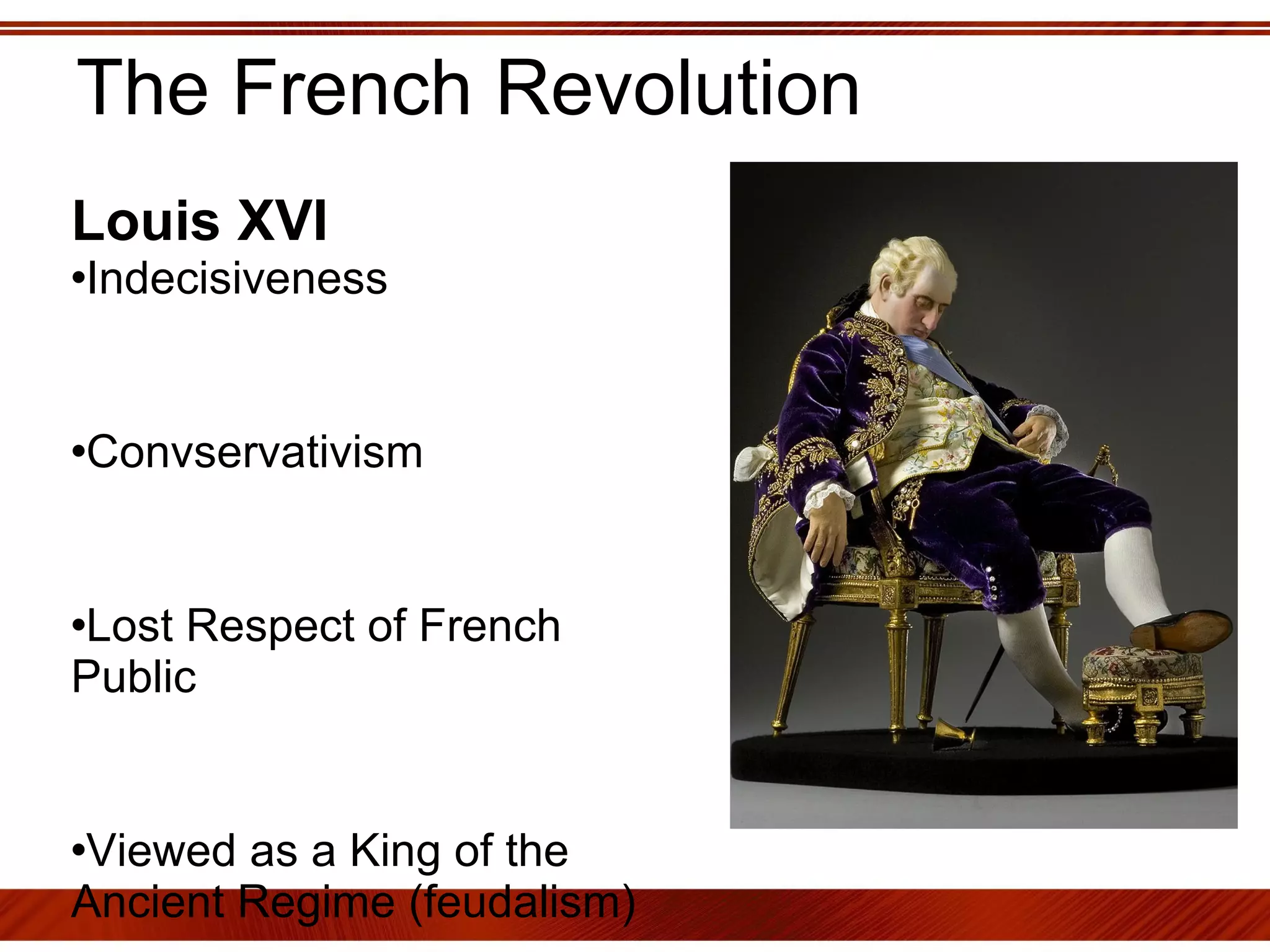
The French Revolution Louis XVI   Indecisiveness Convservativism  Lost Respect of French Public Viewed as a King of the Ancient Regime (feudalism)
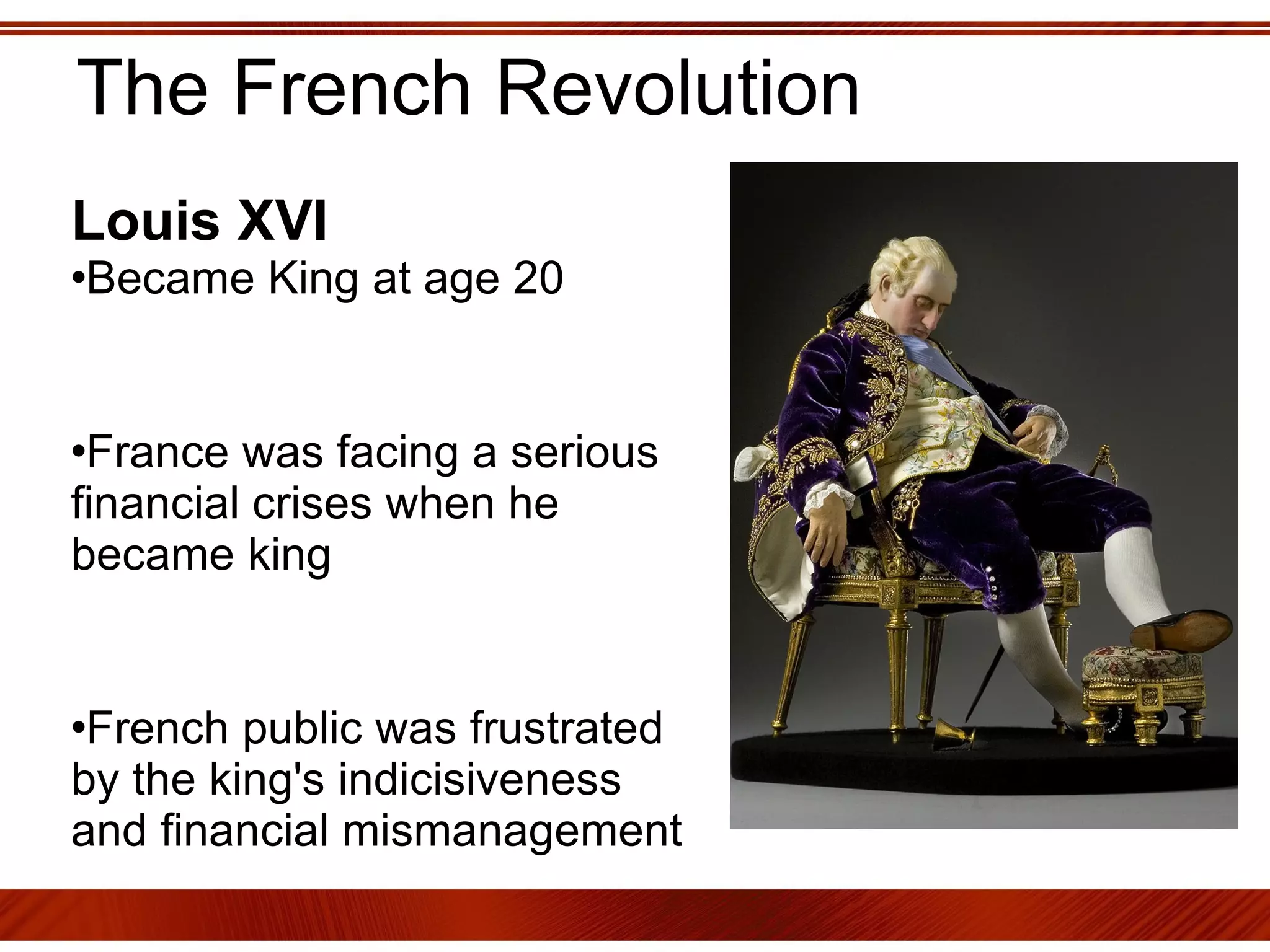
The French Revolution Louis XVI   Became King at age 20  France was facing a serious financial crises when he became king French public was frustrated by the king's indicisiveness and financial mismanagement
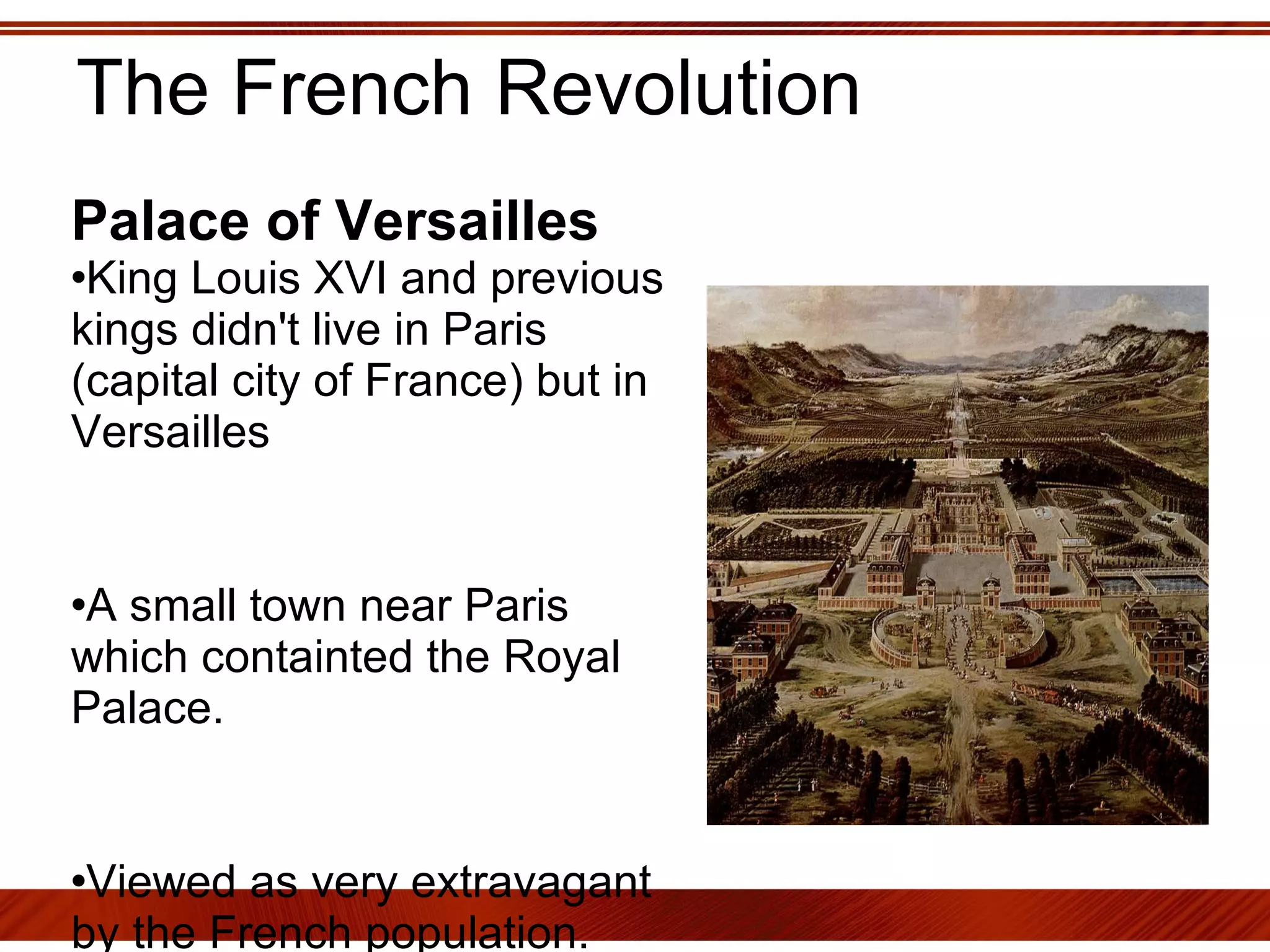
The French Revolution Palace of Versailles   King Louis XVI and previous kings didn't live in Paris (capital city of France) but in Versailles A small town near Paris which containted the Royal Palace.  Viewed as very extravagant by the French population.
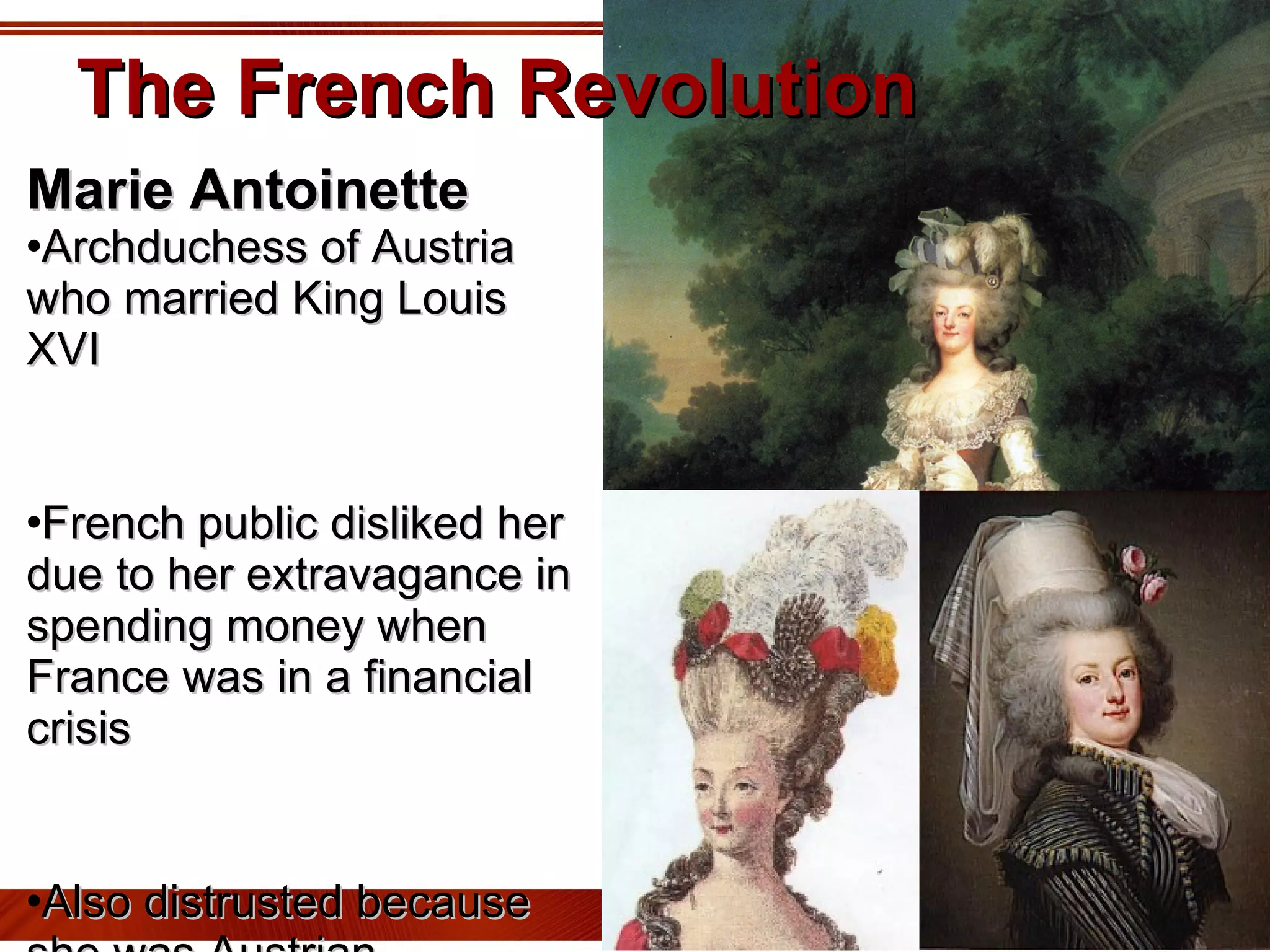
The French Revolution Marie Antoinette   Archduchess of Austria who married King Louis XVI French public disliked her due to her extravagance in spending money when France was in a financial crisis Also distrusted because she was Austrian
The French Revolution Financial Crisis  Financial mismangement and the changing economic world in Europe destablized the French economy King Louis XVI brought in a number of financial advisors to review the weakened French treasury.  Each advisor reached the same conclusion—that France needed a radical change in the way it taxed the public—and each advisor was, in turn, kicked out.
The French Revolution Financial Crisis  King Louis XVI finallay agreed that this taxation problem really did need to be addressed He appointed a new controller general of finance, Charles de Calonne, in 1783.  Calonne suggested that France begin taxing nobility.  The nobility refused during the Assembly of Notables in 1787.  Financial ruin thus seemed imminent.
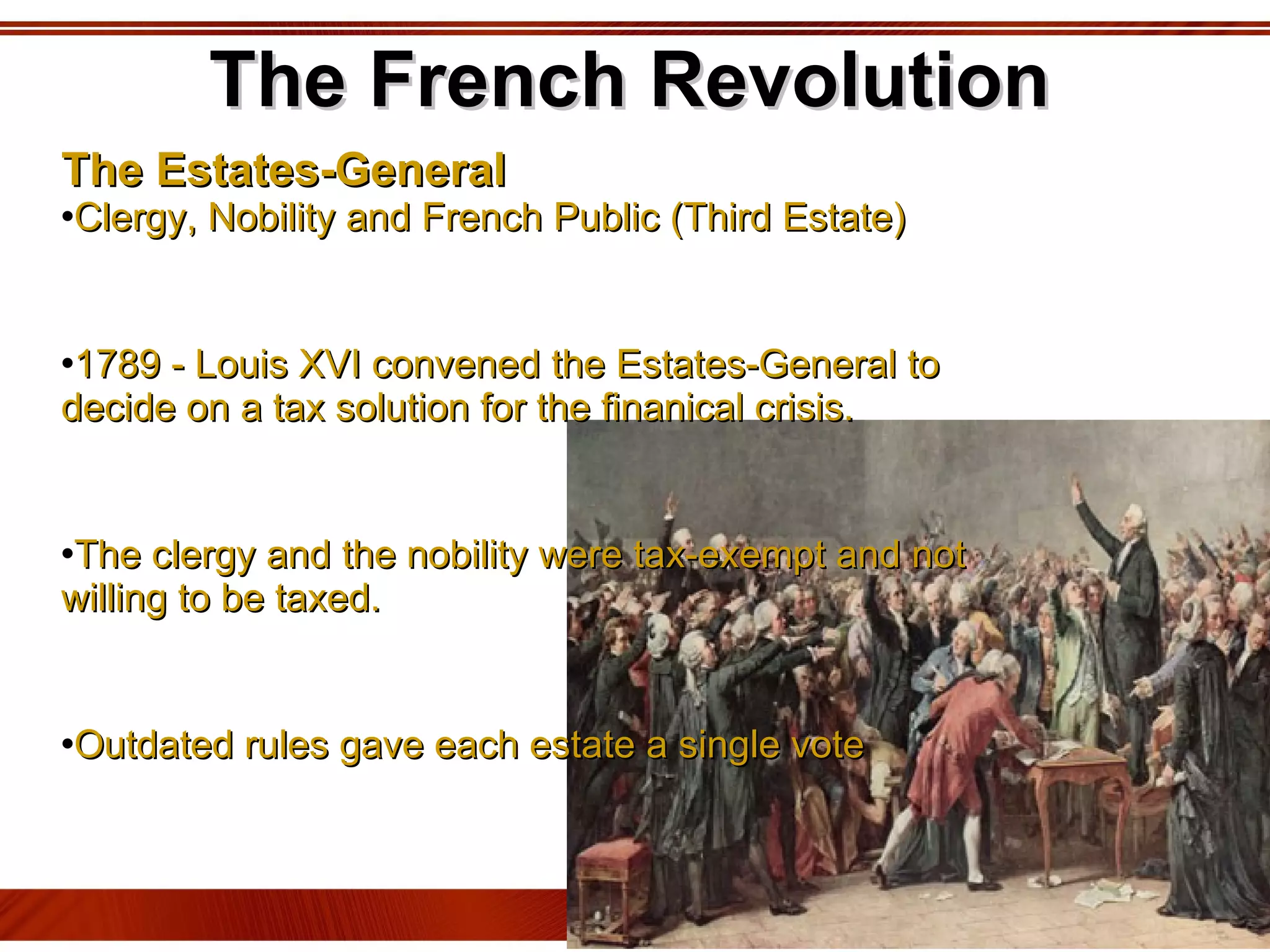
The French Revolution The Estates-General Clergy, Nobility and French Public (Third Estate) 1789 - Louis XVI convened the Estates-General to decide on a tax solution for the finanical crisis.  The clergy and the nobility were tax-exempt and not willing to be taxed. Outdated rules gave each estate a single vote
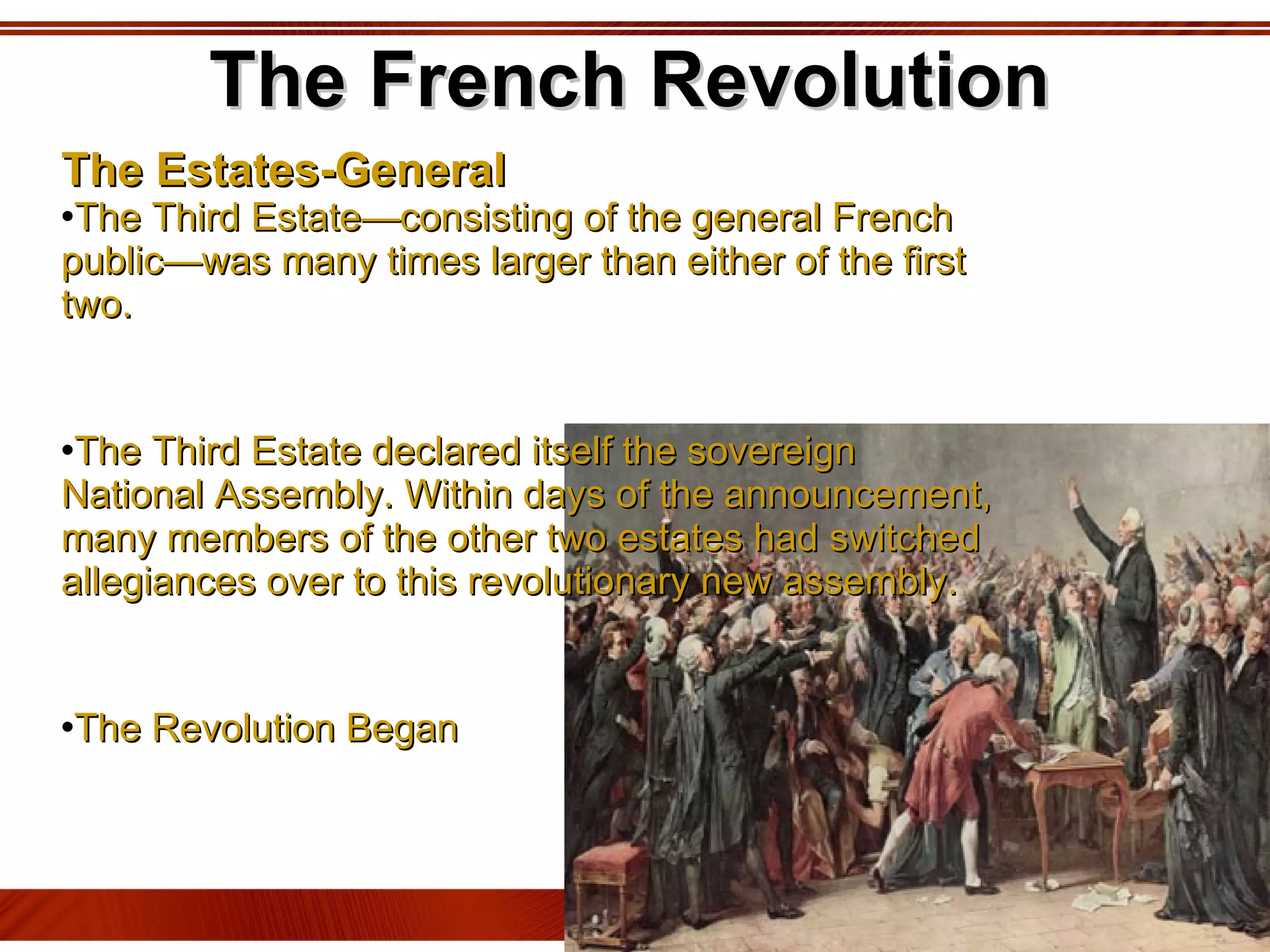
The French Revolution The Estates-General The Third Estate—consisting of the general French public—was many times larger than either of the first two. The Third Estate declared itself the sovereign National Assembly. Within days of the announcement, many members of the other two estates had switched allegiances over to this revolutionary new assembly. The Revolution Began
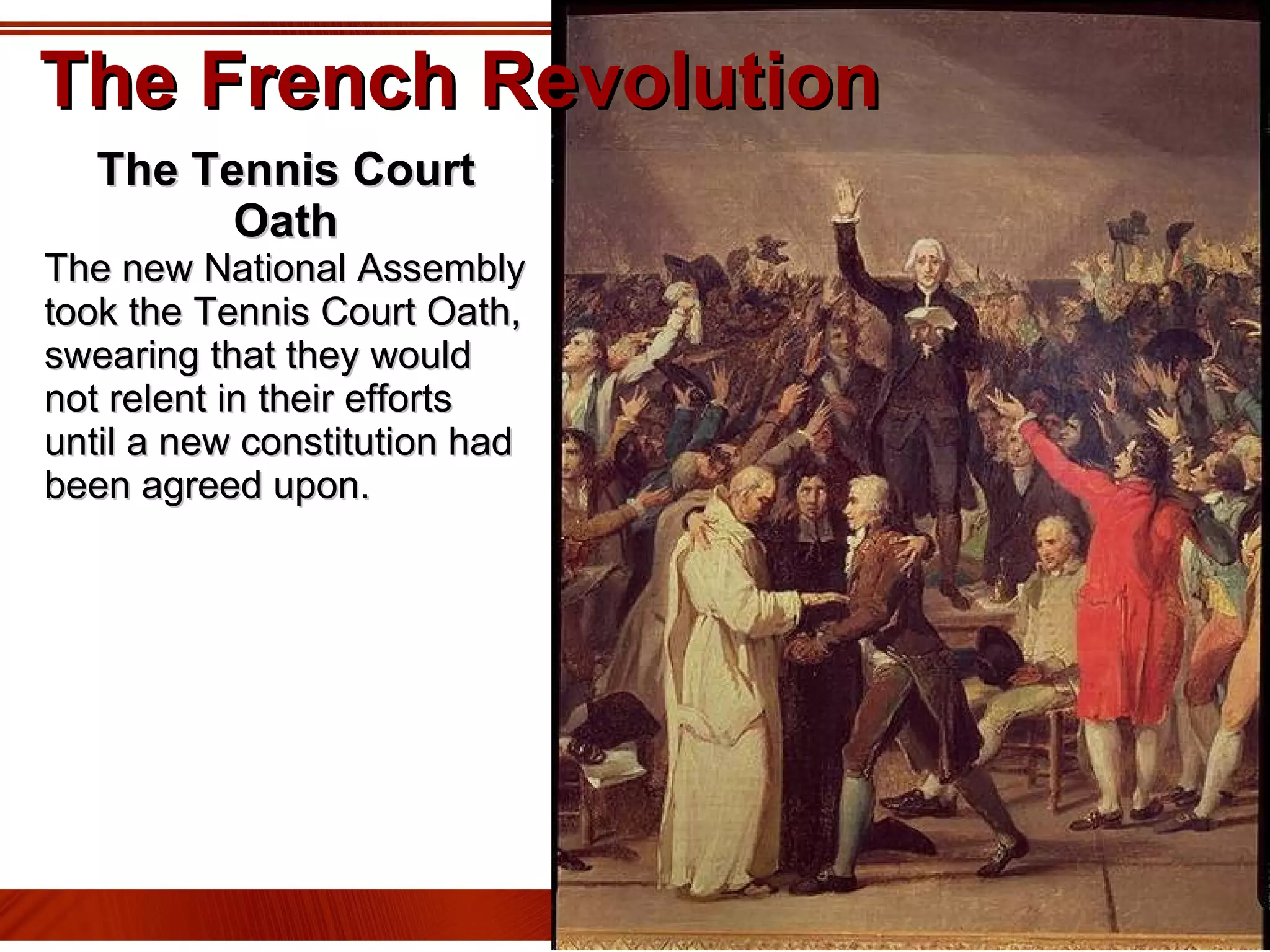
The French Revolution The Tennis Court Oath The new National Assembly took the Tennis Court Oath, swearing that they would not relent in their efforts until a new constitution had been agreed upon.
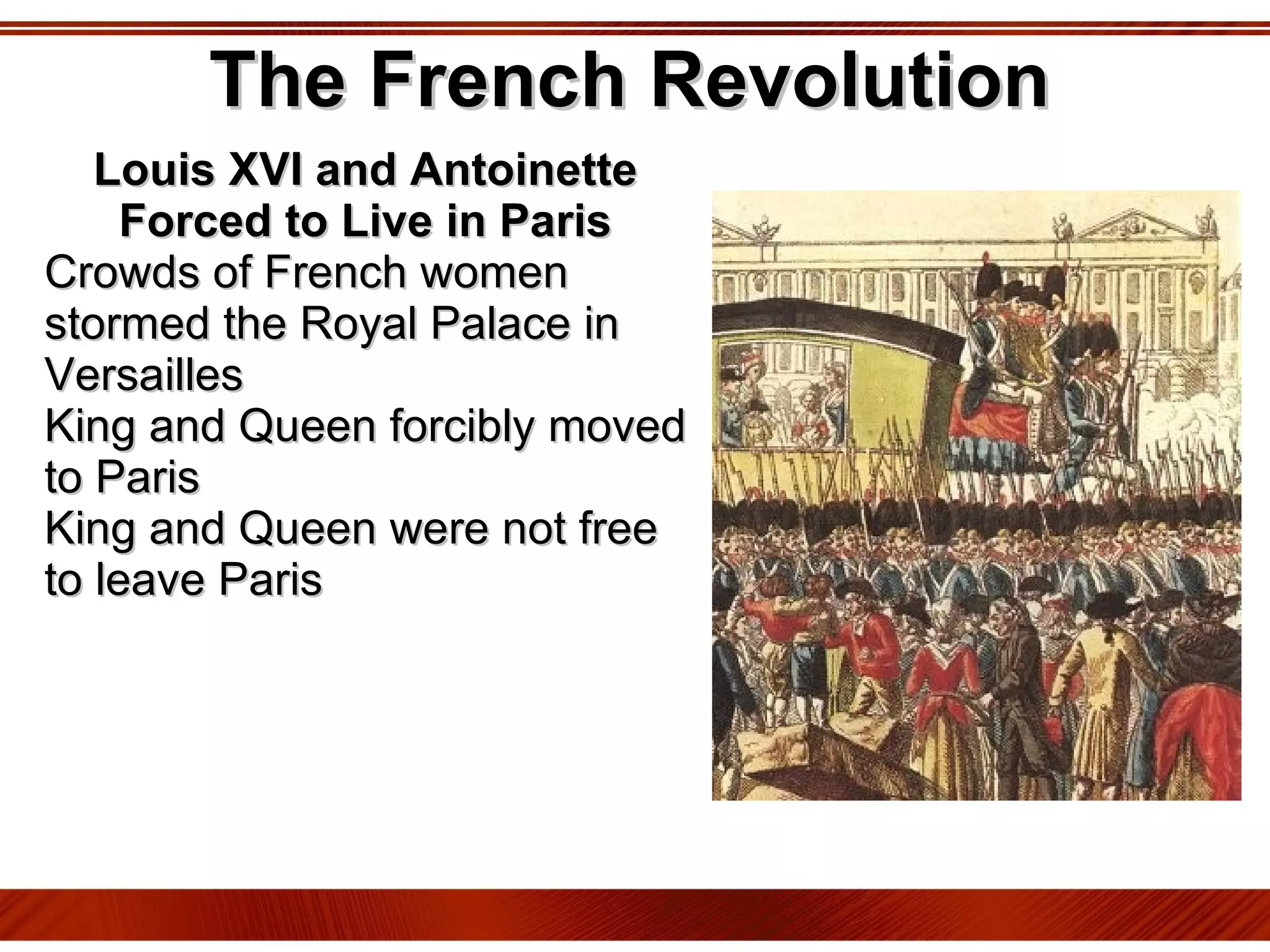
The French Revolution Louis XVI and Antoinette Forced to Live in Paris Crowds of French women stormed the Royal Palace in Versailles King and Queen forcibly moved to Paris King and Queen were not free to leave Paris
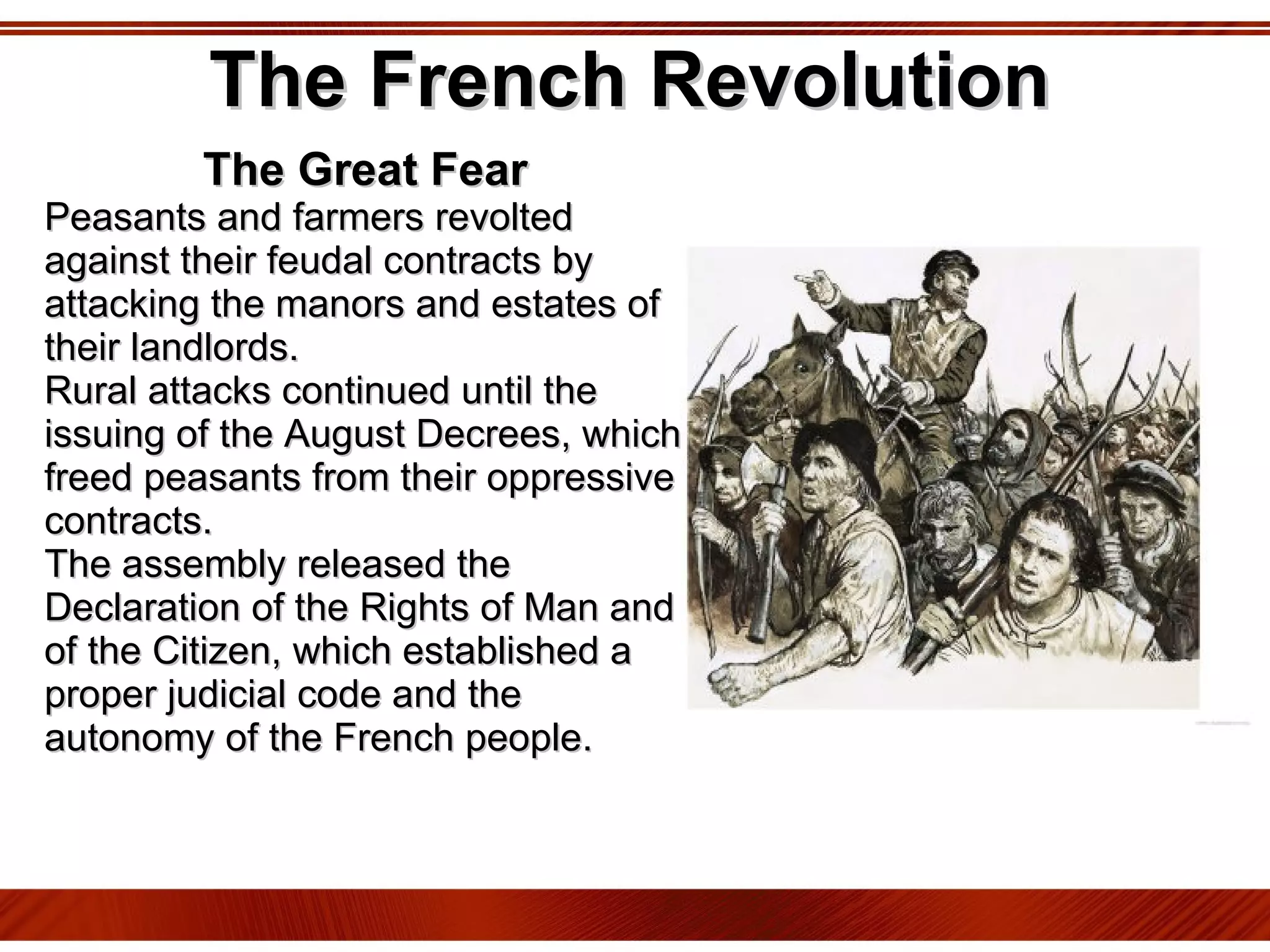
The French Revolution The Great Fear Peasants and farmers revolted against their feudal contracts by attacking the manors and estates of their landlords.  Rural attacks continued until the issuing of the August Decrees, which freed peasants from their oppressive contracts.  The assembly released the Declaration of the Rights of Man and of the Citizen, which established a proper judicial code and the autonomy of the French people.
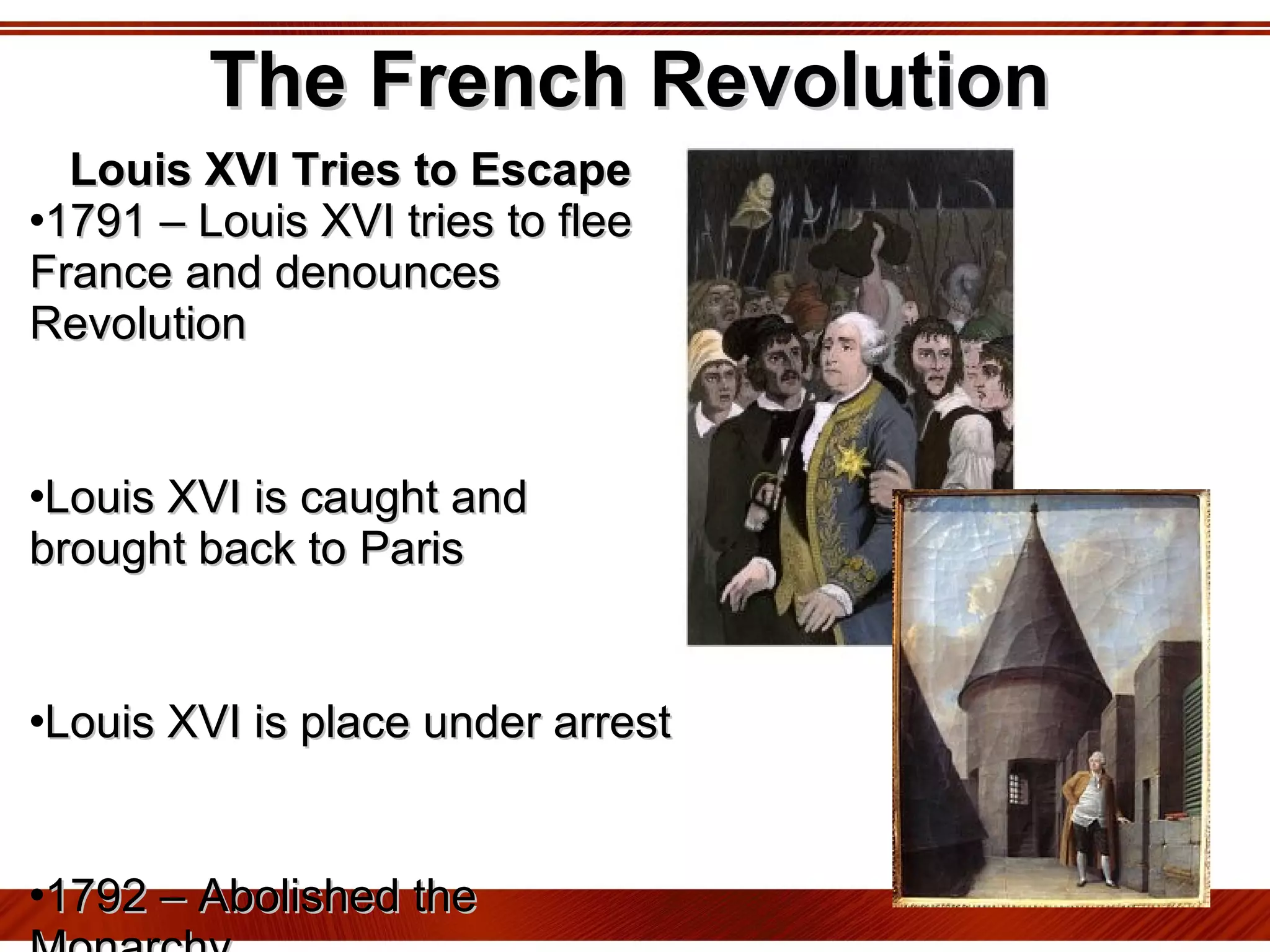
The French Revolution Louis XVI Tries to Escape 1791 – Louis XVI tries to flee France and denounces Revolution Louis XVI is caught and brought back to Paris Louis XVI is place under arrest 1792 – Abolished the Monarchy
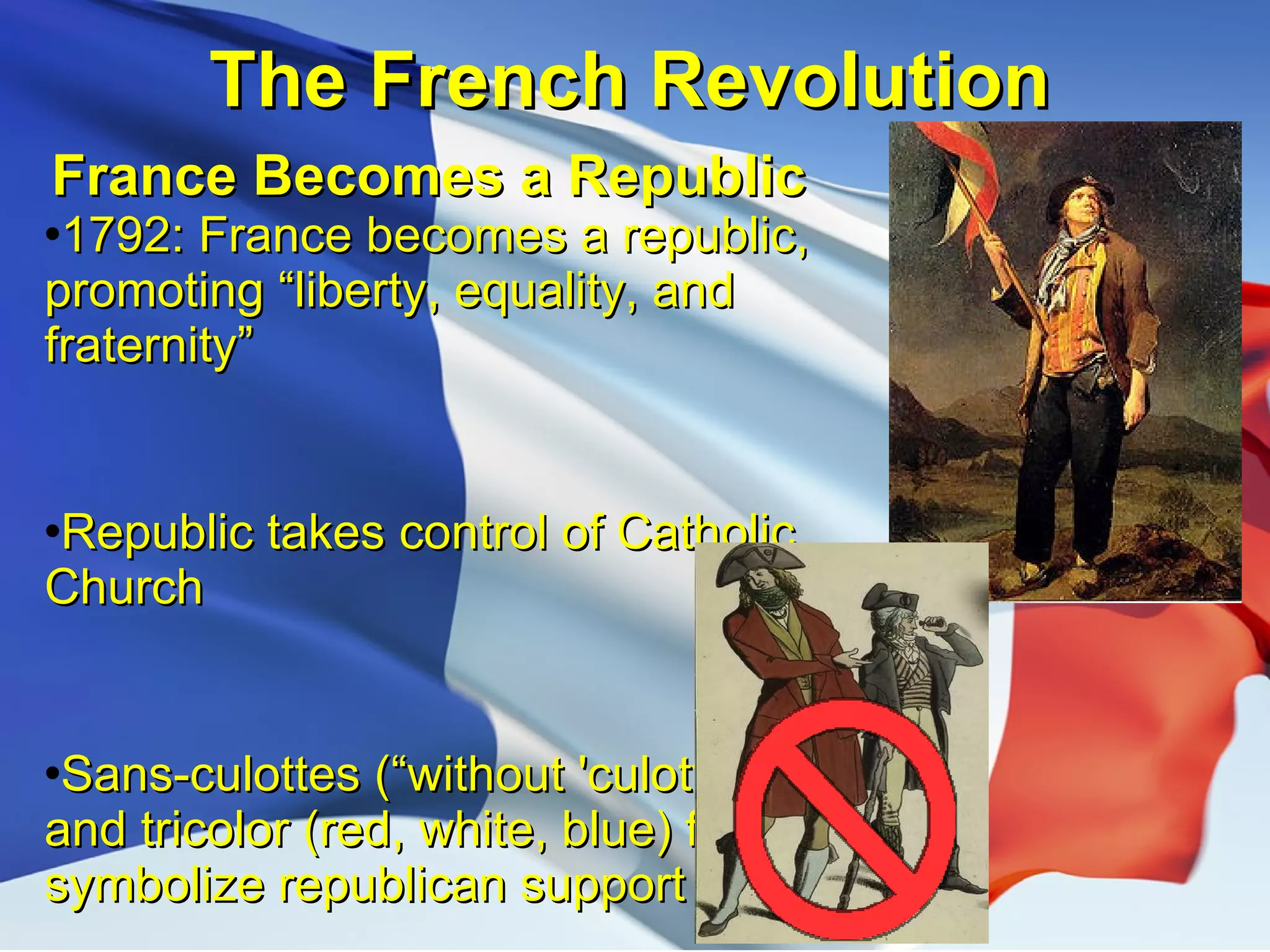
The French Revolution France Becomes a Republic 1792: France becomes a republic, promoting “liberty, equality, and fraternity” Republic takes control of Catholic Church Sans-culottes (“without 'culottes'”) and tricolor (red, white, blue) flag symbolize republican support
The French Revolution Europe at War  1792: France wars against anti-revolution European powers War continues sporadically for 23 years, spreading nationalism, democracy, and suffering across the continent
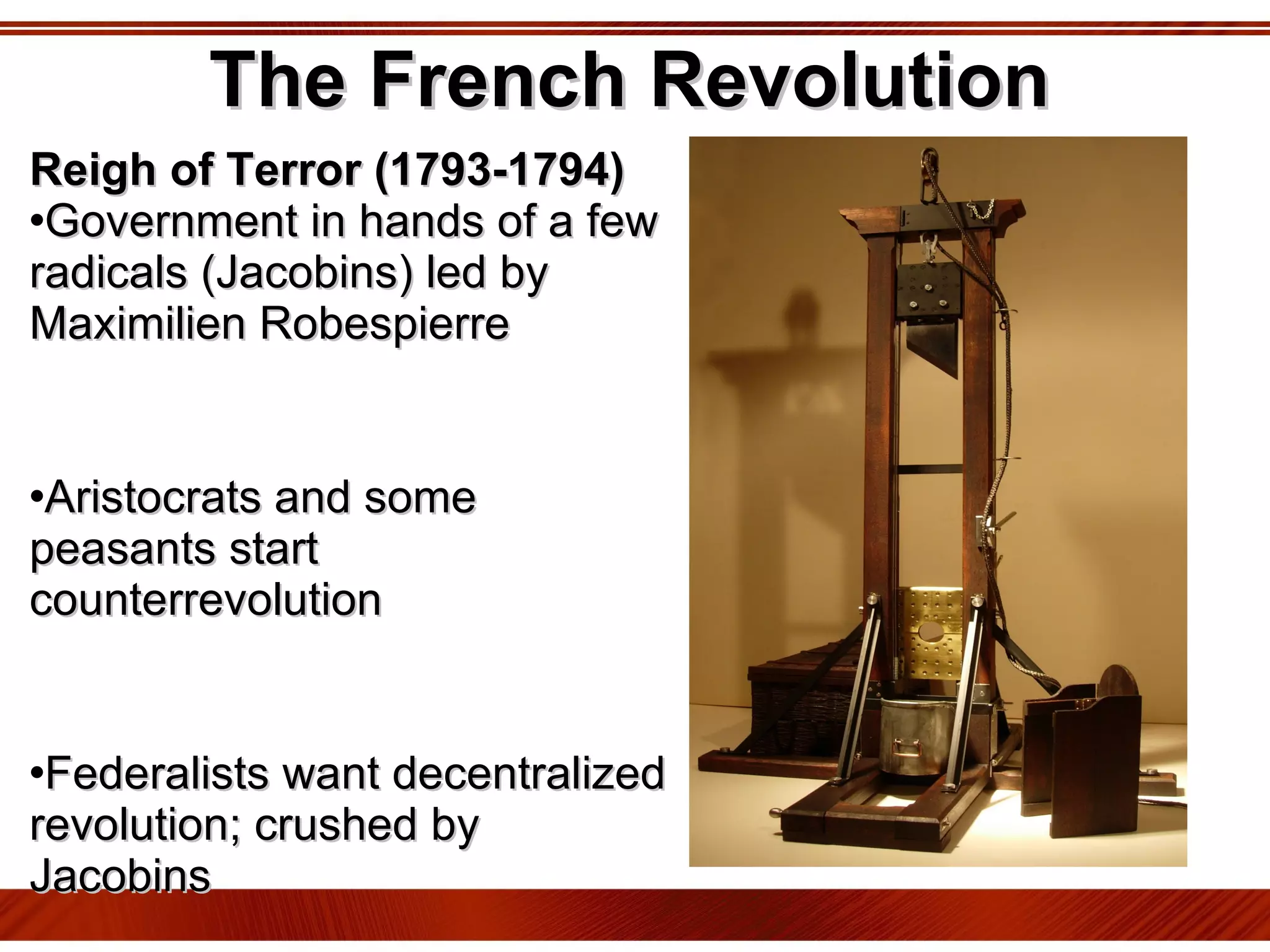
The French Revolution Reigh of Terror (1793-1794) Government in hands of a few radicals (Jacobins) led by Maximilien Robespierre Aristocrats and some peasants start counterrevolution Federalists want decentralized revolution; crushed by Jacobins Over 20,000 people guillotined
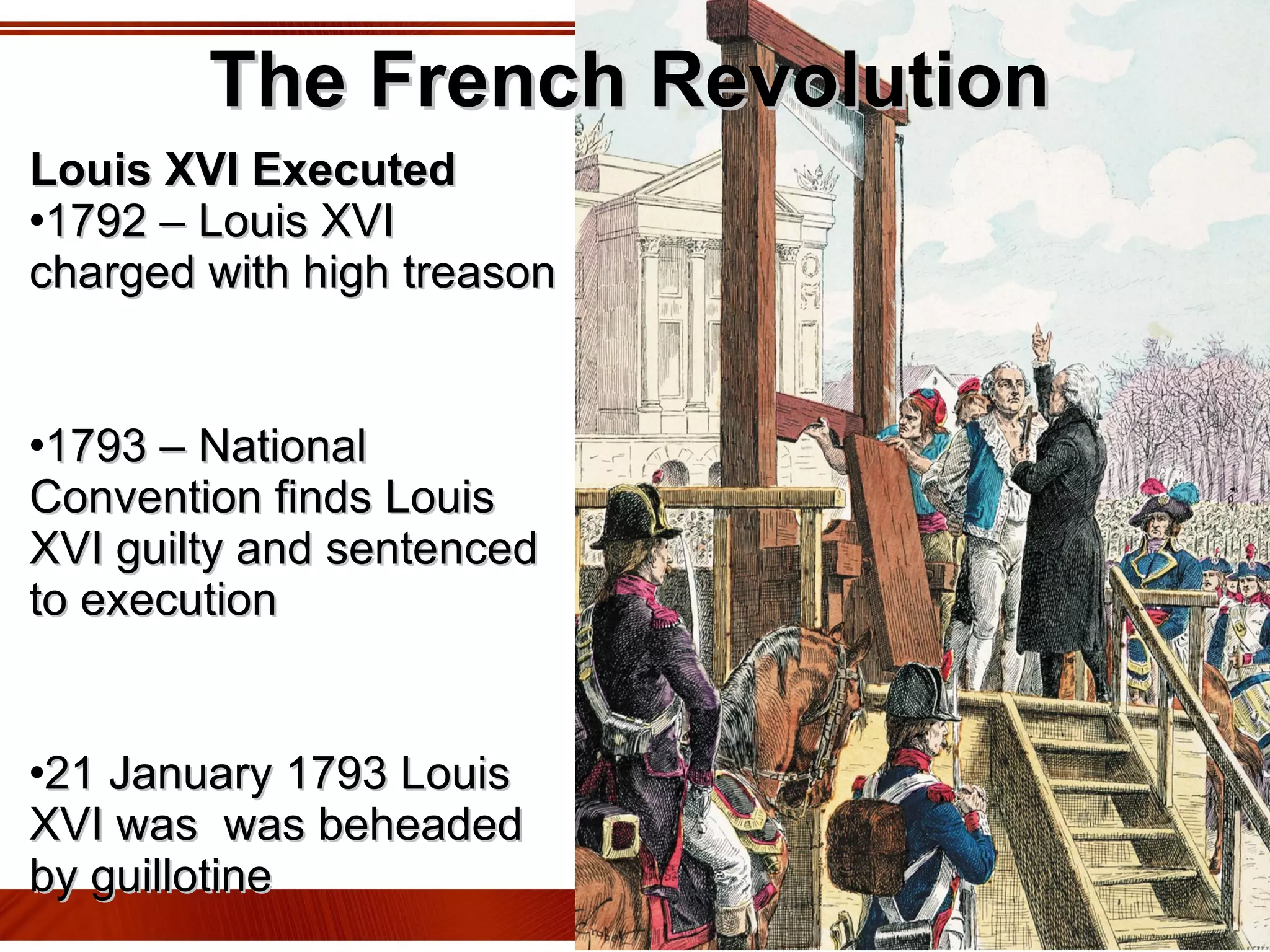
The French Revolution Louis XVI Executed 1792 – Louis XVI charged with high treason 1793 – National Convention finds Louis XVI guilty and sentenced to execution  21 January 1793 Louis XVI was  was beheaded by guillotine
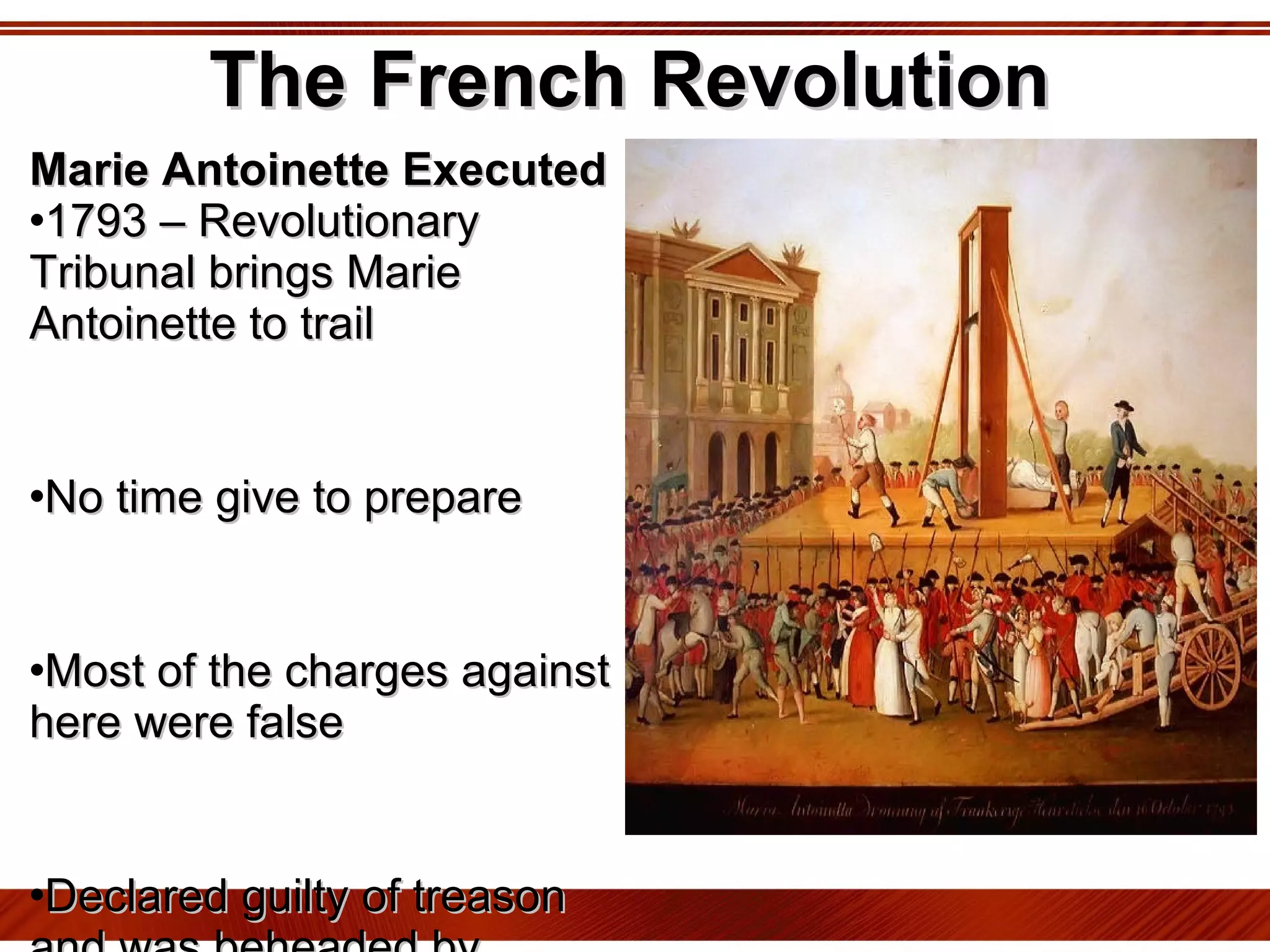
The French Revolution Marie Antoinette Executed 1793 – Revolutionary Tribunal brings Marie Antoinette to trail No time give to prepare Most of the charges against here were false Declared guilty of treason and was beheaded by guillotine
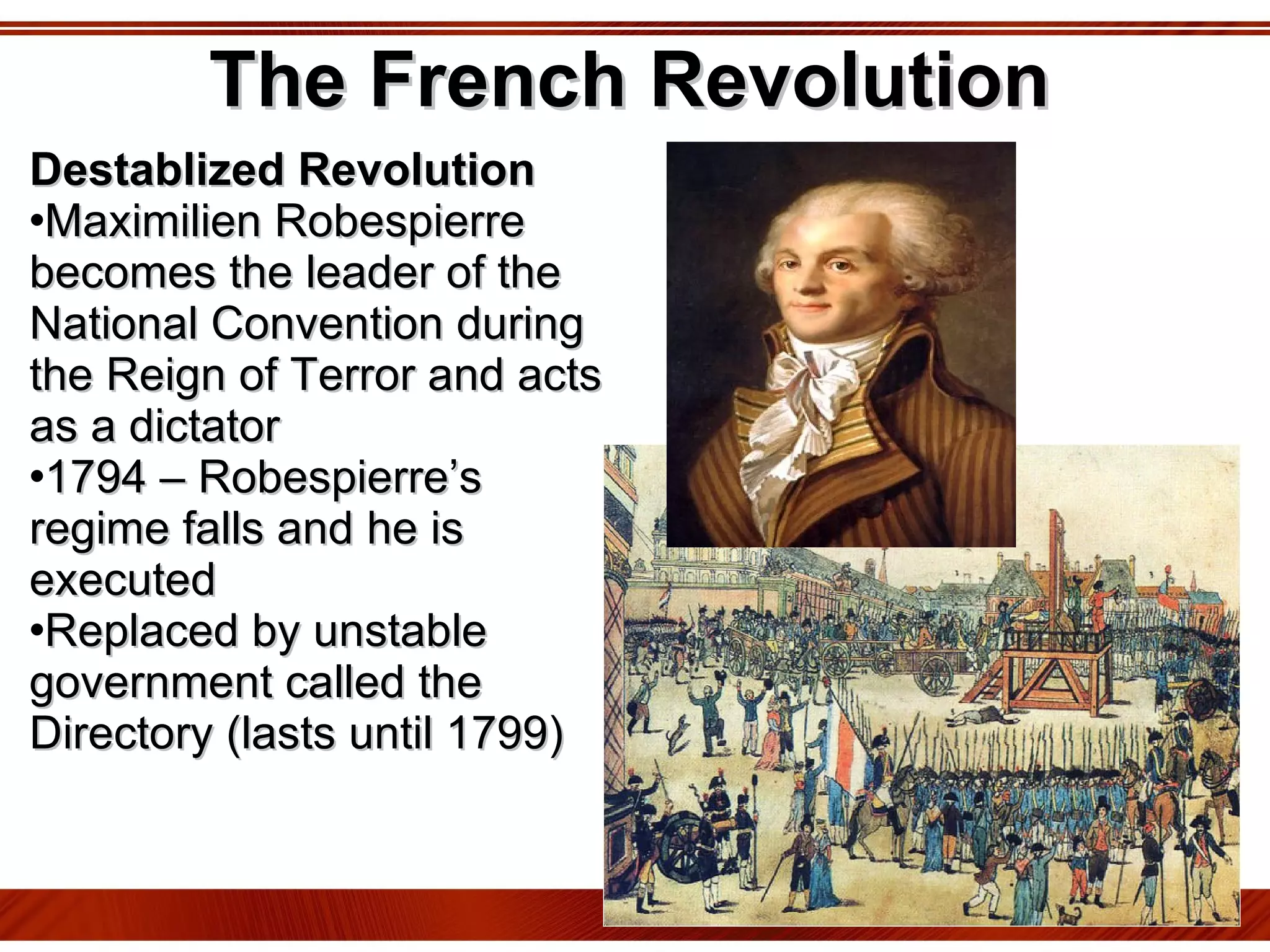
The French Revolution Destablized Revolution Maximilien Robespierre becomes the leader of the National Convention during the Reign of Terror and acts as a dictator 1794 – Robespierre’s regime falls and he is executed Replaced by unstable government called the Directory (lasts until 1799)
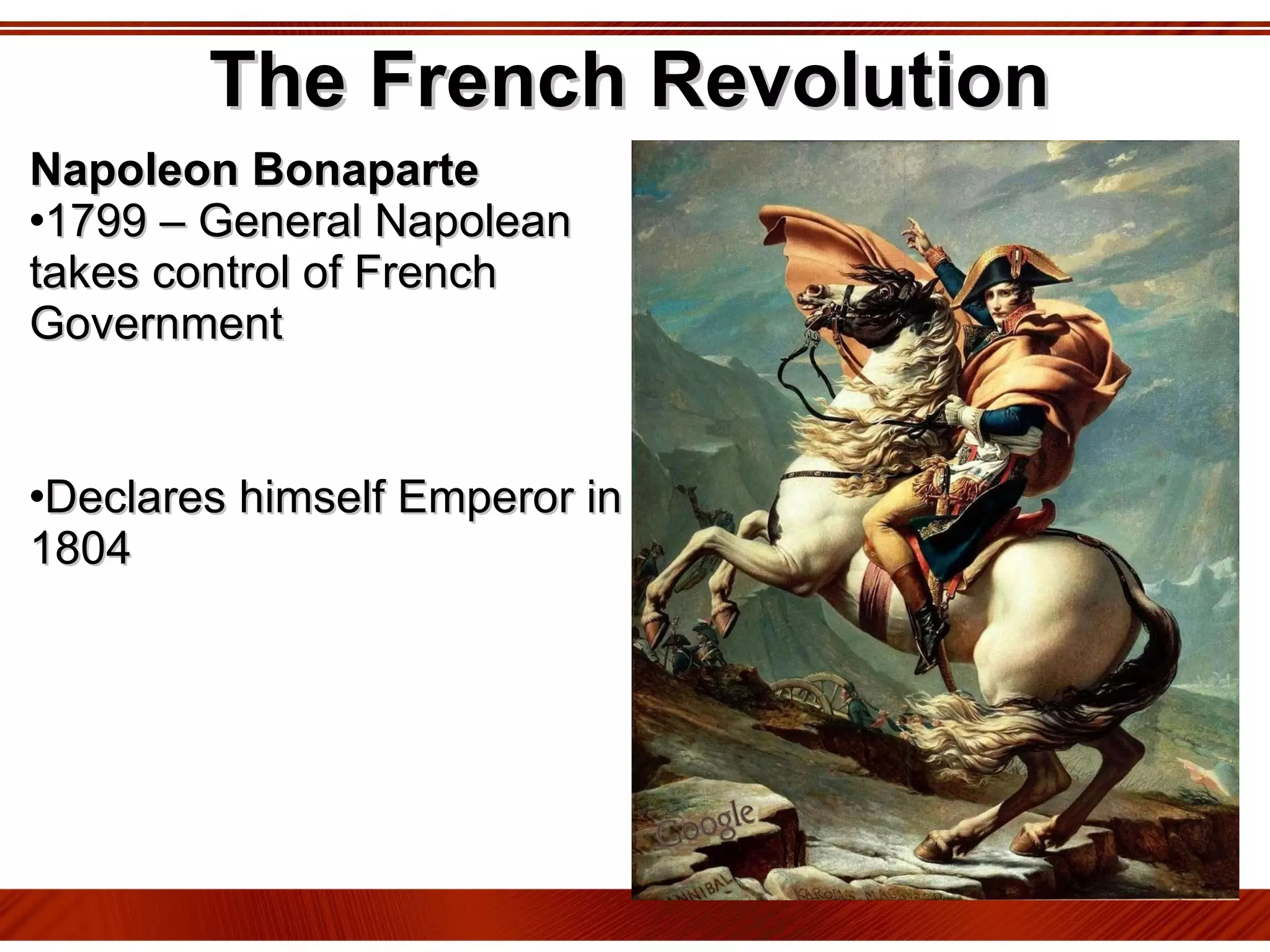
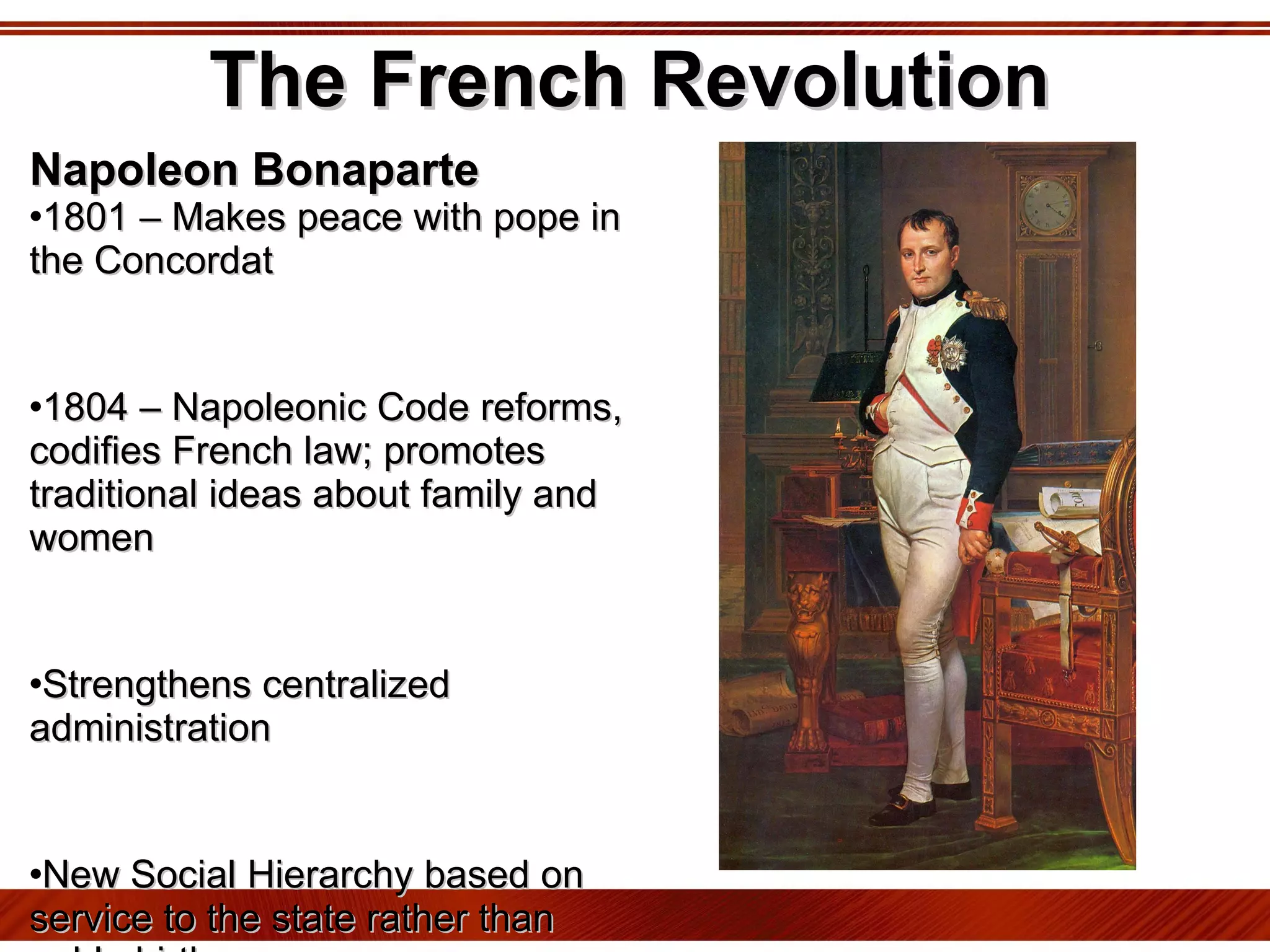
The French Revolution Napoleon Bonaparte 1799 – General Napolean takes control of French Government  Declares himself Emperor in 1804
The French Revolution Napoleon Bonaparte 1801 – Makes peace with pope in the Concordat 1804 – Napoleonic Code reforms, codifies French law; promotes traditional ideas about family and women Strengthens centralized administration New Social Hierarchy based on service to the state rather than noble birth Censorship, arrest for those who disagree
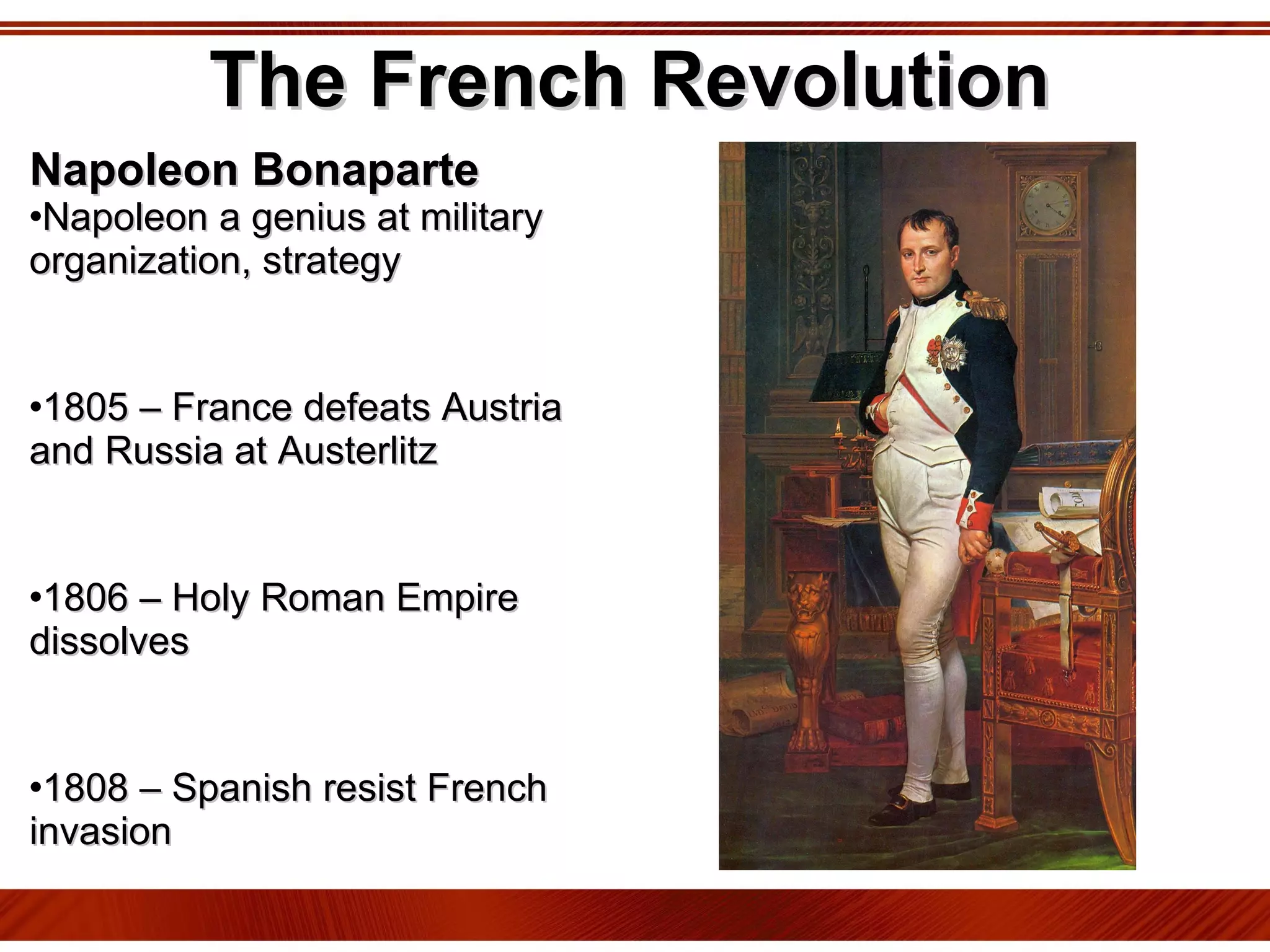
The French Revolution Napoleon Bonaparte Napoleon a genius at military organization, strategy 1805 – France defeats Austria and Russia at Austerlitz 1806 – Holy Roman Empire dissolves 1808 – Spanish resist French invasion 1812 – French invade Russia 1815 – Coalition of Austrian, British, Prussian, and Russian forces defeat Napoleon at Waterloo
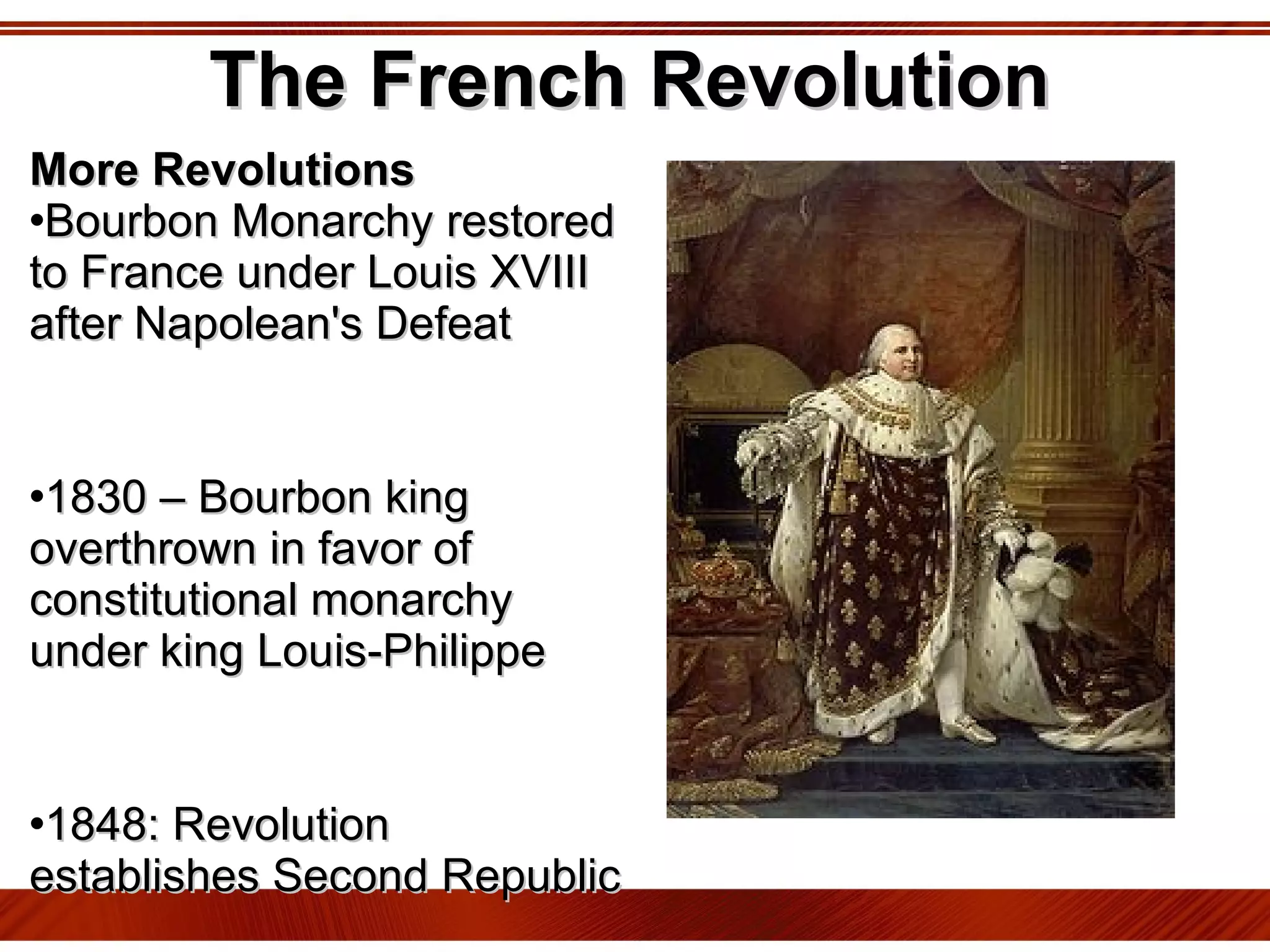
The French Revolution More Revolutions Bourbon Monarchy restored to France under Louis XVIII after Napolean's Defeat 1830 – Bourbon king overthrown in favor of constitutional monarchy under king Louis-Philippe 1848: Revolution establishes Second Republic
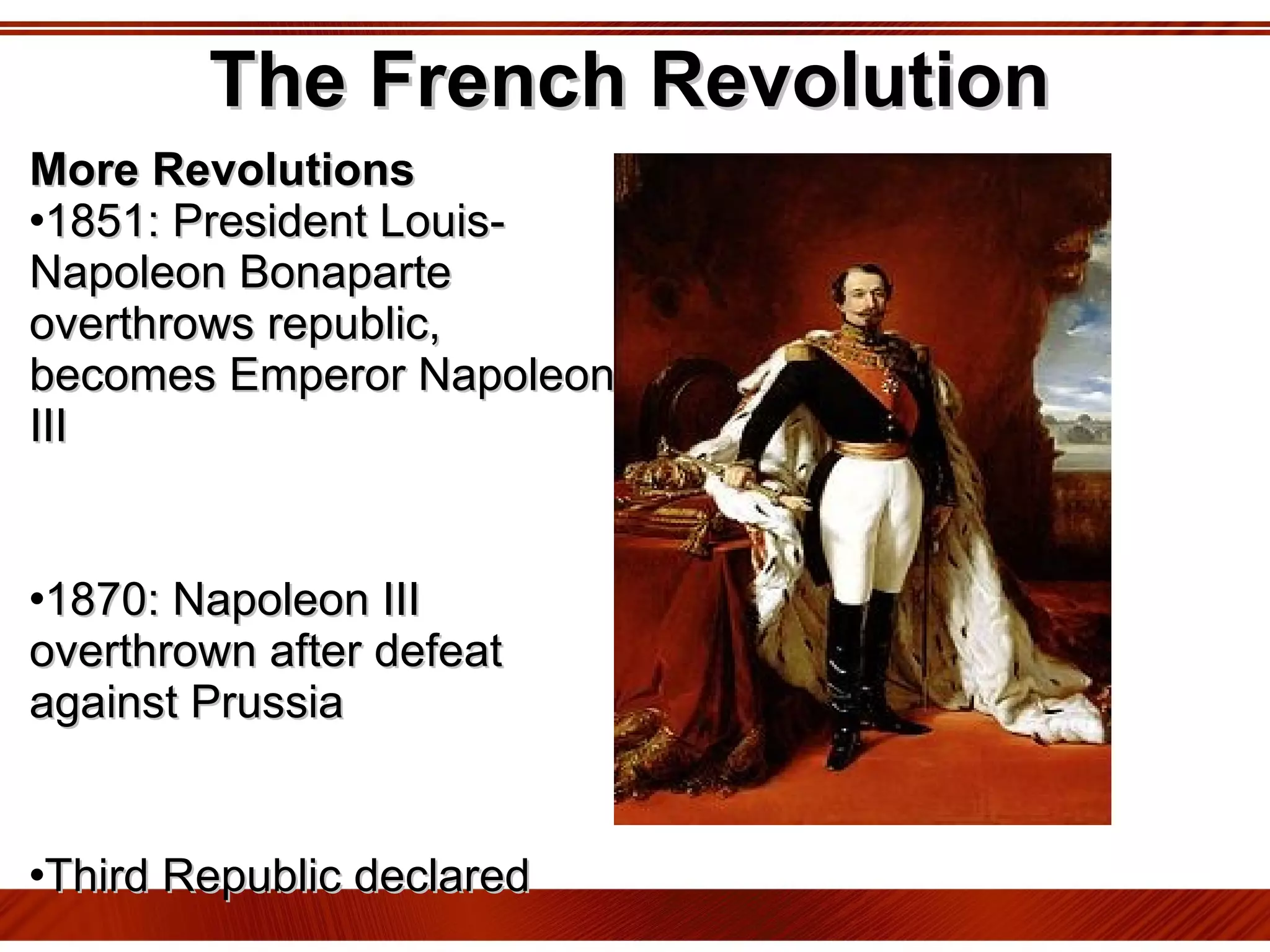
The French Revolution More Revolutions 1851: President Louis-Napoleon Bonaparte overthrows republic, becomes Emperor Napoleon III 1870: Napoleon III overthrown after defeat against Prussia  Third Republic declared

Western Civilization Lecture 7

  • 1.
    Western Civilization Mr.Mike Beard Revolutions
  • 2.
    Revolutions The AmericanRevolution The French Revolution
  • 3.
    The American RevolutionBrittish Colonies Heavily Taxed 1764 – Brittish Prime Minister George Grenville passed the Sugar Act to tax sugar The Stamp Act placed a tax on printed materials The Quartering Act, which required Americans to house and feed British troops.
  • 4.
    The American RevolutionTaxation without Representation Several colonial leaders convened the Stamp Act Congress in New York to petition Parliament and King George III to repeal the tax. Parliament bowed to public pressure and repealed the Stamp Act. But it also quietly passed the Declaratory Act, which stipulated that Parliament reserved the right to tax the colonies anytime it chose.
  • 5.
    The American RevolutionThe Townshend Acts and Boston Massacre Townshend Acts – a series of taxes on lead, paints, and tea. March 5, 1770, an angry mob clashed with several British troops. Five colonists died, and news of the Boston Massacre quickly spread throughout the colonies.
  • 6.
    The American RevolutionThe Boston Tea Party 1773 – Tea Act, granting the financially troubled British East India Company a trade monopoly on the tea exported to the American colonies. In many American cities, tea agents resigned or canceled orders, and merchants refused consignments in response to the unpopular act. On the night of December 16, 1773 sixty men boarded tea ships, disguised as Native Americans, and dumped the entire shipment of tea into the harbor. That event is now famously known as the Boston Tea Party.
  • 7.
    The American RevolutionCoercive Acts 1774 – The Coercive Acts shut down Boston Harbor until the British East India Company had been fully reimbursed for the tea destroyed in the Boston Tea Party. Americans throughout the colonies sent food and supplies to Boston via land to prevent death from hunger and cold in the bitter New England winter.
  • 8.
    The American RevolutionThe First Continental Congress and Boycott 1774 – To protest the Intolerable (Coercive) Acts, prominent colonials gathered in Philadelphia at the First Continental Congress. They once again petitioned Parliament, King George III, and the British people to repeal the acts and restore friendly relations. Also instituted a boycott, or ban, of all British goods in the colonies.
  • 9.
    The American RevolutionLexington, Concord, and the Second Continental Congress 1775 – The British occupation force in Boston marched to the nearby town of Concord, Massachusetts, to seize a colonial militia arsenal. Militiamen of Lexington and Concord intercepted them and attacked. Thousands of militiamen from nearby colonies flocked to Boston to assist. Second Continental Congress issued the Olive Branch Petition, they professed their love and loyalty to King George III and begged him to address their grievances. The king rejected the petition and formally declared that the colonies were in a state of rebellion.
  • 10.
    The American RevolutionThe Declaration of Independence George Washington appointed Commander in Chief. Thomas Jefferson drafted the Declaration of Independence which was signed on 4 July 1776. The United States was born.
  • 11.
    The American RevolutionThe Revolutionary War: 1775–1783 1775 Battle of Lexington 1776 Declaration of Independence 1777 Battle of Saratoga 1778 France and United States form Franco-American Alliance 1779 Spain enters war against Britain 1781 British forces under Cornwallis surrender to Washington at Yorktown 1783 Peace of Paris signed to end war
  • 12.
    The French RevolutionUnrest in France Population Increase Famine Enlightenment ideas that promote democracy and lower prestige of monarchy The Monarchy’s Financial Crisis Feudal Oppression Popular View that the Parliaments and the Public represent the French nation more than the monarch
  • 13.
    The French RevolutionLouis XVI Indecisiveness Convservativism Lost Respect of French Public Viewed as a King of the Ancient Regime (feudalism)
  • 14.
    The French RevolutionLouis XVI Became King at age 20 France was facing a serious financial crises when he became king French public was frustrated by the king's indicisiveness and financial mismanagement
  • 15.
    The French RevolutionPalace of Versailles King Louis XVI and previous kings didn't live in Paris (capital city of France) but in Versailles A small town near Paris which containted the Royal Palace. Viewed as very extravagant by the French population.
  • 16.
    The French RevolutionMarie Antoinette Archduchess of Austria who married King Louis XVI French public disliked her due to her extravagance in spending money when France was in a financial crisis Also distrusted because she was Austrian
  • 17.
    The French RevolutionFinancial Crisis Financial mismangement and the changing economic world in Europe destablized the French economy King Louis XVI brought in a number of financial advisors to review the weakened French treasury. Each advisor reached the same conclusion—that France needed a radical change in the way it taxed the public—and each advisor was, in turn, kicked out.
  • 18.
    The French RevolutionFinancial Crisis King Louis XVI finallay agreed that this taxation problem really did need to be addressed He appointed a new controller general of finance, Charles de Calonne, in 1783. Calonne suggested that France begin taxing nobility. The nobility refused during the Assembly of Notables in 1787. Financial ruin thus seemed imminent.
  • 19.
    The French RevolutionThe Estates-General Clergy, Nobility and French Public (Third Estate) 1789 - Louis XVI convened the Estates-General to decide on a tax solution for the finanical crisis. The clergy and the nobility were tax-exempt and not willing to be taxed. Outdated rules gave each estate a single vote
  • 20.
    The French RevolutionThe Estates-General The Third Estate—consisting of the general French public—was many times larger than either of the first two. The Third Estate declared itself the sovereign National Assembly. Within days of the announcement, many members of the other two estates had switched allegiances over to this revolutionary new assembly. The Revolution Began
  • 21.
    The French RevolutionThe Tennis Court Oath The new National Assembly took the Tennis Court Oath, swearing that they would not relent in their efforts until a new constitution had been agreed upon.
  • 22.
    The French RevolutionLouis XVI and Antoinette Forced to Live in Paris Crowds of French women stormed the Royal Palace in Versailles King and Queen forcibly moved to Paris King and Queen were not free to leave Paris
  • 23.
    The French RevolutionThe Great Fear Peasants and farmers revolted against their feudal contracts by attacking the manors and estates of their landlords. Rural attacks continued until the issuing of the August Decrees, which freed peasants from their oppressive contracts. The assembly released the Declaration of the Rights of Man and of the Citizen, which established a proper judicial code and the autonomy of the French people.
  • 24.
    The French RevolutionLouis XVI Tries to Escape 1791 – Louis XVI tries to flee France and denounces Revolution Louis XVI is caught and brought back to Paris Louis XVI is place under arrest 1792 – Abolished the Monarchy
  • 25.
    The French RevolutionFrance Becomes a Republic 1792: France becomes a republic, promoting “liberty, equality, and fraternity” Republic takes control of Catholic Church Sans-culottes (“without 'culottes'”) and tricolor (red, white, blue) flag symbolize republican support
  • 26.
    The French RevolutionEurope at War 1792: France wars against anti-revolution European powers War continues sporadically for 23 years, spreading nationalism, democracy, and suffering across the continent
  • 27.
    The French RevolutionReigh of Terror (1793-1794) Government in hands of a few radicals (Jacobins) led by Maximilien Robespierre Aristocrats and some peasants start counterrevolution Federalists want decentralized revolution; crushed by Jacobins Over 20,000 people guillotined
  • 28.
    The French RevolutionLouis XVI Executed 1792 – Louis XVI charged with high treason 1793 – National Convention finds Louis XVI guilty and sentenced to execution 21 January 1793 Louis XVI was was beheaded by guillotine
  • 29.
    The French RevolutionMarie Antoinette Executed 1793 – Revolutionary Tribunal brings Marie Antoinette to trail No time give to prepare Most of the charges against here were false Declared guilty of treason and was beheaded by guillotine
  • 30.
    The French RevolutionDestablized Revolution Maximilien Robespierre becomes the leader of the National Convention during the Reign of Terror and acts as a dictator 1794 – Robespierre’s regime falls and he is executed Replaced by unstable government called the Directory (lasts until 1799)
  • 31.
    The French RevolutionNapoleon Bonaparte 1799 – General Napolean takes control of French Government Declares himself Emperor in 1804
  • 32.
    The French RevolutionNapoleon Bonaparte 1801 – Makes peace with pope in the Concordat 1804 – Napoleonic Code reforms, codifies French law; promotes traditional ideas about family and women Strengthens centralized administration New Social Hierarchy based on service to the state rather than noble birth Censorship, arrest for those who disagree
  • 33.
    The French RevolutionNapoleon Bonaparte Napoleon a genius at military organization, strategy 1805 – France defeats Austria and Russia at Austerlitz 1806 – Holy Roman Empire dissolves 1808 – Spanish resist French invasion 1812 – French invade Russia 1815 – Coalition of Austrian, British, Prussian, and Russian forces defeat Napoleon at Waterloo
  • 34.
    The French RevolutionMore Revolutions Bourbon Monarchy restored to France under Louis XVIII after Napolean's Defeat 1830 – Bourbon king overthrown in favor of constitutional monarchy under king Louis-Philippe 1848: Revolution establishes Second Republic
  • 35.
    The French RevolutionMore Revolutions 1851: President Louis-Napoleon Bonaparte overthrows republic, becomes Emperor Napoleon III 1870: Napoleon III overthrown after defeat against Prussia Third Republic declared