Introduction to Philosophy IS-VNU Mr. Mike  Lecture 9
Introduction to Philosophy Idealism Continued Conservatism Liberalism
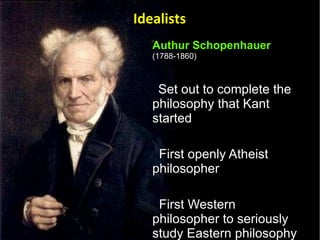
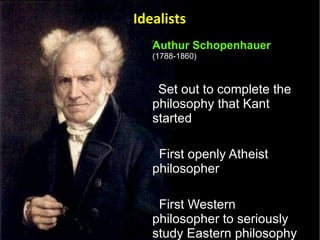
Authur Schopenhauer   (1788-1860) Set out to complete the philosophy that Kant started First openly Atheist philosopher First Western philosopher to seriously study Eastern philosophy  Idealists
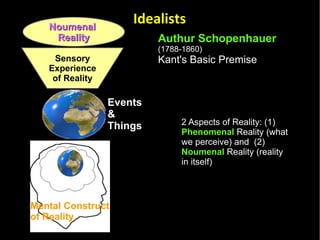
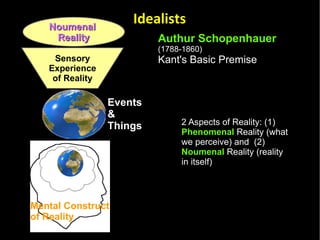
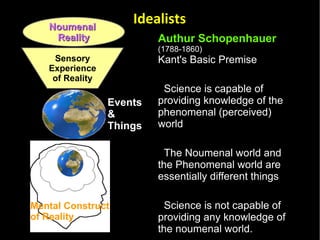
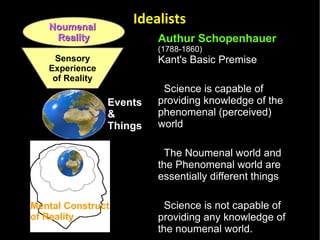
Authur Schopenhauer   (1788-1860) Kant's Basic Premise 2 Aspects of Reality: (1)  Phenomenal  Reality (what we perceive) and  (2)  Noumenal  Reality (reality in itself) Since Reality in itself is beyond our to perceive it we can never know reality as it is  Phenomenal Reality is a mental construct of our mind Idealists Noumenal  Reality Sensory Experience of Reality Events  &  Things Mental Construct of Reality
Authur Schopenhauer   (1788-1860) Kant's Basic Premise Science is capable of providing knowledge of the phenomenal (perceived) world The Noumenal world and the Phenomenal world are essentially different things  Science is not capable of providing any knowledge of the noumenal world. Idealists Noumenal  Reality Sensory Experience of Reality Events  &  Things Mental Construct of Reality
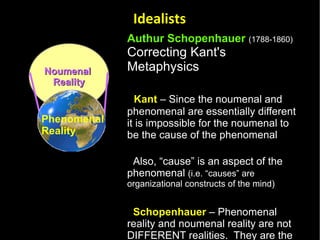
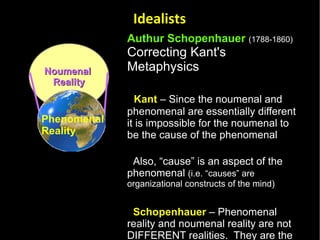
Authur Schopenhauer   (1788-1860) Correcting Kant's Metaphysics Kant  – Since the noumenal and phenomenal are essentially different it is impossible for the noumenal to be the cause of the phenomenal  Also, “cause” is an aspect of the phenomenal  (i.e. “causes” are organizational constructs of the mind) Schopenhauer  – Phenomenal reality and noumenal reality are not DIFFERENT realities.  They are the SAME reality.  Idealists Noumenal  Reality Phenomenal Reality
Authur Schopenhauer   (1788-1860) Metaphysics Since space and time are aspects of the phenomenal world that we can perceive, they have no meaning in the noumenal world.  If space and time do not exist then there can be no differentiation between things –  Everything is One   Idealists
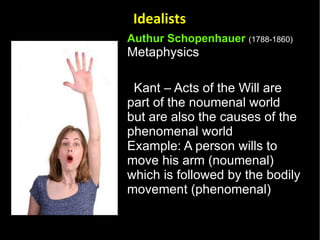
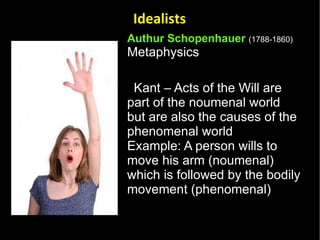
Authur Schopenhauer   (1788-1860) Metaphysics Kant – Acts of the Will are part of the noumenal world but are also the causes of the phenomenal world  Example: A person wills to move his arm (noumenal) which is followed by the bodily movement (phenomenal)  Idealists
Authur Schopenhauer   (1788-1860) Metaphysics Schopenhauer – If the phenomenal and noumenal are different (Kant) then the acts of the will cannot cause anything in phenomenal reality. Idealists
Authur Schopenhauer   (1788-1860) Metaphysics Solution: Phenomenal and Noumenal are not different.  Motives (will) are internal and noumenal.  Bodily movement is external (phenomenal).  Motives and Bodily movements are  the same event apprehended in two different ways (internal and external)  Idealists
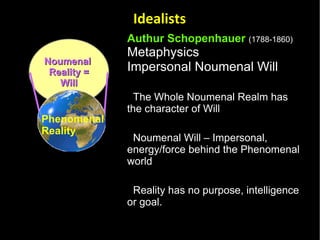
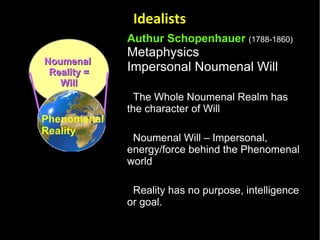
Authur Schopenhauer   (1788-1860) Metaphysics Impersonal Noumenal Will The Whole Noumenal Realm has the character of Will  Noumenal Will – Impersonal, energy/force behind the Phenomenal world Reality has no purpose, intelligence or goal.  Idealists Noumenal  Reality = Will Phenomenal Reality
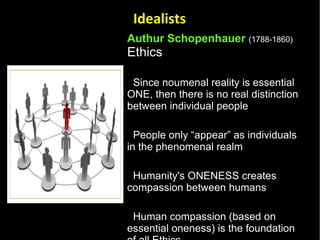
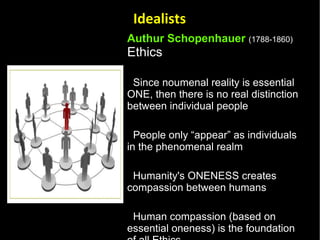
Authur Schopenhauer   (1788-1860) Ethics Since noumenal reality is essential ONE, then there is no real distinction between individual people People only “appear” as individuals in the phenomenal realm Humanity's ONENESS creates compassion between humans Human compassion (based on essential oneness) is the foundation of all Ethics  Idealists
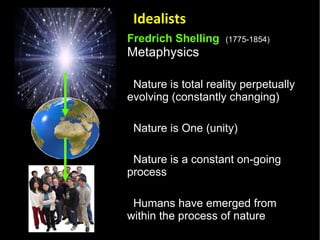
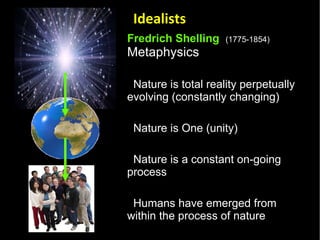
Fredrich Shelling  (1775-1854) Metaphysics Nature is total reality perpetually evolving (constantly changing)  Nature is One (unity) Nature is a constant on-going process  Humans have emerged from within the process of nature Man does not exist outside of nature but is part of nature   Idealists
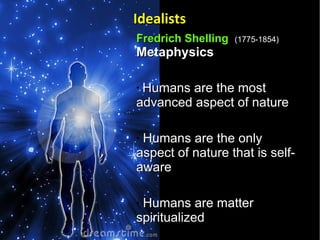
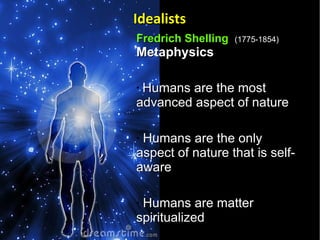
Fredrich Shelling  (1775-1854) Metaphysics   Humans are the most advanced aspect of nature  Humans are the only aspect of nature that is self-aware Humans are matter spiritualized  Humans are nature that has become self-aware  Idealists
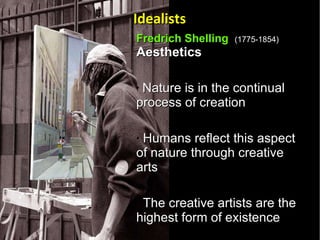
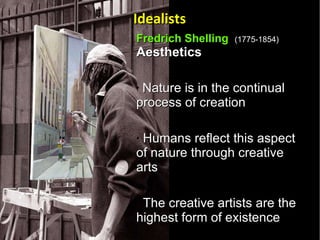
Fredrich Shelling  (1775-1854) Aesthetics  Nature is in the continual process of creation Humans reflect this aspect of nature through creative arts The creative artists are the highest form of existence  Idealists
Fredrich Shelling   (1775-1854) Ultimate Question  Why does anything exist at all? Why not nothing?   Idealists
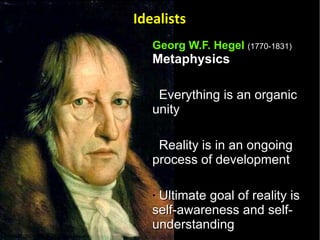
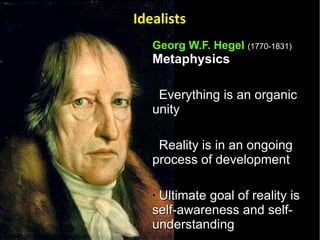
Georg W.F. Hegel   (1770-1831) Metaphysics   Everything is an organic unity  Reality is in an ongoing process of development  Ultimate goal of reality is self-awareness and self-understanding Idealists
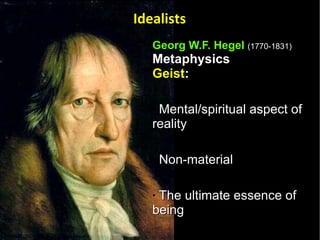
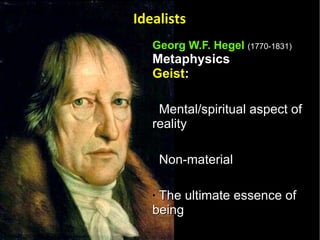
Georg W.F. Hegel   (1770-1831) Metaphysics   Geist : Mental/spiritual aspect of reality  Non-material  The ultimate essence of being Absolute Idealism  Idealists
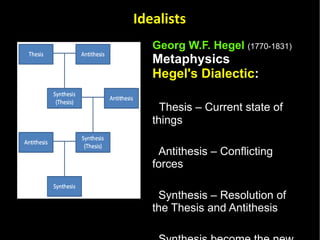
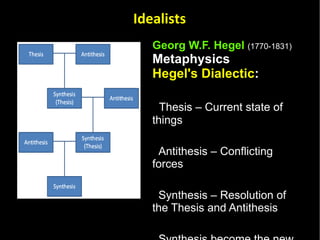
Georg W.F. Hegel   (1770-1831) Metaphysics   Hegel's Dialectic : Thesis – Current state of things  Antithesis – Conflicting forces Synthesis – Resolution of the Thesis and Antithesis  Synthesis become the new thesis Idealists
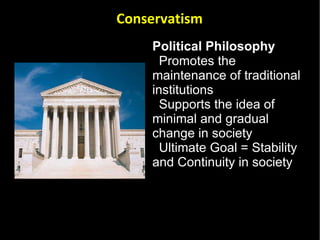
Political Philosophy  Promotes the maintenance of traditional institutions Supports the idea of minimal and gradual change in society Ultimate Goal = Stability and Continuity in society  Conservatism
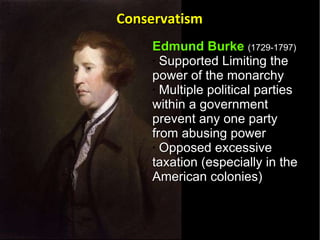
Edmund Burke   (1729-1797)   Supported Limiting the power of the monarchy  Multiple political parties within a government prevent any one party from abusing power Opposed excessive taxation (especially in the American colonies)  Conservatism
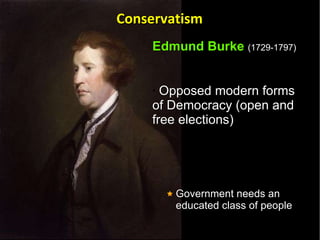
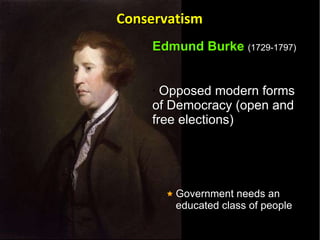
Edmund Burke   (1729-1797)   Opposed modern forms of Democracy (open and free elections)  Government needs an educated class of people  Common people had dangerous passions Democracy could remove protection from some minorities   Conservatism
Political Philosophy  Promotes the importance of Government protecting Liberty and providing Equal Rights Free and Fair Elections Universal Human Rights Freedom of Religion  Constitutionalism –  Government authority is based on and limited by a body of fundamental laws Liberal Democracy - Multiple Political Parties  Capitalism – Privately owned means of production which generate profit for the owners Liberalism
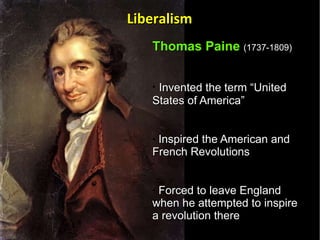
Thomas Paine   (1737-1809)   Invented the term “United States of America”  Inspired the American and French Revolutions Forced to leave England when he attempted to inspire a revolution there Influential in the formation of the American Constitution Liberalism
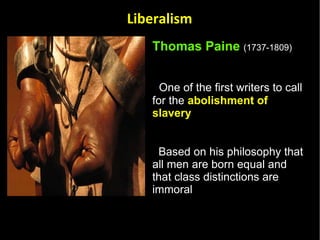
Thomas Paine   (1737-1809)   One of the first writers to call for the  abolishment of slavery Based on his philosophy that all men are born equal and that class distinctions are immoral  Liberalism
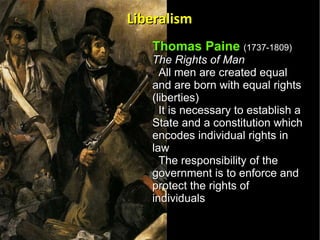
Thomas Paine   (1737-1809)   The Rights of Man All men are created equal and are born with equal rights (liberties)  It is necessary to establish a State and a constitution which encodes individual rights in law  The responsibility of the government is to enforce and protect the rights of individuals Liberalism
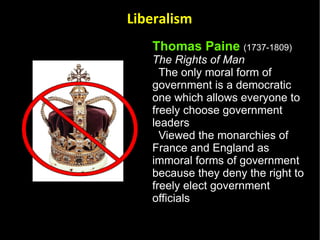
Thomas Paine   (1737-1809)   The Rights of Man The only moral form of government is a democratic one which allows everyone to freely choose government leaders Viewed the monarchies of France and England as immoral forms of government because they deny the right to freely elect government officials Liberalism
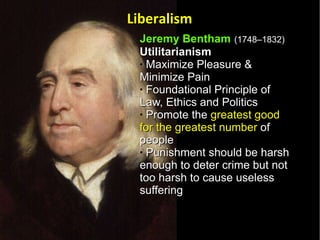
Jeremy Bentham   (1748–1832)   Utilitarianism  Maximize Pleasure & Minimize Pain  Foundational Principle of Law, Ethics and Politics  Promote the  greatest good for the greatest number  of people Punishment should be harsh enough to deter crime but not too harsh to cause useless suffering  Liberalism
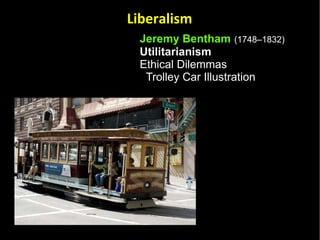
Jeremy Bentham   (1748–1832)   Utilitarianism  Ethical Dilemmas Trolley Car Illustration  Liberalism
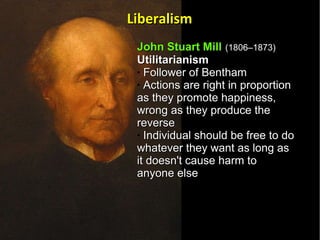
John Stuart Mill   (1806–1873)   Utilitarianism  Follower of Bentham  Actions are right in proportion as they promote happiness, wrong as they produce the reverse Individual should be free to do whatever they want as long as it doesn't cause harm to anyone else  Liberalism
John Stuart Mill   (1806–1873)   Utilitarianism  Bentham saw all pleasures and pains as equal – Mill felt that there are degrees of pleasure and pain. The death of a relative is a greater pain than the death of a pet Liberalism
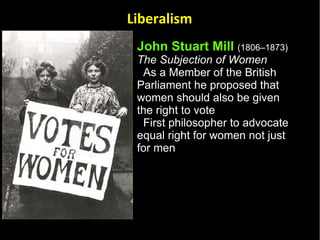
John Stuart Mill   (1806–1873)   The Subjection of Women   As a Member of the British Parliament he proposed that women should also be given the right to vote First philosopher to advocate equal right for women not just for men Liberalism
Mary Wollstonecraft   (1759–1797)   Feminist Thomas Paine   Vindication of the Rights of Man   Agreed with Paine that all men are born equal  British people have the Right to remove a bad king Injustice and mistreatment of the poor is immoral  Slavery is immoral  Liberalism
Mary Wollstonecraft   (1759–1797)   Feminist Thomas Paine   Vindication of the Rights of Women   Argued that Men and Women are also born equal  The greatest crime of her day was the lack of education for women Advocated that women must given the right to vote as a basic right  Liberalism

Philosophy lecture 09

  • 1.
    Introduction to PhilosophyIS-VNU Mr. Mike Lecture 9
  • 2.
    Introduction to PhilosophyIdealism Continued Conservatism Liberalism
  • 3.
    Introduction to PhilosophyIdealism Continued Conservatism Liberalism
  • 4.
    Authur Schopenhauer (1788-1860) Set out to complete the philosophy that Kant started First openly Atheist philosopher First Western philosopher to seriously study Eastern philosophy Idealists
  • 5.
    Authur Schopenhauer (1788-1860) Set out to complete the philosophy that Kant started First openly Atheist philosopher First Western philosopher to seriously study Eastern philosophy Idealists
  • 6.
    Authur Schopenhauer (1788-1860) Kant's Basic Premise 2 Aspects of Reality: (1) Phenomenal Reality (what we perceive) and (2) Noumenal Reality (reality in itself) Since Reality in itself is beyond our to perceive it we can never know reality as it is Phenomenal Reality is a mental construct of our mind Idealists Noumenal Reality Sensory Experience of Reality Events & Things Mental Construct of Reality
  • 7.
    Authur Schopenhauer (1788-1860) Kant's Basic Premise 2 Aspects of Reality: (1) Phenomenal Reality (what we perceive) and (2) Noumenal Reality (reality in itself) Since Reality in itself is beyond our to perceive it we can never know reality as it is Phenomenal Reality is a mental construct of our mind Idealists Noumenal Reality Sensory Experience of Reality Events & Things Mental Construct of Reality
  • 8.
    Authur Schopenhauer (1788-1860) Kant's Basic Premise Science is capable of providing knowledge of the phenomenal (perceived) world The Noumenal world and the Phenomenal world are essentially different things Science is not capable of providing any knowledge of the noumenal world. Idealists Noumenal Reality Sensory Experience of Reality Events & Things Mental Construct of Reality
  • 9.
    Authur Schopenhauer (1788-1860) Kant's Basic Premise Science is capable of providing knowledge of the phenomenal (perceived) world The Noumenal world and the Phenomenal world are essentially different things Science is not capable of providing any knowledge of the noumenal world. Idealists Noumenal Reality Sensory Experience of Reality Events & Things Mental Construct of Reality
  • 10.
    Authur Schopenhauer (1788-1860) Correcting Kant's Metaphysics Kant – Since the noumenal and phenomenal are essentially different it is impossible for the noumenal to be the cause of the phenomenal Also, “cause” is an aspect of the phenomenal (i.e. “causes” are organizational constructs of the mind) Schopenhauer – Phenomenal reality and noumenal reality are not DIFFERENT realities. They are the SAME reality. Idealists Noumenal Reality Phenomenal Reality
  • 11.
    Authur Schopenhauer (1788-1860) Correcting Kant's Metaphysics Kant – Since the noumenal and phenomenal are essentially different it is impossible for the noumenal to be the cause of the phenomenal Also, “cause” is an aspect of the phenomenal (i.e. “causes” are organizational constructs of the mind) Schopenhauer – Phenomenal reality and noumenal reality are not DIFFERENT realities. They are the SAME reality. Idealists Noumenal Reality Phenomenal Reality
  • 12.
    Authur Schopenhauer (1788-1860) Metaphysics Since space and time are aspects of the phenomenal world that we can perceive, they have no meaning in the noumenal world. If space and time do not exist then there can be no differentiation between things – Everything is One Idealists
  • 13.
    Authur Schopenhauer (1788-1860) Metaphysics Since space and time are aspects of the phenomenal world that we can perceive, they have no meaning in the noumenal world. If space and time do not exist then there can be no differentiation between things – Everything is One Idealists
  • 14.
    Authur Schopenhauer (1788-1860) Metaphysics Kant – Acts of the Will are part of the noumenal world but are also the causes of the phenomenal world Example: A person wills to move his arm (noumenal) which is followed by the bodily movement (phenomenal) Idealists
  • 15.
    Authur Schopenhauer (1788-1860) Metaphysics Kant – Acts of the Will are part of the noumenal world but are also the causes of the phenomenal world Example: A person wills to move his arm (noumenal) which is followed by the bodily movement (phenomenal) Idealists
  • 16.
    Authur Schopenhauer (1788-1860) Metaphysics Schopenhauer – If the phenomenal and noumenal are different (Kant) then the acts of the will cannot cause anything in phenomenal reality. Idealists
  • 17.
    Authur Schopenhauer (1788-1860) Metaphysics Schopenhauer – If the phenomenal and noumenal are different (Kant) then the acts of the will cannot cause anything in phenomenal reality. Idealists
  • 18.
    Authur Schopenhauer (1788-1860) Metaphysics Solution: Phenomenal and Noumenal are not different. Motives (will) are internal and noumenal. Bodily movement is external (phenomenal). Motives and Bodily movements are the same event apprehended in two different ways (internal and external) Idealists
  • 19.
    Authur Schopenhauer (1788-1860) Metaphysics Solution: Phenomenal and Noumenal are not different. Motives (will) are internal and noumenal. Bodily movement is external (phenomenal). Motives and Bodily movements are the same event apprehended in two different ways (internal and external) Idealists
  • 20.
    Authur Schopenhauer (1788-1860) Metaphysics Impersonal Noumenal Will The Whole Noumenal Realm has the character of Will Noumenal Will – Impersonal, energy/force behind the Phenomenal world Reality has no purpose, intelligence or goal. Idealists Noumenal Reality = Will Phenomenal Reality
  • 21.
    Authur Schopenhauer (1788-1860) Metaphysics Impersonal Noumenal Will The Whole Noumenal Realm has the character of Will Noumenal Will – Impersonal, energy/force behind the Phenomenal world Reality has no purpose, intelligence or goal. Idealists Noumenal Reality = Will Phenomenal Reality
  • 22.
    Authur Schopenhauer (1788-1860) Ethics Since noumenal reality is essential ONE, then there is no real distinction between individual people People only “appear” as individuals in the phenomenal realm Humanity's ONENESS creates compassion between humans Human compassion (based on essential oneness) is the foundation of all Ethics Idealists
  • 23.
    Authur Schopenhauer (1788-1860) Ethics Since noumenal reality is essential ONE, then there is no real distinction between individual people People only “appear” as individuals in the phenomenal realm Humanity's ONENESS creates compassion between humans Human compassion (based on essential oneness) is the foundation of all Ethics Idealists
  • 24.
    Fredrich Shelling (1775-1854) Metaphysics Nature is total reality perpetually evolving (constantly changing) Nature is One (unity) Nature is a constant on-going process Humans have emerged from within the process of nature Man does not exist outside of nature but is part of nature Idealists
  • 25.
    Fredrich Shelling (1775-1854) Metaphysics Nature is total reality perpetually evolving (constantly changing) Nature is One (unity) Nature is a constant on-going process Humans have emerged from within the process of nature Man does not exist outside of nature but is part of nature Idealists
  • 26.
    Fredrich Shelling (1775-1854) Metaphysics Humans are the most advanced aspect of nature Humans are the only aspect of nature that is self-aware Humans are matter spiritualized Humans are nature that has become self-aware Idealists
  • 27.
    Fredrich Shelling (1775-1854) Metaphysics Humans are the most advanced aspect of nature Humans are the only aspect of nature that is self-aware Humans are matter spiritualized Humans are nature that has become self-aware Idealists
  • 28.
    Fredrich Shelling (1775-1854) Aesthetics Nature is in the continual process of creation Humans reflect this aspect of nature through creative arts The creative artists are the highest form of existence Idealists
  • 29.
    Fredrich Shelling (1775-1854) Aesthetics Nature is in the continual process of creation Humans reflect this aspect of nature through creative arts The creative artists are the highest form of existence Idealists
  • 30.
    Fredrich Shelling (1775-1854) Ultimate Question Why does anything exist at all? Why not nothing? Idealists
  • 31.
    Fredrich Shelling (1775-1854) Ultimate Question Why does anything exist at all? Why not nothing? Idealists
  • 32.
    Georg W.F. Hegel (1770-1831) Metaphysics Everything is an organic unity Reality is in an ongoing process of development Ultimate goal of reality is self-awareness and self-understanding Idealists
  • 33.
    Georg W.F. Hegel (1770-1831) Metaphysics Everything is an organic unity Reality is in an ongoing process of development Ultimate goal of reality is self-awareness and self-understanding Idealists
  • 34.
    Georg W.F. Hegel (1770-1831) Metaphysics Geist : Mental/spiritual aspect of reality Non-material The ultimate essence of being Absolute Idealism Idealists
  • 35.
    Georg W.F. Hegel (1770-1831) Metaphysics Geist : Mental/spiritual aspect of reality Non-material The ultimate essence of being Absolute Idealism Idealists
  • 36.
    Georg W.F. Hegel (1770-1831) Metaphysics Hegel's Dialectic : Thesis – Current state of things Antithesis – Conflicting forces Synthesis – Resolution of the Thesis and Antithesis Synthesis become the new thesis Idealists
  • 37.
    Georg W.F. Hegel (1770-1831) Metaphysics Hegel's Dialectic : Thesis – Current state of things Antithesis – Conflicting forces Synthesis – Resolution of the Thesis and Antithesis Synthesis become the new thesis Idealists
  • 38.
    Political Philosophy Promotes the maintenance of traditional institutions Supports the idea of minimal and gradual change in society Ultimate Goal = Stability and Continuity in society Conservatism
  • 39.
    Edmund Burke (1729-1797) Supported Limiting the power of the monarchy Multiple political parties within a government prevent any one party from abusing power Opposed excessive taxation (especially in the American colonies) Conservatism
  • 40.
    Edmund Burke (1729-1797) Opposed modern forms of Democracy (open and free elections) Government needs an educated class of people Common people had dangerous passions Democracy could remove protection from some minorities Conservatism
  • 41.
    Edmund Burke (1729-1797) Opposed modern forms of Democracy (open and free elections) Government needs an educated class of people Common people had dangerous passions Democracy could remove protection from some minorities Conservatism
  • 42.
    Political Philosophy Promotes the importance of Government protecting Liberty and providing Equal Rights Free and Fair Elections Universal Human Rights Freedom of Religion Constitutionalism – Government authority is based on and limited by a body of fundamental laws Liberal Democracy - Multiple Political Parties Capitalism – Privately owned means of production which generate profit for the owners Liberalism
  • 43.
    Thomas Paine (1737-1809) Invented the term “United States of America” Inspired the American and French Revolutions Forced to leave England when he attempted to inspire a revolution there Influential in the formation of the American Constitution Liberalism
  • 44.
    Thomas Paine (1737-1809) One of the first writers to call for the abolishment of slavery Based on his philosophy that all men are born equal and that class distinctions are immoral Liberalism
  • 45.
    Thomas Paine (1737-1809) The Rights of Man All men are created equal and are born with equal rights (liberties) It is necessary to establish a State and a constitution which encodes individual rights in law The responsibility of the government is to enforce and protect the rights of individuals Liberalism
  • 46.
    Thomas Paine (1737-1809) The Rights of Man The only moral form of government is a democratic one which allows everyone to freely choose government leaders Viewed the monarchies of France and England as immoral forms of government because they deny the right to freely elect government officials Liberalism
  • 47.
    Jeremy Bentham (1748–1832) Utilitarianism Maximize Pleasure & Minimize Pain Foundational Principle of Law, Ethics and Politics Promote the greatest good for the greatest number of people Punishment should be harsh enough to deter crime but not too harsh to cause useless suffering Liberalism
  • 48.
    Jeremy Bentham (1748–1832) Utilitarianism Ethical Dilemmas Trolley Car Illustration Liberalism
  • 49.
    John Stuart Mill (1806–1873) Utilitarianism Follower of Bentham Actions are right in proportion as they promote happiness, wrong as they produce the reverse Individual should be free to do whatever they want as long as it doesn't cause harm to anyone else Liberalism
  • 50.
    John Stuart Mill (1806–1873) Utilitarianism Bentham saw all pleasures and pains as equal – Mill felt that there are degrees of pleasure and pain. The death of a relative is a greater pain than the death of a pet Liberalism
  • 51.
    John Stuart Mill (1806–1873) The Subjection of Women As a Member of the British Parliament he proposed that women should also be given the right to vote First philosopher to advocate equal right for women not just for men Liberalism
  • 52.
    Mary Wollstonecraft (1759–1797) Feminist Thomas Paine Vindication of the Rights of Man Agreed with Paine that all men are born equal British people have the Right to remove a bad king Injustice and mistreatment of the poor is immoral Slavery is immoral Liberalism
  • 53.
    Mary Wollstonecraft (1759–1797) Feminist Thomas Paine Vindication of the Rights of Women Argued that Men and Women are also born equal The greatest crime of her day was the lack of education for women Advocated that women must given the right to vote as a basic right Liberalism