Western Civilization Session 6 Exploration, Enlightenment and Baroque IS-VNU Mr. Mike Beard
The Age of Exploration Feudalism  The Enlightenment Baroque Art and Music  Western Civilization
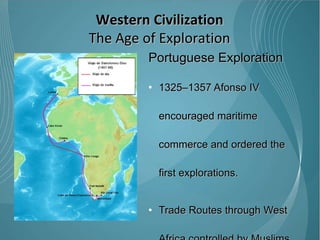
Portuguese Exploration 1325–1357 Afonso IV encouraged maritime commerce and ordered the first explorations. Trade Routes through West Africa controlled by Muslims 1488 - Bartolomeu Dias became 1 st  European to sail around the Southern tip of Africa to establish trade with India and Asia while avoiding Muslim controlled trade routes.  Western Civilization The Age of Exploration
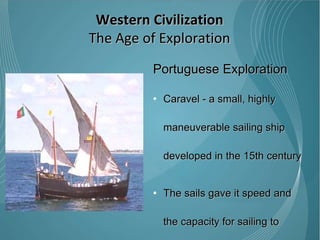
Portuguese Exploration Caravel - a small, highly maneuverable sailing ship developed in the 15th century  The sails gave it speed and the capacity for sailing to windward (beating).  Caravels were much used by the Portuguese for the oceanic exploration voyages during the 15th and 16th centuries in the age of discovery. Western Civilization The Age of Exploration
Christopher Columbus Muslims controlled trade routes though the Middle East and Portugal controlled route around Africa  Columbus wanted to discover a Western route to India believing the world to be round not flat 1492 – Columbus discovered the “New World” though he was convinced until his death that he reached India.  Western Civilization The Age of Exploration
Christopher Columbus The discovery of this “New World” led to the establishment of Spanish colonies.  Disputes between the Spanish and Portuguese over land rights  1494 - Treaty of Tordesillas divided the world outside of Europe in an exclusive duopoly between the Portuguese and the Spanish VIDEO Western Civilization The Age of Exploration
Rich land owners (lords) granted land usage to certain people (vassals) in exchange for service (sometimes requiring vassals to fight for their lords). Ultimately the king is at the top of this system and had ultimate control  It was a system with very sharp distinctions between classes of people and was full of injustices  Western Civilization European Feudalsim
Enlightenment Ideals Progress Superiority of Reason  Science  Questioning Authority  Declining Influence of the Church Religious Tolerance Individual Rights and Freedom Western Civilization The Enlightenment
Individualism, Relativism,  and Rationalism Individualism  –  emphasized the importance of the individual and his inborn rights.  Relativism  –  the concept that different cultures, beliefs, ideas, and value systems had equal merit.  Rationalism  –  the conviction that with the power of reason, humans could arrive at truth and improve the world. Western Civilization The Enlightenment
The Thirty Years’ War Questioned of the justness of absolute monarchy.  Idea of the authority of European divine right was weakened.  War, which broke out in 1618 when Bohemian Protestants revolted against their incoming Catholic king. The ensuing battle between Protestants and Catholics spread into Germany, and over the course of the next thirty years, nearly a third of the German population was killed. Western Civilization The Enlightenment
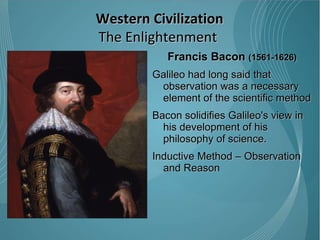
Francis Bacon  (1561-1626) Galileo had long said that observation was a necessary element of the scientific method Bacon solidifies Galileo's view in his development of his philosophy of science.  Inductive Method – Observation and Reason  Western Civilization The Enlightenment
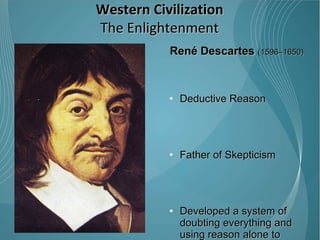
René Descartes  (1596–1650) Deductive Reason  Father of Skepticism  Developed a system of doubting everything and using reason alone to establish a system of knowledge “ I think therefore I am”  Western Civilization The Enlightenment
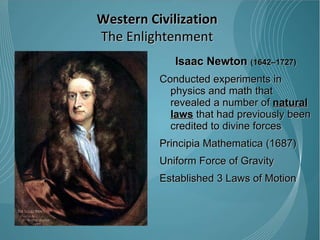
Isaac Newton  (1642–1727) Conducted experiments in physics and math that revealed a number of  natural laws  that had previously been credited to divine forces Principia Mathematica (1687) Uniform Force of Gravity Established 3 Laws of Motion  Western Civilization The Enlightenment
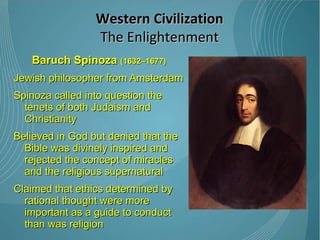
Baruch Spinoza  (1632–1677) Jewish philosopher from Amsterdam Spinoza called into question the tenets of both Judaism and Christianity Believed in God but denied that the Bible was divinely inspired and rejected the concept of miracles and the religious supernatural Claimed that ethics determined by rational thought were more important as a guide to conduct than was religion Western Civilization The Enlightenment
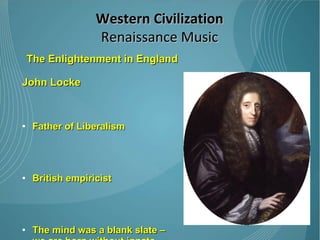
The Enlightenment in England John Locke  Father of Liberalism British empiricist The mind was a blank slate –  we are born without innate ideas, and that knowledge is instead determined only by experience derived from sense perception All people were equal and independent, and everyone had a natural right to defend his “Life, health, Liberty, or Possessions" Western Civilization Renaissance Music
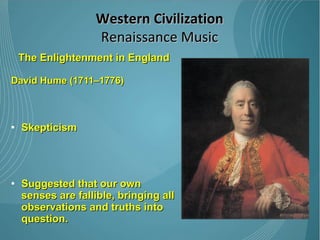
The Enlightenment in England David Hume (1711–1776) Skepticism  Suggested that our own senses are fallible, bringing all observations and truths into question.  Very influential to others, such as Immanuel Kant, and was instrumental in the shift away from rationalist thought that ended the Enlightenment. Western Civilization Renaissance Music
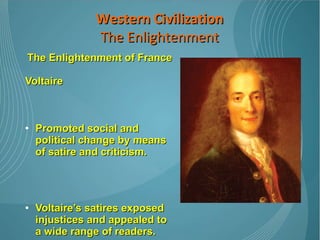
The Enlightenment of France Voltaire  Promoted social and political change by means of satire and criticism.  Voltaire’s satires exposed injustices and appealed to a wide range of readers.  His short novel Candide is regarded as one of the seminal works in history Western Civilization The Enlightenment
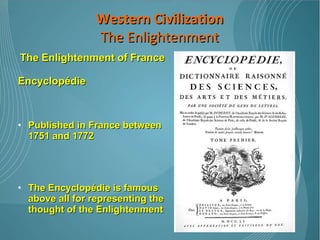
The Enlightenment of France Encyclopédie Published in France between 1751 and 1772 The Encyclopédie is famous above all for representing the thought of the Enlightenment Denis Diderot was the chief editor Many French Enlightenment thinkers contributed articles including Voltaire, Rousseau, and Montesquieu.  Western Civilization The Enlightenment
Skepticism Skeptics questioned whether human society could really be perfected through the use of reason Denied the ability of rational thought to reveal universal truths.  Their philosophies revolved around the idea that the perceived world is relative to the beholder and, as such, no one can be sure whether any truths actually exist. Western Civilization The Enlightenment
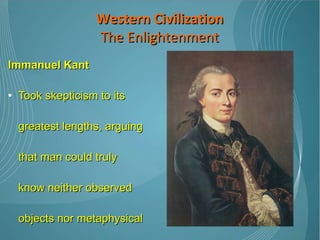
Immanuel Kant   Took skepticism to its greatest lengths, arguing that man could truly know neither observed objects nor metaphysical concepts; Universal truths are impossible.  Western Civilization The Enlightenment
Baroque Art Heavily influenced by the Enlightenment  Individualism Absolutism Counter-Reformation Extension of Renaissance humanism and realism  Western Civilization Baroque
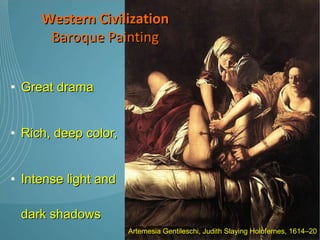
Great drama  Rich, deep color,  Intense light and dark shadows Baroque artists chose the most dramatic point, the moment when the action was occurring Western Civilization Baroque Painting Artemesia Gentileschi, Judith Slaying Holofernes, 1614–20
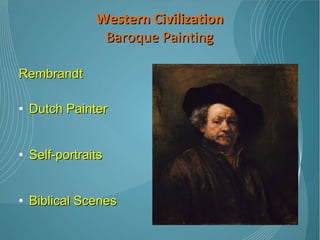
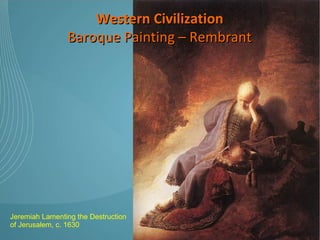
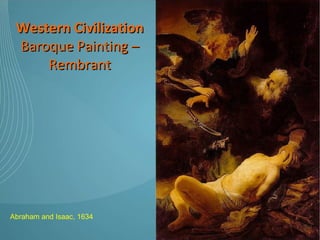
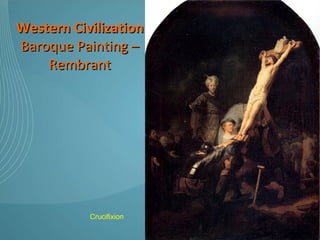
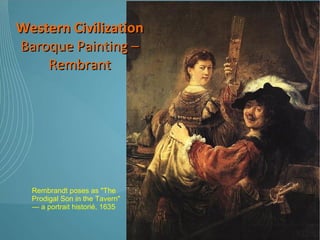
Rembrandt Dutch Painter  Self-portraits Biblical Scenes Western Civilization Baroque Painting
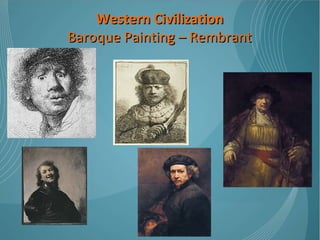
Western Civilization Baroque Painting – Rembrant
Western Civilization Baroque Painting – Rembrant Jeremiah Lamenting the Destruction of Jerusalem, c. 1630
Western Civilization Baroque Painting – Rembrant Abraham and Isaac, 1634
Western Civilization Baroque Painting – Rembrant Crucifixion
Western Civilization Baroque Painting – Rembrant Rembrandt poses as "The Prodigal Son in the Tavern" — a portrait historié, 1635
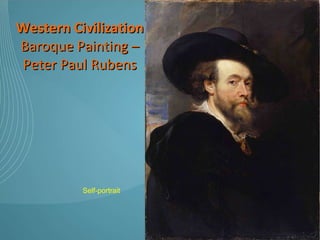
Western Civilization Baroque Painting – Peter Paul Rubens Self-portrait
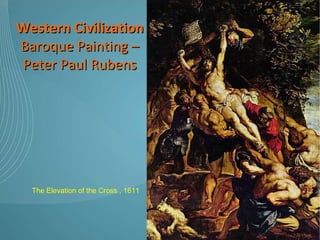
Western Civilization Baroque Painting – Peter Paul Rubens The Elevation of the Cross , 1611
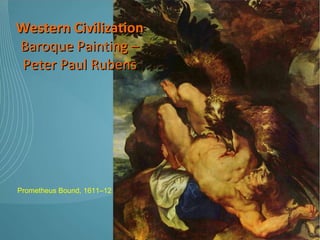
Western Civilization Baroque Painting – Peter Paul Rubens Prometheus Bound, 1611–12
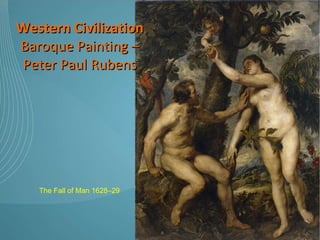
Western Civilization Baroque Painting – Peter Paul Rubens The Fall of Man 1628–29
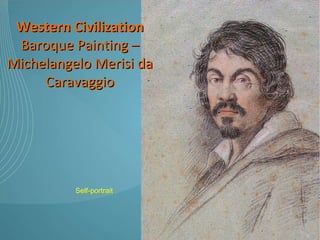
Western Civilization Baroque Painting – Michelangelo Merisi da Caravaggio Self-portrait
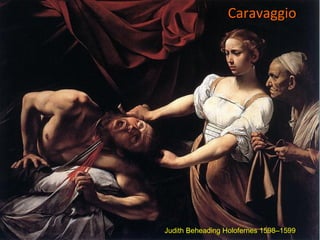
Caravaggio Judith Beheading Holofernes 1598–1599
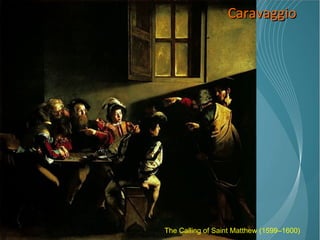
Caravaggio The Calling of Saint Matthew (1599–1600)
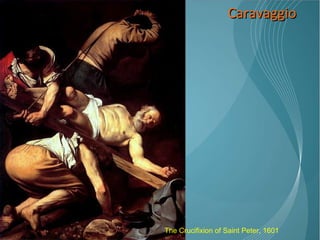
Caravaggio The Crucifixion of Saint Peter, 1601
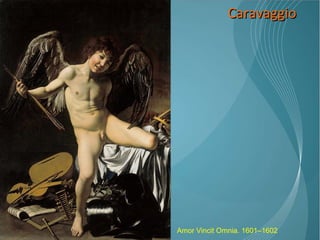
Caravaggio Amor Vincit Omnia. 1601–1602
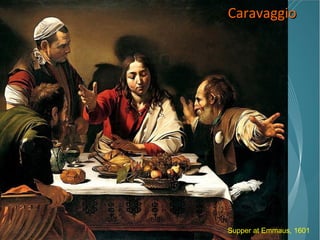
Caravaggio Supper at Emmaus, 1601
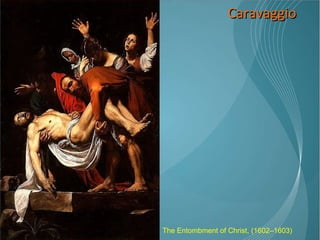
Caravaggio The Entombment of Christ, (1602–1603)
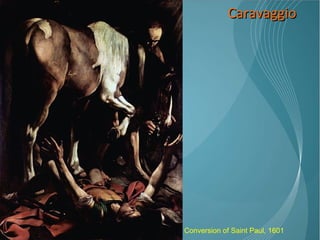
Caravaggio Conversion of Saint Paul, 1601
Baroque Music During the period, composers and performers used more elaborate musical ornamentation Made changes in musical notation Developed new instrumental playing techniques.  Expanded the size, range, and complexity of instrumental performance Established opera as a musical genre  Western Civilization Baroque
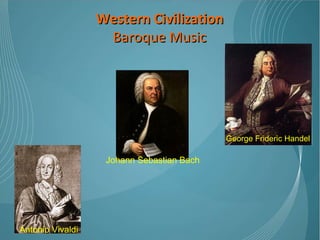
Western Civilization Baroque Music George Frideric Handel Antonio Vivaldi Johann Sebastian Bach

Western Civilization Lecture 6

  • 1.
    Western Civilization Session6 Exploration, Enlightenment and Baroque IS-VNU Mr. Mike Beard
  • 2.
    The Age ofExploration Feudalism The Enlightenment Baroque Art and Music Western Civilization
  • 3.
    Portuguese Exploration 1325–1357Afonso IV encouraged maritime commerce and ordered the first explorations. Trade Routes through West Africa controlled by Muslims 1488 - Bartolomeu Dias became 1 st European to sail around the Southern tip of Africa to establish trade with India and Asia while avoiding Muslim controlled trade routes. Western Civilization The Age of Exploration
  • 4.
    Portuguese Exploration Caravel- a small, highly maneuverable sailing ship developed in the 15th century The sails gave it speed and the capacity for sailing to windward (beating). Caravels were much used by the Portuguese for the oceanic exploration voyages during the 15th and 16th centuries in the age of discovery. Western Civilization The Age of Exploration
  • 5.
    Christopher Columbus Muslimscontrolled trade routes though the Middle East and Portugal controlled route around Africa Columbus wanted to discover a Western route to India believing the world to be round not flat 1492 – Columbus discovered the “New World” though he was convinced until his death that he reached India. Western Civilization The Age of Exploration
  • 6.
    Christopher Columbus Thediscovery of this “New World” led to the establishment of Spanish colonies. Disputes between the Spanish and Portuguese over land rights 1494 - Treaty of Tordesillas divided the world outside of Europe in an exclusive duopoly between the Portuguese and the Spanish VIDEO Western Civilization The Age of Exploration
  • 7.
    Rich land owners(lords) granted land usage to certain people (vassals) in exchange for service (sometimes requiring vassals to fight for their lords). Ultimately the king is at the top of this system and had ultimate control It was a system with very sharp distinctions between classes of people and was full of injustices Western Civilization European Feudalsim
  • 8.
    Enlightenment Ideals ProgressSuperiority of Reason Science Questioning Authority Declining Influence of the Church Religious Tolerance Individual Rights and Freedom Western Civilization The Enlightenment
  • 9.
    Individualism, Relativism, and Rationalism Individualism – emphasized the importance of the individual and his inborn rights. Relativism – the concept that different cultures, beliefs, ideas, and value systems had equal merit. Rationalism – the conviction that with the power of reason, humans could arrive at truth and improve the world. Western Civilization The Enlightenment
  • 10.
    The Thirty Years’War Questioned of the justness of absolute monarchy. Idea of the authority of European divine right was weakened. War, which broke out in 1618 when Bohemian Protestants revolted against their incoming Catholic king. The ensuing battle between Protestants and Catholics spread into Germany, and over the course of the next thirty years, nearly a third of the German population was killed. Western Civilization The Enlightenment
  • 11.
    Francis Bacon (1561-1626) Galileo had long said that observation was a necessary element of the scientific method Bacon solidifies Galileo's view in his development of his philosophy of science. Inductive Method – Observation and Reason Western Civilization The Enlightenment
  • 12.
    René Descartes (1596–1650) Deductive Reason Father of Skepticism Developed a system of doubting everything and using reason alone to establish a system of knowledge “ I think therefore I am” Western Civilization The Enlightenment
  • 13.
    Isaac Newton (1642–1727) Conducted experiments in physics and math that revealed a number of natural laws that had previously been credited to divine forces Principia Mathematica (1687) Uniform Force of Gravity Established 3 Laws of Motion Western Civilization The Enlightenment
  • 14.
    Baruch Spinoza (1632–1677) Jewish philosopher from Amsterdam Spinoza called into question the tenets of both Judaism and Christianity Believed in God but denied that the Bible was divinely inspired and rejected the concept of miracles and the religious supernatural Claimed that ethics determined by rational thought were more important as a guide to conduct than was religion Western Civilization The Enlightenment
  • 15.
    The Enlightenment inEngland John Locke Father of Liberalism British empiricist The mind was a blank slate – we are born without innate ideas, and that knowledge is instead determined only by experience derived from sense perception All people were equal and independent, and everyone had a natural right to defend his “Life, health, Liberty, or Possessions" Western Civilization Renaissance Music
  • 16.
    The Enlightenment inEngland David Hume (1711–1776) Skepticism Suggested that our own senses are fallible, bringing all observations and truths into question. Very influential to others, such as Immanuel Kant, and was instrumental in the shift away from rationalist thought that ended the Enlightenment. Western Civilization Renaissance Music
  • 17.
    The Enlightenment ofFrance Voltaire Promoted social and political change by means of satire and criticism. Voltaire’s satires exposed injustices and appealed to a wide range of readers. His short novel Candide is regarded as one of the seminal works in history Western Civilization The Enlightenment
  • 18.
    The Enlightenment ofFrance Encyclopédie Published in France between 1751 and 1772 The Encyclopédie is famous above all for representing the thought of the Enlightenment Denis Diderot was the chief editor Many French Enlightenment thinkers contributed articles including Voltaire, Rousseau, and Montesquieu. Western Civilization The Enlightenment
  • 19.
    Skepticism Skeptics questionedwhether human society could really be perfected through the use of reason Denied the ability of rational thought to reveal universal truths. Their philosophies revolved around the idea that the perceived world is relative to the beholder and, as such, no one can be sure whether any truths actually exist. Western Civilization The Enlightenment
  • 20.
    Immanuel Kant Took skepticism to its greatest lengths, arguing that man could truly know neither observed objects nor metaphysical concepts; Universal truths are impossible. Western Civilization The Enlightenment
  • 21.
    Baroque Art Heavilyinfluenced by the Enlightenment Individualism Absolutism Counter-Reformation Extension of Renaissance humanism and realism Western Civilization Baroque
  • 22.
    Great drama Rich, deep color, Intense light and dark shadows Baroque artists chose the most dramatic point, the moment when the action was occurring Western Civilization Baroque Painting Artemesia Gentileschi, Judith Slaying Holofernes, 1614–20
  • 23.
    Rembrandt Dutch Painter Self-portraits Biblical Scenes Western Civilization Baroque Painting
  • 24.
    Western Civilization BaroquePainting – Rembrant
  • 25.
    Western Civilization BaroquePainting – Rembrant Jeremiah Lamenting the Destruction of Jerusalem, c. 1630
  • 26.
    Western Civilization BaroquePainting – Rembrant Abraham and Isaac, 1634
  • 27.
    Western Civilization BaroquePainting – Rembrant Crucifixion
  • 28.
    Western Civilization BaroquePainting – Rembrant Rembrandt poses as "The Prodigal Son in the Tavern" — a portrait historié, 1635
  • 29.
    Western Civilization BaroquePainting – Peter Paul Rubens Self-portrait
  • 30.
    Western Civilization BaroquePainting – Peter Paul Rubens The Elevation of the Cross , 1611
  • 31.
    Western Civilization BaroquePainting – Peter Paul Rubens Prometheus Bound, 1611–12
  • 32.
    Western Civilization BaroquePainting – Peter Paul Rubens The Fall of Man 1628–29
  • 33.
    Western Civilization BaroquePainting – Michelangelo Merisi da Caravaggio Self-portrait
  • 34.
    Caravaggio Judith BeheadingHolofernes 1598–1599
  • 35.
    Caravaggio The Callingof Saint Matthew (1599–1600)
  • 36.
    Caravaggio The Crucifixionof Saint Peter, 1601
  • 37.
    Caravaggio Amor VincitOmnia. 1601–1602
  • 38.
  • 39.
    Caravaggio The Entombmentof Christ, (1602–1603)
  • 40.
    Caravaggio Conversion ofSaint Paul, 1601
  • 41.
    Baroque Music Duringthe period, composers and performers used more elaborate musical ornamentation Made changes in musical notation Developed new instrumental playing techniques. Expanded the size, range, and complexity of instrumental performance Established opera as a musical genre Western Civilization Baroque
  • 42.
    Western Civilization BaroqueMusic George Frideric Handel Antonio Vivaldi Johann Sebastian Bach