Introduction to Philosophy IS-VNU Mr. Mike  Lecture 7
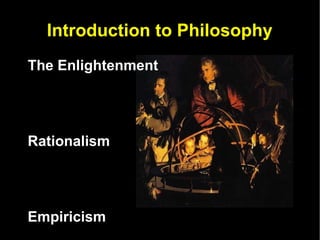
Introduction to Philosophy The Enlightenment  Rationalism Empiricism
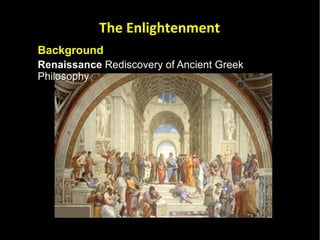
Background  Renaissance  Rediscovery of Ancient Greek Philosophy The Enlightenment
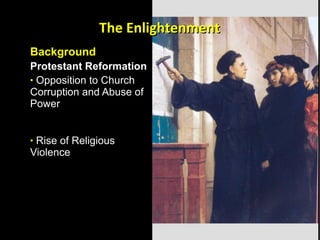
Background  Protestant Reformation Opposition to Church Corruption and Abuse of Power Rise of Religious Violence  The Enlightenment
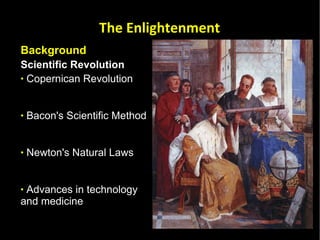
Background  Scientific Revolution Copernican Revolution Bacon's Scientific Method Newton's Natural Laws Advances in technology and medicine  The Enlightenment
Enlightenment Themes Progress Superiority of Reason  Superiority of Scientific Knowledge  Questioning Authority  Opposition to Abuses  Religious Tolerance Freedom, Equality and Liberty  Individualism - Individual Rights and Freedom Relativism  The Enlightenment
Rationalism Appeal to Reason as the most accurate source of knowledge  Sensory Perception cannot be trusted  Truth is established through the intellect by means of deductive reasoning  Reason is established as the primary source of knowledge Criticism  There is no rational reason why reason should be considered a valid form of knowledge The Enlightenment
Rationalism Intuition  is a valid form of rational insight. Intuition is knowledge that is immediate to us.  It doesn't require reasoning or sensory experience.  A Priori  knowledge – Knowledge gained without the use sensory experience.  Innate Knowledge   – Knowledge that we are born with. This knowledge is not learned by deductive reasoning, sensory experience or intuition.  It is knowledge that is part of our nature as humans.  The Enlightenment
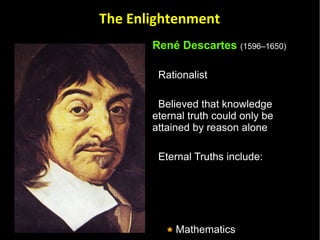
René Descartes   (1596–1650) Rationalist  Believed that knowledge eternal truth could only be attained by reason alone Eternal Truths include:  Mathematics  Philosophical foundations of science Other areas of knowledge such as physics require sensory experience aided by the scientific method The Enlightenment
René Descartes   (1596–1650)   Set out to answer 2 questions:  (1) What can I know?  (2) How can I know it? As a rationalist, Descartes set out to answer these questions by means of reason alone.  The Enlightenment
René Descartes   (1596–1650)   Doubt (Skepticism)  Sensory experience can sometimes be deceptive.  Therefore, it must be doubted.  Consciousness can also be an illusion.  When we dream we believe that we are conscious. Since sensory experience and consciousness are open to error all beliefs about reality should be doubted.  The Enlightenment
René Descartes   (1596–1650)   Method of Attaining Knowledge  Establish truths which cannot be gained through sensory experience. Establish truth which do not rely on consciousness of the world outside yourself. Establish truth though a deductive process of reasoning.  The Enlightenment
René Descartes   (1596–1650)   Cogito Ergo Sum  I can doubt nature because it relies on sensory experience.  I can doubt the existence of other people because it relies on consciousness.  Can I doubt my own existence?  In order to doubt my own existence, I must first exist. If I don't exist then I cannot think about doubting.  I doubt, therefore I think,  therefore I exist.  The Enlightenment
René Descartes   (1596–1650)   Cogito Ergo Sum   Problem :  Only proves the existence of your own mind but not your body or the external world.  If I exist, then it is possible that other things exist as well.  Sensory experience is something I do involuntary – I experience things without trying to using my reason to sense things. Therefore, I must be sensing something.  The Enlightenment
René Descartes   (1596–1650)   Cogito Ergo Sum   Problem :  Only proves the existence of your own mind but not your body or the external world.  Perhaps an evil spirit is deceiving my sensory experience.  Descartes employs Anselm's ontological argument to prove the existence of a good God who does not deceive.  The Enlightenment
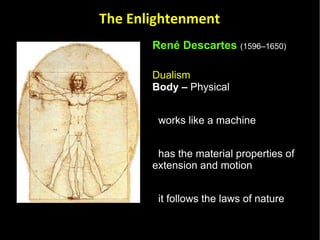
René Descartes   (1596–1650)   Dualism  Body –  Physical  works like a machine has the material properties of extension and motion it follows the laws of nature The Enlightenment
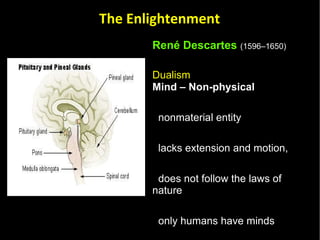
René Descartes   (1596–1650)   Dualism  Mind – Non-physical  nonmaterial entity  lacks extension and motion,  does not follow the laws of nature  only humans have minds the mind interacts with the body at the pineal gland The pineal gland is the “seat of the soul”  The Enlightenment
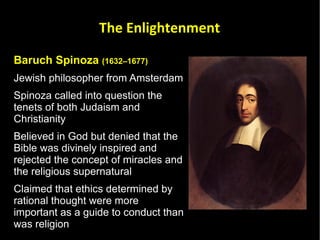
Baruch Spinoza  (1632–1677) Jewish philosopher from Amsterdam Spinoza called into question the tenets of both Judaism and Christianity Believed in God but denied that the Bible was divinely inspired and rejected the concept of miracles and the religious supernatural Claimed that ethics determined by rational thought were more important as a guide to conduct than was religion The Enlightenment
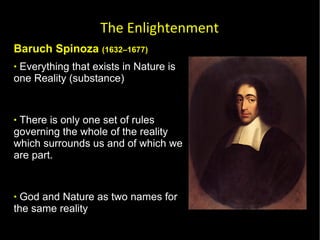
Baruch Spinoza  (1632–1677) Everything that exists in Nature is one Reality (substance)  There is only one set of rules governing the whole of the reality which surrounds us and of which we are part.  God and Nature as two names for the same reality God is  the single substance that is the basis of the universe and of which all lesser "entities" are actually modes or modifications. The Enlightenment
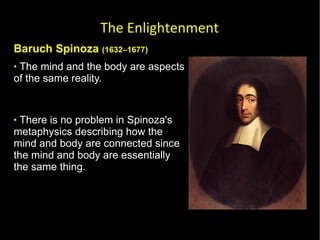
Baruch Spinoza  (1632–1677) The mind and the body are aspects of the same reality.  There is no problem in Spinoza's metaphysics describing how the mind and body are connected since the mind and body are essentially the same thing.  The Enlightenment
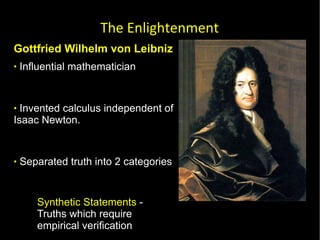
Gottfried Wilhelm von Leibniz  Influential mathematician  Invented calculus independent of Isaac Newton.  Separated truth into 2 categories Synthetic Statements  - Truths which require empirical verification  Analytical Statements  - Truths which do not require empirical investigation  The Enlightenment
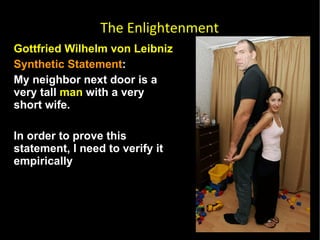
Gottfried Wilhelm von Leibniz  Synthetic Statement :  My neighbor next door is a very tall  man  with a very short wife.  In order to prove this statement, I need to verify it empirically  The Enlightenment
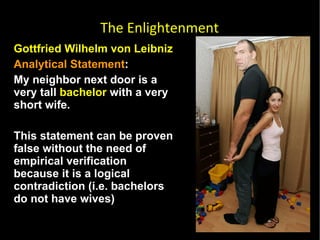
Gottfried Wilhelm von Leibniz  Analytical Statement :  My neighbor next door is a very tall  bachelor  with a very short wife.  This statement can be proven false without the need of empirical verification because it is a logical contradiction (i.e. bachelors do not have wives) The Enlightenment
Gottfried Wilhelm von Leibniz  Sufficient Reason :  Analytical Statements –  Can be proved true without reference to external reality through logic or math Synthetic Statements  – Must show the empirical cause of the statement.  The Enlightenment
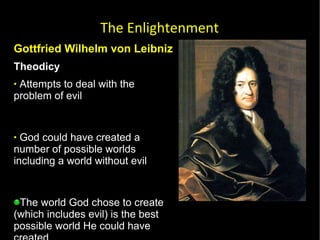
Gottfried Wilhelm von Leibniz  Theodicy   Attempts to deal with the problem of evil  God could have created a number of possible worlds including a world without evil The world God chose to create (which includes evil) is the best possible world He could have created Optimistic view of the world  The Enlightenment
Empiricism Knowledge comes only or primarily through sensory experience  Questions or even rejects the idea of a priori knowledge or innate knowledge  Criticism  Sensory perception can be deceived – dreams Sensory perception can be in error – misjudgement  The Enlightenment
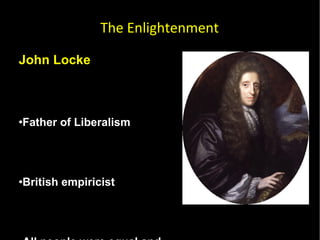
John Locke  Father of Liberalism British empiricist All people were equal and independent, and everyone had a natural right to defend his “Life, health, Liberty, or Possessions" The Enlightenment
John Locke  The mind was a blank slate  We are born without innate ideas  Knowledge is instead determined ONLY by experience derived from sense perception Complete rejection of a priori or innate knowledge The Enlightenment
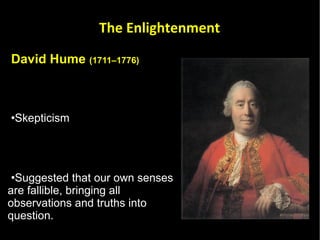
David Hume  (1711–1776) Skepticism  Suggested that our own senses are fallible, bringing all observations and truths into question.  Very influential to others, such as Immanuel Kant, and was instrumental in the shift away from rationalist thought that ended the Enlightenment. The Enlightenment
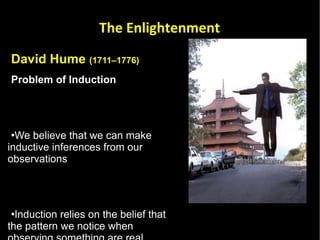
David Hume  (1711–1776) Problem of Induction   We believe that we can make inductive inferences from our observations  Induction relies on the belief that the pattern we notice when observing something are real pattens  There is no way to be certain that an observed pattern will continue to occur when unobserved  The Enlightenment
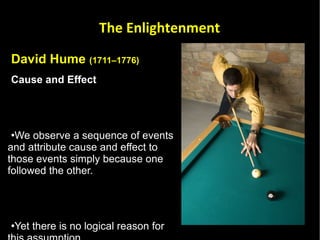
David Hume  (1711–1776) Cause and Effect   We observe a sequence of events and attribute cause and effect to those events simply because one followed the other.  Yet there is no logical reason for this assumption.  If one event precedes another it does not necessarily make it the cause.  Billiards Illustration   The Enlightenment
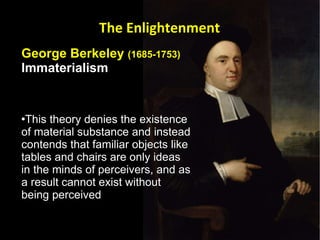
George Berkeley  (1685-1753) Immaterialism   This theory denies the existence of material substance and instead contends that familiar objects like tables and chairs are only ideas in the minds of perceivers, and as a result cannot exist without being perceived The Enlightenment
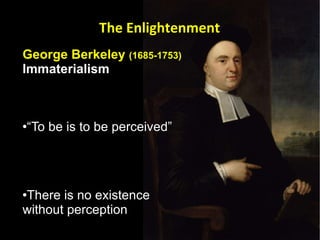
George Berkeley  (1685-1753) Immaterialism   “ To be is to be perceived” There is no existence without perception  Extreme empiricism  The Enlightenment
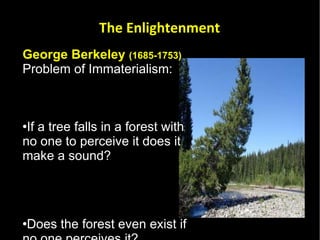
George Berkeley  (1685-1753) Problem of Immaterialism: If a tree falls in a forest with no one to perceive it does it make a sound?  Does the forest even exist if no one perceives it?  The Enlightenment
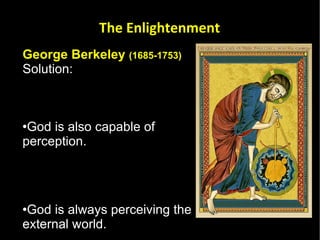
George Berkeley  (1685-1753) Solution: God is also capable of perception.  God is always perceiving the external world.  Therefore, the world doesn't cease to exist when we sleep because God continues to perceive it.  The Enlightenment

Philosophy lecture 07

  • 1.
    Introduction to PhilosophyIS-VNU Mr. Mike Lecture 7
  • 2.
    Introduction to PhilosophyThe Enlightenment Rationalism Empiricism
  • 3.
    Background Renaissance Rediscovery of Ancient Greek Philosophy The Enlightenment
  • 4.
    Background ProtestantReformation Opposition to Church Corruption and Abuse of Power Rise of Religious Violence The Enlightenment
  • 5.
    Background ScientificRevolution Copernican Revolution Bacon's Scientific Method Newton's Natural Laws Advances in technology and medicine The Enlightenment
  • 6.
    Enlightenment Themes ProgressSuperiority of Reason Superiority of Scientific Knowledge Questioning Authority Opposition to Abuses Religious Tolerance Freedom, Equality and Liberty Individualism - Individual Rights and Freedom Relativism The Enlightenment
  • 7.
    Rationalism Appeal toReason as the most accurate source of knowledge Sensory Perception cannot be trusted Truth is established through the intellect by means of deductive reasoning Reason is established as the primary source of knowledge Criticism There is no rational reason why reason should be considered a valid form of knowledge The Enlightenment
  • 8.
    Rationalism Intuition is a valid form of rational insight. Intuition is knowledge that is immediate to us. It doesn't require reasoning or sensory experience. A Priori knowledge – Knowledge gained without the use sensory experience. Innate Knowledge – Knowledge that we are born with. This knowledge is not learned by deductive reasoning, sensory experience or intuition. It is knowledge that is part of our nature as humans. The Enlightenment
  • 9.
    René Descartes (1596–1650) Rationalist Believed that knowledge eternal truth could only be attained by reason alone Eternal Truths include: Mathematics Philosophical foundations of science Other areas of knowledge such as physics require sensory experience aided by the scientific method The Enlightenment
  • 10.
    René Descartes (1596–1650) Set out to answer 2 questions: (1) What can I know? (2) How can I know it? As a rationalist, Descartes set out to answer these questions by means of reason alone. The Enlightenment
  • 11.
    René Descartes (1596–1650) Doubt (Skepticism) Sensory experience can sometimes be deceptive. Therefore, it must be doubted. Consciousness can also be an illusion. When we dream we believe that we are conscious. Since sensory experience and consciousness are open to error all beliefs about reality should be doubted. The Enlightenment
  • 12.
    René Descartes (1596–1650) Method of Attaining Knowledge Establish truths which cannot be gained through sensory experience. Establish truth which do not rely on consciousness of the world outside yourself. Establish truth though a deductive process of reasoning. The Enlightenment
  • 13.
    René Descartes (1596–1650) Cogito Ergo Sum I can doubt nature because it relies on sensory experience. I can doubt the existence of other people because it relies on consciousness. Can I doubt my own existence? In order to doubt my own existence, I must first exist. If I don't exist then I cannot think about doubting. I doubt, therefore I think, therefore I exist. The Enlightenment
  • 14.
    René Descartes (1596–1650) Cogito Ergo Sum Problem : Only proves the existence of your own mind but not your body or the external world. If I exist, then it is possible that other things exist as well. Sensory experience is something I do involuntary – I experience things without trying to using my reason to sense things. Therefore, I must be sensing something. The Enlightenment
  • 15.
    René Descartes (1596–1650) Cogito Ergo Sum Problem : Only proves the existence of your own mind but not your body or the external world. Perhaps an evil spirit is deceiving my sensory experience. Descartes employs Anselm's ontological argument to prove the existence of a good God who does not deceive. The Enlightenment
  • 16.
    René Descartes (1596–1650) Dualism Body – Physical works like a machine has the material properties of extension and motion it follows the laws of nature The Enlightenment
  • 17.
    René Descartes (1596–1650) Dualism Mind – Non-physical nonmaterial entity lacks extension and motion, does not follow the laws of nature only humans have minds the mind interacts with the body at the pineal gland The pineal gland is the “seat of the soul” The Enlightenment
  • 18.
    Baruch Spinoza (1632–1677) Jewish philosopher from Amsterdam Spinoza called into question the tenets of both Judaism and Christianity Believed in God but denied that the Bible was divinely inspired and rejected the concept of miracles and the religious supernatural Claimed that ethics determined by rational thought were more important as a guide to conduct than was religion The Enlightenment
  • 19.
    Baruch Spinoza (1632–1677) Everything that exists in Nature is one Reality (substance) There is only one set of rules governing the whole of the reality which surrounds us and of which we are part. God and Nature as two names for the same reality God is the single substance that is the basis of the universe and of which all lesser "entities" are actually modes or modifications. The Enlightenment
  • 20.
    Baruch Spinoza (1632–1677) The mind and the body are aspects of the same reality. There is no problem in Spinoza's metaphysics describing how the mind and body are connected since the mind and body are essentially the same thing. The Enlightenment
  • 21.
    Gottfried Wilhelm vonLeibniz Influential mathematician Invented calculus independent of Isaac Newton. Separated truth into 2 categories Synthetic Statements - Truths which require empirical verification Analytical Statements - Truths which do not require empirical investigation The Enlightenment
  • 22.
    Gottfried Wilhelm vonLeibniz Synthetic Statement : My neighbor next door is a very tall man with a very short wife. In order to prove this statement, I need to verify it empirically The Enlightenment
  • 23.
    Gottfried Wilhelm vonLeibniz Analytical Statement : My neighbor next door is a very tall bachelor with a very short wife. This statement can be proven false without the need of empirical verification because it is a logical contradiction (i.e. bachelors do not have wives) The Enlightenment
  • 24.
    Gottfried Wilhelm vonLeibniz Sufficient Reason : Analytical Statements – Can be proved true without reference to external reality through logic or math Synthetic Statements – Must show the empirical cause of the statement. The Enlightenment
  • 25.
    Gottfried Wilhelm vonLeibniz Theodicy Attempts to deal with the problem of evil God could have created a number of possible worlds including a world without evil The world God chose to create (which includes evil) is the best possible world He could have created Optimistic view of the world The Enlightenment
  • 26.
    Empiricism Knowledge comesonly or primarily through sensory experience Questions or even rejects the idea of a priori knowledge or innate knowledge Criticism Sensory perception can be deceived – dreams Sensory perception can be in error – misjudgement The Enlightenment
  • 27.
    John Locke Father of Liberalism British empiricist All people were equal and independent, and everyone had a natural right to defend his “Life, health, Liberty, or Possessions" The Enlightenment
  • 28.
    John Locke The mind was a blank slate We are born without innate ideas Knowledge is instead determined ONLY by experience derived from sense perception Complete rejection of a priori or innate knowledge The Enlightenment
  • 29.
    David Hume (1711–1776) Skepticism Suggested that our own senses are fallible, bringing all observations and truths into question. Very influential to others, such as Immanuel Kant, and was instrumental in the shift away from rationalist thought that ended the Enlightenment. The Enlightenment
  • 30.
    David Hume (1711–1776) Problem of Induction We believe that we can make inductive inferences from our observations Induction relies on the belief that the pattern we notice when observing something are real pattens There is no way to be certain that an observed pattern will continue to occur when unobserved The Enlightenment
  • 31.
    David Hume (1711–1776) Cause and Effect We observe a sequence of events and attribute cause and effect to those events simply because one followed the other. Yet there is no logical reason for this assumption. If one event precedes another it does not necessarily make it the cause. Billiards Illustration The Enlightenment
  • 32.
    George Berkeley (1685-1753) Immaterialism This theory denies the existence of material substance and instead contends that familiar objects like tables and chairs are only ideas in the minds of perceivers, and as a result cannot exist without being perceived The Enlightenment
  • 33.
    George Berkeley (1685-1753) Immaterialism “ To be is to be perceived” There is no existence without perception Extreme empiricism The Enlightenment
  • 34.
    George Berkeley (1685-1753) Problem of Immaterialism: If a tree falls in a forest with no one to perceive it does it make a sound? Does the forest even exist if no one perceives it? The Enlightenment
  • 35.
    George Berkeley (1685-1753) Solution: God is also capable of perception. God is always perceiving the external world. Therefore, the world doesn't cease to exist when we sleep because God continues to perceive it. The Enlightenment