Introduction to Philosophy IS-VNU Mr. Mike  Lecture 1
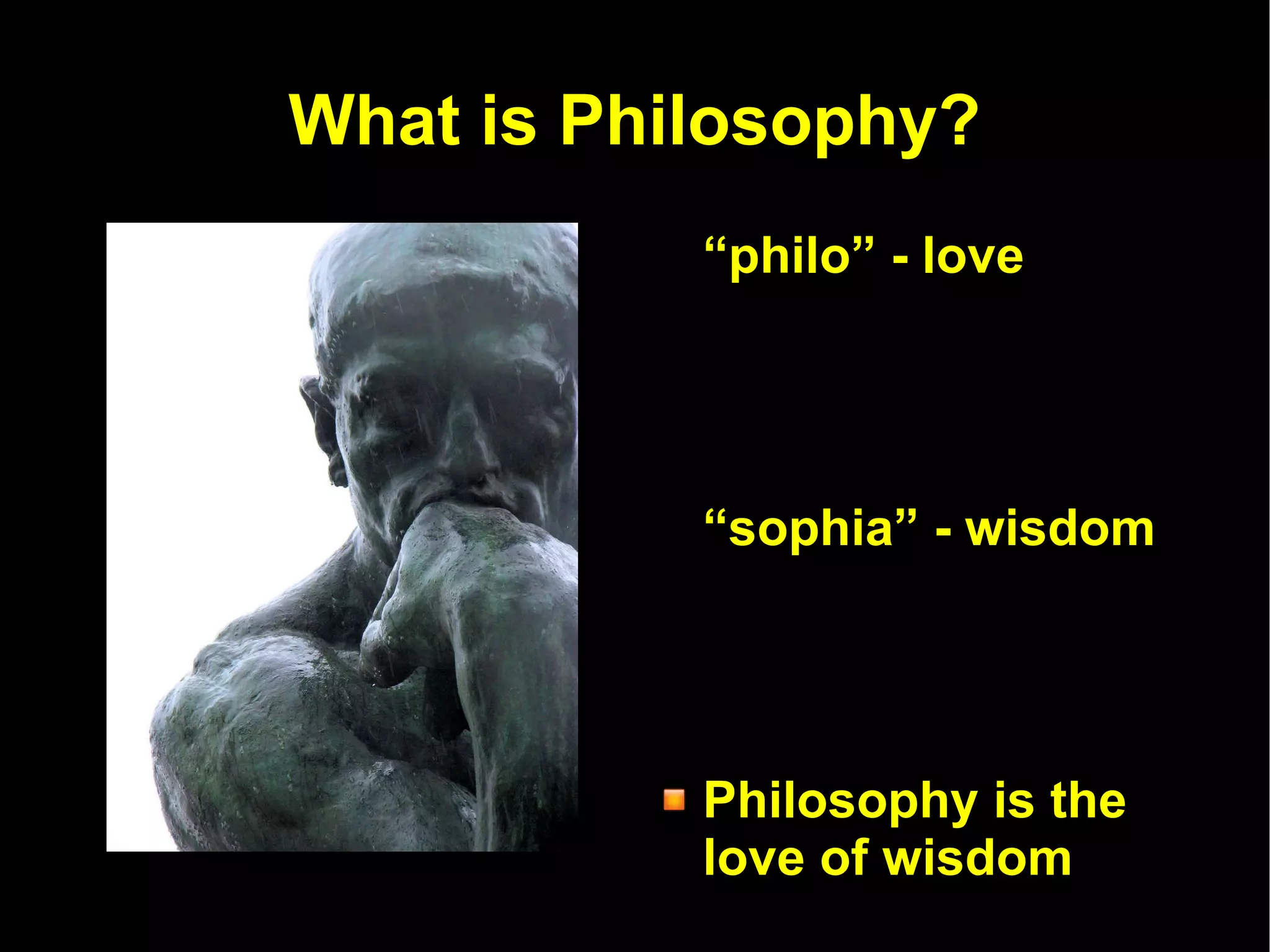
What is Philosophy? “ philo” - love “ sophia” - wisdom Philosophy is the love of wisdom Philosophy attempts to answer life's Big Questions
What is Philosophy? Activity:   Write down 5 questions that you feel are the  most important questions  in life.
Some  BIG  Questions? What is real? Does God exist? What happens after death? Do we have souls? How should I think about things? What can I know? How do I know?
Philosophy is about Questions What? Why? How?
Philosophers ask Questions about what people Believe  What are the   REASONS   for a particular belief? Do you believe in God?  WHY? Do you believe your ancestors protect you?  WHY? Do you believe that murder is wrong?  WHY?
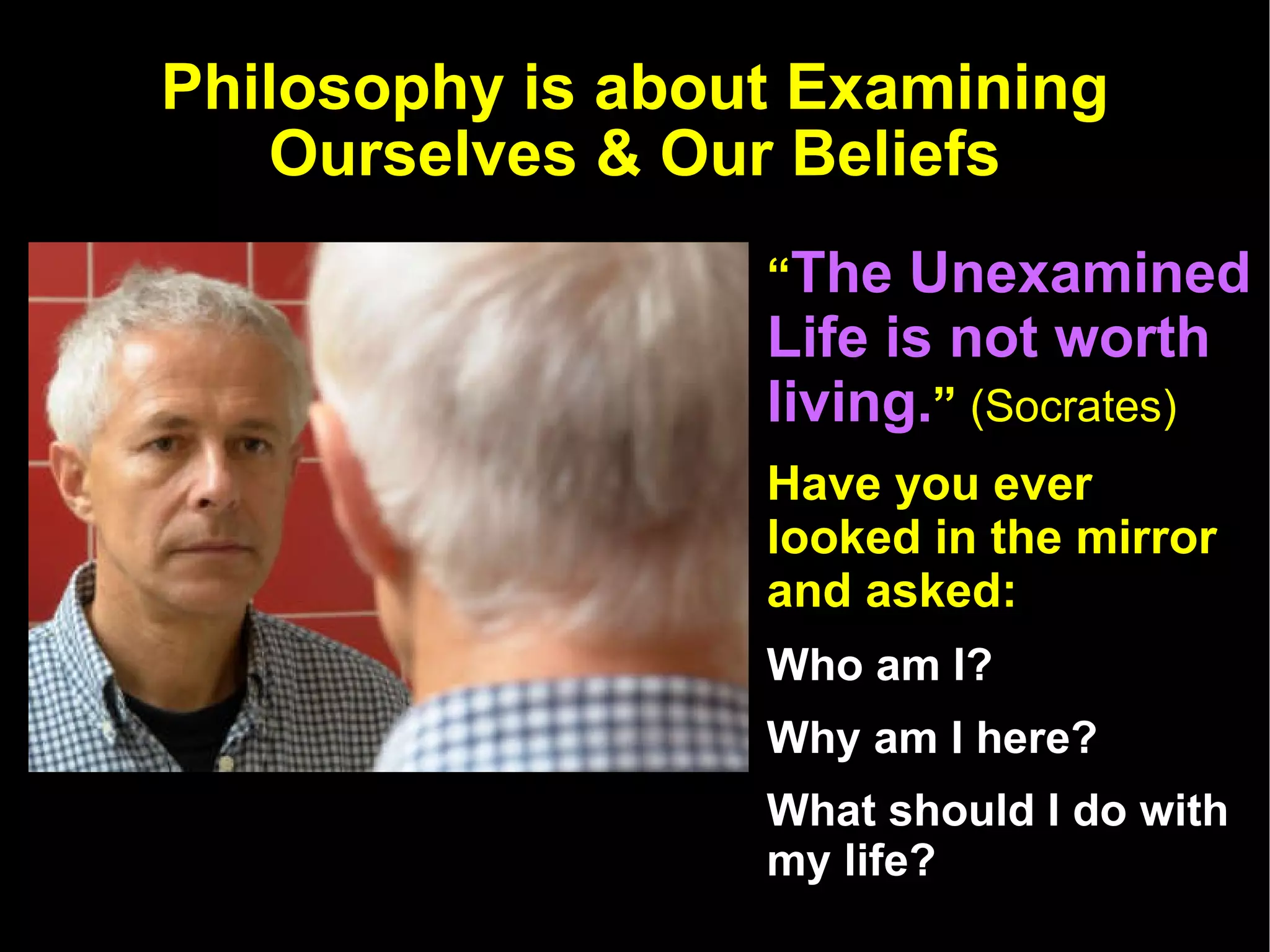
Philosophy is about Examining Ourselves & Our Beliefs “ The Unexamined Life is not worth living. ”  (Socrates) Have you ever looked in the mirror and asked:  Who am I? Why am I here?  What should I do with my life?
Examining Ourselves Activity   Answer the question:   Who are you? Rules   - Don't give your name. - Don't say what you do.  - Don't describe your nationality.
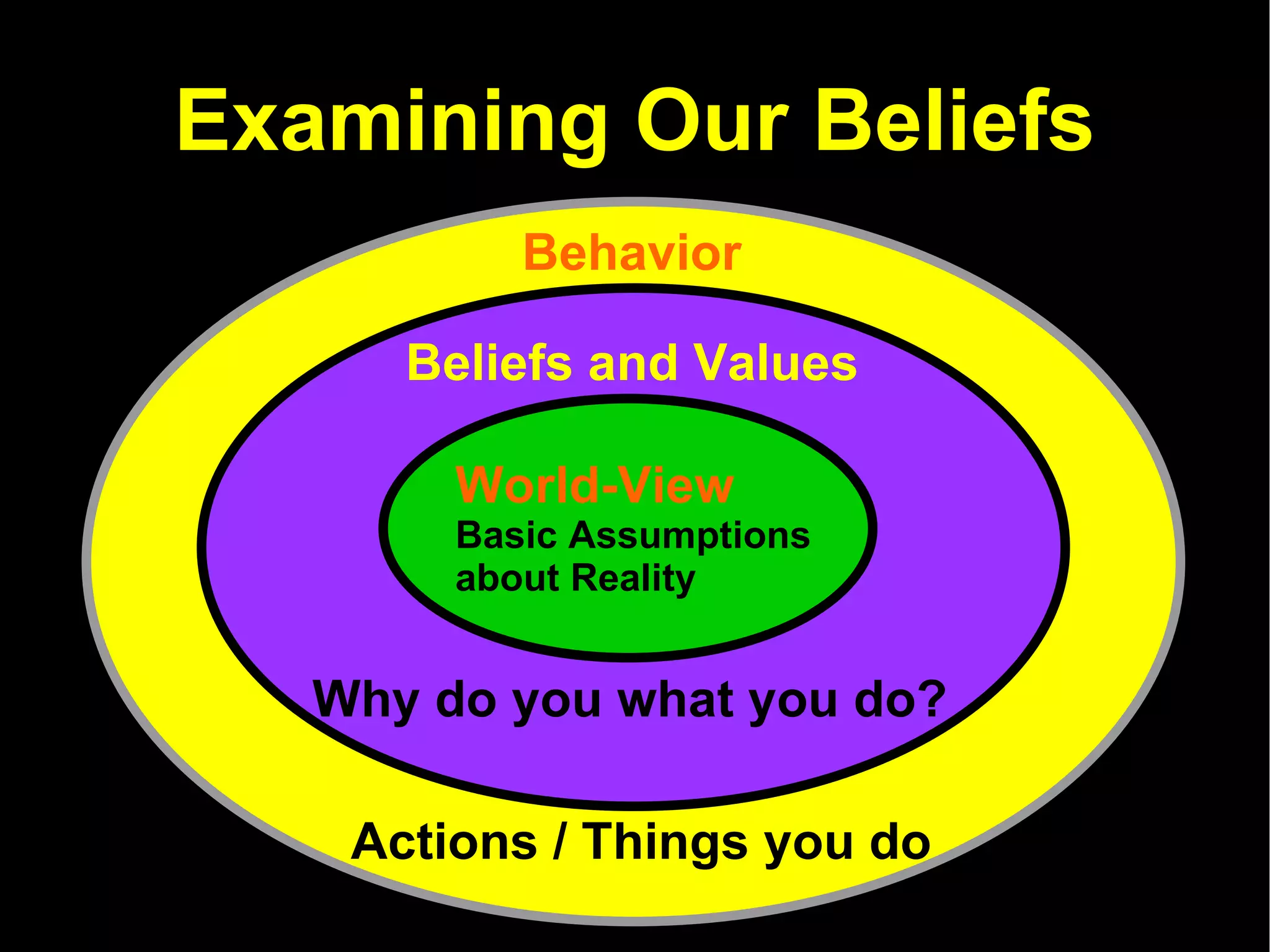
Examining Our Beliefs Behavior Actions / Things you do Beliefs and Values Why do you what you do? World-View Basic Assumptions about Reality
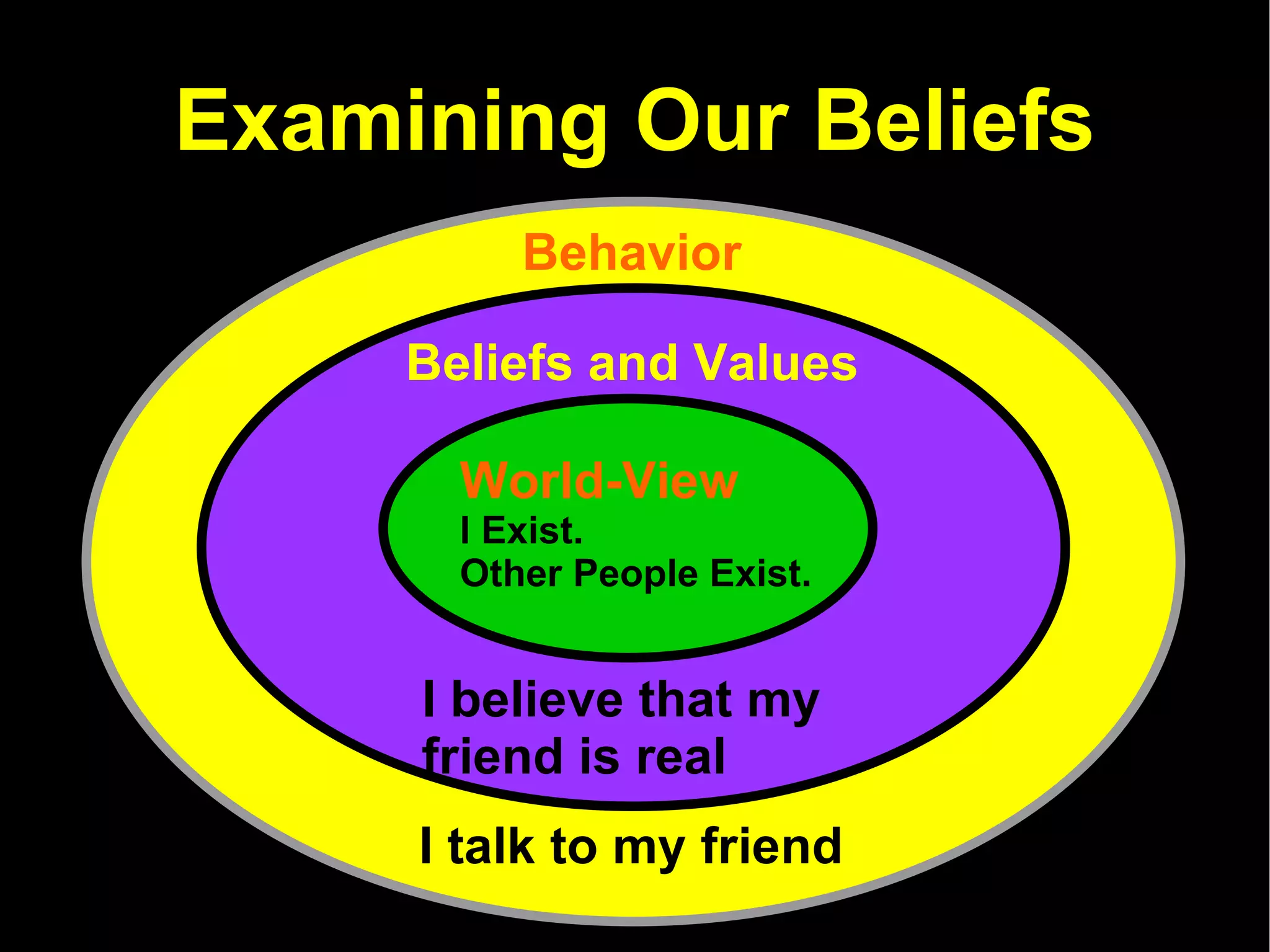
Examining Our Beliefs Behavior I talk to my friend Beliefs and Values I believe that my friend is real World-View I Exist.  Other People Exist.
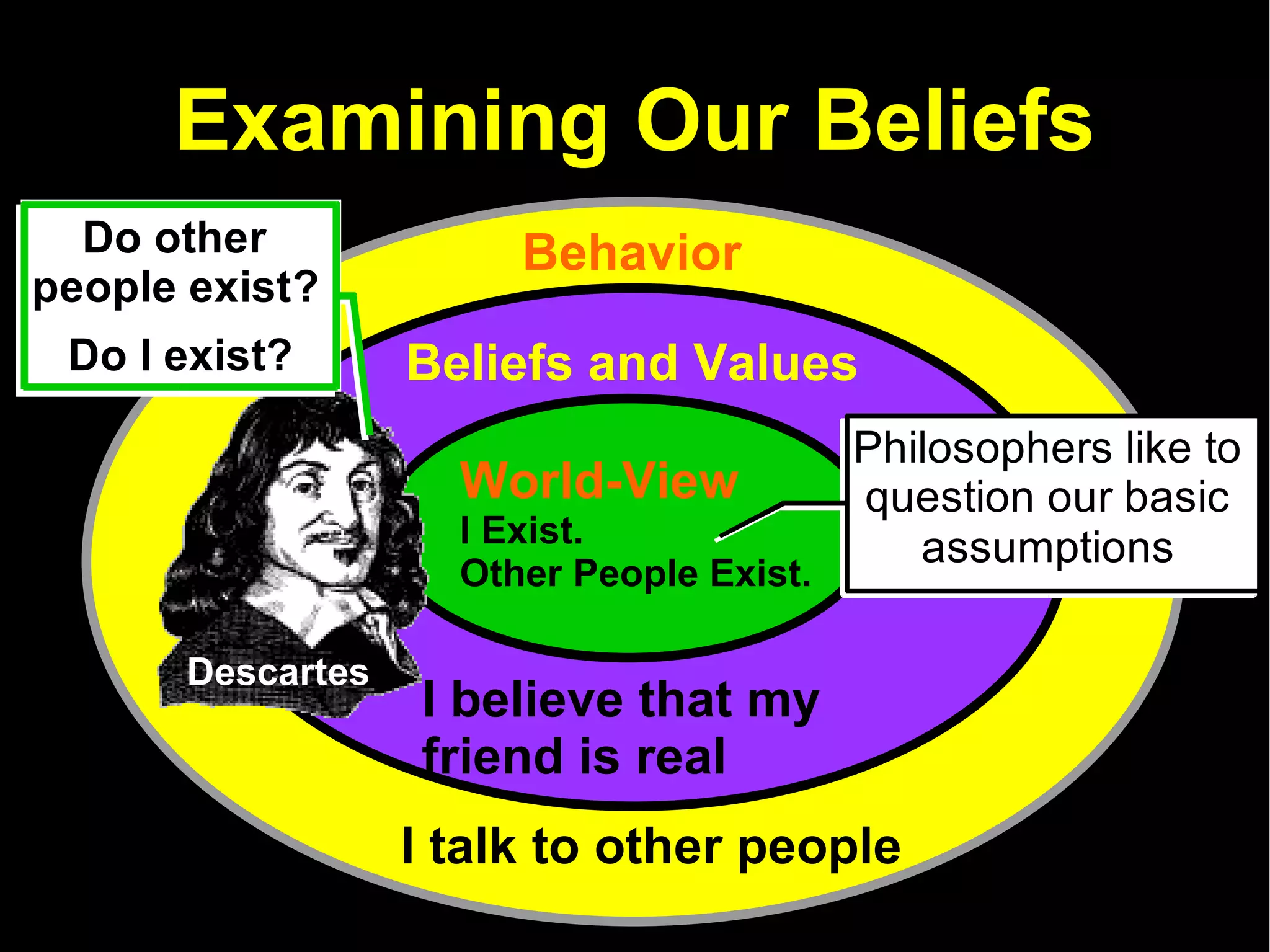
Examining Our Beliefs Behavior I talk to other people Beliefs and Values I believe that my friend is real World-View I Exist.  Other People Exist. Descartes
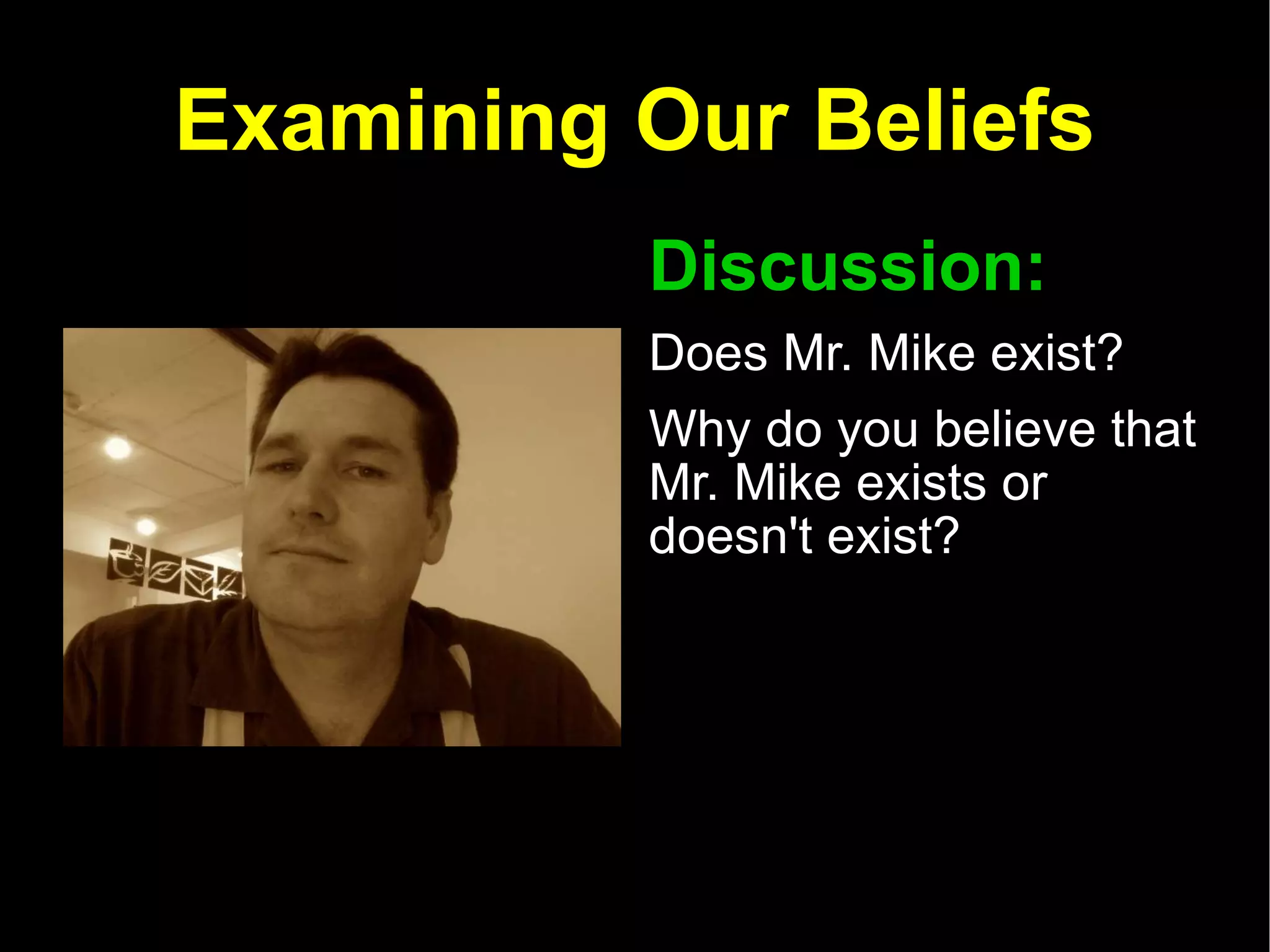
Examining Our Beliefs Discussion:   Does Mr. Mike exist?  Why do you believe that Mr. Mike exists or doesn't exist?
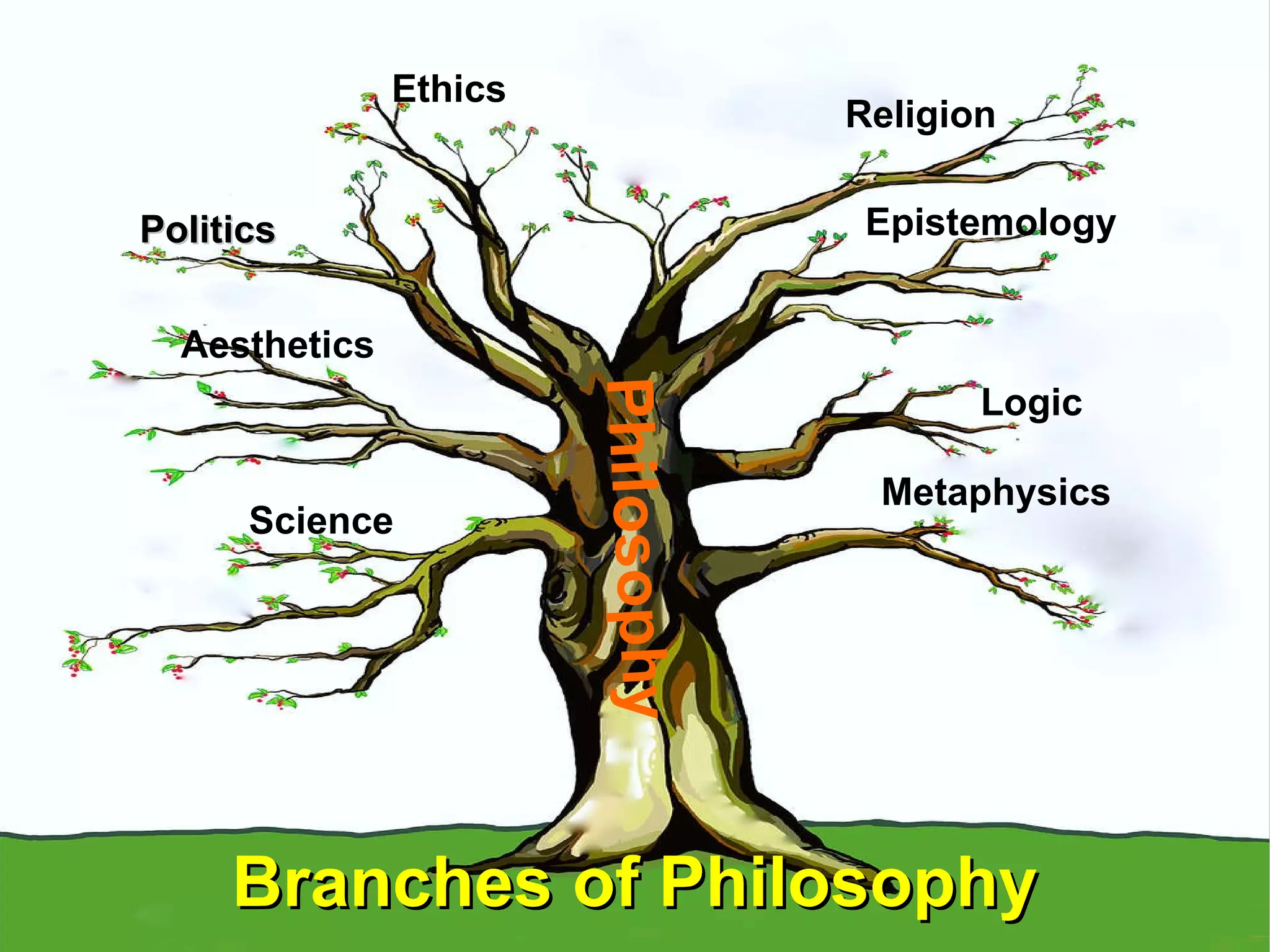
Branches of Philosophy Ethics Politics Religion Metaphysics Logic Epistemology Aesthetics Science Philosophy
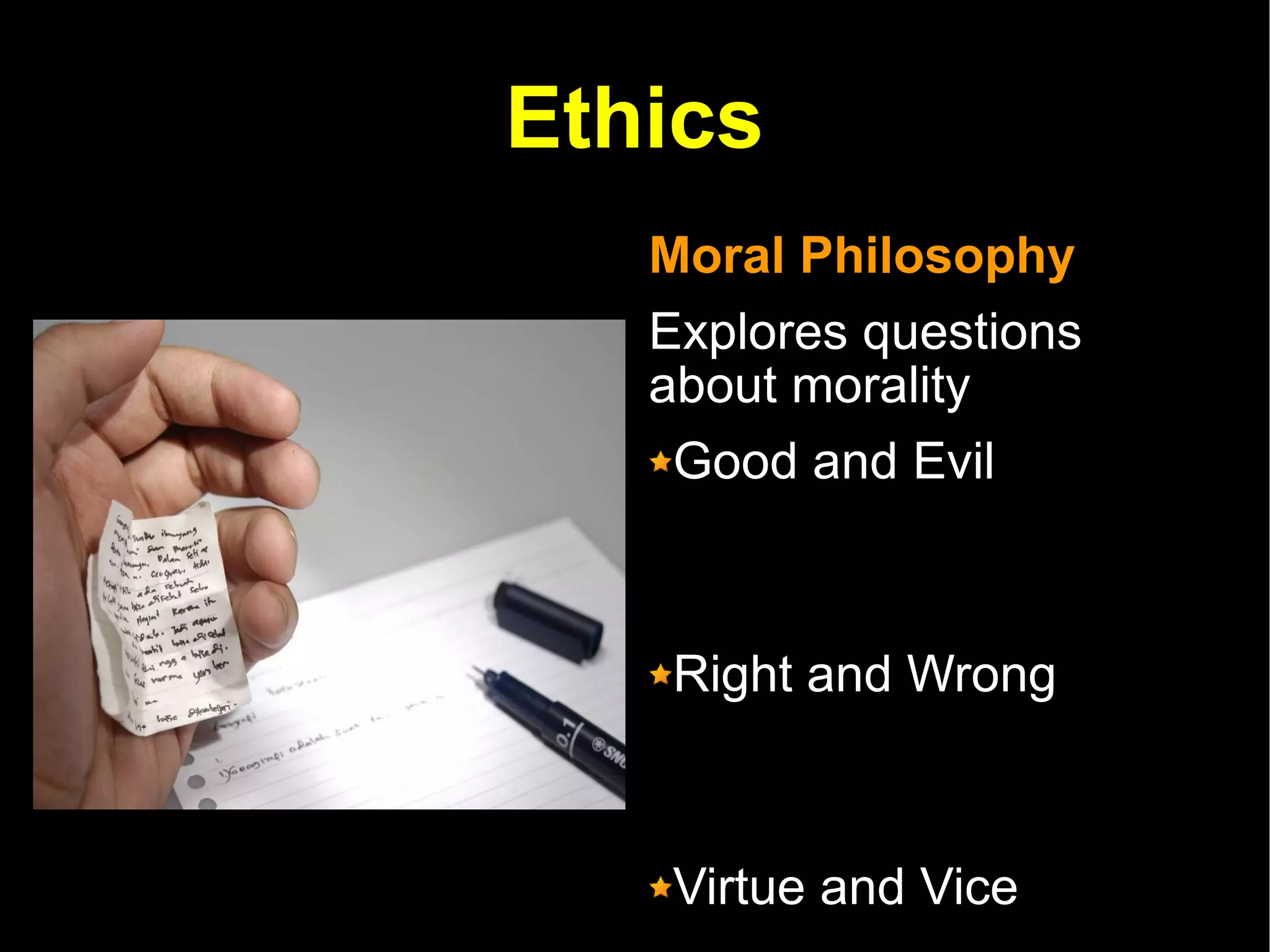
Ethics Moral Philosophy Explores questions about morality  Good and Evil Right and Wrong Virtue and Vice  Justice
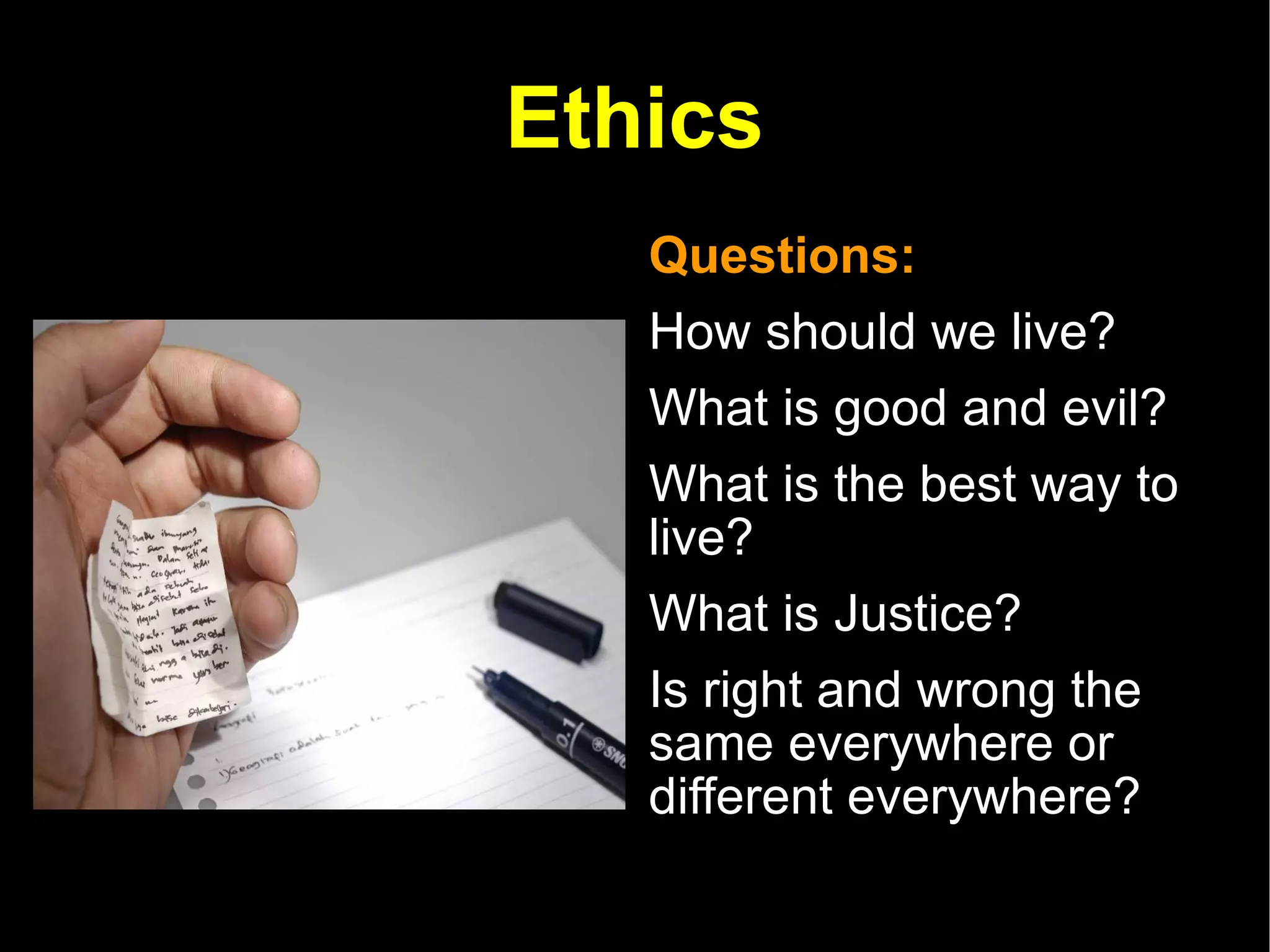
Ethics Questions:   How should we live? What is good and evil?  What is the best way to live? What is Justice?  Is right and wrong the same everywhere or different everywhere?
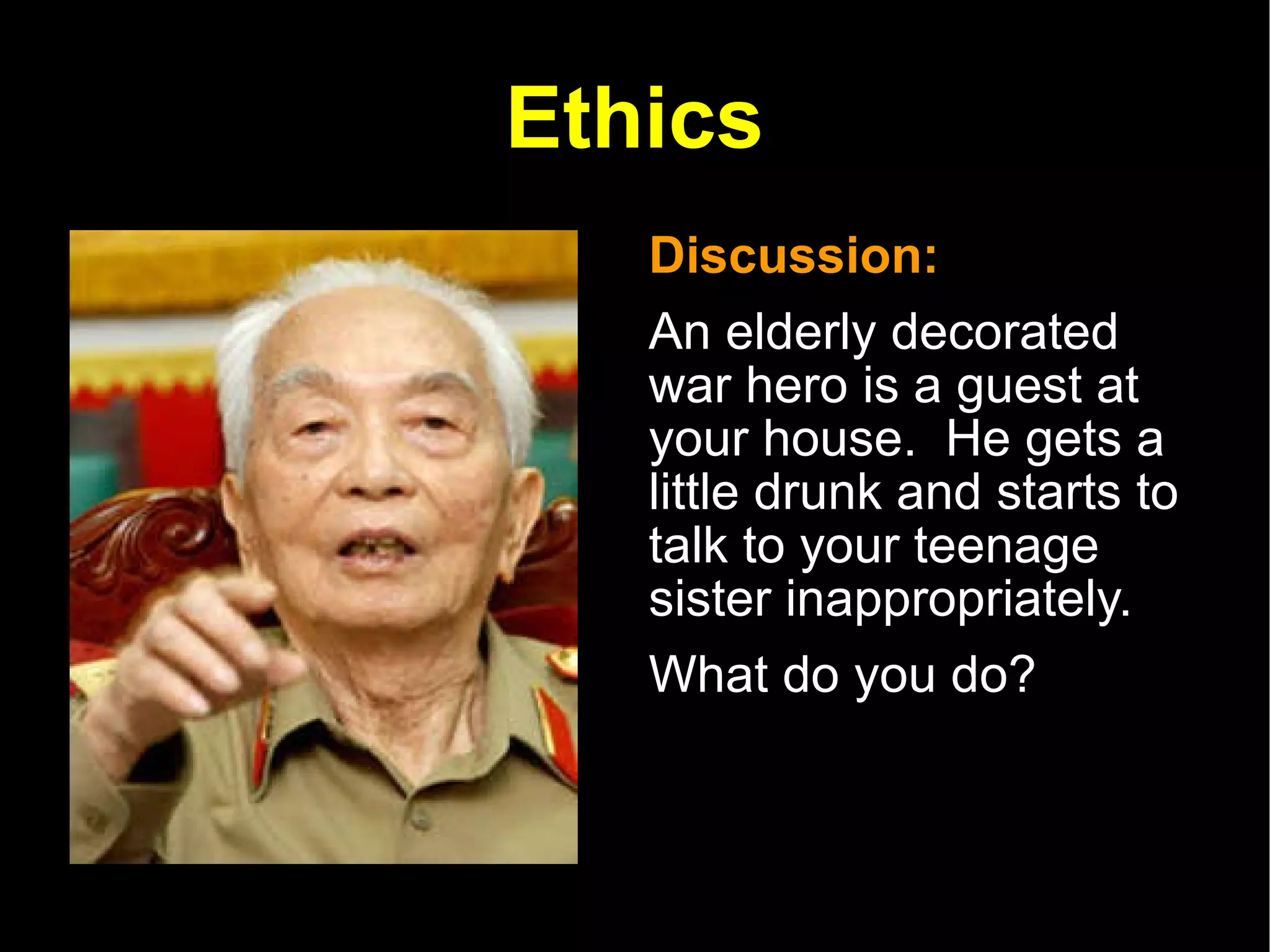
Ethics Discussion:  An elderly decorated war hero is a guest at your house.  He gets a little drunk and starts to talk to your teenage sister inappropriately.  What do you do?
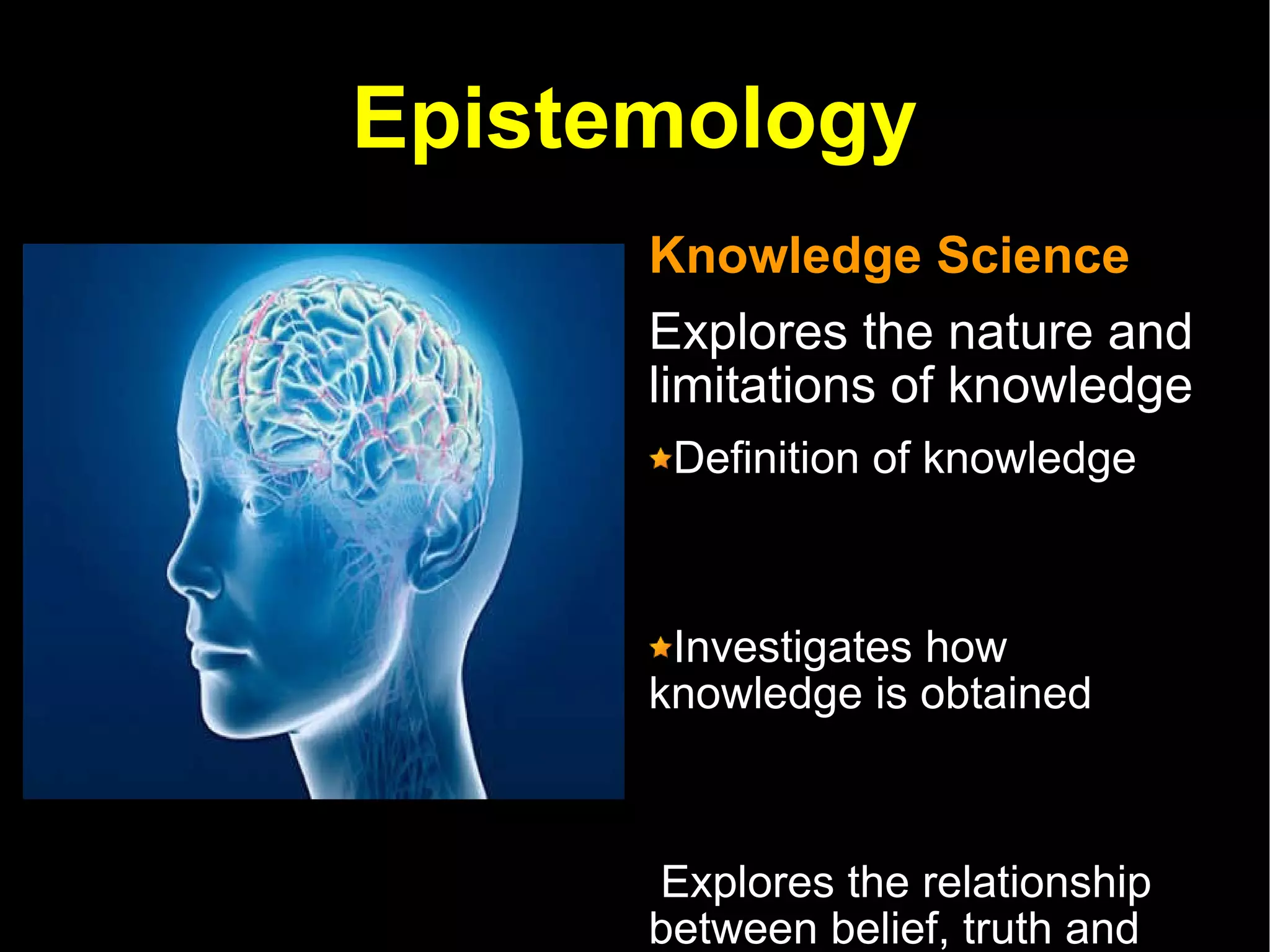
Epistemology Knowledge Science Explores the nature and limitations of knowledge  Definition of knowledge Investigates how knowledge is obtained Explores the relationship between belief, truth and knowledge
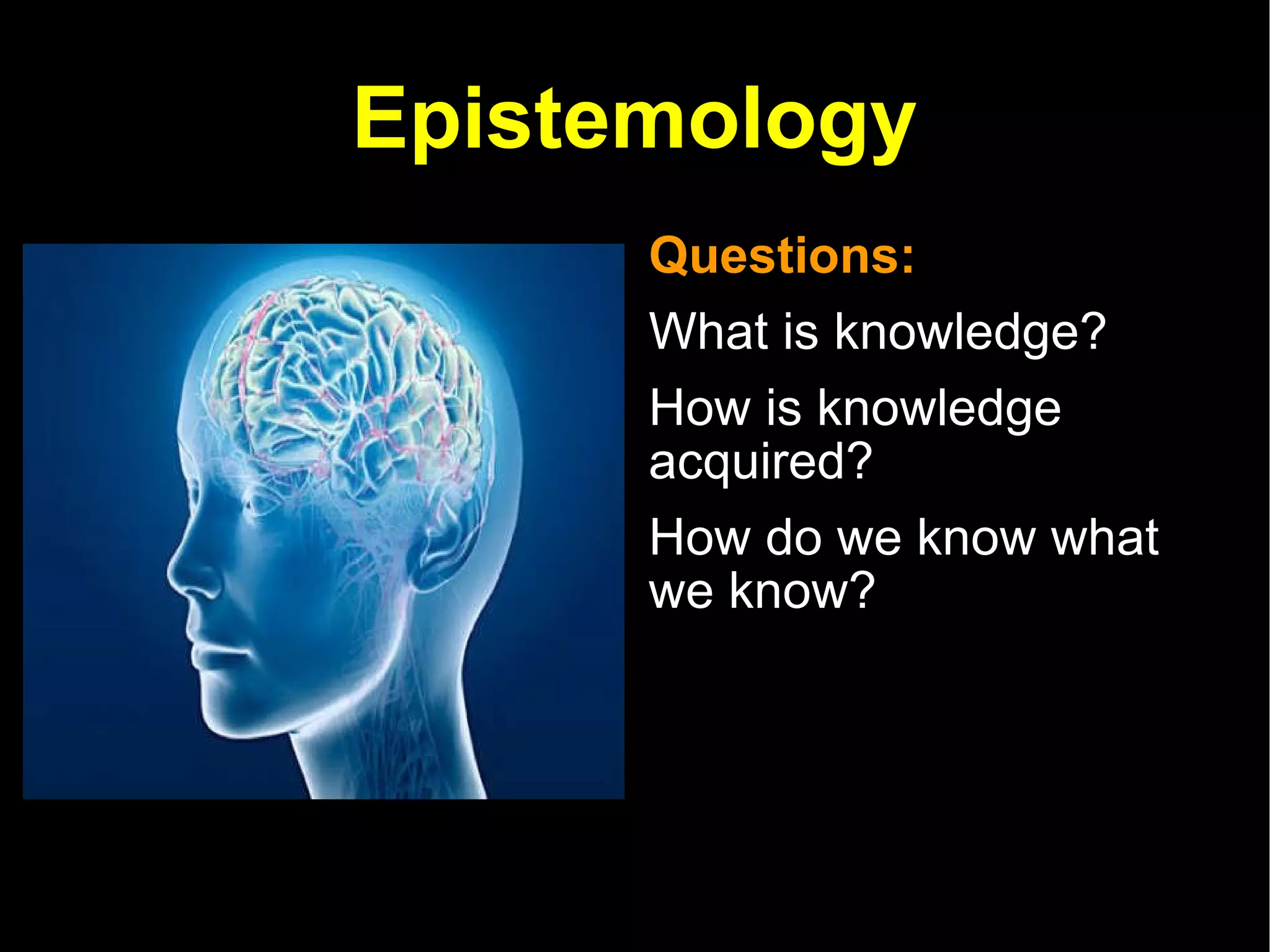
Epistemology Questions:  What is knowledge? How is knowledge acquired? How do we know what we know?
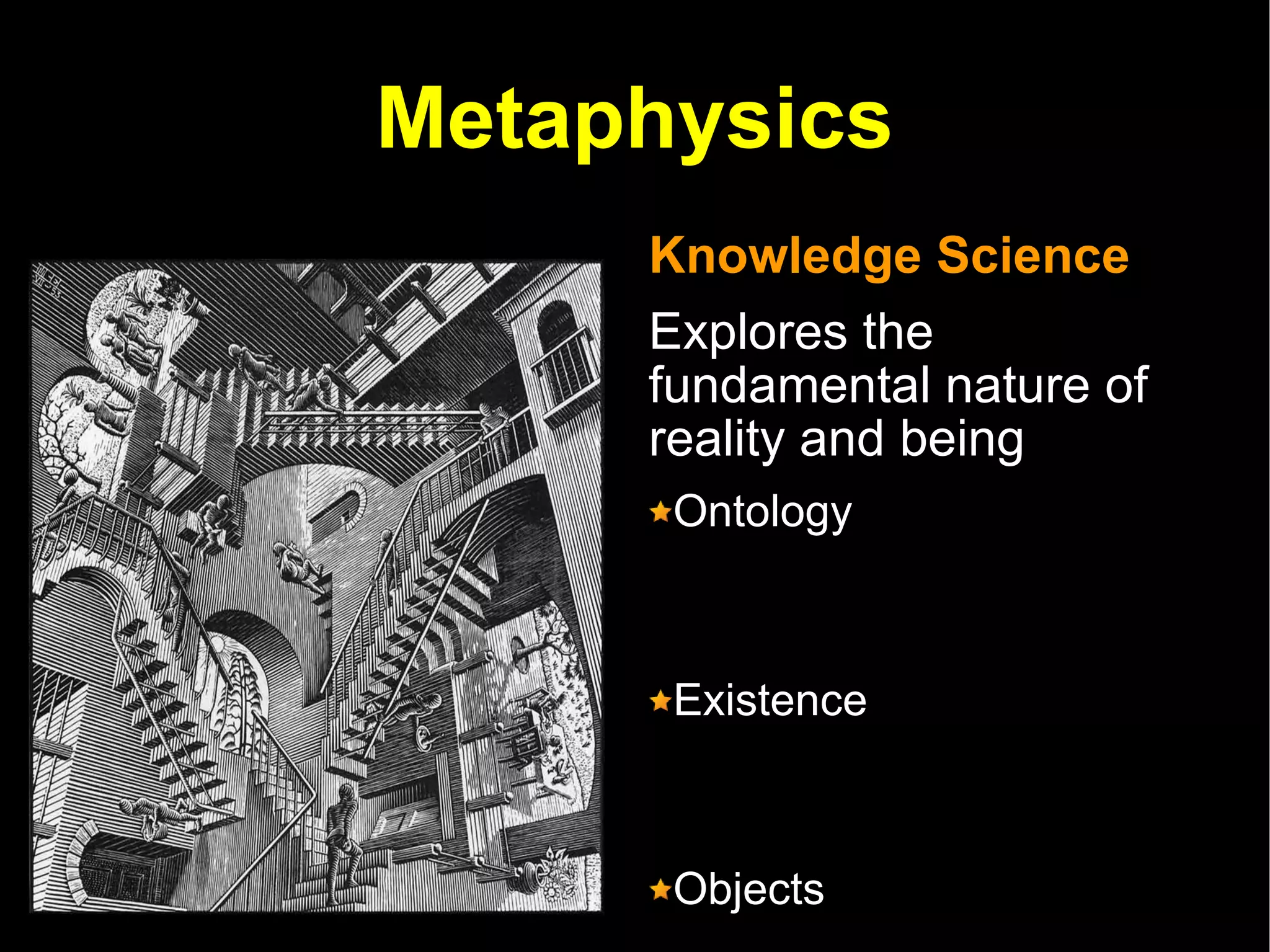
Metaphysics Knowledge Science Explores the fundamental nature of reality and being  Ontology  Existence  Objects  Properties Space and Time Cause and Effect
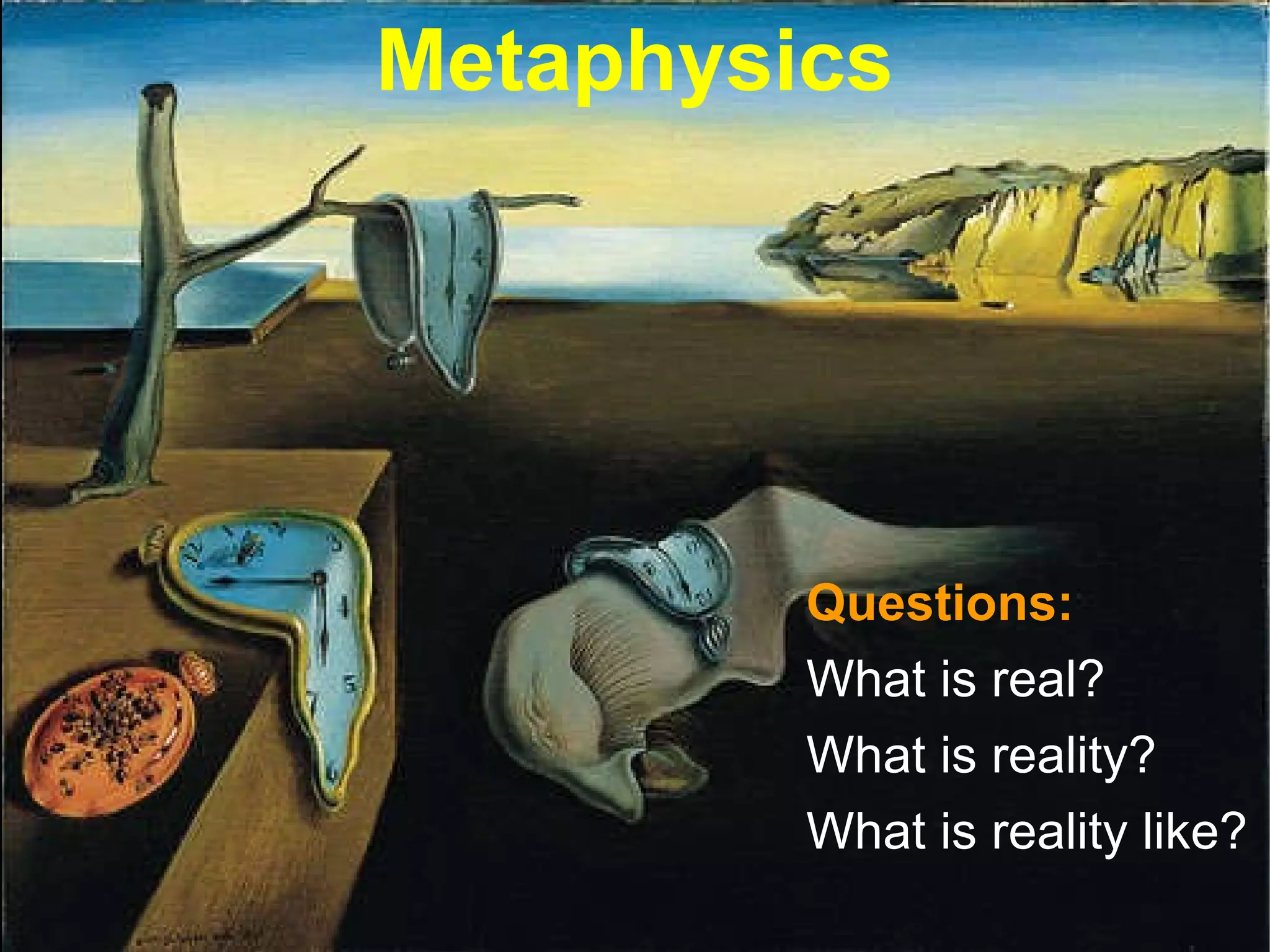
Metaphysics Questions:  What is real?  What is reality?  What is reality like?
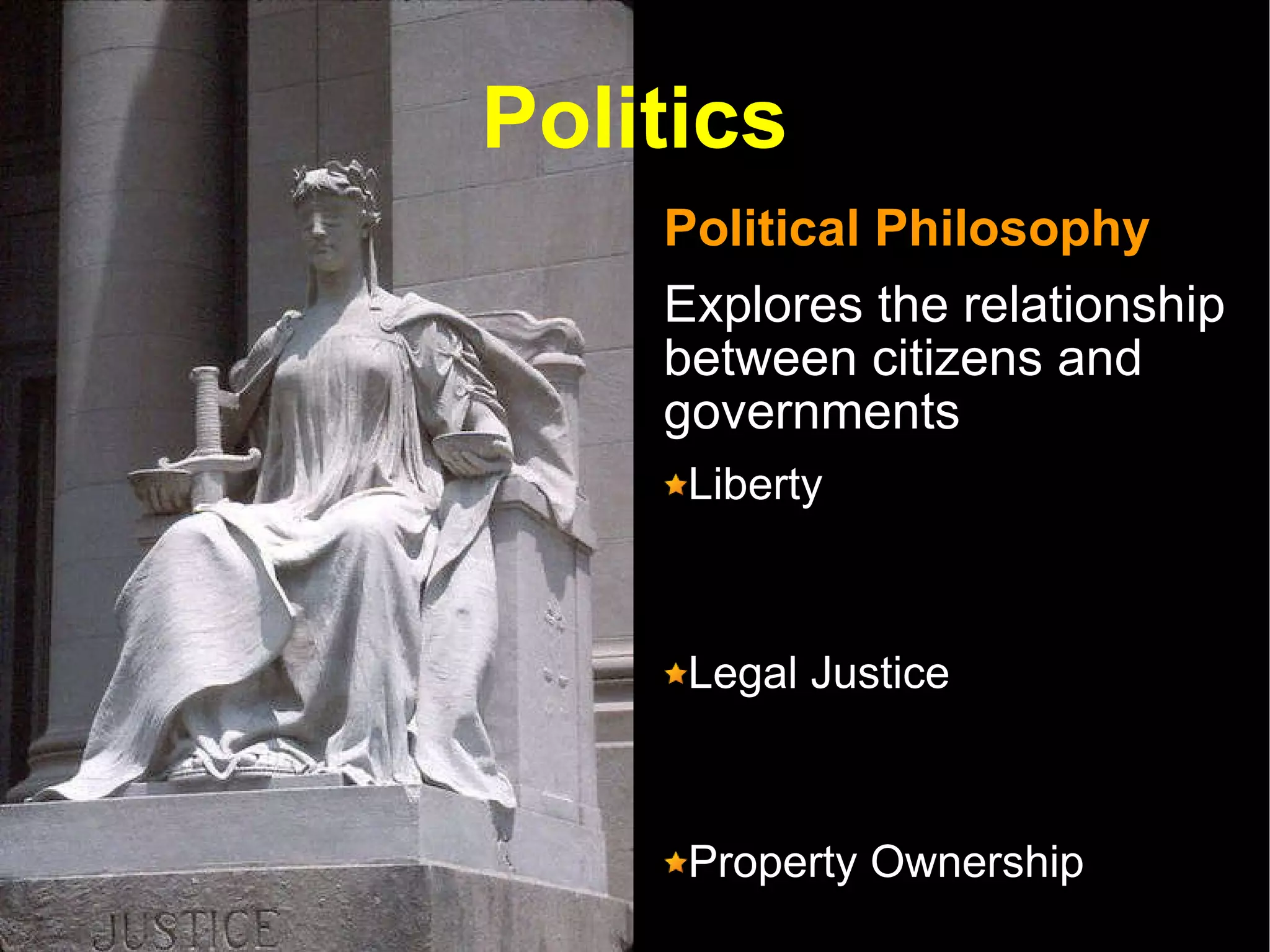
Politics Political Philosophy Explores the relationship between citizens and governments  Liberty Legal Justice Property Ownership Citizen's Rights System of Law
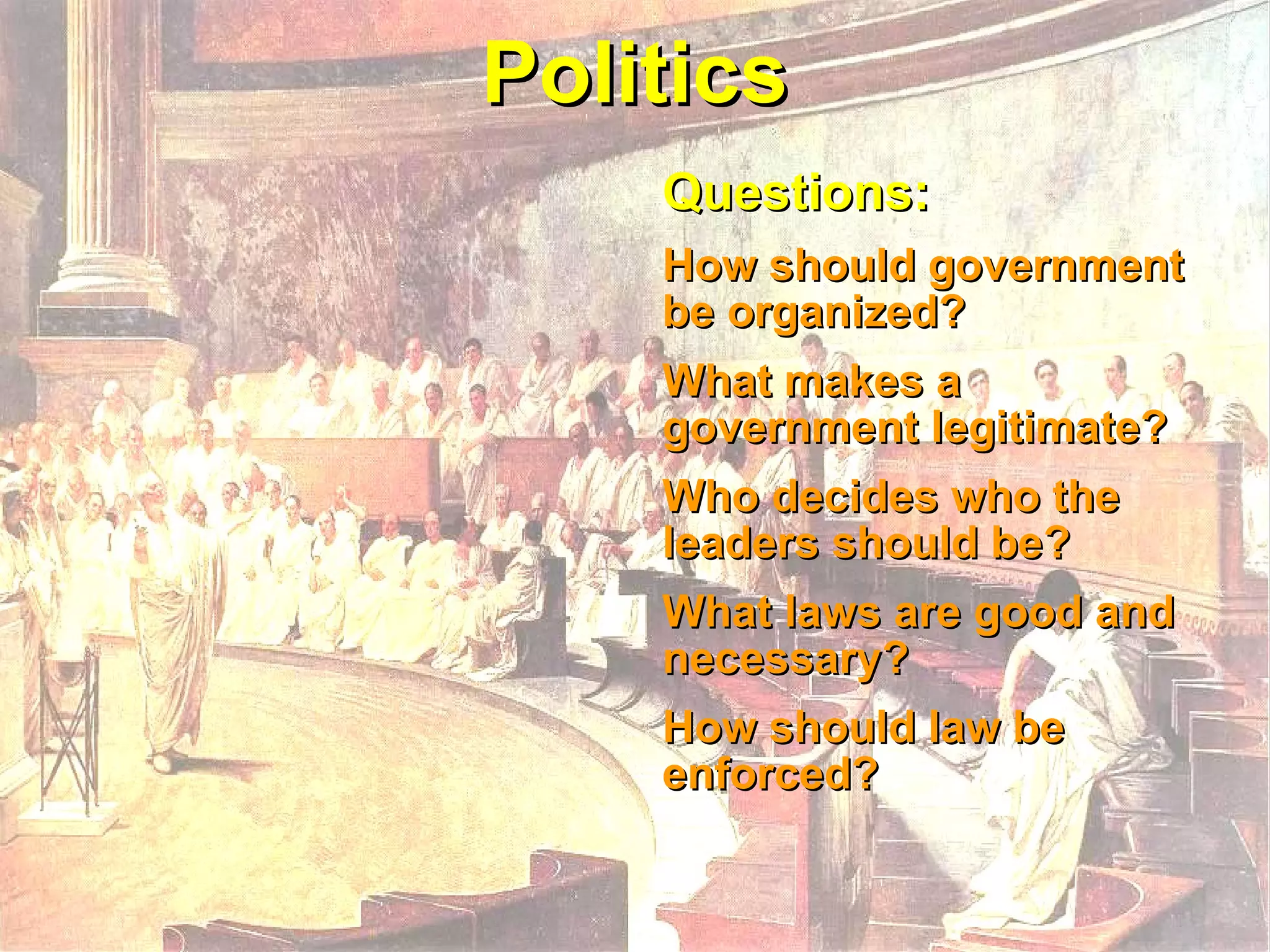
Politics Questions:  How should government be organized? What makes a government legitimate?  Who decides who the leaders should be? What laws are good and necessary?  How should law be enforced?
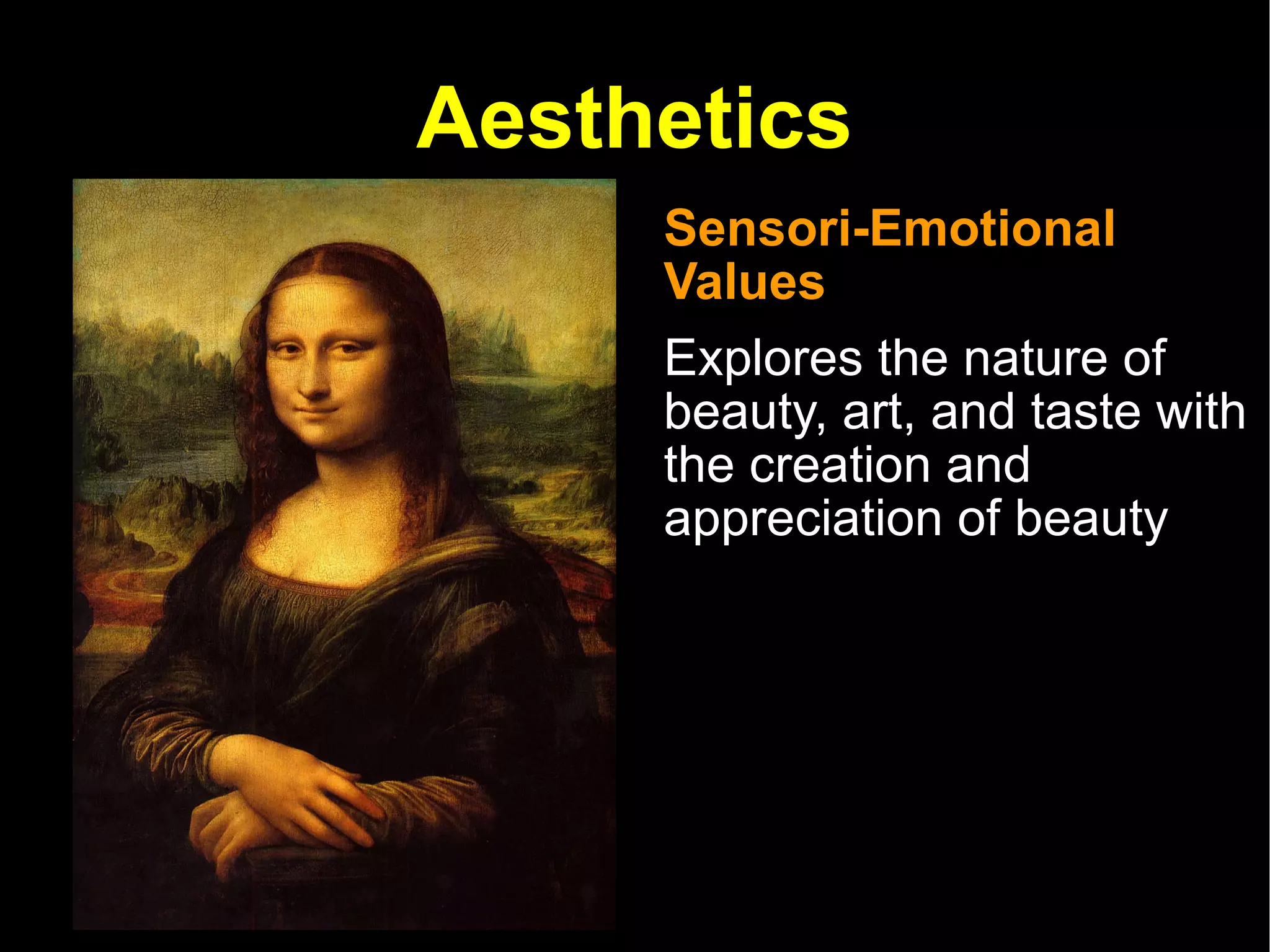
Aesthetics Sensori-Emotional Values Explores the nature of beauty, art, and taste with the creation and appreciation of beauty
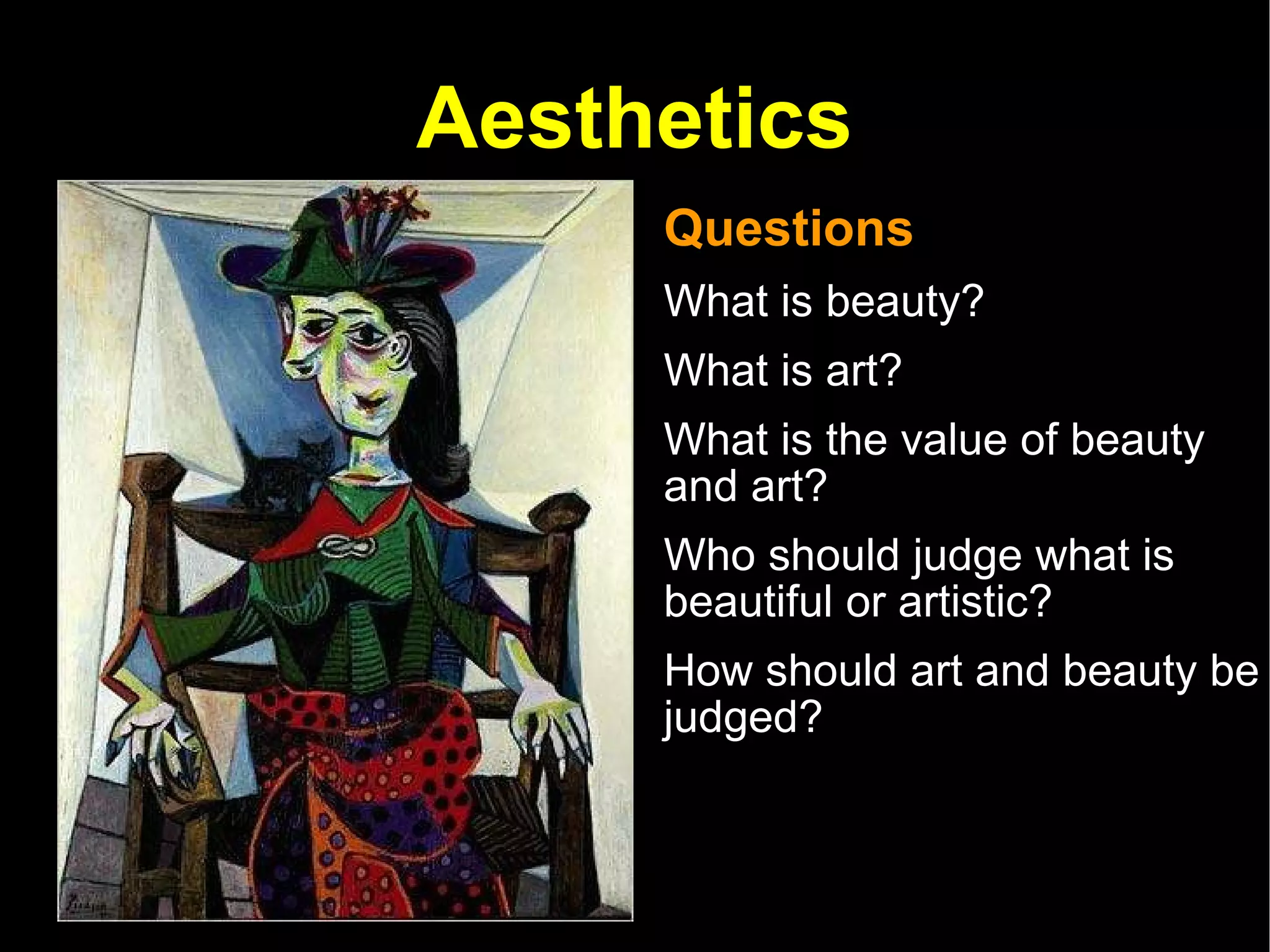
Aesthetics Questions What is beauty?  What is art?  What is the value of beauty and art?  Who should judge what is beautiful or artistic?  How should art and beauty be judged?
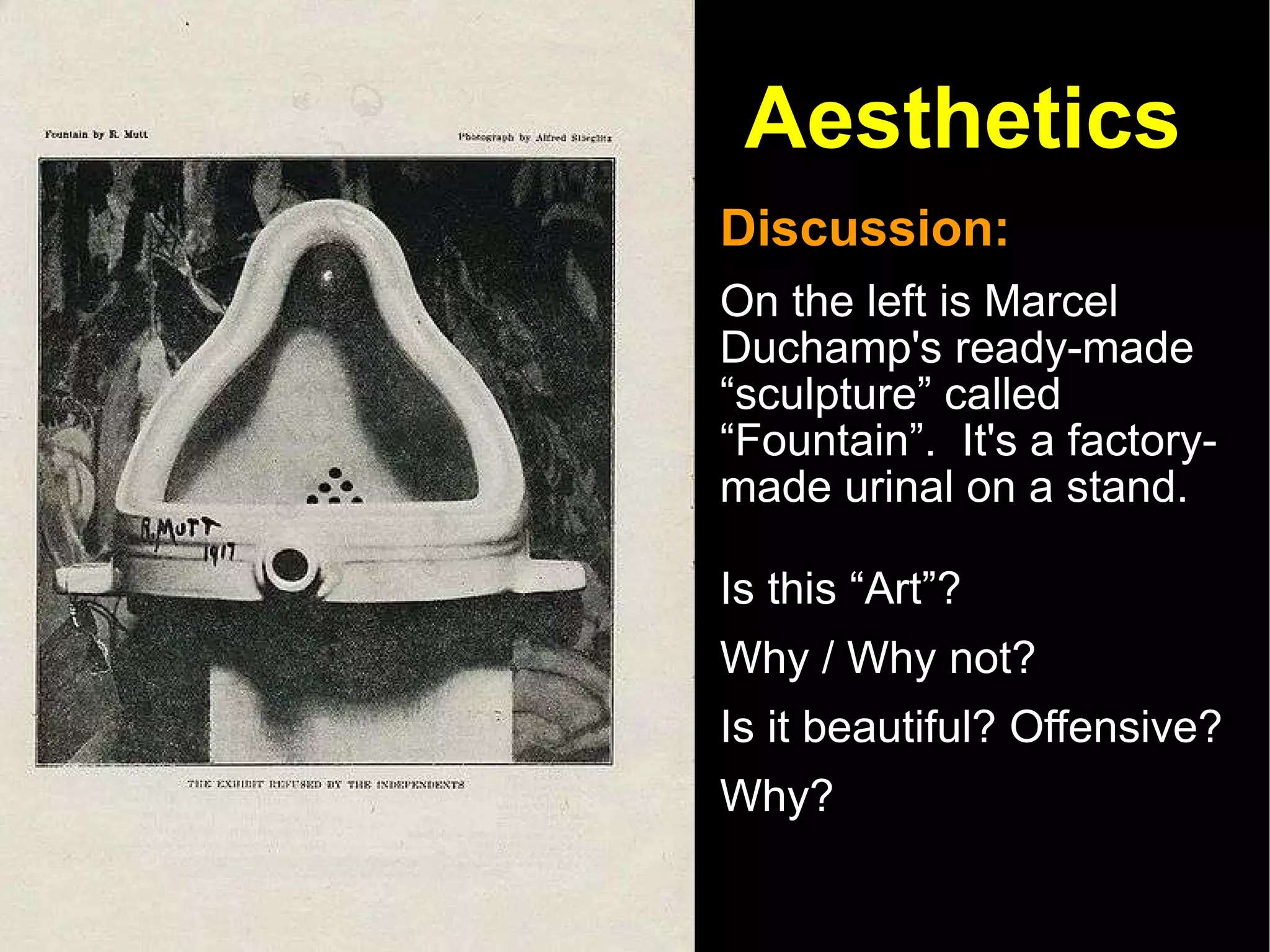
Aesthetics Discussion:  On the left is Marcel Duchamp's ready-made “sculpture” called “Fountain”.  It's a factory-made urinal on a stand. Is this “Art”?  Why / Why not?  Is it beautiful? Offensive? Why?
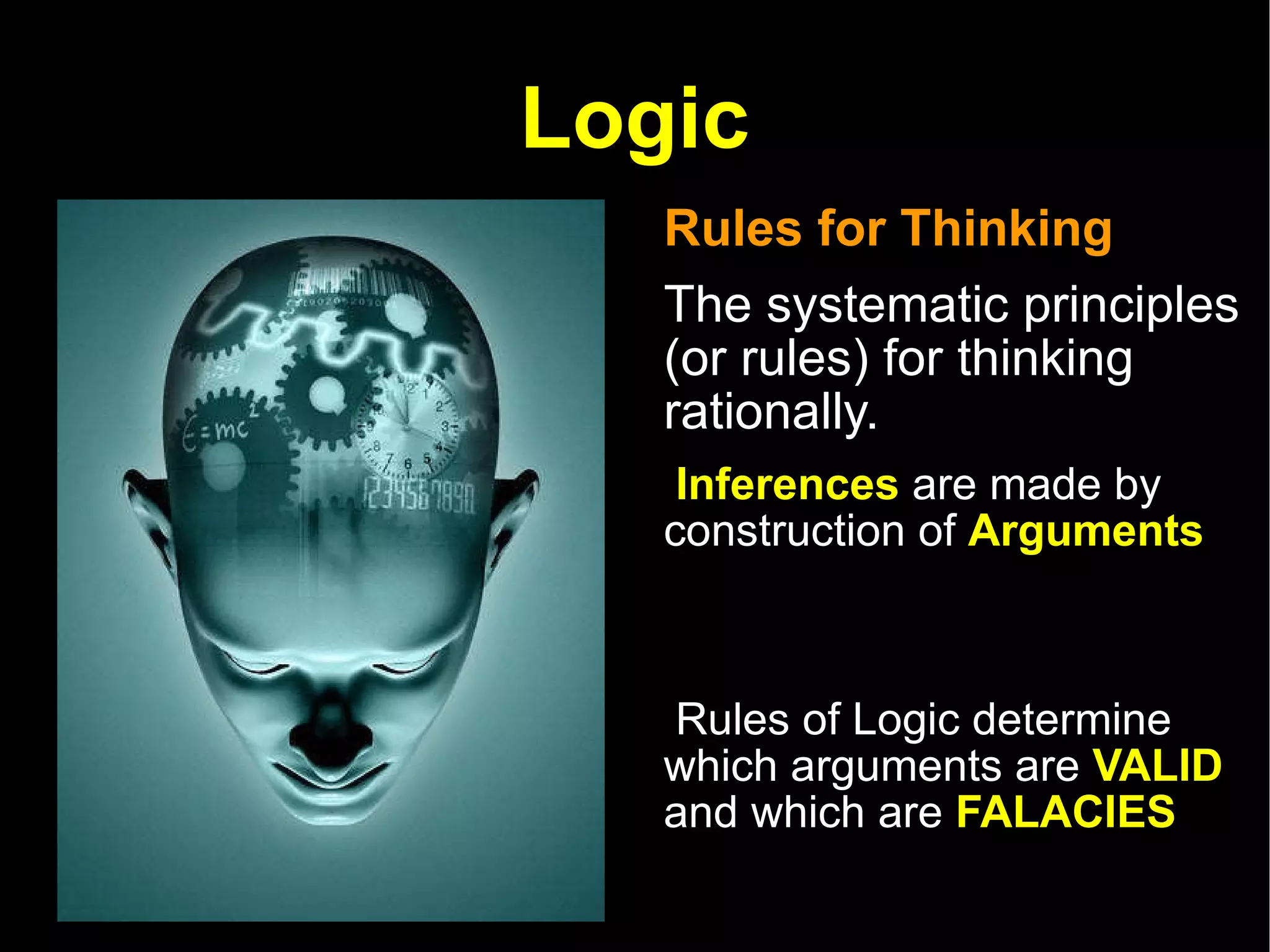
Logic Rules for Thinking The systematic principles (or rules) for thinking rationally.  Inferences  are made by construction of  Arguments Rules of Logic determine which arguments are  VALID  and which are  FALACIES
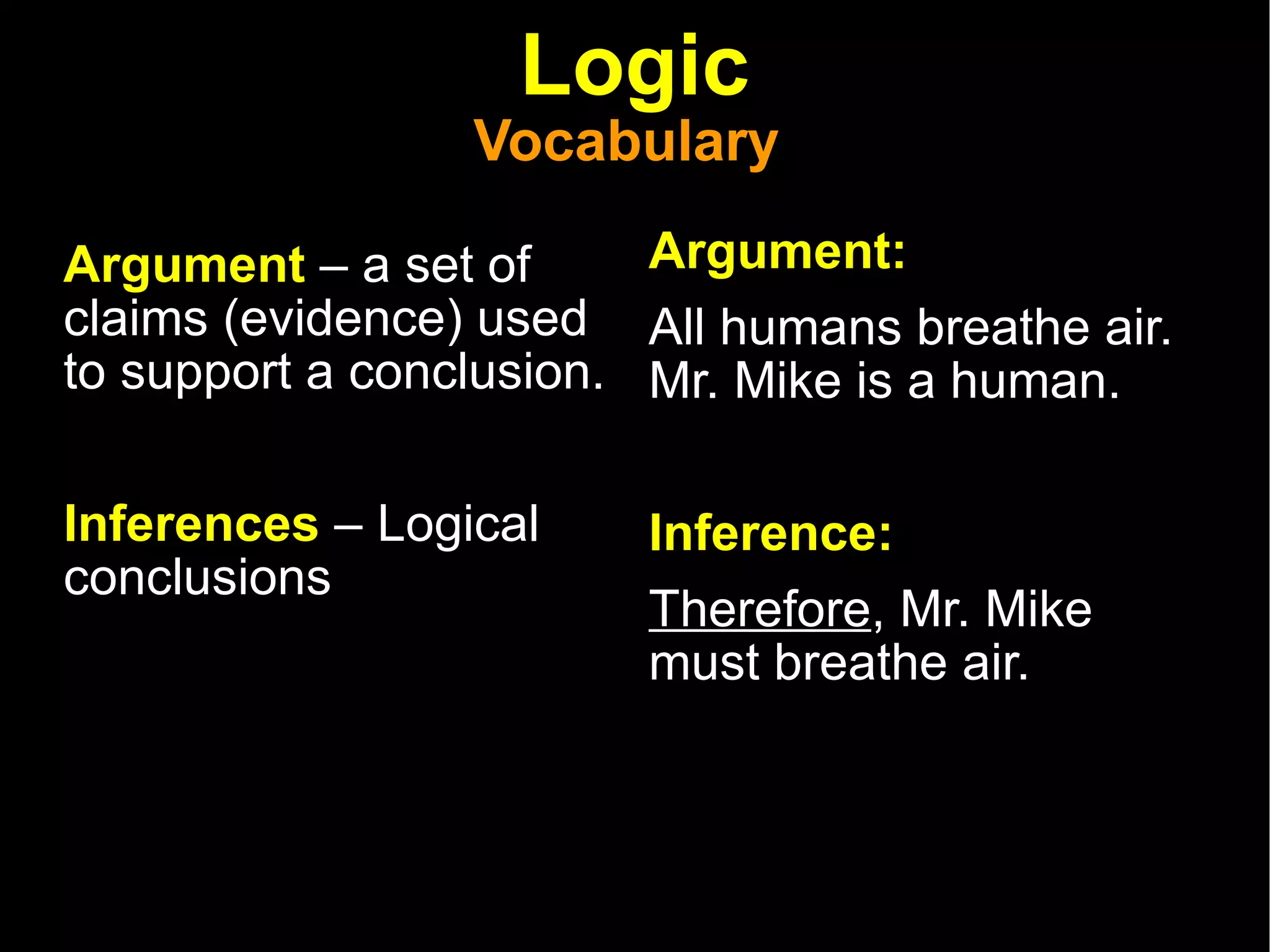
Logic Vocabulary  Argument  – a set of claims (evidence) used to support a conclusion. Inferences  – Logical conclusions  Argument:   All humans breathe air. Mr. Mike is a human.  Inference:  Therefore , Mr. Mike must breathe air.
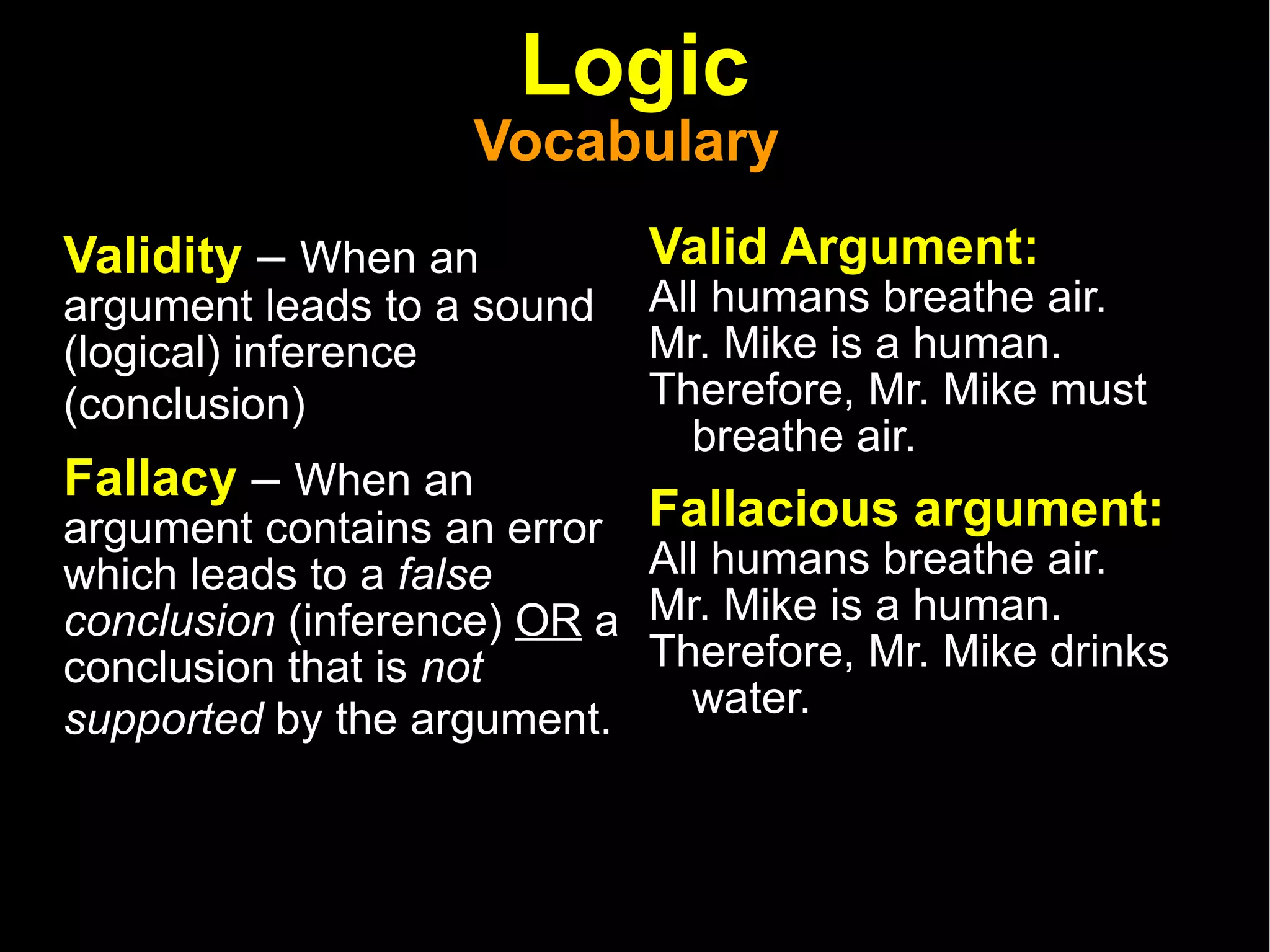
Logic Vocabulary  Validity  –  When an argument leads to a sound (logical) inference (conclusion)   Fallacy  –  When an argument contains an error which leads to a  false conclusion  (inference)  OR  a conclusion that is  not supported  by the argument.   Valid Argument: All humans breathe air.  Mr. Mike is a human.  Therefore, Mr. Mike must breathe air.  Fallacious argument:  All humans breathe air.  Mr. Mike is a human.  Therefore, Mr. Mike drinks water.
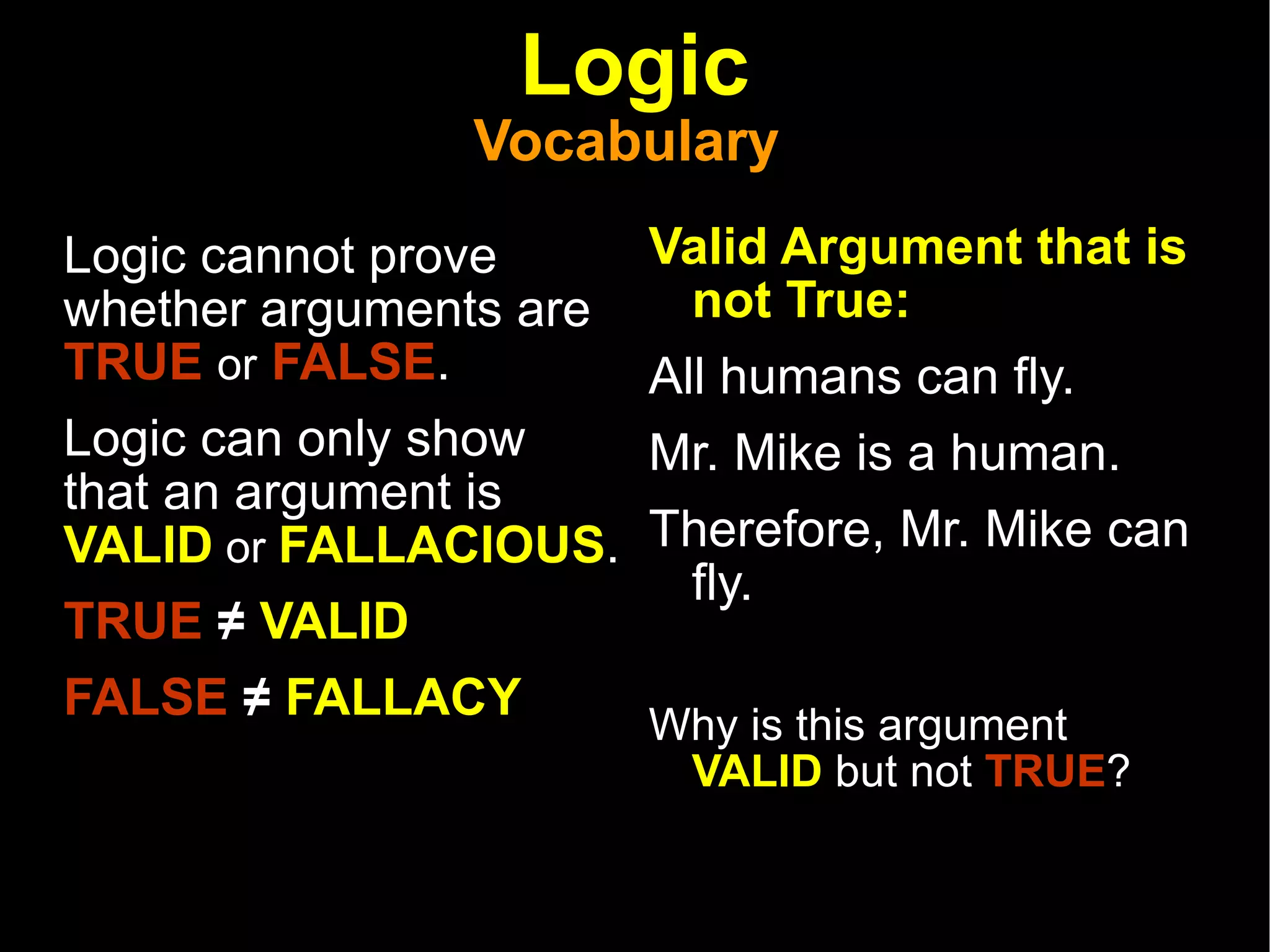
Logic Vocabulary  Logic cannot prove whether arguments are  TRUE   or   FALSE .  Logic can only show that an argument is  VALID  or  FALLACIOUS .  TRUE  ≠  VALID FALSE  ≠  FALLACY   Valid Argument that is not True: All humans can fly.  Mr. Mike is a human.  Therefore, Mr. Mike can fly.   Why is this argument  VALID  but not  TRUE ?
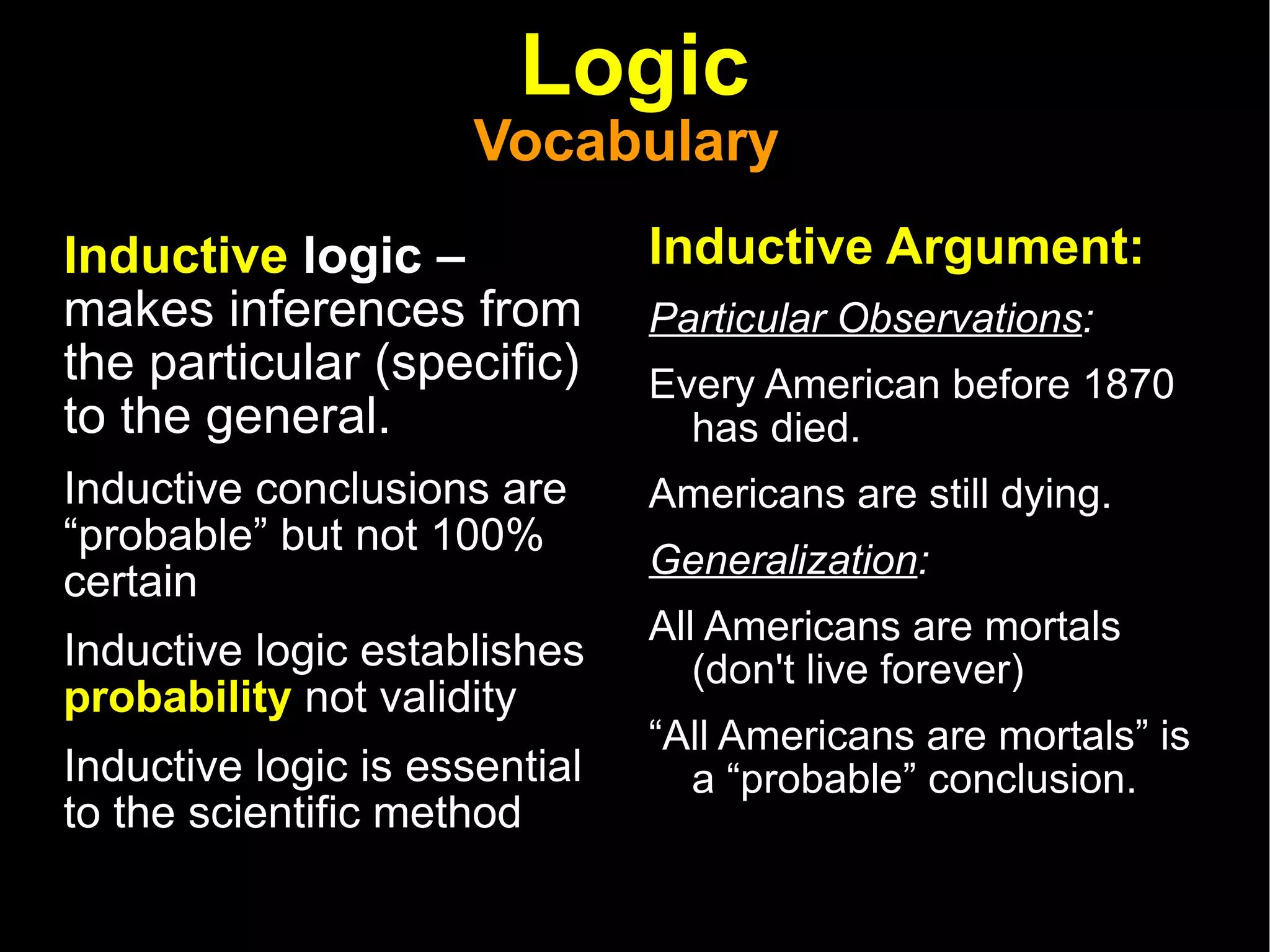
Logic Vocabulary  Inductive  logic –  makes inferences from the particular (specific) to the general. Inductive conclusions are “probable” but not 100% certain  Inductive logic establishes  probability  not validity Inductive logic is essential to the scientific method Inductive Argument: Particular Observations : Every American before 1870 has died. Americans are still dying. Generalization :  All Americans are mortals (don't live forever)  “ All Americans are mortals” is a “probable” conclusion.
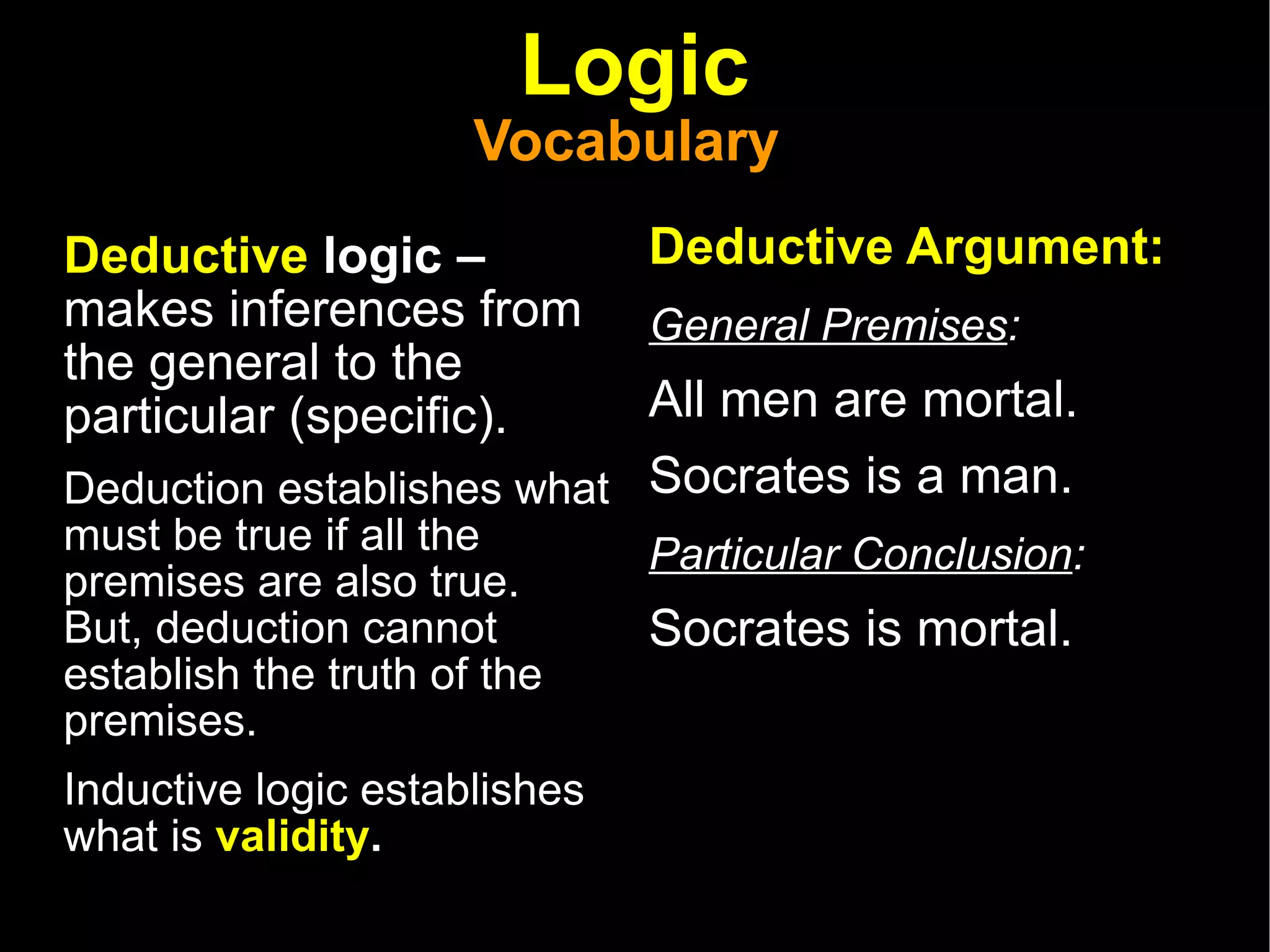
Logic Vocabulary  Deductive  logic –  makes inferences from the general to the particular (specific). Deduction establishes what must be true if all the premises are also true.  But, deduction cannot establish the truth of the premises.  Inductive logic establishes what is  validity . Deductive Argument: General Premises :   All men are mortal.  Socrates is a man.  Particular Conclusion :   Socrates is mortal.
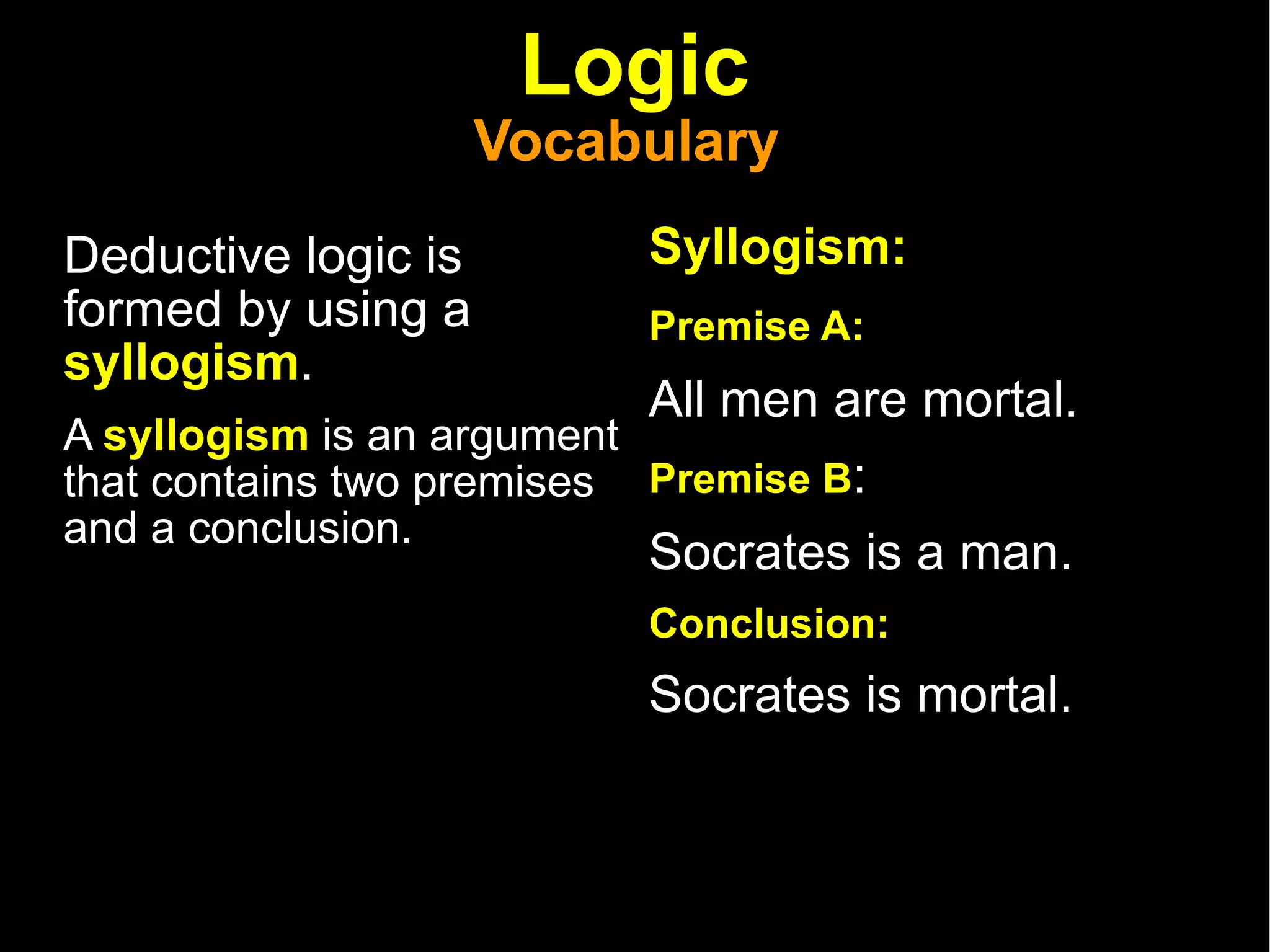
Logic Vocabulary  Deductive logic is formed by using a  syllogism . A  syllogism  is an argument that contains two premises and a conclusion.  Syllogism: Premise A:   All men are mortal.  Premise B :  Socrates is a man.  Conclusion:  Socrates is mortal.
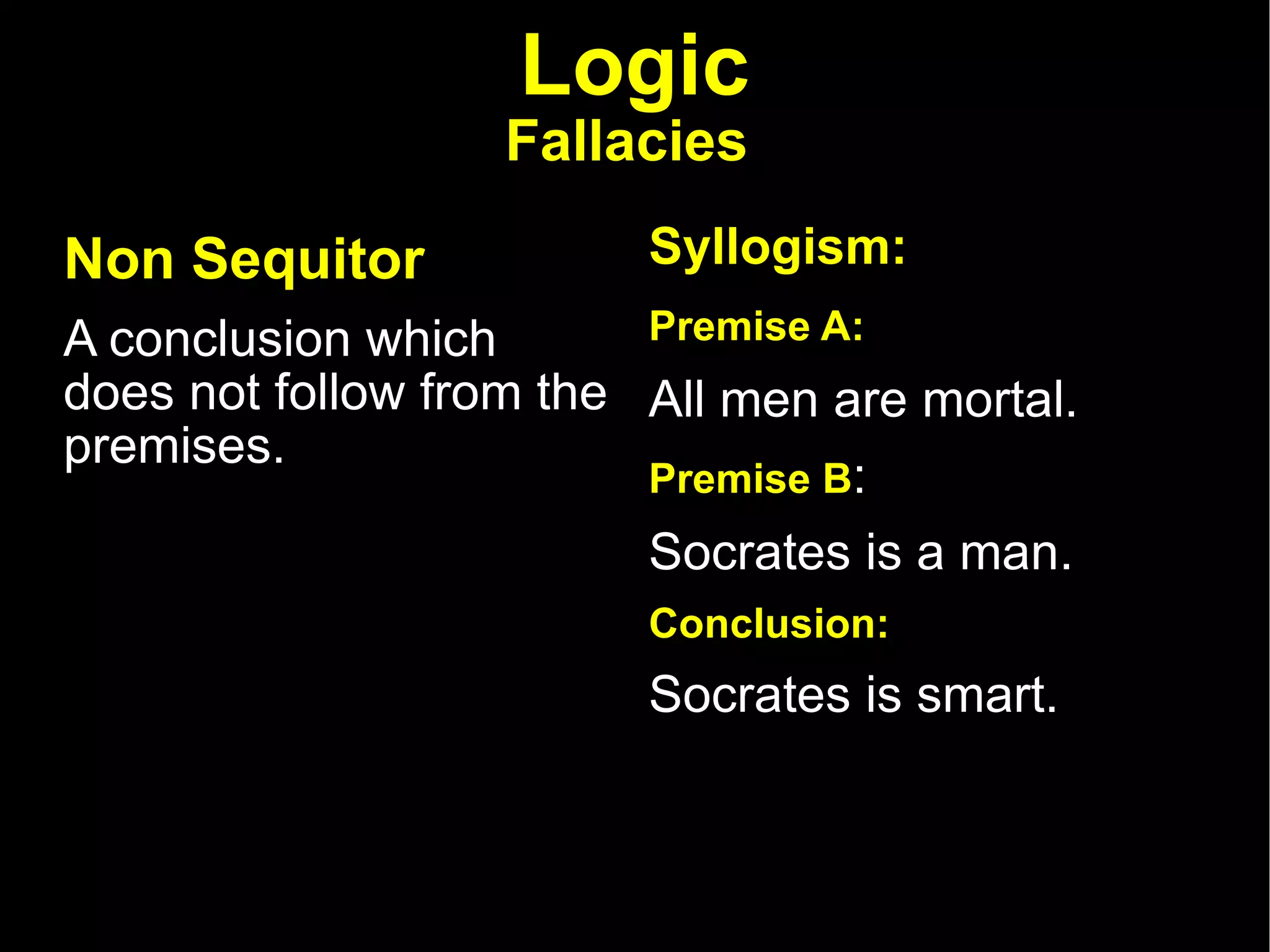
Logic Fallacies   Non Sequitor   A conclusion which does not follow from the premises.  Syllogism: Premise A:   All men are mortal.  Premise B :  Socrates is a man.  Conclusion:  Socrates is smart.
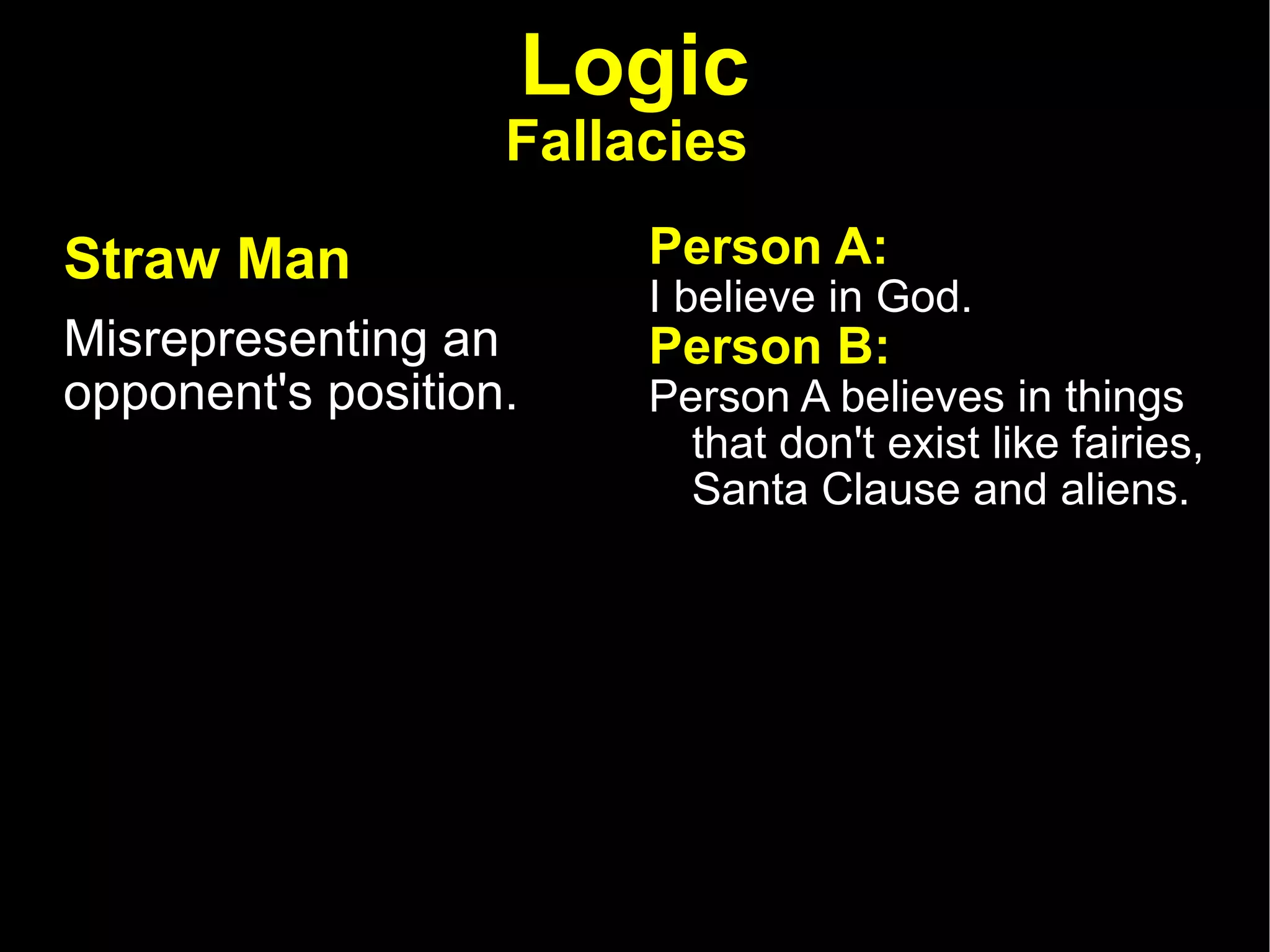
Logic Fallacies   Straw Man   Misrepresenting an opponent's position.  Person A:  I believe in God.  Person B:  Person A believes in things that don't exist like fairies, Santa Clause and aliens.
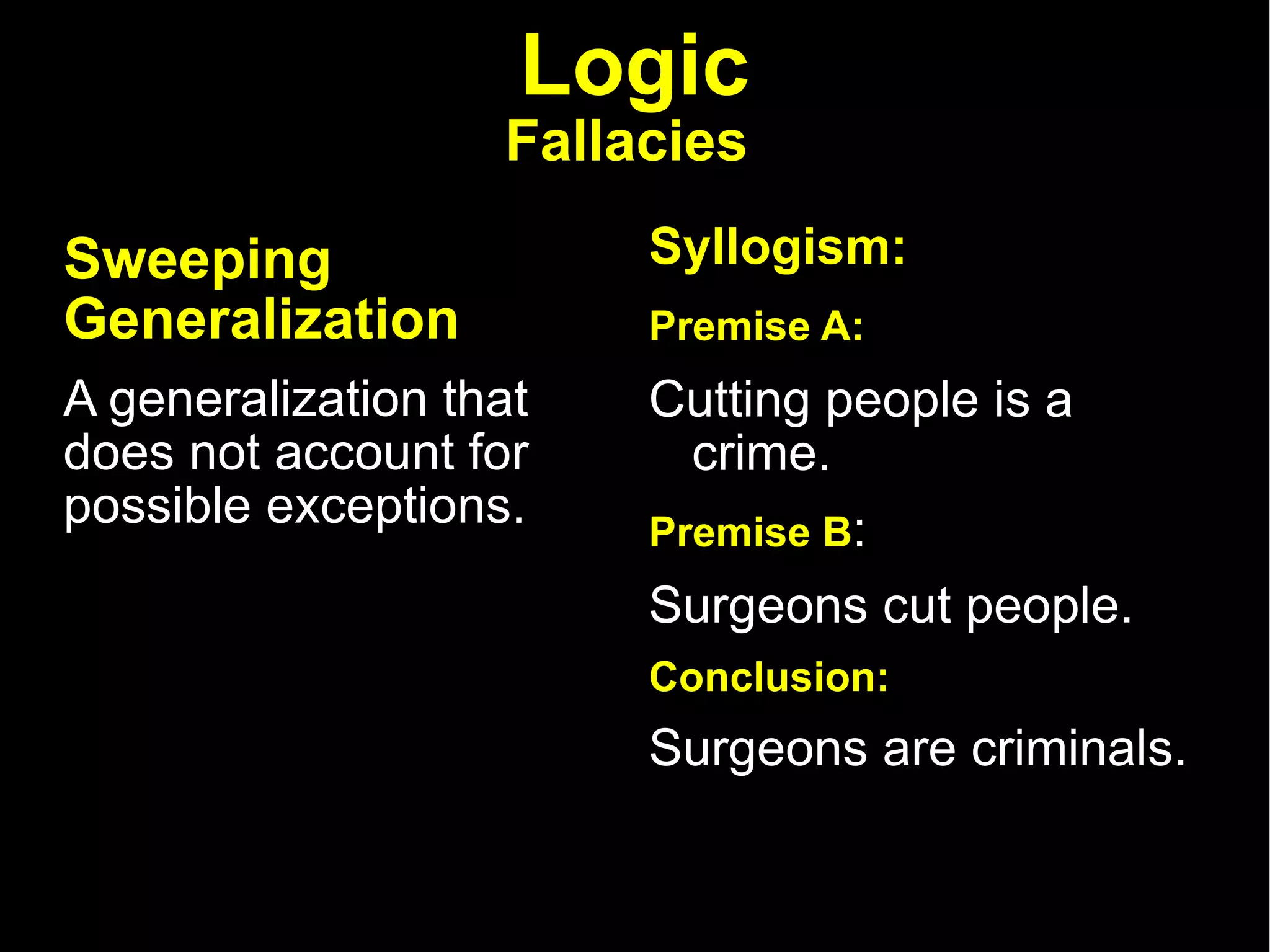
Logic Fallacies   Sweeping Generalization   A generalization that does not account for possible exceptions.  Syllogism: Premise A:   Cutting people is a crime.  Premise B :  Surgeons cut people.  Conclusion:  Surgeons are criminals.
Logic Fallacies   Hasty Generalization   A generalization that follows from examples that are too limited.  Syllogism: Premise A:   Everybody I've met in England speaks English.  Premise B :  Everybody I've met in America speaks English.  Conclusion:  Everybody in the world speaks English.
Logic Fallacies   Red Herring   A deliberate attempt to divert a process of enquiry by changing the subject.  Syllogism: Mr. Jones:   President Smith needs show us good reasons for raising taxes.  President Smith :  Taxes are important, but this country really needs to reduce crime rates.
Logic Fallacies   Ad Hominem   An attempt to disprove an opponents position by attacking his character instead of his logic.  Example: Mr. Johnson's argument for lowering taxes can't be taken seriously.  He is a billionaire and earned his money from very questionable business deals.
Logic Fallacies   Ad Baculum   An attempt to silence an opponents position by threatening to use force or punishment.  Jim: I don't think our company should spend $100,000 on executive bonuses.  Jim's Employer:  Be quiet Jim or I will fire you.
Logic Fallacies   Loaded Questions   Groups more than one question or assertion in a single question.  Example: Did you stop using drugs?  Problems:  (1) Question assumes a conclusion without proving it (i.e. you are a drug user). (2) You can't answer the question without affirming that you used drugs.
Logic Fallacies   Circular Reasoning   An argument is circular if its conclusion is among its premises, if it assumes what it is trying to prove. Example: Honest Joe claims to be honest.  Honest Joe never lies.  Therefore, Honest Joe really is honest.
Logic Fallacies   Appeal to Popularity   Attempts to prove that an idea is true simply because it is widely held.  Example: Most people believe that God exists.  Therefore, God must exist.
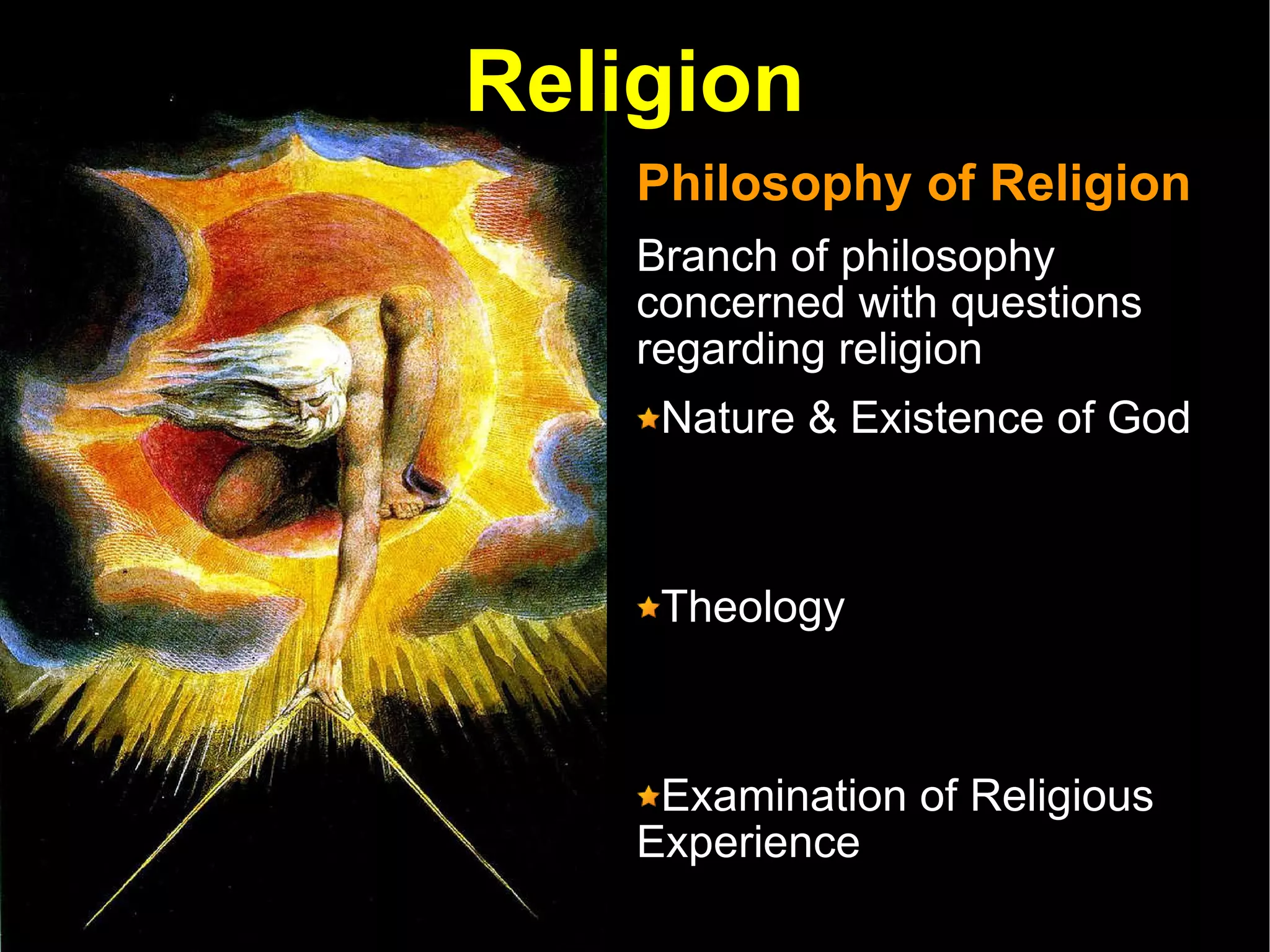
Religion Philosophy of Religion Branch of philosophy concerned with questions regarding religion  Nature & Existence of God Theology Examination of Religious Experience Analysis of Religious language and texts Relationship between Religion and Science
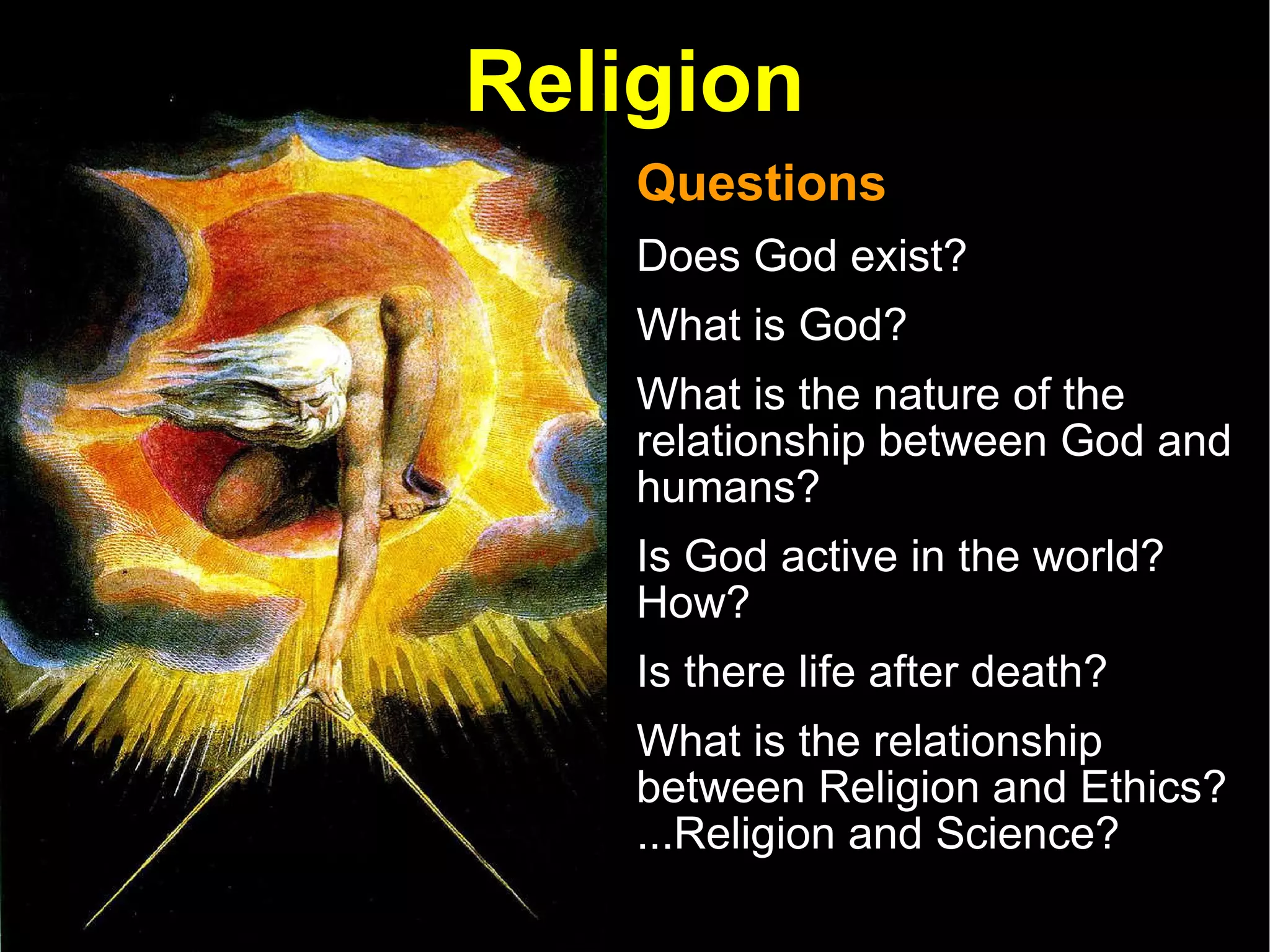
Religion Questions Does God exist?  What is God?  What is the nature of the relationship between God and humans? Is God active in the world?  How?  Is there life after death? What is the relationship between Religion and Ethics? ...Religion and Science?
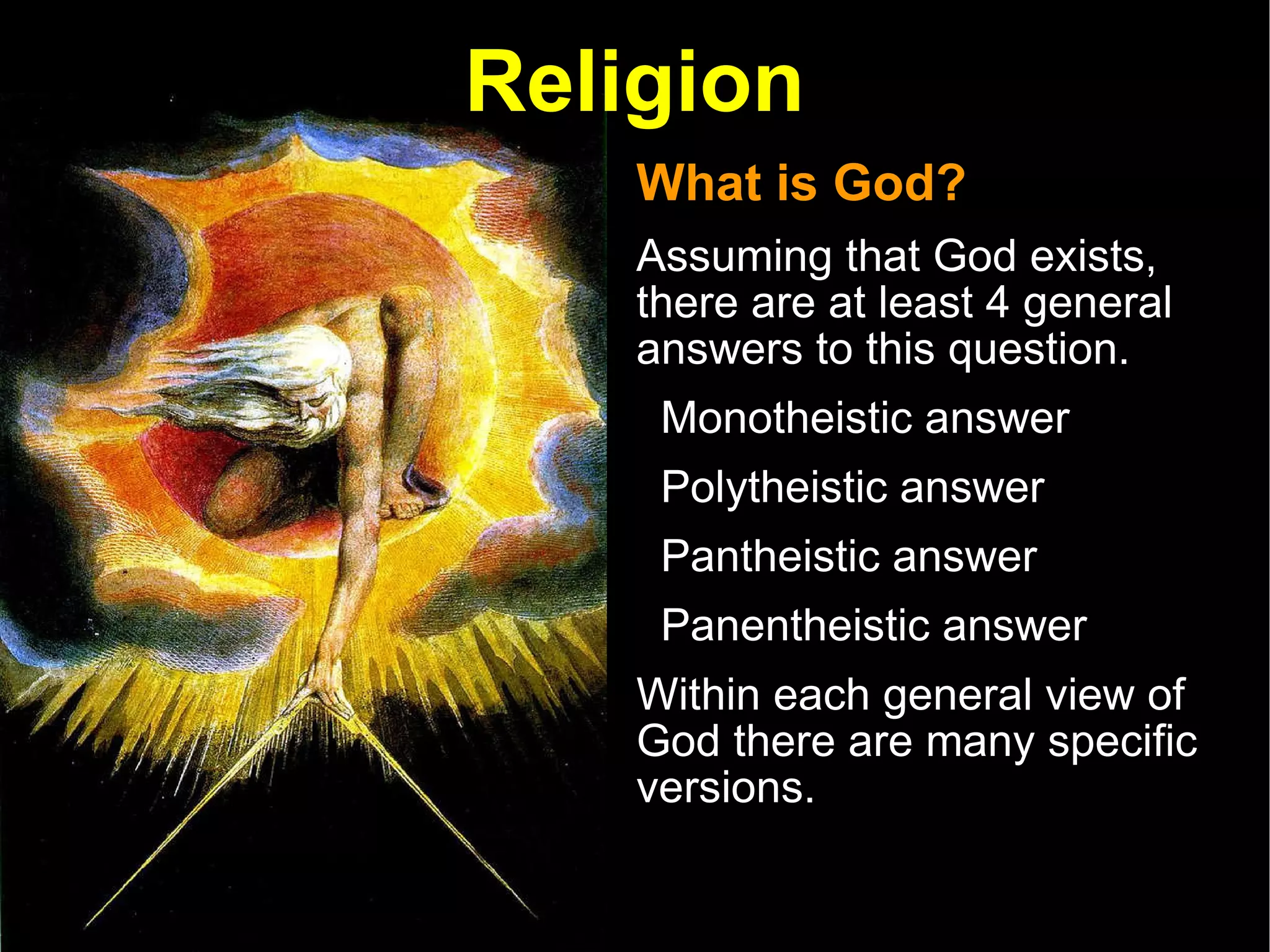
Religion What is God? Assuming that God exists, there are at least 4 general answers to this question.  Monotheistic answer Polytheistic answer  Pantheistic answer Panentheistic answer  Within each general view of God there are many specific versions.
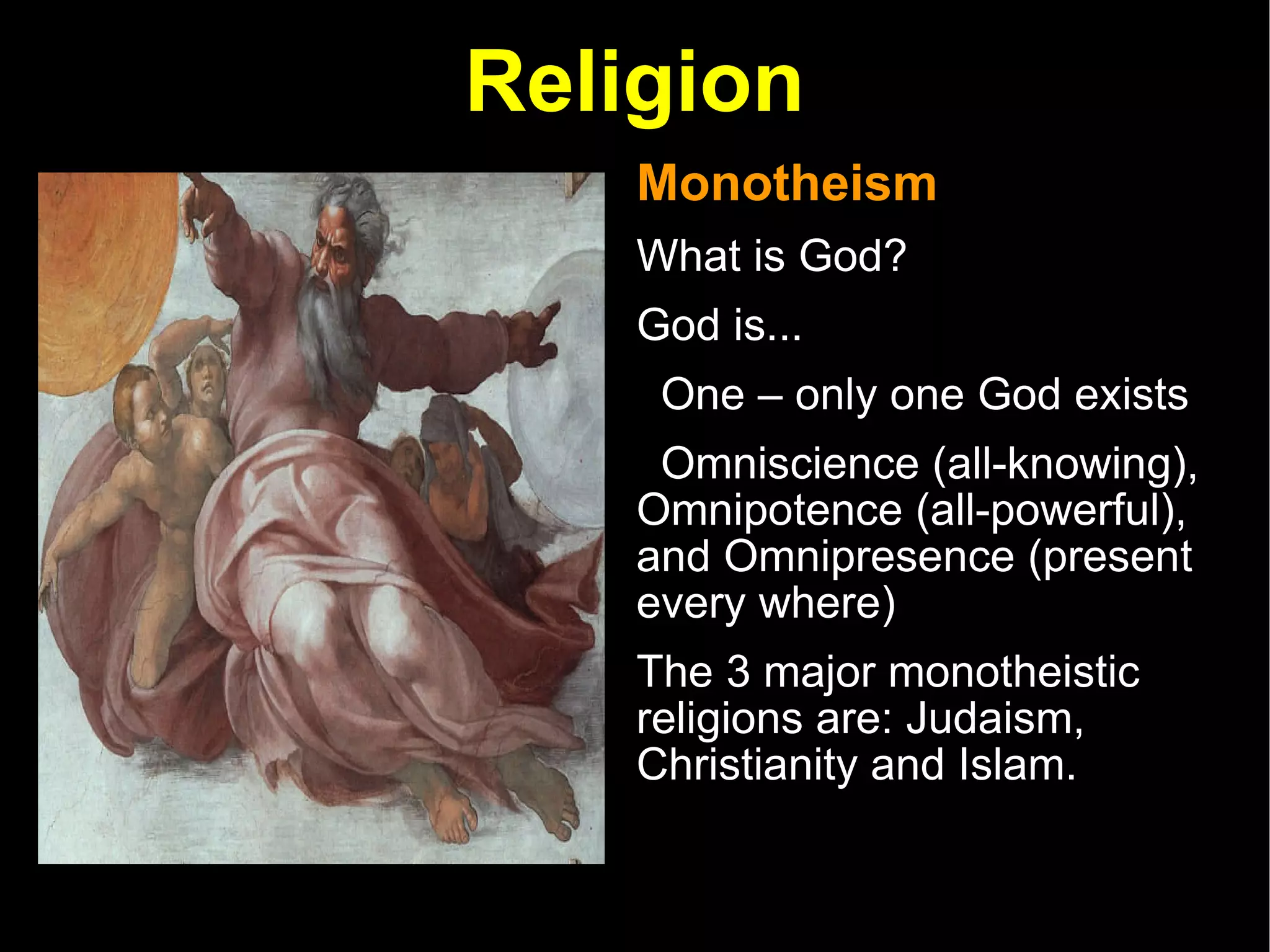
Religion Monotheism  What is God? God is...  One – only one God exists Omniscience (all-knowing), Omnipotence (all-powerful), and Omnipresence (present every where) The 3 major monotheistic religions are: Judaism, Christianity and Islam.
Religion Polytheism  What is God? God is Many  Many gods exists Can be as few as 2 gods or or millions of gods Ancient Greek and Roman religions are examples of polytheistic religions.
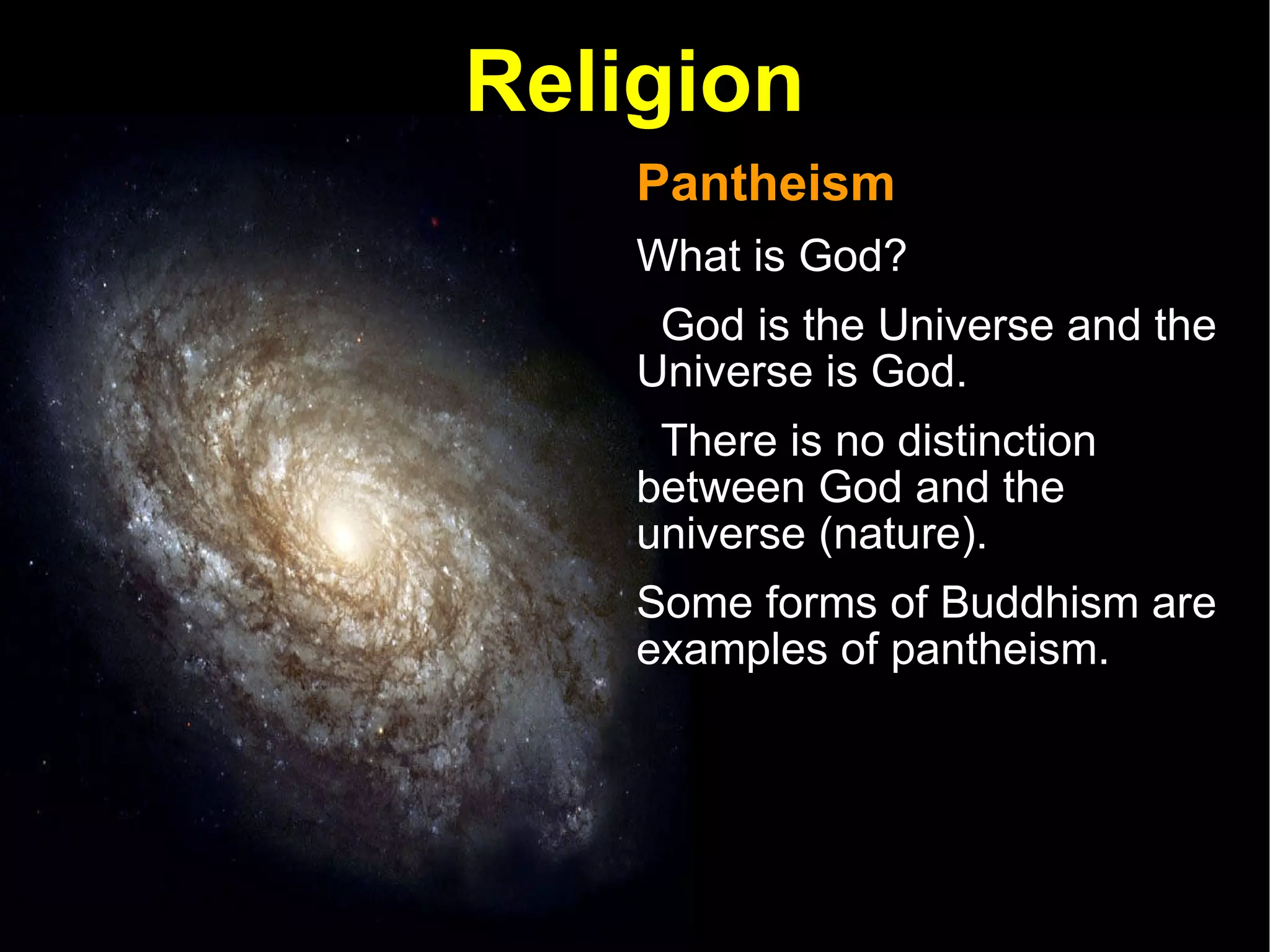
Religion Pantheism  What is God? God is the Universe and the Universe is God. There is no distinction between God and the universe (nature).  Some forms of Buddhism are examples of pantheism.
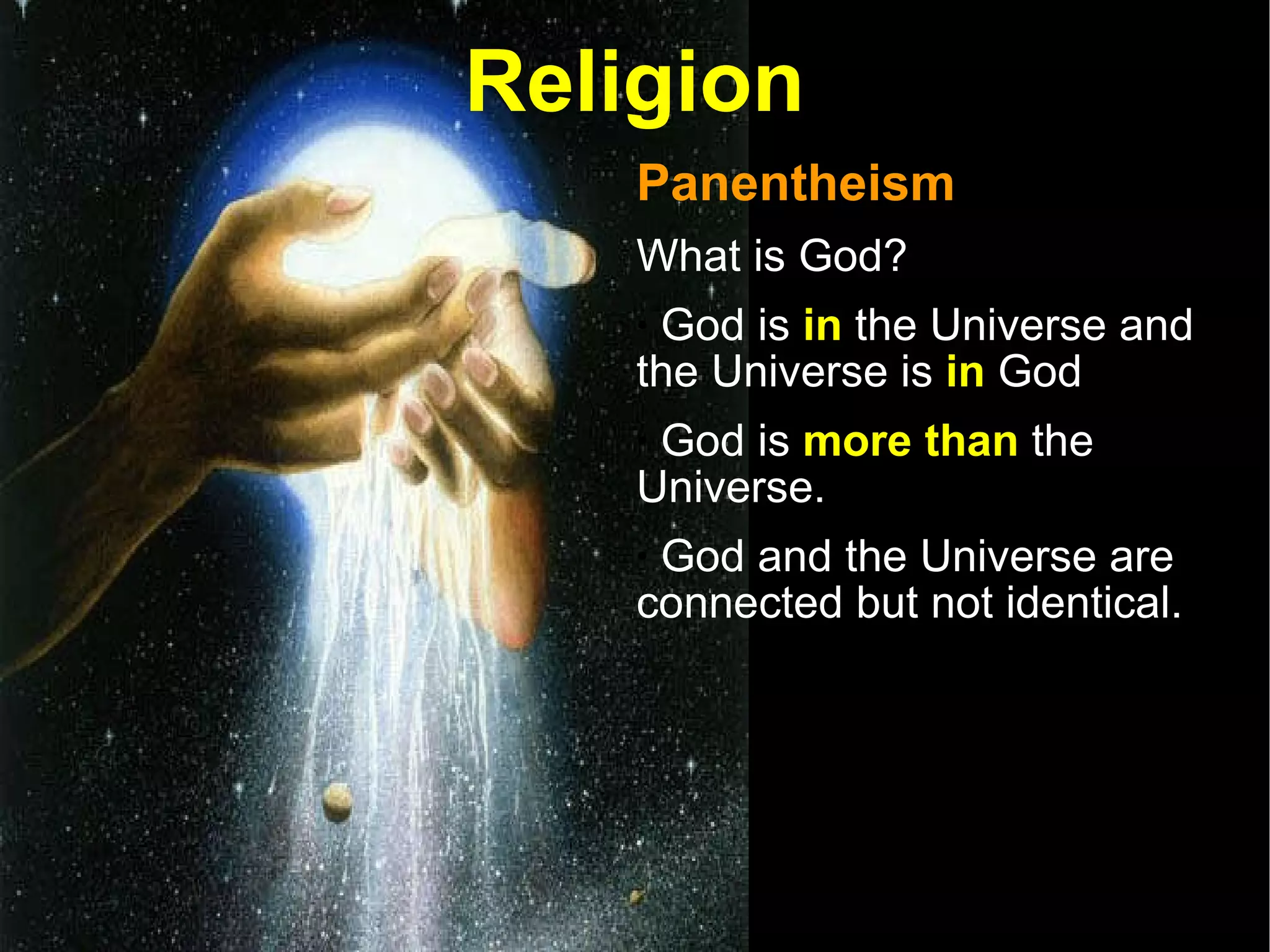
Religion Panentheism  What is God? God is  in  the Universe and the Universe is  in  God  God is  more than  the Universe. God and the Universe are connected but not identical.
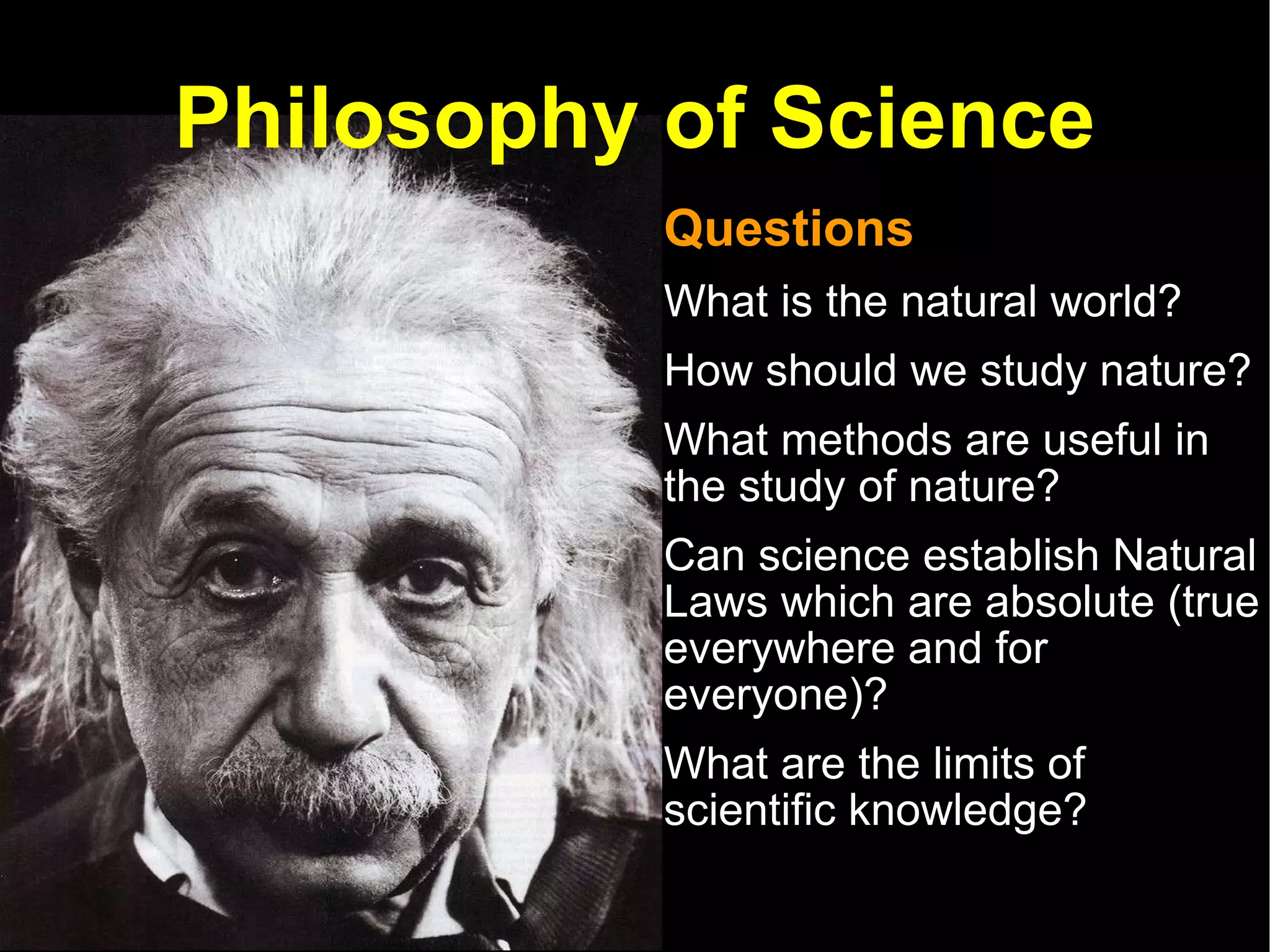
Philosophy of Science Science Concerned with the assumptions, foundations, methods and implications of science.  Empirical Verification Inductive Logic  Objectivity of the Observer
Philosophy of Science Questions  What is the natural world? How should we study nature?  What methods are useful in the study of nature?  Can science establish Natural Laws which are absolute (true everywhere and for everyone)? What are the limits of scientific knowledge?

Philosophy Lecture 01

  • 1.
    Introduction to PhilosophyIS-VNU Mr. Mike Lecture 1
  • 2.
    What is Philosophy?“ philo” - love “ sophia” - wisdom Philosophy is the love of wisdom Philosophy attempts to answer life's Big Questions
  • 3.
    What is Philosophy?Activity: Write down 5 questions that you feel are the most important questions in life.
  • 4.
    Some BIG Questions? What is real? Does God exist? What happens after death? Do we have souls? How should I think about things? What can I know? How do I know?
  • 5.
    Philosophy is aboutQuestions What? Why? How?
  • 6.
    Philosophers ask Questionsabout what people Believe What are the REASONS for a particular belief? Do you believe in God? WHY? Do you believe your ancestors protect you? WHY? Do you believe that murder is wrong? WHY?
  • 7.
    Philosophy is aboutExamining Ourselves & Our Beliefs “ The Unexamined Life is not worth living. ” (Socrates) Have you ever looked in the mirror and asked: Who am I? Why am I here? What should I do with my life?
  • 8.
    Examining Ourselves Activity Answer the question: Who are you? Rules - Don't give your name. - Don't say what you do. - Don't describe your nationality.
  • 9.
    Examining Our BeliefsBehavior Actions / Things you do Beliefs and Values Why do you what you do? World-View Basic Assumptions about Reality
  • 10.
    Examining Our BeliefsBehavior I talk to my friend Beliefs and Values I believe that my friend is real World-View I Exist. Other People Exist.
  • 11.
    Examining Our BeliefsBehavior I talk to other people Beliefs and Values I believe that my friend is real World-View I Exist. Other People Exist. Descartes
  • 12.
    Examining Our BeliefsDiscussion: Does Mr. Mike exist? Why do you believe that Mr. Mike exists or doesn't exist?
  • 13.
    Branches of PhilosophyEthics Politics Religion Metaphysics Logic Epistemology Aesthetics Science Philosophy
  • 14.
    Ethics Moral PhilosophyExplores questions about morality Good and Evil Right and Wrong Virtue and Vice Justice
  • 15.
    Ethics Questions: How should we live? What is good and evil? What is the best way to live? What is Justice? Is right and wrong the same everywhere or different everywhere?
  • 16.
    Ethics Discussion: An elderly decorated war hero is a guest at your house. He gets a little drunk and starts to talk to your teenage sister inappropriately. What do you do?
  • 17.
    Epistemology Knowledge ScienceExplores the nature and limitations of knowledge Definition of knowledge Investigates how knowledge is obtained Explores the relationship between belief, truth and knowledge
  • 18.
    Epistemology Questions: What is knowledge? How is knowledge acquired? How do we know what we know?
  • 19.
    Metaphysics Knowledge ScienceExplores the fundamental nature of reality and being Ontology Existence Objects Properties Space and Time Cause and Effect
  • 20.
    Metaphysics Questions: What is real? What is reality? What is reality like?
  • 21.
    Politics Political PhilosophyExplores the relationship between citizens and governments Liberty Legal Justice Property Ownership Citizen's Rights System of Law
  • 22.
    Politics Questions: How should government be organized? What makes a government legitimate? Who decides who the leaders should be? What laws are good and necessary? How should law be enforced?
  • 23.
    Aesthetics Sensori-Emotional ValuesExplores the nature of beauty, art, and taste with the creation and appreciation of beauty
  • 24.
    Aesthetics Questions Whatis beauty? What is art? What is the value of beauty and art? Who should judge what is beautiful or artistic? How should art and beauty be judged?
  • 25.
    Aesthetics Discussion: On the left is Marcel Duchamp's ready-made “sculpture” called “Fountain”. It's a factory-made urinal on a stand. Is this “Art”? Why / Why not? Is it beautiful? Offensive? Why?
  • 26.
    Logic Rules forThinking The systematic principles (or rules) for thinking rationally. Inferences are made by construction of Arguments Rules of Logic determine which arguments are VALID and which are FALACIES
  • 27.
    Logic Vocabulary Argument – a set of claims (evidence) used to support a conclusion. Inferences – Logical conclusions Argument: All humans breathe air. Mr. Mike is a human. Inference: Therefore , Mr. Mike must breathe air.
  • 28.
    Logic Vocabulary Validity – When an argument leads to a sound (logical) inference (conclusion) Fallacy – When an argument contains an error which leads to a false conclusion (inference) OR a conclusion that is not supported by the argument. Valid Argument: All humans breathe air. Mr. Mike is a human. Therefore, Mr. Mike must breathe air. Fallacious argument: All humans breathe air. Mr. Mike is a human. Therefore, Mr. Mike drinks water.
  • 29.
    Logic Vocabulary Logic cannot prove whether arguments are TRUE or FALSE . Logic can only show that an argument is VALID or FALLACIOUS . TRUE ≠ VALID FALSE ≠ FALLACY Valid Argument that is not True: All humans can fly. Mr. Mike is a human. Therefore, Mr. Mike can fly. Why is this argument VALID but not TRUE ?
  • 30.
    Logic Vocabulary Inductive logic – makes inferences from the particular (specific) to the general. Inductive conclusions are “probable” but not 100% certain Inductive logic establishes probability not validity Inductive logic is essential to the scientific method Inductive Argument: Particular Observations : Every American before 1870 has died. Americans are still dying. Generalization : All Americans are mortals (don't live forever) “ All Americans are mortals” is a “probable” conclusion.
  • 31.
    Logic Vocabulary Deductive logic – makes inferences from the general to the particular (specific). Deduction establishes what must be true if all the premises are also true. But, deduction cannot establish the truth of the premises. Inductive logic establishes what is validity . Deductive Argument: General Premises : All men are mortal. Socrates is a man. Particular Conclusion : Socrates is mortal.
  • 32.
    Logic Vocabulary Deductive logic is formed by using a syllogism . A syllogism is an argument that contains two premises and a conclusion. Syllogism: Premise A: All men are mortal. Premise B : Socrates is a man. Conclusion: Socrates is mortal.
  • 33.
    Logic Fallacies Non Sequitor A conclusion which does not follow from the premises. Syllogism: Premise A: All men are mortal. Premise B : Socrates is a man. Conclusion: Socrates is smart.
  • 34.
    Logic Fallacies Straw Man Misrepresenting an opponent's position. Person A: I believe in God. Person B: Person A believes in things that don't exist like fairies, Santa Clause and aliens.
  • 35.
    Logic Fallacies Sweeping Generalization A generalization that does not account for possible exceptions. Syllogism: Premise A: Cutting people is a crime. Premise B : Surgeons cut people. Conclusion: Surgeons are criminals.
  • 36.
    Logic Fallacies Sweeping Generalization A generalization that does not account for possible exceptions. Syllogism: Premise A: Cutting people is a crime. Premise B : Surgeons cut people. Conclusion: Surgeons are criminals.
  • 37.
    Logic Fallacies Hasty Generalization A generalization that follows from examples that are too limited. Syllogism: Premise A: Everybody I've met in England speaks English. Premise B : Everybody I've met in America speaks English. Conclusion: Everybody in the world speaks English.
  • 38.
    Logic Fallacies Red Herring A deliberate attempt to divert a process of enquiry by changing the subject. Syllogism: Mr. Jones: President Smith needs show us good reasons for raising taxes. President Smith : Taxes are important, but this country really needs to reduce crime rates.
  • 39.
    Logic Fallacies Ad Hominem An attempt to disprove an opponents position by attacking his character instead of his logic. Example: Mr. Johnson's argument for lowering taxes can't be taken seriously. He is a billionaire and earned his money from very questionable business deals.
  • 40.
    Logic Fallacies Ad Baculum An attempt to silence an opponents position by threatening to use force or punishment. Jim: I don't think our company should spend $100,000 on executive bonuses. Jim's Employer: Be quiet Jim or I will fire you.
  • 41.
    Logic Fallacies Loaded Questions Groups more than one question or assertion in a single question. Example: Did you stop using drugs? Problems: (1) Question assumes a conclusion without proving it (i.e. you are a drug user). (2) You can't answer the question without affirming that you used drugs.
  • 42.
    Logic Fallacies Circular Reasoning An argument is circular if its conclusion is among its premises, if it assumes what it is trying to prove. Example: Honest Joe claims to be honest. Honest Joe never lies. Therefore, Honest Joe really is honest.
  • 43.
    Logic Fallacies Appeal to Popularity Attempts to prove that an idea is true simply because it is widely held. Example: Most people believe that God exists. Therefore, God must exist.
  • 44.
    Logic Fallacies Appeal to Popularity Attempts to prove that an idea is true simply because it is widely held. Example: Most people believe that God exists. Therefore, God must exist.
  • 45.
    Religion Philosophy ofReligion Branch of philosophy concerned with questions regarding religion Nature & Existence of God Theology Examination of Religious Experience Analysis of Religious language and texts Relationship between Religion and Science
  • 46.
    Religion Questions DoesGod exist? What is God? What is the nature of the relationship between God and humans? Is God active in the world? How? Is there life after death? What is the relationship between Religion and Ethics? ...Religion and Science?
  • 47.
    Religion What isGod? Assuming that God exists, there are at least 4 general answers to this question. Monotheistic answer Polytheistic answer Pantheistic answer Panentheistic answer Within each general view of God there are many specific versions.
  • 48.
    Religion Monotheism What is God? God is... One – only one God exists Omniscience (all-knowing), Omnipotence (all-powerful), and Omnipresence (present every where) The 3 major monotheistic religions are: Judaism, Christianity and Islam.
  • 49.
    Religion Polytheism What is God? God is Many Many gods exists Can be as few as 2 gods or or millions of gods Ancient Greek and Roman religions are examples of polytheistic religions.
  • 50.
    Religion Pantheism What is God? God is the Universe and the Universe is God. There is no distinction between God and the universe (nature). Some forms of Buddhism are examples of pantheism.
  • 51.
    Religion Panentheism What is God? God is in the Universe and the Universe is in God God is more than the Universe. God and the Universe are connected but not identical.
  • 52.
    Philosophy of ScienceScience Concerned with the assumptions, foundations, methods and implications of science. Empirical Verification Inductive Logic Objectivity of the Observer
  • 53.
    Philosophy of ScienceQuestions What is the natural world? How should we study nature? What methods are useful in the study of nature? Can science establish Natural Laws which are absolute (true everywhere and for everyone)? What are the limits of scientific knowledge?