Introduction to Philosophy IS-VNU Mr. Mike  Lecture 11
Introduction to Philosophy Existentialism Positivism  Logical Positivism
Introduction to Philosophy Exercise:  Write an answer to the following question... Why are you here? What is your purpose in life?
Introduction to Philosophy Discussion:  How do you find out your purpose in life?
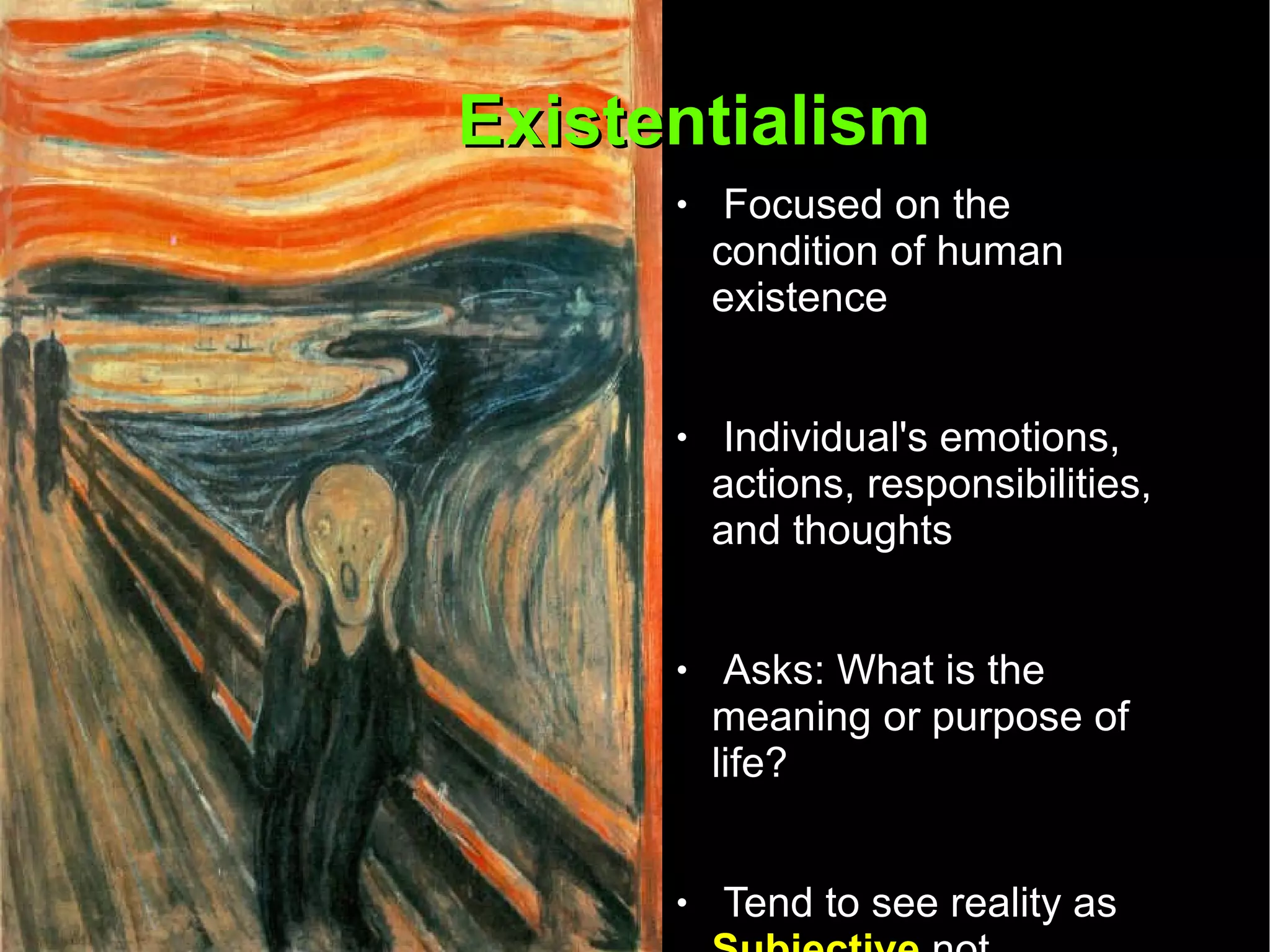
Existentialism  Focused on the condition of human existence Individual's emotions, actions, responsibilities, and thoughts Asks: What is the meaning or purpose of life? Tend to see reality as  Subjective  not  Objective
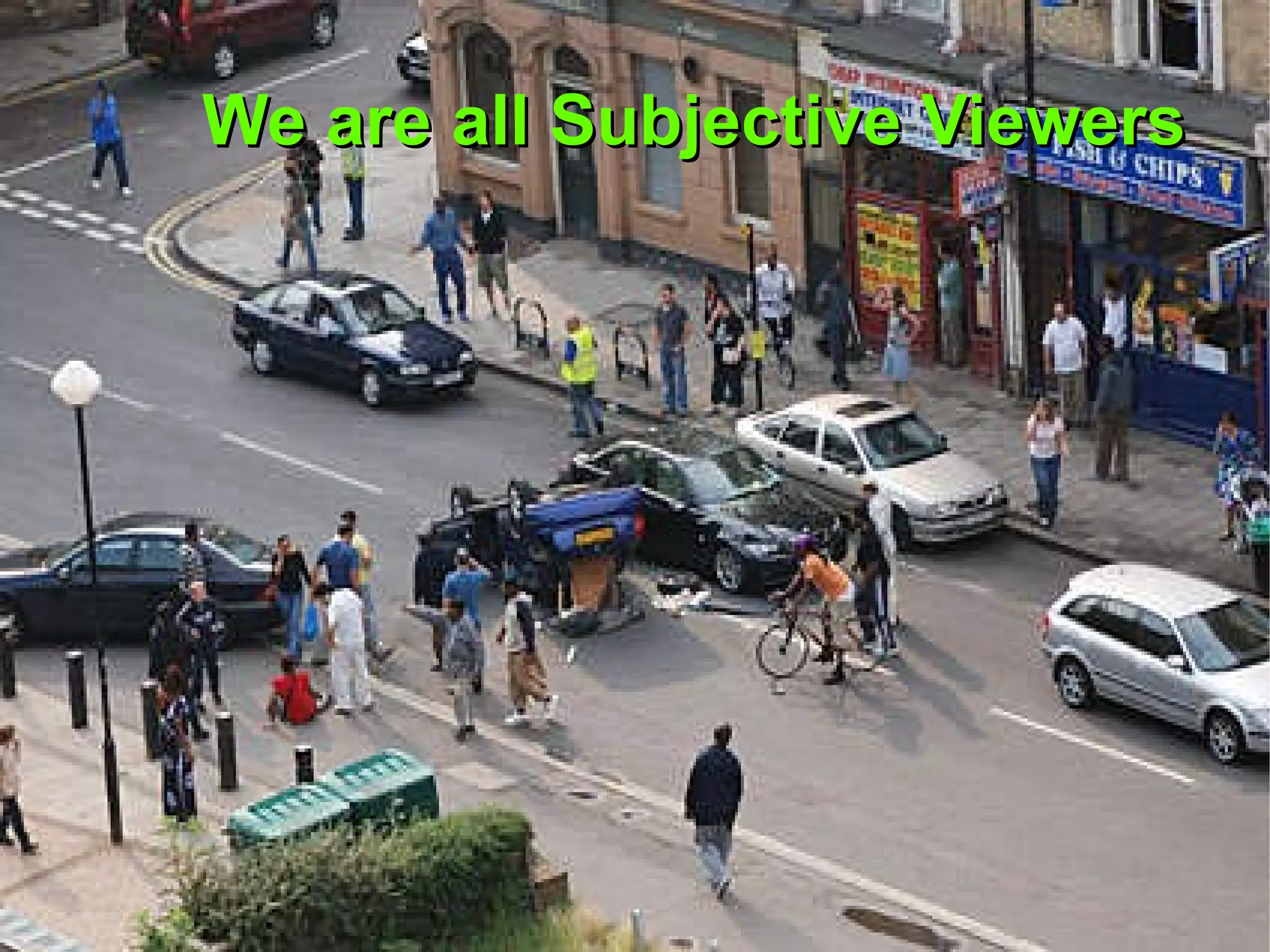
We are all Subjective Viewers
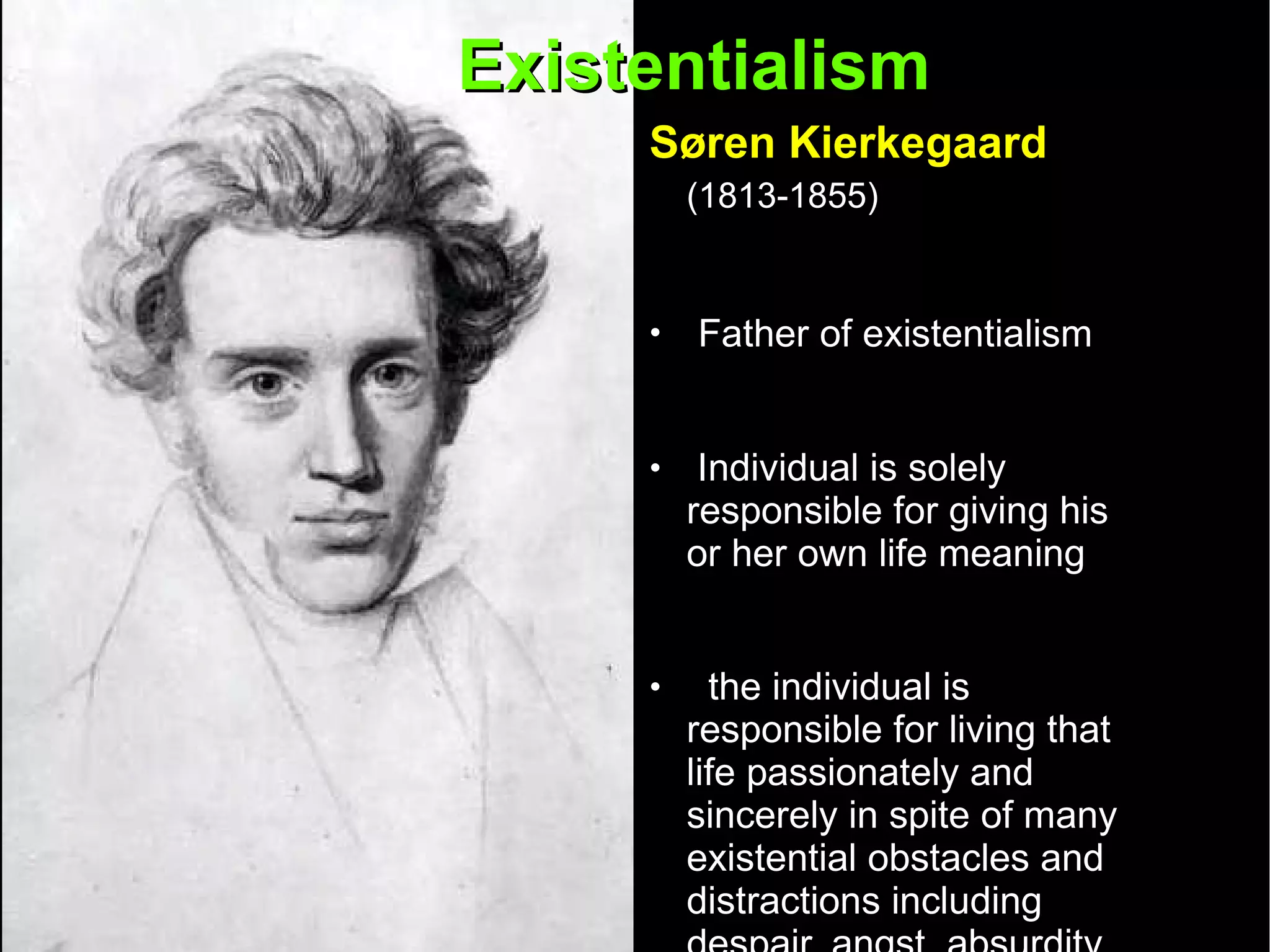
Existentialism  Søren Kierkegaard   (1813-1855)   Father of existentialism Individual is solely responsible for giving his or her own life meaning the individual is responsible for living that life passionately and sincerely in spite of many existential obstacles and distractions including despair, angst, absurdity, alienation, and boredom
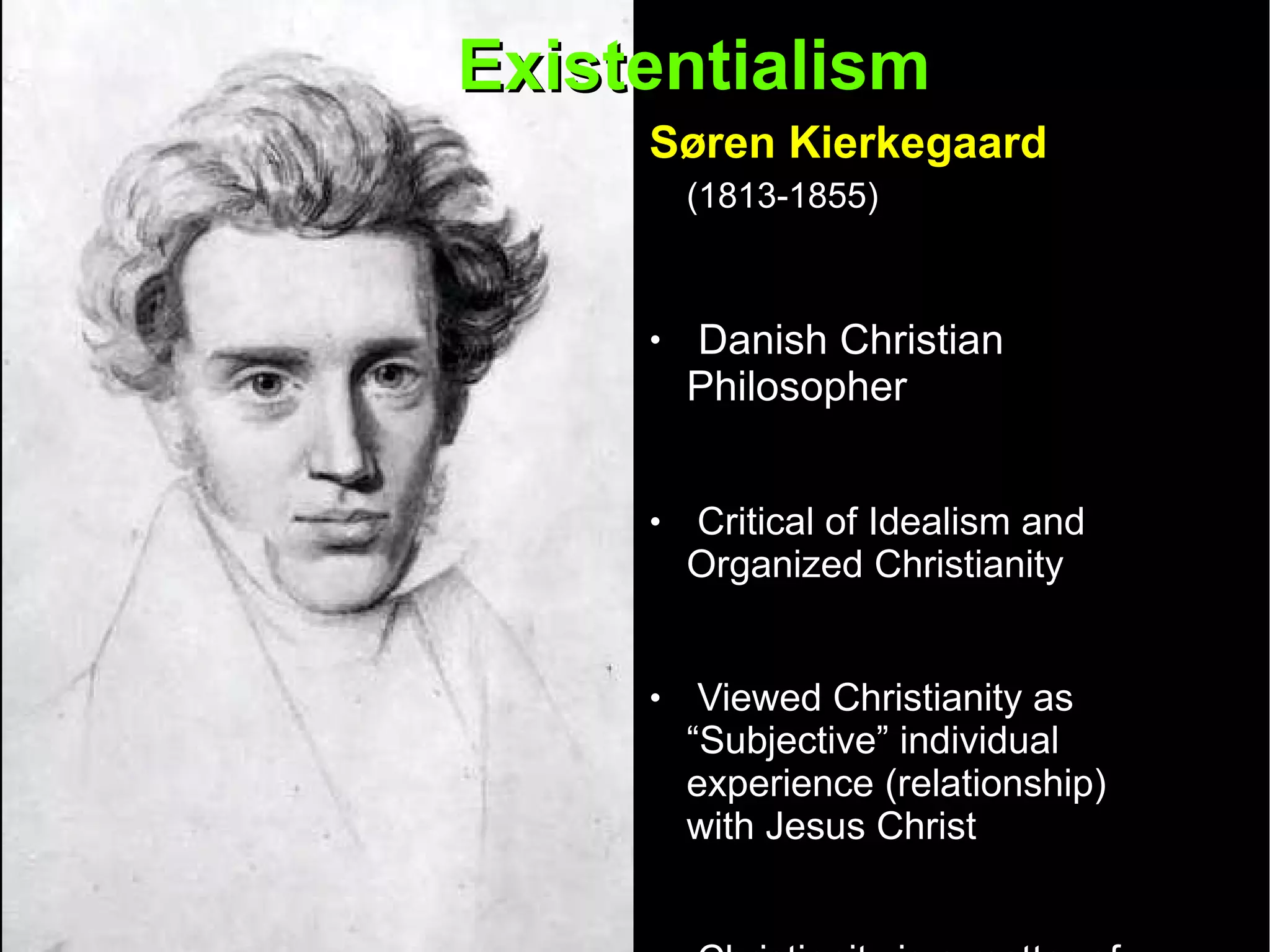
Existentialism  Søren Kierkegaard   (1813-1855)   Danish Christian Philosopher  Critical of Idealism and Organized Christianity Viewed Christianity as “Subjective” individual experience (relationship) with Jesus Christ  Christianity is a matter of faith not rationalism or scientific knowledge
Existentialism  Søren Kierkegaard   (1813-1855)   Leap of Faith   Faith is not a decision based on empirical evidence Love is also not based on rational knowledge of another person  Faith and Love both require the individual to make a commitment  No “evidence” could ever be enough to pragmatically justify the kind of total commitment involved in true religious faith or romantic love
Existentialism  Søren Kierkegaard   (1813-1855)   Leap of Faith  F aith requires Doubt To truly believe in God, you need to experience Doubt Doubt is the rational part of a person's thought involved in weighing evidence Religious Faith and Love are NOT capable of objective certainty
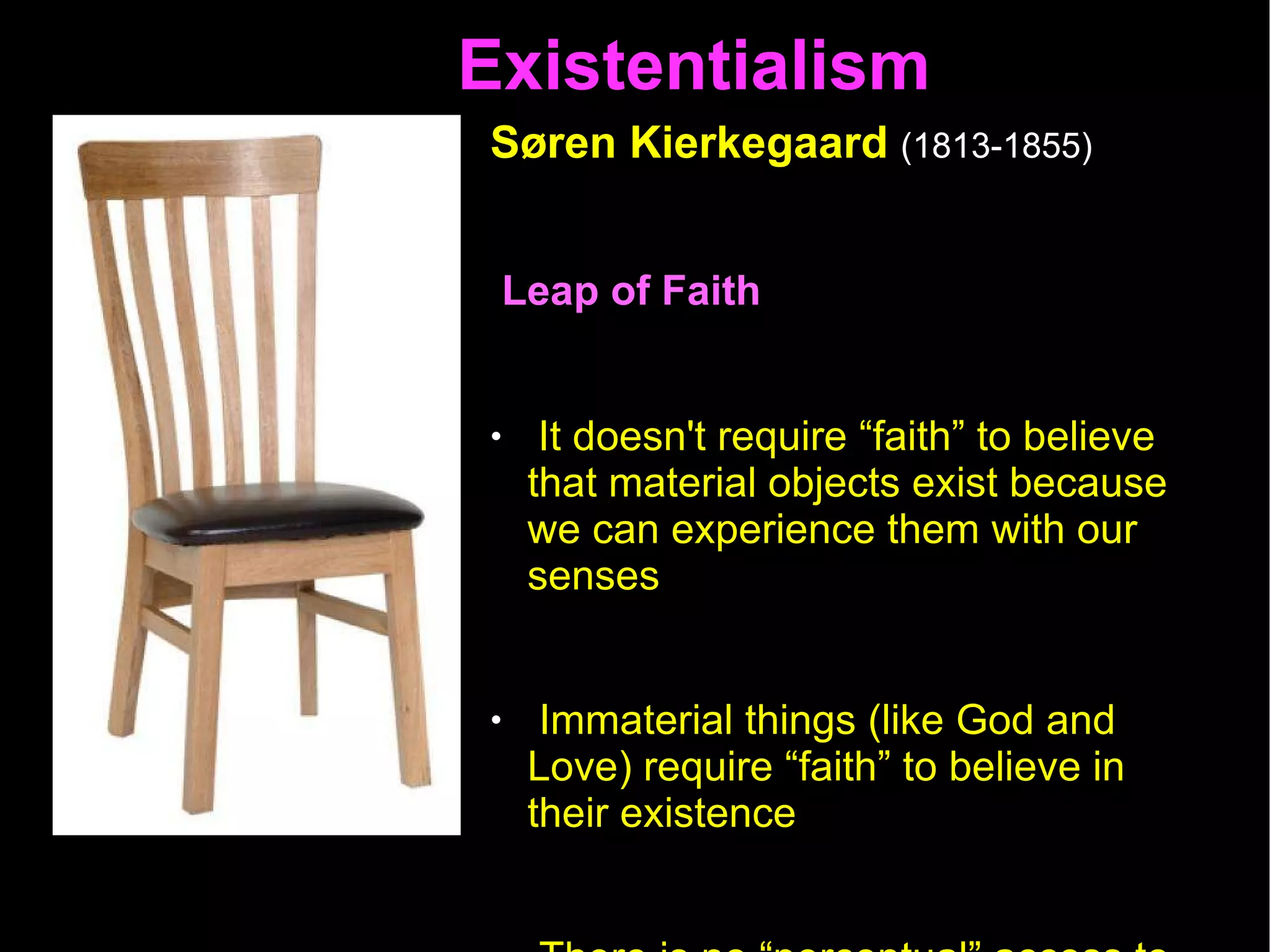
Existentialism  Søren Kierkegaard   (1813-1855)   Leap of Faith  It doesn't require “faith” to believe that material objects exist because we can experience them with our senses  Immaterial things (like God and Love) require “faith” to believe in their existence There is no “perceptual” access to God (or Love); faith is the only access we have to God
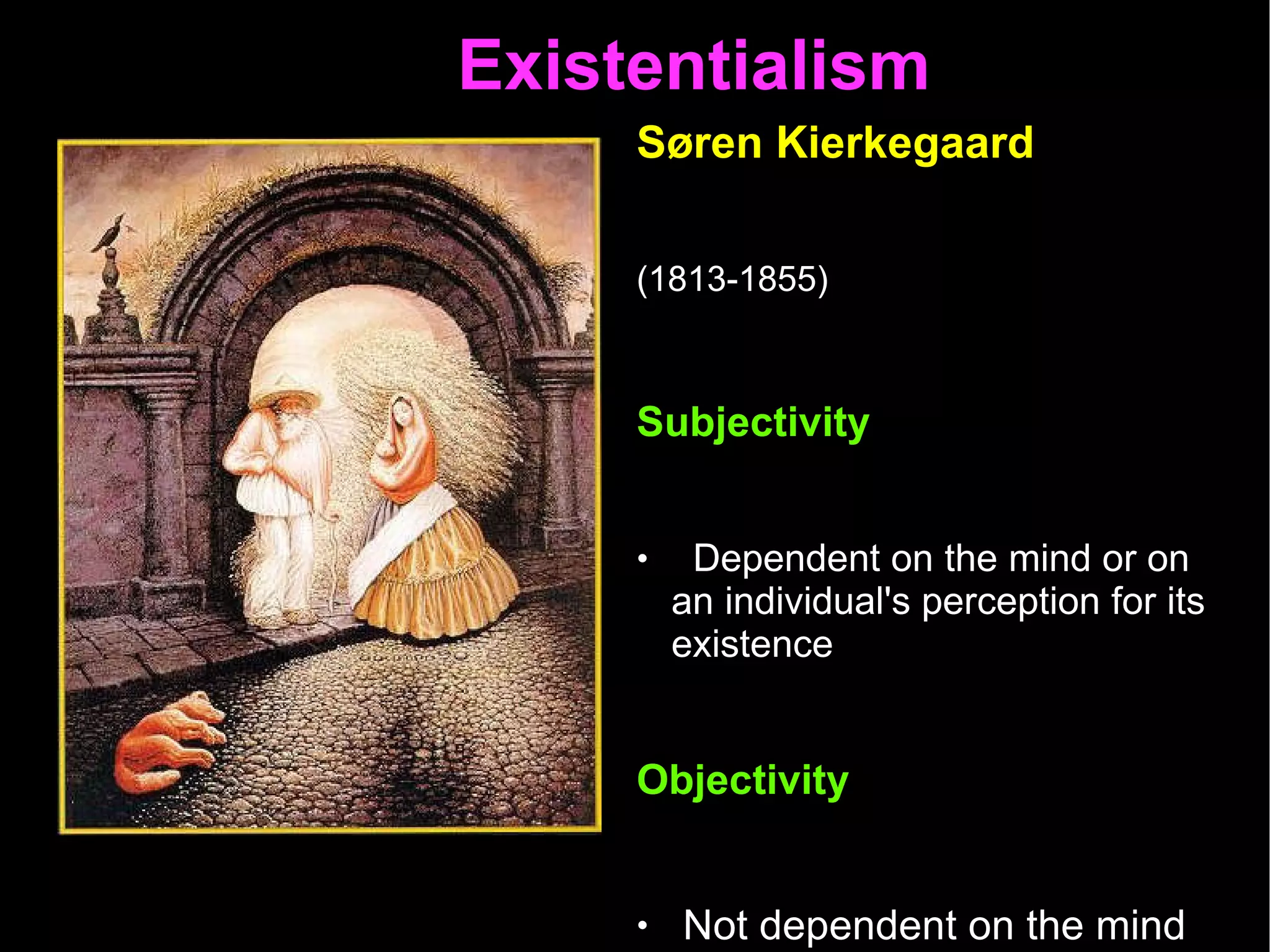
Existentialism  Søren Kierkegaard   (1813-1855)   Subjectivity  Dependent on the mind or on an individual's perception for its existence Objectivity   Not dependent on the mind for existence; actual facts  All religious knowledge is “subjective” not Objective
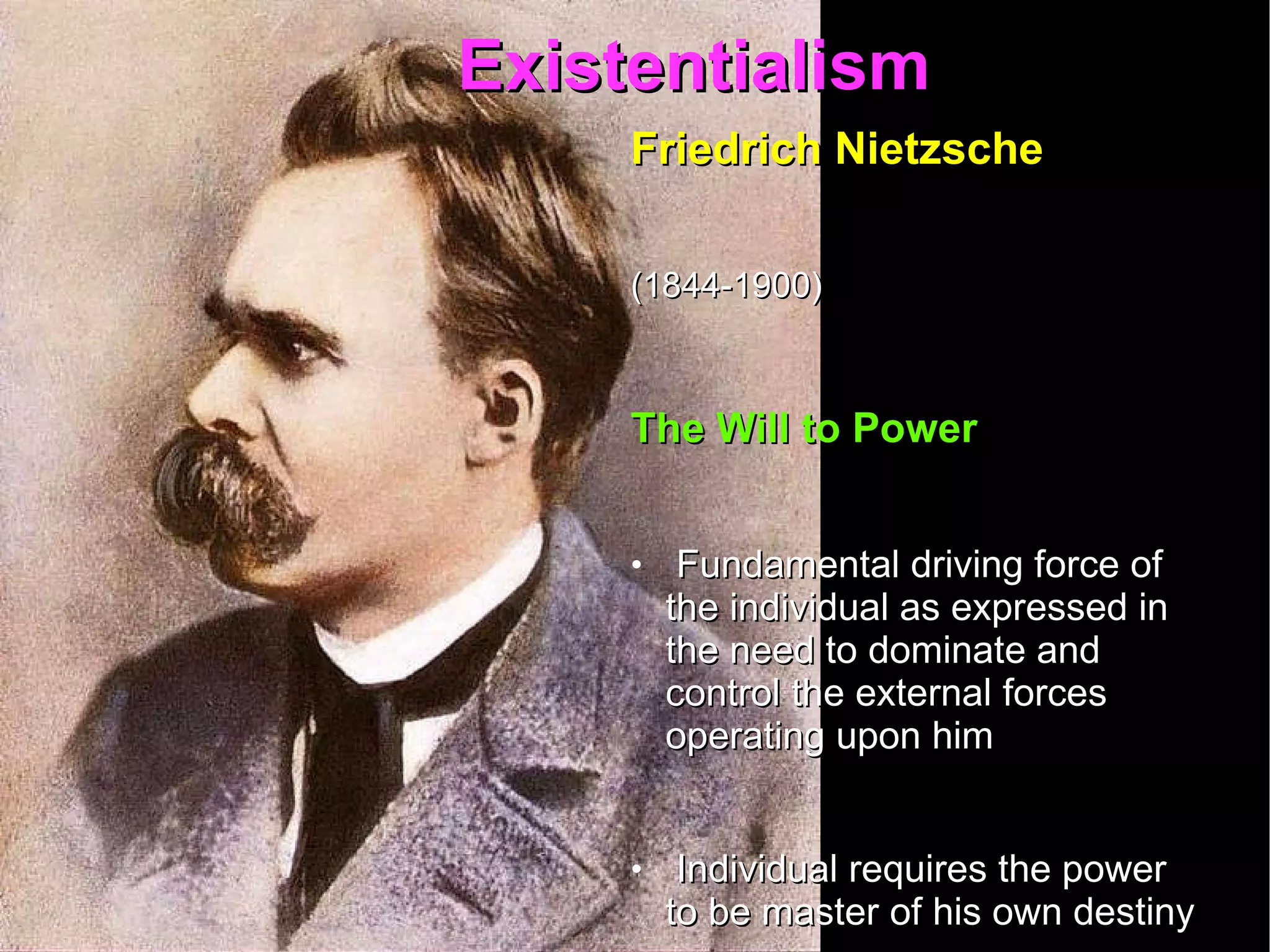
Existentialism  Friedrich Nietzsche   (1844-1900)   The Will to Power Fundamental driving force of the individual as expressed in the need to dominate and control the external forces  operating upon him Individual requires the power to be master of his own destiny Moral systems and religious institutions attempt to bind and subdue the will
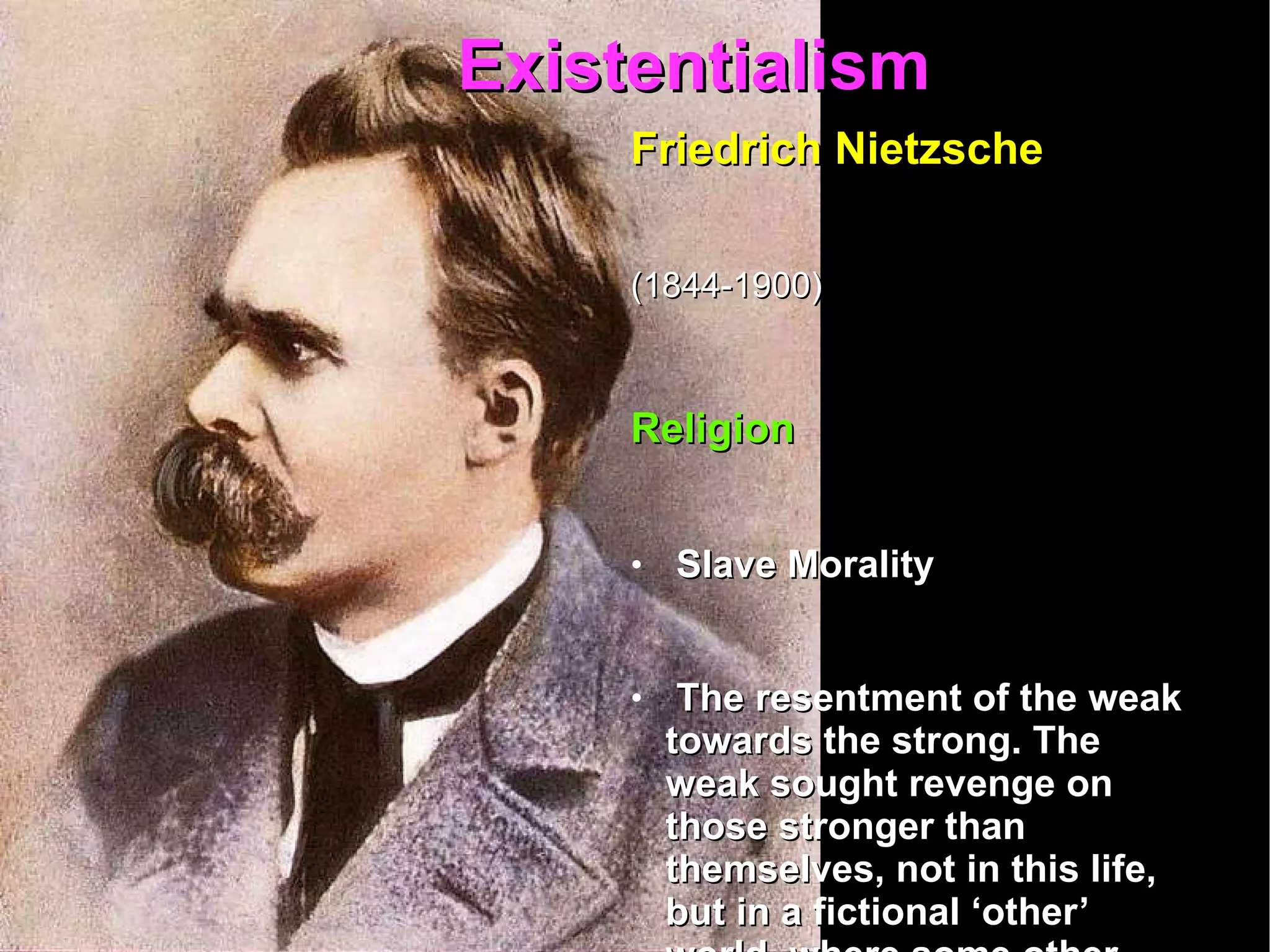
Existentialism  Friedrich Nietzsche   (1844-1900)   Religion Slave Morality The resentment of the weak towards the strong. The weak sought revenge on those stronger than themselves, not in this life, but in a fictional ‘other’ world, where some other power, namely God, would wreak vengeance on their behalf.
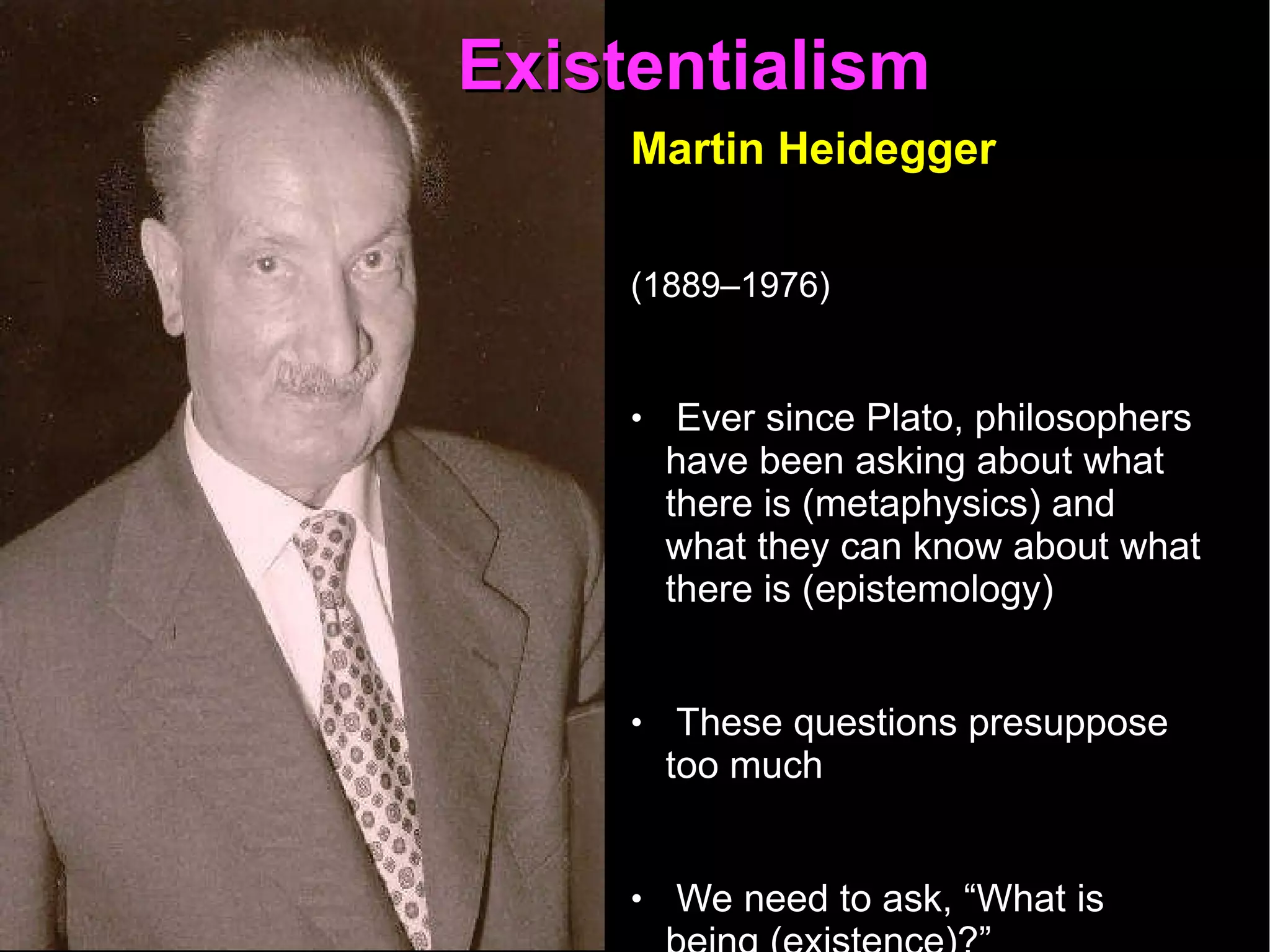
Existentialism  Martin Heidegger   (1889–1976)   Ever since Plato, philosophers have been asking about what there is (metaphysics) and what they can know about what there is (epistemology) These questions presuppose too much  We need to ask, “What is being (existence)?”  Why is there something instead of nothing?
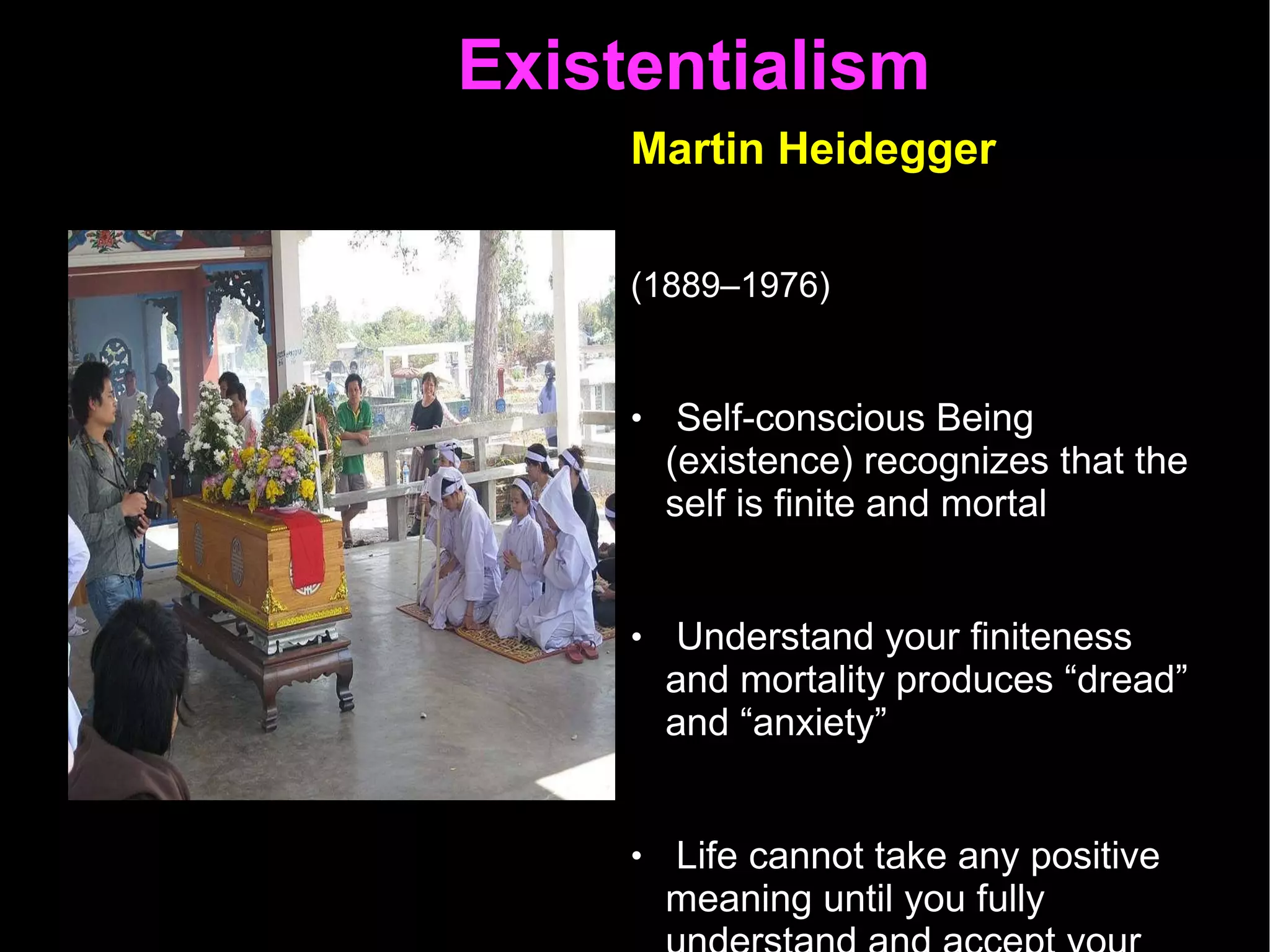
Existentialism  Martin Heidegger   (1889–1976)   Self-conscious Being (existence) recognizes that the self is finite and mortal  Understand your finiteness and mortality produces “dread” and “anxiety”  Life cannot take any positive meaning until you fully understand and accept your finiteness and morality  This self-awareness leads to authenticity – choosing something out of nothing
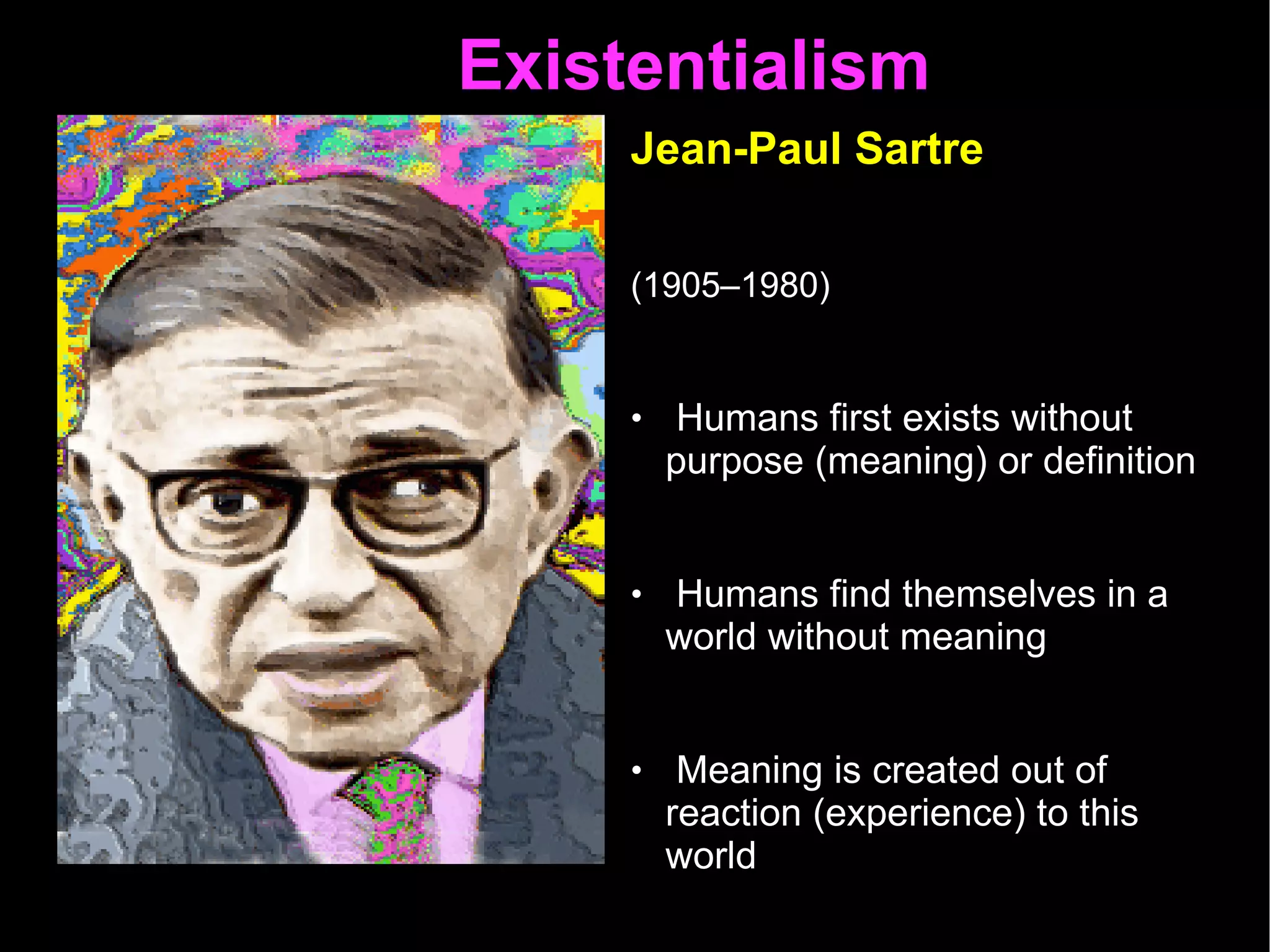
Existentialism  Jean-Paul Sartre   (1905–1980)   Humans first exists without purpose (meaning) or definition Humans find themselves in a world without meaning Meaning is created out of reaction (experience) to this world First existence, then Meaning
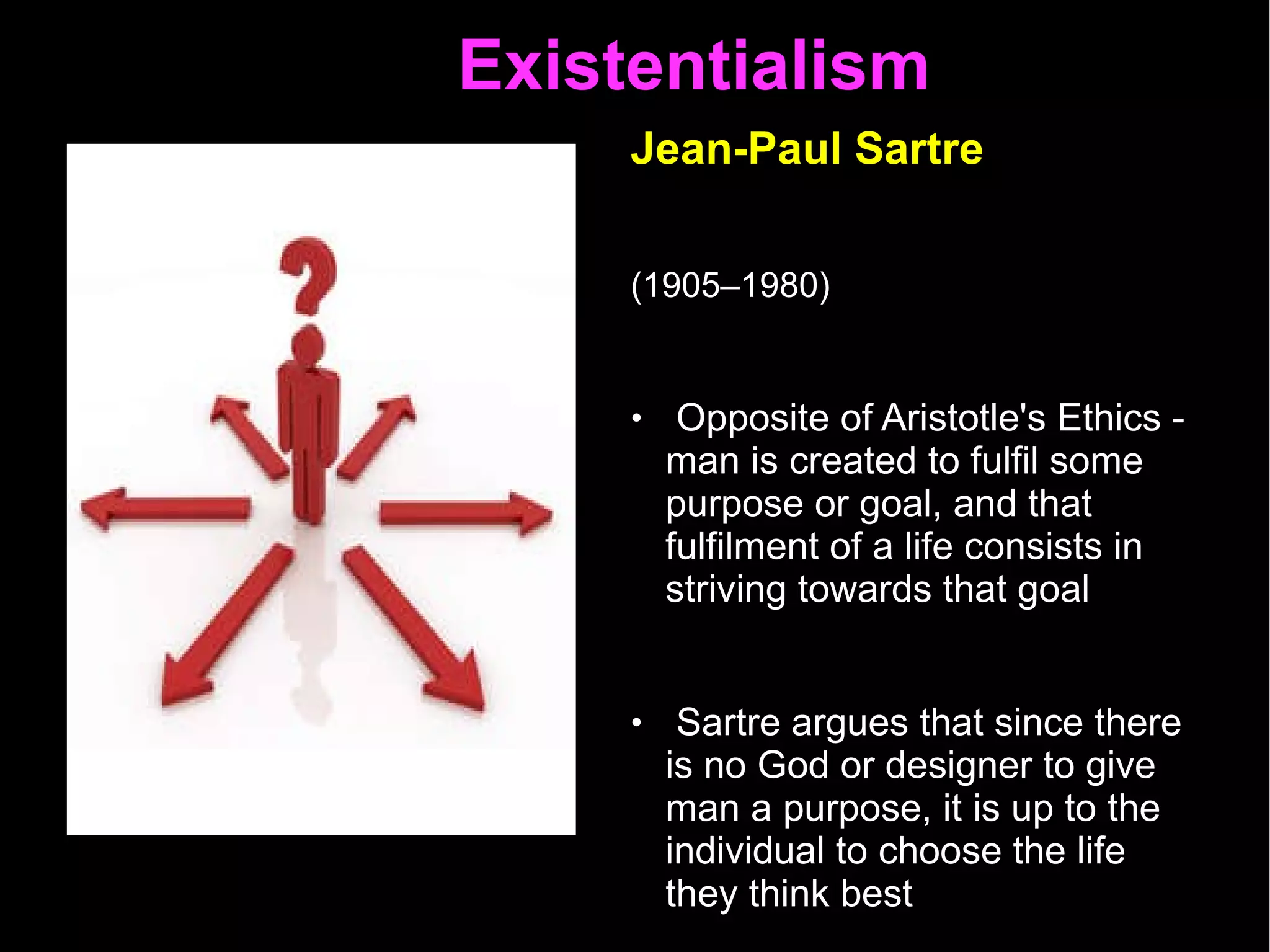
Existentialism  Jean-Paul Sartre   (1905–1980)   Opposite of Aristotle's Ethics - man is created to fulfil some purpose or goal, and that fulfilment of a life consists in striving towards that goal Sartre argues that since there is no God or designer to give man a purpose, it is up to the individual to choose the life they think best “ Man is condemned to be free”
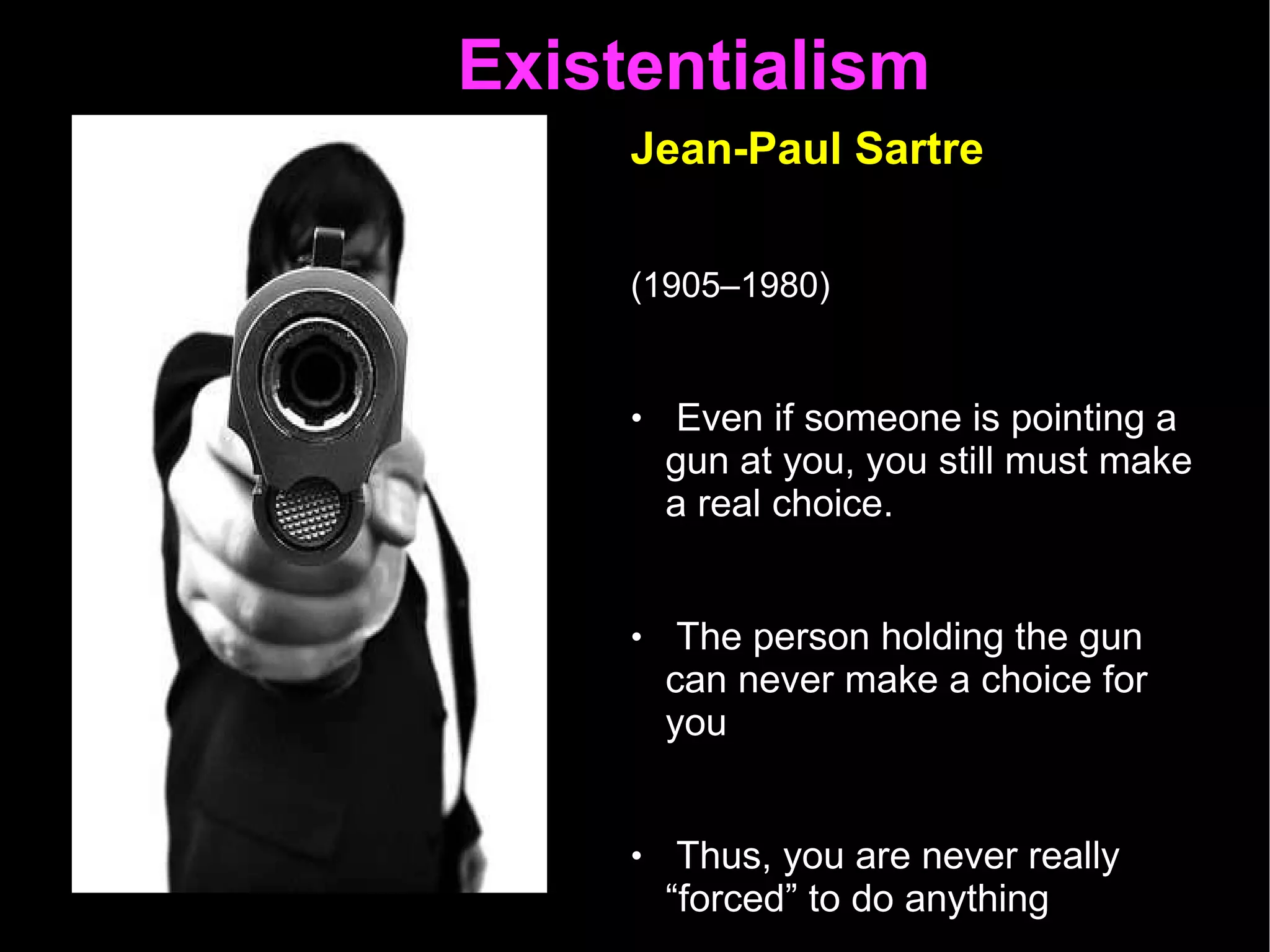
Existentialism  Jean-Paul Sartre   (1905–1980)   Even if someone is pointing a gun at you, you still must make a real choice.  The person holding the gun can never make a choice for you  Thus, you are never really “forced” to do anything You are only forced to choose
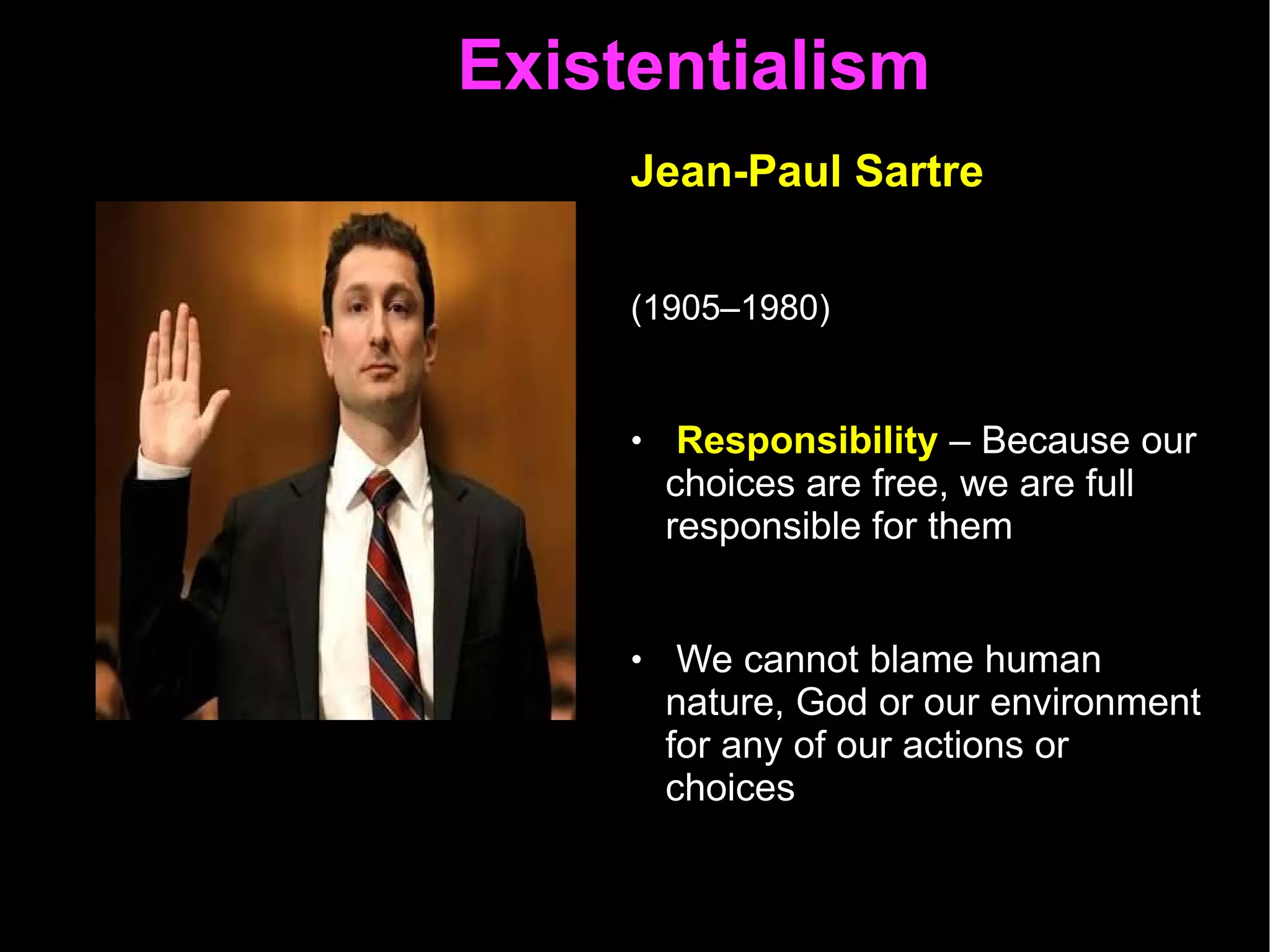
Existentialism  Jean-Paul Sartre   (1905–1980)   Responsibility  – Because our choices are free, we are full responsible for them  We cannot blame human nature, God or our environment for any of our actions or choices
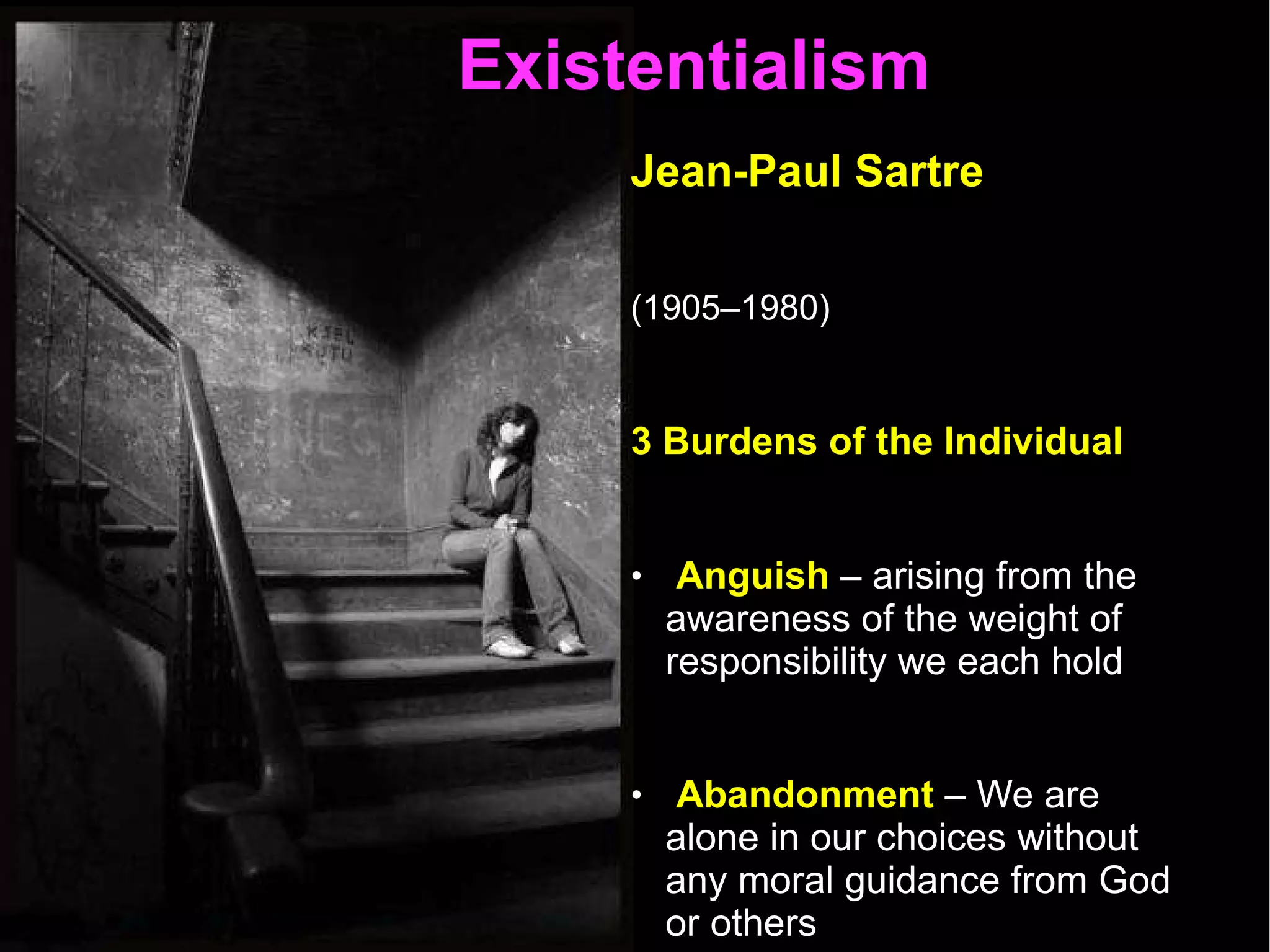
Existentialism  Jean-Paul Sartre   (1905–1980)   3 Burdens of the Individual  Anguish  – arising from the awareness of the weight of responsibility we each hold  Abandonment  – We are alone in our choices without any moral guidance from God or others  Despair  - We must act without hope. We cannot trust that things will turn out for the best. There is no providence.
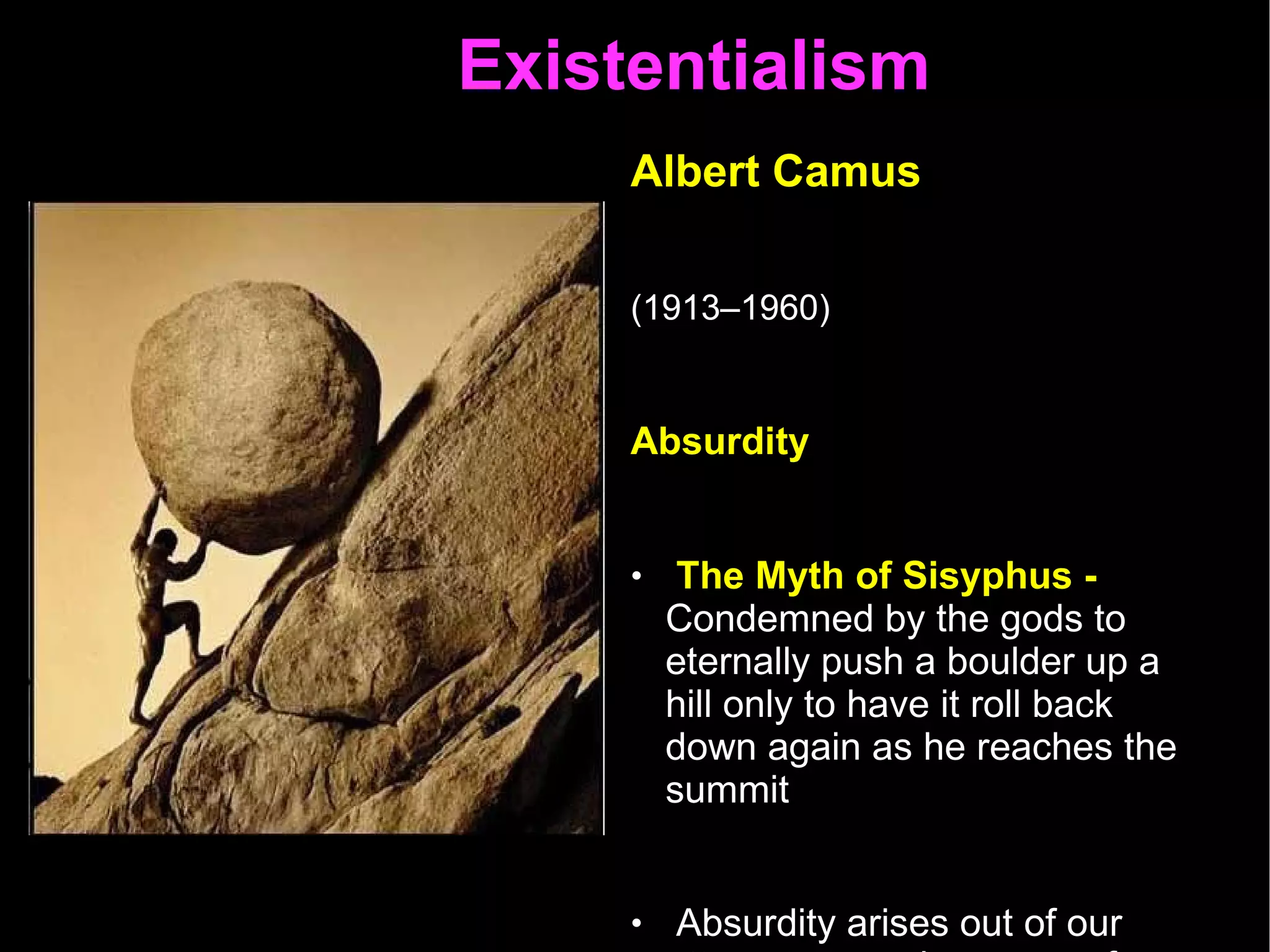
Existentialism  Albert Camus   (1913–1960)   Absurdity  The Myth of Sisyphus -  Condemned by the gods to eternally push a boulder up a hill only to have it roll back down again as he reaches the summit Absurdity arises out of our attempts to make sense of a senseless world Life is pointless
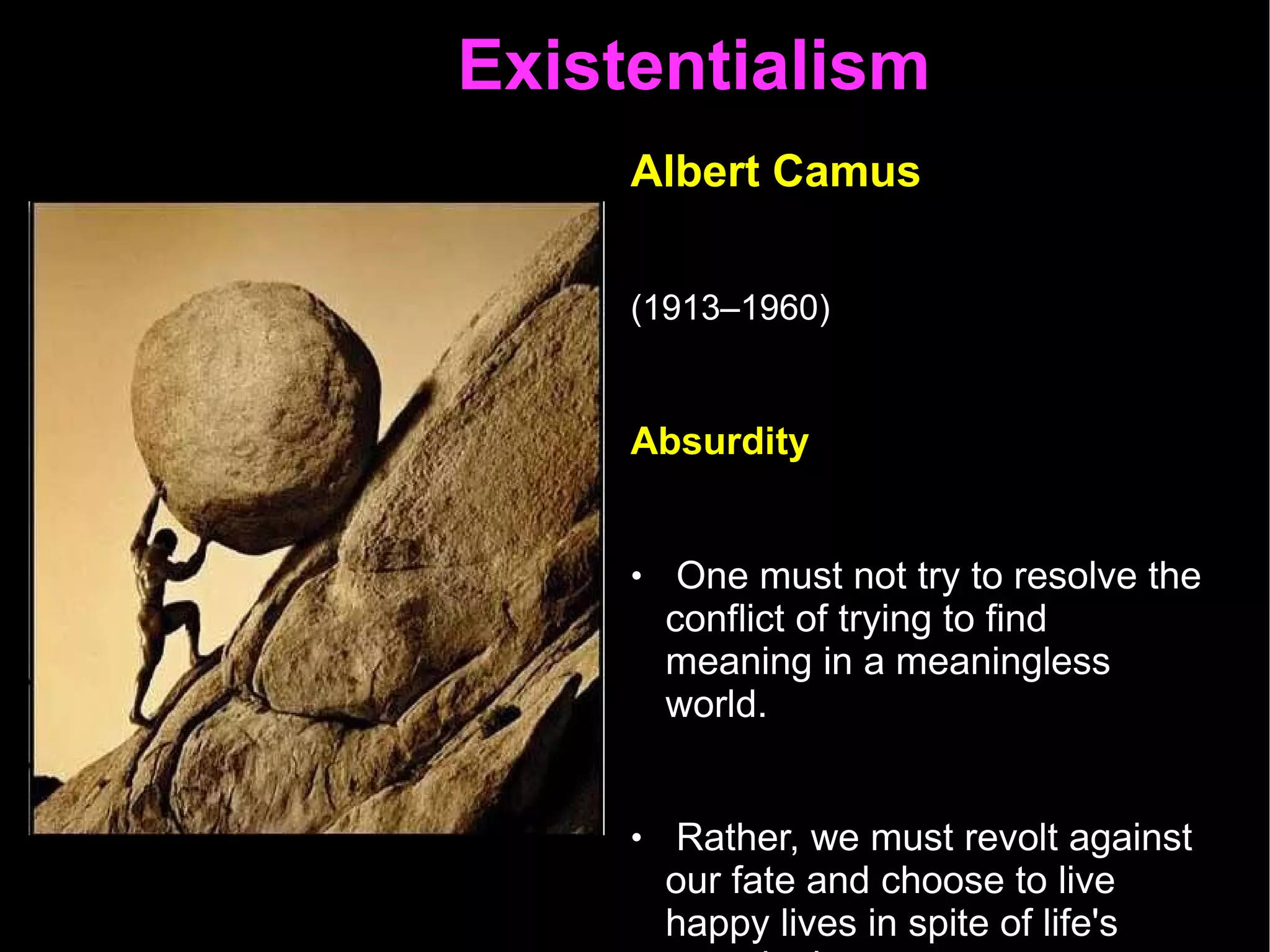
Existentialism  Albert Camus   (1913–1960)   Absurdity  One must not try to resolve the conflict of trying to find meaning in a meaningless world.  Rather, we must revolt against our fate and choose to live happy lives in spite of life's meaninglessness
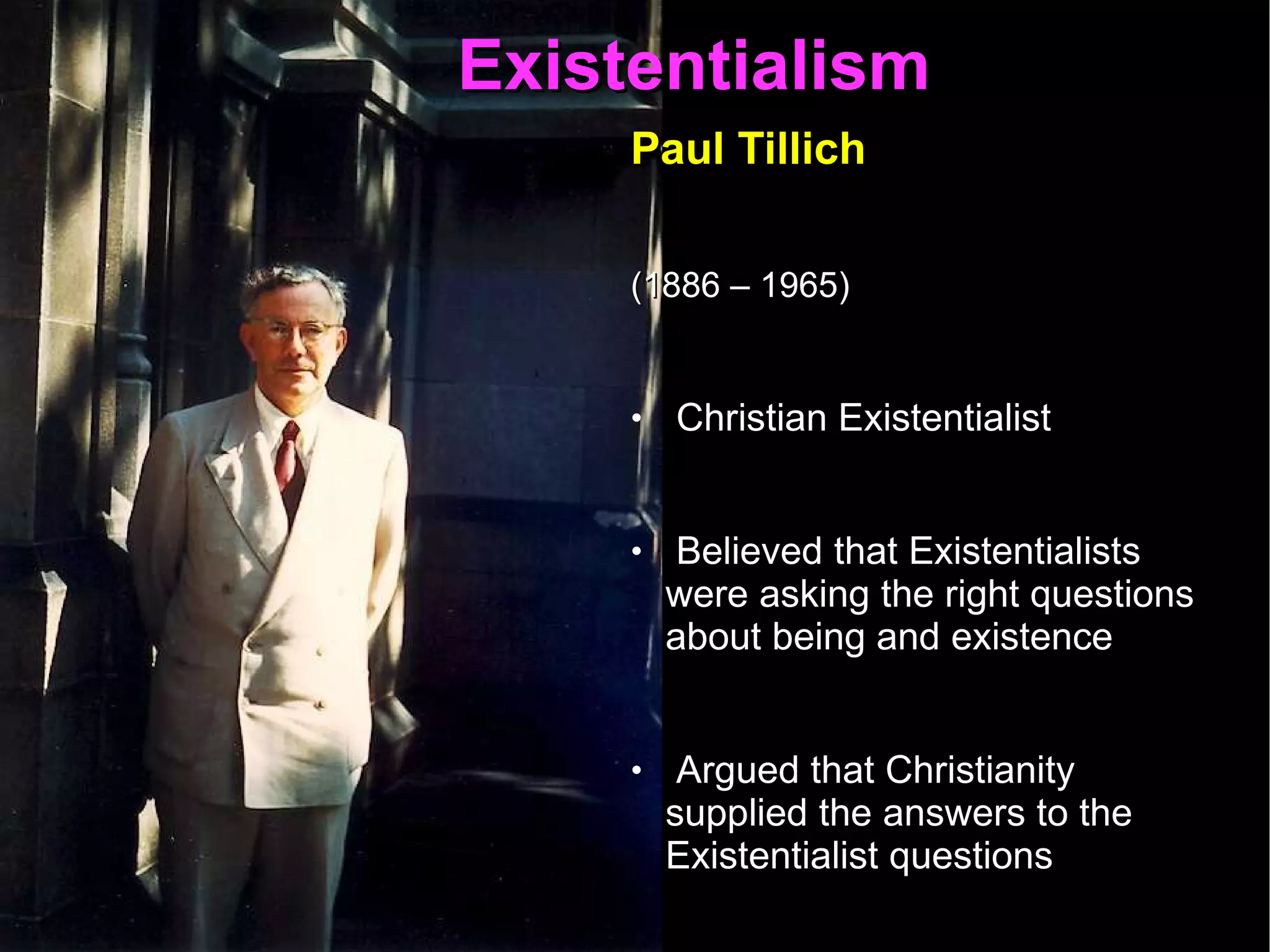
Existentialism  Paul Tillich   (1886 – 1965)   Christian Existentialist  Believed that Existentialists were asking the right questions about being and existence  Argued that Christianity supplied the answers to the Existentialist questions  The task of the philosopher is to formulate questions of existence  The task of the theologian is to formulate the answers
Existentialism  Paul Tillich   (1886 – 1965)   Faith  Faith is not opposed to either reason or emotion  Faith transcend both reason and emotions  Faith is require of both the theist and the atheist  The theist relies on faith to believe God's existence  The atheist relies on faith to deny God's existence
Positivism  The Scientific Method is the best approach to uncovering the processes by which both physical and human events occur  Asserts that the only authentic knowledge is that which is based on sense, experience and positive verification The Scientific Method replaces Metaphysics
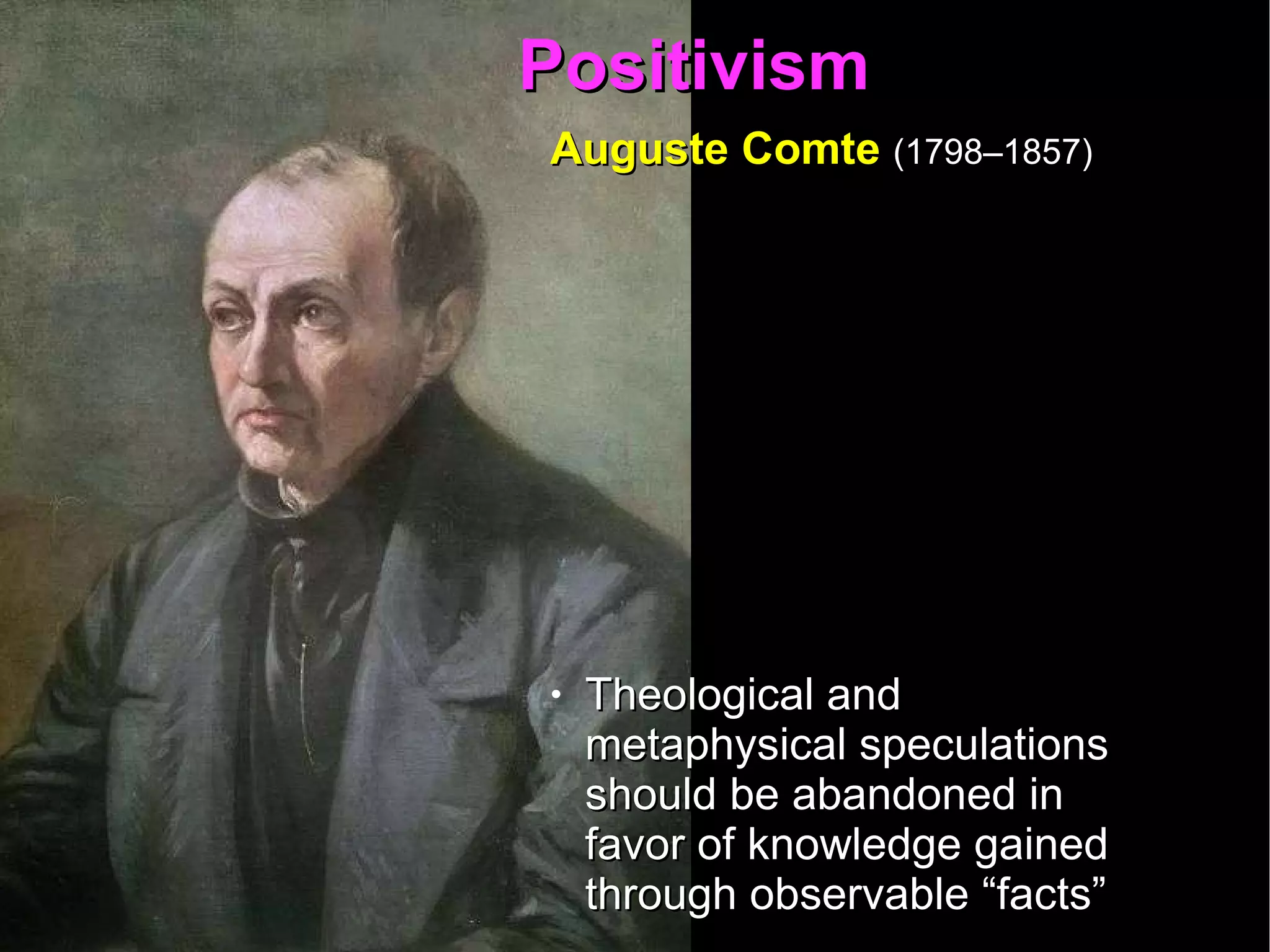
Positivism  Auguste Comte   (1798–1857)   Theological and metaphysical speculations should be abandoned in favor of knowledge gained through observable “facts”
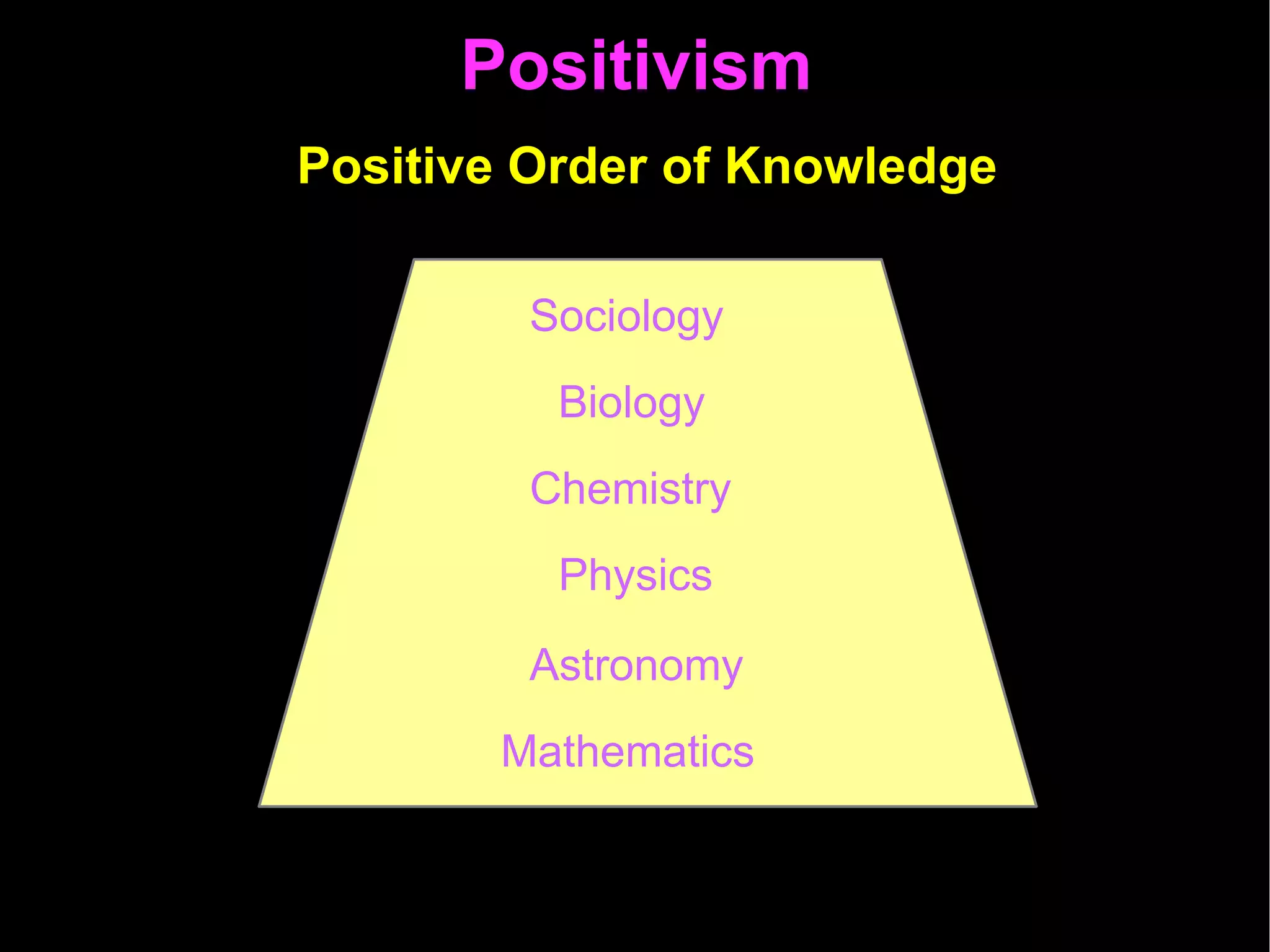
Positivism  Positive Order of Knowledge Mathematics Astronomy Physics  Sociology Biology Chemistry
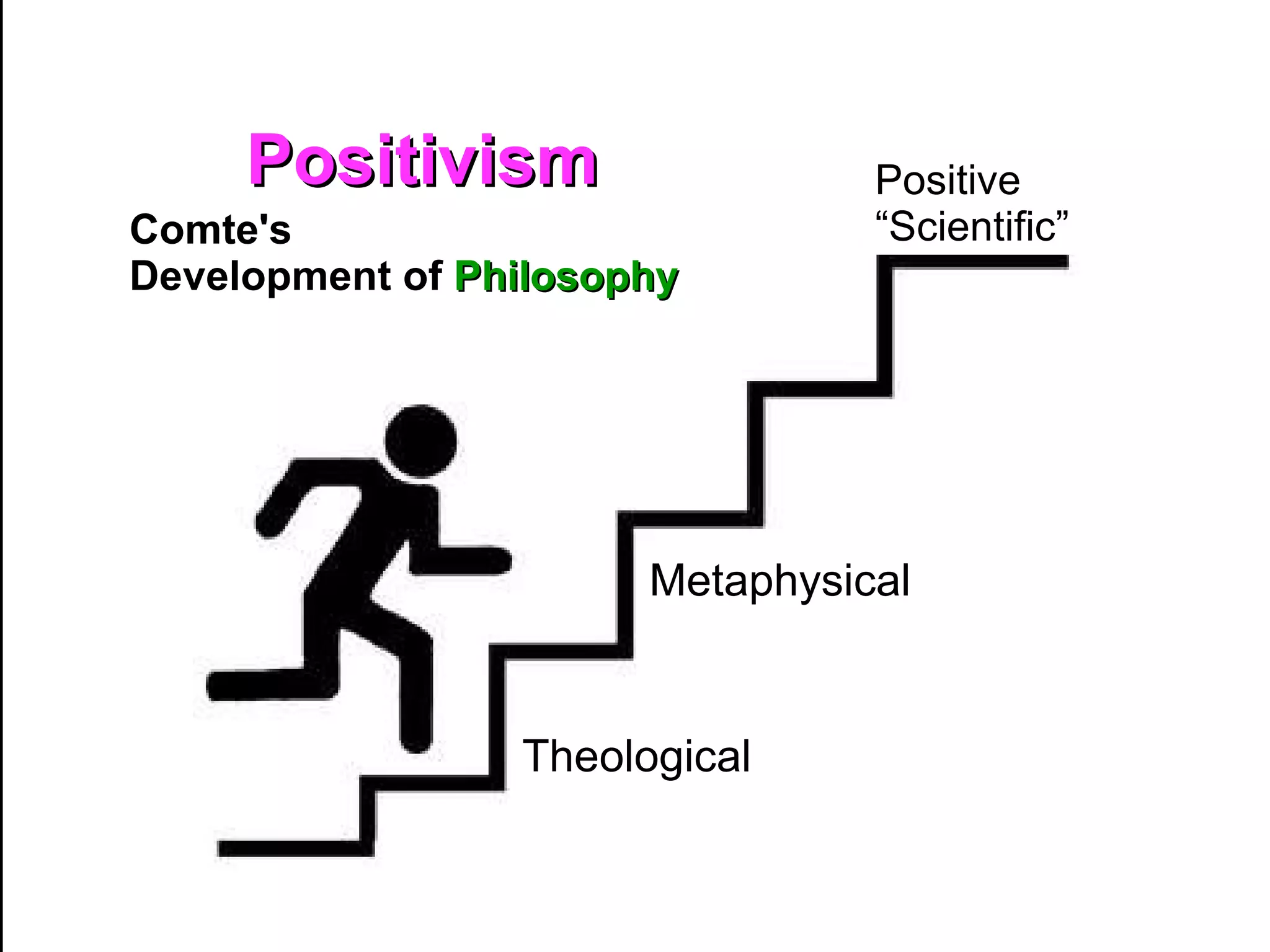
Positivism  Positive  “ Scientific”  Theological Metaphysical  Comte's  Development of  Philosophy
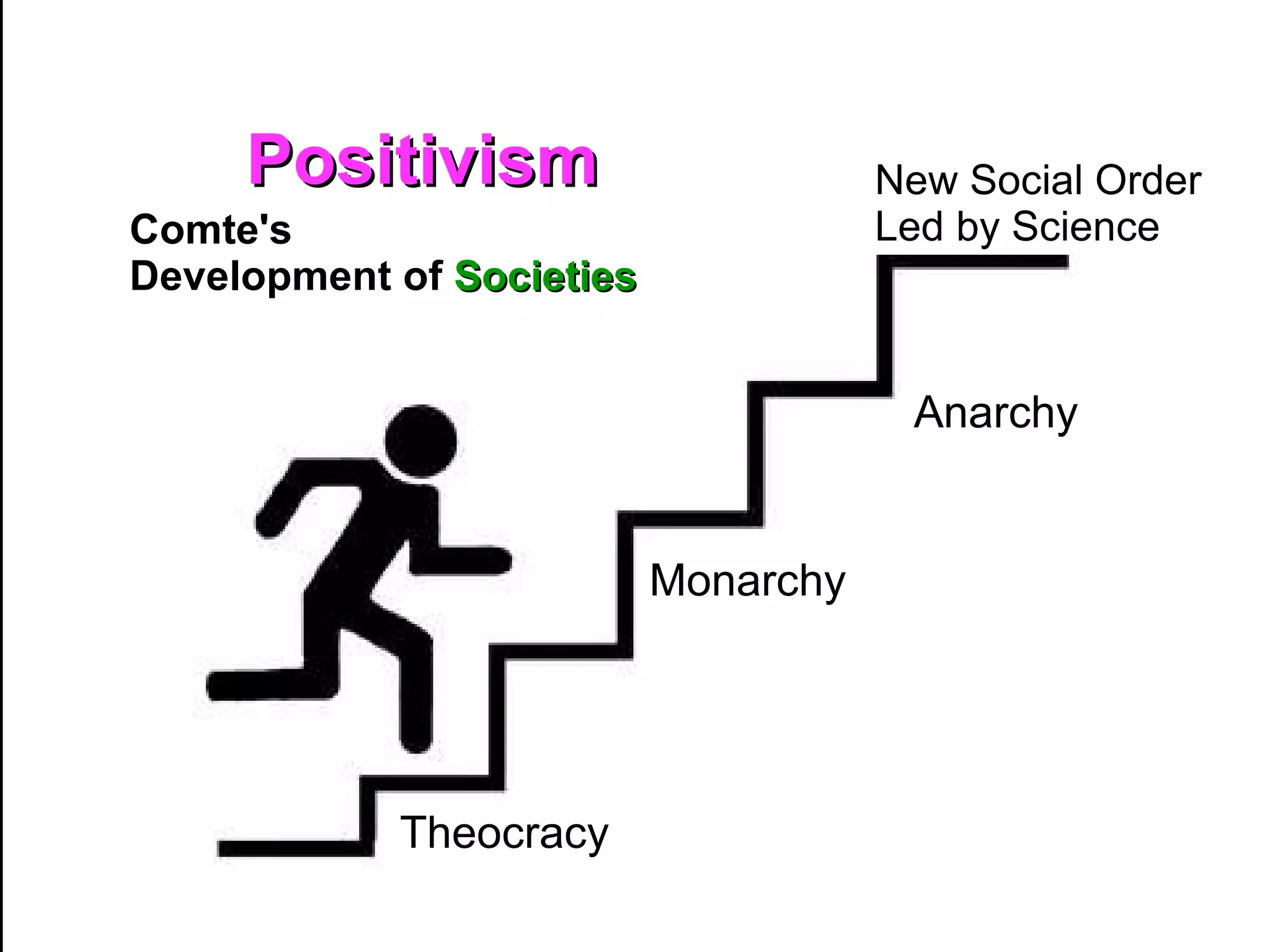
Positivism  New Social Order  Led by Science  Theocracy  Monarchy  Comte's  Development of  Societies  Anarchy
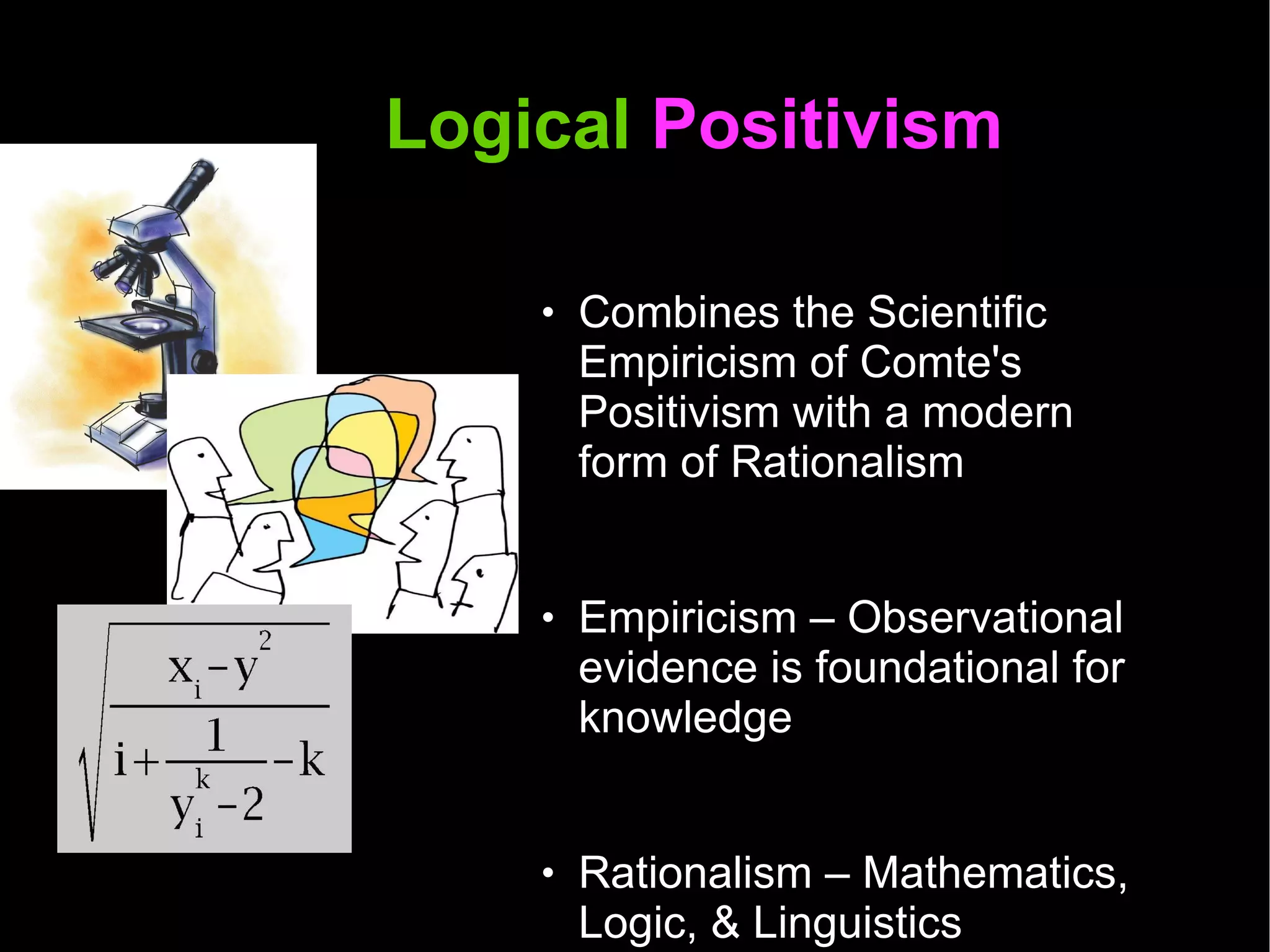
Logical  Positivism  Combines the Scientific Empiricism of Comte's Positivism with a modern form of Rationalism  Empiricism – Observational evidence is foundational for knowledge Rationalism – Mathematics, Logic, & Linguistics
Logical  Positivism  Invalid Sources of Knowledge Theology All religious knowledge Metaphysics Questions about the nature of reality Ontology  Questions about the nature of being or existence Synthetic a priori  A statement in which the predicate is not contained in the subject (synthetic) and does not depend on experience (a priori)
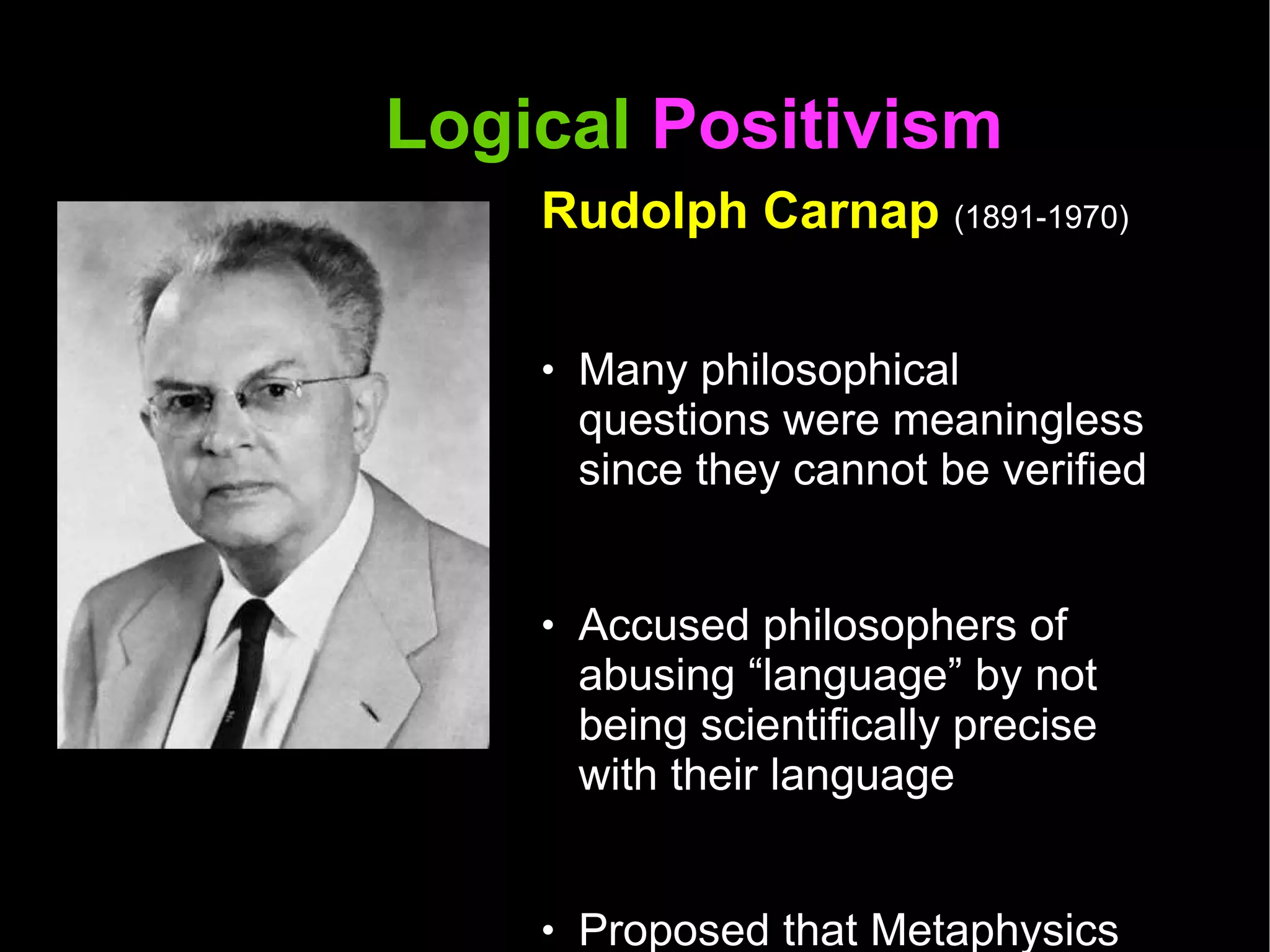
Logical  Positivism  Rudolph Carnap  (1891-1970) Many philosophical questions were meaningless since they cannot be verified  Accused philosophers of abusing “language” by not being scientifically precise with their language  Proposed that Metaphysics be eliminated from the investigations of philosophy
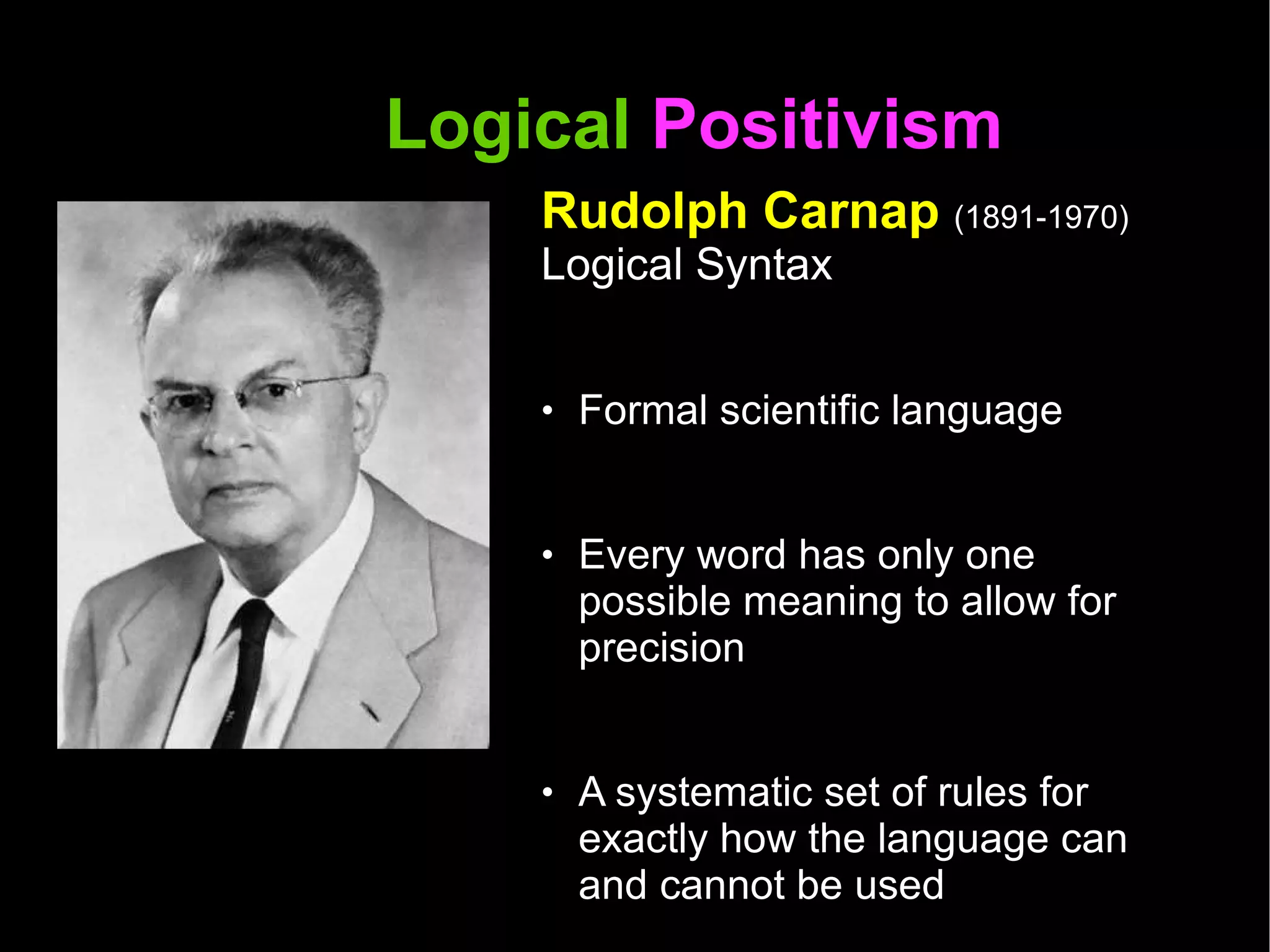
Logical  Positivism  Rudolph Carnap  (1891-1970) Logical Syntax Formal scientific language Every word has only one possible meaning to allow for precision  A systematic set of rules for exactly how the language can and cannot be used Allows for the development of a “logic of science”
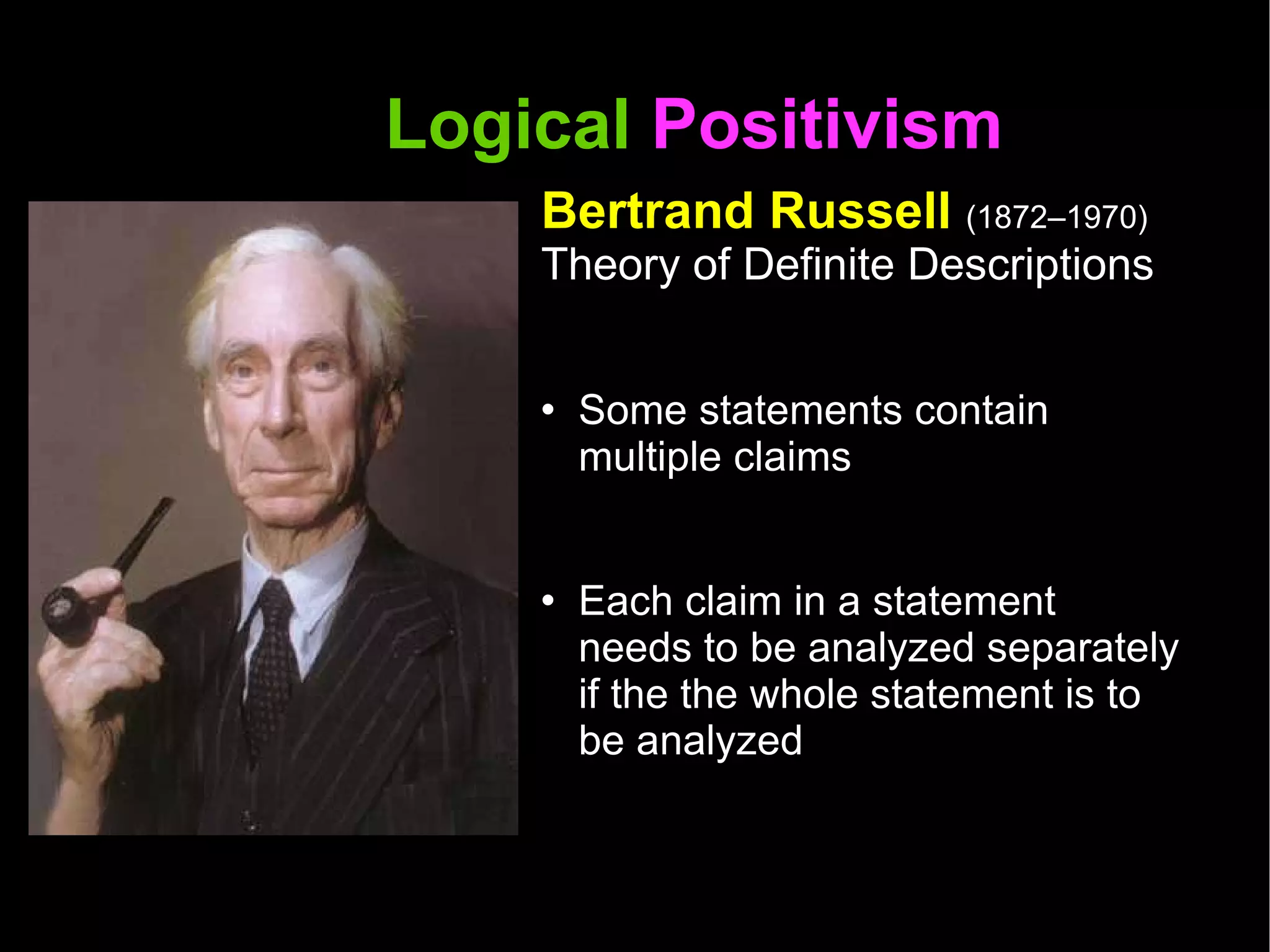
Logical  Positivism  Bertrand Russell  (1872–1970) Theory of Definite Descriptions Some statements contain multiple claims Each claim in a statement needs to be analyzed separately if the the whole statement is to be analyzed
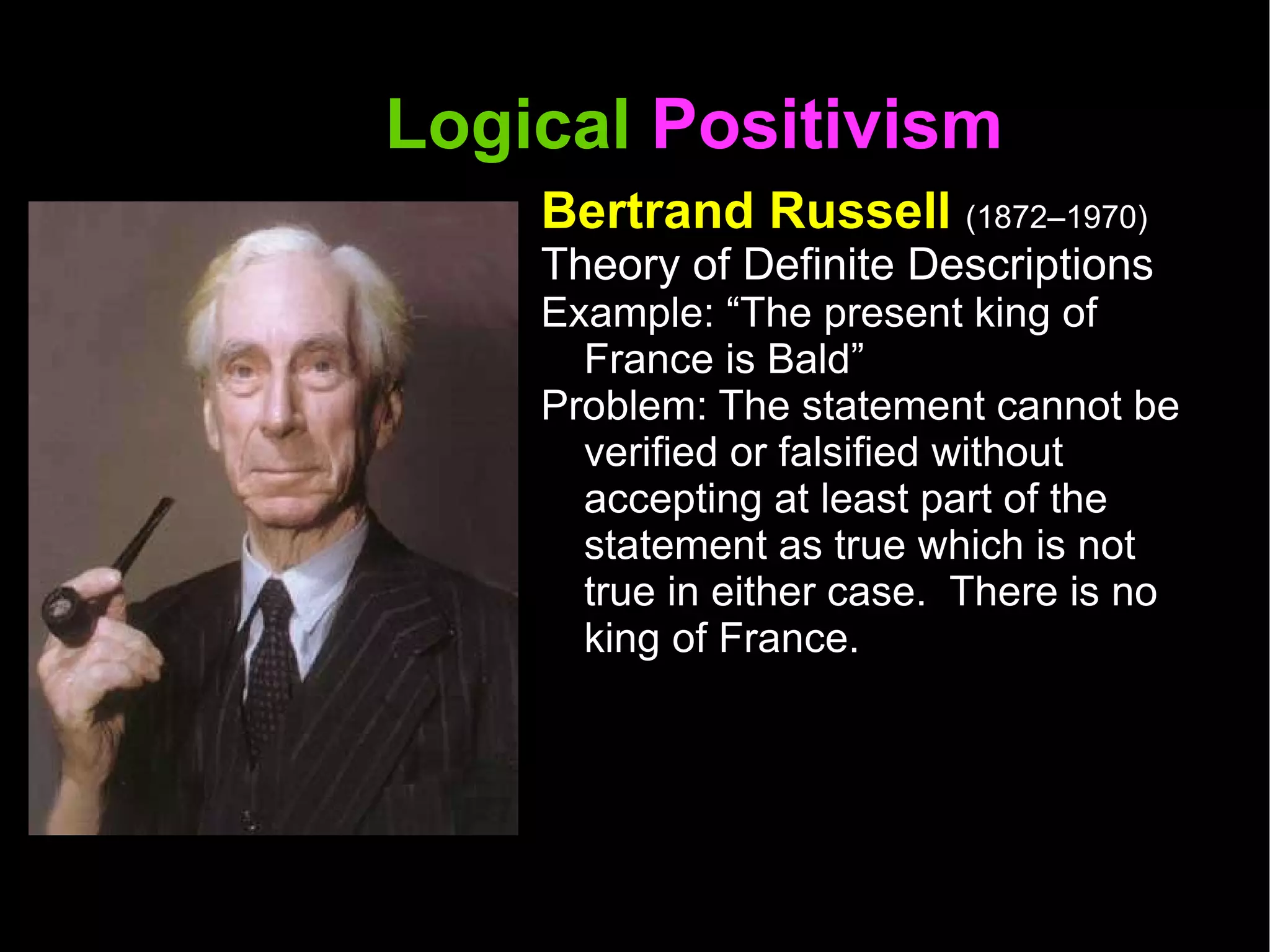
Logical  Positivism  Bertrand Russell  (1872–1970) Theory of Definite Descriptions Example: “The present king of France is Bald” Problem: The statement cannot be verified or falsified without accepting at least part of the statement as true which is not true in either case.  There is no king of France.
Logical  Positivism  Bertrand Russell  (1872–1970) Theory of Definite Descriptions Solution: The statement contains multiple claims  “ The present king of France is Bald” (1) There is a present king of France (2) There is only one king of France (3) If there is a present king of France that person is bald
Logical  Positivism  Ludwig Wittgenstein  (1889–1951) Language is the perceptible form of thought and bound to reality by a common logical form or structure The meaning of words and sentences must be determined by the nature of the world If not, the meaning or sense of an expression would be uncertain and communication would not be possible
Logical  Positivism  Ludwig Wittgenstein  (1889–1951) Language are “picture” (exact representations) of the world Meaning is tied to the user of the language and the context in which it is used.  Language is not tied directly to nature Language can be descriptive, inquisitive, playful, commanding and so on...

Philosophy lecture 11

  • 1.
    Introduction to PhilosophyIS-VNU Mr. Mike Lecture 11
  • 2.
    Introduction to PhilosophyExistentialism Positivism Logical Positivism
  • 3.
    Introduction to PhilosophyExercise: Write an answer to the following question... Why are you here? What is your purpose in life?
  • 4.
    Introduction to PhilosophyDiscussion: How do you find out your purpose in life?
  • 5.
    Existentialism Focusedon the condition of human existence Individual's emotions, actions, responsibilities, and thoughts Asks: What is the meaning or purpose of life? Tend to see reality as Subjective not Objective
  • 6.
    We are allSubjective Viewers
  • 7.
    Existentialism SørenKierkegaard (1813-1855) Father of existentialism Individual is solely responsible for giving his or her own life meaning the individual is responsible for living that life passionately and sincerely in spite of many existential obstacles and distractions including despair, angst, absurdity, alienation, and boredom
  • 8.
    Existentialism SørenKierkegaard (1813-1855) Danish Christian Philosopher Critical of Idealism and Organized Christianity Viewed Christianity as “Subjective” individual experience (relationship) with Jesus Christ Christianity is a matter of faith not rationalism or scientific knowledge
  • 9.
    Existentialism SørenKierkegaard (1813-1855) Leap of Faith Faith is not a decision based on empirical evidence Love is also not based on rational knowledge of another person Faith and Love both require the individual to make a commitment No “evidence” could ever be enough to pragmatically justify the kind of total commitment involved in true religious faith or romantic love
  • 10.
    Existentialism SørenKierkegaard (1813-1855) Leap of Faith F aith requires Doubt To truly believe in God, you need to experience Doubt Doubt is the rational part of a person's thought involved in weighing evidence Religious Faith and Love are NOT capable of objective certainty
  • 11.
    Existentialism SørenKierkegaard (1813-1855) Leap of Faith It doesn't require “faith” to believe that material objects exist because we can experience them with our senses Immaterial things (like God and Love) require “faith” to believe in their existence There is no “perceptual” access to God (or Love); faith is the only access we have to God
  • 12.
    Existentialism SørenKierkegaard (1813-1855) Subjectivity Dependent on the mind or on an individual's perception for its existence Objectivity Not dependent on the mind for existence; actual facts All religious knowledge is “subjective” not Objective
  • 13.
    Existentialism FriedrichNietzsche (1844-1900) The Will to Power Fundamental driving force of the individual as expressed in the need to dominate and control the external forces operating upon him Individual requires the power to be master of his own destiny Moral systems and religious institutions attempt to bind and subdue the will
  • 14.
    Existentialism FriedrichNietzsche (1844-1900) Religion Slave Morality The resentment of the weak towards the strong. The weak sought revenge on those stronger than themselves, not in this life, but in a fictional ‘other’ world, where some other power, namely God, would wreak vengeance on their behalf.
  • 15.
    Existentialism MartinHeidegger (1889–1976) Ever since Plato, philosophers have been asking about what there is (metaphysics) and what they can know about what there is (epistemology) These questions presuppose too much We need to ask, “What is being (existence)?” Why is there something instead of nothing?
  • 16.
    Existentialism MartinHeidegger (1889–1976) Self-conscious Being (existence) recognizes that the self is finite and mortal Understand your finiteness and mortality produces “dread” and “anxiety” Life cannot take any positive meaning until you fully understand and accept your finiteness and morality This self-awareness leads to authenticity – choosing something out of nothing
  • 17.
    Existentialism Jean-PaulSartre (1905–1980) Humans first exists without purpose (meaning) or definition Humans find themselves in a world without meaning Meaning is created out of reaction (experience) to this world First existence, then Meaning
  • 18.
    Existentialism Jean-PaulSartre (1905–1980) Opposite of Aristotle's Ethics - man is created to fulfil some purpose or goal, and that fulfilment of a life consists in striving towards that goal Sartre argues that since there is no God or designer to give man a purpose, it is up to the individual to choose the life they think best “ Man is condemned to be free”
  • 19.
    Existentialism Jean-PaulSartre (1905–1980) Even if someone is pointing a gun at you, you still must make a real choice. The person holding the gun can never make a choice for you Thus, you are never really “forced” to do anything You are only forced to choose
  • 20.
    Existentialism Jean-PaulSartre (1905–1980) Responsibility – Because our choices are free, we are full responsible for them We cannot blame human nature, God or our environment for any of our actions or choices
  • 21.
    Existentialism Jean-PaulSartre (1905–1980) 3 Burdens of the Individual Anguish – arising from the awareness of the weight of responsibility we each hold Abandonment – We are alone in our choices without any moral guidance from God or others Despair - We must act without hope. We cannot trust that things will turn out for the best. There is no providence.
  • 22.
    Existentialism AlbertCamus (1913–1960) Absurdity The Myth of Sisyphus - Condemned by the gods to eternally push a boulder up a hill only to have it roll back down again as he reaches the summit Absurdity arises out of our attempts to make sense of a senseless world Life is pointless
  • 23.
    Existentialism AlbertCamus (1913–1960) Absurdity One must not try to resolve the conflict of trying to find meaning in a meaningless world. Rather, we must revolt against our fate and choose to live happy lives in spite of life's meaninglessness
  • 24.
    Existentialism PaulTillich (1886 – 1965) Christian Existentialist Believed that Existentialists were asking the right questions about being and existence Argued that Christianity supplied the answers to the Existentialist questions The task of the philosopher is to formulate questions of existence The task of the theologian is to formulate the answers
  • 25.
    Existentialism PaulTillich (1886 – 1965) Faith Faith is not opposed to either reason or emotion Faith transcend both reason and emotions Faith is require of both the theist and the atheist The theist relies on faith to believe God's existence The atheist relies on faith to deny God's existence
  • 26.
    Positivism TheScientific Method is the best approach to uncovering the processes by which both physical and human events occur Asserts that the only authentic knowledge is that which is based on sense, experience and positive verification The Scientific Method replaces Metaphysics
  • 27.
    Positivism AugusteComte (1798–1857) Theological and metaphysical speculations should be abandoned in favor of knowledge gained through observable “facts”
  • 28.
    Positivism PositiveOrder of Knowledge Mathematics Astronomy Physics Sociology Biology Chemistry
  • 29.
    Positivism Positive “ Scientific” Theological Metaphysical Comte's Development of Philosophy
  • 30.
    Positivism NewSocial Order Led by Science Theocracy Monarchy Comte's Development of Societies Anarchy
  • 31.
    Logical Positivism Combines the Scientific Empiricism of Comte's Positivism with a modern form of Rationalism Empiricism – Observational evidence is foundational for knowledge Rationalism – Mathematics, Logic, & Linguistics
  • 32.
    Logical Positivism Invalid Sources of Knowledge Theology All religious knowledge Metaphysics Questions about the nature of reality Ontology Questions about the nature of being or existence Synthetic a priori A statement in which the predicate is not contained in the subject (synthetic) and does not depend on experience (a priori)
  • 33.
    Logical Positivism Rudolph Carnap (1891-1970) Many philosophical questions were meaningless since they cannot be verified Accused philosophers of abusing “language” by not being scientifically precise with their language Proposed that Metaphysics be eliminated from the investigations of philosophy
  • 34.
    Logical Positivism Rudolph Carnap (1891-1970) Logical Syntax Formal scientific language Every word has only one possible meaning to allow for precision A systematic set of rules for exactly how the language can and cannot be used Allows for the development of a “logic of science”
  • 35.
    Logical Positivism Bertrand Russell (1872–1970) Theory of Definite Descriptions Some statements contain multiple claims Each claim in a statement needs to be analyzed separately if the the whole statement is to be analyzed
  • 36.
    Logical Positivism Bertrand Russell (1872–1970) Theory of Definite Descriptions Example: “The present king of France is Bald” Problem: The statement cannot be verified or falsified without accepting at least part of the statement as true which is not true in either case. There is no king of France.
  • 37.
    Logical Positivism Bertrand Russell (1872–1970) Theory of Definite Descriptions Example: “The present king of France is Bald” Problem: The statement cannot be verified or falsified without accepting at least part of the statement as true which is not true in either case. There is no king of France.
  • 38.
    Logical Positivism Bertrand Russell (1872–1970) Theory of Definite Descriptions Solution: The statement contains multiple claims “ The present king of France is Bald” (1) There is a present king of France (2) There is only one king of France (3) If there is a present king of France that person is bald
  • 39.
    Logical Positivism Ludwig Wittgenstein (1889–1951) Language is the perceptible form of thought and bound to reality by a common logical form or structure The meaning of words and sentences must be determined by the nature of the world If not, the meaning or sense of an expression would be uncertain and communication would not be possible
  • 40.
    Logical Positivism Ludwig Wittgenstein (1889–1951) Language are “picture” (exact representations) of the world Meaning is tied to the user of the language and the context in which it is used. Language is not tied directly to nature Language can be descriptive, inquisitive, playful, commanding and so on...