American Industrial Revolution Gavin
Industrial Revolution 1791-1860 American economy shifted focus from agriculture to manufacturing and Inventing Many notable inventors and Inventions came from this time period
Textile Industry Help begin Industrial Revolution Francis Cabot Lowell built first dual purpose textile mill in 1814 Early factories just spun fiber into tread, weaving was done by hand Three story mill was built on the bank of the Charles River  Significance- Shifted manufacturing from home to factory
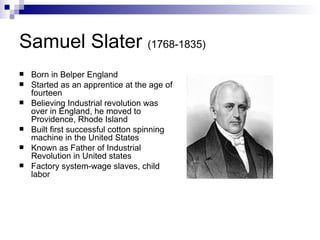
Samuel Slater  (1768-1835) Born in Belper England Started as an apprentice at the age of fourteen Believing Industrial revolution was over in England, he moved to Providence, Rhode Island Built first successful cotton spinning machine in the United States Known as Father of Industrial Revolution in United states Factory system-wage slaves, child labor
Eli Whitney Invented the Cotton Gin in1793 50 times more effective than picking by hand Made little money on his Invention due to copyright infringement
Cotton Gin- Eli Whitney Separates the cotton fibers from the seedpods  Made producing cotton highly profitable Slavery began to rise Westward expansion, due to the need for more land Stimulated Industrial revolution by supplying New England with Cotton
Interchangeable Parts – Eli Whitney 1798- Whitney manufactured rifles for the U.S. Army.  Discovered Interchangeable Parts Modern day assembly still uses interchangeable parts
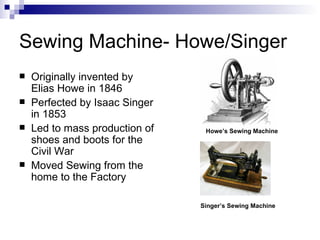
Sewing Machine- Howe/Singer Originally invented by Elias Howe in 1846 Perfected by Isaac Singer in 1853 Led to mass production of shoes and boots for the Civil War Moved Sewing from the home to the Factory Howe’s Sewing Machine Singer’s Sewing Machine
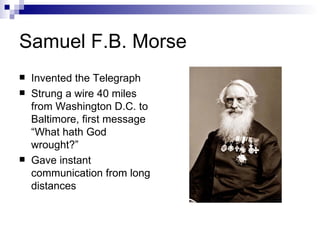
Samuel F.B. Morse Invented the Telegraph Strung a wire 40 miles from Washington D.C. to Baltimore, first message “What hath God wrought?” Gave instant communication from long distances
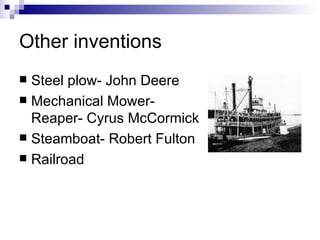
Other inventions Steel plow- John Deere Mechanical Mower-Reaper- Cyrus McCormick Steamboat- Robert Fulton Railroad
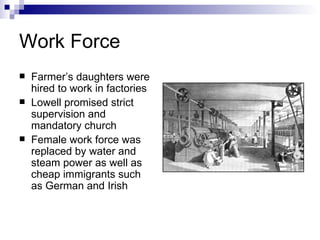
Work Force Farmer’s daughters were hired to work in factories Lowell promised strict supervision and mandatory church Female work force was replaced by water and steam power as well as cheap immigrants such as German and Irish
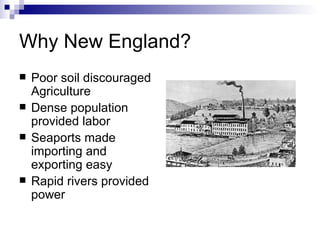
Why New England? Poor soil discouraged Agriculture Dense population provided labor Seaports made importing and exporting easy Rapid rivers provided power
Why Not the South? Capital was tied up in slaves Most of the Consumers were too poor to afford most finished goods
Effects of the Industrial Revolution Moved many tasks from the home to factories Made production of goods faster Helped Union win Civil War
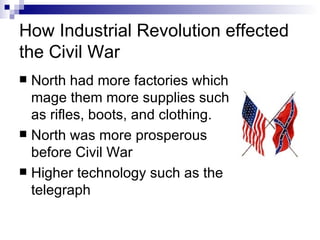
How Industrial Revolution effected the Civil War North had more factories which mage them more supplies such as rifles, boots, and clothing.  North was more prosperous before Civil War Higher technology such as the telegraph
Other effects of Industrial Revolution Urbanization Ten hour work day Economic Expansion Social standards Commonwealth V Hunt

American Industrial Revolution[2]

  • 1.
  • 2.
    Industrial Revolution 1791-1860American economy shifted focus from agriculture to manufacturing and Inventing Many notable inventors and Inventions came from this time period
  • 3.
    Textile Industry Helpbegin Industrial Revolution Francis Cabot Lowell built first dual purpose textile mill in 1814 Early factories just spun fiber into tread, weaving was done by hand Three story mill was built on the bank of the Charles River Significance- Shifted manufacturing from home to factory
  • 4.
    Samuel Slater (1768-1835) Born in Belper England Started as an apprentice at the age of fourteen Believing Industrial revolution was over in England, he moved to Providence, Rhode Island Built first successful cotton spinning machine in the United States Known as Father of Industrial Revolution in United states Factory system-wage slaves, child labor
  • 5.
    Eli Whitney Inventedthe Cotton Gin in1793 50 times more effective than picking by hand Made little money on his Invention due to copyright infringement
  • 6.
    Cotton Gin- EliWhitney Separates the cotton fibers from the seedpods Made producing cotton highly profitable Slavery began to rise Westward expansion, due to the need for more land Stimulated Industrial revolution by supplying New England with Cotton
  • 7.
    Interchangeable Parts –Eli Whitney 1798- Whitney manufactured rifles for the U.S. Army. Discovered Interchangeable Parts Modern day assembly still uses interchangeable parts
  • 8.
    Sewing Machine- Howe/SingerOriginally invented by Elias Howe in 1846 Perfected by Isaac Singer in 1853 Led to mass production of shoes and boots for the Civil War Moved Sewing from the home to the Factory Howe’s Sewing Machine Singer’s Sewing Machine
  • 9.
    Samuel F.B. MorseInvented the Telegraph Strung a wire 40 miles from Washington D.C. to Baltimore, first message “What hath God wrought?” Gave instant communication from long distances
  • 10.
    Other inventions Steelplow- John Deere Mechanical Mower-Reaper- Cyrus McCormick Steamboat- Robert Fulton Railroad
  • 11.
    Work Force Farmer’sdaughters were hired to work in factories Lowell promised strict supervision and mandatory church Female work force was replaced by water and steam power as well as cheap immigrants such as German and Irish
  • 12.
    Why New England?Poor soil discouraged Agriculture Dense population provided labor Seaports made importing and exporting easy Rapid rivers provided power
  • 13.
    Why Not theSouth? Capital was tied up in slaves Most of the Consumers were too poor to afford most finished goods
  • 14.
    Effects of theIndustrial Revolution Moved many tasks from the home to factories Made production of goods faster Helped Union win Civil War
  • 15.
    How Industrial Revolutioneffected the Civil War North had more factories which mage them more supplies such as rifles, boots, and clothing. North was more prosperous before Civil War Higher technology such as the telegraph
  • 16.
    Other effects ofIndustrial Revolution Urbanization Ten hour work day Economic Expansion Social standards Commonwealth V Hunt