Introduction to Philosophy IS-VNU Mr. Mike  Lecture 10
Introduction to Philosophy Socialism Evolution Social Darwinism
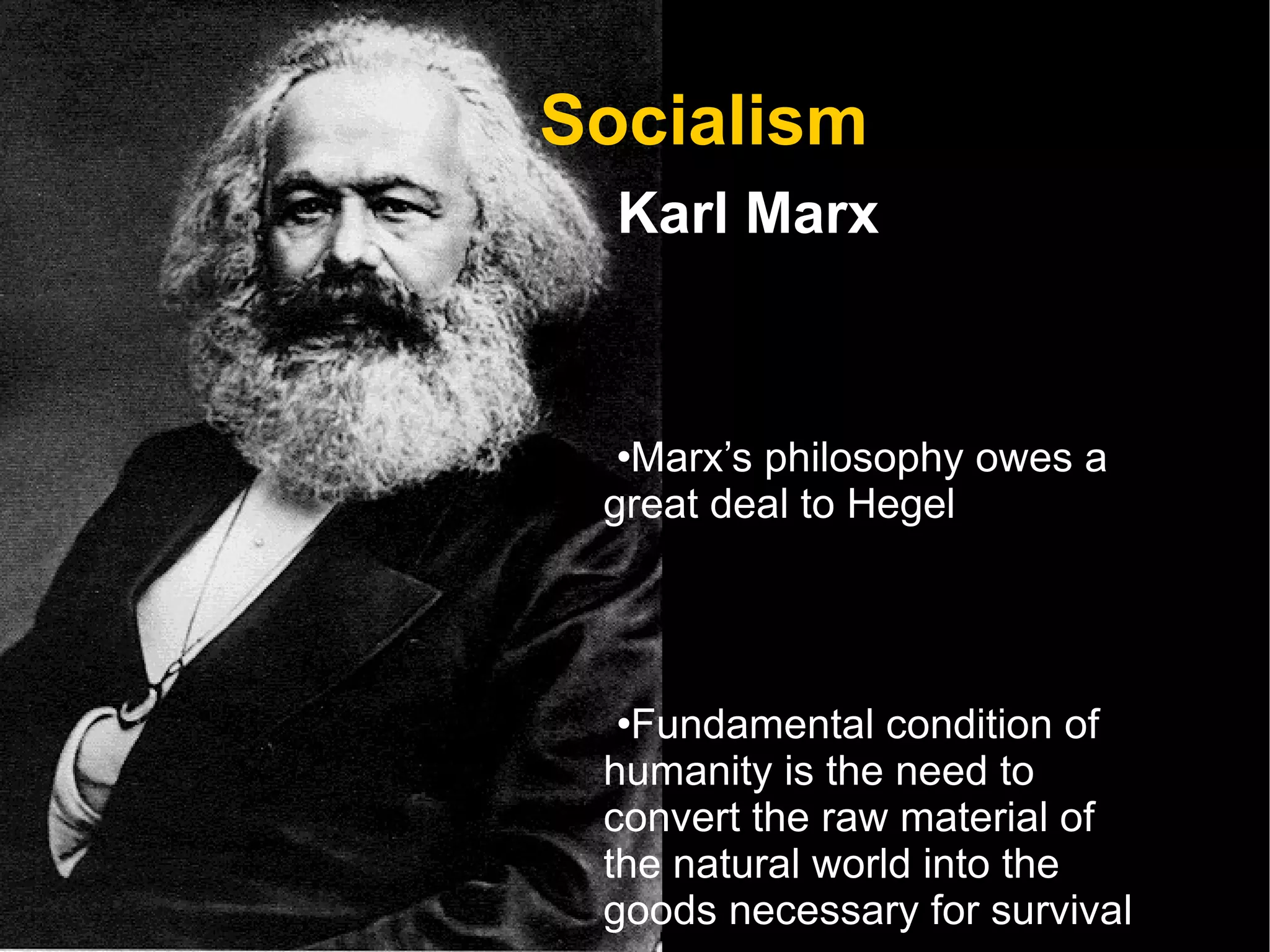
Socialism Karl Marx Marx’s philosophy owes a great deal to Hegel Fundamental condition of humanity is the need to convert the raw material of the natural world into the goods necessary for survival  Production (economics) is the primary conditioning factor of life
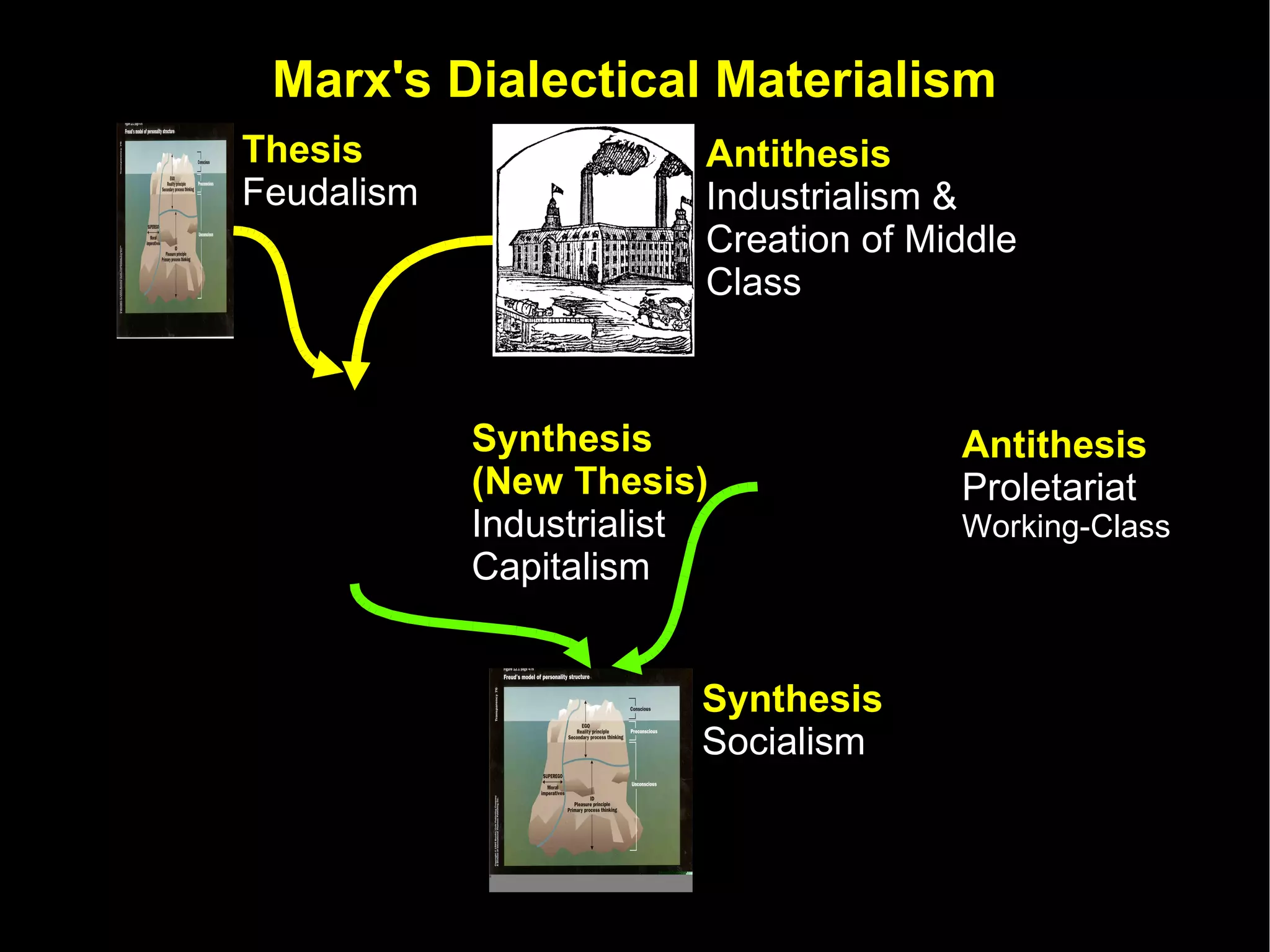
Marx's Dialectical Materialism Thesis Feudalism Antithesis Industrialism &  Creation of Middle  Class Synthesis (New Thesis) Industrialist Capitalism Antithesis Proletariat Working-Class Synthesis Socialism
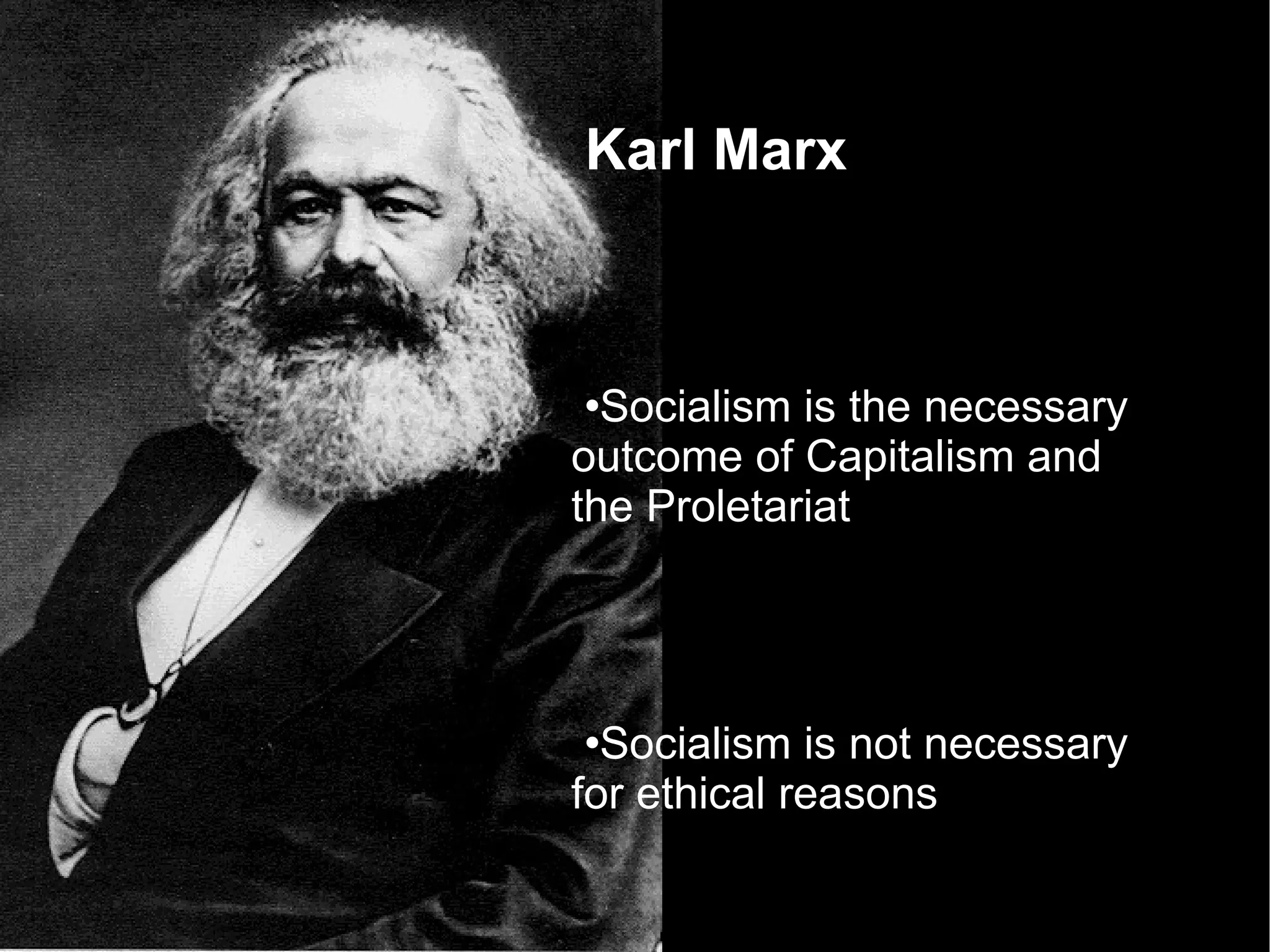
Karl Marx Socialism is the necessary outcome of Capitalism and the Proletariat  Socialism is not necessary for ethical reasons Socialism is necessary because Marx believes it to be the most efficient means of production and therefore survival
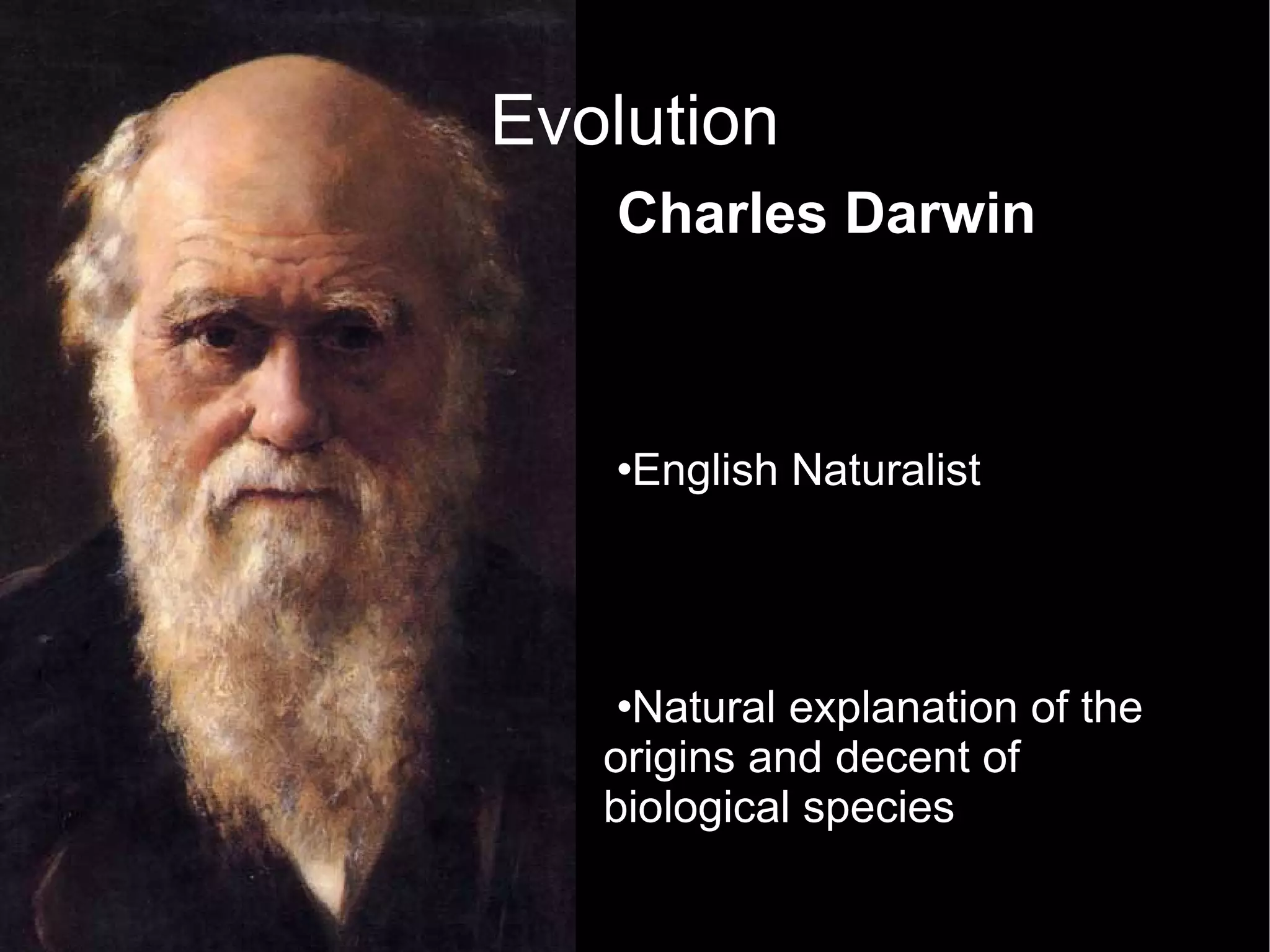
Evolution Charles Darwin English Naturalist Natural explanation of the origins and decent of biological species  5-year Voyage on HMS Beagle studying/collecting species specimens
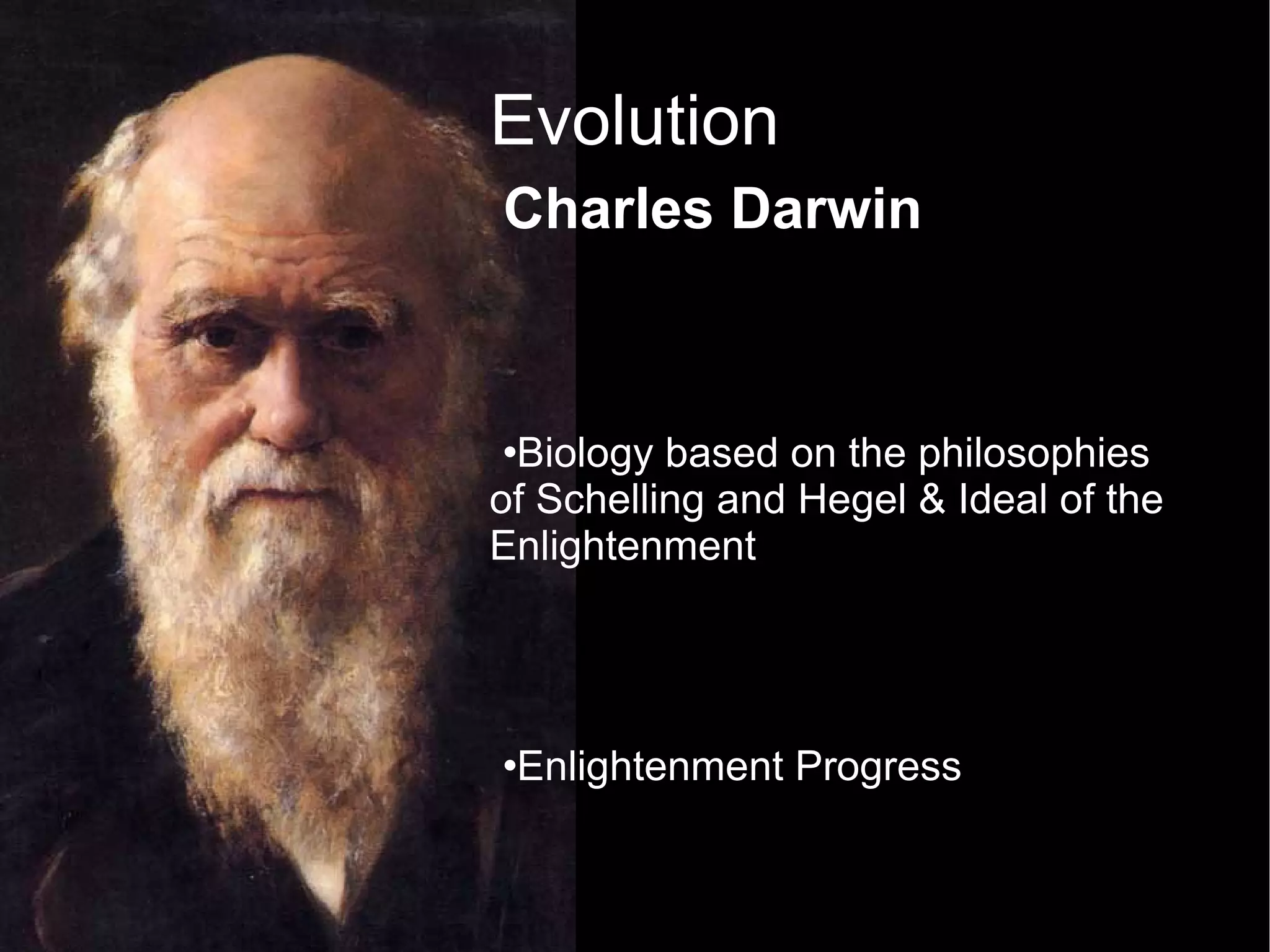
Evolution Charles Darwin Biology based on the philosophies of Schelling and Hegel & Ideal of the Enlightenment  Enlightenment Progress Schelling –  Nature is in a perpetual state of progress Humans are the highest form of natural progress Hegel – Dialectic  (Thesis ↔ Antithesis) -> Synthesis
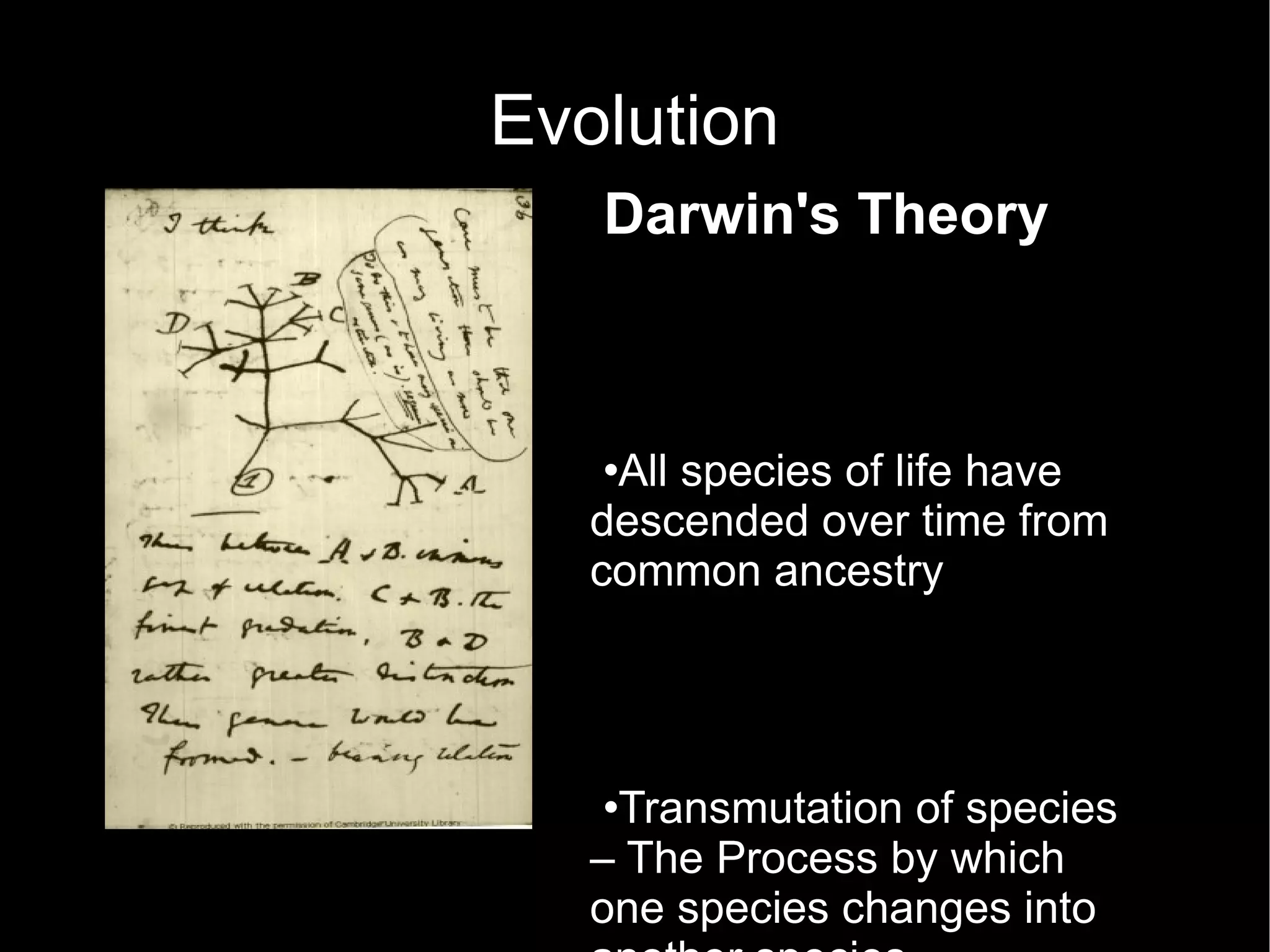
Evolution Darwin's Theory All species of life have descended over time from common ancestry Transmutation of species – The Process by which one species changes into another species
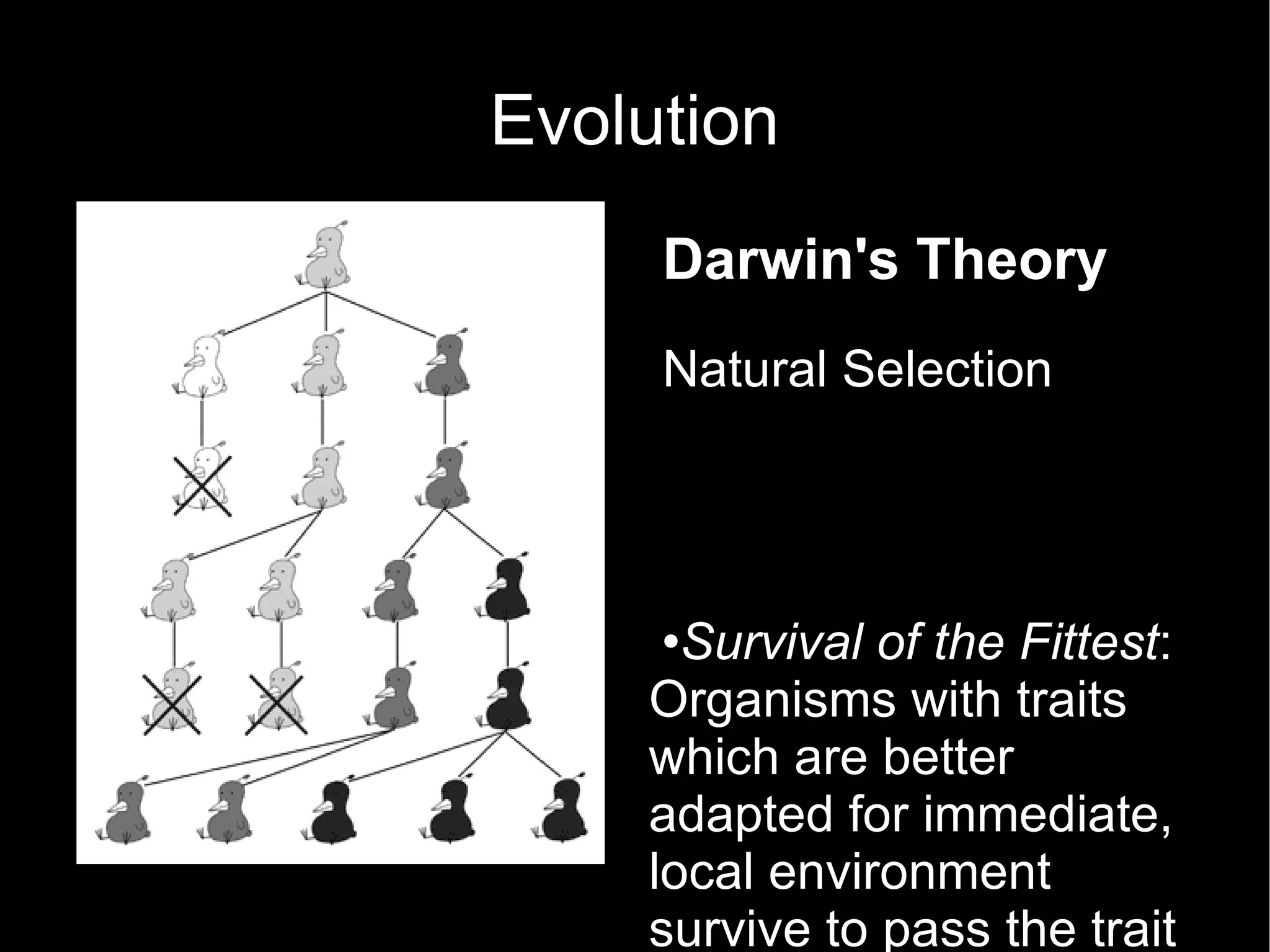
Evolution Darwin's Theory Natural Selection Survival of the Fittest : Organisms with traits which are better adapted for immediate, local environment survive to pass the trait on.
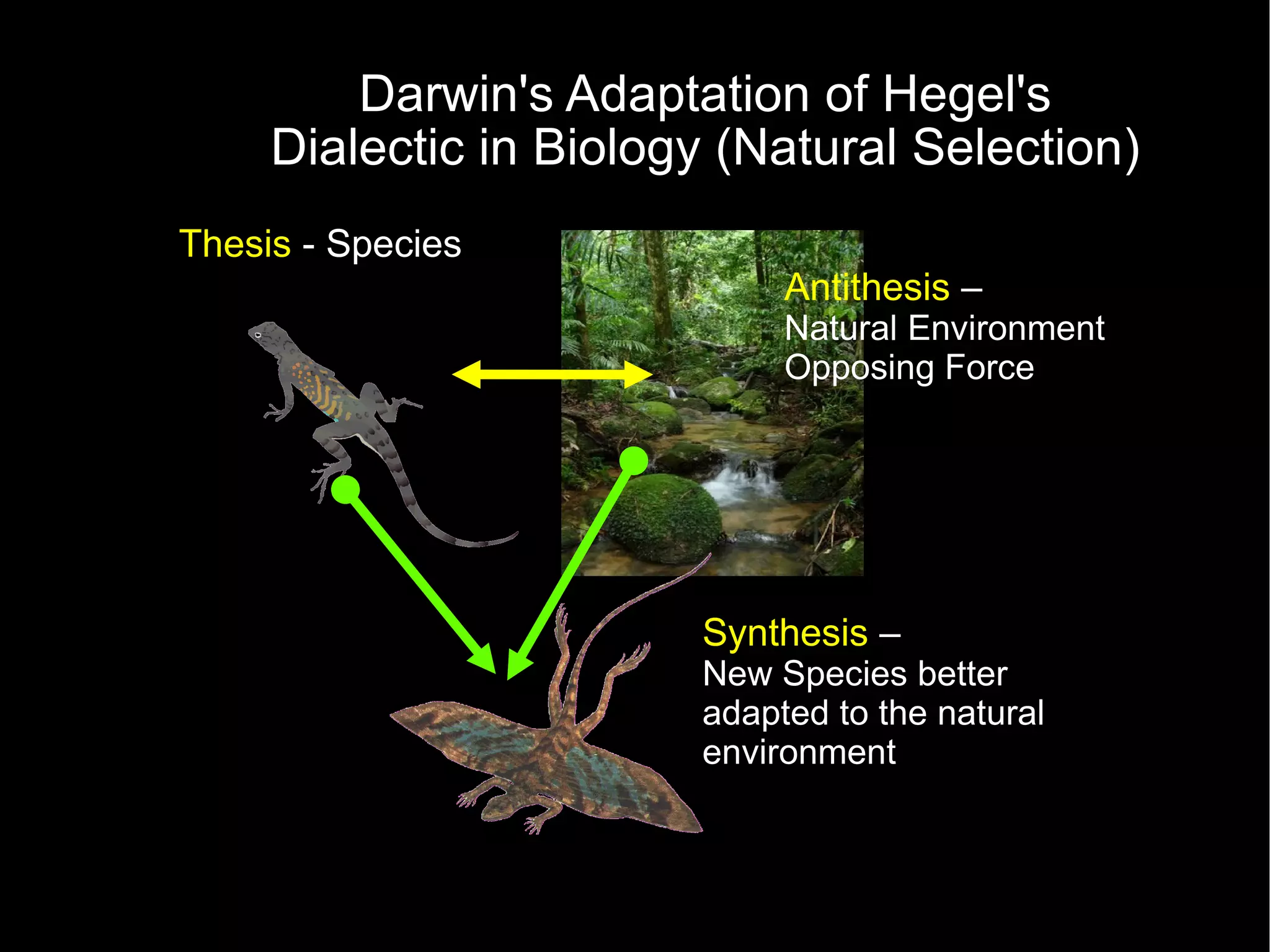
Darwin's Adaptation of Hegel's Dialectic in Biology (Natural Selection) Thesis  - Species Antithesis  –  Natural Environment Opposing Force Synthesis  –  New Species better adapted to the natural environment
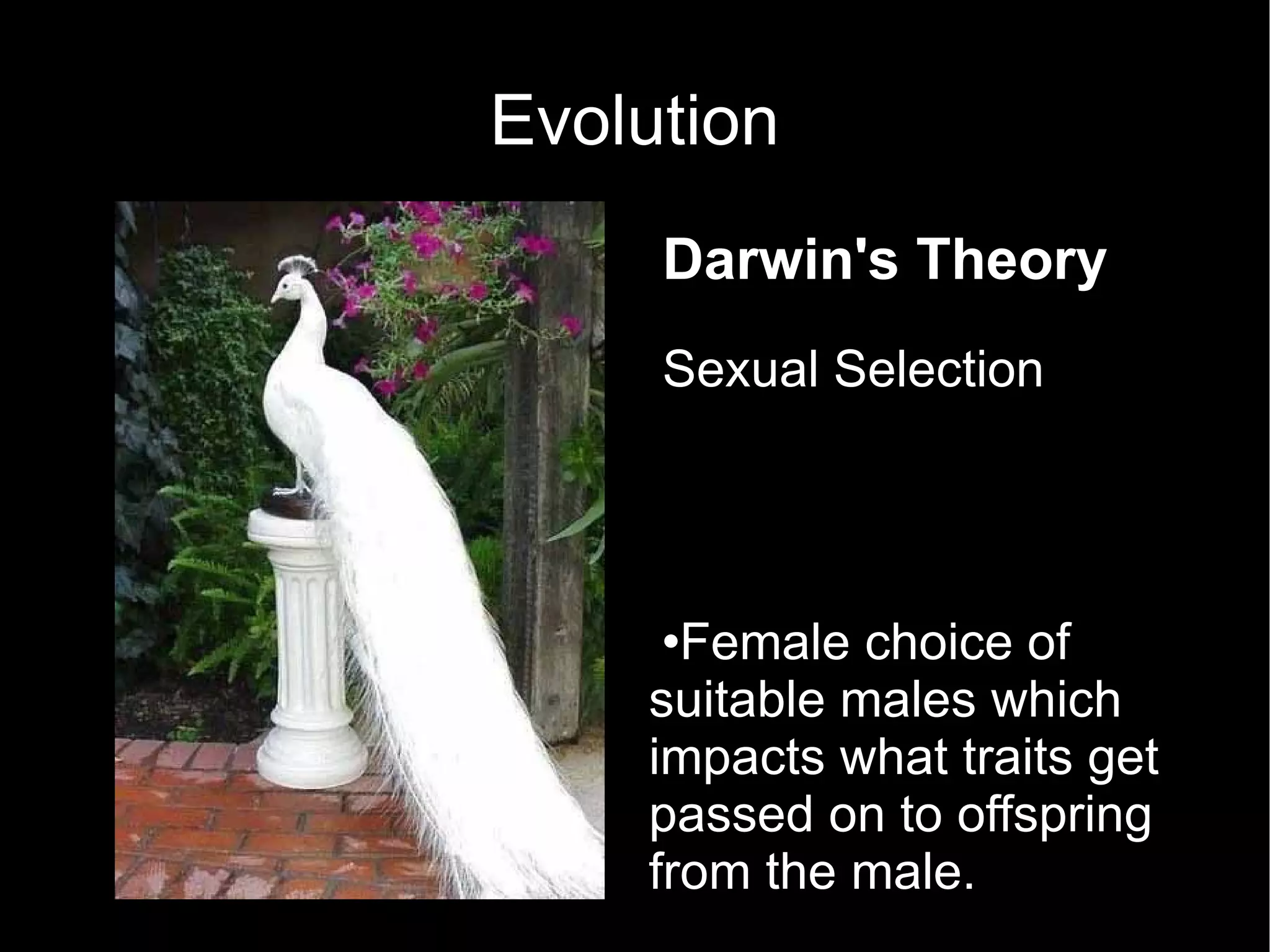
Evolution Darwin's Theory Sexual Selection Female choice of suitable males which impacts what traits get passed on to offspring from the male.
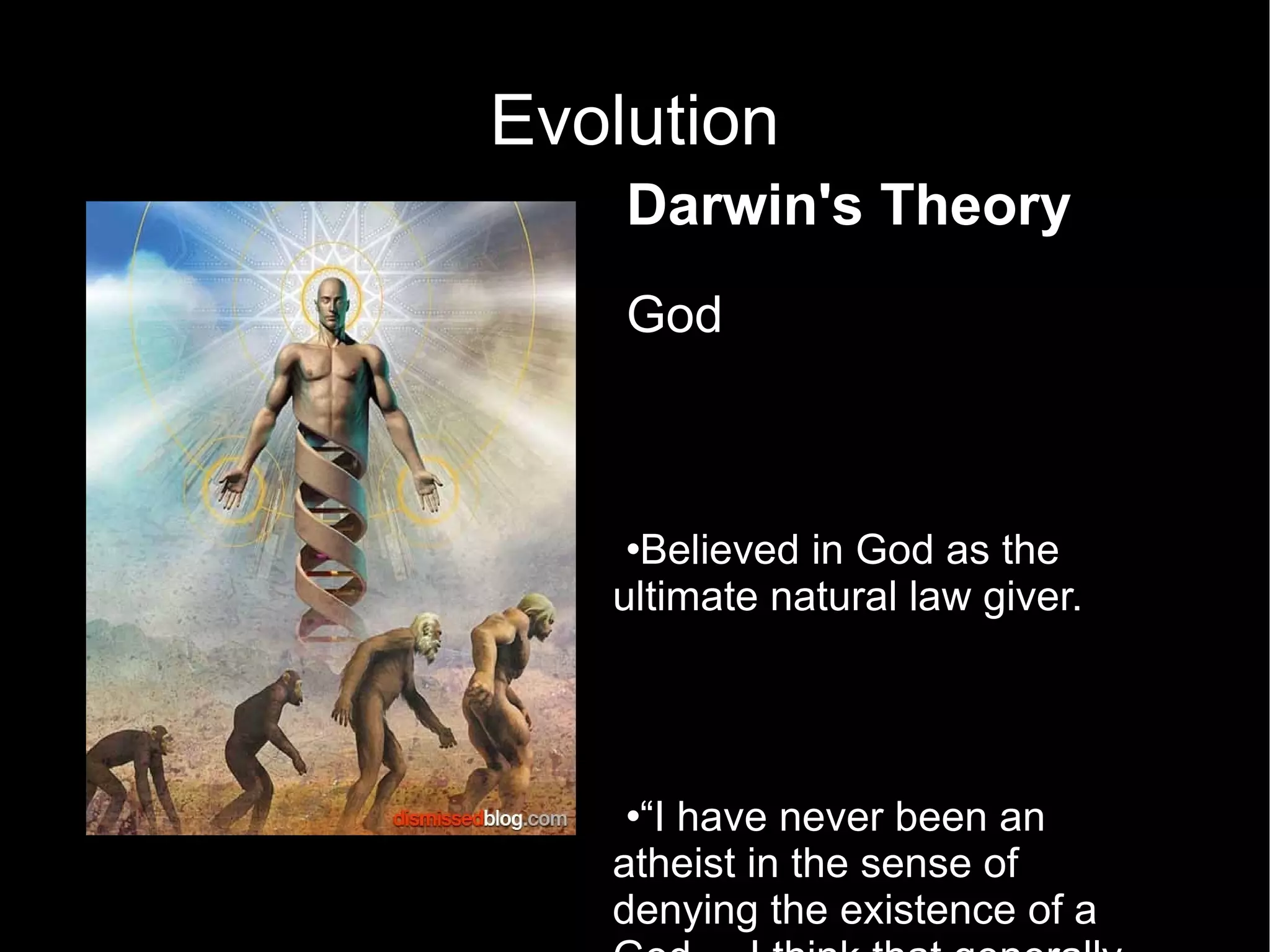
Evolution Darwin's Theory God Believed in God as the ultimate natural law giver.  “ I have never been an atheist in the sense of denying the existence of a God. – I think that generally ... an agnostic would be the most correct description of my state of mind.”
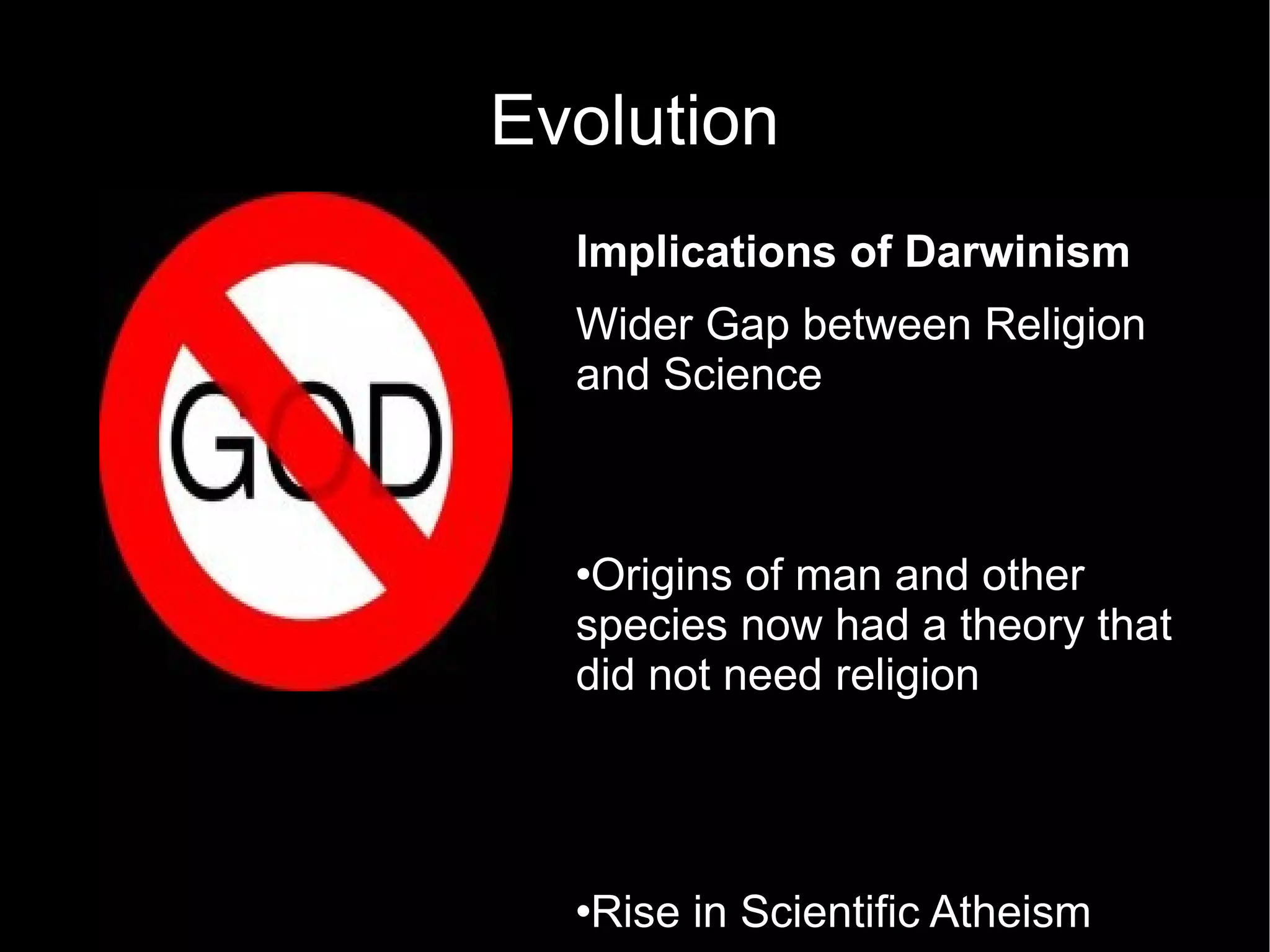
Evolution Implications of Darwinism Wider Gap between Religion and Science  Origins of man and other species now had a theory that did not need religion Rise in Scientific Atheism
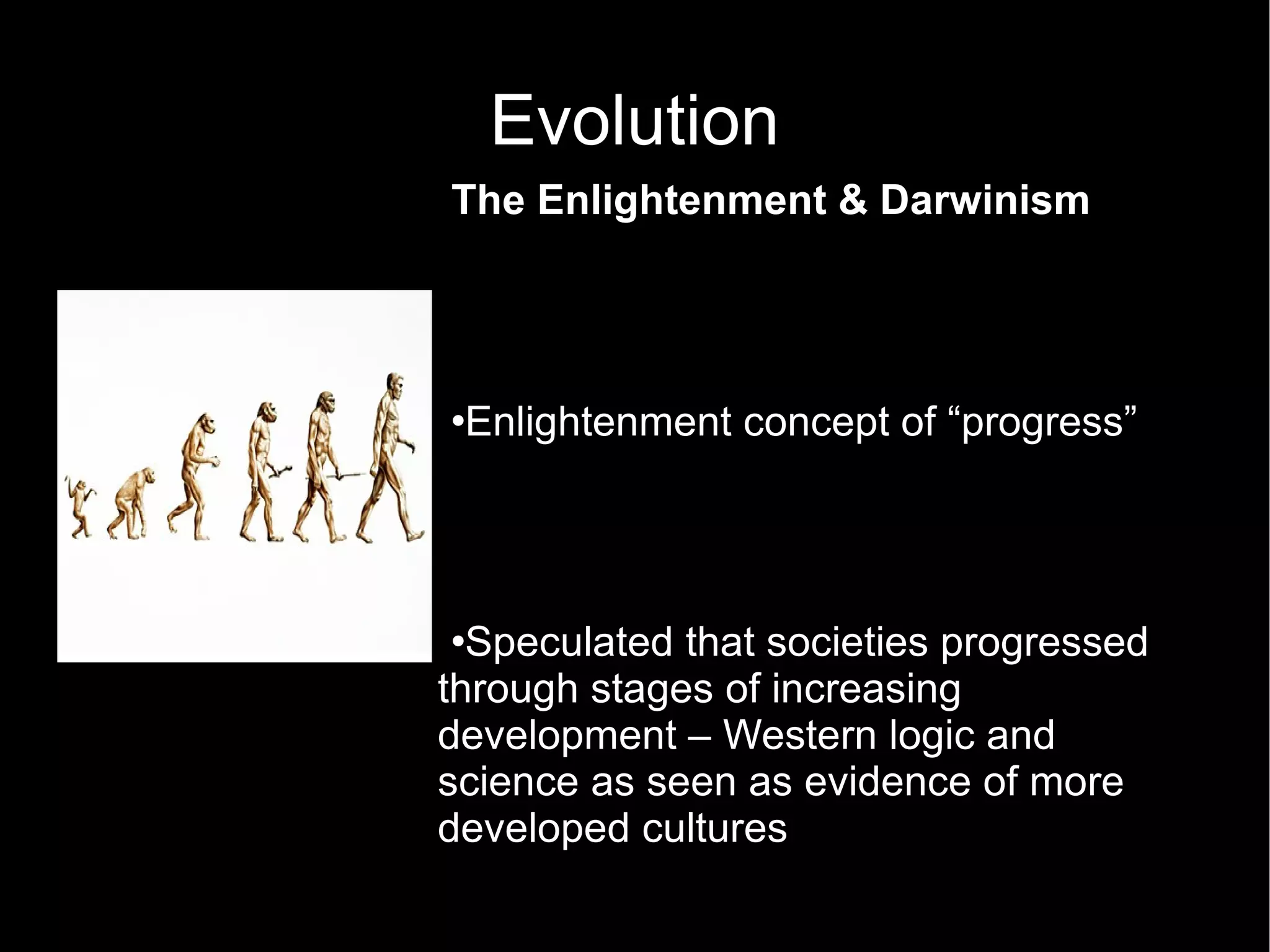
Evolution The Enlightenment & Darwinism   Enlightenment concept of “progress”  Speculated that societies progressed through stages of increasing development – Western logic and science as seen as evidence of more developed cultures Societies begin as primitive then progress toward industrialized Europe  Darwin's theory was seen as “scientific evidence” of progress
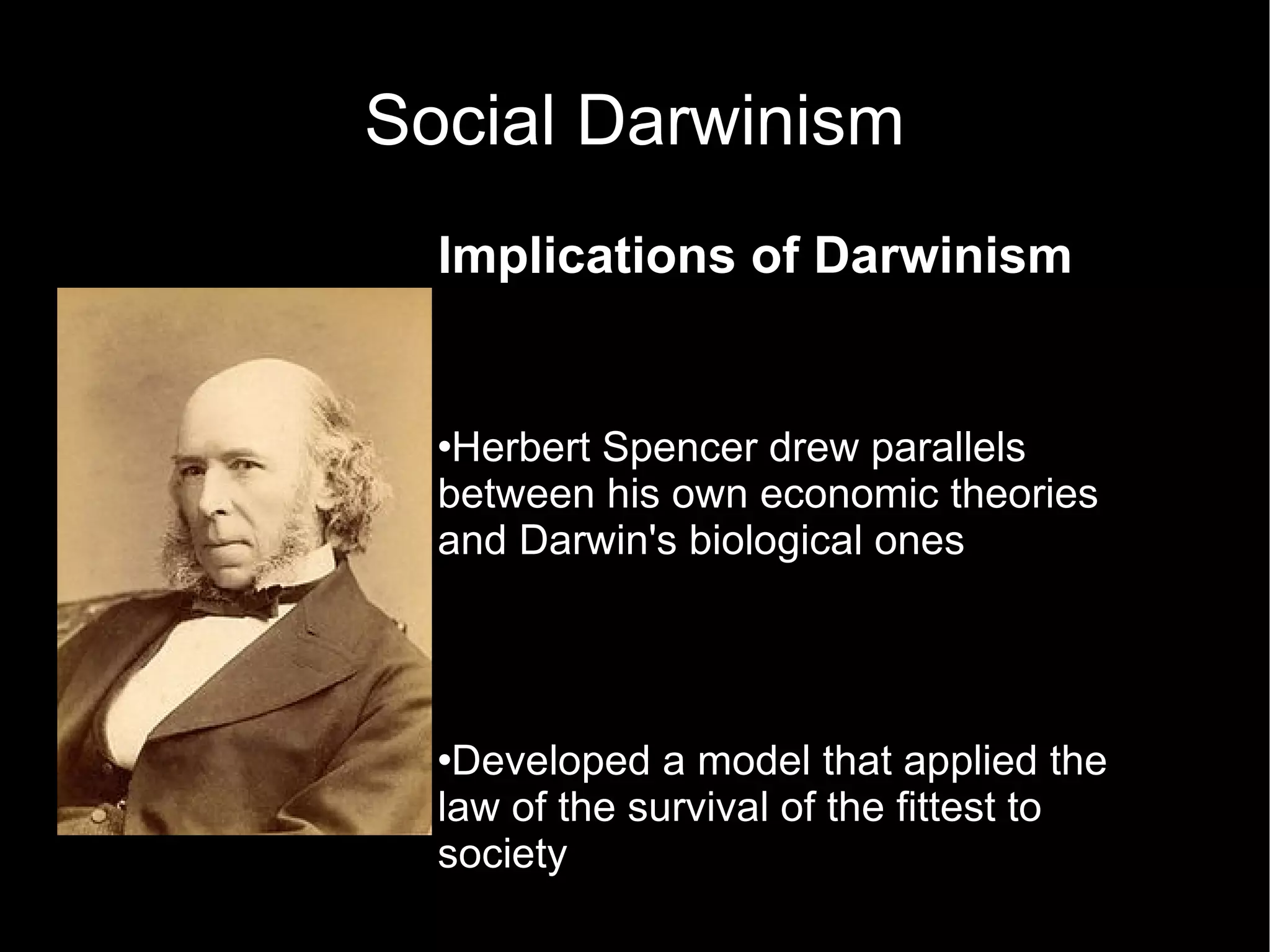
Social Darwinism Implications of Darwinism Herbert Spencer drew parallels between his own economic theories and Darwin's biological ones Developed a model that applied the law of the survival of the fittest to society Humanitarian impulses had to be resisted as nothing should be allowed to interfere with nature's laws.
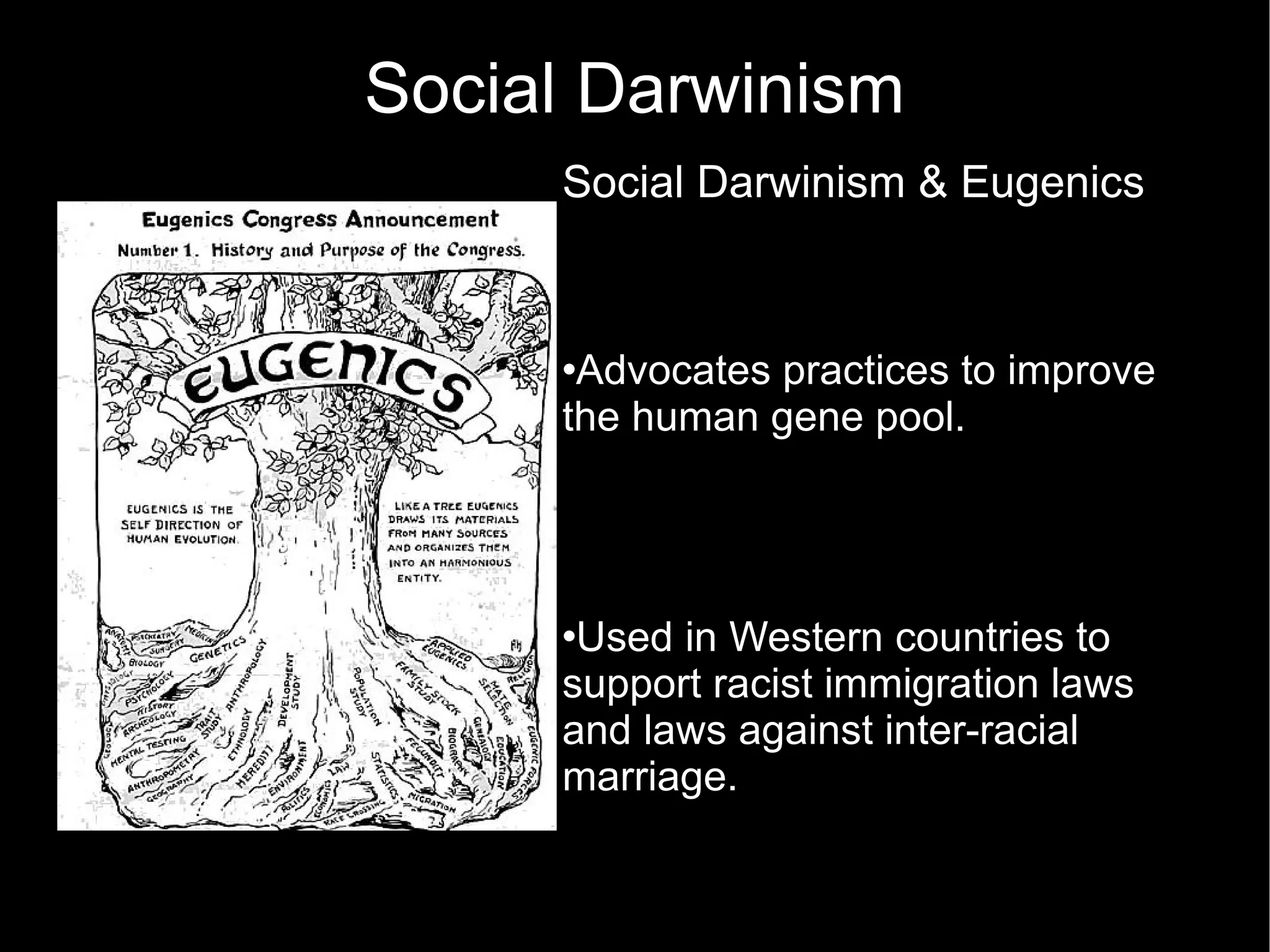
Social Darwinism Social Darwinism & Eugenics  Advocates practices to improve the human gene pool.  Used in Western countries to support racist immigration laws and laws against inter-racial marriage.  In severe cases used to advocate genocide. Advocated the killing of old people because they are no longer productive
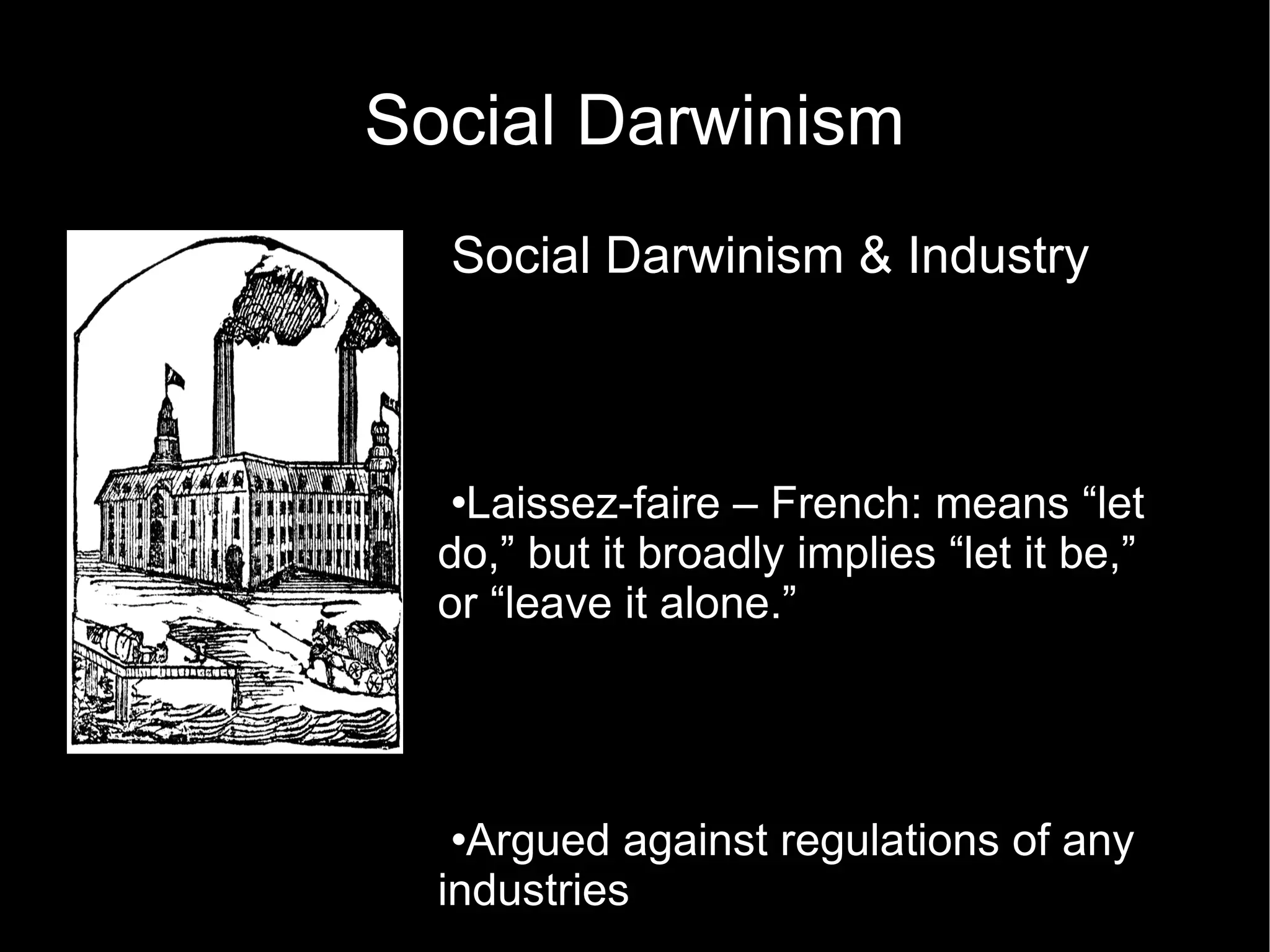
Social Darwinism Social Darwinism & Industry  Laissez-faire – French: means “let do,” but it broadly implies “let it be,” or “leave it alone.”  Argued against regulations of any industries Social Darwinists supported Laissez-faire politics as a form of economic “natural selection”
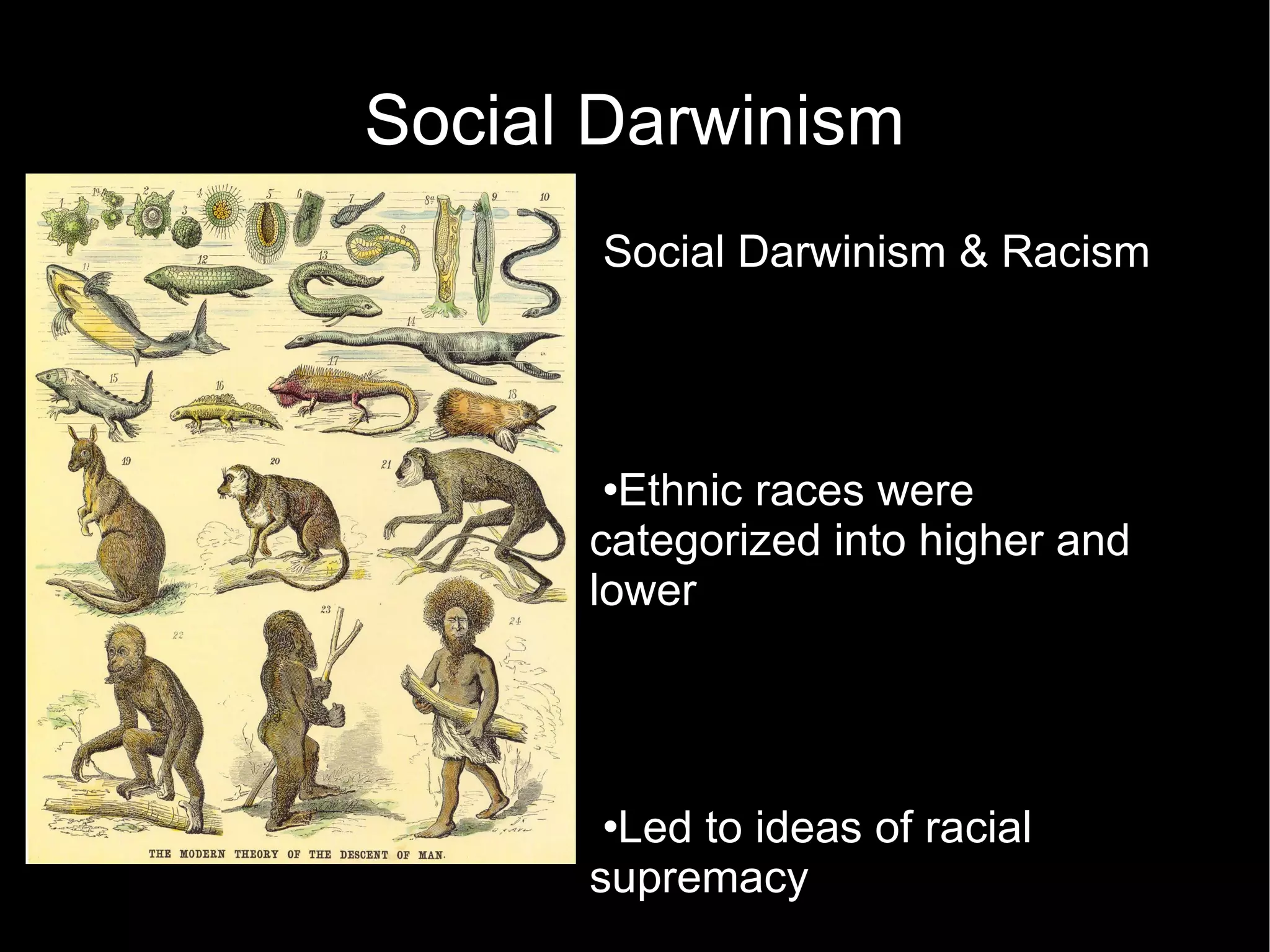
Social Darwinism Social Darwinism & Racism  Ethnic races were categorized into higher and lower  Led to ideas of racial supremacy  Used as a justification for slavery
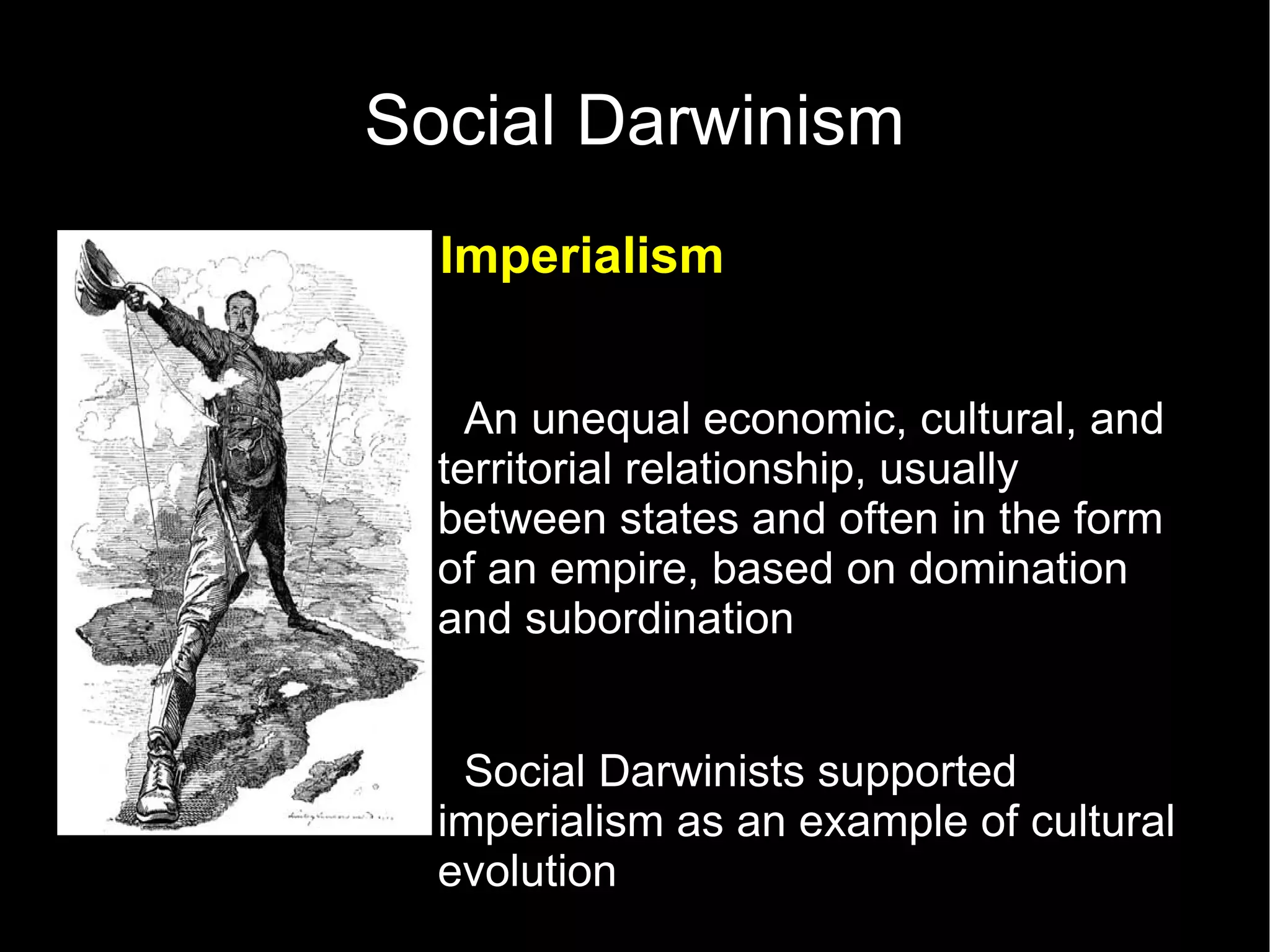
Social Darwinism Imperialism An unequal economic, cultural, and territorial relationship, usually between states and often in the form of an empire, based on domination and subordination Social Darwinists supported imperialism as an example of cultural evolution
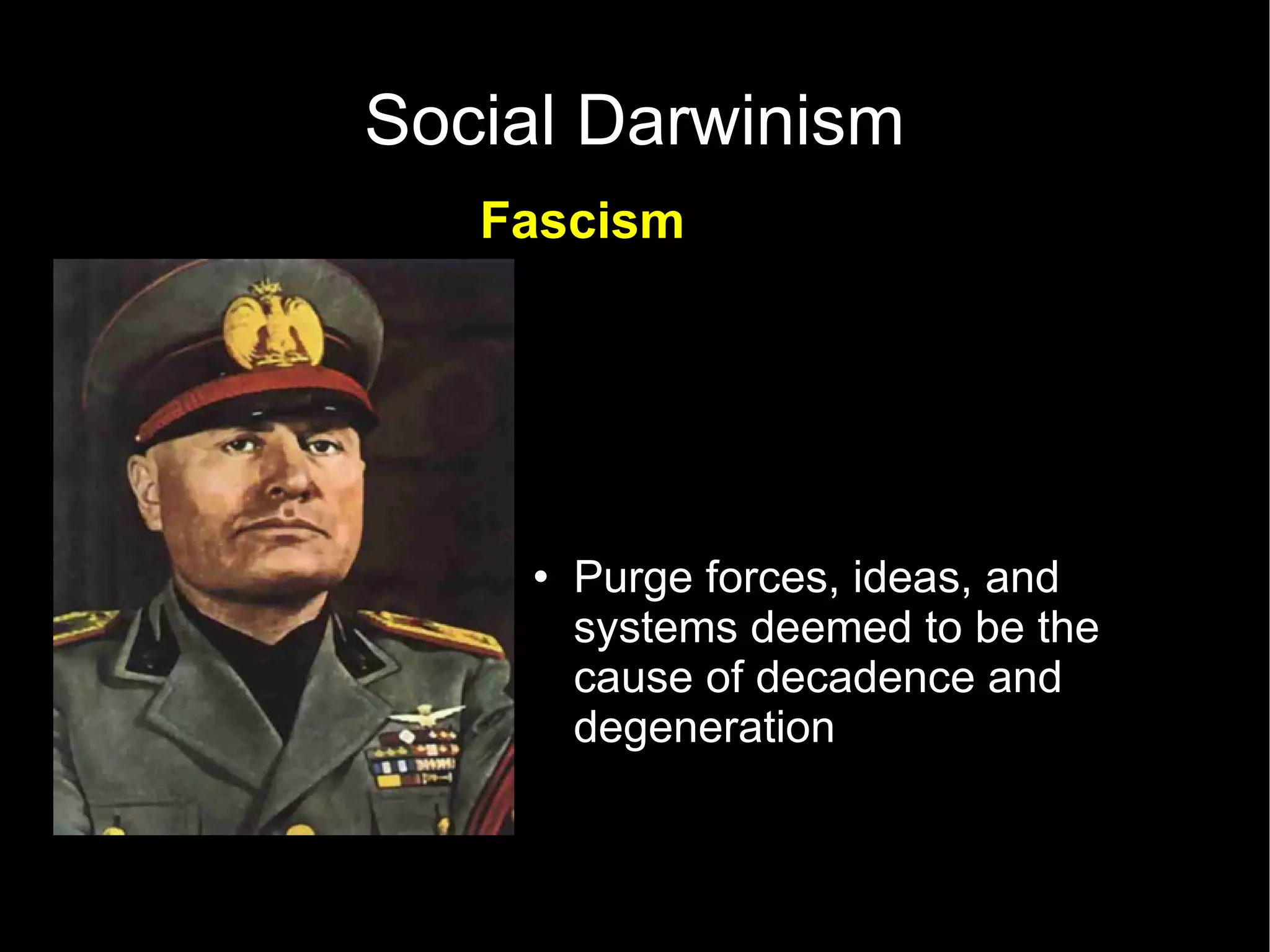
Social Darwinism Fascism Purge forces, ideas, and systems deemed to be the cause of decadence and degeneration  Promote violence and war as actions that create national regeneration Conflict as a fact of life that is responsible for all human progress.
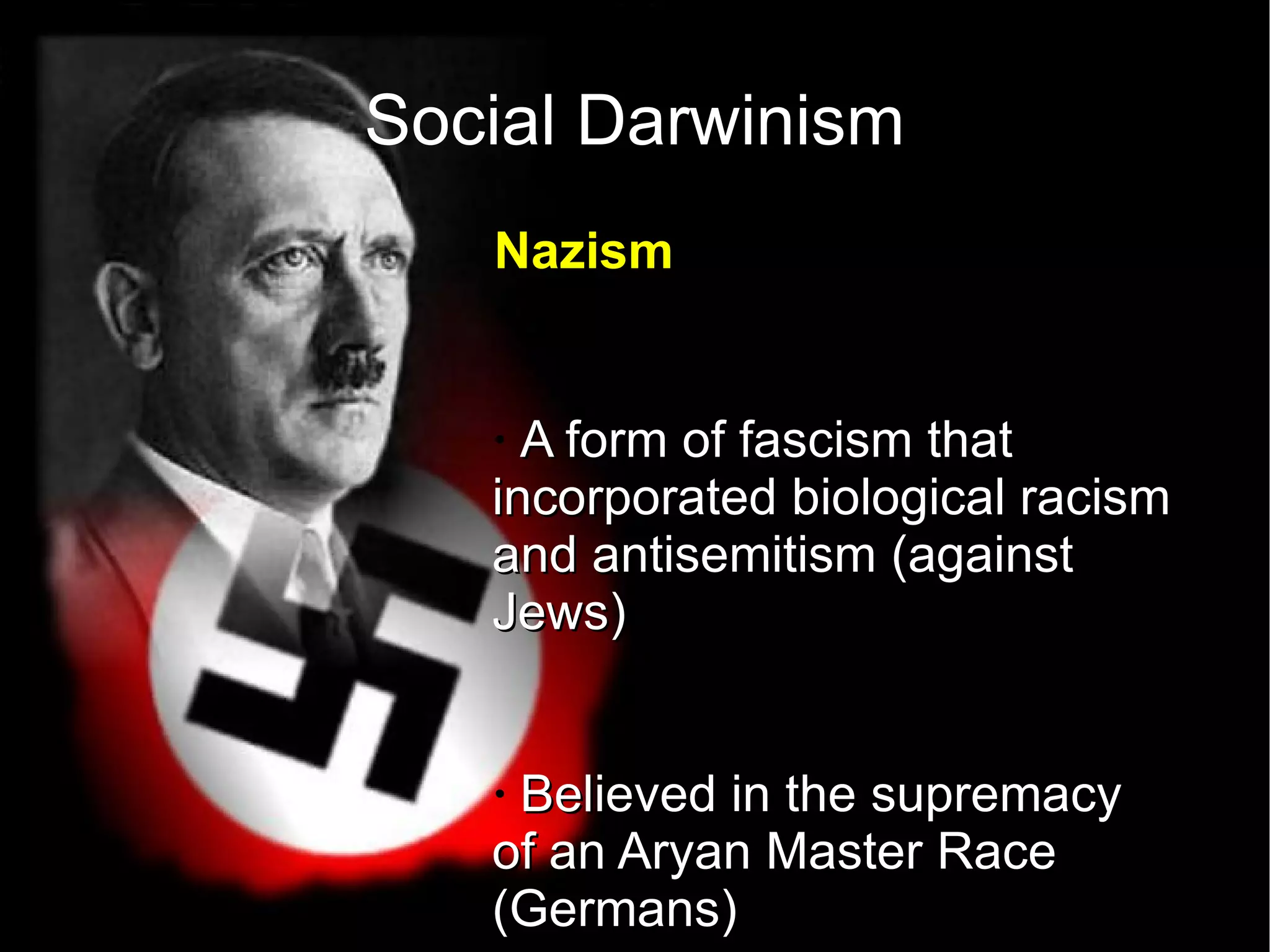
Social Darwinism Nazism   A form of fascism that incorporated biological racism and antisemitism (against Jews) Believed in the supremacy of an Aryan Master Race (Germans)
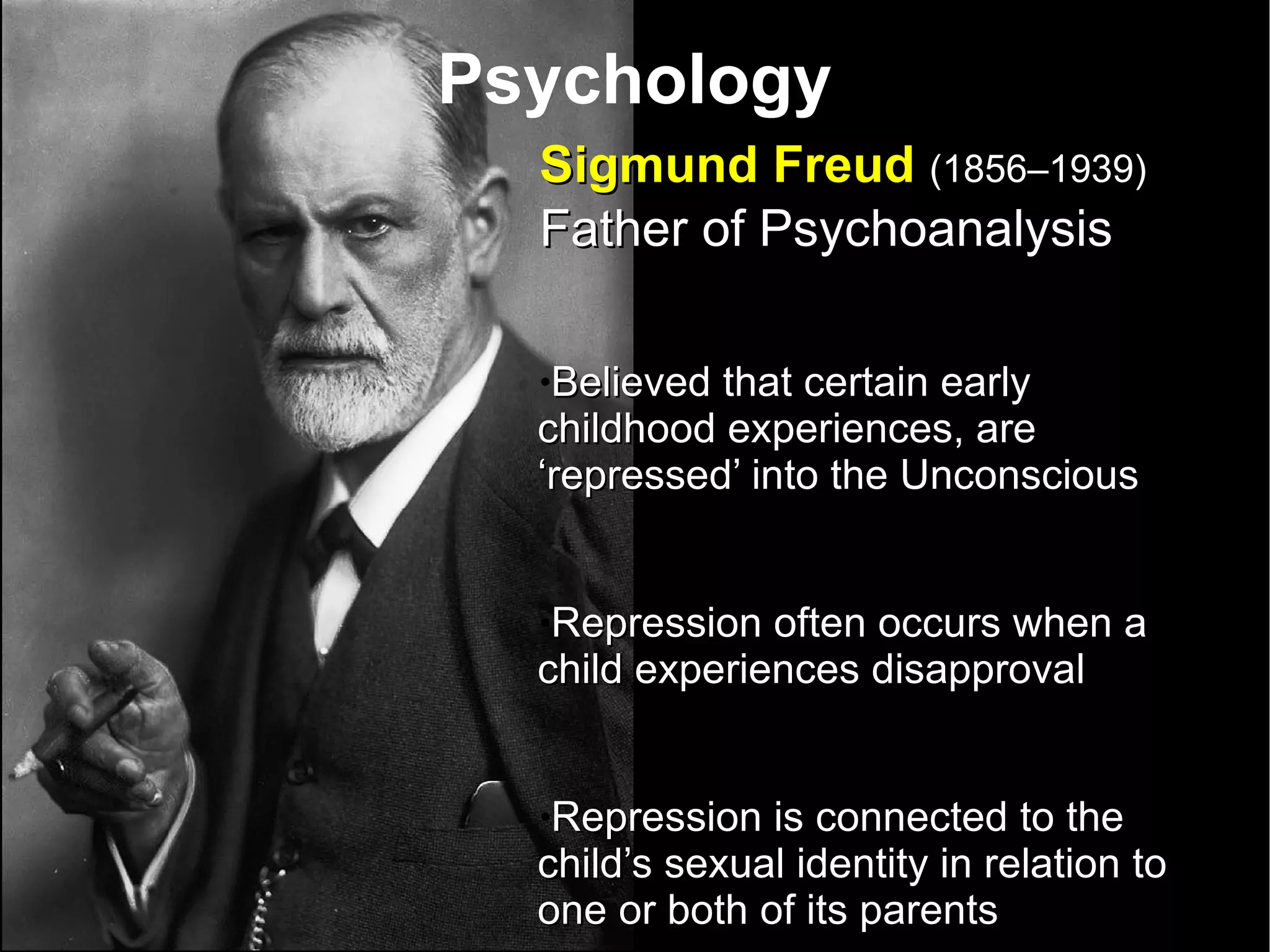
Psychology Sigmund Freud  (1856–1939)   Father of Psychoanalysis Believed that certain early childhood experiences, are ‘repressed’ into the Unconscious Repression often occurs when a child experiences disapproval  Repression is connected to the child’s sexual identity in relation to one or both of its parents
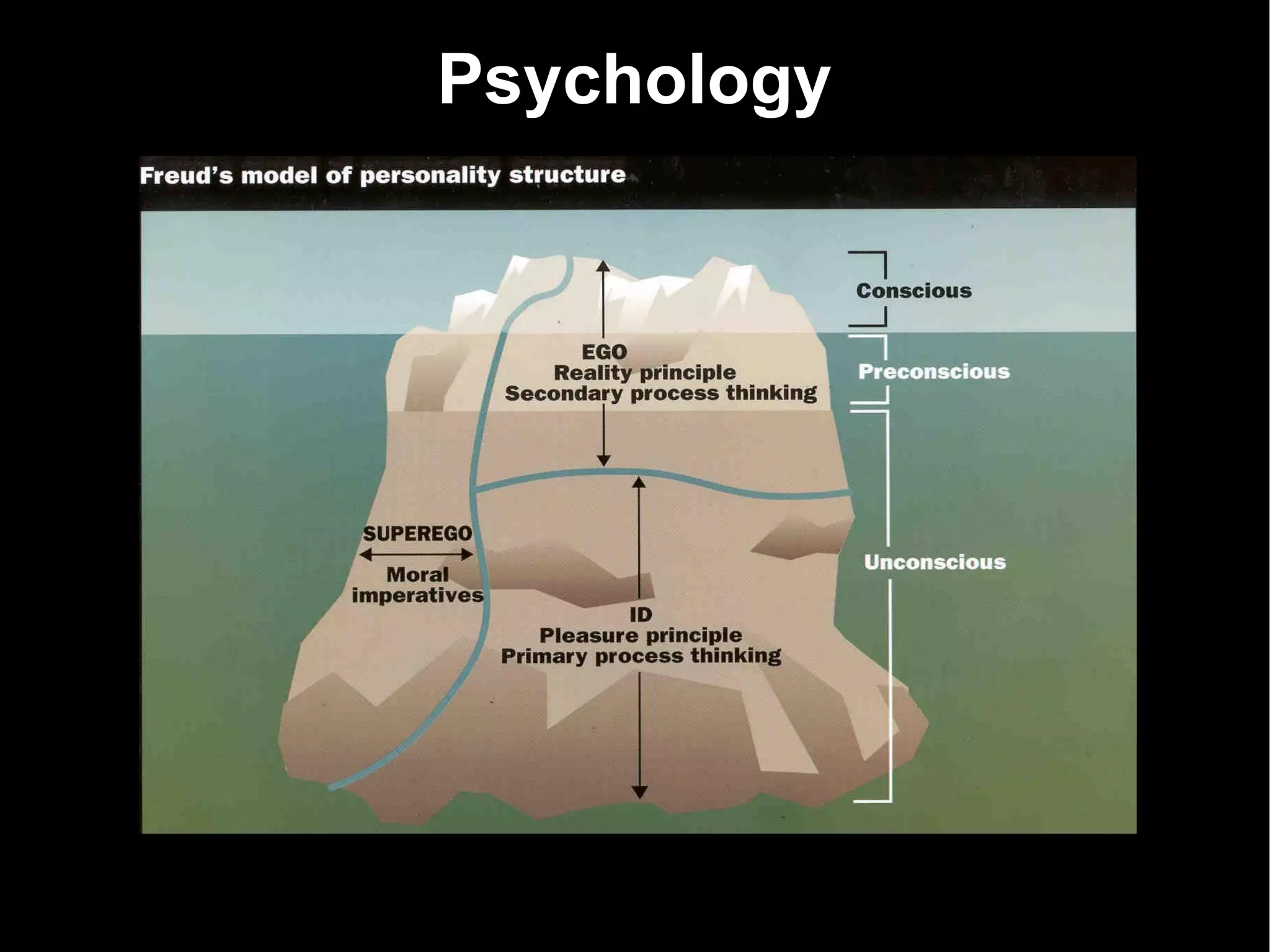
Psychology Sigmund Freud  (1856–1939)   Conscious : Awareness, thoughts, perceptions Pre-conscious : Memories, Stored Knowledge Unconscious : Fears, Motives, Desires, Needs, Wishes, Shameful experiences
Psychology Sigmund Freud  (1856–1939)   Ego : Realistic, organized aspect of personality.  Seeks to satisfy unconscious drives (motives) in realistic ways.  Id : Unconscious, unorganized aspect of personality.  Operates from the “pleasure principle” which attempts to maximize pleasure and minimize pain.  Comprised of instinctive drives and impulses.  Super-Ego : The moral conscience.  Produces the feeling of guilt what a moral conviction has been acted against.  A system of internalized social and cultural regulations for behavior.
Psychology
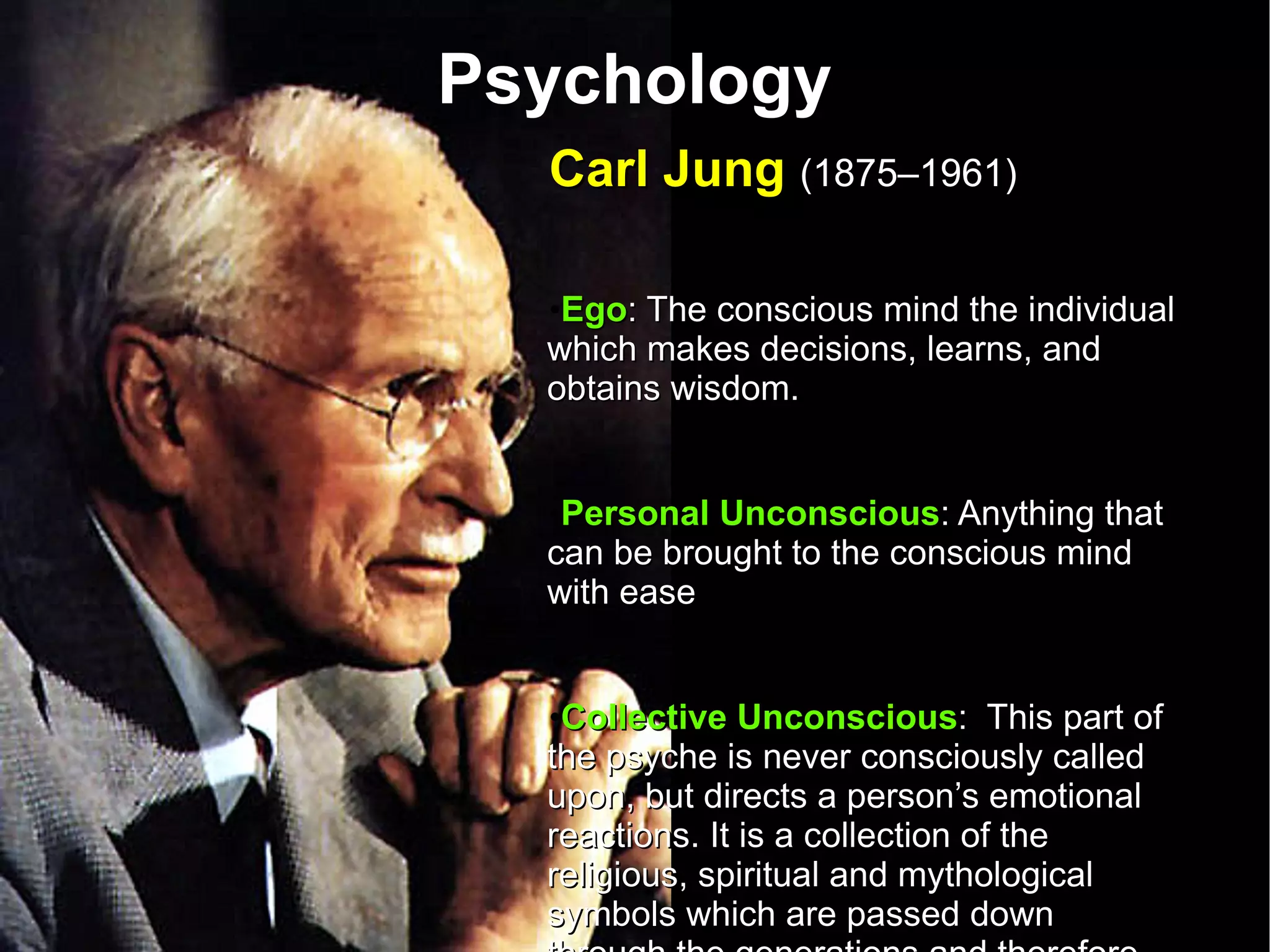
Psychology Carl Jung  (1875–1961)   Ego : The conscious mind the individual which makes decisions, learns, and obtains wisdom. Personal Unconscious : Anything that can be brought to the conscious mind with ease Collective Unconscious :  This part of the psyche is never consciously called upon, but directs a person’s emotional reactions. It is a collection of the religious, spiritual and mythological symbols which are passed down through the generations and therefore pre-date the individual.
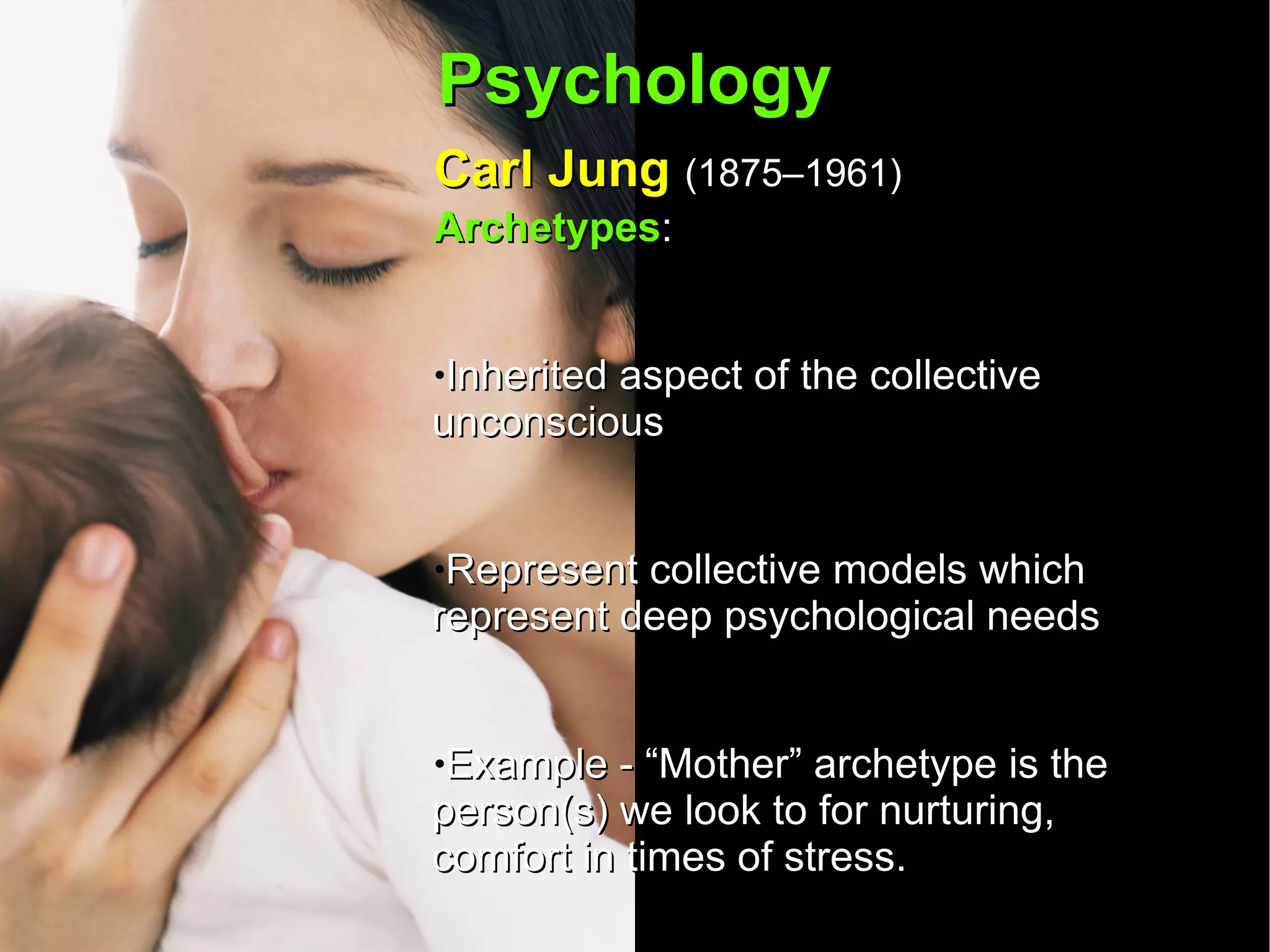
Psychology Carl Jung  (1875–1961)   Archetypes :  Inherited aspect of the collective unconscious Represent collective models which represent deep psychological needs Example - “Mother” archetype is the person(s) we look to for nurturing, comfort in times of stress.  It an archetype is not fulfilled then a person will seek one out in different ways.
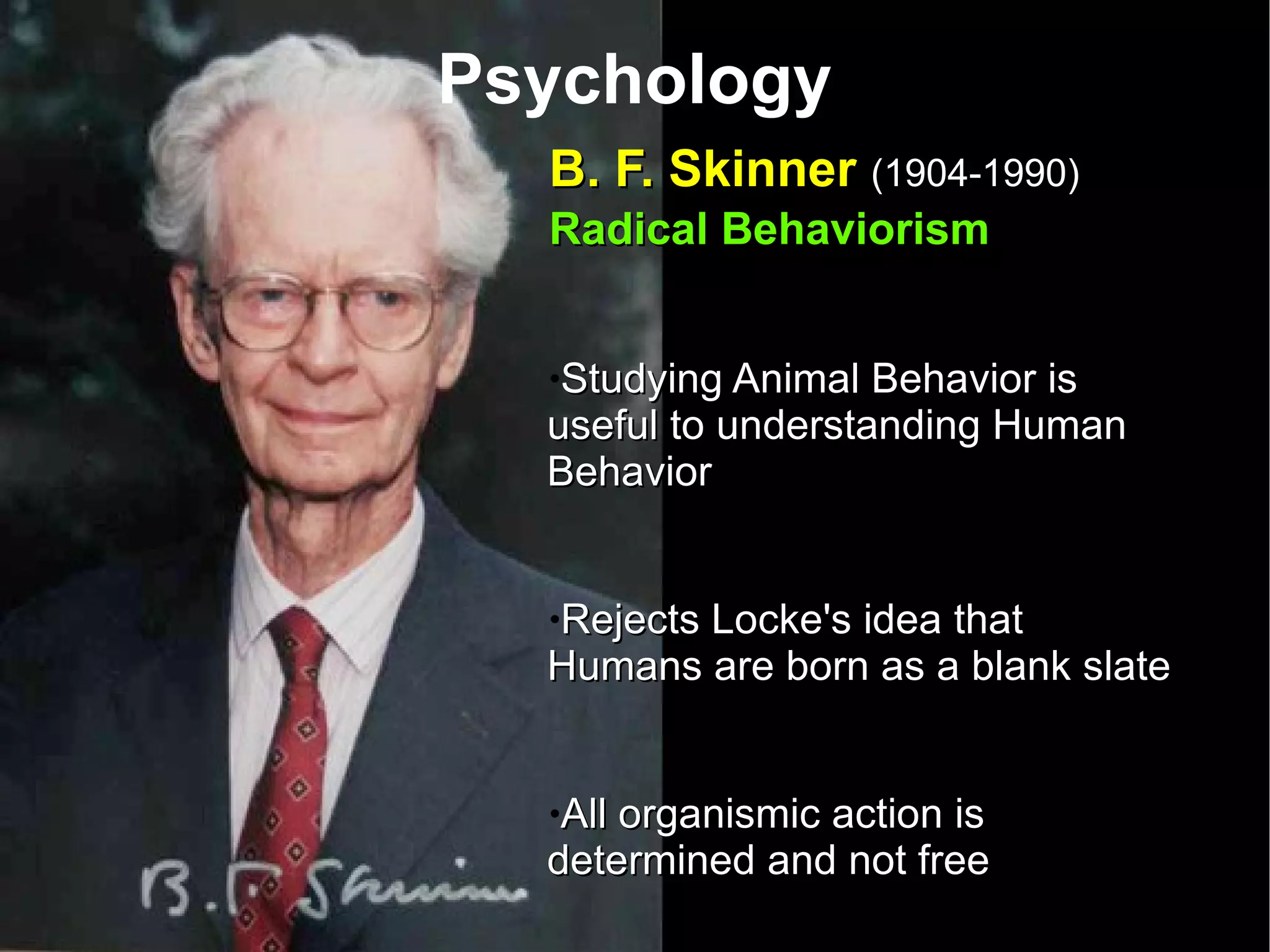
Psychology B. F. Skinner  (1904-1990)   Radical Behaviorism Studying Animal Behavior is useful to understanding Human Behavior Rejects Locke's idea that Humans are born as a blank slate All organismic action is determined and not free
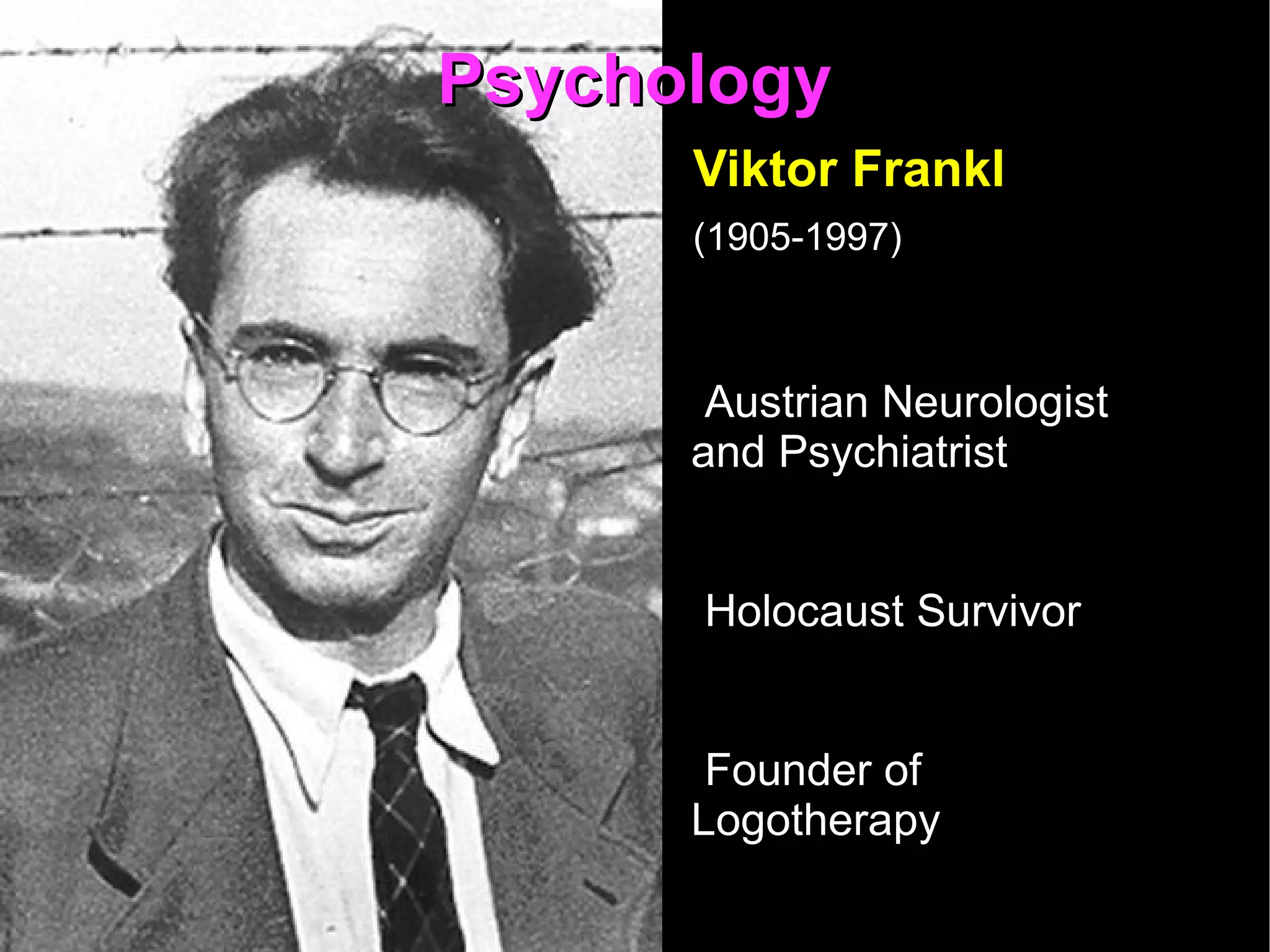
Psychology Viktor Frankl  (1905-1997)   Austrian Neurologist and Psychiatrist Holocaust Survivor Founder of Logotherapy Wrote  Man's Search for Meaning
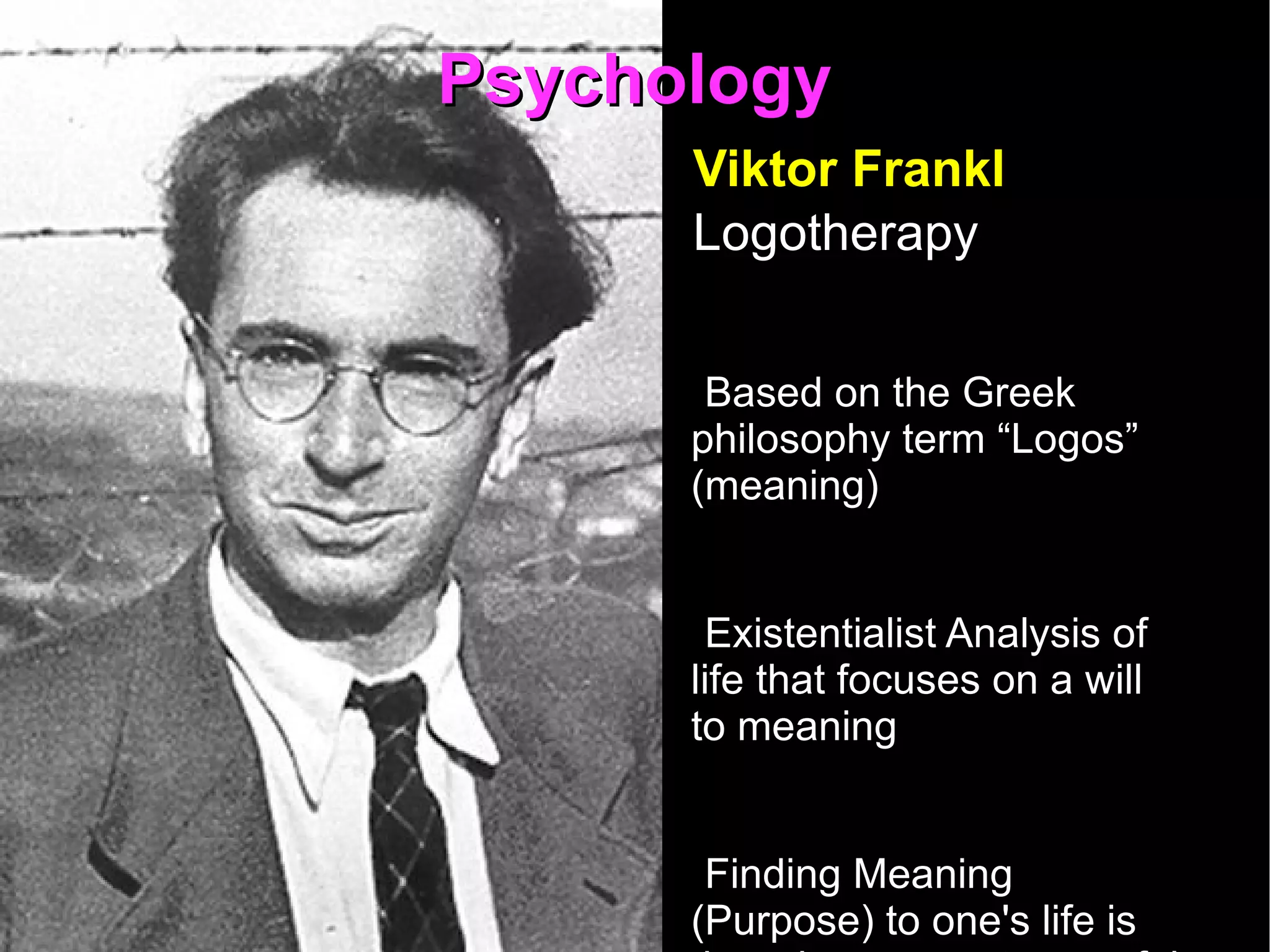
Psychology Viktor Frankl  Logotherapy Based on the Greek philosophy term “Logos”  (meaning) Existentialist Analysis of life that focuses on a will to meaning  Finding Meaning (Purpose) to one's life is the primary, most powerful driving force in Humans
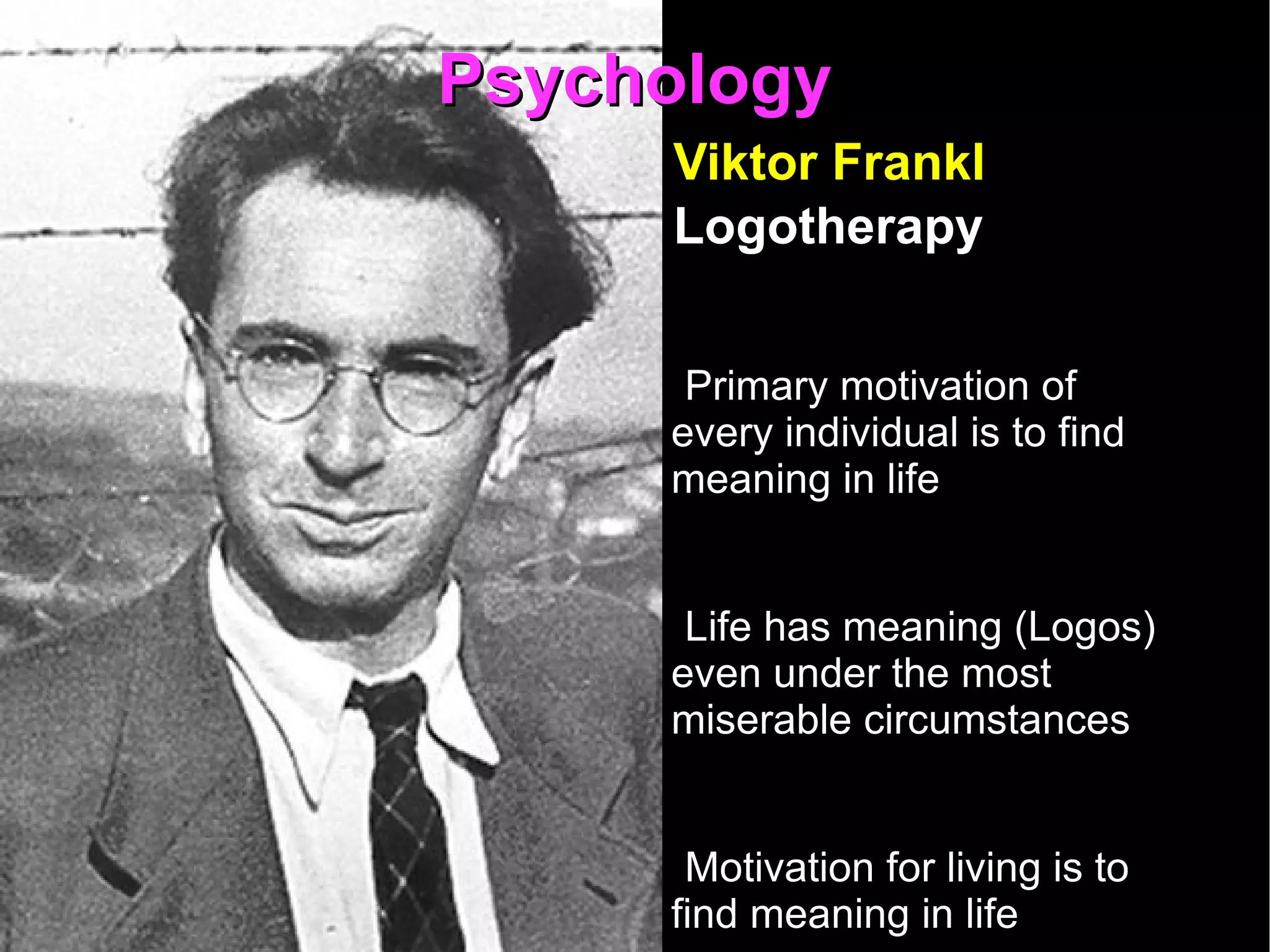
Psychology Viktor Frankl  Logotherapy Primary motivation of every individual is to find meaning in life Life has meaning (Logos) even under the most miserable circumstances Motivation for living is to find meaning in life We are free to find meaning in our circumstances

Philosophy lecture 10

  • 1.
    Introduction to PhilosophyIS-VNU Mr. Mike Lecture 10
  • 2.
    Introduction to PhilosophySocialism Evolution Social Darwinism
  • 3.
    Socialism Karl MarxMarx’s philosophy owes a great deal to Hegel Fundamental condition of humanity is the need to convert the raw material of the natural world into the goods necessary for survival Production (economics) is the primary conditioning factor of life
  • 4.
    Marx's Dialectical MaterialismThesis Feudalism Antithesis Industrialism & Creation of Middle Class Synthesis (New Thesis) Industrialist Capitalism Antithesis Proletariat Working-Class Synthesis Socialism
  • 5.
    Karl Marx Socialismis the necessary outcome of Capitalism and the Proletariat Socialism is not necessary for ethical reasons Socialism is necessary because Marx believes it to be the most efficient means of production and therefore survival
  • 6.
    Evolution Charles DarwinEnglish Naturalist Natural explanation of the origins and decent of biological species 5-year Voyage on HMS Beagle studying/collecting species specimens
  • 7.
    Evolution Charles DarwinBiology based on the philosophies of Schelling and Hegel & Ideal of the Enlightenment Enlightenment Progress Schelling – Nature is in a perpetual state of progress Humans are the highest form of natural progress Hegel – Dialectic (Thesis ↔ Antithesis) -> Synthesis
  • 8.
    Evolution Darwin's TheoryAll species of life have descended over time from common ancestry Transmutation of species – The Process by which one species changes into another species
  • 9.
    Evolution Darwin's TheoryNatural Selection Survival of the Fittest : Organisms with traits which are better adapted for immediate, local environment survive to pass the trait on.
  • 10.
    Darwin's Adaptation ofHegel's Dialectic in Biology (Natural Selection) Thesis - Species Antithesis – Natural Environment Opposing Force Synthesis – New Species better adapted to the natural environment
  • 11.
    Evolution Darwin's TheorySexual Selection Female choice of suitable males which impacts what traits get passed on to offspring from the male.
  • 12.
    Evolution Darwin's TheoryGod Believed in God as the ultimate natural law giver. “ I have never been an atheist in the sense of denying the existence of a God. – I think that generally ... an agnostic would be the most correct description of my state of mind.”
  • 13.
    Evolution Implications ofDarwinism Wider Gap between Religion and Science Origins of man and other species now had a theory that did not need religion Rise in Scientific Atheism
  • 14.
    Evolution The Enlightenment& Darwinism Enlightenment concept of “progress” Speculated that societies progressed through stages of increasing development – Western logic and science as seen as evidence of more developed cultures Societies begin as primitive then progress toward industrialized Europe Darwin's theory was seen as “scientific evidence” of progress
  • 15.
    Social Darwinism Implicationsof Darwinism Herbert Spencer drew parallels between his own economic theories and Darwin's biological ones Developed a model that applied the law of the survival of the fittest to society Humanitarian impulses had to be resisted as nothing should be allowed to interfere with nature's laws.
  • 16.
    Social Darwinism SocialDarwinism & Eugenics Advocates practices to improve the human gene pool. Used in Western countries to support racist immigration laws and laws against inter-racial marriage. In severe cases used to advocate genocide. Advocated the killing of old people because they are no longer productive
  • 17.
    Social Darwinism SocialDarwinism & Industry Laissez-faire – French: means “let do,” but it broadly implies “let it be,” or “leave it alone.” Argued against regulations of any industries Social Darwinists supported Laissez-faire politics as a form of economic “natural selection”
  • 18.
    Social Darwinism SocialDarwinism & Racism Ethnic races were categorized into higher and lower Led to ideas of racial supremacy Used as a justification for slavery
  • 19.
    Social Darwinism ImperialismAn unequal economic, cultural, and territorial relationship, usually between states and often in the form of an empire, based on domination and subordination Social Darwinists supported imperialism as an example of cultural evolution
  • 20.
    Social Darwinism FascismPurge forces, ideas, and systems deemed to be the cause of decadence and degeneration Promote violence and war as actions that create national regeneration Conflict as a fact of life that is responsible for all human progress.
  • 21.
    Social Darwinism Nazism A form of fascism that incorporated biological racism and antisemitism (against Jews) Believed in the supremacy of an Aryan Master Race (Germans)
  • 22.
    Psychology Sigmund Freud (1856–1939) Father of Psychoanalysis Believed that certain early childhood experiences, are ‘repressed’ into the Unconscious Repression often occurs when a child experiences disapproval Repression is connected to the child’s sexual identity in relation to one or both of its parents
  • 23.
    Psychology Sigmund Freud (1856–1939) Conscious : Awareness, thoughts, perceptions Pre-conscious : Memories, Stored Knowledge Unconscious : Fears, Motives, Desires, Needs, Wishes, Shameful experiences
  • 24.
    Psychology Sigmund Freud (1856–1939) Ego : Realistic, organized aspect of personality. Seeks to satisfy unconscious drives (motives) in realistic ways. Id : Unconscious, unorganized aspect of personality. Operates from the “pleasure principle” which attempts to maximize pleasure and minimize pain. Comprised of instinctive drives and impulses. Super-Ego : The moral conscience. Produces the feeling of guilt what a moral conviction has been acted against. A system of internalized social and cultural regulations for behavior.
  • 25.
  • 26.
    Psychology Carl Jung (1875–1961) Ego : The conscious mind the individual which makes decisions, learns, and obtains wisdom. Personal Unconscious : Anything that can be brought to the conscious mind with ease Collective Unconscious : This part of the psyche is never consciously called upon, but directs a person’s emotional reactions. It is a collection of the religious, spiritual and mythological symbols which are passed down through the generations and therefore pre-date the individual.
  • 27.
    Psychology Carl Jung (1875–1961) Archetypes : Inherited aspect of the collective unconscious Represent collective models which represent deep psychological needs Example - “Mother” archetype is the person(s) we look to for nurturing, comfort in times of stress. It an archetype is not fulfilled then a person will seek one out in different ways.
  • 28.
    Psychology B. F.Skinner (1904-1990) Radical Behaviorism Studying Animal Behavior is useful to understanding Human Behavior Rejects Locke's idea that Humans are born as a blank slate All organismic action is determined and not free
  • 29.
    Psychology Viktor Frankl (1905-1997) Austrian Neurologist and Psychiatrist Holocaust Survivor Founder of Logotherapy Wrote Man's Search for Meaning
  • 30.
    Psychology Viktor Frankl Logotherapy Based on the Greek philosophy term “Logos” (meaning) Existentialist Analysis of life that focuses on a will to meaning Finding Meaning (Purpose) to one's life is the primary, most powerful driving force in Humans
  • 31.
    Psychology Viktor Frankl Logotherapy Primary motivation of every individual is to find meaning in life Life has meaning (Logos) even under the most miserable circumstances Motivation for living is to find meaning in life We are free to find meaning in our circumstances