1
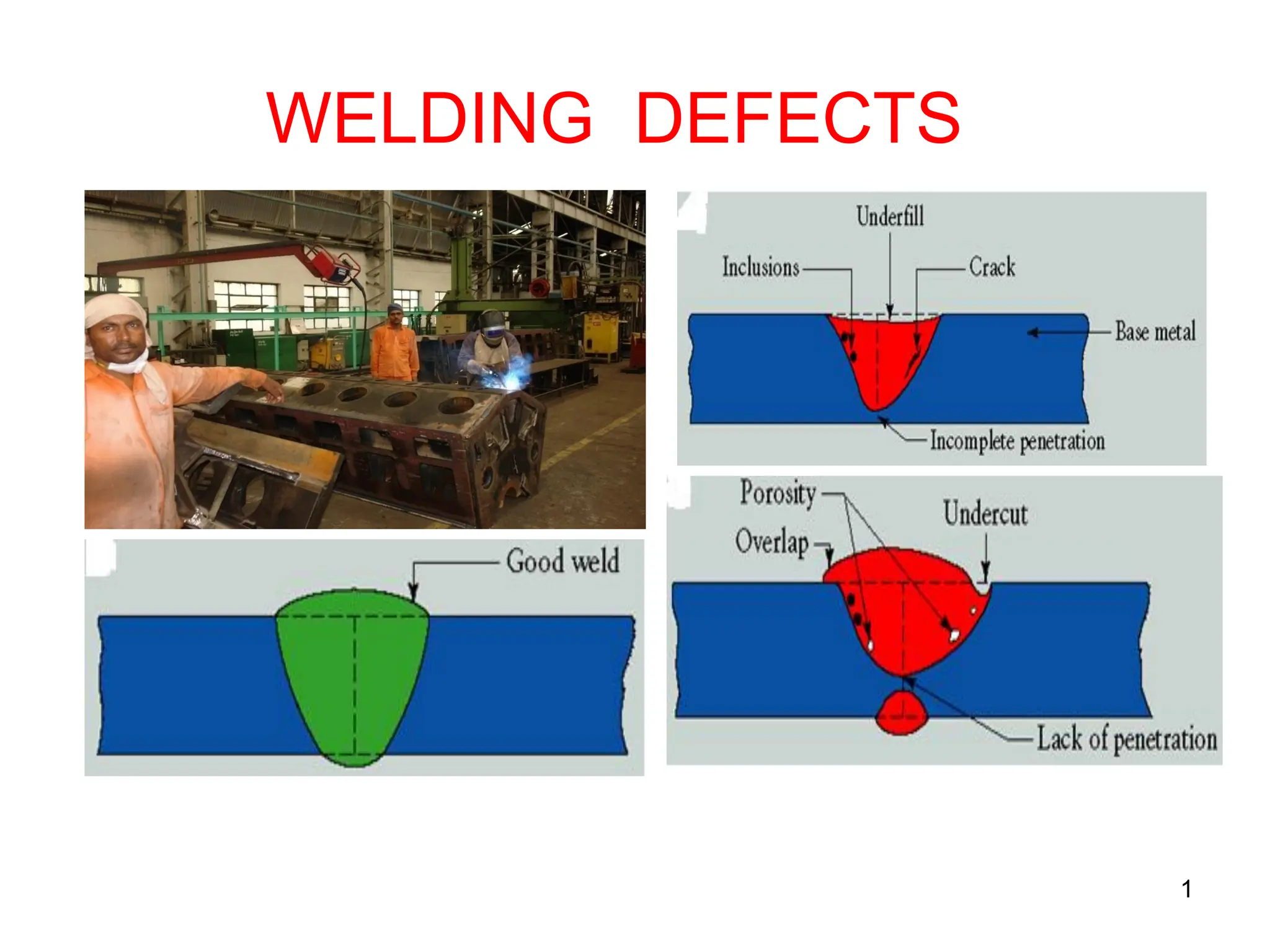
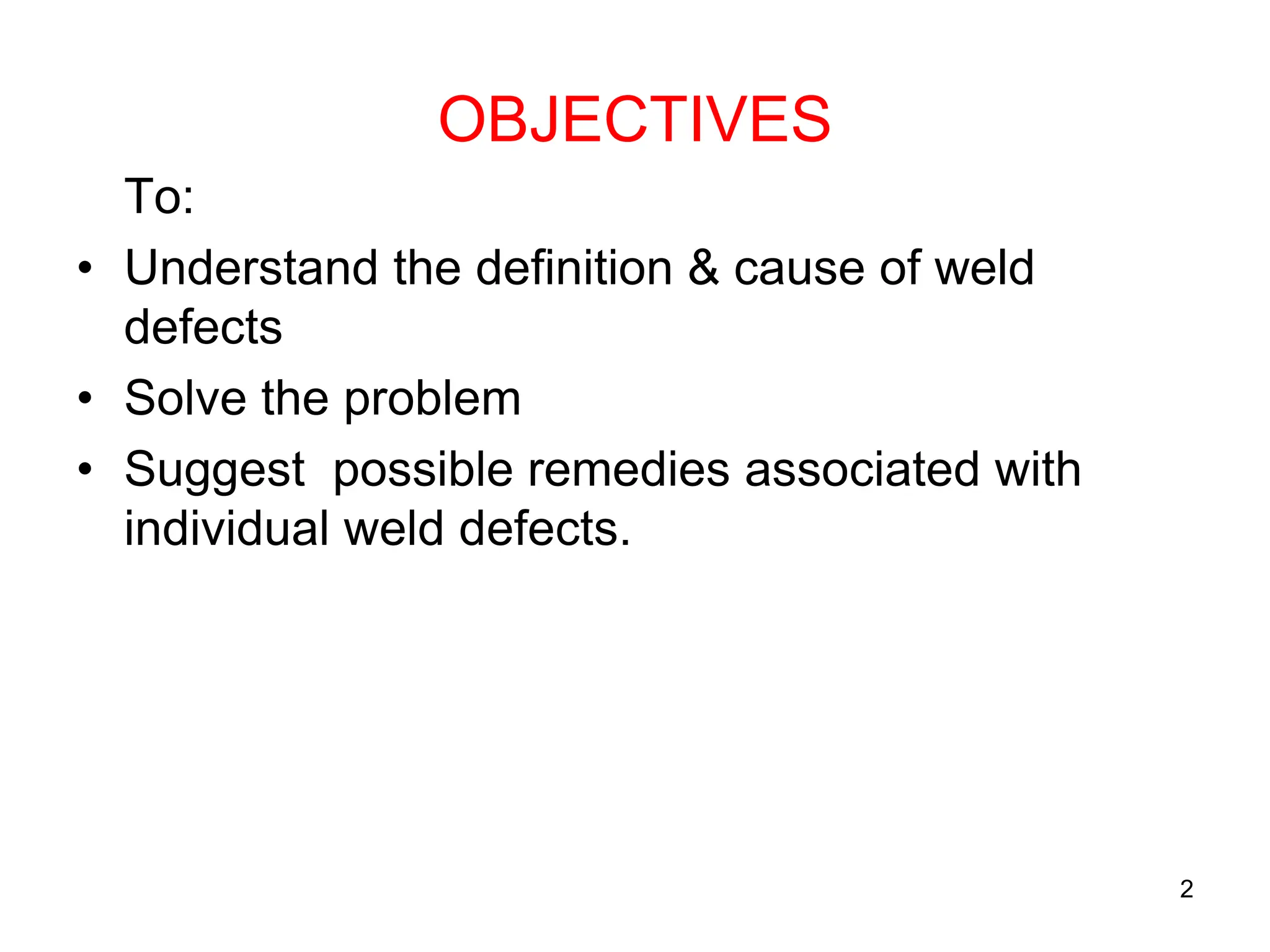
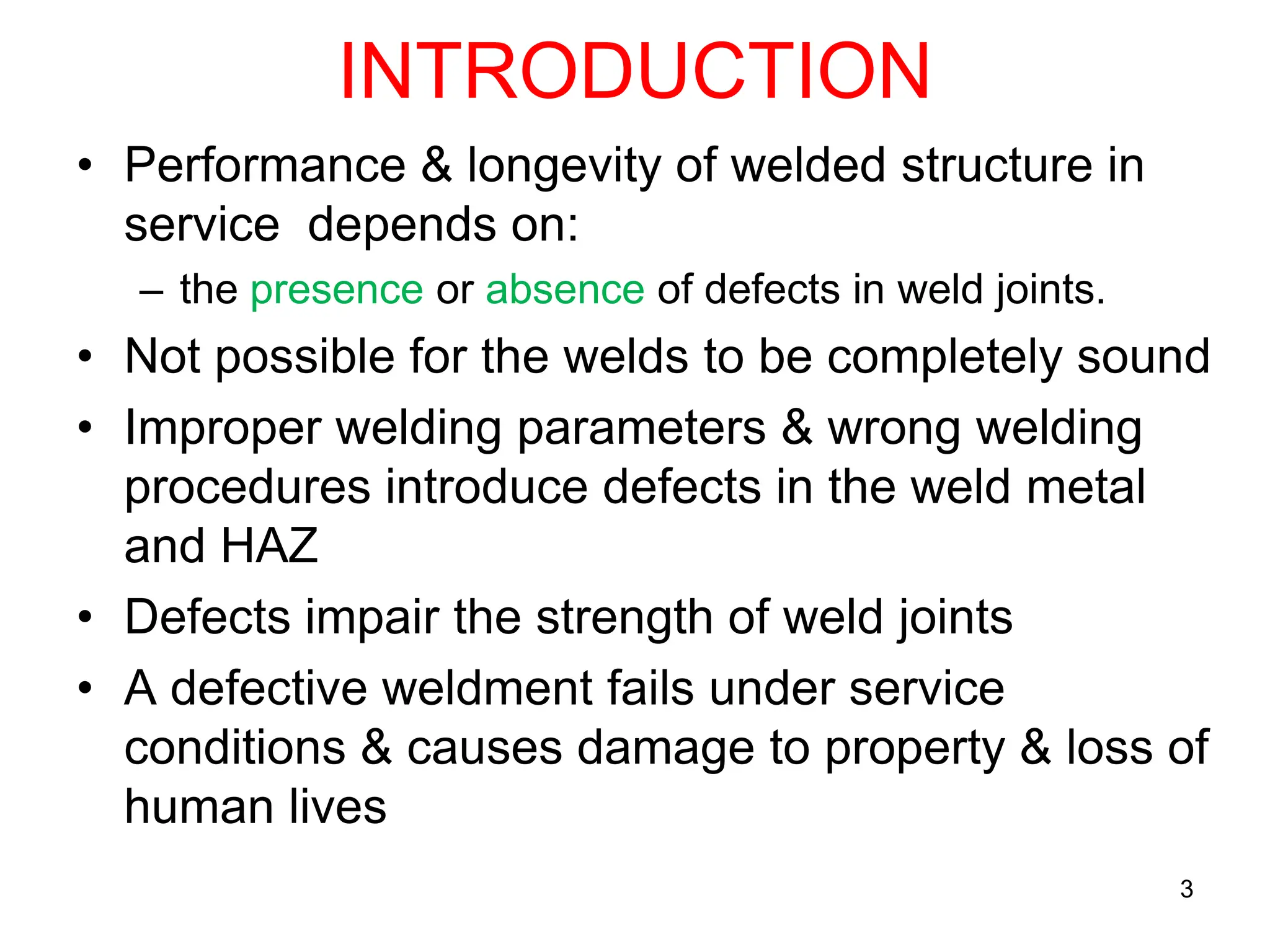
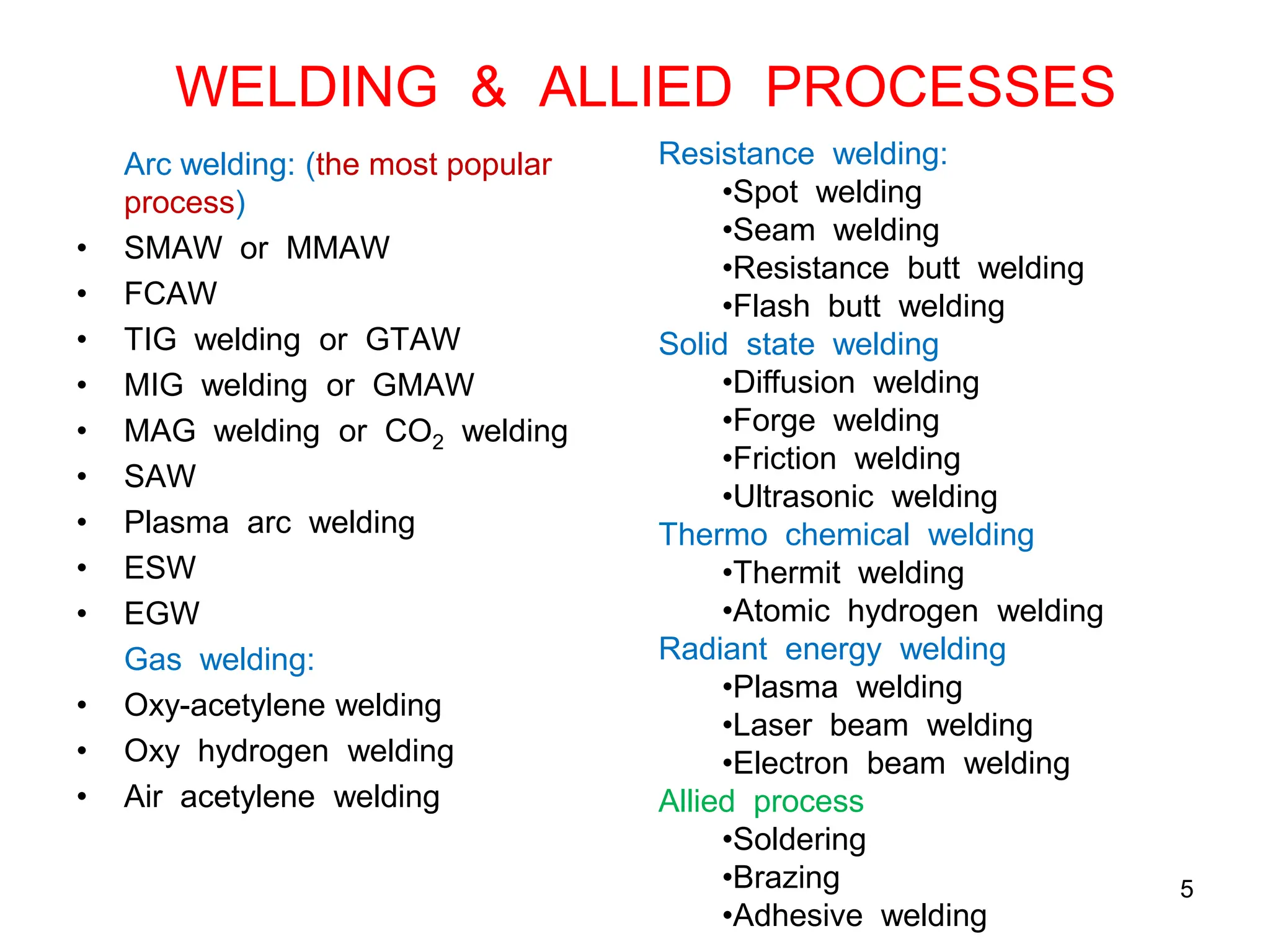
WELDING DEFECTS
OBJECTIVES
To:
• Understand the definition & cause of weld
defects
• Solve the problem
• Suggest possible remedies associated with
individual weld defects.
2
INTRODUCTION
• Performance & longevity of welded structure in
service depends on:
– the presence or absence of defects in weld joints.
• Not possible for the welds to be completely sound
• Improper welding parameters & wrong welding
procedures introduce defects in the weld metal
and HAZ
• Defects impair the strength of weld joints
• A defective weldment fails under service
conditions & causes damage to property & loss of
human lives
3
4
DEFINITION OF WELDING
Definition:
“Process of joining two similar or dissimilar metals by
heat or by pressure or by both using a filler metal to
achieve a defect less joint having the physical
properties similar to that of parent metal”.
Dissimilar metal means:-
• Those that are chemically different (steel,Cu, Al, etc).
• Those that are metallurgically different (MS, SS, etc).
*Dissimilar metal imparts galvanic cell corrosion
Commonly welded base metals:-
– Ferrous-[WI, CI, C-steel (low, med, high), alloy
steel, SS]
– Non-ferrous-(Al, Cu ,Mg, Ni, Zn & their alloys)
5
WELDING & ALLIED PROCESSES
Arc welding: (the most popular
process)
• SMAW or MMAW
• FCAW
• TIG welding or GTAW
• MIG welding or GMAW
• MAG welding or CO2 welding
• SAW
• Plasma arc welding
• ESW
• EGW
Gas welding:
• Oxy-acetylene welding
• Oxy hydrogen welding
• Air acetylene welding
Resistance welding:
•Spot welding
•Seam welding
•Resistance butt welding
•Flash butt welding
Solid state welding
•Diffusion welding
•Forge welding
•Friction welding
•Ultrasonic welding
Thermo chemical welding
•Thermit welding
•Atomic hydrogen welding
Radiant energy welding
•Plasma welding
•Laser beam welding
•Electron beam welding
Allied process
•Soldering
•Brazing
•Adhesive welding
WELDING PROCESSES MAINLY
USED ON IR
• MMAW
• SAWMIG/MAG
• Gas welding
• Thermit welding
• Flash butt welding
• Gas pressure welding
• Brazing
6
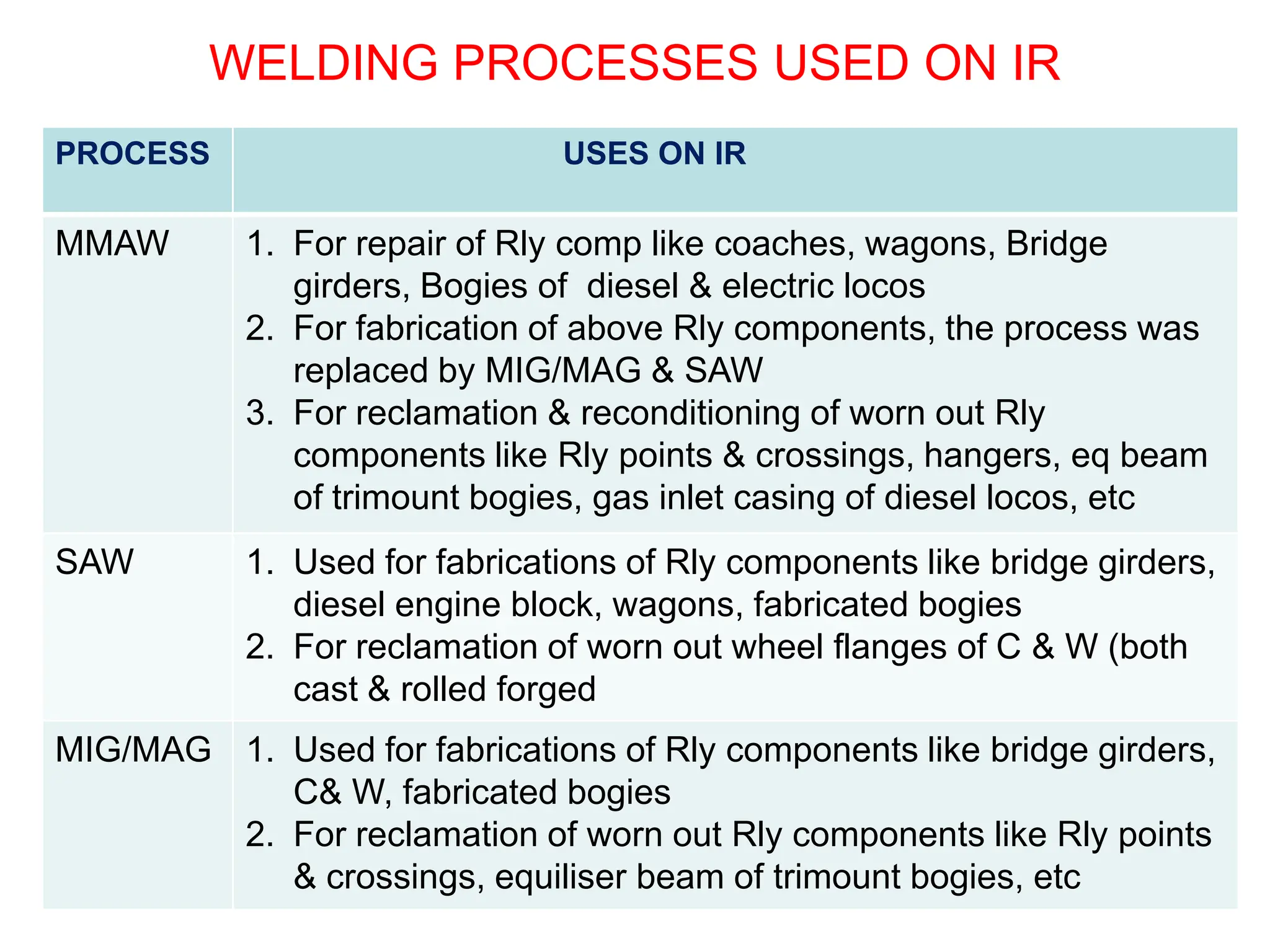
WELDING PROCESSES USED ON IR
PROCESS USES ON IR
MMAW 1. For repair of Rly comp like coaches, wagons, Bridge
girders, Bogies of diesel & electric locos
2. For fabrication of above Rly components, the process was
replaced by MIG/MAG & SAW
3. For reclamation & reconditioning of worn out Rly
components like Rly points & crossings, hangers, eq beam
of trimount bogies, gas inlet casing of diesel locos, etc
SAW 1. Used for fabrications of Rly components like bridge girders,
diesel engine block, wagons, fabricated bogies
2. For reclamation of worn out wheel flanges of C & W (both
cast & rolled forged
MIG/MAG 1. Used for fabrications of Rly components like bridge girders,
C& W, fabricated bogies
2. For reclamation of worn out Rly components like Rly points
& crossings, equiliser beam of trimount bogies, etc
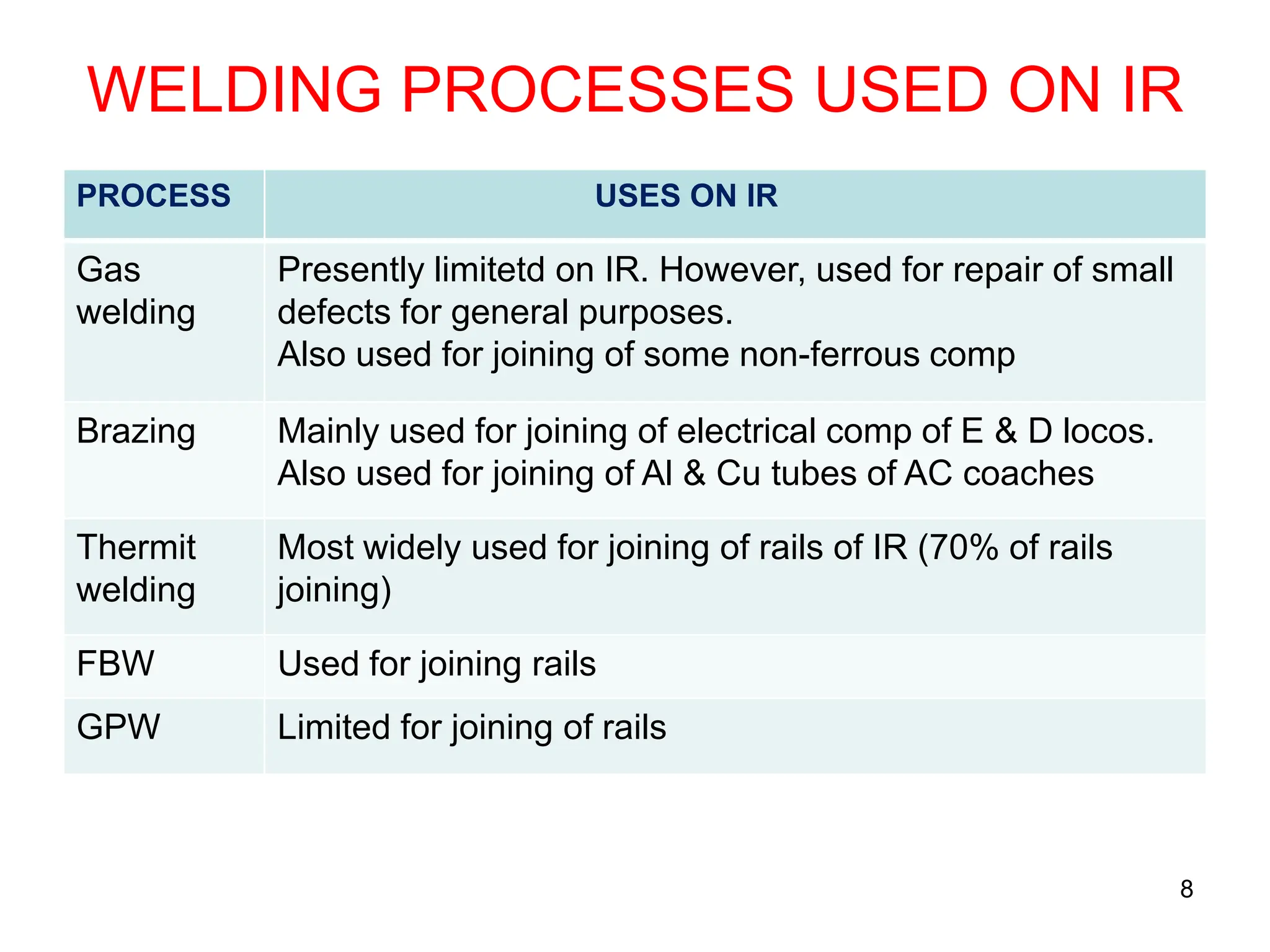
WELDING PROCESSES USED ON IR
PROCESS USES ON IR
Gas
welding
Presently limitetd on IR. However, used for repair of small
defects for general purposes.
Also used for joining of some non-ferrous comp
Brazing Mainly used for joining of electrical comp of E & D locos.
Also used for joining of Al & Cu tubes of AC coaches
Thermit
welding
Most widely used for joining of rails of IR (70% of rails
joining)
FBW Used for joining rails
GPW Limited for joining of rails
8
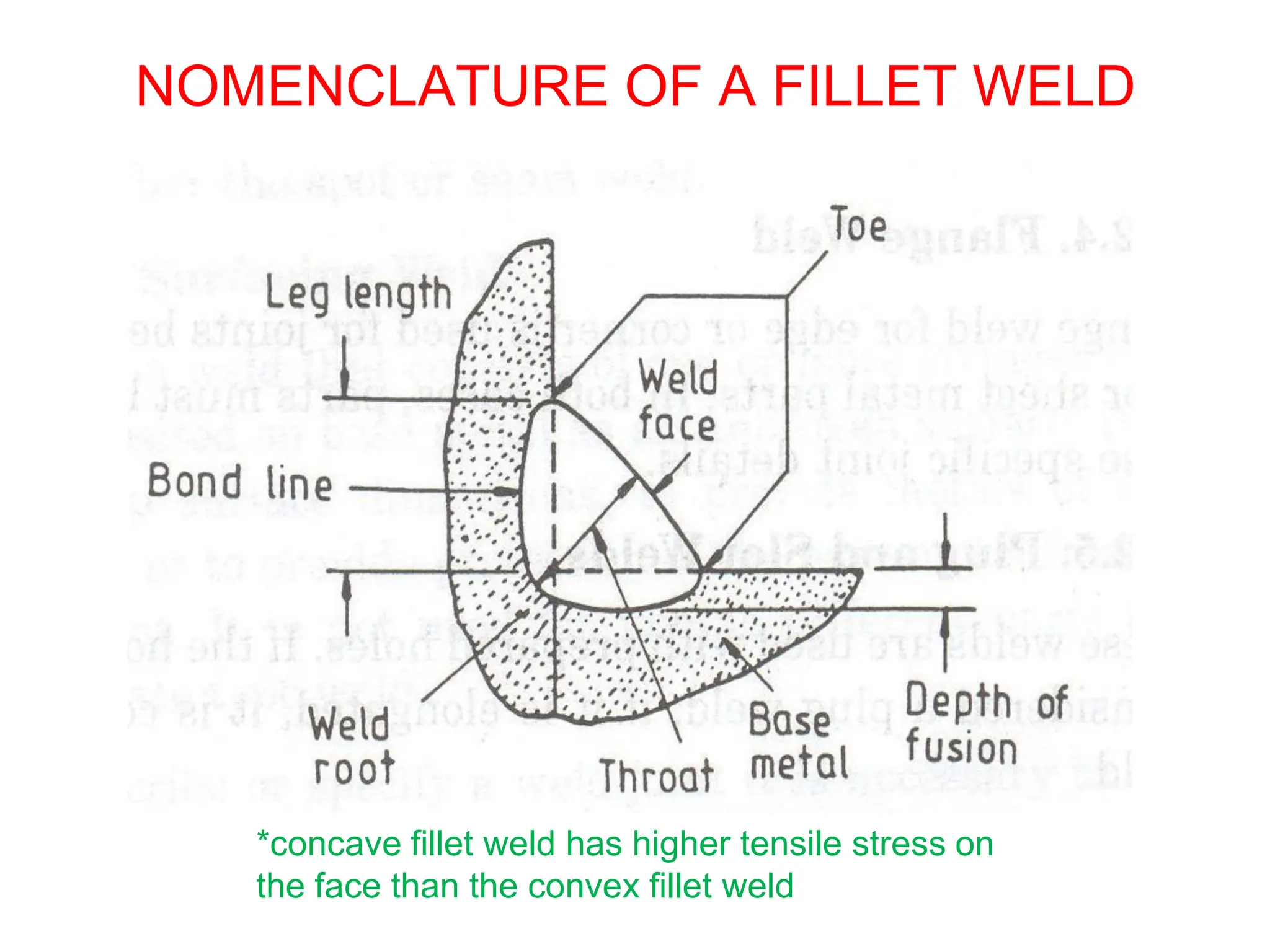
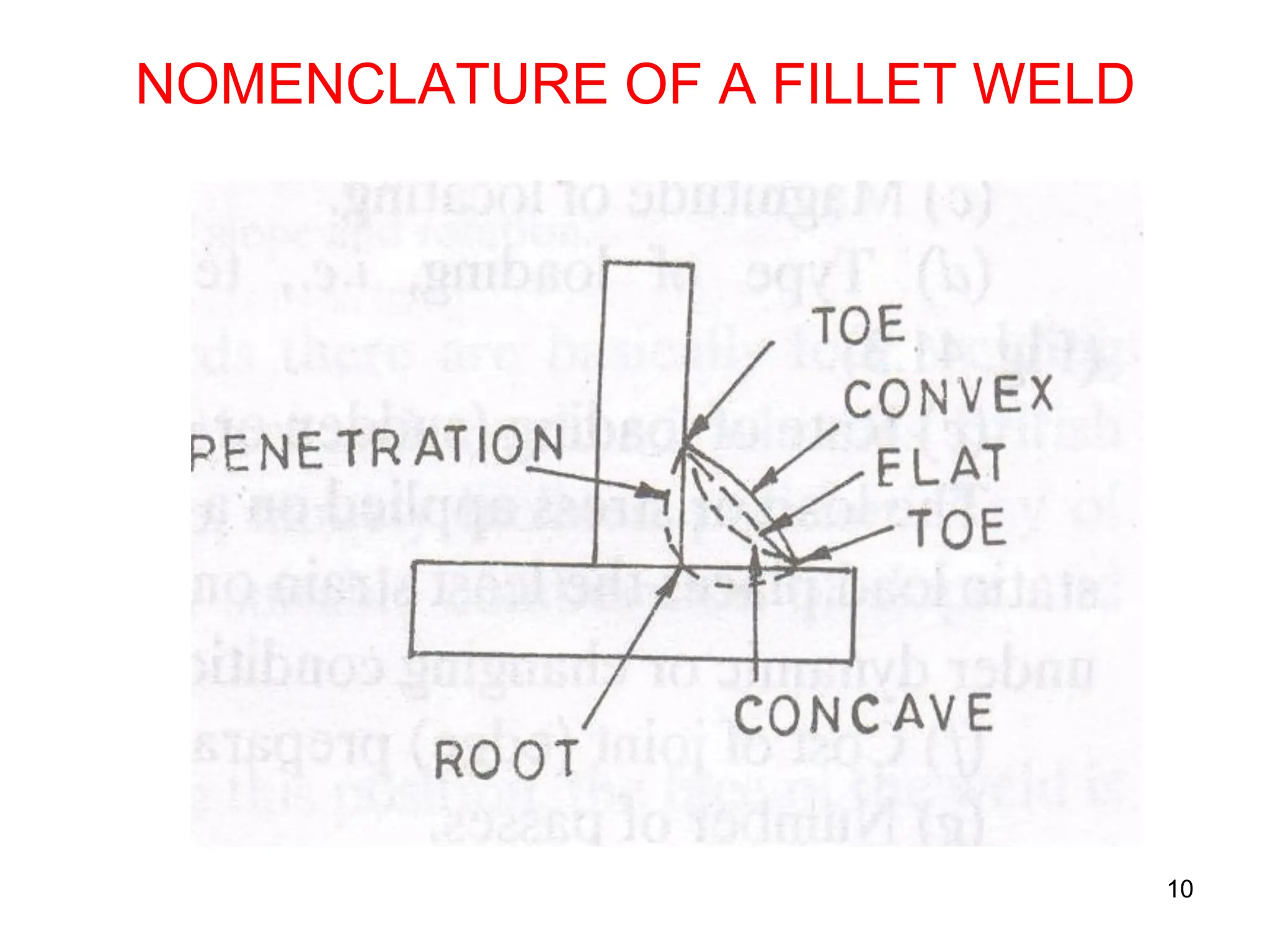
NOMENCLATURE OF A FILLET WELD
*concave fillet weld has higher tensile stress on
the face than the convex fillet weld
NOMENCLATURE OF A FILLET WELD
10
WELDING DEFECTS
11
12
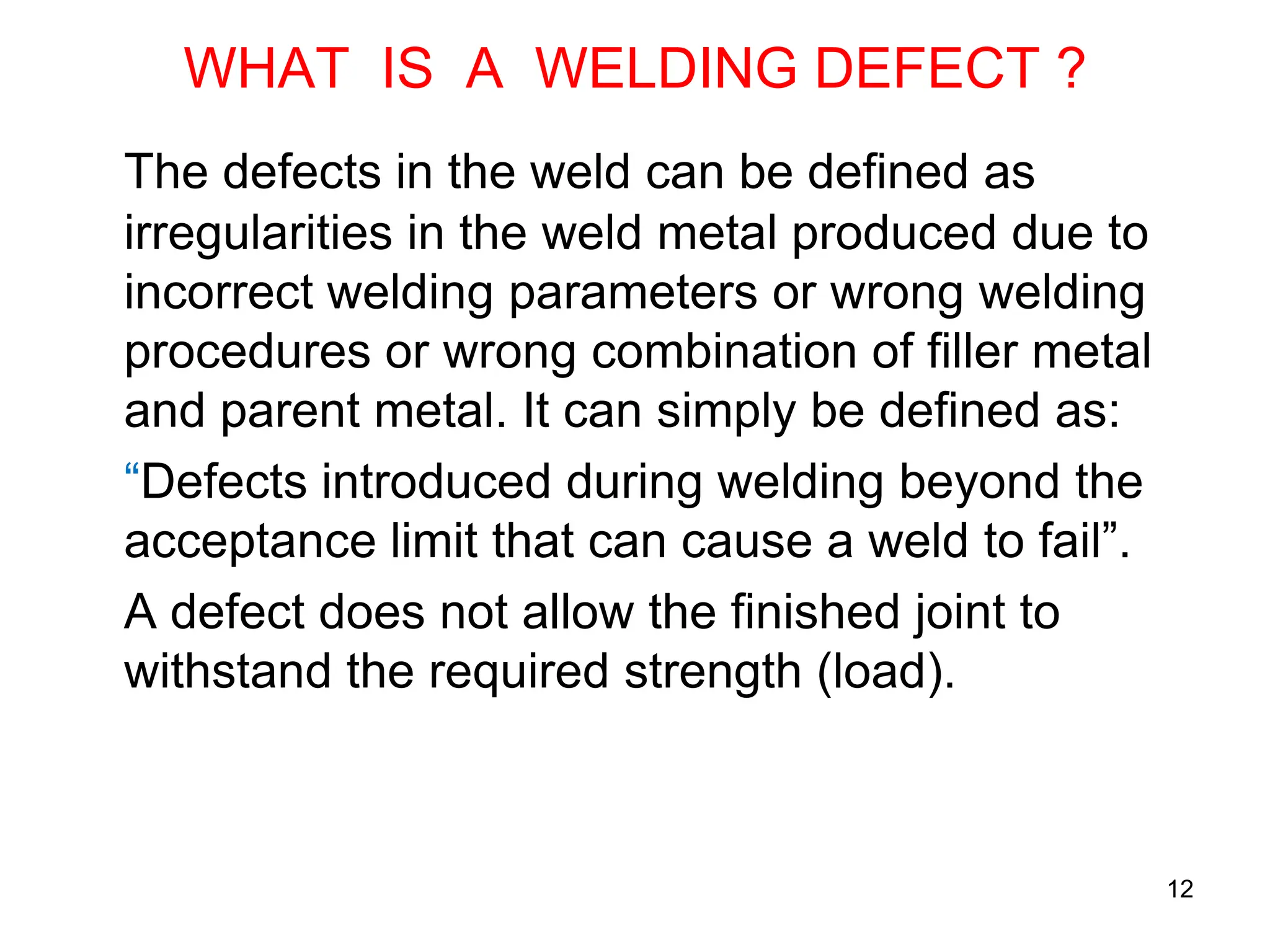
WHAT IS A WELDING DEFECT ?
The defects in the weld can be defined as
irregularities in the weld metal produced due to
incorrect welding parameters or wrong welding
procedures or wrong combination of filler metal
and parent metal. It can simply be defined as:
“Defects introduced during welding beyond the
acceptance limit that can cause a weld to fail”.
A defect does not allow the finished joint to
withstand the required strength (load).
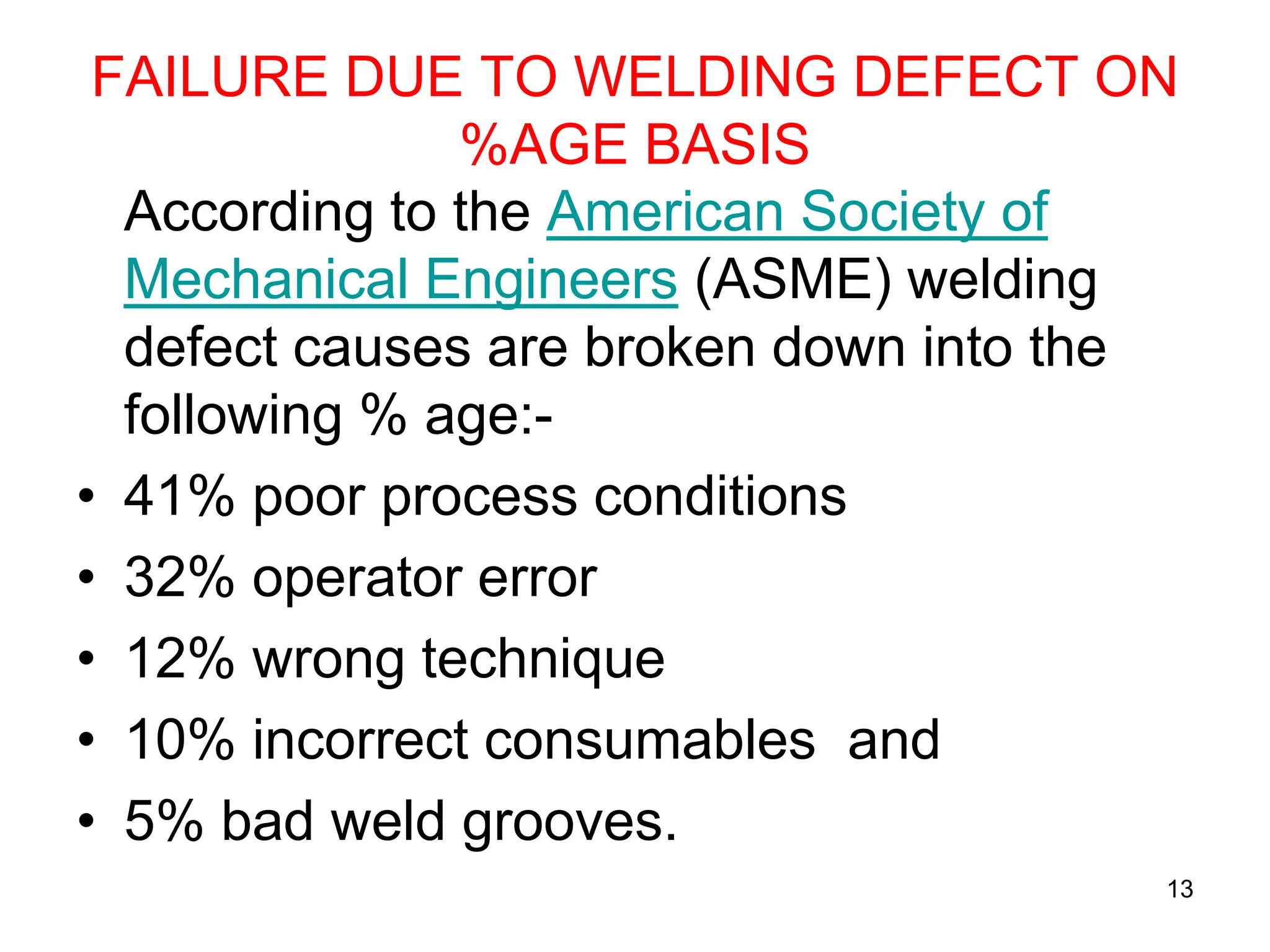
FAILURE DUE TO WELDING DEFECT ON
%AGE BASIS
According to the American Society of
Mechanical Engineers (ASME) welding
defect causes are broken down into the
following % age:-
• 41% poor process conditions
• 32% operator error
• 12% wrong technique
• 10% incorrect consumables and
• 5% bad weld grooves.
13
14
PRESENCE OF WELDING DEFECTS:
ACTION
What should be done when Welding-defects are
detected?
One should reject the items and put them
temporarily on hold.
One should determine the cause and try to
implement a corrective action to avoid future
reoccurrence.
Then an authorized professional should
determine, if the defects are repairable or not.
If yes, by which procedure. Standard procedures
may be approved for routine application.
EVALUATION WELDING DEFECTS
All discontinuities are not defects. Discontinuities
are rejectable only if they exceed specification
requirements
Radiographic standards used for evaluation of
weld defects:-
• IIW standards
• ASTM standards
*Acceptance standards vary with service requirements
15
IIW STANDARDS
Five IIW standards:
– Black
– Blue
– Green
– Brown
– Red
16
IIW STANDARDS
Black
• A homogeneous weld or
a weld with a few small
scattered gas cavities
Blue
• Very slight variation from
homogeneity in the form
of one or more of the
following defects:-:
– Cavity
– Shrinkage cavity
– Slag inclusion
– Undercut
Green
• Slight variation from
homogeneity in the form
of one or more of the
following defects:-
– Gas cavity
– Shrinkage cavity
– Slag inclusion
– Undercut
– Incomplete penetration
17
IIW STANDARDS
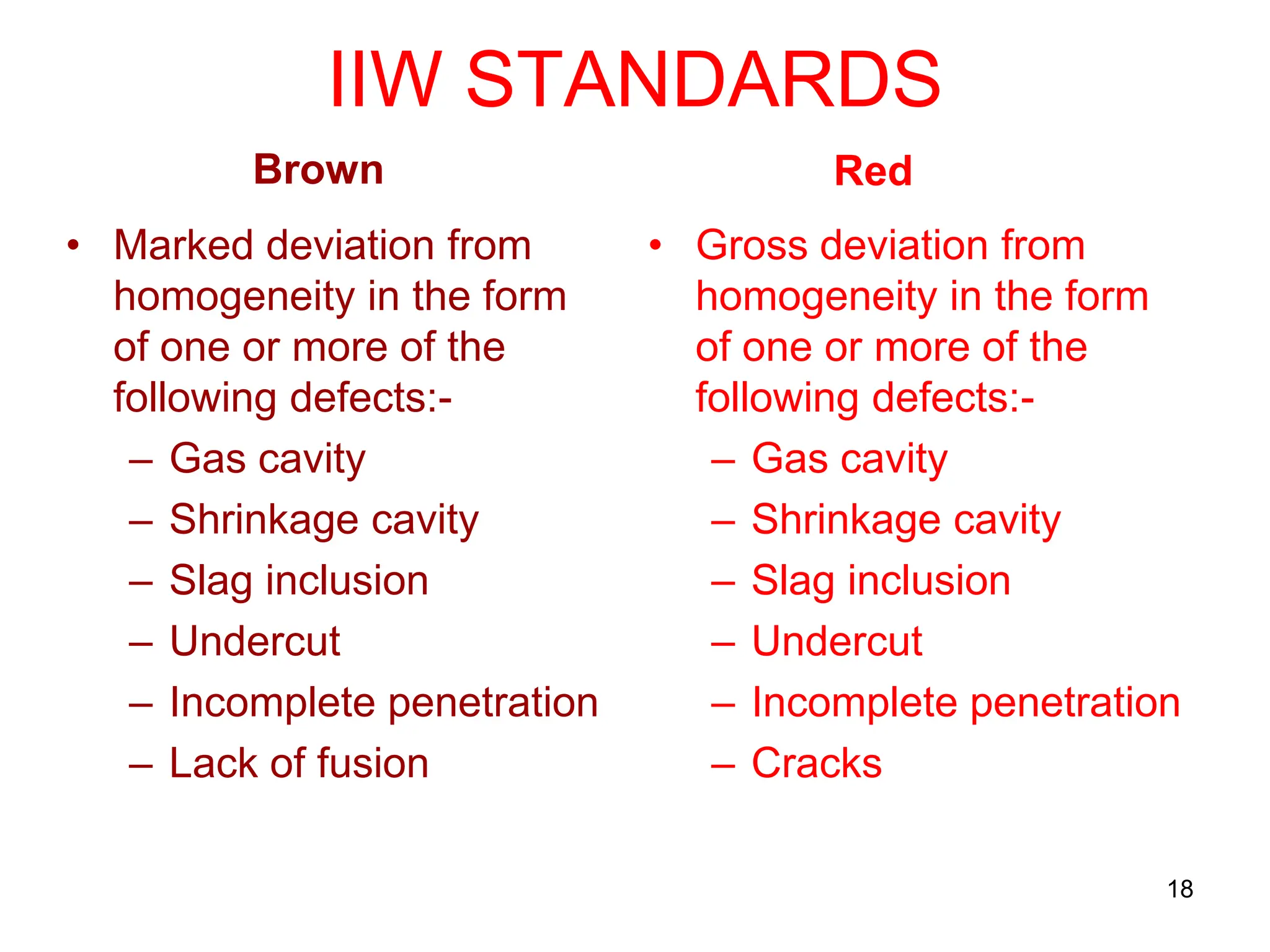
Brown
• Marked deviation from
homogeneity in the form
of one or more of the
following defects:-
– Gas cavity
– Shrinkage cavity
– Slag inclusion
– Undercut
– Incomplete penetration
– Lack of fusion
Red
• Gross deviation from
homogeneity in the form
of one or more of the
following defects:-
– Gas cavity
– Shrinkage cavity
– Slag inclusion
– Undercut
– Incomplete penetration
– Cracks
18
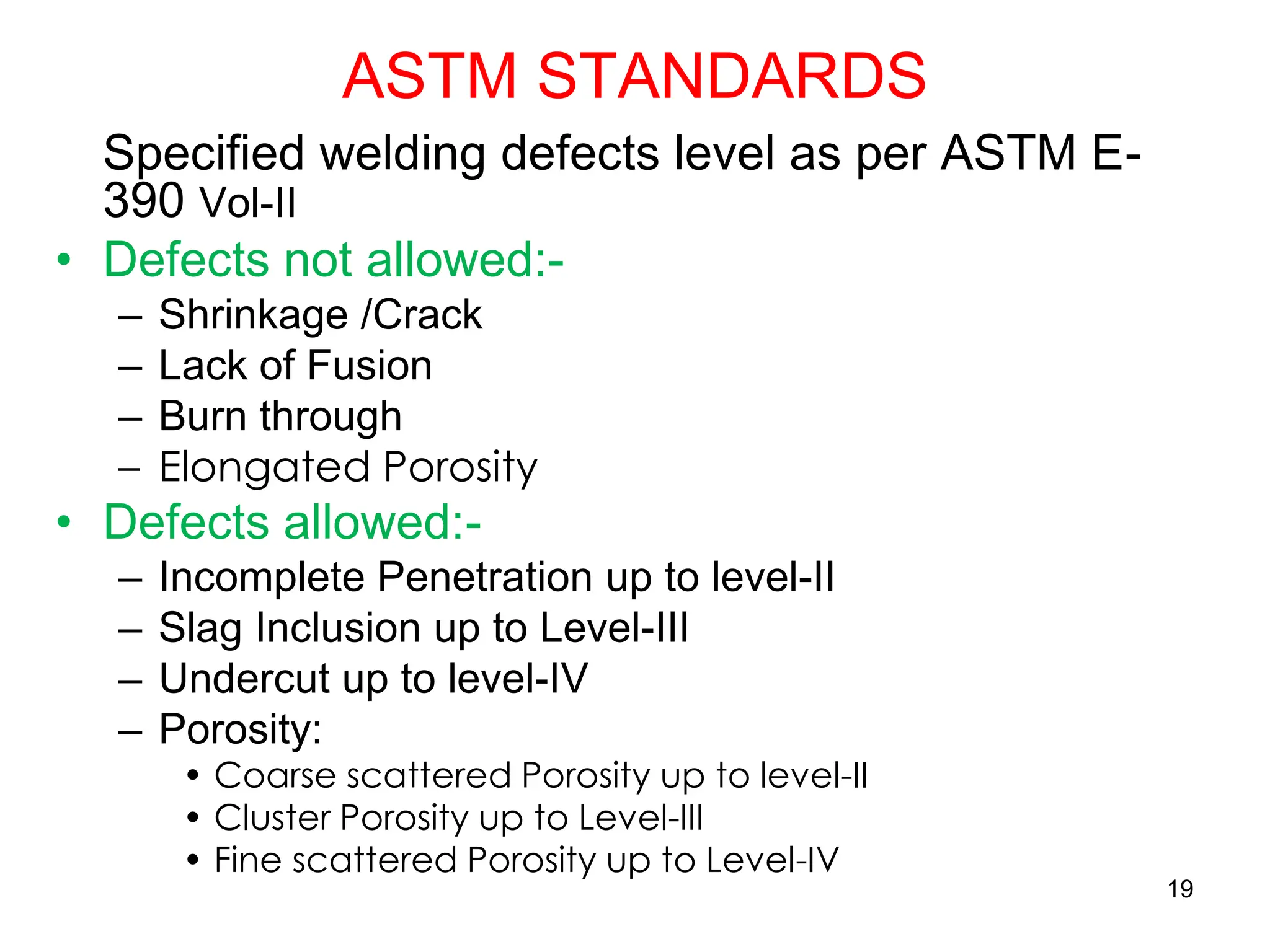
ASTM STANDARDS
Specified welding defects level as per ASTM E-
390 Vol-II
• Defects not allowed:-
– Shrinkage /Crack
– Lack of Fusion
– Burn through
– Elongated Porosity
• Defects allowed:-
– Incomplete Penetration up to level-II
– Slag Inclusion up to Level-III
– Undercut up to level-IV
– Porosity:
• Coarse scattered Porosity up to level-II
• Cluster Porosity up to Level-III
• Fine scattered Porosity up to Level-IV
19
20
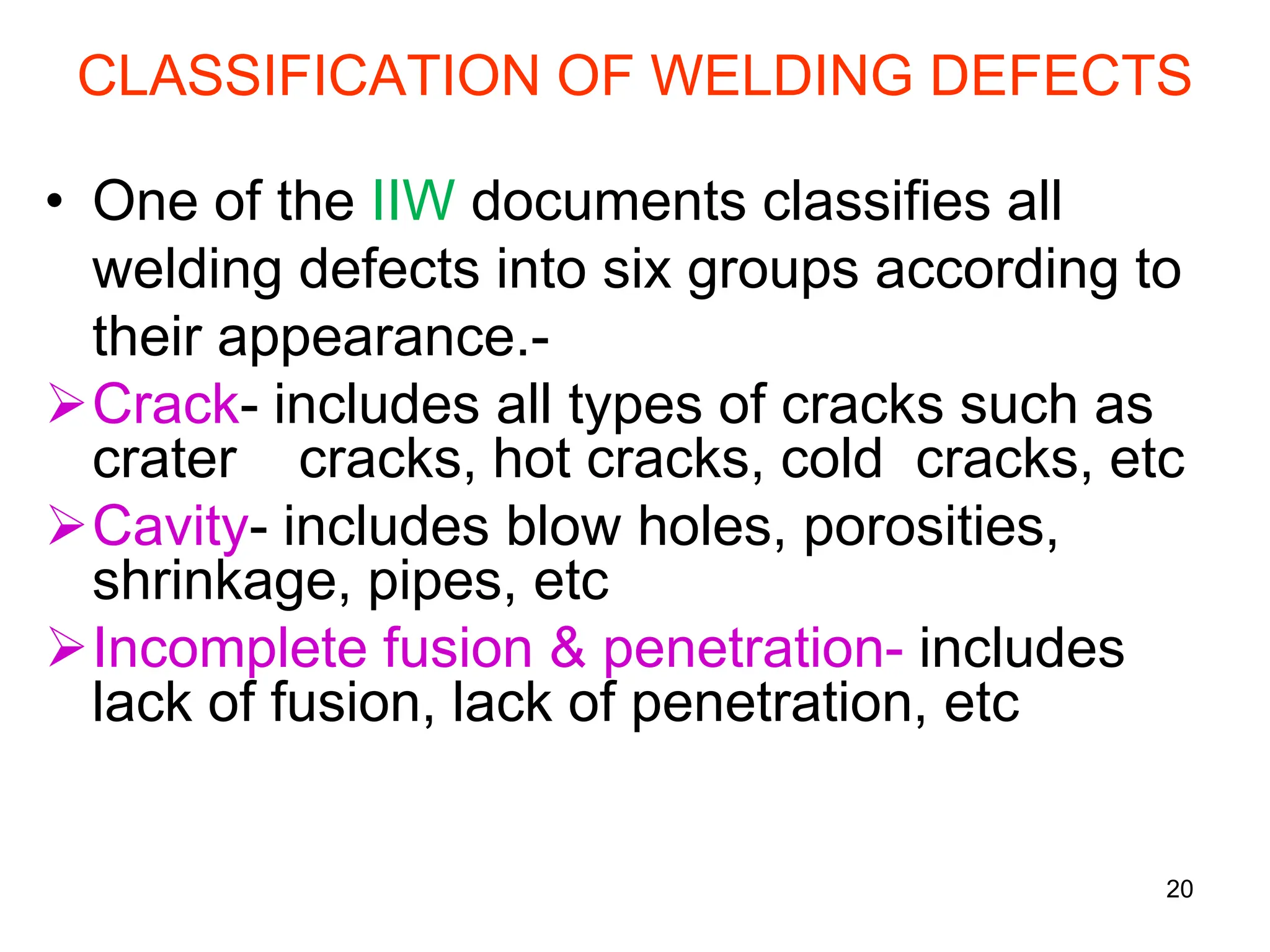
CLASSIFICATION OF WELDING DEFECTS
• One of the IIW documents classifies all
welding defects into six groups according to
their appearance.-
Crack- includes all types of cracks such as
crater cracks, hot cracks, cold cracks, etc
Cavity- includes blow holes, porosities,
shrinkage, pipes, etc
Incomplete fusion & penetration- includes
lack of fusion, lack of penetration, etc
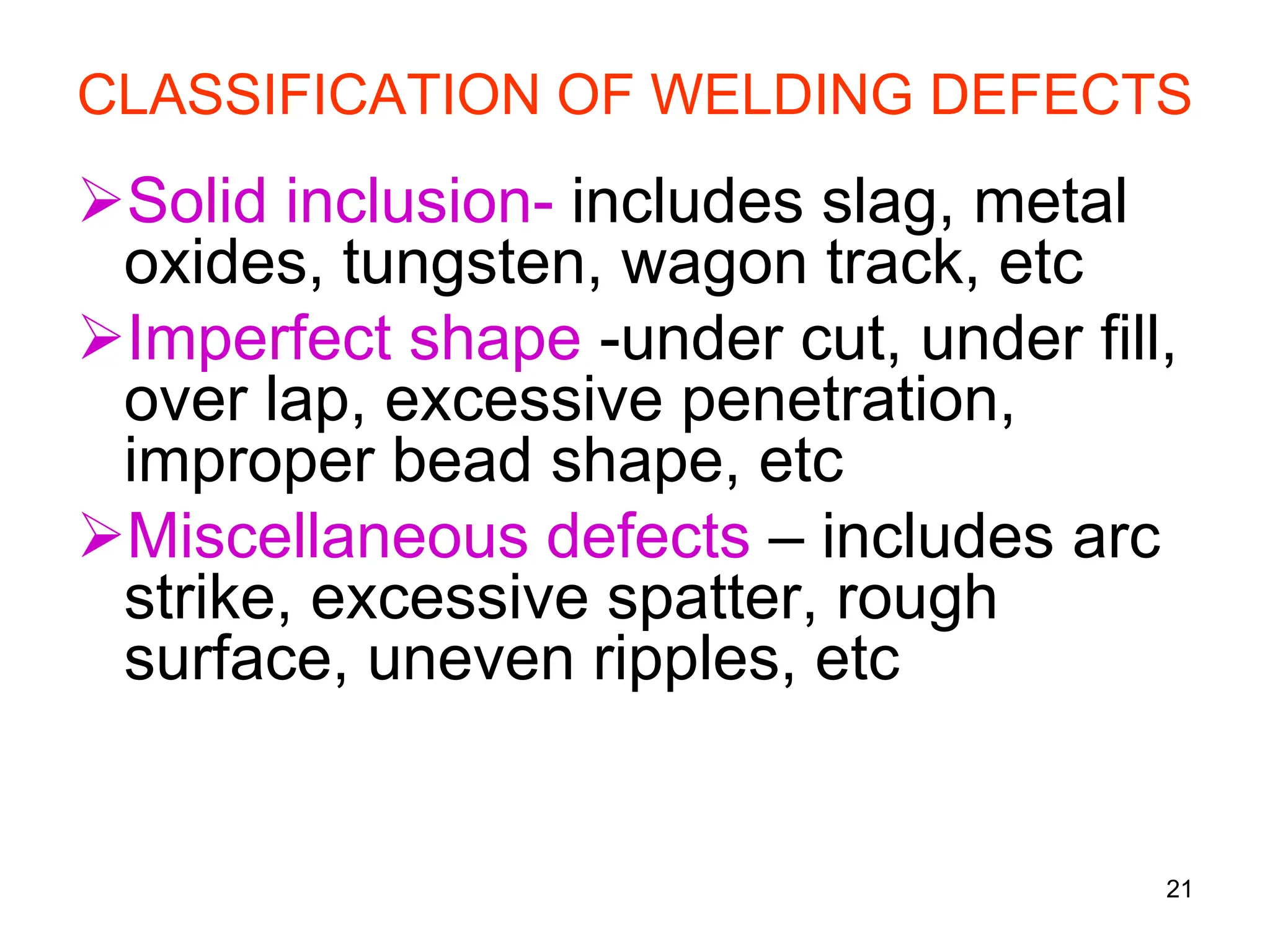
CLASSIFICATION OF WELDING DEFECTS
Solid inclusion- includes slag, metal
oxides, tungsten, wagon track, etc
Imperfect shape -under cut, under fill,
over lap, excessive penetration,
improper bead shape, etc
Miscellaneous defects – includes arc
strike, excessive spatter, rough
surface, uneven ripples, etc
21
15 22
CLASSIFICATION OF WELDING DEFECTS
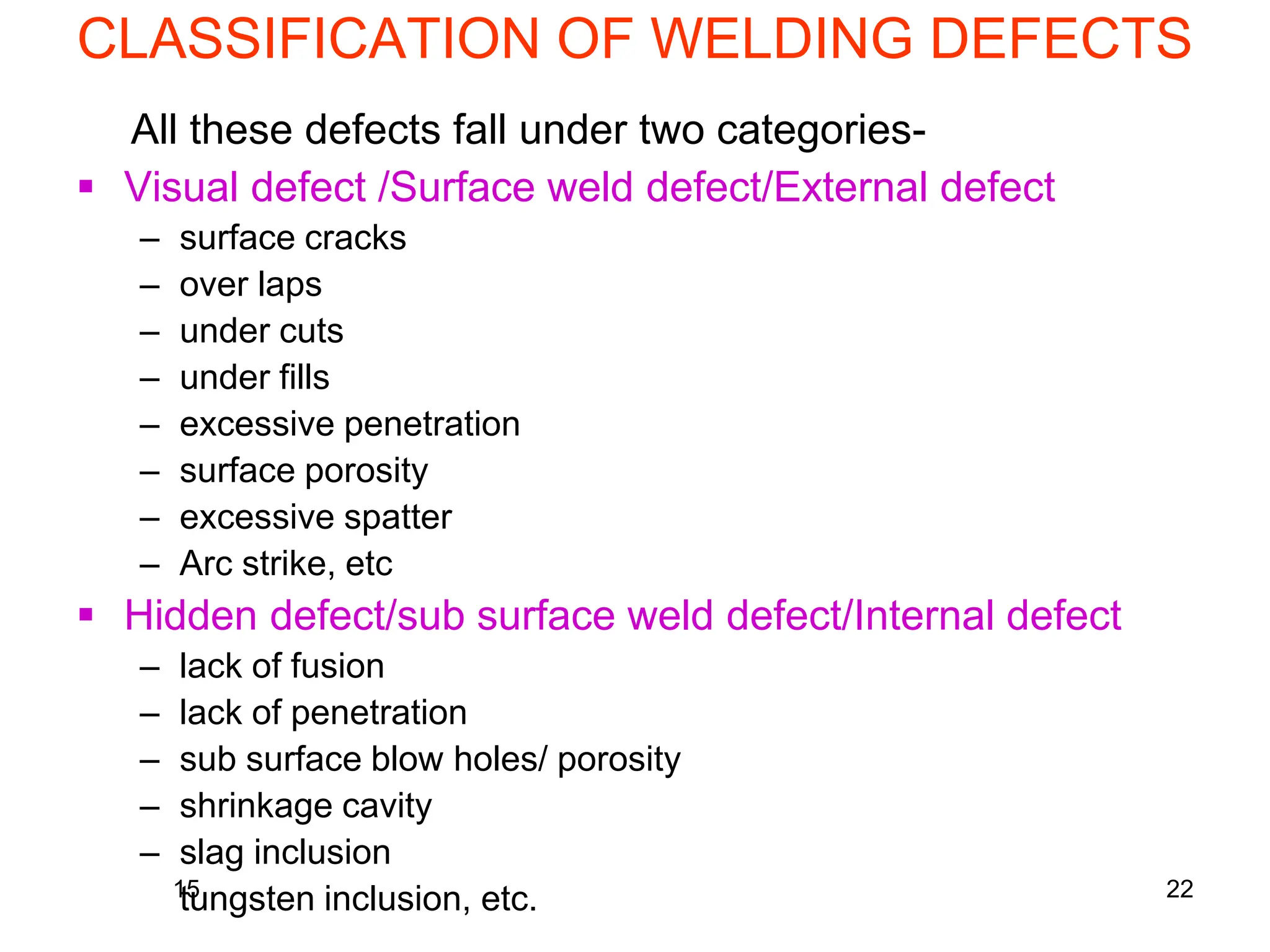
All these defects fall under two categories-
 Visual defect /Surface weld defect/External defect
– surface cracks
– over laps
– under cuts
– under fills
– excessive penetration
– surface porosity
– excessive spatter
– Arc strike, etc
 Hidden defect/sub surface weld defect/Internal defect
– lack of fusion
– lack of penetration
– sub surface blow holes/ porosity
– shrinkage cavity
– slag inclusion
tungsten inclusion, etc.
CRACKS
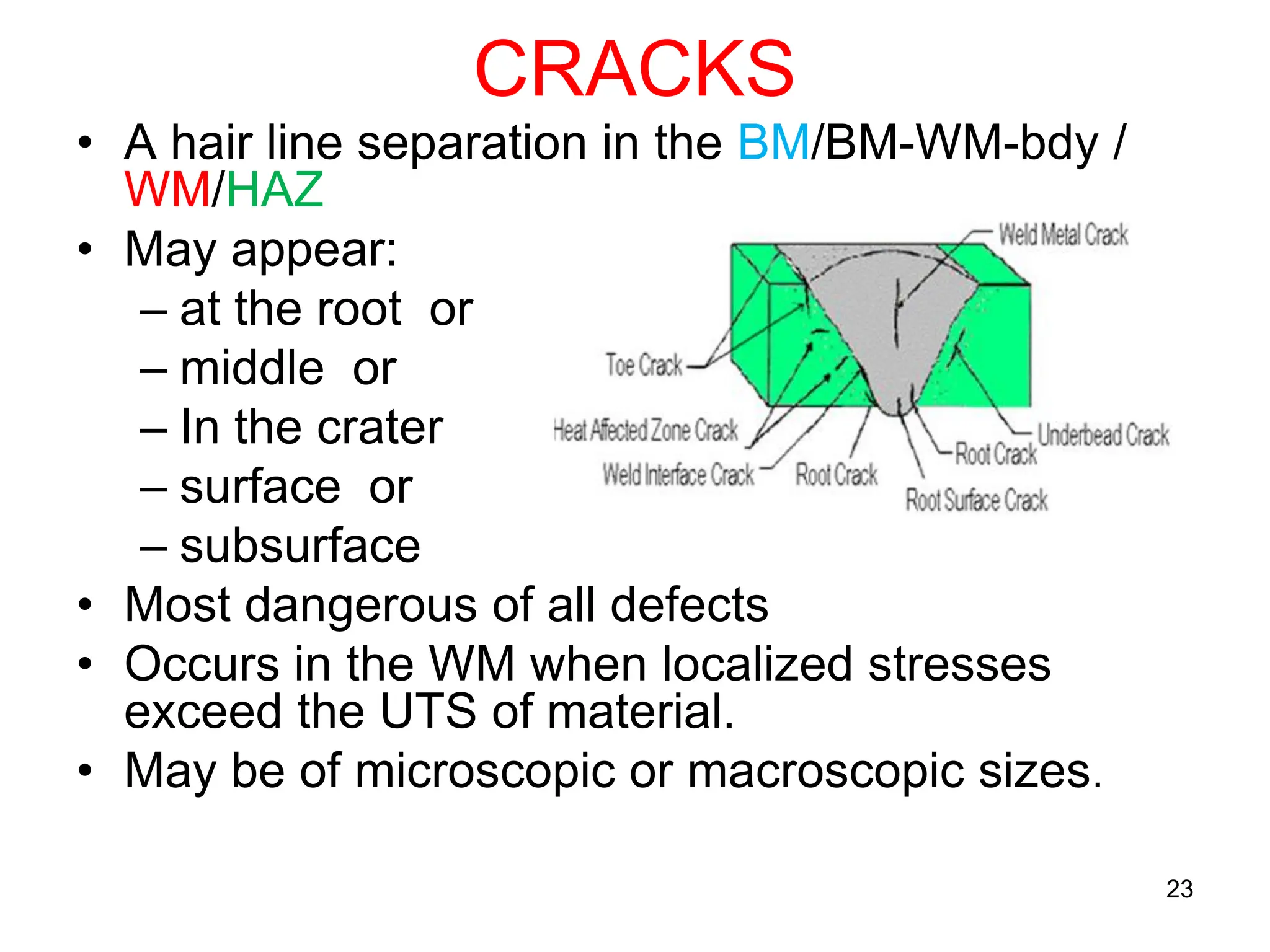
• A hair line separation in the BM/BM-WM-bdy /
WM/HAZ
• May appear:
– at the root or
– middle or
– In the crater
– surface or
– subsurface
• Most dangerous of all defects
• Occurs in the WM when localized stresses
exceed the UTS of material.
• May be of microscopic or macroscopic sizes.
23
CRACKS
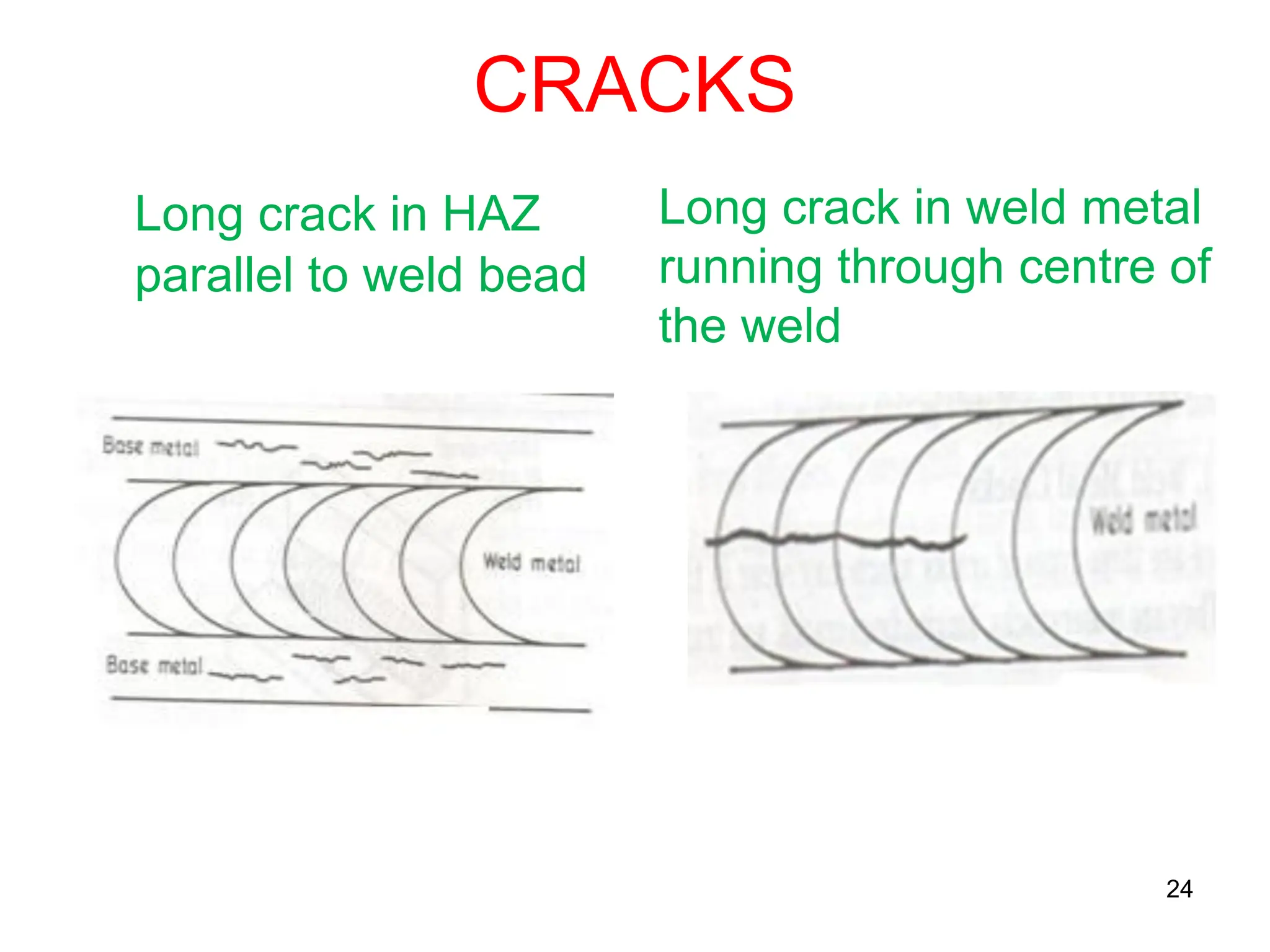
Long crack in HAZ
parallel to weld bead
24
Long crack in weld metal
running through centre of
the weld
CRACKS
Cause:-
• Poor ductility of base metal
• High C & S- content of BM/WM
• High contraction stresses
• Electrode with high hydrogen content
Remedy:-
• Pre- heating
• Mn/S ratio: 18 min.
• Use low H₂ electrode
• Avoid rapid cooling
Classification:-
Cracks may be grouped mainly into
two categories-
– Hot crack
– Cold crack
25
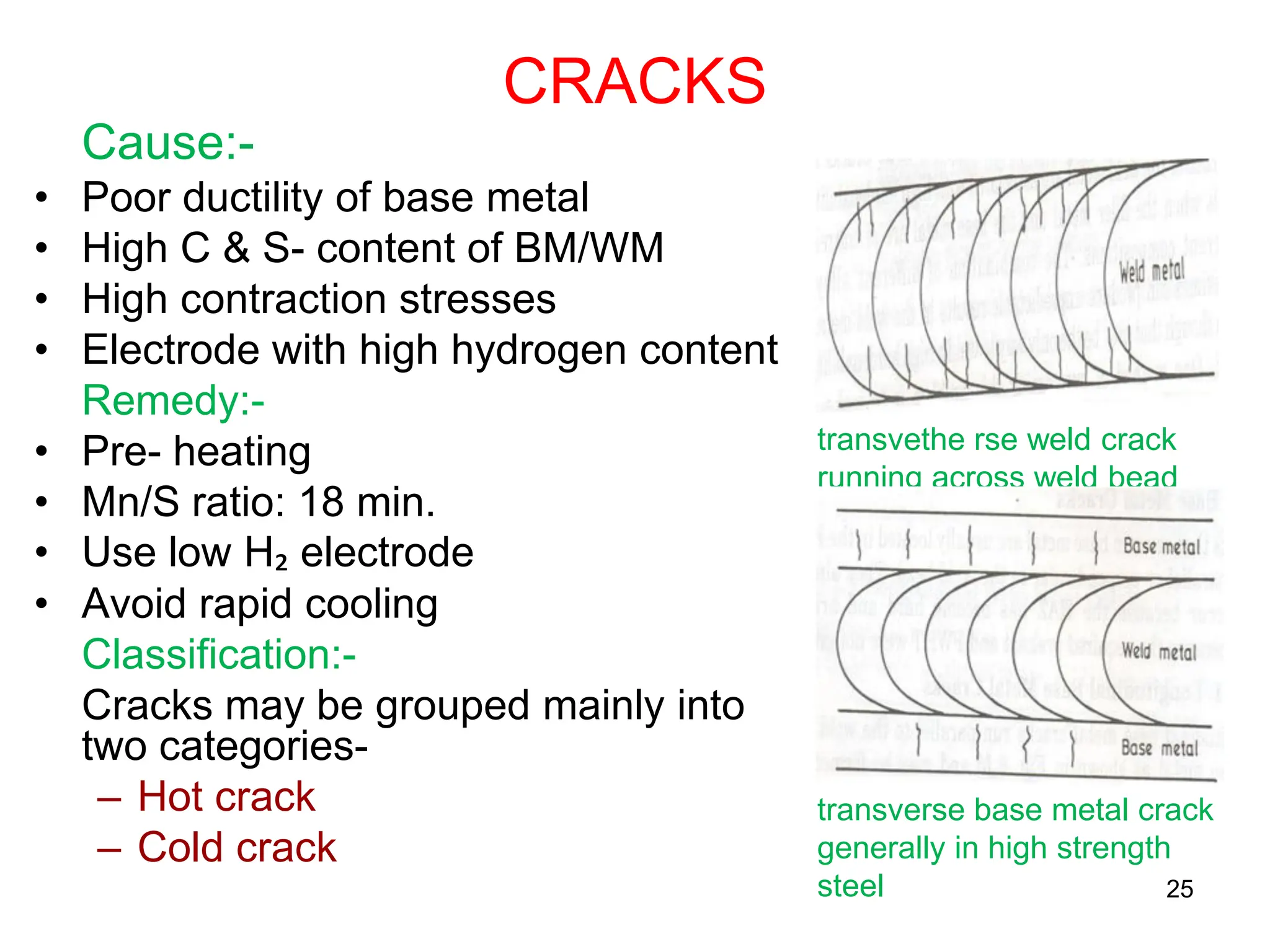
transvethe rse weld crack
running across weld bead
transverse base metal crack
generally in high strength
steel
HOT CRACKS
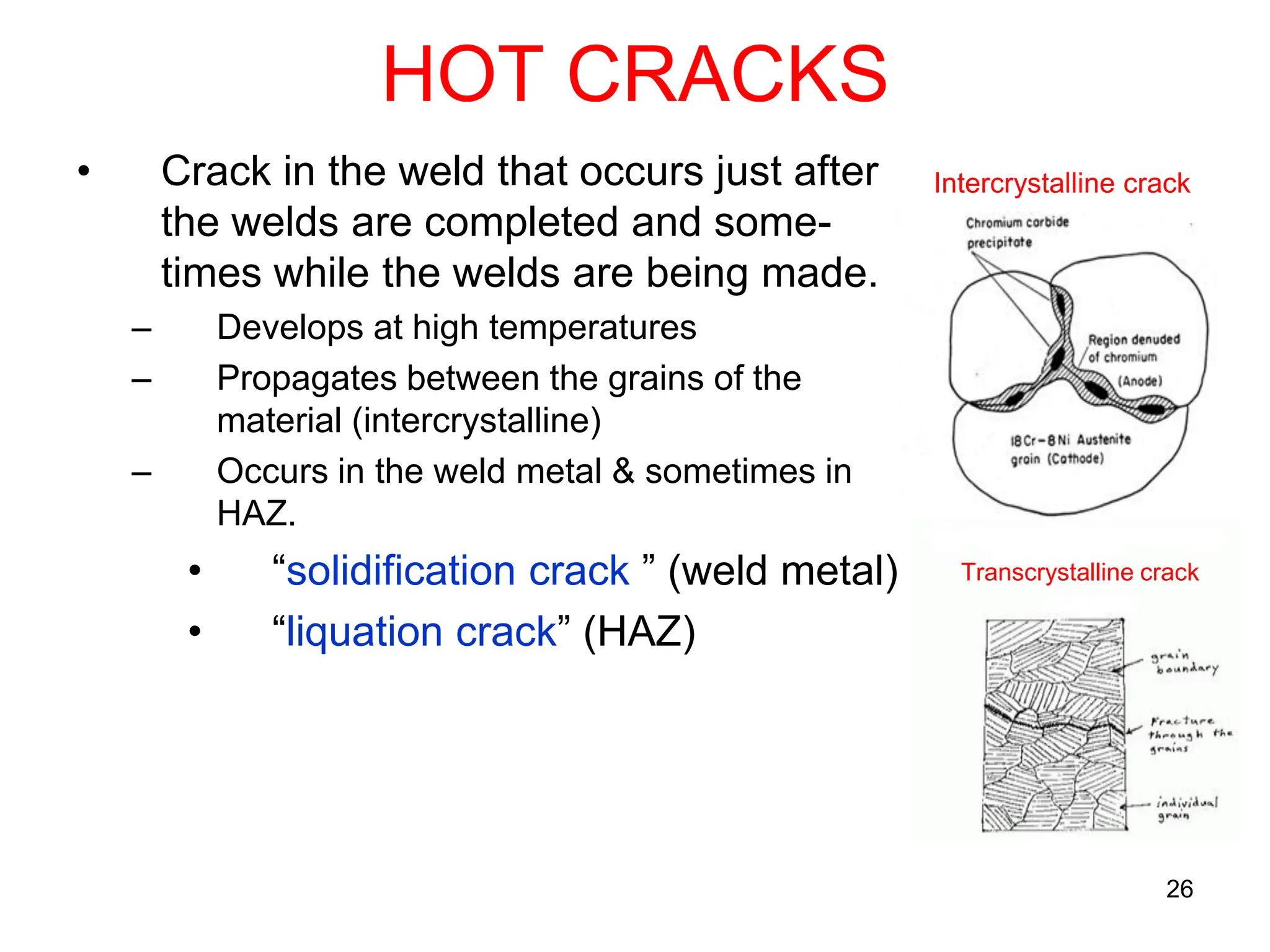
• Crack in the weld that occurs just after
the welds are completed and some-
times while the welds are being made.
– Develops at high temperatures
– Propagates between the grains of the
material (intercrystalline)
– Occurs in the weld metal & sometimes in
HAZ.
• “solidification crack ” (weld metal)
• “liquation crack” (HAZ)
26
Intercrystalline crack
Transcrystalline crack
HOT CRACKS
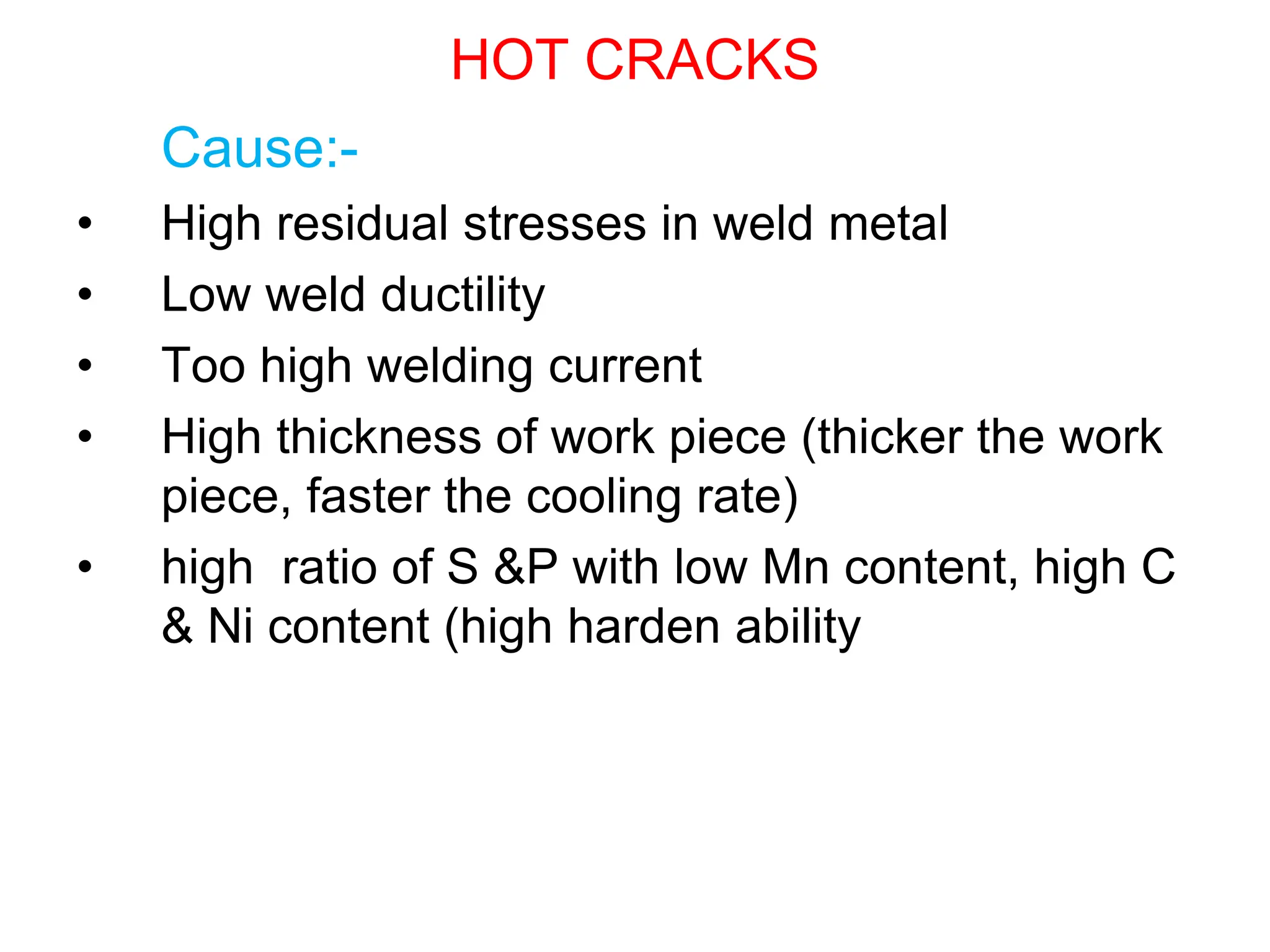
Cause:-
• High residual stresses in weld metal
• Low weld ductility
• Too high welding current
• High thickness of work piece (thicker the work
piece, faster the cooling rate)
• high ratio of S &P with low Mn content, high C
& Ni content (high harden ability
HOT CRACKS
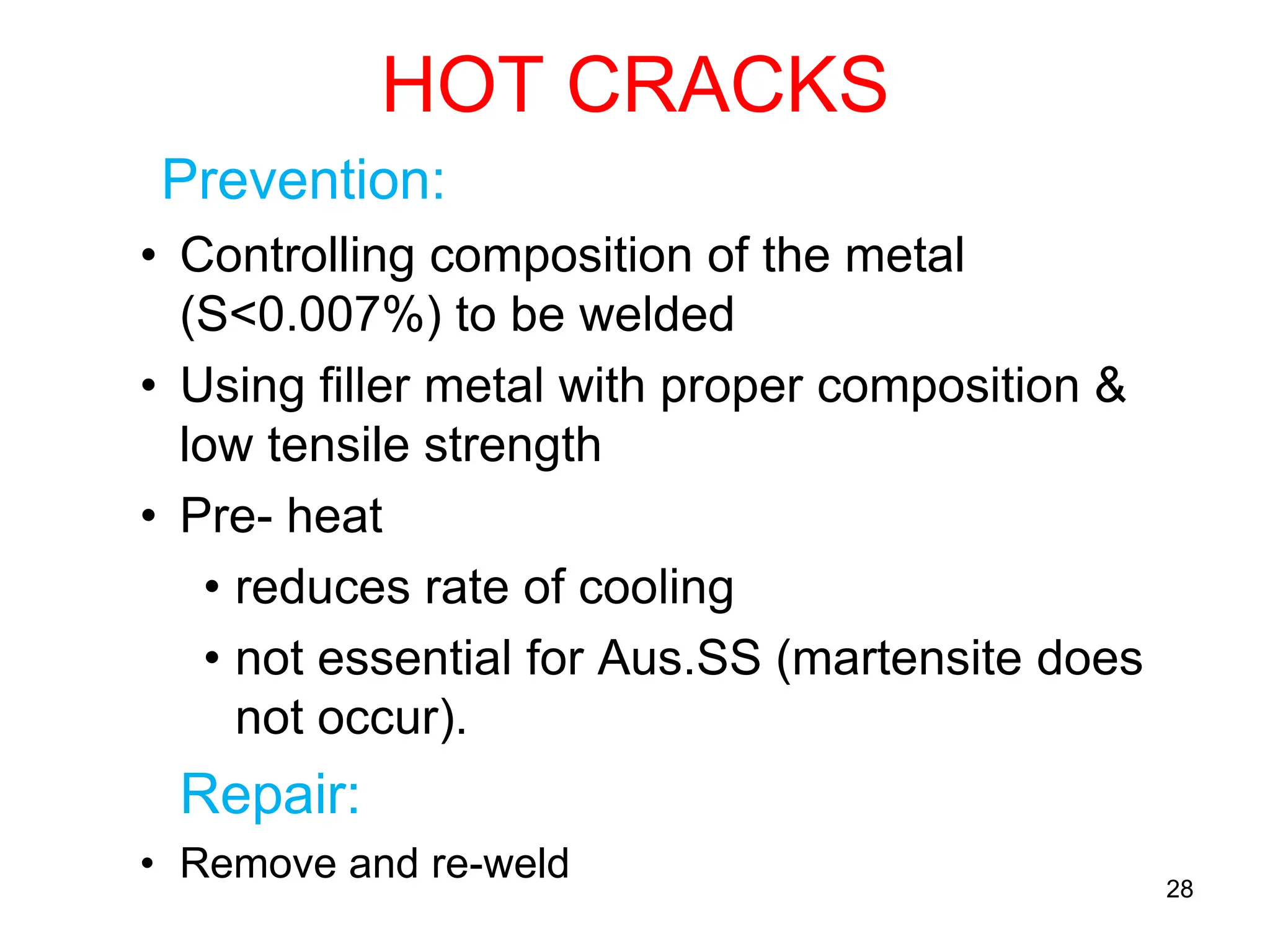
Prevention:
• Controlling composition of the metal
(S<0.007%) to be welded
• Using filler metal with proper composition &
low tensile strength
• Pre- heat
• reduces rate of cooling
• not essential for Aus.SS (martensite does
not occur).
Repair:
• Remove and re-weld 28
COLD CRACK
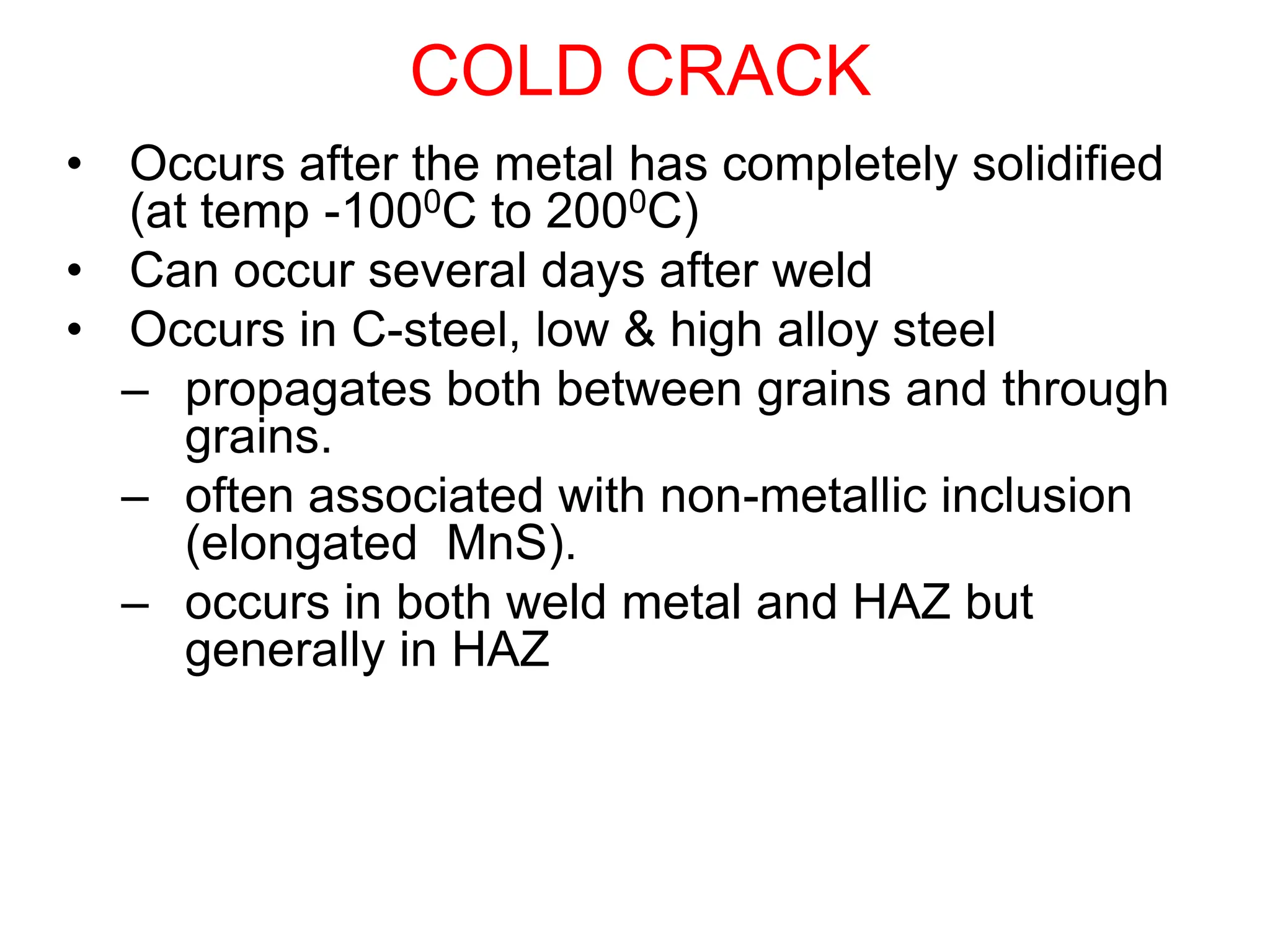
• Occurs after the metal has completely solidified
(at temp -1000C to 2000C)
• Can occur several days after weld
• Occurs in C-steel, low & high alloy steel
– propagates both between grains and through
grains.
– often associated with non-metallic inclusion
(elongated MnS).
– occurs in both weld metal and HAZ but
generally in HAZ
COLD CRACK
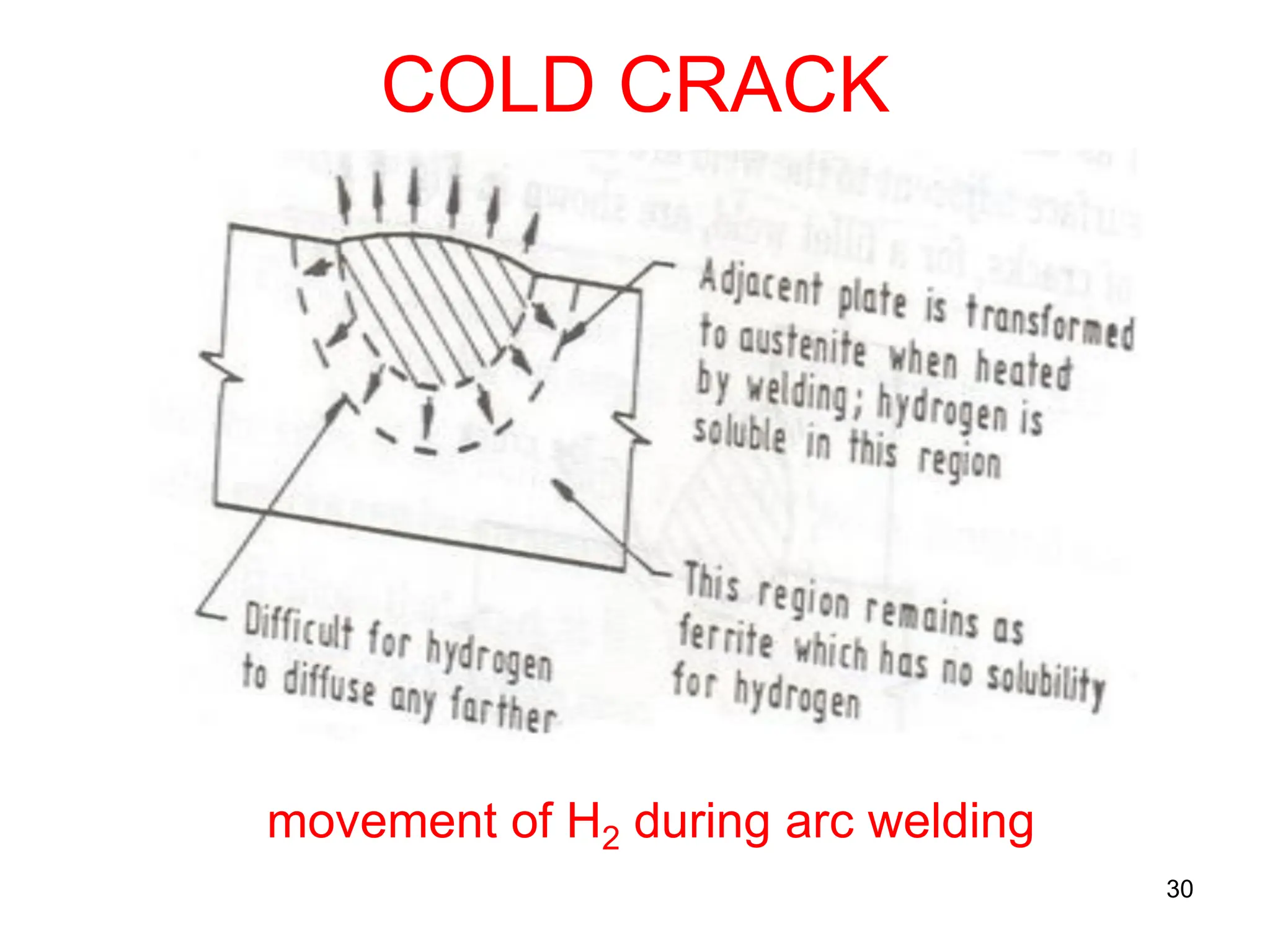
30
movement of H2 during arc welding
COLD CRACK
31
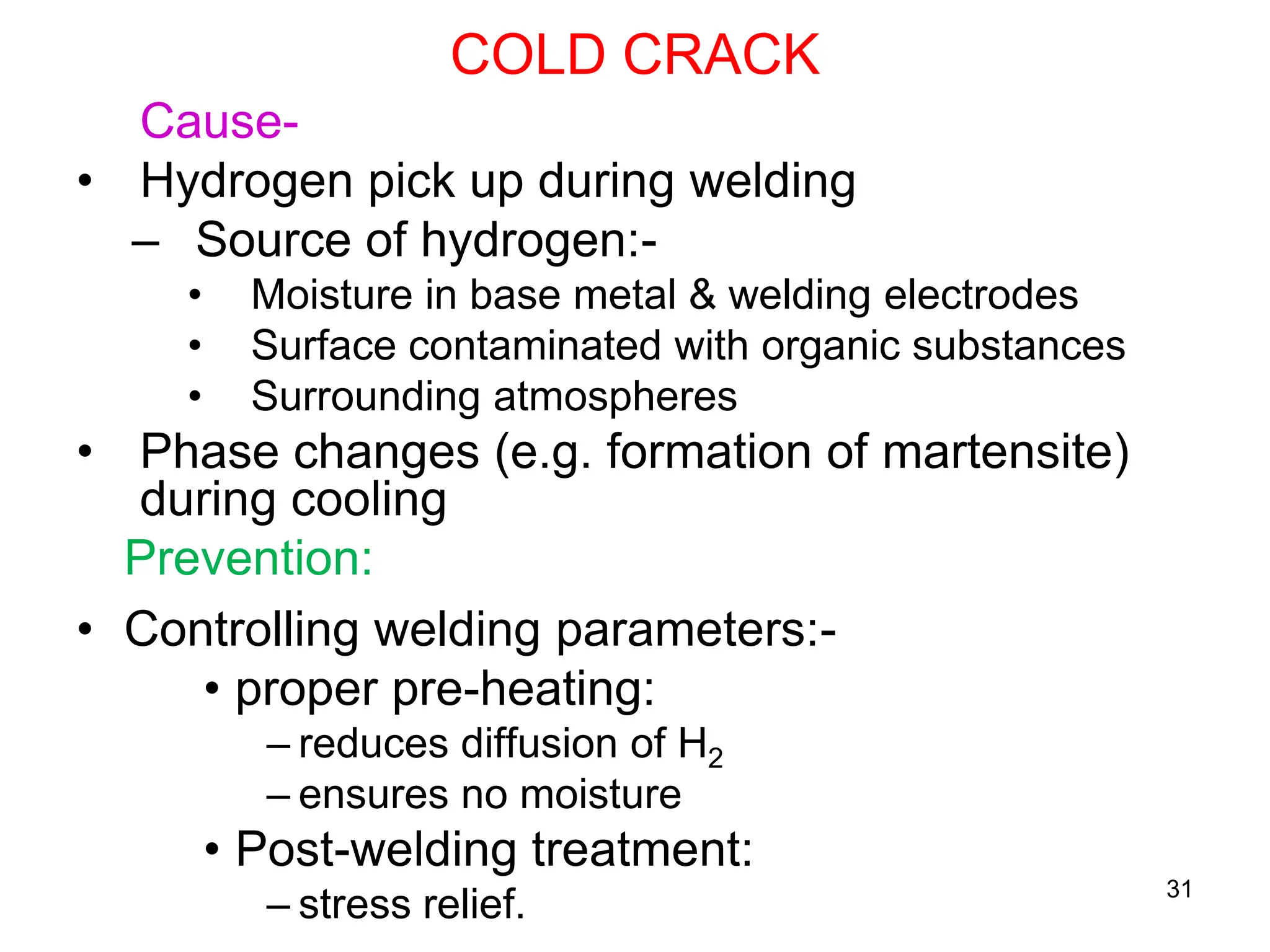
Cause-
• Hydrogen pick up during welding
– Source of hydrogen:-
• Moisture in base metal & welding electrodes
• Surface contaminated with organic substances
• Surrounding atmospheres
• Phase changes (e.g. formation of martensite)
during cooling
Prevention:
• Controlling welding parameters:-
• proper pre-heating:
– reduces diffusion of H2
– ensures no moisture
• Post-welding treatment:
– stress relief.
COLD CRACK
• Clean joint from rust
• Use proper welding processes and
consumables:
– Low strength filler metals.
– Use low hydrogen type baked electrode
Repair:
– Remove and reweld.
32
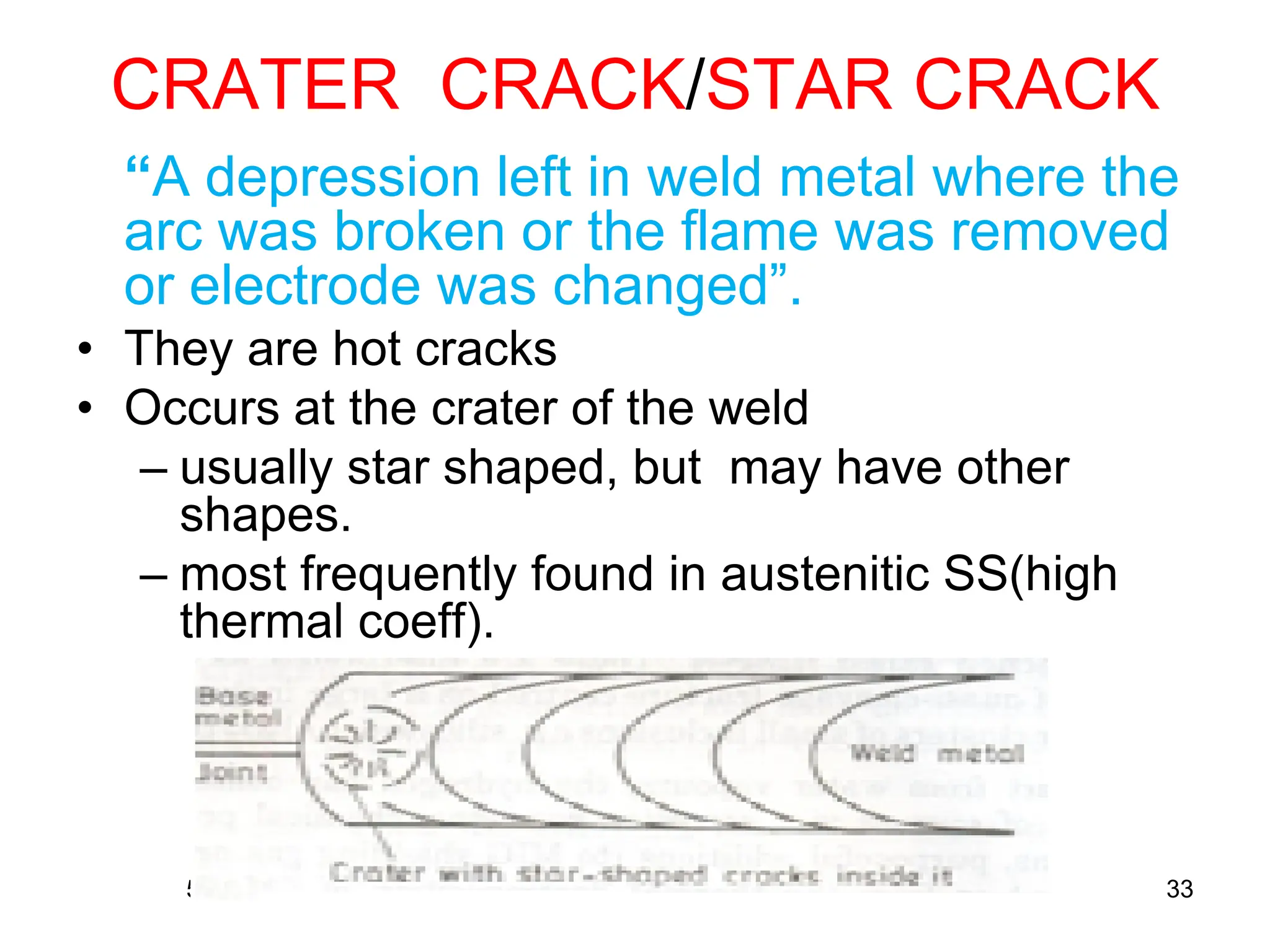
CRATER CRACK/STAR CRACK
“A depression left in weld metal where the
arc was broken or the flame was removed
or electrode was changed”.
• They are hot cracks
• Occurs at the crater of the weld
– usually star shaped, but may have other
shapes.
– most frequently found in austenitic SS(high
thermal coeff).
5 33
CRATER CRACK/STAR CRACK
Cause:
• The center of weld pool becomes solid before
the outside, pulling the center apart during
cooling.
• High current (deep crater)
Prevention:
• can be minimised by filling craters to a slightly
convex shape prior to breaking the welding arc.
• may be avoided through improved welding skill
Repair:
– remove and reweld using appropriate
procedure.
34
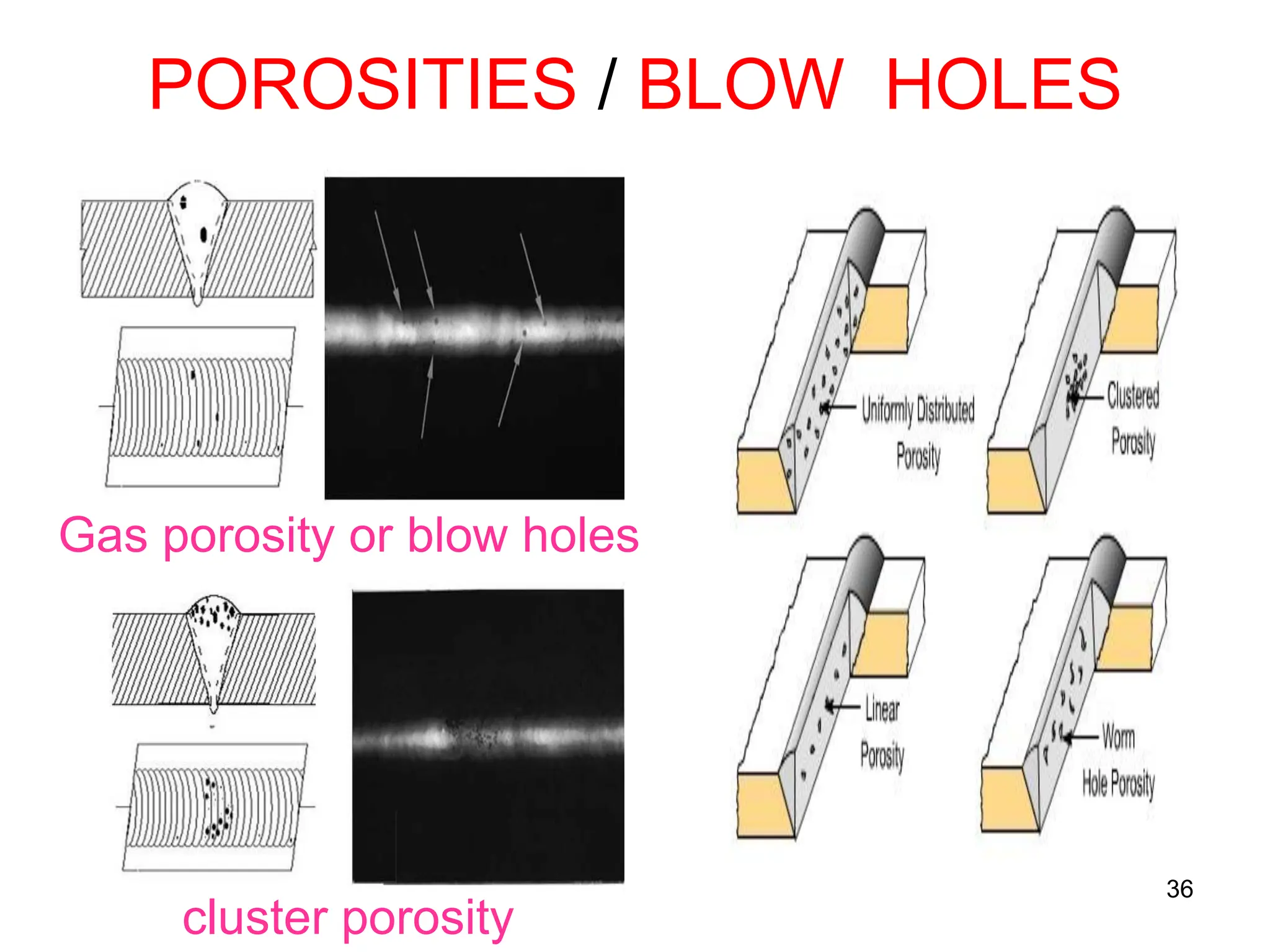
POROSITIES/BLOW HOLES
“Porosity is a group of small voids, where
as blow holes are comparatively bigger
hole or cavity caused by entrapment of
gases [gases:H2,CO,CO2,N2 &O2 from
coating ingredients in the electrode or
moisture, oil, grease, rust, etc on BM]
within the solidified weld”.
• Porosity can occur on or just below the
surface of a weld.
• Porosity in the weld and HAZ may lead to
cracking.
35
POROSITIES / BLOW HOLES
6/06/2015 36
Gas porosity or blow holes
cluster porosity
BLOW HOLES / POROSITIES
Cause:
• Work piece or electrode
contains/contaminated
with:-
– High sulphur & carbon
– Excessive moisture, rust or
scale, oil, grease, etc
• Atmospheric gases [N2,
excessive O2 (Al-
welding)]
• Anodising coating on Al
(contains moisture)
• Long arc
• Fast solidification rate
Prevention:
• Preheat
• Maintain proper arc
length
• Use low hydrogen
electrode
• Use recommended
procedure for baking &
storing electrodes
• Clean joint surfaces &
adjacent surfaces
37
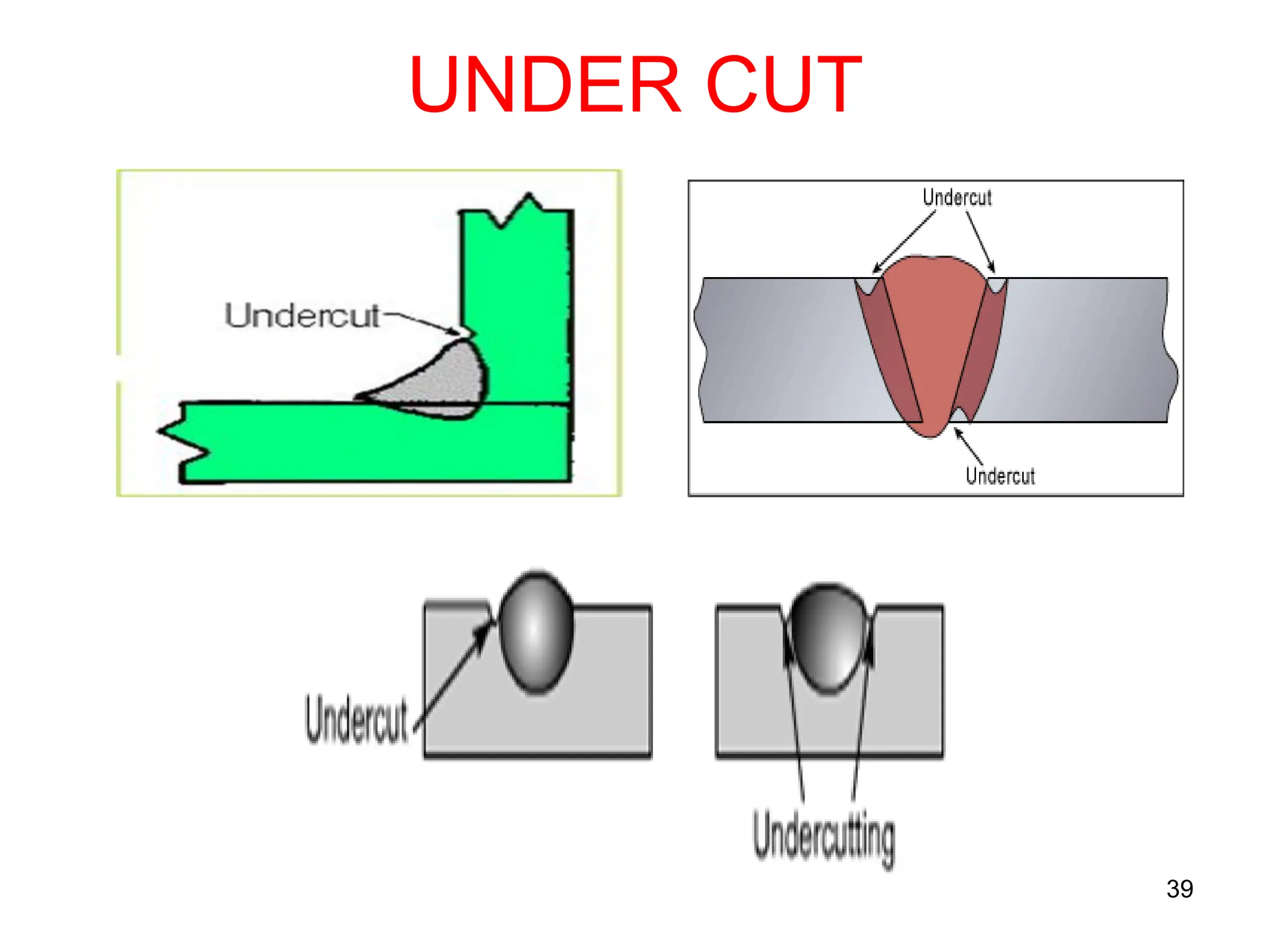
UNDER CUT
“A defect that appears as a groove formed
in the BM adjacent to the toe of a weld
along the edge of the weld & left unfilled
by the weld metal”.
• Generally located parallel to the junction of
weld metal & base metal at the toe or root
of the weld
• Reduces the cross-sectional thickness of
the base metal
• Acts as stress raiser in fatigue loading
38
UNDER CUT
39
UNDER CUT
Cause:
• High welding current & arc voltage
• Too large electrode dia
• Incorrect electrode angle
• Longer arc length
Prevention:
• Use prescribed welding current for electrode
size.
• Adjust electrode angle to fill undercut area.
• Correct travel speed, arc length, etc.
Repair:
• Gouge & weld with low hydrogen electrode
40
41
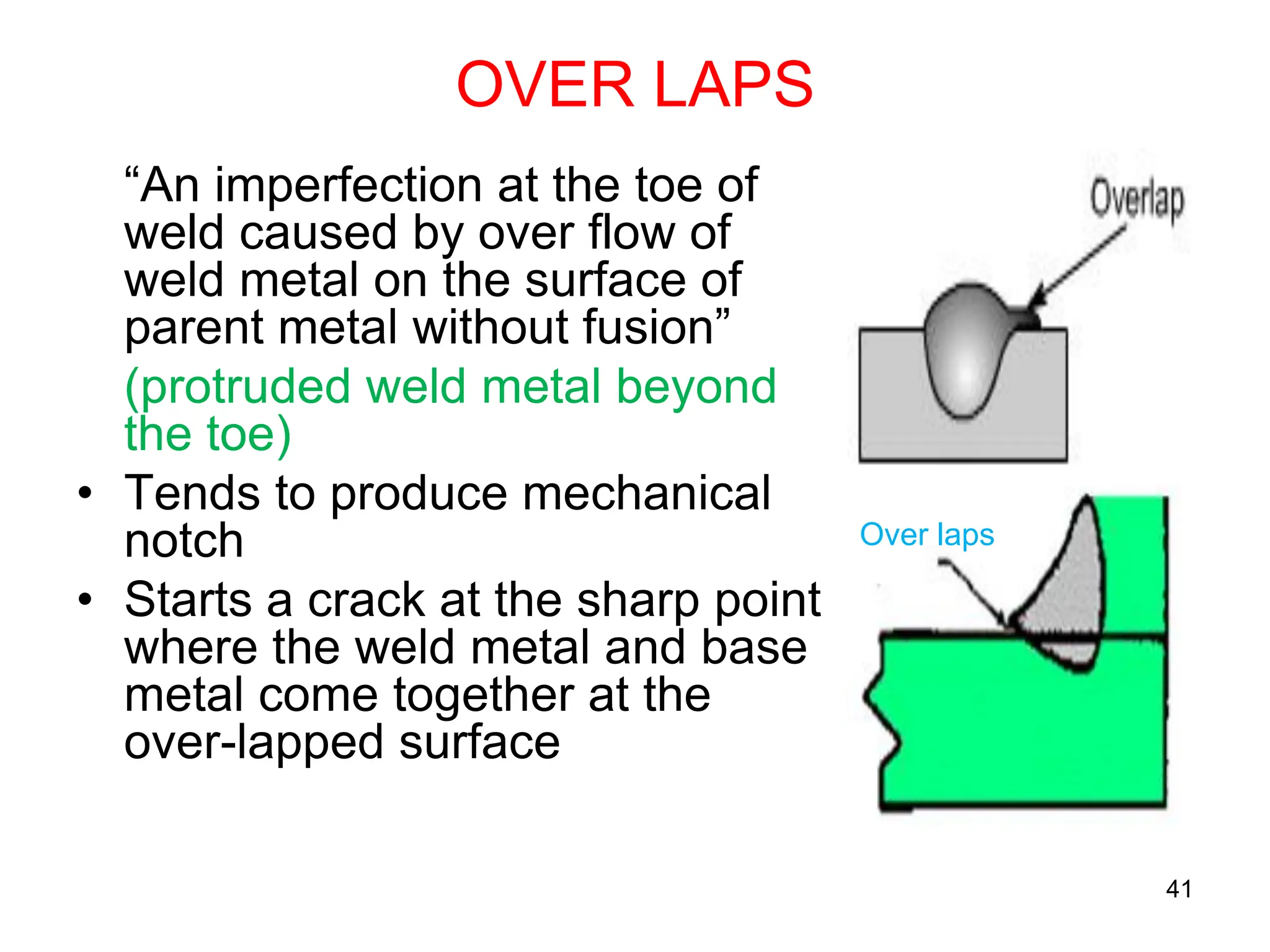
OVER LAPS
“An imperfection at the toe of
weld caused by over flow of
weld metal on the surface of
parent metal without fusion”
(protruded weld metal beyond
the toe)
• Tends to produce mechanical
notch
• Starts a crack at the sharp point
where the weld metal and base
metal come together at the
over-lapped surface
Over laps
OVER LAPS
Cause:-
– current too low
– Too large deposition in a single run
– Longer arc
– slow arc travel speed.
Prevention:
– Proper welding technique
– Use proper size of electrode
Repair:
– Overlap must be removed to blend smoothly
into the base metal.
42
43
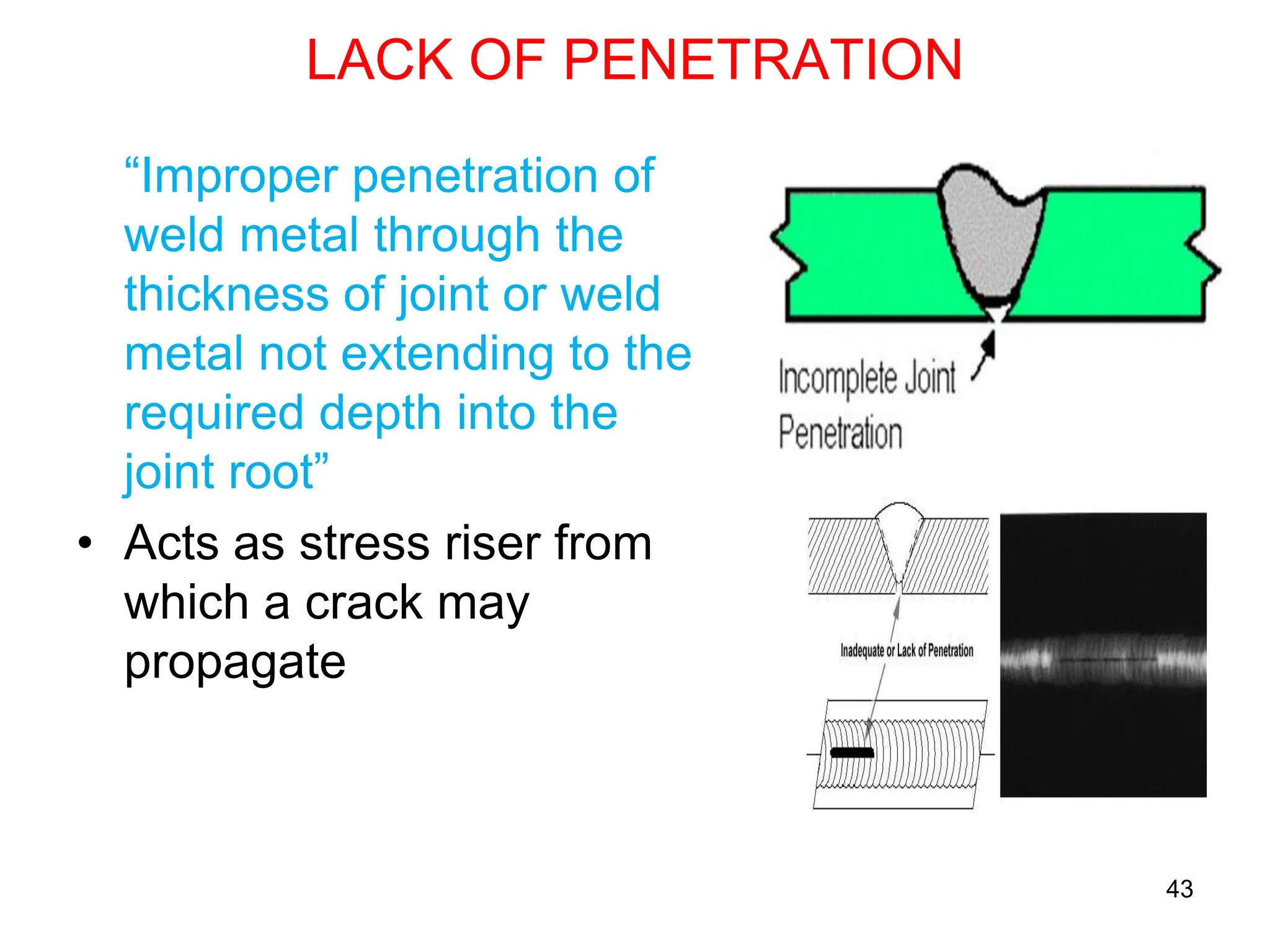
LACK OF PENETRATION
“Improper penetration of
weld metal through the
thickness of joint or weld
metal not extending to the
required depth into the
joint root”
• Acts as stress riser from
which a crack may
propagate
LACK OF PENETRATION
Cause –
• Root gap too small
• high welding speed
• Low heat input
• Too large electrode dia
Prevention:
• Proper joint preparation
• Proper heat input & welding speed
• Use suitable size of electrode
Repair:
• Back gouge and back weld or
remove and reweld. 44
45
LACK OF FUSION
“Lack of complete melting/
fusion of some portion of
the weld metal in a joint”
• May be at the root, sides
or between two runs.
• Reduces the strength of
welds & makes welded
structures unreliable
LACK OF FUSION
16/06/2015
46
lack of fusion between passes
LACK OF FUSION
Cause:
• Low welding current
• Excess welding speed
• Unfavourable heat input
Prevention:
• Maintain proper current & welding speed
• Proper cleaning of each bead
Repair:
• Chipping back & re-welding
47
48
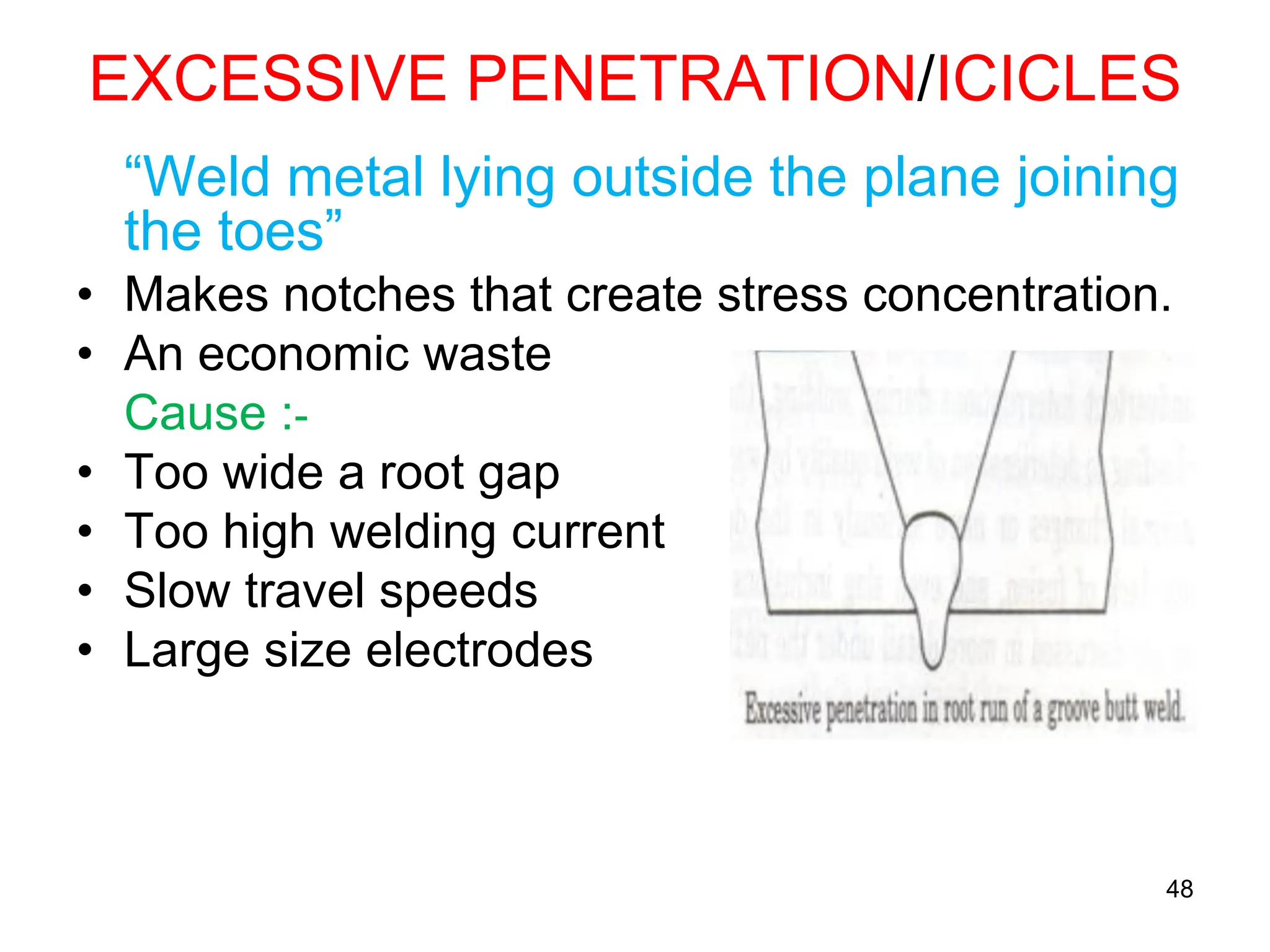
EXCESSIVE PENETRATION/ICICLES
“Weld metal lying outside the plane joining
the toes”
• Makes notches that create stress concentration.
• An economic waste
Cause :-
• Too wide a root gap
• Too high welding current
• Slow travel speeds
• Large size electrodes
EXCESSIVE PENETRATION/ICICLES
Prevention:
– Correct the root opening and root face
– Reduce the wire-feed speed
Repair:-
– Remove and re-weld
49
16/06/2015 50
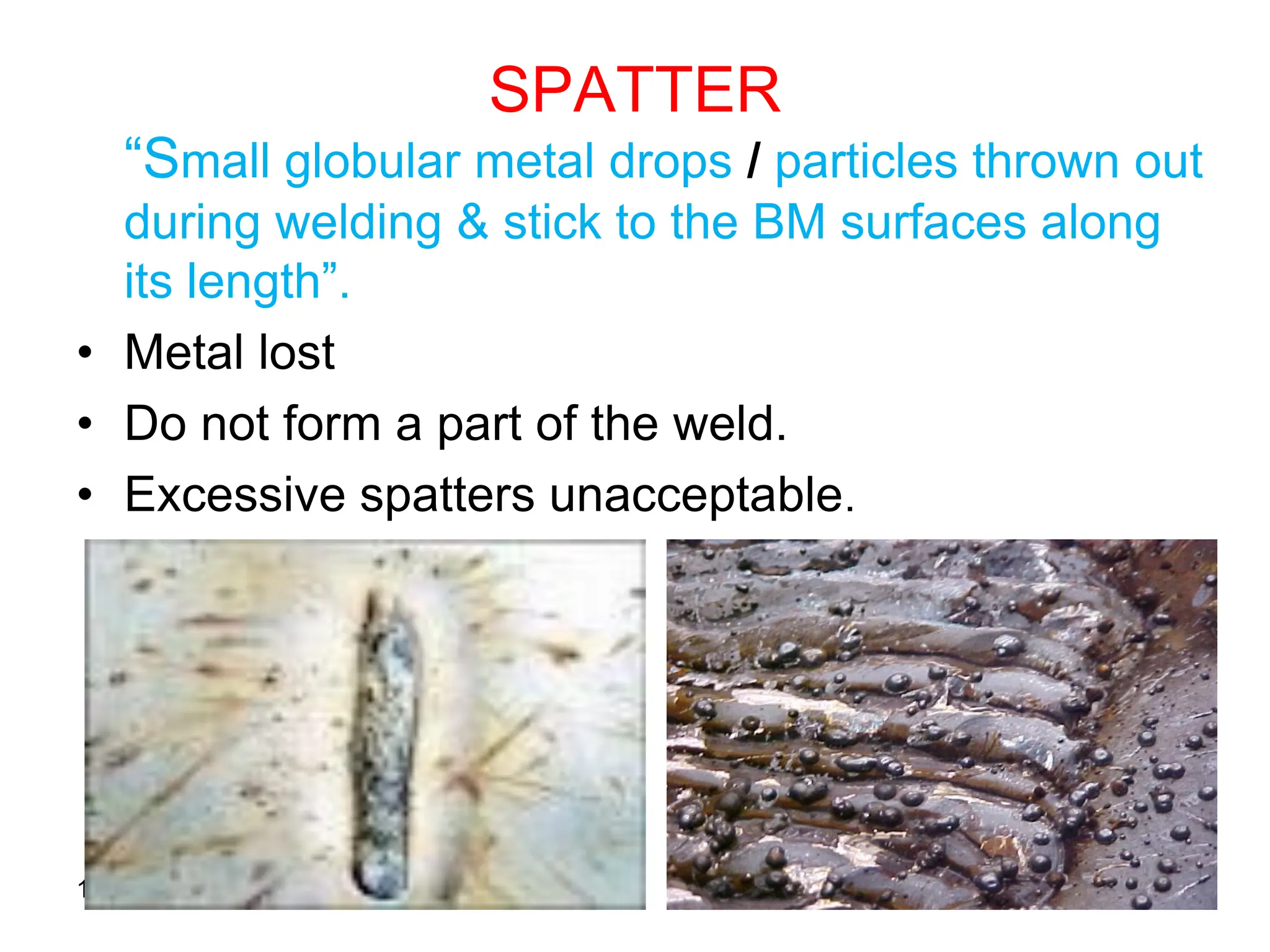
SPATTER
“Small globular metal drops / particles thrown out
during welding & stick to the BM surfaces along
its length”.
• Metal lost
• Do not form a part of the weld.
• Excessive spatters unacceptable.
SPATTER
Cause –
– Excessive arc current
– Excessive long arc
– Improper shielding gas
– Electrodes coated with improper flux ingredients
– Damp electrodes
Prevention:
– Correct welding current for type & size electrode used.
– Correct proper arc length & use correct arc voltage
– Spatter cure SC-07(Non-toxic, non- pollutant, water
based inorganic anti–spatter flux)
– can easily be removed either by hair brush or by
washing.
Repair:
Remove by grinding or sanding.
015
51
52
INCLUSION
“Metallic or nonmetallic solid material entrapped
within the WM, between weld passes or
between WM & BM”.
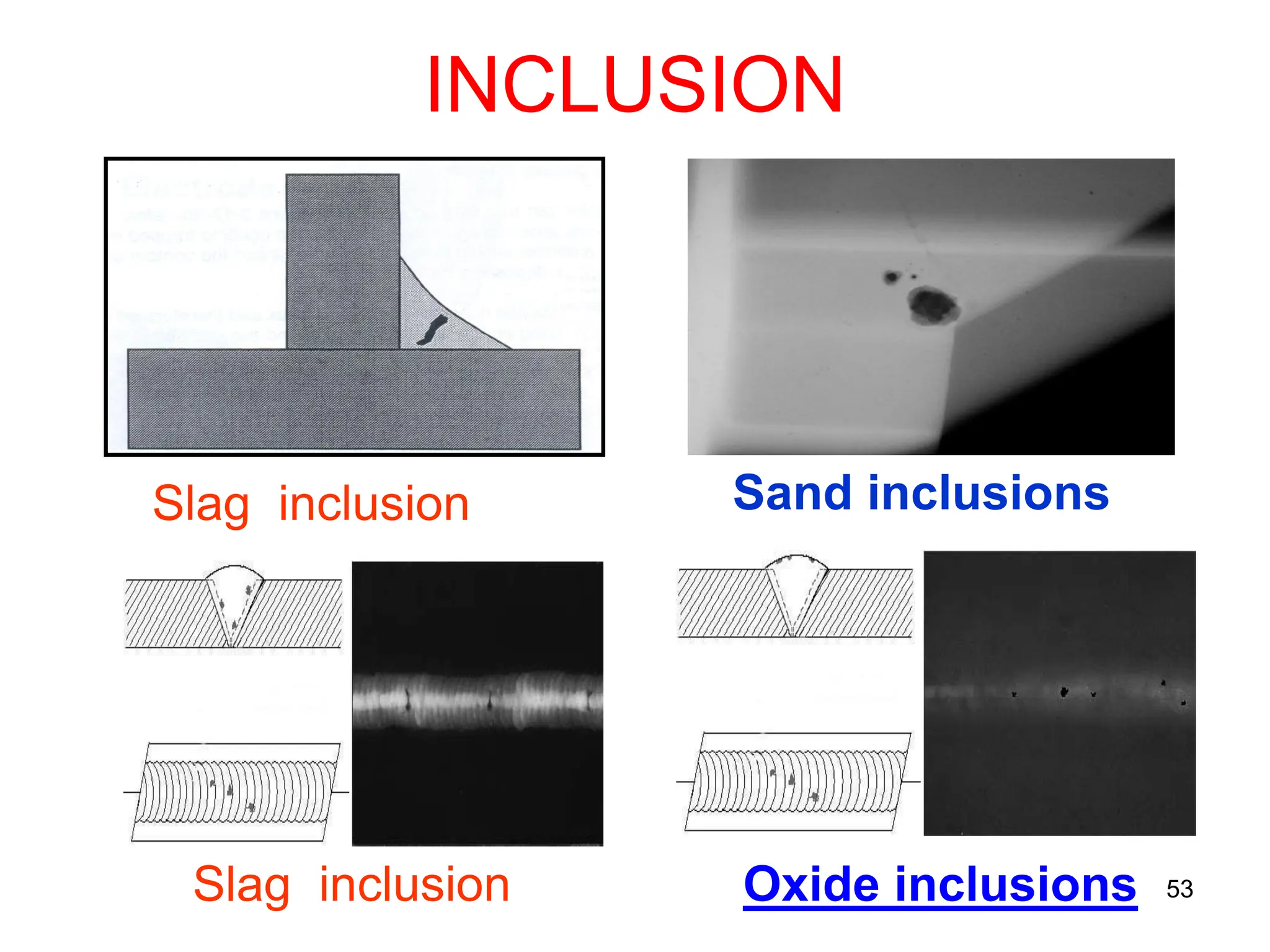
• May be in the form of slag or any other foreign material,
which does not get a chance to float on the surface of
the solidifying WM
• H₂: the most undesirable inclusion (causing: cold crack)
• Lowers the strength of joint & make it weaker
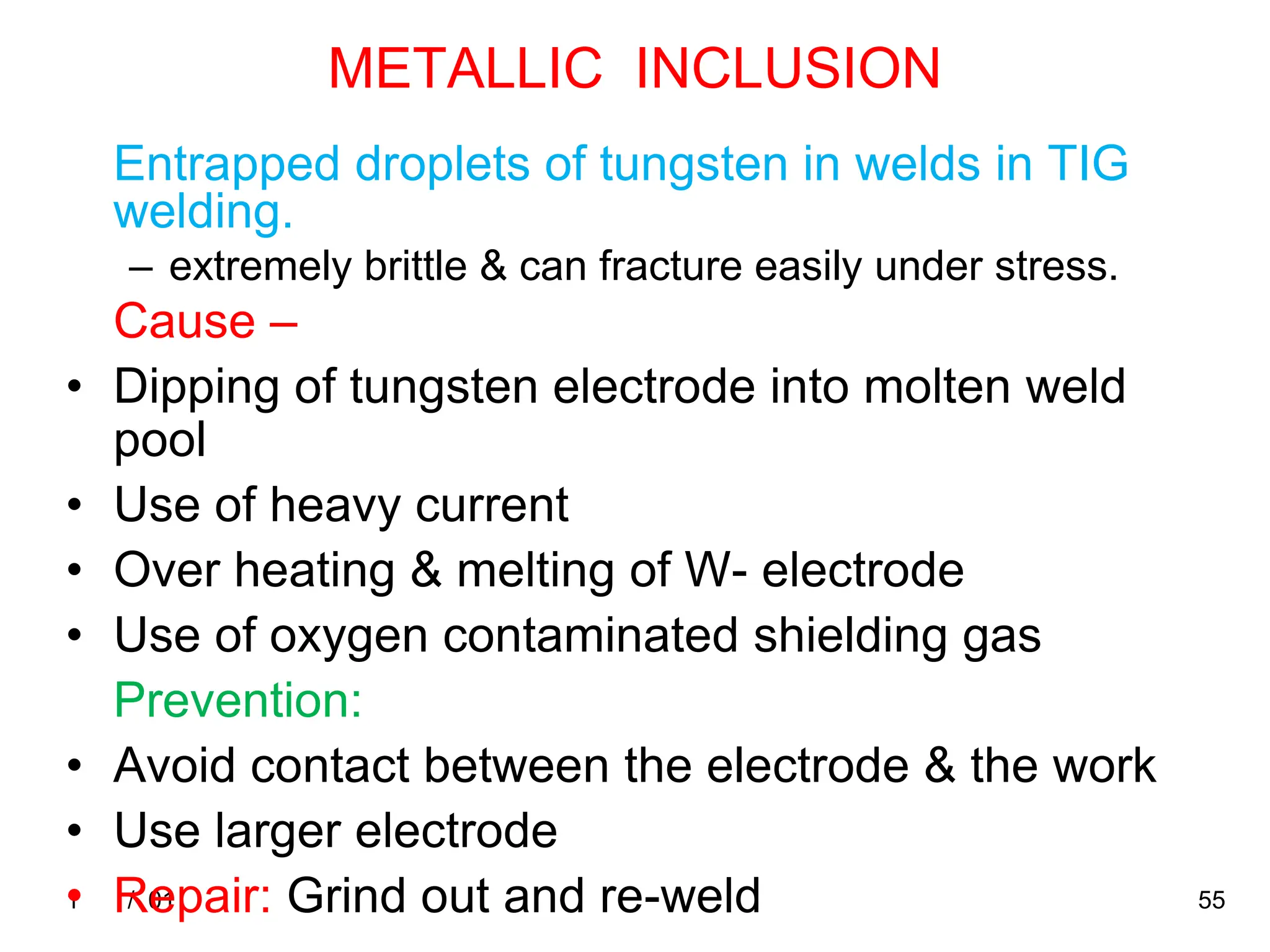
• Non- metallic inclusion:-
– Most dangerous
– May be sulphide, oxide, silicate or aluminate type
– Acts as stress raiser
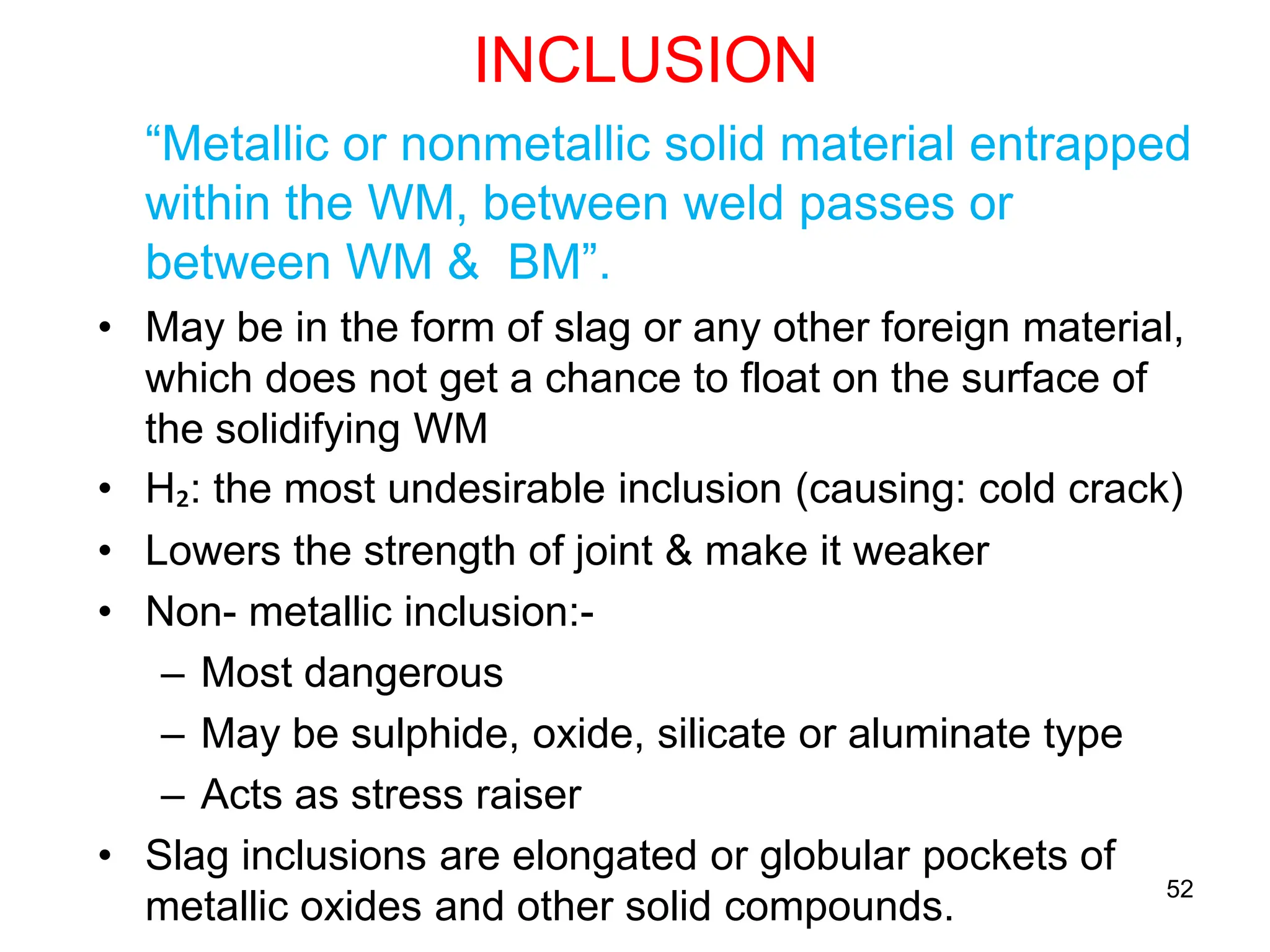
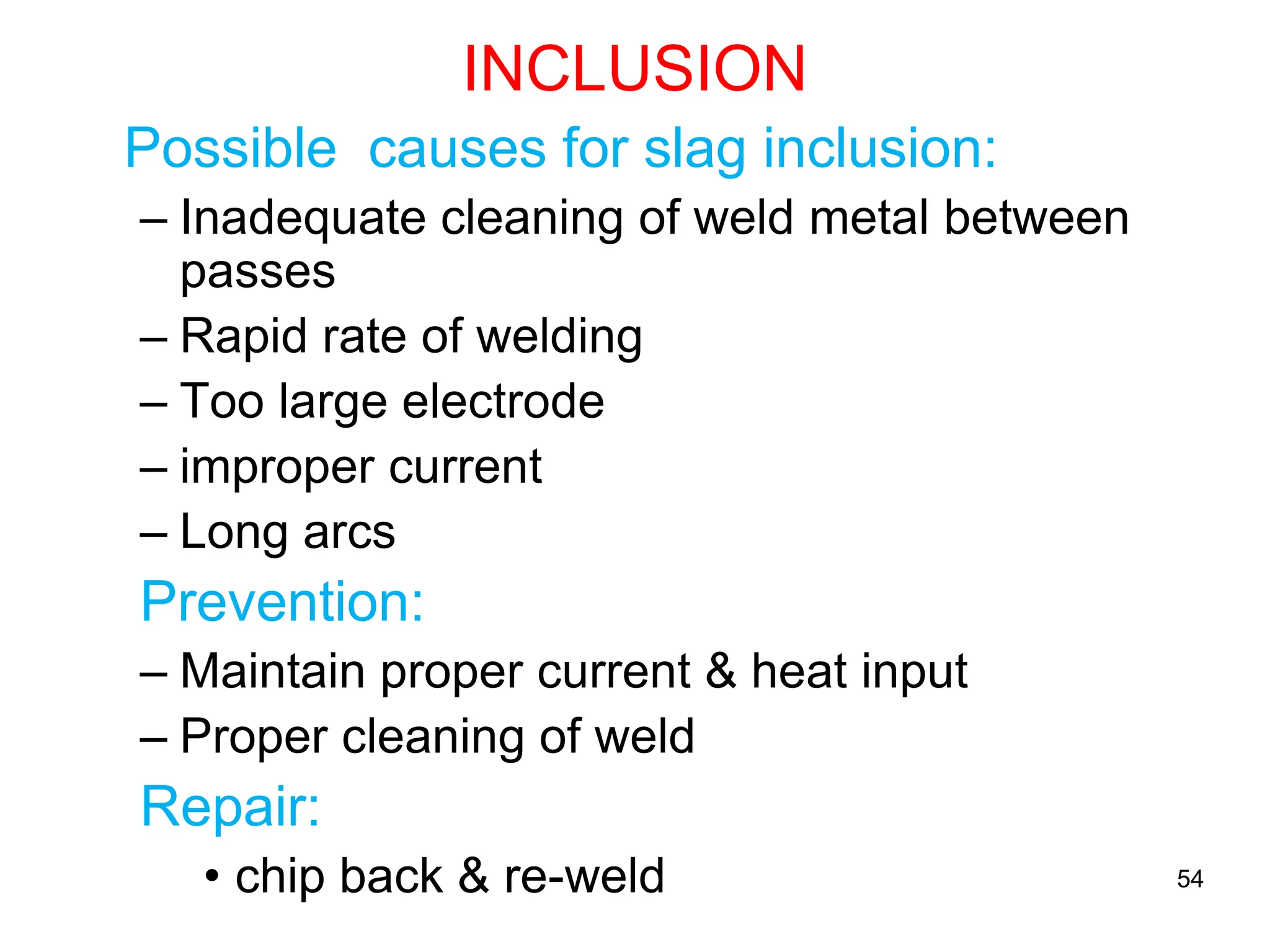
• Slag inclusions are elongated or globular pockets of
metallic oxides and other solid compounds.
INCLUSION
53
Slag inclusion Sand inclusions
Slag inclusion Oxide inclusions
INCLUSION
Possible causes for slag inclusion:
– Inadequate cleaning of weld metal between
passes
– Rapid rate of welding
– Too large electrode
– improper current
– Long arcs
Prevention:
– Maintain proper current & heat input
– Proper cleaning of weld
Repair:
• chip back & re-weld 54
1 / 01 55
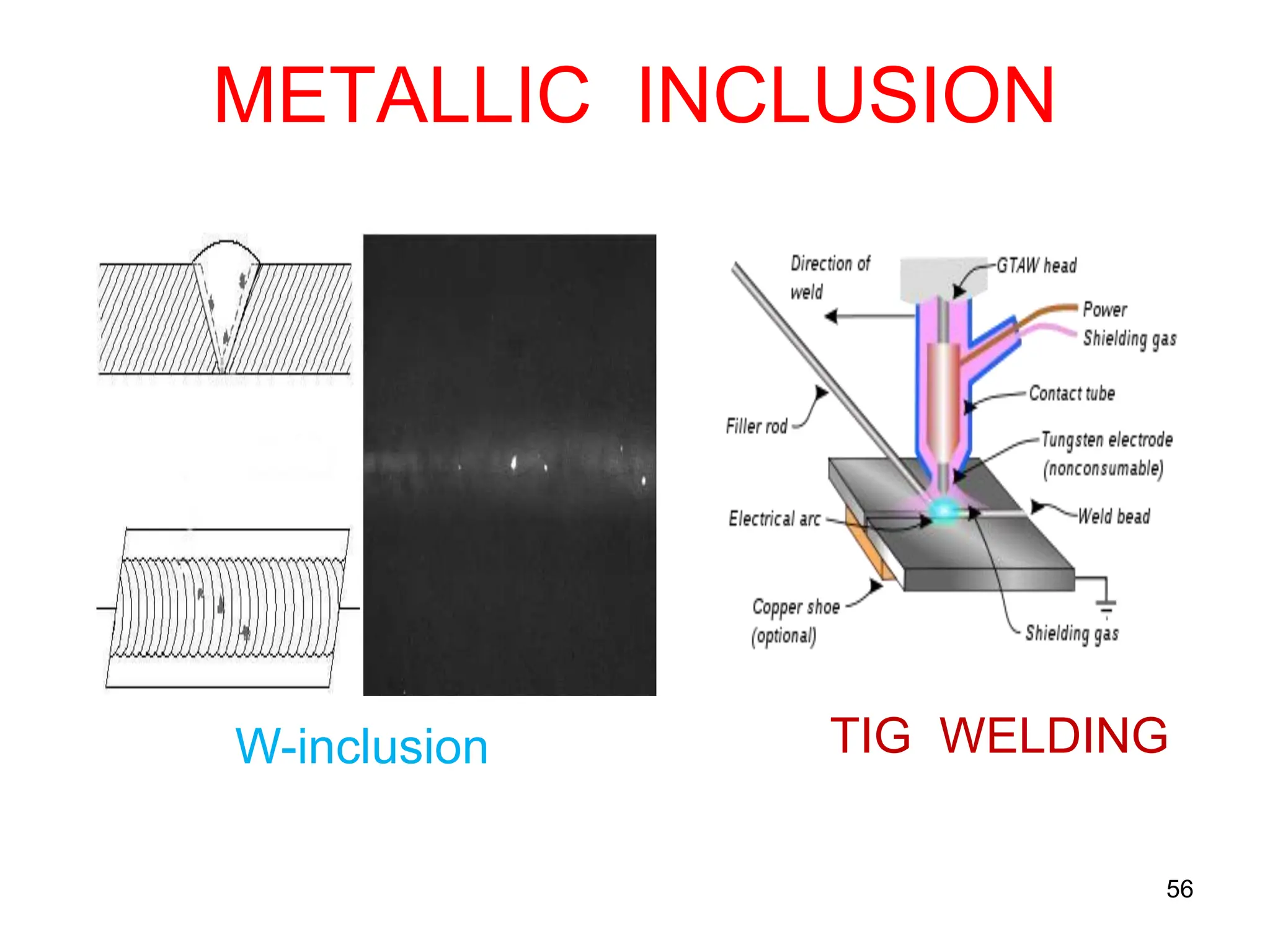
METALLIC INCLUSION
Entrapped droplets of tungsten in welds in TIG
welding.
– extremely brittle & can fracture easily under stress.
Cause –
• Dipping of tungsten electrode into molten weld
pool
• Use of heavy current
• Over heating & melting of W- electrode
• Use of oxygen contaminated shielding gas
Prevention:
• Avoid contact between the electrode & the work
• Use larger electrode
• Repair: Grind out and re-weld
METALLIC INCLUSION
56
TIG WELDING
W-inclusion
57
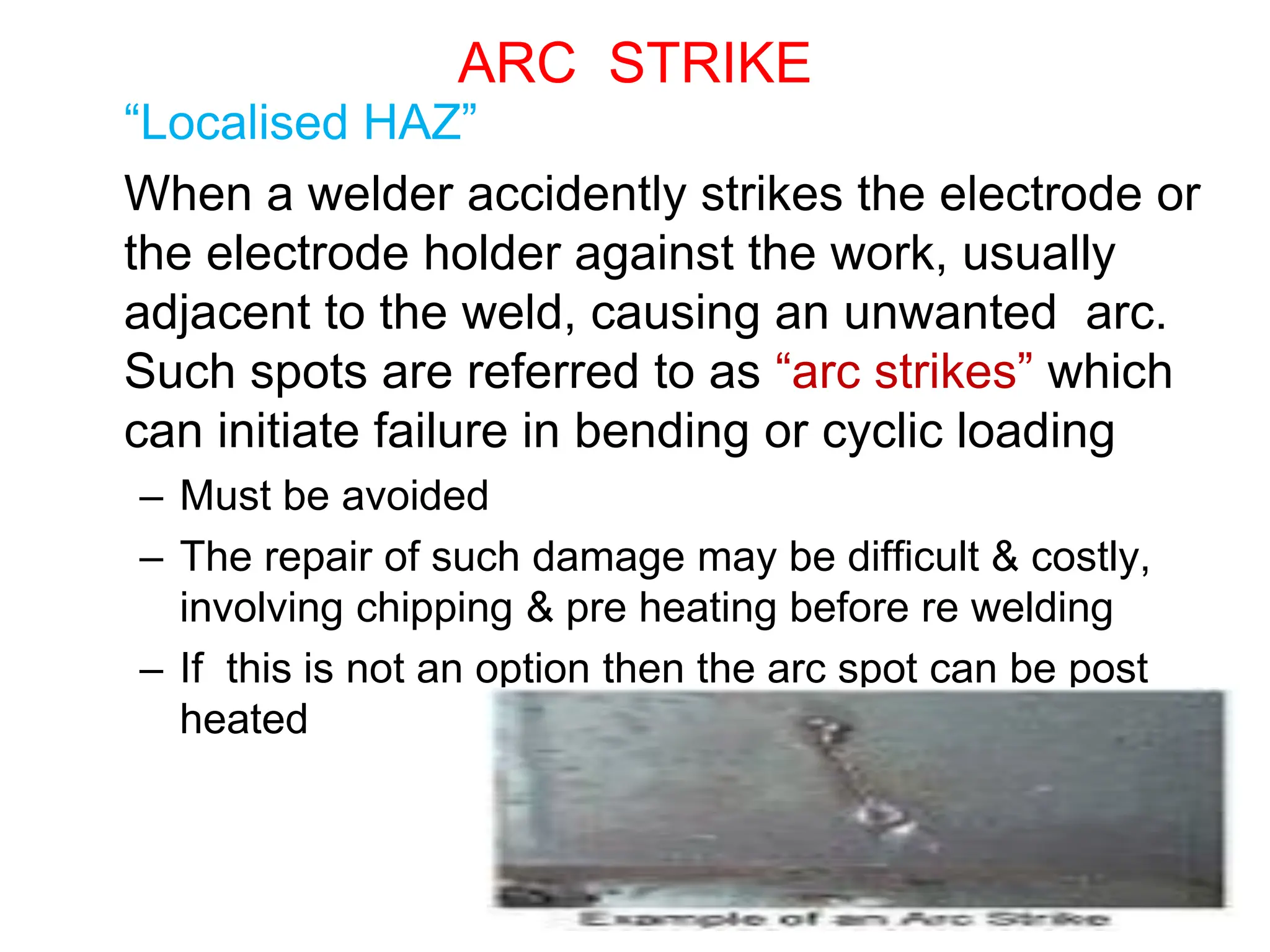
ARC STRIKE
“Localised HAZ”
When a welder accidently strikes the electrode or
the electrode holder against the work, usually
adjacent to the weld, causing an unwanted arc.
Such spots are referred to as “arc strikes” which
can initiate failure in bending or cyclic loading
– Must be avoided
– The repair of such damage may be difficult & costly,
involving chipping & pre heating before re welding
– If this is not an option then the arc spot can be post
heated
58
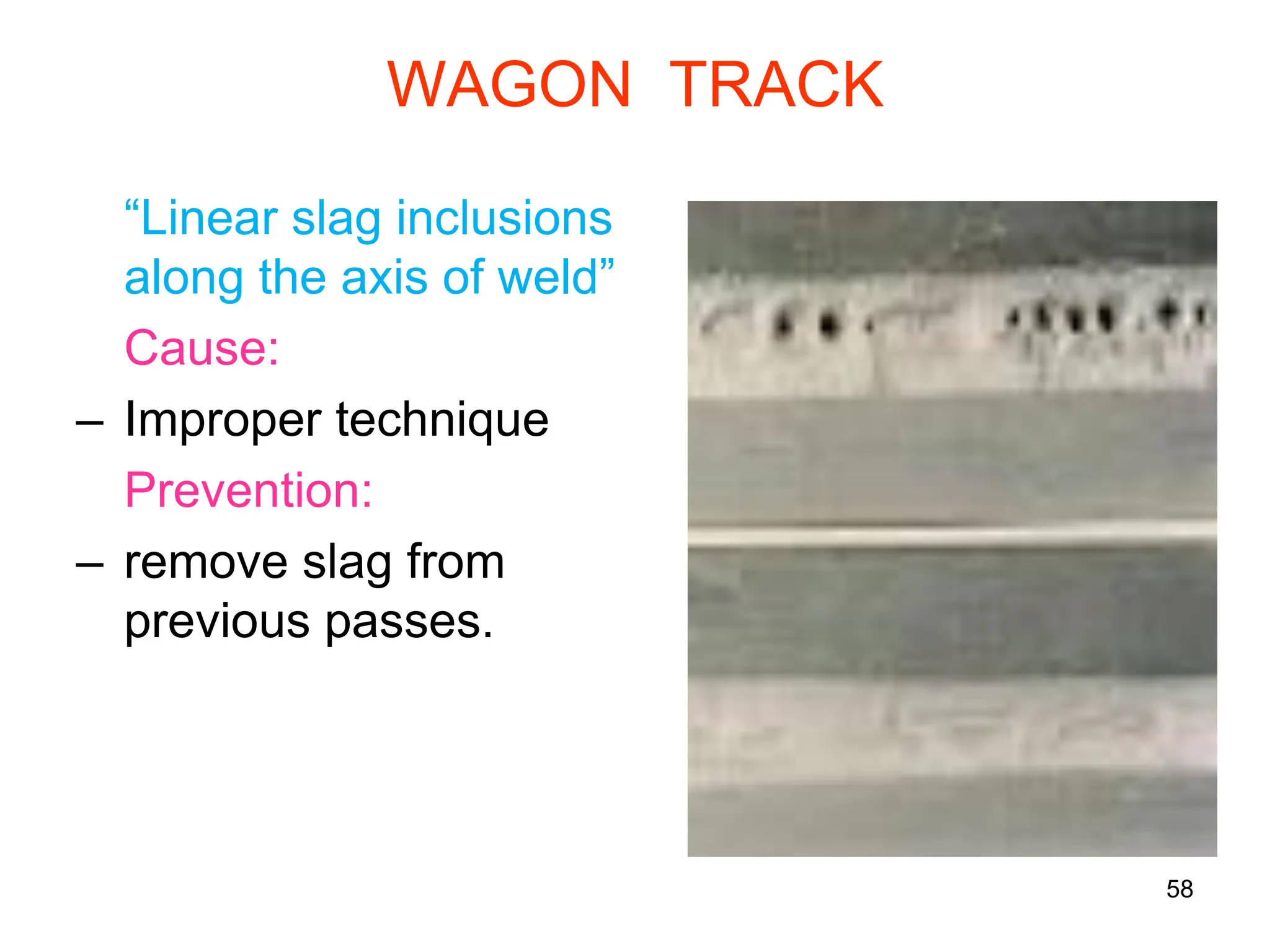
WAGON TRACK
“Linear slag inclusions
along the axis of weld”
Cause:
– Improper technique
Prevention:
– remove slag from
previous passes.
59
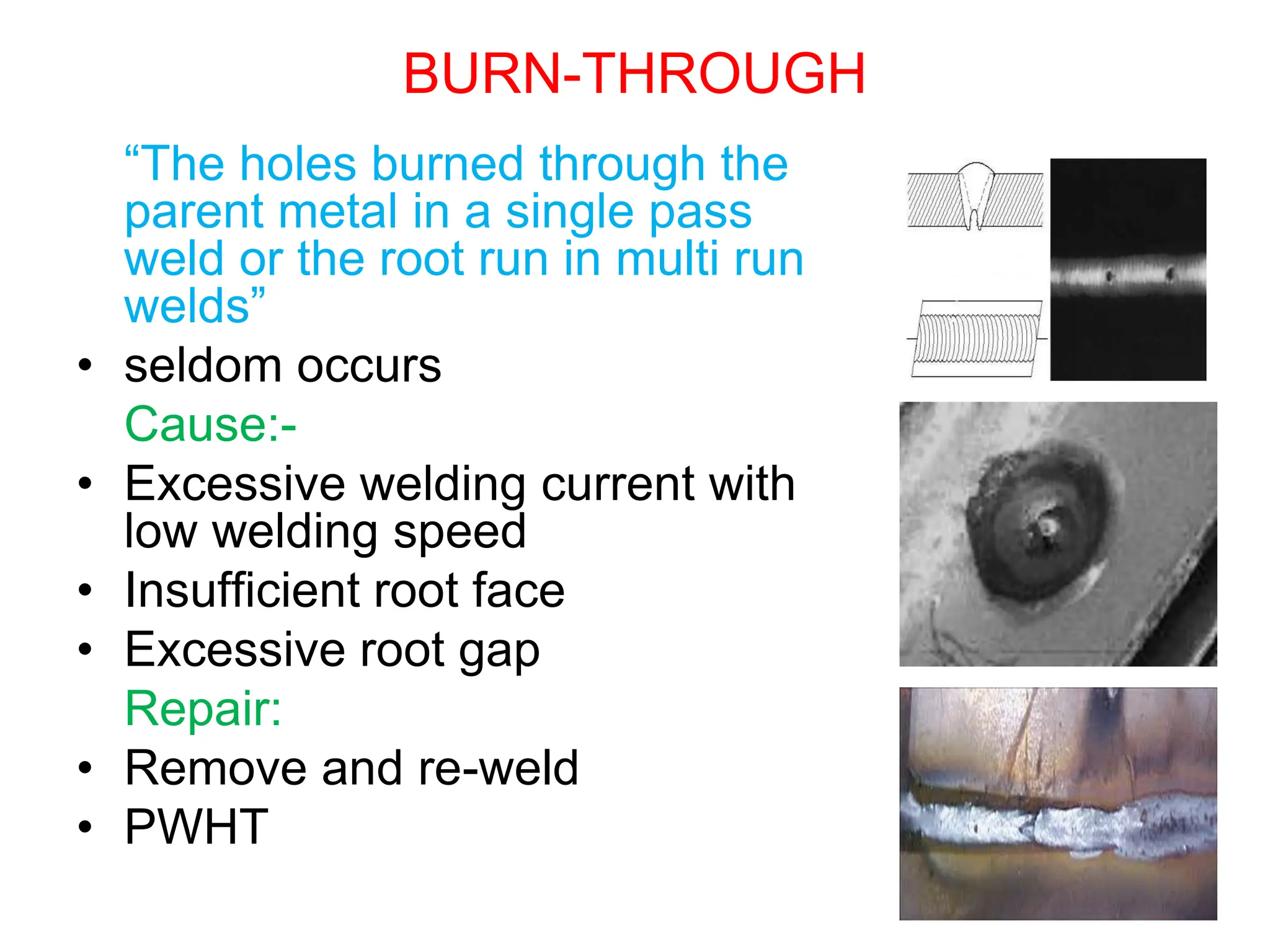
BURN-THROUGH
“The holes burned through the
parent metal in a single pass
weld or the root run in multi run
welds”
• seldom occurs
Cause:-
• Excessive welding current with
low welding speed
• Insufficient root face
• Excessive root gap
Repair:
• Remove and re-weld
• PWHT
60
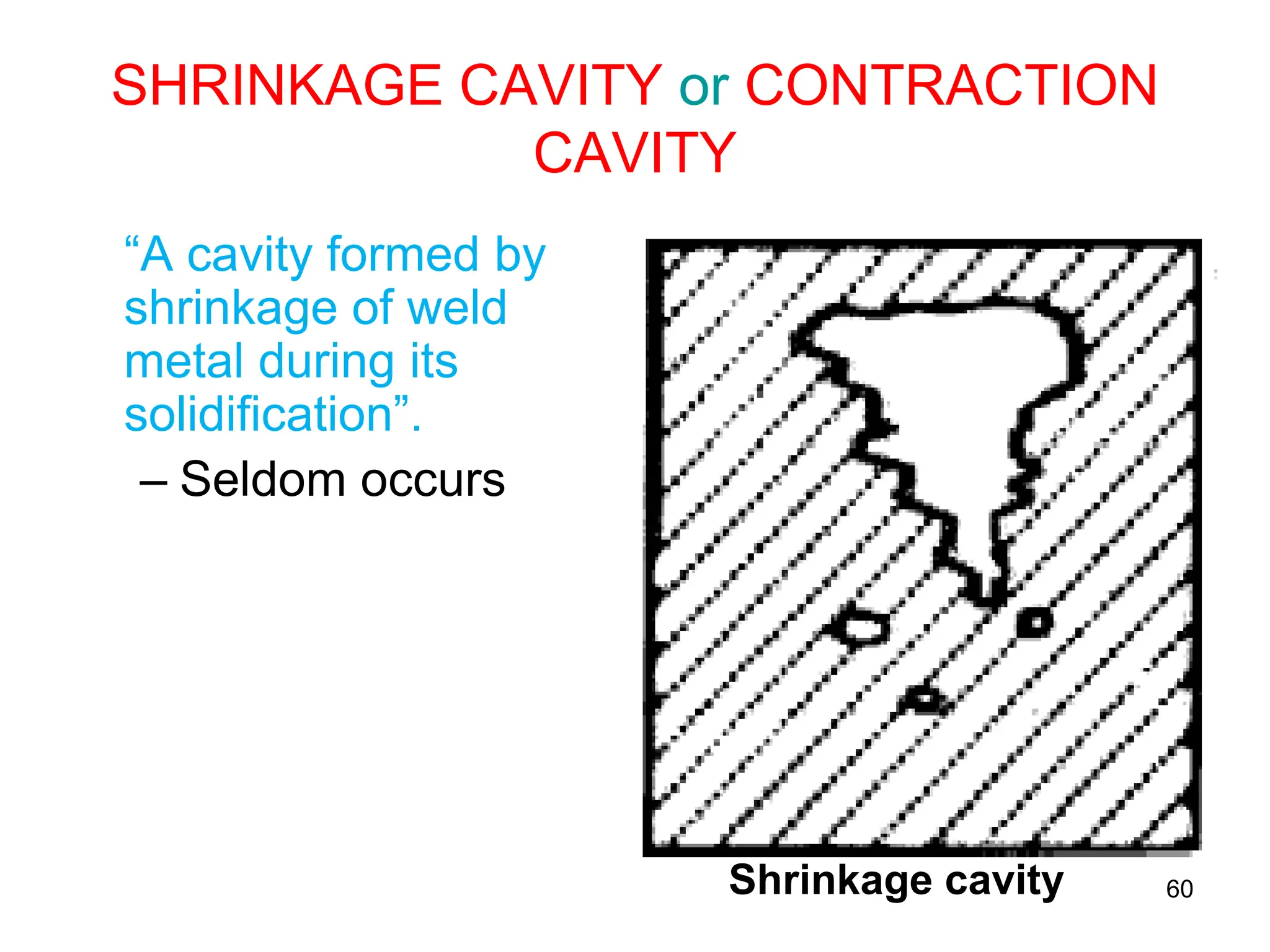
SHRINKAGE CAVITY or CONTRACTION
CAVITY
“A cavity formed by
shrinkage of weld
metal during its
solidification”.
– Seldom occurs
Shrinkage cavity

welding defects DSS guidelines and basics

  • 1.
  • 2.
    OBJECTIVES To: • Understand thedefinition & cause of weld defects • Solve the problem • Suggest possible remedies associated with individual weld defects. 2
  • 3.
    INTRODUCTION • Performance &longevity of welded structure in service depends on: – the presence or absence of defects in weld joints. • Not possible for the welds to be completely sound • Improper welding parameters & wrong welding procedures introduce defects in the weld metal and HAZ • Defects impair the strength of weld joints • A defective weldment fails under service conditions & causes damage to property & loss of human lives 3
  • 4.
    4 DEFINITION OF WELDING Definition: “Processof joining two similar or dissimilar metals by heat or by pressure or by both using a filler metal to achieve a defect less joint having the physical properties similar to that of parent metal”. Dissimilar metal means:- • Those that are chemically different (steel,Cu, Al, etc). • Those that are metallurgically different (MS, SS, etc). *Dissimilar metal imparts galvanic cell corrosion Commonly welded base metals:- – Ferrous-[WI, CI, C-steel (low, med, high), alloy steel, SS] – Non-ferrous-(Al, Cu ,Mg, Ni, Zn & their alloys)
  • 5.
    5 WELDING & ALLIEDPROCESSES Arc welding: (the most popular process) • SMAW or MMAW • FCAW • TIG welding or GTAW • MIG welding or GMAW • MAG welding or CO2 welding • SAW • Plasma arc welding • ESW • EGW Gas welding: • Oxy-acetylene welding • Oxy hydrogen welding • Air acetylene welding Resistance welding: •Spot welding •Seam welding •Resistance butt welding •Flash butt welding Solid state welding •Diffusion welding •Forge welding •Friction welding •Ultrasonic welding Thermo chemical welding •Thermit welding •Atomic hydrogen welding Radiant energy welding •Plasma welding •Laser beam welding •Electron beam welding Allied process •Soldering •Brazing •Adhesive welding
  • 6.
    WELDING PROCESSES MAINLY USEDON IR • MMAW • SAWMIG/MAG • Gas welding • Thermit welding • Flash butt welding • Gas pressure welding • Brazing 6
  • 7.
    WELDING PROCESSES USEDON IR PROCESS USES ON IR MMAW 1. For repair of Rly comp like coaches, wagons, Bridge girders, Bogies of diesel & electric locos 2. For fabrication of above Rly components, the process was replaced by MIG/MAG & SAW 3. For reclamation & reconditioning of worn out Rly components like Rly points & crossings, hangers, eq beam of trimount bogies, gas inlet casing of diesel locos, etc SAW 1. Used for fabrications of Rly components like bridge girders, diesel engine block, wagons, fabricated bogies 2. For reclamation of worn out wheel flanges of C & W (both cast & rolled forged MIG/MAG 1. Used for fabrications of Rly components like bridge girders, C& W, fabricated bogies 2. For reclamation of worn out Rly components like Rly points & crossings, equiliser beam of trimount bogies, etc
  • 8.
    WELDING PROCESSES USEDON IR PROCESS USES ON IR Gas welding Presently limitetd on IR. However, used for repair of small defects for general purposes. Also used for joining of some non-ferrous comp Brazing Mainly used for joining of electrical comp of E & D locos. Also used for joining of Al & Cu tubes of AC coaches Thermit welding Most widely used for joining of rails of IR (70% of rails joining) FBW Used for joining rails GPW Limited for joining of rails 8
  • 9.
    NOMENCLATURE OF AFILLET WELD *concave fillet weld has higher tensile stress on the face than the convex fillet weld
  • 10.
    NOMENCLATURE OF AFILLET WELD 10
  • 11.
  • 12.
    12 WHAT IS AWELDING DEFECT ? The defects in the weld can be defined as irregularities in the weld metal produced due to incorrect welding parameters or wrong welding procedures or wrong combination of filler metal and parent metal. It can simply be defined as: “Defects introduced during welding beyond the acceptance limit that can cause a weld to fail”. A defect does not allow the finished joint to withstand the required strength (load).
  • 13.
    FAILURE DUE TOWELDING DEFECT ON %AGE BASIS According to the American Society of Mechanical Engineers (ASME) welding defect causes are broken down into the following % age:- • 41% poor process conditions • 32% operator error • 12% wrong technique • 10% incorrect consumables and • 5% bad weld grooves. 13
  • 14.
    14 PRESENCE OF WELDINGDEFECTS: ACTION What should be done when Welding-defects are detected? One should reject the items and put them temporarily on hold. One should determine the cause and try to implement a corrective action to avoid future reoccurrence. Then an authorized professional should determine, if the defects are repairable or not. If yes, by which procedure. Standard procedures may be approved for routine application.
  • 15.
    EVALUATION WELDING DEFECTS Alldiscontinuities are not defects. Discontinuities are rejectable only if they exceed specification requirements Radiographic standards used for evaluation of weld defects:- • IIW standards • ASTM standards *Acceptance standards vary with service requirements 15
  • 16.
    IIW STANDARDS Five IIWstandards: – Black – Blue – Green – Brown – Red 16
  • 17.
    IIW STANDARDS Black • Ahomogeneous weld or a weld with a few small scattered gas cavities Blue • Very slight variation from homogeneity in the form of one or more of the following defects:-: – Cavity – Shrinkage cavity – Slag inclusion – Undercut Green • Slight variation from homogeneity in the form of one or more of the following defects:- – Gas cavity – Shrinkage cavity – Slag inclusion – Undercut – Incomplete penetration 17
  • 18.
    IIW STANDARDS Brown • Markeddeviation from homogeneity in the form of one or more of the following defects:- – Gas cavity – Shrinkage cavity – Slag inclusion – Undercut – Incomplete penetration – Lack of fusion Red • Gross deviation from homogeneity in the form of one or more of the following defects:- – Gas cavity – Shrinkage cavity – Slag inclusion – Undercut – Incomplete penetration – Cracks 18
  • 19.
    ASTM STANDARDS Specified weldingdefects level as per ASTM E- 390 Vol-II • Defects not allowed:- – Shrinkage /Crack – Lack of Fusion – Burn through – Elongated Porosity • Defects allowed:- – Incomplete Penetration up to level-II – Slag Inclusion up to Level-III – Undercut up to level-IV – Porosity: • Coarse scattered Porosity up to level-II • Cluster Porosity up to Level-III • Fine scattered Porosity up to Level-IV 19
  • 20.
    20 CLASSIFICATION OF WELDINGDEFECTS • One of the IIW documents classifies all welding defects into six groups according to their appearance.- Crack- includes all types of cracks such as crater cracks, hot cracks, cold cracks, etc Cavity- includes blow holes, porosities, shrinkage, pipes, etc Incomplete fusion & penetration- includes lack of fusion, lack of penetration, etc
  • 21.
    CLASSIFICATION OF WELDINGDEFECTS Solid inclusion- includes slag, metal oxides, tungsten, wagon track, etc Imperfect shape -under cut, under fill, over lap, excessive penetration, improper bead shape, etc Miscellaneous defects – includes arc strike, excessive spatter, rough surface, uneven ripples, etc 21
  • 22.
    15 22 CLASSIFICATION OFWELDING DEFECTS All these defects fall under two categories-  Visual defect /Surface weld defect/External defect – surface cracks – over laps – under cuts – under fills – excessive penetration – surface porosity – excessive spatter – Arc strike, etc  Hidden defect/sub surface weld defect/Internal defect – lack of fusion – lack of penetration – sub surface blow holes/ porosity – shrinkage cavity – slag inclusion tungsten inclusion, etc.
  • 23.
    CRACKS • A hairline separation in the BM/BM-WM-bdy / WM/HAZ • May appear: – at the root or – middle or – In the crater – surface or – subsurface • Most dangerous of all defects • Occurs in the WM when localized stresses exceed the UTS of material. • May be of microscopic or macroscopic sizes. 23
  • 24.
    CRACKS Long crack inHAZ parallel to weld bead 24 Long crack in weld metal running through centre of the weld
  • 25.
    CRACKS Cause:- • Poor ductilityof base metal • High C & S- content of BM/WM • High contraction stresses • Electrode with high hydrogen content Remedy:- • Pre- heating • Mn/S ratio: 18 min. • Use low H₂ electrode • Avoid rapid cooling Classification:- Cracks may be grouped mainly into two categories- – Hot crack – Cold crack 25 transvethe rse weld crack running across weld bead transverse base metal crack generally in high strength steel
  • 26.
    HOT CRACKS • Crackin the weld that occurs just after the welds are completed and some- times while the welds are being made. – Develops at high temperatures – Propagates between the grains of the material (intercrystalline) – Occurs in the weld metal & sometimes in HAZ. • “solidification crack ” (weld metal) • “liquation crack” (HAZ) 26 Intercrystalline crack Transcrystalline crack
  • 27.
    HOT CRACKS Cause:- • Highresidual stresses in weld metal • Low weld ductility • Too high welding current • High thickness of work piece (thicker the work piece, faster the cooling rate) • high ratio of S &P with low Mn content, high C & Ni content (high harden ability
  • 28.
    HOT CRACKS Prevention: • Controllingcomposition of the metal (S<0.007%) to be welded • Using filler metal with proper composition & low tensile strength • Pre- heat • reduces rate of cooling • not essential for Aus.SS (martensite does not occur). Repair: • Remove and re-weld 28
  • 29.
    COLD CRACK • Occursafter the metal has completely solidified (at temp -1000C to 2000C) • Can occur several days after weld • Occurs in C-steel, low & high alloy steel – propagates both between grains and through grains. – often associated with non-metallic inclusion (elongated MnS). – occurs in both weld metal and HAZ but generally in HAZ
  • 30.
    COLD CRACK 30 movement ofH2 during arc welding
  • 31.
    COLD CRACK 31 Cause- • Hydrogenpick up during welding – Source of hydrogen:- • Moisture in base metal & welding electrodes • Surface contaminated with organic substances • Surrounding atmospheres • Phase changes (e.g. formation of martensite) during cooling Prevention: • Controlling welding parameters:- • proper pre-heating: – reduces diffusion of H2 – ensures no moisture • Post-welding treatment: – stress relief.
  • 32.
    COLD CRACK • Cleanjoint from rust • Use proper welding processes and consumables: – Low strength filler metals. – Use low hydrogen type baked electrode Repair: – Remove and reweld. 32
  • 33.
    CRATER CRACK/STAR CRACK “Adepression left in weld metal where the arc was broken or the flame was removed or electrode was changed”. • They are hot cracks • Occurs at the crater of the weld – usually star shaped, but may have other shapes. – most frequently found in austenitic SS(high thermal coeff). 5 33
  • 34.
    CRATER CRACK/STAR CRACK Cause: •The center of weld pool becomes solid before the outside, pulling the center apart during cooling. • High current (deep crater) Prevention: • can be minimised by filling craters to a slightly convex shape prior to breaking the welding arc. • may be avoided through improved welding skill Repair: – remove and reweld using appropriate procedure. 34
  • 35.
    POROSITIES/BLOW HOLES “Porosity isa group of small voids, where as blow holes are comparatively bigger hole or cavity caused by entrapment of gases [gases:H2,CO,CO2,N2 &O2 from coating ingredients in the electrode or moisture, oil, grease, rust, etc on BM] within the solidified weld”. • Porosity can occur on or just below the surface of a weld. • Porosity in the weld and HAZ may lead to cracking. 35
  • 36.
    POROSITIES / BLOWHOLES 6/06/2015 36 Gas porosity or blow holes cluster porosity
  • 37.
    BLOW HOLES /POROSITIES Cause: • Work piece or electrode contains/contaminated with:- – High sulphur & carbon – Excessive moisture, rust or scale, oil, grease, etc • Atmospheric gases [N2, excessive O2 (Al- welding)] • Anodising coating on Al (contains moisture) • Long arc • Fast solidification rate Prevention: • Preheat • Maintain proper arc length • Use low hydrogen electrode • Use recommended procedure for baking & storing electrodes • Clean joint surfaces & adjacent surfaces 37
  • 38.
    UNDER CUT “A defectthat appears as a groove formed in the BM adjacent to the toe of a weld along the edge of the weld & left unfilled by the weld metal”. • Generally located parallel to the junction of weld metal & base metal at the toe or root of the weld • Reduces the cross-sectional thickness of the base metal • Acts as stress raiser in fatigue loading 38
  • 39.
  • 40.
    UNDER CUT Cause: • Highwelding current & arc voltage • Too large electrode dia • Incorrect electrode angle • Longer arc length Prevention: • Use prescribed welding current for electrode size. • Adjust electrode angle to fill undercut area. • Correct travel speed, arc length, etc. Repair: • Gouge & weld with low hydrogen electrode 40
  • 41.
    41 OVER LAPS “An imperfectionat the toe of weld caused by over flow of weld metal on the surface of parent metal without fusion” (protruded weld metal beyond the toe) • Tends to produce mechanical notch • Starts a crack at the sharp point where the weld metal and base metal come together at the over-lapped surface Over laps
  • 42.
    OVER LAPS Cause:- – currenttoo low – Too large deposition in a single run – Longer arc – slow arc travel speed. Prevention: – Proper welding technique – Use proper size of electrode Repair: – Overlap must be removed to blend smoothly into the base metal. 42
  • 43.
    43 LACK OF PENETRATION “Improperpenetration of weld metal through the thickness of joint or weld metal not extending to the required depth into the joint root” • Acts as stress riser from which a crack may propagate
  • 44.
    LACK OF PENETRATION Cause– • Root gap too small • high welding speed • Low heat input • Too large electrode dia Prevention: • Proper joint preparation • Proper heat input & welding speed • Use suitable size of electrode Repair: • Back gouge and back weld or remove and reweld. 44
  • 45.
    45 LACK OF FUSION “Lackof complete melting/ fusion of some portion of the weld metal in a joint” • May be at the root, sides or between two runs. • Reduces the strength of welds & makes welded structures unreliable
  • 46.
    LACK OF FUSION 16/06/2015 46 lackof fusion between passes
  • 47.
    LACK OF FUSION Cause: •Low welding current • Excess welding speed • Unfavourable heat input Prevention: • Maintain proper current & welding speed • Proper cleaning of each bead Repair: • Chipping back & re-welding 47
  • 48.
    48 EXCESSIVE PENETRATION/ICICLES “Weld metallying outside the plane joining the toes” • Makes notches that create stress concentration. • An economic waste Cause :- • Too wide a root gap • Too high welding current • Slow travel speeds • Large size electrodes
  • 49.
    EXCESSIVE PENETRATION/ICICLES Prevention: – Correctthe root opening and root face – Reduce the wire-feed speed Repair:- – Remove and re-weld 49
  • 50.
    16/06/2015 50 SPATTER “Small globularmetal drops / particles thrown out during welding & stick to the BM surfaces along its length”. • Metal lost • Do not form a part of the weld. • Excessive spatters unacceptable.
  • 51.
    SPATTER Cause – – Excessivearc current – Excessive long arc – Improper shielding gas – Electrodes coated with improper flux ingredients – Damp electrodes Prevention: – Correct welding current for type & size electrode used. – Correct proper arc length & use correct arc voltage – Spatter cure SC-07(Non-toxic, non- pollutant, water based inorganic anti–spatter flux) – can easily be removed either by hair brush or by washing. Repair: Remove by grinding or sanding. 015 51
  • 52.
    52 INCLUSION “Metallic or nonmetallicsolid material entrapped within the WM, between weld passes or between WM & BM”. • May be in the form of slag or any other foreign material, which does not get a chance to float on the surface of the solidifying WM • H₂: the most undesirable inclusion (causing: cold crack) • Lowers the strength of joint & make it weaker • Non- metallic inclusion:- – Most dangerous – May be sulphide, oxide, silicate or aluminate type – Acts as stress raiser • Slag inclusions are elongated or globular pockets of metallic oxides and other solid compounds.
  • 53.
    INCLUSION 53 Slag inclusion Sandinclusions Slag inclusion Oxide inclusions
  • 54.
    INCLUSION Possible causes forslag inclusion: – Inadequate cleaning of weld metal between passes – Rapid rate of welding – Too large electrode – improper current – Long arcs Prevention: – Maintain proper current & heat input – Proper cleaning of weld Repair: • chip back & re-weld 54
  • 55.
    1 / 0155 METALLIC INCLUSION Entrapped droplets of tungsten in welds in TIG welding. – extremely brittle & can fracture easily under stress. Cause – • Dipping of tungsten electrode into molten weld pool • Use of heavy current • Over heating & melting of W- electrode • Use of oxygen contaminated shielding gas Prevention: • Avoid contact between the electrode & the work • Use larger electrode • Repair: Grind out and re-weld
  • 56.
  • 57.
    57 ARC STRIKE “Localised HAZ” Whena welder accidently strikes the electrode or the electrode holder against the work, usually adjacent to the weld, causing an unwanted arc. Such spots are referred to as “arc strikes” which can initiate failure in bending or cyclic loading – Must be avoided – The repair of such damage may be difficult & costly, involving chipping & pre heating before re welding – If this is not an option then the arc spot can be post heated
  • 58.
    58 WAGON TRACK “Linear slaginclusions along the axis of weld” Cause: – Improper technique Prevention: – remove slag from previous passes.
  • 59.
    59 BURN-THROUGH “The holes burnedthrough the parent metal in a single pass weld or the root run in multi run welds” • seldom occurs Cause:- • Excessive welding current with low welding speed • Insufficient root face • Excessive root gap Repair: • Remove and re-weld • PWHT
  • 60.
    60 SHRINKAGE CAVITY orCONTRACTION CAVITY “A cavity formed by shrinkage of weld metal during its solidification”. – Seldom occurs Shrinkage cavity