   Planning
   The Issue
   Structure
   Information
   Listening
   Invitation decisions often create a dilemma
   What criteria should we consider?
       Expertise
       Motivation
       Politics
       Time
       Differences
       Potential disagreements
       Diversity
       Expense
       Resources
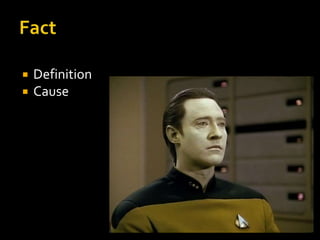
   Fact
   Value
   Policy
   Definition
   Cause
“Everybody lies, search the house.” – House M.D.
   How much order?
   How much time?
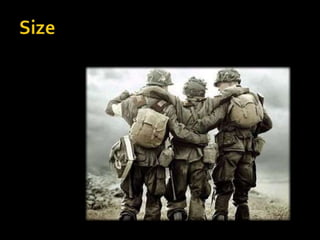
   How many people?
   Emotion involvment?
   Nature of the task?
   Know your members.
   How detailed and organized do instructions
    need to be for them to thrive?
   How much autonomy do they need?
   Use a calendar. Use doodle. Contact participants.
   Find a length that gets the job done.
   Find a length that helps people remember.
   When its high:
     Longer
     Painful
     More conflict
     Need for references to policy
   Difficulty
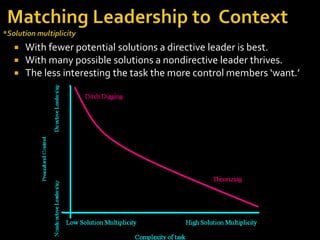
   Solution multiplicity
   Intrinsic group interest
   Cooperation requirements
   Population interest

                       (Hirokawa, 1990)
   With fewer potential solutions a directive leader is best.
   With many possible solutions a nondirective leader thrives.
   The less interesting the task the more control members ‘want.’
   Primary Research
     Interviews
     Surveys
     Direct Observation
   Secondary Research
     Library
     Electronic Search
Where to begin?
Literature Review
  Question(s)
  Domain
  Scope

Resources ex. Articles, film, text, sites.
   Interviews
   Surveys
   Direct Observation
   Experiments
Correlation does not imply causation.

Do Ice-cream Sales cause Pirate Attacks?
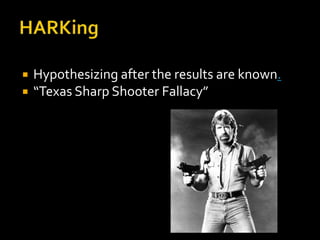
   Hypothesizing after the results are known.
   “Texas Sharp Shooter Fallacy”
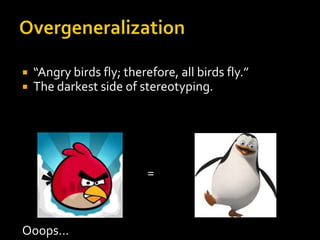
   “Angry birds fly; therefore, all birds fly.”
   The darkest side of stereotyping.


                           =


Ooops…
   Availability Bias
   Listen to this list and try to remember
    everything you hear.
   Group Competition: Get to the other side
    without touch or going under the fence.
   If you touch the whole team goes back.
    (You must also recite the alphabet allowed in unison before starting again.)

   First team to have all members on the ground
    on the greener side wins. Please shout ‘donzo.’
   Group listening will be very important here.
"When people talk, listen completely.
 Most people never listen."


                          — Ernest Hemingway
   Components of Listening
   Listening Problems
   Tips and Tricks
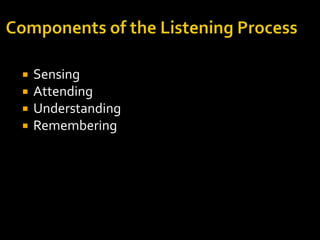
   Sensing
   Attending
   Understanding
   Remembering
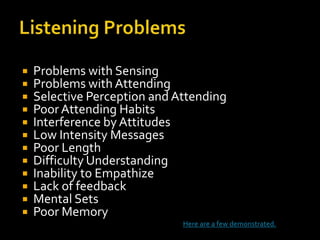
   Problems with Sensing
   Problems with Attending
   Selective Perception and Attending
   Poor Attending Habits
   Interference by Attitudes
   Low Intensity Messages
   Poor Length
   Difficulty Understanding
   Inability to Empathize
   Lack of feedback
   Mental Sets
   Poor Memory
                              Here are a few demonstrated.
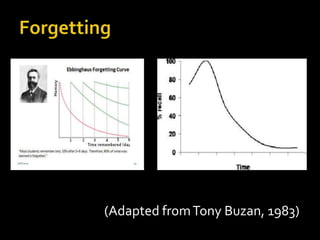
(Adapted from Tony Buzan, 1983)
   Paraphrase
   Double-check
   Empathize
   Practice
   Create a MS Word document of an agenda (red)
    for one of your group meetings and include
    notes on what actually happened (blue).

   Identify the type of meeting (1) and the parent
    format (2) of the agenda you used.

     ▪ When complete, save your document to your Gmail account
       and mark the document as public or viewable by link.
     ▪ Paste this link in the Facebook group to achieve your point.
"No man ever listened himself out of a job."

                           — Calvin Coolidge
   Don’t forget to read for next class and
    complete your online assignment for points.
   Also send any questions you or your group
    have and I will focus on answering them.

Week 2 PPT

  • 2.
     Planning  The Issue  Structure  Information  Listening
  • 3.
     Invitation decisions often create a dilemma  What criteria should we consider?  Expertise  Motivation  Politics  Time  Differences  Potential disagreements  Diversity  Expense  Resources
  • 4.
     Fact  Value  Policy
  • 5.
     Definition  Cause
  • 7.
    “Everybody lies, searchthe house.” – House M.D.
  • 8.
     How much order?  How much time?  How many people?  Emotion involvment?  Nature of the task?
  • 9.
     Know your members.  How detailed and organized do instructions need to be for them to thrive?  How much autonomy do they need?
  • 11.
     Use a calendar. Use doodle. Contact participants.  Find a length that gets the job done.  Find a length that helps people remember.
  • 13.
     When its high:  Longer  Painful  More conflict  Need for references to policy
  • 14.
     Difficulty  Solution multiplicity  Intrinsic group interest  Cooperation requirements  Population interest (Hirokawa, 1990)
  • 15.
     With fewer potential solutions a directive leader is best.  With many possible solutions a nondirective leader thrives.  The less interesting the task the more control members ‘want.’
  • 16.
     Primary Research  Interviews  Surveys  Direct Observation  Secondary Research  Library  Electronic Search
  • 17.
    Where to begin? LiteratureReview Question(s) Domain Scope Resources ex. Articles, film, text, sites.
  • 19.
     Interviews  Surveys  Direct Observation  Experiments
  • 20.
    Correlation does notimply causation. Do Ice-cream Sales cause Pirate Attacks?
  • 21.
     Hypothesizing after the results are known.  “Texas Sharp Shooter Fallacy”
  • 22.
     “Angry birds fly; therefore, all birds fly.”  The darkest side of stereotyping. = Ooops…
  • 23.
     Availability Bias  Listen to this list and try to remember everything you hear.
  • 25.
     Group Competition: Get to the other side without touch or going under the fence.  If you touch the whole team goes back. (You must also recite the alphabet allowed in unison before starting again.)  First team to have all members on the ground on the greener side wins. Please shout ‘donzo.’  Group listening will be very important here.
  • 26.
    "When people talk,listen completely. Most people never listen." — Ernest Hemingway
  • 27.
     Components of Listening  Listening Problems  Tips and Tricks
  • 28.
     Sensing  Attending  Understanding  Remembering
  • 29.
     Problems with Sensing  Problems with Attending  Selective Perception and Attending  Poor Attending Habits  Interference by Attitudes  Low Intensity Messages  Poor Length  Difficulty Understanding  Inability to Empathize  Lack of feedback  Mental Sets  Poor Memory Here are a few demonstrated.
  • 30.
    (Adapted from TonyBuzan, 1983)
  • 31.
     Paraphrase  Double-check  Empathize  Practice
  • 32.
     Create a MS Word document of an agenda (red) for one of your group meetings and include notes on what actually happened (blue).  Identify the type of meeting (1) and the parent format (2) of the agenda you used. ▪ When complete, save your document to your Gmail account and mark the document as public or viewable by link. ▪ Paste this link in the Facebook group to achieve your point.
  • 33.
    "No man everlistened himself out of a job." — Calvin Coolidge
  • 35.
     Don’t forget to read for next class and complete your online assignment for points.  Also send any questions you or your group have and I will focus on answering them.