Effective Leadership of Interactive Education Dr Elyssebeth Leigh Sydney, Australia [email_address]
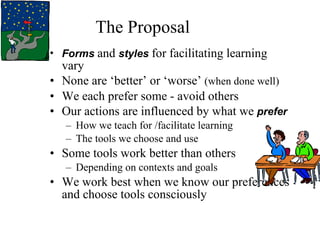
The Proposal Forms  and  styles  for facilitating learning vary None are  ‘better’ or ‘worse’  (when done well)  We each prefer some - avoid others Our actions are influenced by what we  prefer How we teach for /facilitate learning The tools we choose and use Some tools work better than others  Depending on contexts and goals  We work best when we know our preferences and choose tools consciously
A Goal for Facilitating  Interactive Education This happens when there is lack of accord between the external world experienced by humans and their internal biographical interests and knowledge Disjuncture makes learning possible The paradox is that if “ harmony ”  is fully established, there can be no learning situation  (Jarvis,1992, p 83) To create  “ disjuncture ”  - ambiguity,  uncertainty, discomfort SO – how to create [just] enough disjuncture?
Two Guiding Questions How can we identify our preferences – without judging their comparative  ‘value’? How can we think about interactive learning in regard to those tools?
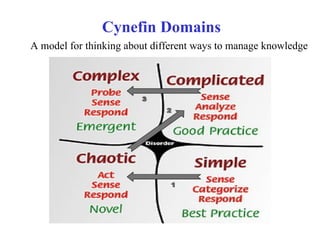
Cynefin Domains A model for thinking about different ways to manage knowledge
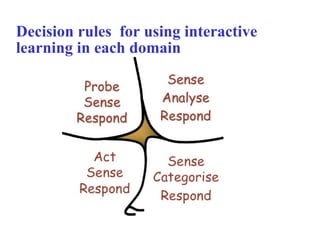
Decision rules  for using interactive learning in each domain
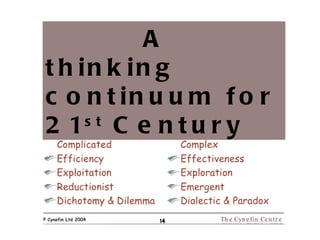
A thinking continuum for 21 st  Century
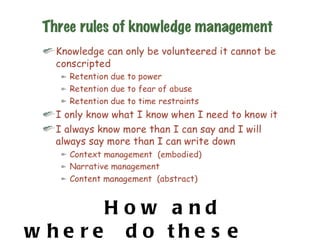
How and where  do these occur in interactive learning?
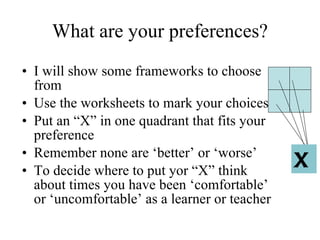
What are your preferences? I will show some frameworks to choose from Use the worksheets to mark your choices  Put an  “X” in one quadrant that fits your preference Remember none are  ‘better’ or ‘worse’ To decide where to put yor  “X” think about times you have been ‘comfortable’ or ‘uncomfortable’ as a learner or teacher X
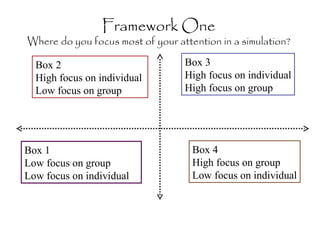
Framework One Where do you focus most of your attention in a simulation? Box 2 High focus on individual  Low focus on group Box 1 Low focus on group  Low focus on individual Box 3 High focus on individual High focus on group Box 4 High focus on group Low focus on individual
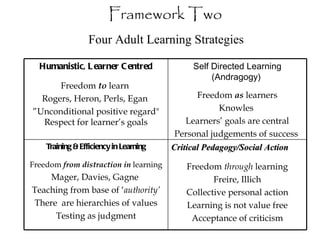
Framework Two Four Adult Learning Strategies  Humanistic, Learner Centred Freedom  to  learn  Rogers, Heron, Perls, Egan  ” Unconditional positive regard" Respect for learner’s goals Self Directed Learning (Andragogy)   Freedom  as  learners Knowles  Learners’ goals are central Personal judgements of success  Training & Efficiency in Learning Freedom  from distraction in  learning Mager, Davies, Gagne  Teaching from base of ‘ authority ’ There  are hierarchies of values Testing as judgment Critical Pedagogy/Social Action   Freedom  through  learning Freire, Illich Collective personal action Learning is not value free Acceptance of criticism
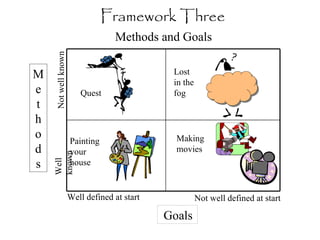
Quest  Painting your house Lost  in the fog Making movies Goals Well defined at start M e t h o d s Not well defined at start Well known Not well known Framework Three Methods and Goals
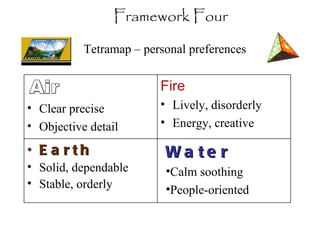
Tetramap – personal preferences  Clear precise Objective detail Fire  Lively, disorderly Energy, creative  Air  Framework Four Water Calm soothing People-oriented Earth  Solid, dependable Stable, orderly
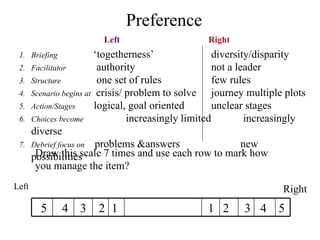
Draw this scale 7 times and use each row to mark how you manage the item? Left  Right  Preference Briefing   ‘togetherness’ diversity/disparity Facilitator   authority   not a leader Structure   one set of rules   few rules  Scenario begins at   crisis/ problem to solve  journey multiple plots Action/Stages     logical, goal oriented unclear stages Choices become   increasingly limited   increasingly diverse Debrief focus on  problems &answers   new possibilities Left Right 5 4 3 2 1 1 2 3 4 5
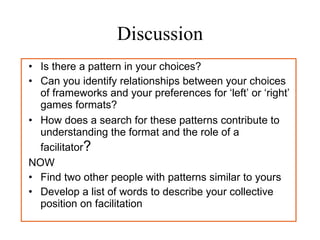
Discussion Is there a pattern in your choices? Can you identify relationships between your choices of frameworks and your preferences for ‘left’ or ‘right’ games formats? How does a search for these patterns contribute to understanding the format and the role of a facilitator ? NOW Find two other people with patterns similar to yours  Develop a list of words to describe your collective position on facilitation
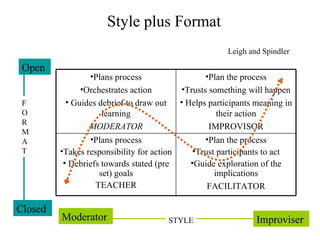
Style plus Format Leigh and Spindler F O  R M A T Closed  Open  Moderator  Improviser  STYLE Plans process Orchestrates action Guides debrief to draw out learning MODERATOR Plan the process Trusts something will happen Helps participants meaning in their action IMPROVISOR Plans process Takes responsibility for action Debriefs towards stated (pre set) goals TEACHER Plan the process Trust participants to act Guide exploration of the implications FACILITATOR
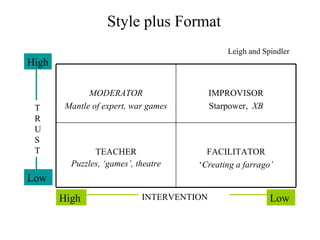
Style plus Format Leigh and Spindler MODERATOR Mantle of expert, war games IMPROVISOR Starpower,  XB TEACHER Puzzles,  ‘games’, theatre FACILITATOR ‘ Creating a farrago’ Low  High T R U S T Low  High  INTERVENTION
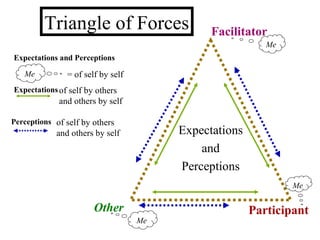
Expectations and Perceptions Facilitator Participant Other Expectations of self by others and others by self of self by others and others by self Perceptions Me Me Expectations and Perceptions Me Me = of self by self Triangle of Forces
Purposes of Facilitation Experiential learning Self-directed learning Engaging with complexity ‘ Out of the ordinary’ learning Shifting the power focus Leading/emerging not imposing
Let ’s Play
Dr Elyssebeth Leigh Gaming Simulation Facilitation  and Team Work
Conceptual Frameworks Group Emotionality Wilfred Bion Life Cycle of Groups Tuckman Team Role preferences  Meredith Belbin Parataxic distortion Harry Stack Sullivan Impostor syndrome Stephen Brookfield Espoused/enacted beliefs Chris Argyris
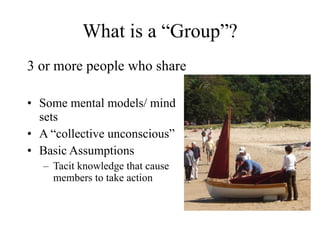
What is a  “Group”? 3 or more people who share Some mental models/ mind sets A  “collective unconscious” Basic Assumptions Tacit knowledge that cause members to take action
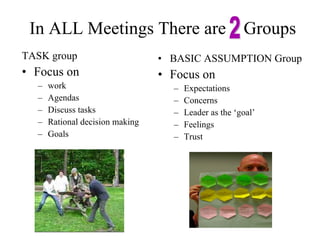
In ALL Meetings There are  Groups TASK group Focus on work Agendas Discuss tasks Rational decision making Goals BASIC ASSUMPTION Group Focus on Expectations Concerns Leader as the  ‘goal’ Feelings Trust 2
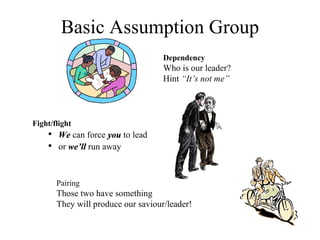
Basic Assumption Group Fight/flight We  can force  you  to lead  or  we ’ll  run away Dependency Who is our leader?  Hint  “It’s not me” Pairing Those two have something They will produce our saviour/leader!
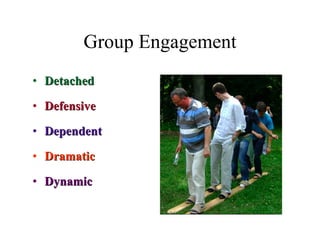
Group Engagement Detached Defensive Dependent Dramatic Dynamic
Detachment  Group Culture The  “Flight” in the Fight/Flight response Emotions - anger / apathy Physical and psychological withdrawal Low ability/willingness to influence group dynamics  EXIT
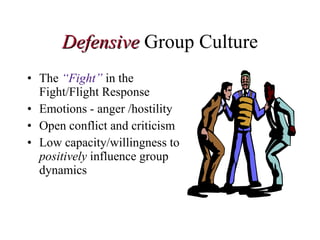
Defensive  Group Culture The  “Fight”  in the Fight/Flight Response Emotions - anger /hostility Open conflict and criticism Low capacity/willingness to  positively  influence group dynamics
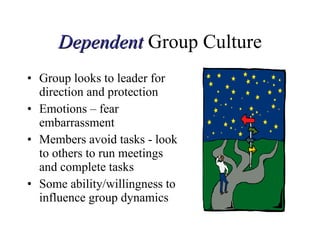
Group looks to leader for direction and protection Emotions – fear embarrassment Members avoid tasks - look to others to run meetings and complete tasks Some ability/willingness to influence group dynamics Dependent  Group Culture
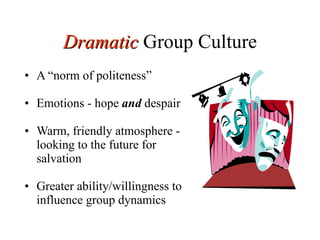
A  “norm of politeness” Emotions - hope  and  despair Warm, friendly atmosphere - looking to the future for salvation Greater ability/willingness to influence group dynamics Dramatic  Group Culture
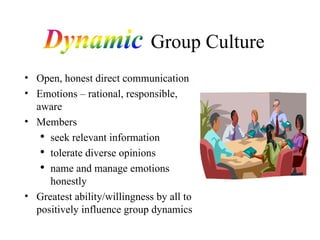
Dynamic   Group Culture Open, honest direct communication Emotions – rational, responsible, aware  Members  seek relevant information  tolerate diverse opinions name and manage emotions honestly Greatest ability/willingness by all to positively influence group dynamics
A Life Cycle of Group Development According to Tuckman ’s analysis of research – groups go through a number of phases Each group may spend more or less time in each phase – but the phases occur in a specific order Groups that manage their transitions from phase to phase in a positive and open manner are more likely to have a positive experience – and may do a  ‘better’ job However groups that do not do so, can  still achieve goals – with less likelihood of having a  ‘good’ experience
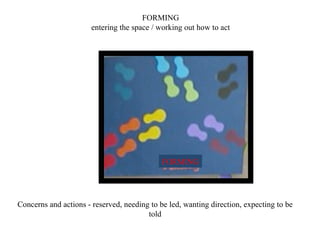
FORMING entering the space / working out how to act Concerns and actions - reserved, needing to be led, wanting direction, expecting to be told FORMING
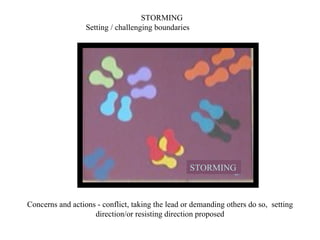
STORMING Setting / challenging boundaries STORMING Concerns and actions - conflict, taking the lead or demanding others do so,  setting direction/or resisting direction proposed
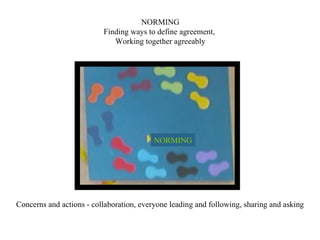
NORMING NORMING Finding ways to define agreement,  Working together agreeably Concerns and actions - collaboration, everyone leading and following, sharing and asking
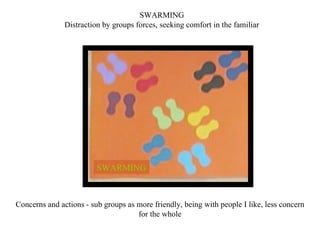
Concerns and actions - sub groups as more friendly, being with people I like, less concern for the whole SWARMING SWARMING Distraction by groups forces, seeking comfort in the familiar
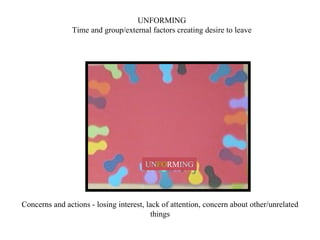
UN FO RM ING UNFORMING Time and group/external factors creating desire to leave Concerns and actions - losing interest, lack of attention, concern about other/unrelated things
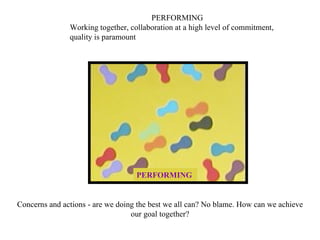
PERFORMING PERFORMING Working together, collaboration at a high level of commitment, quality is paramount Concerns and actions - are we doing the best we all can? No blame. How can we achieve our goal together?
MOURNING Time to end this group, leaving friends/enemies. What did we gain/learn? Concerns and actions - It’s time to part. What happens next? How did we do? I am leaving friends. I am sad MOURNING
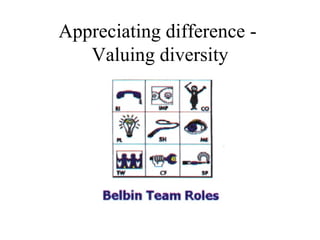
Appreciating difference -  Valuing diversity
What is a team role? A team role as defined by Dr Meredith Belbin is: "A tendency to behave, contribute and interrelate with others in a particular way." Belbin team roles describe a pattern of behaviour that characterises a person ’s behaviour in relationship to another in helping the team make progress. The value of Belbin team-role theory lies in helping an individual or team to benefit from self-knowledge and adjust according to the demands being made by the external situation.
The Resource Investigator Develops contacts with the outside world.  A source of outside information and ideas.  Explores and reports on ideas, developments and other resources from outside the group.  Creates and maintains external contacts which may be useful to the team.  Negotiates with outside contacts.
The Plant The "ideas person" of the team, the prime source of ideas and innovation.  Can play a strategic role such as forward planning.  Advances new ideas and strategies, with special attention to major issues.  Looks for ways around problems confronting the team.
The Shaper Provides leadership (in the conventional sense of the term) by directing and controlling the team's members.  Exerts a strong influence on the way in which the team operates and the objectives it pursues.  Directs attention to such matters as setting goals and priorities.  Imposes a predetermined shape on the team's operating style..
The Implementer The backbone of the team in accomplishing detailed and practical outcomes. Is best allowed a considerable amount of direct responsibility, and a principal action role in implementing group decisions.  Turns concepts and plans into practical working procedures.  Carries out agreed plans systematically and efficiently.
The Monitor Evaluator The "devils advocate", critiquing the ideas and suggestions offered by team members.  Evaluates new plans (which should seldom be implemented against the ME's advice).  Analyses problems.  Evaluates ideas and suggestions so that the team is better placed to take balanced decisions.
The Team worker Maintains group harmony, member satisfaction, and team spirit to maintain team effectiveness.  Usefully fills support positions within a team.  There are often several in a team.  Supports members in their strengths, for example by building on their suggestions.  Underpins members in their shortcomings.  Improves communication and fosters team spirit.
The Completer Finisher Attends to detail and follow-up, Maintains a sense of urgency. Most usefully given the role of checking completion of team tasks.  Valuable in an emergency.  Protects the team from mistakes and omissions.  Searches for aspects which require special attention.
The Co-ordinator Provides leadership by co-ordinating the efforts and contributions of team members. Encourages contributions from others, and sums up the team verdict.  Often uses a subtle form of leadership.  Controls the way in which the team moves towards group objectives.  Helps to make best use of the team's resources by recognising the team's strengths and weaknesses.
The Specialist Single-minded, self-starting, dedicated. Provides knowledge and skills in rare supply. Contributes only on a narrow front. Dwells on technicalities.
Parataxic Distortion We tend to distort perceptions we have of others.  These distortions amount to cognitive errors which occur when we relate to others not on the basis of their real attributes, but chiefly on the basis of the person we see in our fantasy This  ‘personification’ is partly transferred from the past and partly unconsciously manufactured by us under the pressure of our needs Put simply – we tend to move towards people who appear to be like people whom we know and like This eases discomfort and allows us to manage the fear of new contexts
“ Impostor” Syndrome Feelings of inadequacy that persist when information  indicates the opposite is true It is experienced internally as chronic self-doubt, and feelings of intellectual fraudulence A feeling you are not really a successful, competent, and smart student, you are only posing as one Common feelings and thoughts characterizing the imposter syndrome “ I feel like a fake”  “ My classmates/professors etc. are going to find out I don’t really belong here” “ Admissions made a mistake”
Categories of  “Impostor” Feeling like a fake Believing success is not deserved, somehow others are deceived into thinking it is People who feel this way identify with statements such as “ I can give the impression I am more competent than I really am.”  “ I am often afraid others will discover how much I don’t know ” Attributing success to luck / external factors People who feel this  way refer to their achievements by saying “ I just got lucky this time”  “ it was a fluke” Discounting Success  People who feel this way say “ it is not a big deal” “ it was not important”  “ I did well because it is an easy class etc.”  Have a hard time accepting compliments
Espoused and Enacted theories of behaviours What we believe and what we do – do not match Facilitators may want to  ‘ rescue ’  participants from  ‘ pain ’ ‘ save ’  learners struggling with difficult team interactions  Facilitators can avoid the paradox of knowing this is real learning yet causing it to cease – BY modulating frustration, so that people do not “give up” but work at the edges of their competence not intervening to save students but working to help them become independent learners

LMSU Interactive education - Elyssebeth Leigh

  • 1.
    Effective Leadership ofInteractive Education Dr Elyssebeth Leigh Sydney, Australia [email_address]
  • 2.
    The Proposal Forms and styles for facilitating learning vary None are ‘better’ or ‘worse’ (when done well) We each prefer some - avoid others Our actions are influenced by what we prefer How we teach for /facilitate learning The tools we choose and use Some tools work better than others Depending on contexts and goals We work best when we know our preferences and choose tools consciously
  • 3.
    A Goal forFacilitating Interactive Education This happens when there is lack of accord between the external world experienced by humans and their internal biographical interests and knowledge Disjuncture makes learning possible The paradox is that if “ harmony ” is fully established, there can be no learning situation (Jarvis,1992, p 83) To create “ disjuncture ” - ambiguity, uncertainty, discomfort SO – how to create [just] enough disjuncture?
  • 4.
    Two Guiding QuestionsHow can we identify our preferences – without judging their comparative ‘value’? How can we think about interactive learning in regard to those tools?
  • 5.
    Cynefin Domains Amodel for thinking about different ways to manage knowledge
  • 6.
    Decision rules for using interactive learning in each domain
  • 7.
    A thinking continuumfor 21 st Century
  • 8.
    How and where do these occur in interactive learning?
  • 9.
    What are yourpreferences? I will show some frameworks to choose from Use the worksheets to mark your choices Put an “X” in one quadrant that fits your preference Remember none are ‘better’ or ‘worse’ To decide where to put yor “X” think about times you have been ‘comfortable’ or ‘uncomfortable’ as a learner or teacher X
  • 10.
    Framework One Wheredo you focus most of your attention in a simulation? Box 2 High focus on individual Low focus on group Box 1 Low focus on group Low focus on individual Box 3 High focus on individual High focus on group Box 4 High focus on group Low focus on individual
  • 11.
    Framework Two FourAdult Learning Strategies Humanistic, Learner Centred Freedom to learn Rogers, Heron, Perls, Egan ” Unconditional positive regard" Respect for learner’s goals Self Directed Learning (Andragogy) Freedom as learners Knowles Learners’ goals are central Personal judgements of success Training & Efficiency in Learning Freedom from distraction in learning Mager, Davies, Gagne Teaching from base of ‘ authority ’ There are hierarchies of values Testing as judgment Critical Pedagogy/Social Action Freedom through learning Freire, Illich Collective personal action Learning is not value free Acceptance of criticism
  • 12.
    Quest Paintingyour house Lost in the fog Making movies Goals Well defined at start M e t h o d s Not well defined at start Well known Not well known Framework Three Methods and Goals
  • 13.
    Tetramap – personalpreferences Clear precise Objective detail Fire Lively, disorderly Energy, creative Air Framework Four Water Calm soothing People-oriented Earth Solid, dependable Stable, orderly
  • 14.
    Draw this scale7 times and use each row to mark how you manage the item? Left Right Preference Briefing ‘togetherness’ diversity/disparity Facilitator authority not a leader Structure one set of rules few rules Scenario begins at crisis/ problem to solve journey multiple plots Action/Stages logical, goal oriented unclear stages Choices become increasingly limited increasingly diverse Debrief focus on problems &answers new possibilities Left Right 5 4 3 2 1 1 2 3 4 5
  • 15.
    Discussion Is therea pattern in your choices? Can you identify relationships between your choices of frameworks and your preferences for ‘left’ or ‘right’ games formats? How does a search for these patterns contribute to understanding the format and the role of a facilitator ? NOW Find two other people with patterns similar to yours Develop a list of words to describe your collective position on facilitation
  • 16.
    Style plus FormatLeigh and Spindler F O R M A T Closed Open Moderator Improviser STYLE Plans process Orchestrates action Guides debrief to draw out learning MODERATOR Plan the process Trusts something will happen Helps participants meaning in their action IMPROVISOR Plans process Takes responsibility for action Debriefs towards stated (pre set) goals TEACHER Plan the process Trust participants to act Guide exploration of the implications FACILITATOR
  • 17.
    Style plus FormatLeigh and Spindler MODERATOR Mantle of expert, war games IMPROVISOR Starpower, XB TEACHER Puzzles, ‘games’, theatre FACILITATOR ‘ Creating a farrago’ Low High T R U S T Low High INTERVENTION
  • 18.
    Expectations and PerceptionsFacilitator Participant Other Expectations of self by others and others by self of self by others and others by self Perceptions Me Me Expectations and Perceptions Me Me = of self by self Triangle of Forces
  • 19.
    Purposes of FacilitationExperiential learning Self-directed learning Engaging with complexity ‘ Out of the ordinary’ learning Shifting the power focus Leading/emerging not imposing
  • 20.
  • 21.
    Dr Elyssebeth LeighGaming Simulation Facilitation and Team Work
  • 22.
    Conceptual Frameworks GroupEmotionality Wilfred Bion Life Cycle of Groups Tuckman Team Role preferences Meredith Belbin Parataxic distortion Harry Stack Sullivan Impostor syndrome Stephen Brookfield Espoused/enacted beliefs Chris Argyris
  • 23.
    What is a “Group”? 3 or more people who share Some mental models/ mind sets A “collective unconscious” Basic Assumptions Tacit knowledge that cause members to take action
  • 24.
    In ALL MeetingsThere are Groups TASK group Focus on work Agendas Discuss tasks Rational decision making Goals BASIC ASSUMPTION Group Focus on Expectations Concerns Leader as the ‘goal’ Feelings Trust 2
  • 25.
    Basic Assumption GroupFight/flight We can force you to lead or we ’ll run away Dependency Who is our leader? Hint “It’s not me” Pairing Those two have something They will produce our saviour/leader!
  • 26.
    Group Engagement DetachedDefensive Dependent Dramatic Dynamic
  • 27.
    Detachment GroupCulture The “Flight” in the Fight/Flight response Emotions - anger / apathy Physical and psychological withdrawal Low ability/willingness to influence group dynamics EXIT
  • 28.
    Defensive GroupCulture The “Fight” in the Fight/Flight Response Emotions - anger /hostility Open conflict and criticism Low capacity/willingness to positively influence group dynamics
  • 29.
    Group looks toleader for direction and protection Emotions – fear embarrassment Members avoid tasks - look to others to run meetings and complete tasks Some ability/willingness to influence group dynamics Dependent Group Culture
  • 30.
    A “normof politeness” Emotions - hope and despair Warm, friendly atmosphere - looking to the future for salvation Greater ability/willingness to influence group dynamics Dramatic Group Culture
  • 31.
    Dynamic Group Culture Open, honest direct communication Emotions – rational, responsible, aware Members seek relevant information tolerate diverse opinions name and manage emotions honestly Greatest ability/willingness by all to positively influence group dynamics
  • 32.
    A Life Cycleof Group Development According to Tuckman ’s analysis of research – groups go through a number of phases Each group may spend more or less time in each phase – but the phases occur in a specific order Groups that manage their transitions from phase to phase in a positive and open manner are more likely to have a positive experience – and may do a ‘better’ job However groups that do not do so, can still achieve goals – with less likelihood of having a ‘good’ experience
  • 33.
    FORMING entering thespace / working out how to act Concerns and actions - reserved, needing to be led, wanting direction, expecting to be told FORMING
  • 34.
    STORMING Setting /challenging boundaries STORMING Concerns and actions - conflict, taking the lead or demanding others do so, setting direction/or resisting direction proposed
  • 35.
    NORMING NORMING Findingways to define agreement, Working together agreeably Concerns and actions - collaboration, everyone leading and following, sharing and asking
  • 36.
    Concerns and actions- sub groups as more friendly, being with people I like, less concern for the whole SWARMING SWARMING Distraction by groups forces, seeking comfort in the familiar
  • 37.
    UN FO RMING UNFORMING Time and group/external factors creating desire to leave Concerns and actions - losing interest, lack of attention, concern about other/unrelated things
  • 38.
    PERFORMING PERFORMING Workingtogether, collaboration at a high level of commitment, quality is paramount Concerns and actions - are we doing the best we all can? No blame. How can we achieve our goal together?
  • 39.
    MOURNING Time toend this group, leaving friends/enemies. What did we gain/learn? Concerns and actions - It’s time to part. What happens next? How did we do? I am leaving friends. I am sad MOURNING
  • 40.
    Appreciating difference - Valuing diversity
  • 41.
    What is ateam role? A team role as defined by Dr Meredith Belbin is: "A tendency to behave, contribute and interrelate with others in a particular way." Belbin team roles describe a pattern of behaviour that characterises a person ’s behaviour in relationship to another in helping the team make progress. The value of Belbin team-role theory lies in helping an individual or team to benefit from self-knowledge and adjust according to the demands being made by the external situation.
  • 42.
    The Resource InvestigatorDevelops contacts with the outside world. A source of outside information and ideas. Explores and reports on ideas, developments and other resources from outside the group. Creates and maintains external contacts which may be useful to the team. Negotiates with outside contacts.
  • 43.
    The Plant The"ideas person" of the team, the prime source of ideas and innovation. Can play a strategic role such as forward planning. Advances new ideas and strategies, with special attention to major issues. Looks for ways around problems confronting the team.
  • 44.
    The Shaper Providesleadership (in the conventional sense of the term) by directing and controlling the team's members. Exerts a strong influence on the way in which the team operates and the objectives it pursues. Directs attention to such matters as setting goals and priorities. Imposes a predetermined shape on the team's operating style..
  • 45.
    The Implementer Thebackbone of the team in accomplishing detailed and practical outcomes. Is best allowed a considerable amount of direct responsibility, and a principal action role in implementing group decisions. Turns concepts and plans into practical working procedures. Carries out agreed plans systematically and efficiently.
  • 46.
    The Monitor EvaluatorThe "devils advocate", critiquing the ideas and suggestions offered by team members. Evaluates new plans (which should seldom be implemented against the ME's advice). Analyses problems. Evaluates ideas and suggestions so that the team is better placed to take balanced decisions.
  • 47.
    The Team workerMaintains group harmony, member satisfaction, and team spirit to maintain team effectiveness. Usefully fills support positions within a team. There are often several in a team. Supports members in their strengths, for example by building on their suggestions. Underpins members in their shortcomings. Improves communication and fosters team spirit.
  • 48.
    The Completer FinisherAttends to detail and follow-up, Maintains a sense of urgency. Most usefully given the role of checking completion of team tasks. Valuable in an emergency. Protects the team from mistakes and omissions. Searches for aspects which require special attention.
  • 49.
    The Co-ordinator Providesleadership by co-ordinating the efforts and contributions of team members. Encourages contributions from others, and sums up the team verdict. Often uses a subtle form of leadership. Controls the way in which the team moves towards group objectives. Helps to make best use of the team's resources by recognising the team's strengths and weaknesses.
  • 50.
    The Specialist Single-minded,self-starting, dedicated. Provides knowledge and skills in rare supply. Contributes only on a narrow front. Dwells on technicalities.
  • 51.
    Parataxic Distortion Wetend to distort perceptions we have of others. These distortions amount to cognitive errors which occur when we relate to others not on the basis of their real attributes, but chiefly on the basis of the person we see in our fantasy This ‘personification’ is partly transferred from the past and partly unconsciously manufactured by us under the pressure of our needs Put simply – we tend to move towards people who appear to be like people whom we know and like This eases discomfort and allows us to manage the fear of new contexts
  • 52.
    “ Impostor” SyndromeFeelings of inadequacy that persist when information indicates the opposite is true It is experienced internally as chronic self-doubt, and feelings of intellectual fraudulence A feeling you are not really a successful, competent, and smart student, you are only posing as one Common feelings and thoughts characterizing the imposter syndrome “ I feel like a fake” “ My classmates/professors etc. are going to find out I don’t really belong here” “ Admissions made a mistake”
  • 53.
    Categories of “Impostor” Feeling like a fake Believing success is not deserved, somehow others are deceived into thinking it is People who feel this way identify with statements such as “ I can give the impression I am more competent than I really am.” “ I am often afraid others will discover how much I don’t know ” Attributing success to luck / external factors People who feel this way refer to their achievements by saying “ I just got lucky this time” “ it was a fluke” Discounting Success People who feel this way say “ it is not a big deal” “ it was not important” “ I did well because it is an easy class etc.” Have a hard time accepting compliments
  • 54.
    Espoused and Enactedtheories of behaviours What we believe and what we do – do not match Facilitators may want to ‘ rescue ’ participants from ‘ pain ’ ‘ save ’ learners struggling with difficult team interactions Facilitators can avoid the paradox of knowing this is real learning yet causing it to cease – BY modulating frustration, so that people do not “give up” but work at the edges of their competence not intervening to save students but working to help them become independent learners