
STAMFORD COLLEGE

DIPLOMA IN MEDIA AND
COMMUNICATION

PREPARED BY : MS GOMALA SUKUMARAN
LEARNING OBJECTIVES
At the end of the lesson students will be able to :
 define and describe the meaning of public
relations
 familiarize with PR fields
 define and describe Marston’s R-A-C-E
 understand the functions of PR
Distinguish the differences between PR and
marketing
 know PR skills
INTRODUCTION
• Public relations is practiced in
organizations that range from giant,
multinational telecommunications
companies to small human service
agencies.
WHAT IS PUBLIC RELATIONS
• Public relations is a leadership and management function that helps
achieve organizational objectives, define philosophy and facilitate
organizational change.
• Public relations practitioners communicate with all relevant internal
and external publics to develop positive relationship and create
consistency between organizational goals and societal expectations.
• Public relations practitioners develop, execute and evaluate
organizational programs to promote the exchange of influence and
understanding among a organizations constituent and publics
(Lattimore et al ., 2012)
WHAT IS PUBLIC RELATIONS
„the management of communication between
an organization and its publics‟
(Grunig & Hunt, Managing public relations,1984)

„using communication to adapt relationships
between organizations and their publics‟
(Carl H. Botan “International public relations: Critique and
reformulation” in Public Relations Review, Vol. 18, No. 2, 1992:
149-152)
WHAT IS PUBLIC RELATIONS
Public relations is a distinctive
management function which helps
establish and maintain mutual lines
of
▫ Understanding
▫ Communications
▫ Acceptance
WHAT IS PUBLIC RELATIONS
• Co-operation between an organization and its
publics. Whereby it involves
▫ The management of problems or issues
▫ Helps management to keep informed on and
responsive to public opinion.
▫ Defines and emphasizes the responsibility of
management to serve the public interest.
▫ Helps management keep abreast of and effectively
utilize change.
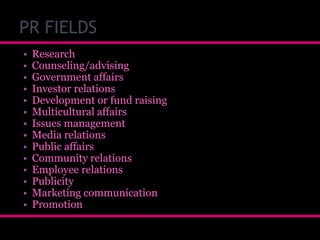
PR FIELDS
•
•
•
•
•
•
•
•
•
•
•
•
•
•

Research
Counseling/advising
Government affairs
Investor relations
Development or fund raising
Multicultural affairs
Issues management
Media relations
Public affairs
Community relations
Employee relations
Publicity
Marketing communication
Promotion
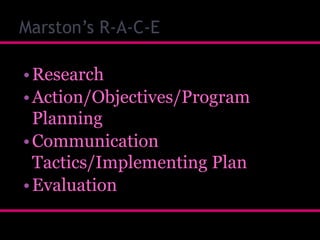
Marston’s R-A-C-E
• Research
• Action/Objectives/Program
Planning
• Communication
Tactics/Implementing Plan
• Evaluation
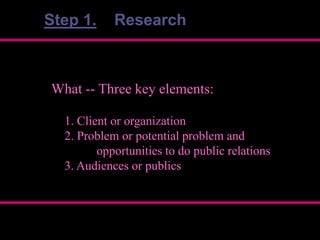
Step 1. Research
4-Step Process of Public Relations

What -- Three key elements:
1. Client or organization
2. Problem or potential problem and
opportunities to do public relations
3. Audiences or publics

How –

Informal and Formal
Research Methods
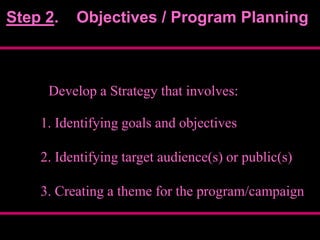
Step 2.

Objectives / Program Planning

Develop a Strategy that involves:
1. Identifying goals and objectives
2. Identifying target audience(s) or public(s)

3. Creating a theme for the program/campaign
Step 3. Develop & Implement
Communication Tactics
Develop and Implement
1. Tactics for communicating

2. Time line for the program/campaign
3. Budget
Step 4.

Evaluation During & After Campaign / Program

Identify research methods to be used to
evaluate the success of the
program/campaign during & after.

Determine a way to measure whether the
campaign achieved its objectives.
The Functions of Public Relations
• Writing
▫ The fundamental public relations skill, with
written vehicles from news releases to speeches
and from brochures to advertisements.

• Media relations
▫ Dealing with the press.

• Planning
▫ Special events, media events, management
functions.
The Functions of Public Relations
• Counseling
▫ In dealing with management and its interactions
with key publics.

• Researching
▫ Of attitudes and opinions that influence behavior
and beliefs.

• Publicity
▫ The marketing related functions
The Functions of Public Relations
• Marketing communications
▫ Other marketing related functions such as
creating brochures, sales literature, meeting
displays and promotions.

• Community relations
▫ Putting forth the organization’s messages and
image within the community.

• Consumer relations
▫ Interfacing with consumers through written and
verbal communications
The Functions of Public Relations
• Employee relations
▫ Communicating with all the all-important internal
publics of the organization, those managers and
employees who work for the firm.

• Government affairs
▫ Dealing with legislators, regulators and local, state
and federal officials – all of those who have
governmental interface with the organization

• Investor relations
▫ For public companies, communicating with
stockholders and those who advise them.
The Functions of Public Relations
• Special public relations
▫ Dealing with those publics uniquely critical to
particular organizations.

• Public affairs and issues
▫ Dealing with public policy and its impact on the
organization and identifying and addressing issues
of consequences that affect the firm

• Social media interface
▫ Creating what often is the organization’s principle
interface with the public: its Website, as well as
creating links with social media options.
DIFFERENCES BETWEEN PUBLIC
RELATIONS AND MARKETING
• Marketing focuses primarily on only one
public consumers
• PR focused on relationships with all
publics essential to an organization's
success
• PR and Marketing are “separate and
equal, but related functions”, and must
work together toward organizational goals.
PR SKILLS
• Good people skills
▫ A pleasing and amiable personality and the ability
to get along with people and network effectively
are vital to making it in this field.
▫ Clients can be difficult and demanding.
▫ Learning how to win friends and influence people
is what a large part of the job is about.
▫ People who choose public relations as a career
should have an outgoing personality, selfconfidence and be team players.
PR SKILLS
• Strong communication abilities
▫ A lot of public relations is centered on
what you say and how well you say it.
Being able to communicate effectively
verbally and a flair for writing are
essential.
PR SKILLS
• ORGANIZATIONAL SKILLS
▫ You have to be good at organizing meetings,
presentations, press conferences and events like
openings and product launches.
▫ Time management and multitasking are skills you
need as you will be faced with multiple pressures
and tight deadlines.
▫ Overtime is common and work schedules are
irregular. You cannot be a clock watcher and may
have to work late into the night or on weekends.
PR SKILLS
• Relevant formal education
▫ A degree or diploma in public relations,
journalism, mass media, communications,
corporate communications or even advertising
or marketing are useful.
▫ An internship with a firm will also prepare you
for what to expect and also help you find out
whether you are cut out for this job.
PR SKILLS
• Versatility
▫ A PR job involves many things – interacting
with clients, organizing events, dealing with
the media, writing and editing press releases
and managing a website.
▫ You should have the versatility to tackle these
varied roles.
PR SKILLS
• Creativity and sales skills
▫ You may be required to visualize an
effective campaign.
▫ This needs creativity and imagination.
▫ You also need to have the knack of how
to sell your idea.
PR SKILLS
• Resilience
▫ Last but not the least you will have to have the
ability to bounce back from failure.
▫ ''You have to be confident and thick-skinned
working in PR. You're responsible for a client's
reputation and if a campaign goes wrong,
sometimes for reasons out of your control, you
have to be able to speak to the client and take
criticism from the media.''
Week 1 principles pr

Week 1 principles pr

  • 1.
    STAMFORD COLLEGE DIPLOMA INMEDIA AND COMMUNICATION PREPARED BY : MS GOMALA SUKUMARAN
  • 2.
    LEARNING OBJECTIVES At theend of the lesson students will be able to :  define and describe the meaning of public relations  familiarize with PR fields  define and describe Marston’s R-A-C-E  understand the functions of PR Distinguish the differences between PR and marketing  know PR skills
  • 3.
    INTRODUCTION • Public relationsis practiced in organizations that range from giant, multinational telecommunications companies to small human service agencies.
  • 4.
    WHAT IS PUBLICRELATIONS • Public relations is a leadership and management function that helps achieve organizational objectives, define philosophy and facilitate organizational change. • Public relations practitioners communicate with all relevant internal and external publics to develop positive relationship and create consistency between organizational goals and societal expectations. • Public relations practitioners develop, execute and evaluate organizational programs to promote the exchange of influence and understanding among a organizations constituent and publics (Lattimore et al ., 2012)
  • 5.
    WHAT IS PUBLICRELATIONS „the management of communication between an organization and its publics‟ (Grunig & Hunt, Managing public relations,1984) „using communication to adapt relationships between organizations and their publics‟ (Carl H. Botan “International public relations: Critique and reformulation” in Public Relations Review, Vol. 18, No. 2, 1992: 149-152)
  • 6.
    WHAT IS PUBLICRELATIONS Public relations is a distinctive management function which helps establish and maintain mutual lines of ▫ Understanding ▫ Communications ▫ Acceptance
  • 7.
    WHAT IS PUBLICRELATIONS • Co-operation between an organization and its publics. Whereby it involves ▫ The management of problems or issues ▫ Helps management to keep informed on and responsive to public opinion. ▫ Defines and emphasizes the responsibility of management to serve the public interest. ▫ Helps management keep abreast of and effectively utilize change.
  • 8.
    PR FIELDS • • • • • • • • • • • • • • Research Counseling/advising Government affairs Investorrelations Development or fund raising Multicultural affairs Issues management Media relations Public affairs Community relations Employee relations Publicity Marketing communication Promotion
  • 9.
    Marston’s R-A-C-E • Research •Action/Objectives/Program Planning • Communication Tactics/Implementing Plan • Evaluation
  • 10.
    Step 1. Research 4-StepProcess of Public Relations What -- Three key elements: 1. Client or organization 2. Problem or potential problem and opportunities to do public relations 3. Audiences or publics How – Informal and Formal Research Methods
  • 11.
    Step 2. Objectives /Program Planning Develop a Strategy that involves: 1. Identifying goals and objectives 2. Identifying target audience(s) or public(s) 3. Creating a theme for the program/campaign
  • 12.
    Step 3. Develop& Implement Communication Tactics Develop and Implement 1. Tactics for communicating 2. Time line for the program/campaign 3. Budget
  • 13.
    Step 4. Evaluation During& After Campaign / Program Identify research methods to be used to evaluate the success of the program/campaign during & after. Determine a way to measure whether the campaign achieved its objectives.
  • 14.
    The Functions ofPublic Relations • Writing ▫ The fundamental public relations skill, with written vehicles from news releases to speeches and from brochures to advertisements. • Media relations ▫ Dealing with the press. • Planning ▫ Special events, media events, management functions.
  • 15.
    The Functions ofPublic Relations • Counseling ▫ In dealing with management and its interactions with key publics. • Researching ▫ Of attitudes and opinions that influence behavior and beliefs. • Publicity ▫ The marketing related functions
  • 16.
    The Functions ofPublic Relations • Marketing communications ▫ Other marketing related functions such as creating brochures, sales literature, meeting displays and promotions. • Community relations ▫ Putting forth the organization’s messages and image within the community. • Consumer relations ▫ Interfacing with consumers through written and verbal communications
  • 17.
    The Functions ofPublic Relations • Employee relations ▫ Communicating with all the all-important internal publics of the organization, those managers and employees who work for the firm. • Government affairs ▫ Dealing with legislators, regulators and local, state and federal officials – all of those who have governmental interface with the organization • Investor relations ▫ For public companies, communicating with stockholders and those who advise them.
  • 18.
    The Functions ofPublic Relations • Special public relations ▫ Dealing with those publics uniquely critical to particular organizations. • Public affairs and issues ▫ Dealing with public policy and its impact on the organization and identifying and addressing issues of consequences that affect the firm • Social media interface ▫ Creating what often is the organization’s principle interface with the public: its Website, as well as creating links with social media options.
  • 19.
    DIFFERENCES BETWEEN PUBLIC RELATIONSAND MARKETING • Marketing focuses primarily on only one public consumers • PR focused on relationships with all publics essential to an organization's success • PR and Marketing are “separate and equal, but related functions”, and must work together toward organizational goals.
  • 20.
    PR SKILLS • Goodpeople skills ▫ A pleasing and amiable personality and the ability to get along with people and network effectively are vital to making it in this field. ▫ Clients can be difficult and demanding. ▫ Learning how to win friends and influence people is what a large part of the job is about. ▫ People who choose public relations as a career should have an outgoing personality, selfconfidence and be team players.
  • 21.
    PR SKILLS • Strongcommunication abilities ▫ A lot of public relations is centered on what you say and how well you say it. Being able to communicate effectively verbally and a flair for writing are essential.
  • 22.
    PR SKILLS • ORGANIZATIONALSKILLS ▫ You have to be good at organizing meetings, presentations, press conferences and events like openings and product launches. ▫ Time management and multitasking are skills you need as you will be faced with multiple pressures and tight deadlines. ▫ Overtime is common and work schedules are irregular. You cannot be a clock watcher and may have to work late into the night or on weekends.
  • 23.
    PR SKILLS • Relevantformal education ▫ A degree or diploma in public relations, journalism, mass media, communications, corporate communications or even advertising or marketing are useful. ▫ An internship with a firm will also prepare you for what to expect and also help you find out whether you are cut out for this job.
  • 24.
    PR SKILLS • Versatility ▫A PR job involves many things – interacting with clients, organizing events, dealing with the media, writing and editing press releases and managing a website. ▫ You should have the versatility to tackle these varied roles.
  • 25.
    PR SKILLS • Creativityand sales skills ▫ You may be required to visualize an effective campaign. ▫ This needs creativity and imagination. ▫ You also need to have the knack of how to sell your idea.
  • 26.
    PR SKILLS • Resilience ▫Last but not the least you will have to have the ability to bounce back from failure. ▫ ''You have to be confident and thick-skinned working in PR. You're responsible for a client's reputation and if a campaign goes wrong, sometimes for reasons out of your control, you have to be able to speak to the client and take criticism from the media.''