CORPORATE COMMUNICATION
MANAGEMENT
What it is ?
Why it is?
Where it is?
Presented By:
aANJANEYA pANDEY
aanjaneyapandey@gmail.com
CORPORATE COMMUNICATION MANAGEMENT
 COMMUNICATION
 The greatest threat to many corporate is the
failure to communicate.
 MANAGEMENT
 Getting the right information to the right
people at the right time and in a useful format
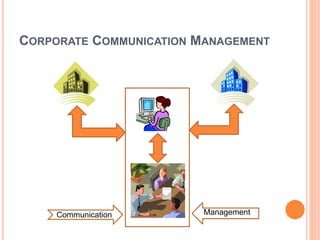
CORPORATE COMMUNICATION MANAGEMENT
ManagementCommunication
CORPORATE COMMUNICATION MANAGEMENT
HISTORY:
Fathers
Of Corporate
Communication:
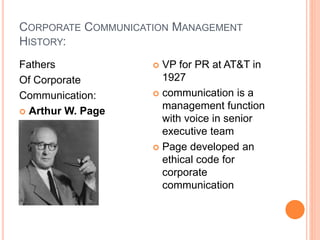
 Arthur W. Page
 VP for PR at AT&T in
1927
 communication is a
management function
with voice in senior
executive team
 Page developed an
ethical code for
corporate
communication
CORPORATE COMMUNICATION MANAGEMENT
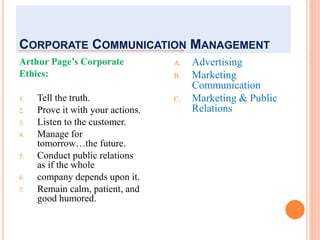
Arthur Page’s Corporate
Ethics:
1. Tell the truth.
2. Prove it with your actions.
3. Listen to the customer.
4. Manage for
tomorrow…the future.
5. Conduct public relations
as if the whole
6. company depends upon it.
7. Remain calm, patient, and
good humored.
A. Advertising
B. Marketing
Communication
C. Marketing & Public
Relations
CORPORATE COMMUNICATION MANAGEMENT
HISTORY:
Fathers
Of Corporate
Communication:
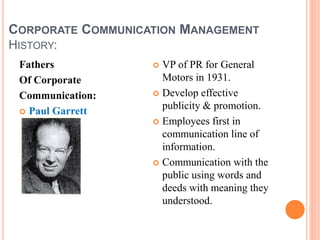
 Paul Garrett
 VP of PR for General
Motors in 1931.
 Develop effective
publicity & promotion.
 Employees first in
communication line of
information.
 Communication with the
public using words and
deeds with meaning they
understood.
CORPORATE COMMUNICATION MANAGEMENT
HISTORICAL ROOTS & RELATION
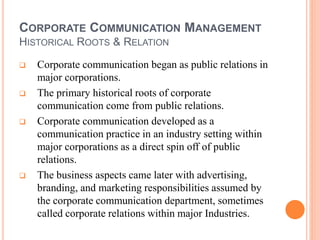
 Corporate communication began as public relations in
major corporations.
 The primary historical roots of corporate
communication come from public relations.
 Corporate communication developed as a
communication practice in an industry setting within
major corporations as a direct spin off of public
relations.
 The business aspects came later with advertising,
branding, and marketing responsibilities assumed by
the corporate communication department, sometimes
called corporate relations within major Industries.
CORPORATE COMMUNICATION MANAGEMENT
DEFINITION:
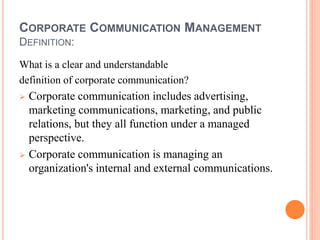
What is a clear and understandable
definition of corporate communication?
 Corporate communication includes advertising,
marketing communications, marketing, and public
relations, but they all function under a managed
perspective.
 Corporate communication is managing an
organization's internal and external communications.
CORPORATE COMMUNICATION MANAGEMENT
ASPECTS & NEED:
Why is there need of corporate communication?
 managing communication or fulfilling the
communication management function.
 advocating communication strategies and tactics.
 dealing with controlled and uncontrolled media
 branding products and services
 monitoring the responses from audiences and markets
 serving both internal and external audiences
 organizational presence building and monitoring
 counseling and advising senior executives
 managing issues and responding to crisis situations.
CORPORATE COMMUNICATION MANAGEMENT
INTEGRATION & USES:
Today the keys to success in corporate communication are multitasking,
management, and integration. Here are the fields of corporate
communication Management.
Media Relations:
 The always increasing role of the electronic media (Internet, newspapers,
magazines, radio, and television) has created a special importance for media
relations.
Employee Relations:
 Internal communication is the key: informed employees are happy and they spread
the good news through their families and friends.
 Never surprise employees; make them a part of the planning process and keep them
informed.
Government Relations:
 Building meaningful relationships with government officials is essential to industry
success in today’s political world.
 Lobbying- the legal influencing of public officials on stands appropriate for industry.
 Public Affairs- stances on controversial issues of public concern is imperative for
business success today.
CORPORATE COMMUNICATION MANAGEMENT
SCOPE :
 Corporations - Departments with the tasks such as
community relations and marketing communications
dealing with an organization's reputation and service to
clients.
 Nonprofit Agencies - Options ranging from membership
organizations to social and cultural groups, hospitals, and
health care agencies offer public relations opportunities
where fund raising is always involved.
 Entertainment, Sports and Travel - Communicators in
these areas are usually concerned with press agency and
promotion of events. Publicity is an important part of
practitioner duties here.
CORPORATE COMMUNICATION MANAGEMENT
SCOPE :
 Education - Higher education opportunities cover
relationships with alumni, faculty and administration,
students, and the general public promoting the college
image, recruiting students, and raising funds.
 International - With today's almost instantaneous global
communication, intriguing new areas have opened.
These areas are particularly desirable for bilingual or
multilingual practitioners who are familiar with many
cultures.
 *Government and Military - Here communicators
focus on promotion of political issues(often including
lobbying), information dissemination about government
activities to citizens, and information distribution to and
about the military.
CORPORATE COMMUNICATION MANAGEMENT
MANAGEMENT PERSPECTIVE:
Strategic and Operational Management
Knowledge
 Develop strategies for solving public relations and communication
problems.
 Manage the organization's response to issues.
 Develop goals and objectives for the communication department.
 Prepare a departmental budget.
 Manage people.
Research Knowledge
 Perform environmental scanning.
 Determine public relations to your organization.
 use research to segment publics.
 Conduct evaluative research.
CORPORATE COMMUNICATION MANAGEMENT
MANAGEMENT PERSPECTIVE:
Negotiation Knowledge
 Negotiate with an activist public.
 Help management to understand the opinions of
particular publics.
 Use theories of conflict resolution in dealing with
publics.
Persuasion Knowledge
 Persuade a public that you organization is right on an
issue.
 Use attitude theory in a campaign.
 Get publics to behave as your organization wants.
CORPORATE COMMUNICATION MANAGEMENT
REFERENCES OF BOOKS
 “CORPRATE COMMINICATION” BY PAUL ARGENTI
 “CORPORATE COMMINICATION- THEORY AND PRACTICE” BY
JOEP P CORNELISSEN
CORPORATE COMMUNICATION MANAGEMENT

Corporate communication management

  • 1.
    CORPORATE COMMUNICATION MANAGEMENT What itis ? Why it is? Where it is? Presented By: aANJANEYA pANDEY aanjaneyapandey@gmail.com
  • 2.
    CORPORATE COMMUNICATION MANAGEMENT COMMUNICATION  The greatest threat to many corporate is the failure to communicate.  MANAGEMENT  Getting the right information to the right people at the right time and in a useful format
  • 3.
  • 4.
    CORPORATE COMMUNICATION MANAGEMENT HISTORY: Fathers OfCorporate Communication:  Arthur W. Page  VP for PR at AT&T in 1927  communication is a management function with voice in senior executive team  Page developed an ethical code for corporate communication
  • 5.
    CORPORATE COMMUNICATION MANAGEMENT ArthurPage’s Corporate Ethics: 1. Tell the truth. 2. Prove it with your actions. 3. Listen to the customer. 4. Manage for tomorrow…the future. 5. Conduct public relations as if the whole 6. company depends upon it. 7. Remain calm, patient, and good humored. A. Advertising B. Marketing Communication C. Marketing & Public Relations
  • 6.
    CORPORATE COMMUNICATION MANAGEMENT HISTORY: Fathers OfCorporate Communication:  Paul Garrett  VP of PR for General Motors in 1931.  Develop effective publicity & promotion.  Employees first in communication line of information.  Communication with the public using words and deeds with meaning they understood.
  • 7.
    CORPORATE COMMUNICATION MANAGEMENT HISTORICALROOTS & RELATION  Corporate communication began as public relations in major corporations.  The primary historical roots of corporate communication come from public relations.  Corporate communication developed as a communication practice in an industry setting within major corporations as a direct spin off of public relations.  The business aspects came later with advertising, branding, and marketing responsibilities assumed by the corporate communication department, sometimes called corporate relations within major Industries.
  • 8.
    CORPORATE COMMUNICATION MANAGEMENT DEFINITION: Whatis a clear and understandable definition of corporate communication?  Corporate communication includes advertising, marketing communications, marketing, and public relations, but they all function under a managed perspective.  Corporate communication is managing an organization's internal and external communications.
  • 9.
    CORPORATE COMMUNICATION MANAGEMENT ASPECTS& NEED: Why is there need of corporate communication?  managing communication or fulfilling the communication management function.  advocating communication strategies and tactics.  dealing with controlled and uncontrolled media  branding products and services  monitoring the responses from audiences and markets  serving both internal and external audiences  organizational presence building and monitoring  counseling and advising senior executives  managing issues and responding to crisis situations.
  • 10.
    CORPORATE COMMUNICATION MANAGEMENT INTEGRATION& USES: Today the keys to success in corporate communication are multitasking, management, and integration. Here are the fields of corporate communication Management. Media Relations:  The always increasing role of the electronic media (Internet, newspapers, magazines, radio, and television) has created a special importance for media relations. Employee Relations:  Internal communication is the key: informed employees are happy and they spread the good news through their families and friends.  Never surprise employees; make them a part of the planning process and keep them informed. Government Relations:  Building meaningful relationships with government officials is essential to industry success in today’s political world.  Lobbying- the legal influencing of public officials on stands appropriate for industry.  Public Affairs- stances on controversial issues of public concern is imperative for business success today.
  • 11.
    CORPORATE COMMUNICATION MANAGEMENT SCOPE:  Corporations - Departments with the tasks such as community relations and marketing communications dealing with an organization's reputation and service to clients.  Nonprofit Agencies - Options ranging from membership organizations to social and cultural groups, hospitals, and health care agencies offer public relations opportunities where fund raising is always involved.  Entertainment, Sports and Travel - Communicators in these areas are usually concerned with press agency and promotion of events. Publicity is an important part of practitioner duties here.
  • 12.
    CORPORATE COMMUNICATION MANAGEMENT SCOPE:  Education - Higher education opportunities cover relationships with alumni, faculty and administration, students, and the general public promoting the college image, recruiting students, and raising funds.  International - With today's almost instantaneous global communication, intriguing new areas have opened. These areas are particularly desirable for bilingual or multilingual practitioners who are familiar with many cultures.  *Government and Military - Here communicators focus on promotion of political issues(often including lobbying), information dissemination about government activities to citizens, and information distribution to and about the military.
  • 13.
    CORPORATE COMMUNICATION MANAGEMENT MANAGEMENTPERSPECTIVE: Strategic and Operational Management Knowledge  Develop strategies for solving public relations and communication problems.  Manage the organization's response to issues.  Develop goals and objectives for the communication department.  Prepare a departmental budget.  Manage people. Research Knowledge  Perform environmental scanning.  Determine public relations to your organization.  use research to segment publics.  Conduct evaluative research.
  • 14.
    CORPORATE COMMUNICATION MANAGEMENT MANAGEMENTPERSPECTIVE: Negotiation Knowledge  Negotiate with an activist public.  Help management to understand the opinions of particular publics.  Use theories of conflict resolution in dealing with publics. Persuasion Knowledge  Persuade a public that you organization is right on an issue.  Use attitude theory in a campaign.  Get publics to behave as your organization wants.
  • 15.
    CORPORATE COMMUNICATION MANAGEMENT REFERENCESOF BOOKS  “CORPRATE COMMINICATION” BY PAUL ARGENTI  “CORPORATE COMMINICATION- THEORY AND PRACTICE” BY JOEP P CORNELISSEN
  • 16.