E_English Grammar Course  Chapter VI The Complex Sentence
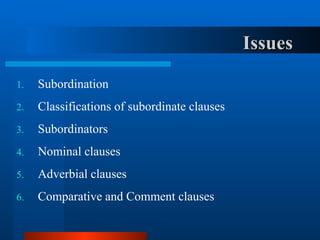
Subordination  Classifications of subordinate clauses Subordinators Nominal clauses Adverbial clauses Comparative and Comment clauses Issues
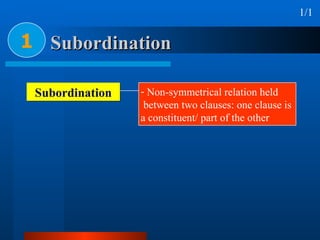
Subordination 1 1/1 Subordination Non-symmetrical relation held  between two clauses: one clause is  a constituent/ part of the other
Subordination 1 1/2 1  2  21 [I like John  [because John likes me] ] 1   1 [superordinate/ independent/ main clause  ] 2   2 [subordinate/ dependent clause] Non-symmetrical relation held  between two clauses: one clause is  a constituent/ part of the other Subordination i.e. one clause is  Non-symmetrical relation,  a constituent/ part of the other
Subordination 1 1/3 X-   Y-   Z- ( I think [ that you can do it { if you try} ] ) S  V  O  A Z = subordinate to Y Y = subordinate to X Y & Z = dependent clauses X = independent clause Subordination Hierarchy of clauses
Let's check Do Exercise 11.1 (handout Week 9)
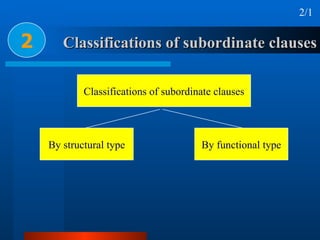
Classifications of subordinate clauses 2 2/1 Classifications of subordinate clauses By structural type By functional type
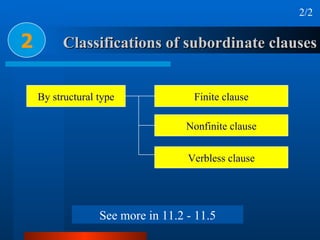
Classifications of subordinate clauses 2 2/2 See more in 11.2 - 11.5 By structural type Finite clause Nonfinite clause Verbless clause
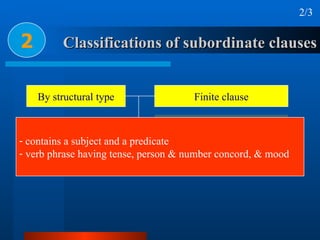
Classifications of subordinate clauses 2 2/3 contains a subject and a predicate verb phrase having tense, person & number concord, & mood By structural type Finite clause Nonfinite clause Verbless clause
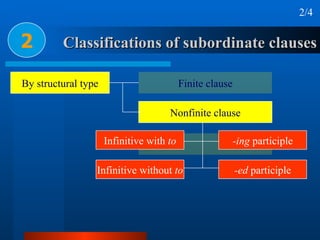
Classifications of subordinate clauses 2 2/4 By structural type Finite clause Nonfinite clause Infinitive with  to Infinitive without  to -ed  participle -ing  participle
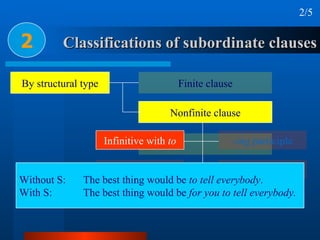
Classifications of subordinate clauses 2 2/5 By structural type Finite clause Nonfinite clause Infinitive with  to Infinitive without  to -ed  participle -ing  participle Without S:  The best thing would be  to tell everybody . With S:  The best thing would be  for you to tell everybody.
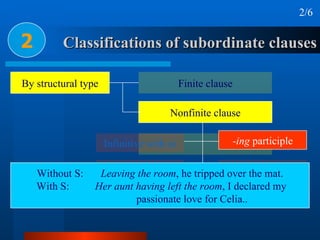
Classifications of subordinate clauses 2 2/6 By structural type Finite clause Nonfinite clause Infinitive with  to Infinitive without  to -ed  participle -ing  participle Without S:  Leaving the room , he tripped over the mat. With S:  Her aunt having left the room , I declared my  passionate love for Celia..
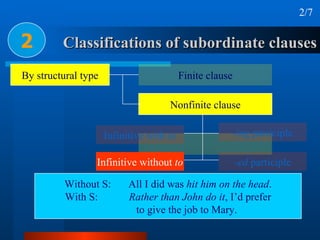
Classifications of subordinate clauses 2 2/7 Without S:  All I did was  hit him on the head . With S:  Rather than John do it , I’d prefer to give the job to Mary. By structural type Finite clause Nonfinite clause Infinitive with  to Infinitive without  to -ed  participle -ing  participle
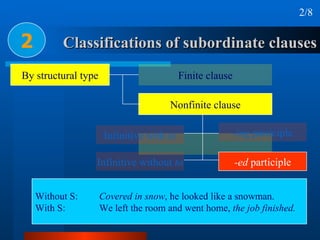
Classifications of subordinate clauses 2 2/8 Without S:  Covered in snow , he looked like a snowman. With S:  We left the room and went home,  the job finished. By structural type Finite clause Nonfinite clause Infinitive with  to Infinitive without  to -ed  participle -ing  participle
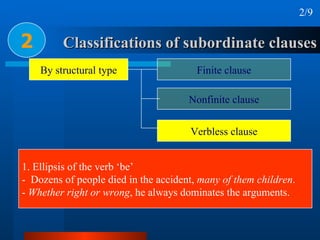
Classifications of subordinate clauses 2 2/9 1. Ellipsis of the verb ‘be’ -  Dozens of people died in the accident,  many of them children . -  Whether right or wrong , he always dominates the arguments. By structural type Finite clause Nonfinite clause Verbless clause
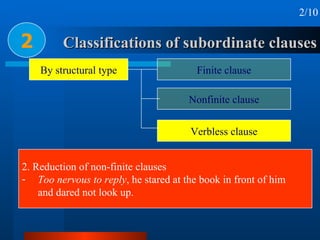
Classifications of subordinate clauses 2 2/10 2. Reduction of non-finite clauses Too nervous to reply , he stared at the book in front of him  and dared not look up. By structural type Finite clause Nonfinite clause Verbless clause
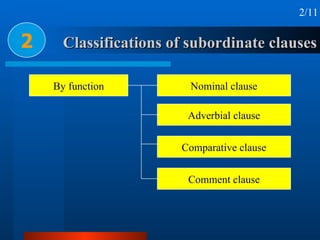
Classifications of subordinate clauses 2 2/11 By function Nominal clause Adverbial clause Comparative clause Comment clause
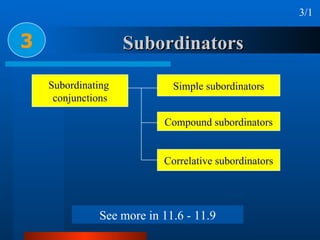
Subordinators 3 3/1 See more in 11.6 - 11.9 Subordinating  conjunctions Simple subordinators Compound subordinators Correlative subordinators
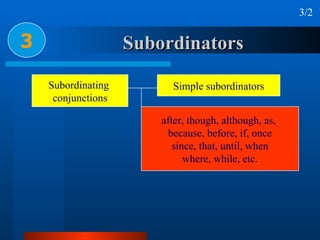
Subordinators 3 3/2 after, though, although, as,  because, before, if, once since, that, until, when where, while, etc. Subordinating  conjunctions Simple subordinators Compound subordinators Correlative subordinators
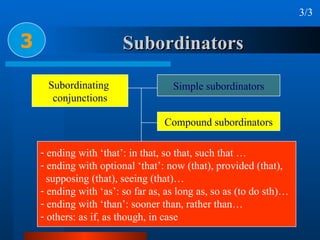
Subordinators 3 3/3 ending with ‘that’: in that, so that, such that … ending with optional ‘that’: now (that), provided (that),  supposing (that), seeing (that)… ending with ‘as’: so far as, as long as, so as (to do sth)… ending with ‘than’: sooner than, rather than… others: as if, as though, in case Subordinating  conjunctions Simple subordinators Compound subordinators Correlative subordinators
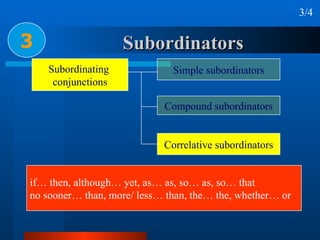
Subordinators 3 3/4 if… then, although… yet, as… as, so… as, so… that no sooner… than, more/ less… than, the… the, whether… or Subordinating  conjunctions Simple subordinators Compound subordinators Correlative subordinators
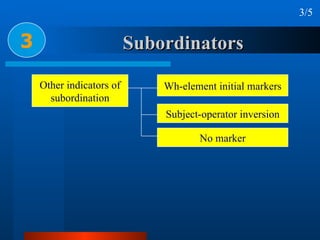
Subordinators 3 3/5 Other indicators of subordination Wh-element initial markers Subject-operator inversion No marker
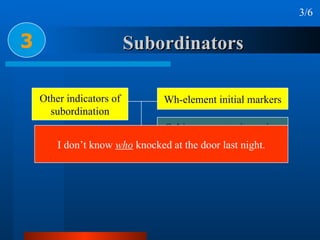
Subordinators 3 3/6 I don’t know  who  knocked at the door last night. Other indicators of subordination Wh-element initial markers Subject-operator inversion No marker
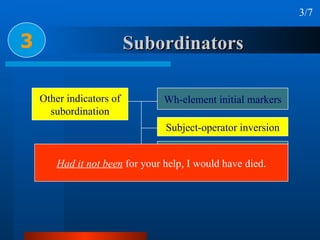
Subordinators 3 3/7 Had it not been  for your help, I would have died. Other indicators of subordination Wh-element initial markers Subject-operator inversion No marker
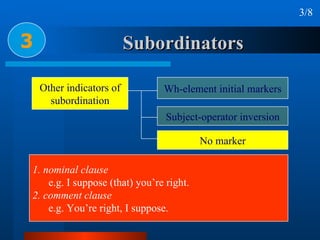
Subordinators 3 3/8 1. nominal clause e.g. I suppose (that) you’re right. 2. comment clause e.g. You’re right, I suppose. Other indicators of subordination Wh-element initial markers Subject-operator inversion No marker
Do exercise 11.4 (handout Week 9)
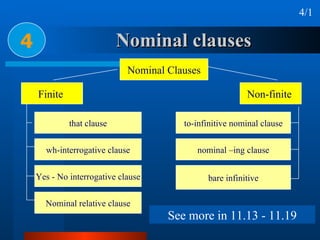
Nominal clauses 4 4/1 Nominal Clauses Finite  Non-finite  that clause wh-interrogative clause Yes - No interrogative clause Nominal relative clause to-infinitive nominal clause nominal –ing clause bare infinitive See more in 11.13 - 11.19
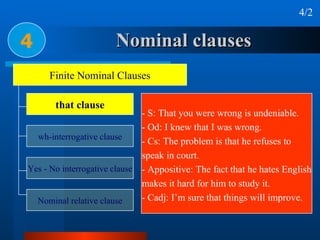
Nominal clauses 4 4/2 - S: That you were wrong is undeniable. - Od: I knew that I was wrong. - Cs: The problem is that he refuses to  speak in court. - Appositive: The fact that he hates English makes it hard for him to study it. - Cadj: I’m sure that things will improve. Finite Nominal Clauses that clause wh-interrogative clause Yes - No interrogative clause Nominal relative clause
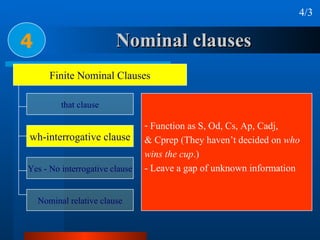
Nominal clauses 4 4/3 Function as S, Od, Cs, Ap, Cadj,  & Cprep (They haven’t decided on  who  wins the cup .) - Leave a gap of unknown information Finite Nominal Clauses that clause wh-interrogative clause Yes - No interrogative clause Nominal relative clause
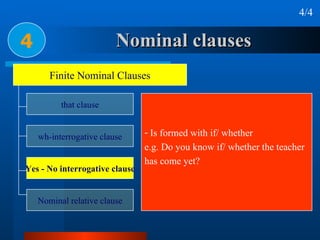
Nominal clauses 4 4/4 Is formed with if/ whether e.g. Do you know if/ whether the teacher  has come yet? Finite Nominal Clauses that clause wh-interrogative clause Yes - No interrogative clause Nominal relative clause
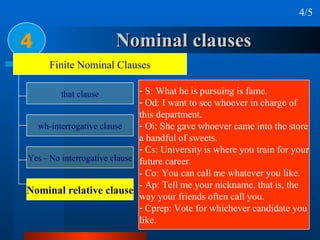
Nominal clauses 4 4/5 S: What he is pursuing is fame. Od: I want to see whoever in charge of  this department. Oi: She gave whoever came into the store a handful of sweets. Cs: University is where you train for your future career. - Co: You can call me whatever you like. - Ap: Tell me your nickname, that is, the  way your friends often call you. Cprep: Vote for whichever candidate you like. Finite Nominal Clauses that clause wh-interrogative clause Yes - No interrogative clause Nominal relative clause
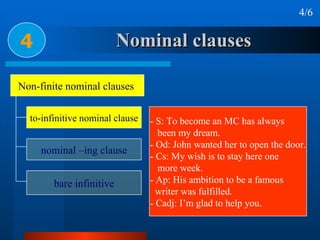
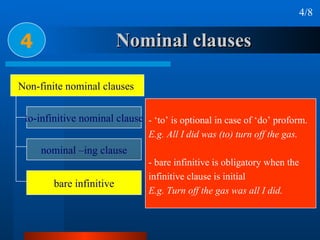
Nominal clauses 4 4/6 - S: To become an MC has always  been my dream. - Od: John wanted her to open the door. - Cs: My wish is to stay here one  more week. - Ap: His ambition to be a famous  writer was fulfilled. - Cadj: I’m glad to help you. Non-finite nominal clauses  to-infinitive nominal clause nominal –ing clause bare infinitive
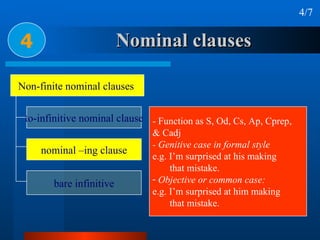
Nominal clauses 4 4/7 - Function as S, Od, Cs, Ap, Cprep,  & Cadj - Genitive case in formal style e.g. I’m surprised at his making  that mistake. Objective or common case: e.g. I’m surprised at him making  that mistake. Non-finite nominal clauses  to-infinitive nominal clause nominal –ing clause bare infinitive
Nominal clauses 4 4/8 - ‘to’ is optional in case of ‘do’ proform. E.g. All I did was (to) turn off the gas. - bare infinitive is obligatory when the infinitive clause is initial E.g. Turn off the gas was all I did. Non-finite nominal clauses  to-infinitive nominal clause nominal –ing clause bare infinitive
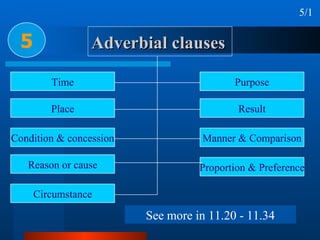
Adverbial clauses 5 5/1 Time Place Condition & concession Reason or cause Circumstance Purpose Result Manner & Comparison Proportion & Preference See more in 11.20 - 11.34
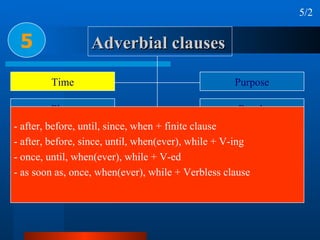
Adverbial clauses 5 5/2 Time Place Condition & concession Reason or cause Circumstance Purpose Result Manner & Comparison Proportion & Preference - after, before, until, since, when + finite clause - after, before, since, until, when(ever), while + V-ing - once, until, when(ever), while + V-ed - as soon as, once, when(ever), while + Verbless clause
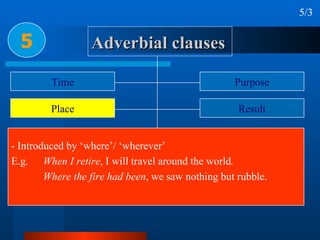
Adverbial clauses 5 5/3 Time Place Condition & concession Reason or cause Circumstance Purpose Result Manner & Comparison Proportion & Preference - Introduced by ‘where’/ ‘wherever’ E.g.  When I retire , I will travel around the world . Where the fire had been , we saw nothing but rubble.
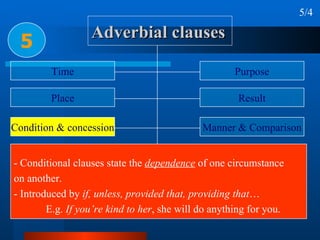
Adverbial clauses 5 5/4 - Conditional clauses state the  dependence  of one circumstance  on another. - Introduced by  if, unless, provided that, providing that … E.g.  If you’re kind to her , she will do anything for you. Time Place Condition & concession Reason or cause Circumstance Purpose Result Manner & Comparison Proportion & Preference
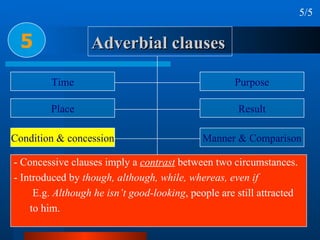
Adverbial clauses 5 5/5 Time Place Condition & concession Reason or cause Circumstance Purpose Result Manner & Comparison Proportion & Preference - Concessive clauses imply a  contrast  between two circumstances. - Introduced by  though, although, while, whereas, even if E.g.  Although he isn’t good-looking , people are still attracted to him.
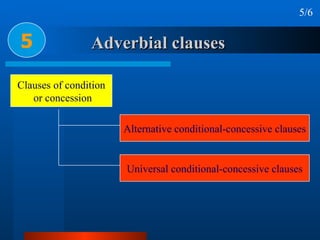
Adverbial clauses 5 5/6 Clauses of condition or concession Alternative conditional-concessive clauses Universal conditional-concessive clauses
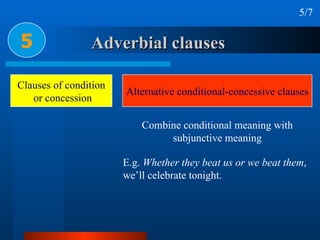
Adverbial clauses 5 5/7 Clauses of condition or concession Alternative conditional-concessive clauses E.g.  Whether they beat us or we beat them , we’ll celebrate tonight. Combine conditional meaning with subjunctive meaning
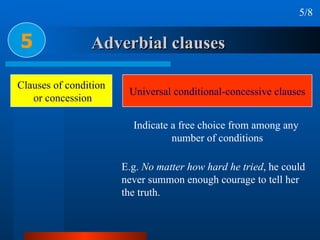
Adverbial clauses 5 5/8 Clauses of condition or concession Universal conditional-concessive clauses E.g.  No matter how hard he tried , he could  never summon enough courage to tell her  the truth. Indicate a free choice from among any  number of conditions
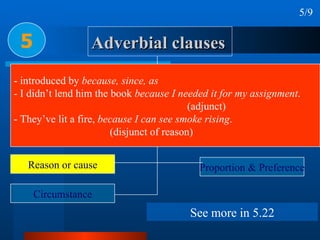
Adverbial clauses 5 5/9 Time Place Condition & concession Reason or cause Circumstance Purpose Result Manner & Comparison Proportion & Preference - introduced by  because, since, as -  I didn’t lend him the book  because I needed it for my assignment . (adjunct) - They’ve lit a fire,  because I can see smoke rising .  (disjunct of reason) See more in 5.22
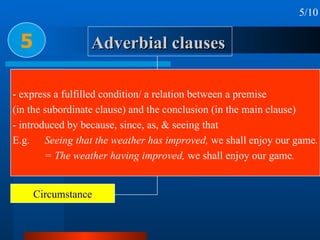
Adverbial clauses 5 5/10 Time Place Condition & concession Reason or cause Circumstance Purpose Result Manner & Comparison Proportion & Preference - express a fulfilled condition/ a relation between a premise  (in the subordinate clause) and the conclusion (in the main clause) - introduced by because, since, as, & seeing that E.g.  Seeing that the weather has improved,  we shall enjoy our game . = The weather having improved,  we shall enjoy our game .
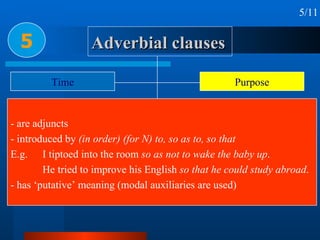
Adverbial clauses 5 5/11 Time Place Condition & concession Reason or cause Circumstance Purpose Result Manner & Comparison Proportion & Preference - are adjuncts - introduced by  (in order) (for N) to, so as to, so that E.g. I tiptoed into the room  so as not to wake the baby up .  He tried to improve his English  so that he could study abroad . - has ‘putative’ meaning (modal auxiliaries are used)
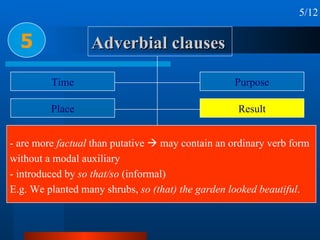
Adverbial clauses 5 5/12 Time Place Condition & concession Reason or cause Circumstance Purpose Result Manner & Comparison Proportion & Preference - are more  factual  than putative    may contain an ordinary verb form without a modal auxiliary - introduced by  so that/so  (informal) E.g. We planted many shrubs,  so (that) the garden looked beautiful .
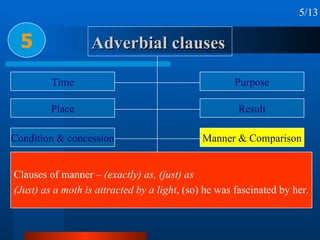
Adverbial clauses 5 5/13 Time Place Condition & concession Reason or cause Circumstance Purpose Result Manner & Comparison Proportion & Preference Clauses of manner –  (exactly) as, (just) as (Just) as a moth is attracted by a light , (so) he was fascinated by her.
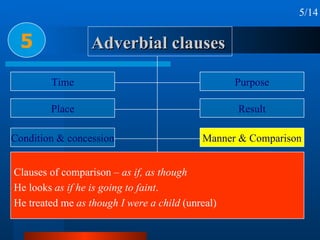
Adverbial clauses 5 5/14 Time Place Condition & concession Reason or cause Circumstance Purpose Result Manner & Comparison Proportion & Preference Clauses of comparison –  as if, as though He looks  as if he is going to faint . He treated me  as though I were a child  (unreal)
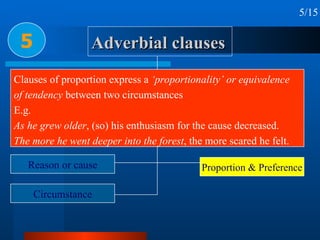
Adverbial clauses 5 5/15 Time Place Condition & concession Reason or cause Circumstance Purpose Result Manner & Comparison Proportion & Preference Clauses of proportion express a  ‘proportionality’ or equivalence  of tendency  between two circumstances E.g. As he grew older , (so) his enthusiasm for the cause decreased. The more he went deeper into the forest , the more scared he felt.
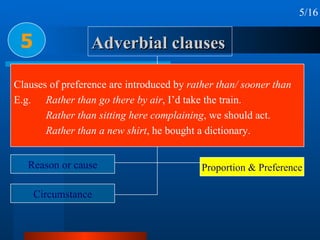
Adverbial clauses 5 5/16 Time Place Condition & concession Reason or cause Circumstance Purpose Result Manner & Comparison Proportion & Preference Clauses of preference are introduced by  rather than/ sooner than   E.g.  Rather than go there by air , I’d take the train. Rather than sitting here complaining , we should act. Rather than a new shirt , he bought a dictionary.
Let's check Do exercise 11.9 (handout Week 9)
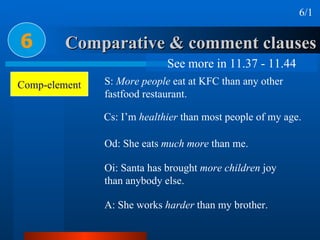
Comparative & comment clauses 6 6/1 Comp-element S:  More people  eat at KFC than any other  fastfood restaurant. Cs: I’m  healthier  than most people of my age. Od: She eats  much more  than me. Oi: Santa has brought  more children  joy  than anybody else. A: She works  harder  than my brother. See more in 11.37 - 11.44
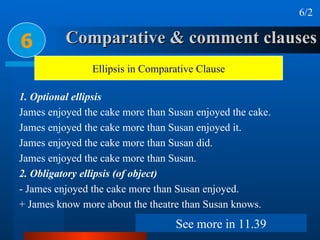
Comparative & comment clauses 6 6/2 Ellipsis in Comparative Clause 1. Optional ellipsis James enjoyed the cake more than Susan enjoyed the cake. James enjoyed the cake more than Susan enjoyed it. James enjoyed the cake more than Susan did. James enjoyed the cake more than Susan. 2. Obligatory ellipsis (of object) - James enjoyed the cake more than Susan enjoyed. + James know more about the theatre than Susan knows. See more in 11.39
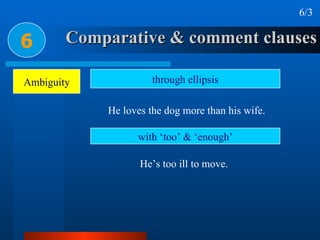
Comparative & comment clauses 6 6/3 Ambiguity He loves the dog more than his wife. through ellipsis with ‘too’ & ‘enough’ He’s too ill to move.
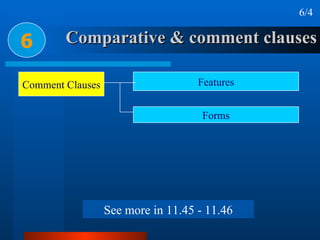
Comparative & comment clauses 6 6/4 Comment Clauses Features Forms See more in 11.45 - 11.46
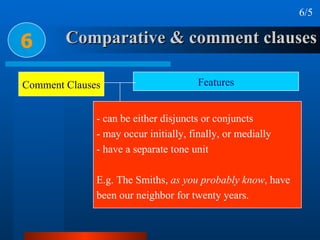
Comparative & comment clauses 6 6/5 Comment Clauses Features Forms - can be either disjuncts or conjuncts - may occur initially, finally, or medially - have a separate tone unit E.g. The Smiths,  as you probably know , have  been our neighbor for twenty years.
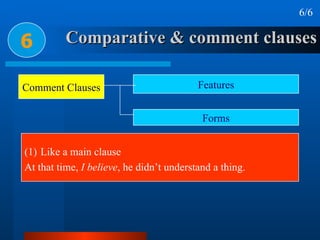
Comparative & comment clauses 6 6/6 Like a main clause At that time,  I believe , he didn’t understand a thing. Comment Clauses Features Forms
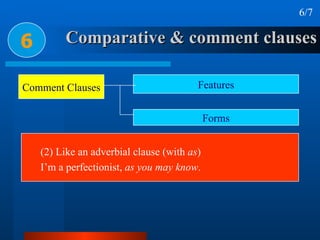
Comparative & comment clauses 6 6/7 (2) Like an adverbial clause (with  as ) I’m a perfectionist,  as you may know . Comment Clauses Features Forms
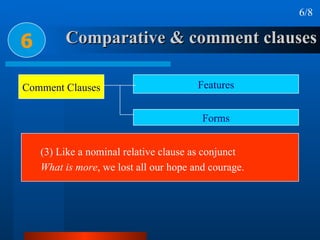
Comparative & comment clauses 6 6/8 (3) Like a nominal relative clause as conjunct What is more , we lost all our hope and courage. Comment Clauses Features Forms
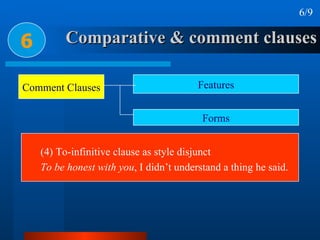
Comparative & comment clauses 6 6/9 (4) To-infinitive clause as style disjunct To be honest with you , I didn’t understand a thing he said. Comment Clauses Features Forms
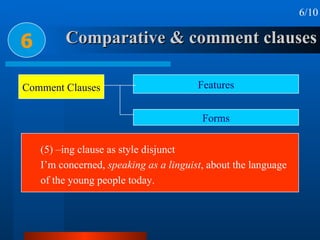
Comparative & comment clauses 6 6/10 (5) –ing clause as style disjunct I’m concerned,  speaking as a linguist , about the language of the young people today. Comment Clauses Features Forms
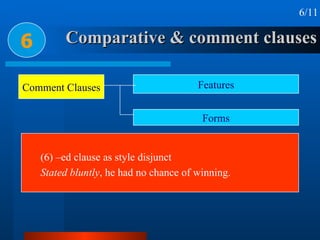
Comparative & comment clauses 6 6/11 (6) –ed clause as style disjunct Stated bluntly , he had no chance of winning. Comment Clauses Features Forms
Let's check Do exercise 11.11 (handout Week 9)
Homework Exercises 172-176 Workbook Handout Week 9

Week 9 the complex sentence

  • 1.
    E_English Grammar Course Chapter VI The Complex Sentence
  • 2.
    Subordination Classificationsof subordinate clauses Subordinators Nominal clauses Adverbial clauses Comparative and Comment clauses Issues
  • 3.
    Subordination 1 1/1Subordination Non-symmetrical relation held between two clauses: one clause is a constituent/ part of the other
  • 4.
    Subordination 1 1/21 2 21 [I like John [because John likes me] ] 1 1 [superordinate/ independent/ main clause ] 2 2 [subordinate/ dependent clause] Non-symmetrical relation held between two clauses: one clause is a constituent/ part of the other Subordination i.e. one clause is Non-symmetrical relation, a constituent/ part of the other
  • 5.
    Subordination 1 1/3X- Y- Z- ( I think [ that you can do it { if you try} ] ) S V O A Z = subordinate to Y Y = subordinate to X Y & Z = dependent clauses X = independent clause Subordination Hierarchy of clauses
  • 6.
    Let's check DoExercise 11.1 (handout Week 9)
  • 7.
    Classifications of subordinateclauses 2 2/1 Classifications of subordinate clauses By structural type By functional type
  • 8.
    Classifications of subordinateclauses 2 2/2 See more in 11.2 - 11.5 By structural type Finite clause Nonfinite clause Verbless clause
  • 9.
    Classifications of subordinateclauses 2 2/3 contains a subject and a predicate verb phrase having tense, person & number concord, & mood By structural type Finite clause Nonfinite clause Verbless clause
  • 10.
    Classifications of subordinateclauses 2 2/4 By structural type Finite clause Nonfinite clause Infinitive with to Infinitive without to -ed participle -ing participle
  • 11.
    Classifications of subordinateclauses 2 2/5 By structural type Finite clause Nonfinite clause Infinitive with to Infinitive without to -ed participle -ing participle Without S: The best thing would be to tell everybody . With S: The best thing would be for you to tell everybody.
  • 12.
    Classifications of subordinateclauses 2 2/6 By structural type Finite clause Nonfinite clause Infinitive with to Infinitive without to -ed participle -ing participle Without S: Leaving the room , he tripped over the mat. With S: Her aunt having left the room , I declared my passionate love for Celia..
  • 13.
    Classifications of subordinateclauses 2 2/7 Without S: All I did was hit him on the head . With S: Rather than John do it , I’d prefer to give the job to Mary. By structural type Finite clause Nonfinite clause Infinitive with to Infinitive without to -ed participle -ing participle
  • 14.
    Classifications of subordinateclauses 2 2/8 Without S: Covered in snow , he looked like a snowman. With S: We left the room and went home, the job finished. By structural type Finite clause Nonfinite clause Infinitive with to Infinitive without to -ed participle -ing participle
  • 15.
    Classifications of subordinateclauses 2 2/9 1. Ellipsis of the verb ‘be’ - Dozens of people died in the accident, many of them children . - Whether right or wrong , he always dominates the arguments. By structural type Finite clause Nonfinite clause Verbless clause
  • 16.
    Classifications of subordinateclauses 2 2/10 2. Reduction of non-finite clauses Too nervous to reply , he stared at the book in front of him and dared not look up. By structural type Finite clause Nonfinite clause Verbless clause
  • 17.
    Classifications of subordinateclauses 2 2/11 By function Nominal clause Adverbial clause Comparative clause Comment clause
  • 18.
    Subordinators 3 3/1See more in 11.6 - 11.9 Subordinating conjunctions Simple subordinators Compound subordinators Correlative subordinators
  • 19.
    Subordinators 3 3/2after, though, although, as, because, before, if, once since, that, until, when where, while, etc. Subordinating conjunctions Simple subordinators Compound subordinators Correlative subordinators
  • 20.
    Subordinators 3 3/3ending with ‘that’: in that, so that, such that … ending with optional ‘that’: now (that), provided (that), supposing (that), seeing (that)… ending with ‘as’: so far as, as long as, so as (to do sth)… ending with ‘than’: sooner than, rather than… others: as if, as though, in case Subordinating conjunctions Simple subordinators Compound subordinators Correlative subordinators
  • 21.
    Subordinators 3 3/4if… then, although… yet, as… as, so… as, so… that no sooner… than, more/ less… than, the… the, whether… or Subordinating conjunctions Simple subordinators Compound subordinators Correlative subordinators
  • 22.
    Subordinators 3 3/5Other indicators of subordination Wh-element initial markers Subject-operator inversion No marker
  • 23.
    Subordinators 3 3/6I don’t know who knocked at the door last night. Other indicators of subordination Wh-element initial markers Subject-operator inversion No marker
  • 24.
    Subordinators 3 3/7Had it not been for your help, I would have died. Other indicators of subordination Wh-element initial markers Subject-operator inversion No marker
  • 25.
    Subordinators 3 3/81. nominal clause e.g. I suppose (that) you’re right. 2. comment clause e.g. You’re right, I suppose. Other indicators of subordination Wh-element initial markers Subject-operator inversion No marker
  • 26.
    Do exercise 11.4(handout Week 9)
  • 27.
    Nominal clauses 44/1 Nominal Clauses Finite Non-finite that clause wh-interrogative clause Yes - No interrogative clause Nominal relative clause to-infinitive nominal clause nominal –ing clause bare infinitive See more in 11.13 - 11.19
  • 28.
    Nominal clauses 44/2 - S: That you were wrong is undeniable. - Od: I knew that I was wrong. - Cs: The problem is that he refuses to speak in court. - Appositive: The fact that he hates English makes it hard for him to study it. - Cadj: I’m sure that things will improve. Finite Nominal Clauses that clause wh-interrogative clause Yes - No interrogative clause Nominal relative clause
  • 29.
    Nominal clauses 44/3 Function as S, Od, Cs, Ap, Cadj, & Cprep (They haven’t decided on who wins the cup .) - Leave a gap of unknown information Finite Nominal Clauses that clause wh-interrogative clause Yes - No interrogative clause Nominal relative clause
  • 30.
    Nominal clauses 44/4 Is formed with if/ whether e.g. Do you know if/ whether the teacher has come yet? Finite Nominal Clauses that clause wh-interrogative clause Yes - No interrogative clause Nominal relative clause
  • 31.
    Nominal clauses 44/5 S: What he is pursuing is fame. Od: I want to see whoever in charge of this department. Oi: She gave whoever came into the store a handful of sweets. Cs: University is where you train for your future career. - Co: You can call me whatever you like. - Ap: Tell me your nickname, that is, the way your friends often call you. Cprep: Vote for whichever candidate you like. Finite Nominal Clauses that clause wh-interrogative clause Yes - No interrogative clause Nominal relative clause
  • 32.
    Nominal clauses 44/6 - S: To become an MC has always been my dream. - Od: John wanted her to open the door. - Cs: My wish is to stay here one more week. - Ap: His ambition to be a famous writer was fulfilled. - Cadj: I’m glad to help you. Non-finite nominal clauses to-infinitive nominal clause nominal –ing clause bare infinitive
  • 33.
    Nominal clauses 44/7 - Function as S, Od, Cs, Ap, Cprep, & Cadj - Genitive case in formal style e.g. I’m surprised at his making that mistake. Objective or common case: e.g. I’m surprised at him making that mistake. Non-finite nominal clauses to-infinitive nominal clause nominal –ing clause bare infinitive
  • 34.
    Nominal clauses 44/8 - ‘to’ is optional in case of ‘do’ proform. E.g. All I did was (to) turn off the gas. - bare infinitive is obligatory when the infinitive clause is initial E.g. Turn off the gas was all I did. Non-finite nominal clauses to-infinitive nominal clause nominal –ing clause bare infinitive
  • 35.
    Adverbial clauses 55/1 Time Place Condition & concession Reason or cause Circumstance Purpose Result Manner & Comparison Proportion & Preference See more in 11.20 - 11.34
  • 36.
    Adverbial clauses 55/2 Time Place Condition & concession Reason or cause Circumstance Purpose Result Manner & Comparison Proportion & Preference - after, before, until, since, when + finite clause - after, before, since, until, when(ever), while + V-ing - once, until, when(ever), while + V-ed - as soon as, once, when(ever), while + Verbless clause
  • 37.
    Adverbial clauses 55/3 Time Place Condition & concession Reason or cause Circumstance Purpose Result Manner & Comparison Proportion & Preference - Introduced by ‘where’/ ‘wherever’ E.g. When I retire , I will travel around the world . Where the fire had been , we saw nothing but rubble.
  • 38.
    Adverbial clauses 55/4 - Conditional clauses state the dependence of one circumstance on another. - Introduced by if, unless, provided that, providing that … E.g. If you’re kind to her , she will do anything for you. Time Place Condition & concession Reason or cause Circumstance Purpose Result Manner & Comparison Proportion & Preference
  • 39.
    Adverbial clauses 55/5 Time Place Condition & concession Reason or cause Circumstance Purpose Result Manner & Comparison Proportion & Preference - Concessive clauses imply a contrast between two circumstances. - Introduced by though, although, while, whereas, even if E.g. Although he isn’t good-looking , people are still attracted to him.
  • 40.
    Adverbial clauses 55/6 Clauses of condition or concession Alternative conditional-concessive clauses Universal conditional-concessive clauses
  • 41.
    Adverbial clauses 55/7 Clauses of condition or concession Alternative conditional-concessive clauses E.g. Whether they beat us or we beat them , we’ll celebrate tonight. Combine conditional meaning with subjunctive meaning
  • 42.
    Adverbial clauses 55/8 Clauses of condition or concession Universal conditional-concessive clauses E.g. No matter how hard he tried , he could never summon enough courage to tell her the truth. Indicate a free choice from among any number of conditions
  • 43.
    Adverbial clauses 55/9 Time Place Condition & concession Reason or cause Circumstance Purpose Result Manner & Comparison Proportion & Preference - introduced by because, since, as - I didn’t lend him the book because I needed it for my assignment . (adjunct) - They’ve lit a fire, because I can see smoke rising . (disjunct of reason) See more in 5.22
  • 44.
    Adverbial clauses 55/10 Time Place Condition & concession Reason or cause Circumstance Purpose Result Manner & Comparison Proportion & Preference - express a fulfilled condition/ a relation between a premise (in the subordinate clause) and the conclusion (in the main clause) - introduced by because, since, as, & seeing that E.g. Seeing that the weather has improved, we shall enjoy our game . = The weather having improved, we shall enjoy our game .
  • 45.
    Adverbial clauses 55/11 Time Place Condition & concession Reason or cause Circumstance Purpose Result Manner & Comparison Proportion & Preference - are adjuncts - introduced by (in order) (for N) to, so as to, so that E.g. I tiptoed into the room so as not to wake the baby up . He tried to improve his English so that he could study abroad . - has ‘putative’ meaning (modal auxiliaries are used)
  • 46.
    Adverbial clauses 55/12 Time Place Condition & concession Reason or cause Circumstance Purpose Result Manner & Comparison Proportion & Preference - are more factual than putative  may contain an ordinary verb form without a modal auxiliary - introduced by so that/so (informal) E.g. We planted many shrubs, so (that) the garden looked beautiful .
  • 47.
    Adverbial clauses 55/13 Time Place Condition & concession Reason or cause Circumstance Purpose Result Manner & Comparison Proportion & Preference Clauses of manner – (exactly) as, (just) as (Just) as a moth is attracted by a light , (so) he was fascinated by her.
  • 48.
    Adverbial clauses 55/14 Time Place Condition & concession Reason or cause Circumstance Purpose Result Manner & Comparison Proportion & Preference Clauses of comparison – as if, as though He looks as if he is going to faint . He treated me as though I were a child (unreal)
  • 49.
    Adverbial clauses 55/15 Time Place Condition & concession Reason or cause Circumstance Purpose Result Manner & Comparison Proportion & Preference Clauses of proportion express a ‘proportionality’ or equivalence of tendency between two circumstances E.g. As he grew older , (so) his enthusiasm for the cause decreased. The more he went deeper into the forest , the more scared he felt.
  • 50.
    Adverbial clauses 55/16 Time Place Condition & concession Reason or cause Circumstance Purpose Result Manner & Comparison Proportion & Preference Clauses of preference are introduced by rather than/ sooner than E.g. Rather than go there by air , I’d take the train. Rather than sitting here complaining , we should act. Rather than a new shirt , he bought a dictionary.
  • 51.
    Let's check Doexercise 11.9 (handout Week 9)
  • 52.
    Comparative & commentclauses 6 6/1 Comp-element S: More people eat at KFC than any other fastfood restaurant. Cs: I’m healthier than most people of my age. Od: She eats much more than me. Oi: Santa has brought more children joy than anybody else. A: She works harder than my brother. See more in 11.37 - 11.44
  • 53.
    Comparative & commentclauses 6 6/2 Ellipsis in Comparative Clause 1. Optional ellipsis James enjoyed the cake more than Susan enjoyed the cake. James enjoyed the cake more than Susan enjoyed it. James enjoyed the cake more than Susan did. James enjoyed the cake more than Susan. 2. Obligatory ellipsis (of object) - James enjoyed the cake more than Susan enjoyed. + James know more about the theatre than Susan knows. See more in 11.39
  • 54.
    Comparative & commentclauses 6 6/3 Ambiguity He loves the dog more than his wife. through ellipsis with ‘too’ & ‘enough’ He’s too ill to move.
  • 55.
    Comparative & commentclauses 6 6/4 Comment Clauses Features Forms See more in 11.45 - 11.46
  • 56.
    Comparative & commentclauses 6 6/5 Comment Clauses Features Forms - can be either disjuncts or conjuncts - may occur initially, finally, or medially - have a separate tone unit E.g. The Smiths, as you probably know , have been our neighbor for twenty years.
  • 57.
    Comparative & commentclauses 6 6/6 Like a main clause At that time, I believe , he didn’t understand a thing. Comment Clauses Features Forms
  • 58.
    Comparative & commentclauses 6 6/7 (2) Like an adverbial clause (with as ) I’m a perfectionist, as you may know . Comment Clauses Features Forms
  • 59.
    Comparative & commentclauses 6 6/8 (3) Like a nominal relative clause as conjunct What is more , we lost all our hope and courage. Comment Clauses Features Forms
  • 60.
    Comparative & commentclauses 6 6/9 (4) To-infinitive clause as style disjunct To be honest with you , I didn’t understand a thing he said. Comment Clauses Features Forms
  • 61.
    Comparative & commentclauses 6 6/10 (5) –ing clause as style disjunct I’m concerned, speaking as a linguist , about the language of the young people today. Comment Clauses Features Forms
  • 62.
    Comparative & commentclauses 6 6/11 (6) –ed clause as style disjunct Stated bluntly , he had no chance of winning. Comment Clauses Features Forms
  • 63.
    Let's check Doexercise 11.11 (handout Week 9)
  • 64.
    Homework Exercises 172-176Workbook Handout Week 9

Editor's Notes

  • #18 Lecture 22 Inservice grammar