SENTENCE, FRAGMENT
AND CL AUSE
CREATED BY:
NI’MATUL MAULA
NURUL KHIKMAH
UMI SIMTIYAH
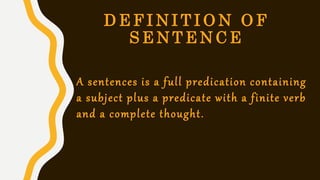
D E F I N I T I O N O F
S E N T E N C E
A sentences is a full predication containing
a subject plus a predicate with a finite verb
and a complete thought.
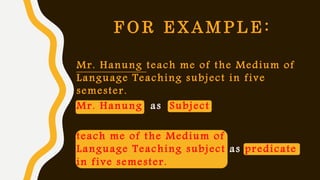
F O R E X A M P L E :
Mr. Hanung teach me of the Medium of
Language Teaching subject in five
semester.
Mr. Hanung as Subject
teach me of the Medium of
Language Teaching subject as predicate
in five semester.
F R A G M E N T
A fragment occurs whenever you do
these three things:
 You begin a group of words with a
capital letter.
 You conclude this group of words with
an end mark —either a period [ . ],
question mark [ ? ], or exclamation
point [ ! ].
 You neglect to insert a main clause
somewhere between the capital letter
at the beginning and the end mark
concluding the word group.
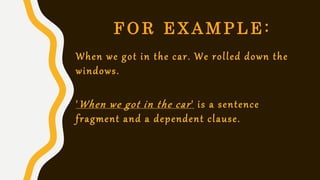
F O R E X A M P L E :
When we got in the car. We rolled down the
windows.
'When we got in the car' is a sentence
fragment and a dependent clause.
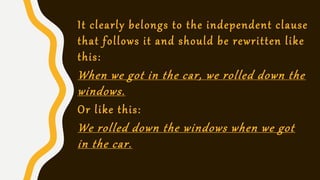
It clearly belongs to the independent clause
that follows it and should be rewritten like
this:
When we got in the car, we rolled down the
windows.
Or like this:
We rolled down the windows when we got
in the car.
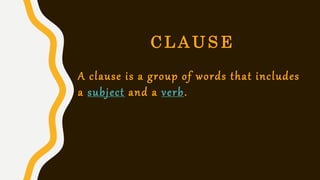
C L A U S E
A clause is a group of words that includes
a subject and a verb.
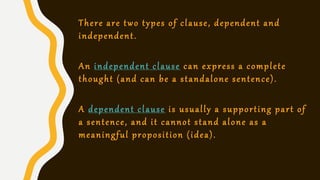
There are two types of clause, dependent and
independent.
An independent clause can express a complete
thought (and can be a standalone sentence).
A dependent clause is usually a supporting part of
a sentence, and it cannot stand alone as a
meaningful proposition (idea).
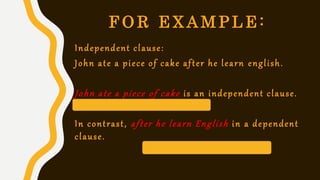
F O R E X A M P L E :
Independent clause:
John ate a piece of cake after he learn english.
John ate a piece of cake is an independent clause.
In contrast, after he learn English in a dependent
clause.
Thank you
for your
attention

Sentence, fragment and clause

  • 1.
    SENTENCE, FRAGMENT AND CLAUSE CREATED BY: NI’MATUL MAULA NURUL KHIKMAH UMI SIMTIYAH
  • 2.
    D E FI N I T I O N O F S E N T E N C E A sentences is a full predication containing a subject plus a predicate with a finite verb and a complete thought.
  • 3.
    F O RE X A M P L E : Mr. Hanung teach me of the Medium of Language Teaching subject in five semester. Mr. Hanung as Subject teach me of the Medium of Language Teaching subject as predicate in five semester.
  • 4.
    F R AG M E N T A fragment occurs whenever you do these three things:  You begin a group of words with a capital letter.  You conclude this group of words with an end mark —either a period [ . ], question mark [ ? ], or exclamation point [ ! ].  You neglect to insert a main clause somewhere between the capital letter at the beginning and the end mark concluding the word group.
  • 5.
    F O RE X A M P L E : When we got in the car. We rolled down the windows. 'When we got in the car' is a sentence fragment and a dependent clause.
  • 6.
    It clearly belongsto the independent clause that follows it and should be rewritten like this: When we got in the car, we rolled down the windows. Or like this: We rolled down the windows when we got in the car.
  • 7.
    C L AU S E A clause is a group of words that includes a subject and a verb.
  • 8.
    There are twotypes of clause, dependent and independent. An independent clause can express a complete thought (and can be a standalone sentence). A dependent clause is usually a supporting part of a sentence, and it cannot stand alone as a meaningful proposition (idea).
  • 9.
    F O RE X A M P L E : Independent clause: John ate a piece of cake after he learn english. John ate a piece of cake is an independent clause. In contrast, after he learn English in a dependent clause.
  • 10.