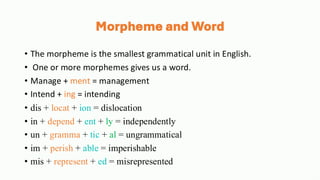
Morpheme and Word
•The morpheme is the smallest grammatical unit in English.
• One or more morphemes gives us a word.
• Manage + ment = management
• Intend + ing = intending
• dis + locat + ion = dislocation
• in + depend + ent + ly = independently
• un + gramma + tic + al = ungrammatical
• im + perish + able = imperishable
• mis + represent + ed = misrepresented
3.
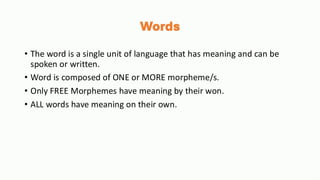
Words
• The wordis a single unit of language that has meaning and can be
spoken or written.
• Word is composed of ONE or MORE morpheme/s.
• Only FREE Morphemes have meaning by their won.
• ALL words have meaning on their own.
4.
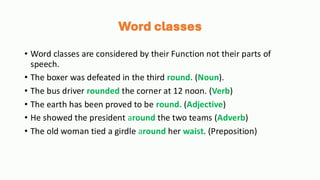
Word classes
• Wordclasses are considered by their Function not their parts of
speech.
• The boxer was defeated in the third round. (Noun).
• The bus driver rounded the corner at 12 noon. (Verb)
• The earth has been proved to be round. (Adjective)
• He showed the president around the two teams (Adverb)
• The old woman tied a girdle around her waist. (Preposition)
5.
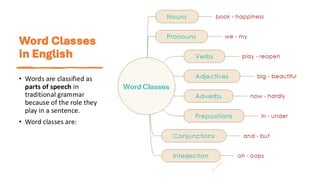
Word Classes
in English
•Words are classified as
parts of speech in
traditional grammar
because of the role they
play in a sentence.
• Word classes are:
6.
1- Nouns
• Nouns:
•Nouns are words that represent people, places, things, or
ideas.
• They can be further classified into:
• Common nouns ("book").
• Proper nouns ("London" or "Mary").
• Abstract noun: (love).
7.
2- Verbs_Main Verbs
•Verbs are action words that show what someone or something is
doing.
• Major parts: Regular verbs and irregular verbs.
• Regular verb: "walk"
• Irregular verb: "go“
• Auxiliary Verbs
8.
2- Verbs_Auxiliary Verbs
•Auxiliary verbs, also known as helping verbs, are used in combination
with main verbs to form different tenses, moods, and voices.
• They help to convey the timing and emphasis of an action or state of
being in a sentence. [ "be," "have," and "do,“]
• "Be" as an auxiliary verb in the progressive aspect: "She is singing."
• "Have" as an auxiliary verb in the perfect aspect: "They have finished
their homework."
• "Do" as an auxiliary verb in questions and negations: "Do you like
chocolate?" / "He does not understand."
9.
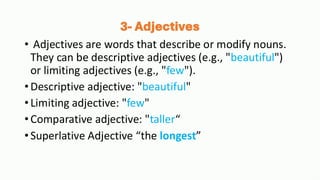
3- Adjectives
• Adjectivesare words that describe or modify nouns.
They can be descriptive adjectives (e.g., "beautiful")
or limiting adjectives (e.g., "few").
•Descriptive adjective: "beautiful"
•Limiting adjective: "few"
•Comparative adjective: "taller“
•Superlative Adjective “the longest”
10.
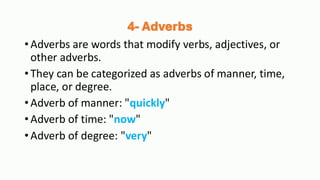
4- Adverbs
•Adverbs arewords that modify verbs, adjectives, or
other adverbs.
•They can be categorized as adverbs of manner, time,
place, or degree.
•Adverb of manner: "quickly"
•Adverb of time: "now"
•Adverb of degree: "very"
11.
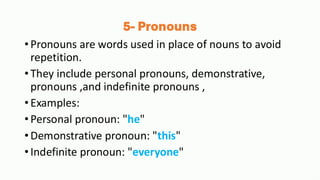
5- Pronouns
•Pronouns arewords used in place of nouns to avoid
repetition.
•They include personal pronouns, demonstrative,
pronouns ,and indefinite pronouns ,
•Examples:
•Personal pronoun: "he"
•Demonstrative pronoun: "this"
•Indefinite pronoun: "everyone"
12.
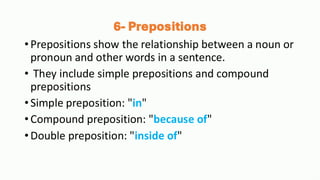
6- Prepositions
•Prepositions showthe relationship between a noun or
pronoun and other words in a sentence.
• They include simple prepositions and compound
prepositions
•Simple preposition: "in"
•Compound preposition: "because of"
•Double preposition: "inside of"
13.
7- Conjunctions
•Conjunctions arewords used to connect words,
phrases, or clauses.
• They can be coordinating conjunctions, subordinating
conjunctions or correlative conjunctions
•Coordinating conjunction: "and"
•Subordinating conjunction: "although"
•Correlative conjunction: "either...or"
14.
8- Interjections
•Interjections arewords used to express strong
emotions or sentiments and are often standalone
words or phrases.
•Examples:
•Interjection: "Wow!"
•Interjection: "Ouch!"
•Interjection: "Bravo!"
15.
Word formation processes
•InEnglish words are formed by many process such as
borrowing, coinage,
•Borrowing: This process involves adopting words from
other languages into English.
• "piano" and "ballet" from Italian, "sushi" and "karaoke"
are borrowed from Japanese, sugar, cotton, safari from
Arabic.
•Coinage: creating entirely new words. from brand
names, or the adoption of terms from popular culture.
• Aspirin, google, nylon, Kleenex
16.
Word formation processes
•Acronyms:creating new words from the
abbreviation of a phrase or a sentence:
• NATO, North Atlantic Treaty Organization
• PIN: personal identification number
• AIDS: acquired immunodeficiency syndrome
• RADAR - Radio Detection and Ranging
•Clipping: shortening a word. For example, (ad)
"advertisement" , (Prof.) “professor”, (bot) “robot”,
(net” (internet
17.
Word formation processes
•Thereare three processes that are made by using
morphology.
• Derivation.
•Compounding
•Back-formation
18.
Derivation
• Adding affixes(prefixes or suffixes) to a base word to create
a new word with a different meaning.
• The noun "friend" can be transformed into the adjective "friendly" by
adding the suffix "-ly".
• It can change the meaning im- + possible = impossible
• Re- + open = reopen
19.
Compounding
• Combining twoor more complete words to form a new
word.
• Black and board = blackboard.
• Sun + glass = sunglass
• Cup + cake = cupcake
• Mail + man = mailman
• Word + list = wordlist
20.
Back-formation
• Creating anew word by removing an affix from an existing
word.
• The noun "editor" led to the formation of the verb "edit".
• The noun “television" led to the formation of the verb
“televise".
• The noun “burglar" led to the formation of the verb
“burgle".
21.
Syntax
•Syntax refers tothe study of sentence structure.
•It analyzes how words are organized to form
meaningful phrases.
• It focuses on the arrangement of words, phrases,
and clauses within a sentence, as well as the
grammatical relationship between them.
22.
Syntactic Analysis
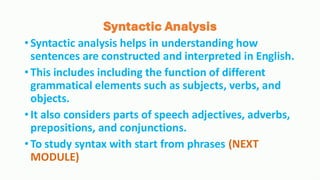
•Syntactic analysishelps in understanding how
sentences are constructed and interpreted in English.
•This includes including the function of different
grammatical elements such as subjects, verbs, and
objects.
•It also considers parts of speech adjectives, adverbs,
prepositions, and conjunctions.
•To study syntax with start from phrases (NEXT
MODULE)

![2- Verbs_Auxiliary Verbs
• Auxiliary verbs, also known as helping verbs, are used in combination
with main verbs to form different tenses, moods, and voices.
• They help to convey the timing and emphasis of an action or state of
being in a sentence. [ "be," "have," and "do,“]
• "Be" as an auxiliary verb in the progressive aspect: "She is singing."
• "Have" as an auxiliary verb in the perfect aspect: "They have finished
their homework."
• "Do" as an auxiliary verb in questions and negations: "Do you like
chocolate?" / "He does not understand."](https://image.slidesharecdn.com/ch-4morphemesandwords-250428181843-d2fc91db/85/Morphemeseeeeeeeeeeeeeeeeeeeeeeeeeeeeeee-8-320.jpg)