Outline:
 What is deixis ?
 Types of deixis
 Person deixis
 PERSON DEIXIS HONORIFICS
 Spatial (place) Deixis
Deictic projection
Psychological distance
 Temporal deixis
 Deictic expressions
 Psychological basis of temporal deixis
 Distance and tenses
 Deixis and Grammar
 Conclusion
 references
What is deixis ?
 The word ‘deixis’ is a technical term (from
Greek) for one of the most basic things we do
with utterances, which means ‘pointing’ via
language.‘
 Any linguistic form used to accomplish ‘pointing’
is called a deictic expression. Words like here,
there, this, that, now and then, as well as most
pronouns, such as I, we, you, he, her and
them are deictic expressions. Deictic
expressions are also known as indexicals.
Type of deixis
 to indicate
time
Deixis
person spatial
to indicate
people
to indicate
location
temporal
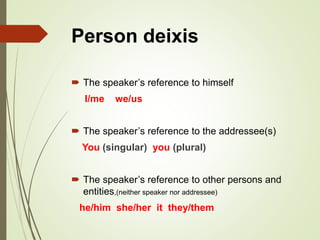
Person deixis
 The speaker’s reference to himself
I/me we/us
 The speaker’s reference to the addressee(s)
You (singular) you (plural)
 The speaker’s reference to other persons and
entities,(neither speaker nor addressee)
he/him she/her it they/them
PERSON DEIXIS
HONORIFICS
 Person deixis operates on a basic three part division,
the speaker (I), the addressee (you) and other(s) (he,
she, it).
 in many languages these deictic expressions are
elaborated with markers of social status Yule (1996) .
Expressions which indicate higher status are
described as honorifics (social deixis).
 For example, in French and Romanian there are two
different forms that encode a social contrast within
person deixis, ‘tu’ (tu) and ‘vous’(dumneavoastra).
This is known as T/V distinction.
Person deixis
 Using a third person form, where a second person would be
possible, is one way of communicating distance. This can also be
done for humorous or ironic purposes, as in:
‘Would his highness like some coffee?’
 The distance associated with third person forms is also used to make
potential accusations less direct, as in:
Somebody didn’t clean up after himself.
 There is also a potential ambiguity in the use in English of the first
person plural. There is an exclusive we (speaker plus others,
excluding addressee) and inclusive we (speaker and addressee
included), as in the following possible reply to the accusation:
We clean up after ourselves around here.
Spatial (place) Deixis
 Identifying entities
this/ these , that/those
 Informing about locations
Here/ there , above/below
 ‘’Acknowledging’’ locations
Come/go
Place Deixis
In Spanish: aqui, ahi, alli
In English: here, there, (yonder)
Spatial Deictic System
Proximl
Here
Distal
There
SPATIAL DEIXIS
 The concept of distance is relevant to spatial
deixis, where the relative location of people
and things is being indicated. Contemporary
English makes use of two adverbs, ‘here’
and ‘there’, for the basic distinction. Some
verbs of motion, such as ‘come’ and ‘go’,
retain deictic sense when they are used to
mark movement toward the speaker (‘Come
to bed’) or away the speaker (‘Go to bed’).
Deictic projection
Deictic projection= speakers being able to project
themselves into other locations, time or shift
person reference. Eg. via dramatic
performances, when using direct speech to
represent the person, location and feelings of
someone else.
E.g.: I was looking at this little puppy in a cage
with such a sad look on its face. It was like,
‘Oh, I’m so unhappy here, will you set me
free?’ (taken from Yule, 1996:13)
All indexical expressions refer to certain world
conditions, either subjective or objective in
nature. The following story, borrowed from
Levinson 1983:68) is meant to illustrate the
importance of having the right point of view, and
how one can anticipate the way people will
construe the world in terms of their point of view.
A melamed (Hebrew teacher) discovering that he
had left his comfortable slippers back in the house,
sent a student after them with a note for his wife.
The note read: “Send me your slippers with this
boy”. When the student asked why he had written
‘your’ slippers, the melamed answered: ‘Yold!
(Fool) If I wrote ‘my’ slippers, she would read ‘my
slippers’ and would send her slippers. What could I
do with her slippers? So I wrote ‘your’ slippers,
she’ll read ‘your’ slippers and send me mine.”
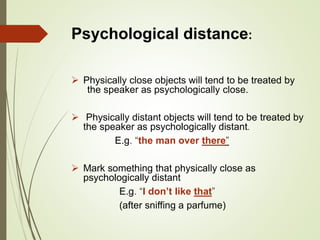
Psychological distance:
 Physically close objects will tend to be treated by
the speaker as psychologically close.
 Physically distant objects will tend to be treated by
the speaker as psychologically distant.
E.g. “the man over there”
 Mark something that physically close as
psychologically distant
E.g. “I don’t like that”
(after sniffing a parfume)
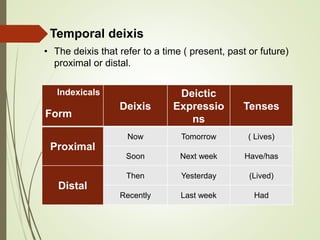
Temporal deixis
• The deixis that refer to a time ( present, past or future)
proximal or distal.
Indexicals
Form
Deixis
Deictic
Expressio
ns
Tenses
Proximal
Now Tomorrow ( Lives)
Soon Next week Have/has
Distal
Then Yesterday (Lived)
Recently Last week Had
Proximal VS. Distal
Past tense
( Then )
Present tense
( Now )
Future time
( Then )
“In 2009? I was in
Australia then”
“I will tell you
everything now”
“You are busy? I will
see you tomorrow
then”
• “Contrast to ‘now’, the distal expression ‘then’ applies
to both past and future time relative to the speaker’s
present time” (Yule, G. 1996:14)
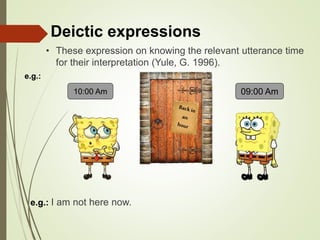
Deictic expressions
• These expression on knowing the relevant utterance time
for their interpretation (Yule, G. 1996).
10:00 Am 09:00 Am
e.g.:
e.g.: I am not here now.
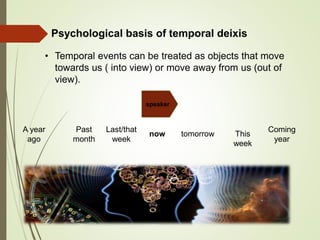
Psychological basis of temporal deixis
speaker
A year
ago
Past
month
Last/that
week
now tomorrow This
week
Coming
year
• Temporal events can be treated as objects that move
towards us ( into view) or move away from us (out of
view).
Distance and tenses
• The present tense is proximal as in [1a] and past tense is
distal form as in [1b], the past tense determine a distant
event, speech, or place from the speaker’s current
situation, as in [1c].
[1] a. I live here now.
b. I lived there then.
c. I could swim (when I was a child).
• Distal forms able to make impossibility sense, as in [2].
[2]. I could be in Hawaii (if I had a lot of money).
Note: apart from to be used to communicate distance from
current time, but used for distance from current reality or
fact.
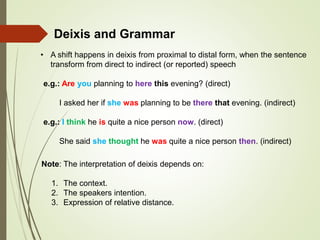
Deixis and Grammar
• A shift happens in deixis from proximal to distal form, when the sentence
transform from direct to indirect (or reported) speech
e.g.: Are you planning to here this evening? (direct)
I asked her if she was planning to be there that evening. (indirect)
e.g.: I think he is quite a nice person now. (direct)
She said she thought he was quite a nice person then. (indirect)
Note: The interpretation of deixis depends on:
1. The context.
2. The speakers intention.
3. Expression of relative distance.
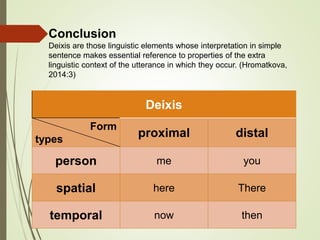
Conclusion
Deixis are those linguistic elements whose interpretation in simple
sentence makes essential reference to properties of the extra
linguistic context of the utterance in which they occur. (Hromatkova,
2014:3)
Deixis
Form
types
proximal distal
person me you
spatial here There
temporal now then
references
• Haverkate, H. (n.d). Deictic Categories As Mitigating Devices:
Pragmatics. International Pragmatics Association, 2:4.509-510.
http://elanguage.net/journals/pragmatics/articlelviewfile/393/324
• Hromatkova, V. (2014), Pragmatics of Legal Language: Deixis.
(Master thesis). Retrieved from
http://is.muni.cz/th/330848/ff_m/MA_Thesis.pdf
• Yule, G. (1996), Pragmatics, Oxford: Oxford University Press.
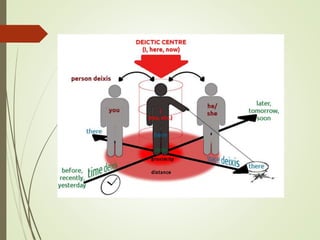
• Word press. (2014).Deixis [Image]. Retrieved from
http://introruins.wordpress.com/2014/03/24/jacob-maps-and-deixis/
•‫د‬.‫ش‬ ،‫على‬.‫س‬( .٢٠١٤.)‫پراگماتيك‬.‫هةولئر‬:‫ئةكاديمياى‬ ‫بالوكراوةكانى‬
‫كوردى‬.

Deixis and distance

  • 2.
    Outline:  What isdeixis ?  Types of deixis  Person deixis  PERSON DEIXIS HONORIFICS  Spatial (place) Deixis Deictic projection Psychological distance  Temporal deixis  Deictic expressions  Psychological basis of temporal deixis  Distance and tenses  Deixis and Grammar  Conclusion  references
  • 3.
    What is deixis?  The word ‘deixis’ is a technical term (from Greek) for one of the most basic things we do with utterances, which means ‘pointing’ via language.‘  Any linguistic form used to accomplish ‘pointing’ is called a deictic expression. Words like here, there, this, that, now and then, as well as most pronouns, such as I, we, you, he, her and them are deictic expressions. Deictic expressions are also known as indexicals.
  • 4.
    Type of deixis to indicate time Deixis person spatial to indicate people to indicate location temporal
  • 5.
    Person deixis  Thespeaker’s reference to himself I/me we/us  The speaker’s reference to the addressee(s) You (singular) you (plural)  The speaker’s reference to other persons and entities,(neither speaker nor addressee) he/him she/her it they/them
  • 6.
    PERSON DEIXIS HONORIFICS  Persondeixis operates on a basic three part division, the speaker (I), the addressee (you) and other(s) (he, she, it).  in many languages these deictic expressions are elaborated with markers of social status Yule (1996) . Expressions which indicate higher status are described as honorifics (social deixis).  For example, in French and Romanian there are two different forms that encode a social contrast within person deixis, ‘tu’ (tu) and ‘vous’(dumneavoastra). This is known as T/V distinction.
  • 7.
    Person deixis  Usinga third person form, where a second person would be possible, is one way of communicating distance. This can also be done for humorous or ironic purposes, as in: ‘Would his highness like some coffee?’  The distance associated with third person forms is also used to make potential accusations less direct, as in: Somebody didn’t clean up after himself.  There is also a potential ambiguity in the use in English of the first person plural. There is an exclusive we (speaker plus others, excluding addressee) and inclusive we (speaker and addressee included), as in the following possible reply to the accusation: We clean up after ourselves around here.
  • 8.
    Spatial (place) Deixis Identifying entities this/ these , that/those  Informing about locations Here/ there , above/below  ‘’Acknowledging’’ locations Come/go
  • 9.
    Place Deixis In Spanish:aqui, ahi, alli In English: here, there, (yonder) Spatial Deictic System Proximl Here Distal There
  • 10.
    SPATIAL DEIXIS  Theconcept of distance is relevant to spatial deixis, where the relative location of people and things is being indicated. Contemporary English makes use of two adverbs, ‘here’ and ‘there’, for the basic distinction. Some verbs of motion, such as ‘come’ and ‘go’, retain deictic sense when they are used to mark movement toward the speaker (‘Come to bed’) or away the speaker (‘Go to bed’).
  • 11.
    Deictic projection Deictic projection=speakers being able to project themselves into other locations, time or shift person reference. Eg. via dramatic performances, when using direct speech to represent the person, location and feelings of someone else. E.g.: I was looking at this little puppy in a cage with such a sad look on its face. It was like, ‘Oh, I’m so unhappy here, will you set me free?’ (taken from Yule, 1996:13) All indexical expressions refer to certain world conditions, either subjective or objective in nature. The following story, borrowed from Levinson 1983:68) is meant to illustrate the importance of having the right point of view, and how one can anticipate the way people will construe the world in terms of their point of view.
  • 12.
    A melamed (Hebrewteacher) discovering that he had left his comfortable slippers back in the house, sent a student after them with a note for his wife. The note read: “Send me your slippers with this boy”. When the student asked why he had written ‘your’ slippers, the melamed answered: ‘Yold! (Fool) If I wrote ‘my’ slippers, she would read ‘my slippers’ and would send her slippers. What could I do with her slippers? So I wrote ‘your’ slippers, she’ll read ‘your’ slippers and send me mine.”
  • 13.
    Psychological distance:  Physicallyclose objects will tend to be treated by the speaker as psychologically close.  Physically distant objects will tend to be treated by the speaker as psychologically distant. E.g. “the man over there”  Mark something that physically close as psychologically distant E.g. “I don’t like that” (after sniffing a parfume)
  • 14.
    Temporal deixis • Thedeixis that refer to a time ( present, past or future) proximal or distal. Indexicals Form Deixis Deictic Expressio ns Tenses Proximal Now Tomorrow ( Lives) Soon Next week Have/has Distal Then Yesterday (Lived) Recently Last week Had
  • 15.
    Proximal VS. Distal Pasttense ( Then ) Present tense ( Now ) Future time ( Then ) “In 2009? I was in Australia then” “I will tell you everything now” “You are busy? I will see you tomorrow then” • “Contrast to ‘now’, the distal expression ‘then’ applies to both past and future time relative to the speaker’s present time” (Yule, G. 1996:14)
  • 16.
    Deictic expressions • Theseexpression on knowing the relevant utterance time for their interpretation (Yule, G. 1996). 10:00 Am 09:00 Am e.g.: e.g.: I am not here now.
  • 17.
    Psychological basis oftemporal deixis speaker A year ago Past month Last/that week now tomorrow This week Coming year • Temporal events can be treated as objects that move towards us ( into view) or move away from us (out of view).
  • 18.
    Distance and tenses •The present tense is proximal as in [1a] and past tense is distal form as in [1b], the past tense determine a distant event, speech, or place from the speaker’s current situation, as in [1c]. [1] a. I live here now. b. I lived there then. c. I could swim (when I was a child). • Distal forms able to make impossibility sense, as in [2]. [2]. I could be in Hawaii (if I had a lot of money). Note: apart from to be used to communicate distance from current time, but used for distance from current reality or fact.
  • 19.
    Deixis and Grammar •A shift happens in deixis from proximal to distal form, when the sentence transform from direct to indirect (or reported) speech e.g.: Are you planning to here this evening? (direct) I asked her if she was planning to be there that evening. (indirect) e.g.: I think he is quite a nice person now. (direct) She said she thought he was quite a nice person then. (indirect) Note: The interpretation of deixis depends on: 1. The context. 2. The speakers intention. 3. Expression of relative distance.
  • 20.
    Conclusion Deixis are thoselinguistic elements whose interpretation in simple sentence makes essential reference to properties of the extra linguistic context of the utterance in which they occur. (Hromatkova, 2014:3) Deixis Form types proximal distal person me you spatial here There temporal now then
  • 22.
    references • Haverkate, H.(n.d). Deictic Categories As Mitigating Devices: Pragmatics. International Pragmatics Association, 2:4.509-510. http://elanguage.net/journals/pragmatics/articlelviewfile/393/324 • Hromatkova, V. (2014), Pragmatics of Legal Language: Deixis. (Master thesis). Retrieved from http://is.muni.cz/th/330848/ff_m/MA_Thesis.pdf • Yule, G. (1996), Pragmatics, Oxford: Oxford University Press. • Word press. (2014).Deixis [Image]. Retrieved from http://introruins.wordpress.com/2014/03/24/jacob-maps-and-deixis/ •‫د‬.‫ش‬ ،‫على‬.‫س‬( .٢٠١٤.)‫پراگماتيك‬.‫هةولئر‬:‫ئةكاديمياى‬ ‫بالوكراوةكانى‬ ‫كوردى‬.