1
2
PRESENTATION :1
DESCRIPTIVE SYNTAX
3
TOPIC
WORDS
4
GROUP NO:4
KIRAN NAZIR
AQSA A.R
ANEEZA AKRAM
FARWA RANA
RAHEELA RANI 5
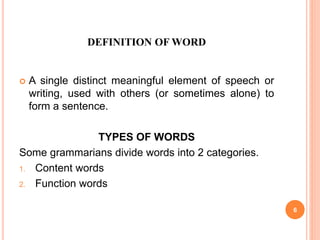
DEFINITION OF WORD
 A single distinct meaningful element of speech or
writing, used with others (or sometimes alone) to
form a sentence.
TYPES OF WORDS
Some grammarians divide words into 2 categories.
1. Content words
2. Function words
6
 Content words: have clear lexical meaning → open
class →new words can be added
 Function words: have a functional purpose →
closed class → new words cannot be added
Morphology
 In linguistics morphology is the study how words
are formed and their relationship to other words in
same language.
7
MORPHEMES
 In many languages the words are made up of a
large number of elements. In linguistics from is
called “elements” but technically is called
“morphemes” .
 Ex: peace (1 morpheme)
peaceful (2 morphemes)
peacefully (3 morphemes)
TYPES OF MORPHEMES
 There are two types of morphemes:
1:Free morphemes
2:Bound morphemes
8
FREE MORPHEMES
 It is the smallest unit of language that cannot be further
divided .It can stand alone.
 For example: New , Close, Rose
BOUND MORPHEMES
 A bound morpheme is a morpheme that cannot stand
alone as a word. In English bound morpheme includes
prefixes and suffixes
Ex: pre, un, ness, y
Examples of morphemes
action unchanged rainbow untrustworthy
9
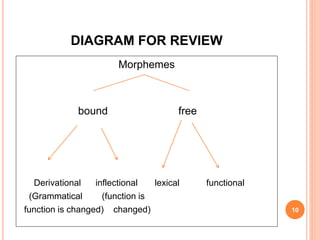
DIAGRAM FOR REVIEW
10
Morphemes
bound free
Derivational inflectional lexical functional
(Grammatical (function is
function is changed) changed)
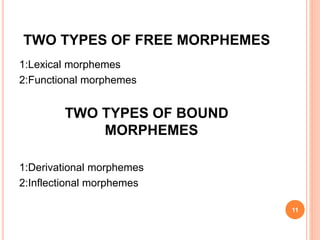
TWO TYPES OF FREE MORPHEMES
1:Lexical morphemes
2:Functional morphemes
TWO TYPES OF BOUND
MORPHEMES
1:Derivational morphemes
2:Inflectional morphemes
11
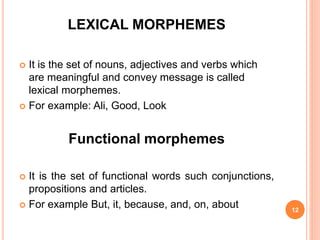
LEXICAL MORPHEMES
 It is the set of nouns, adjectives and verbs which
are meaningful and convey message is called
lexical morphemes.
 For example: Ali, Good, Look
Functional morphemes
 It is the set of functional words such conjunctions,
propositions and articles.
 For example But, it, because, and, on, about 12
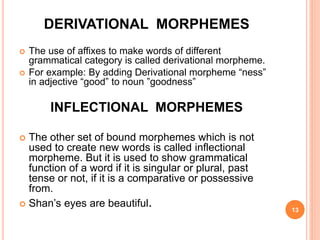
DERIVATIONAL MORPHEMES
 The use of affixes to make words of different
grammatical category is called derivational morpheme.
 For example: By adding Derivational morpheme “ness”
in adjective “good” to noun ”goodness”
INFLECTIONAL MORPHEMES
 The other set of bound morphemes which is not
used to create new words is called inflectional
morpheme. But it is used to show grammatical
function of a word if it is singular or plural, past
tense or not, if it is a comparative or possessive
from.
 Shan’s eyes are beautiful. 13
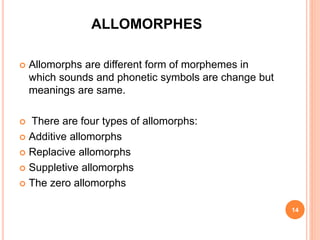
ALLOMORPHES
 Allomorphs are different form of morphemes in
which sounds and phonetic symbols are change but
meanings are same.
 There are four types of allomorphs:
 Additive allomorphs
 Replacive allomorphs
 Suppletive allomorphs
 The zero allomorphs
14
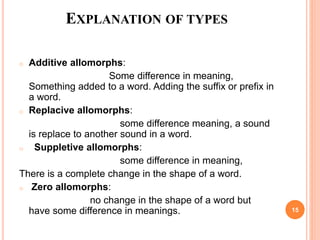
EXPLANATION OF TYPES
o Additive allomorphs:
Some difference in meaning,
Something added to a word. Adding the suffix or prefix in
a word.
o Replacive allomorphs:
some difference meaning, a sound
is replace to another sound in a word.
o Suppletive allomorphs:
some difference in meaning,
There is a complete change in the shape of a word.
o Zero allomorphs:
no change in the shape of a word but
have some difference in meanings. 15
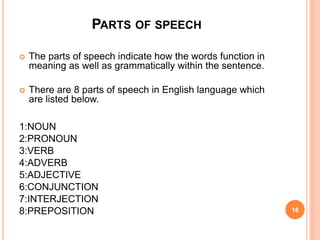
PARTS OF SPEECH
 The parts of speech indicate how the words function in
meaning as well as grammatically within the sentence.
 There are 8 parts of speech in English language which
are listed below.
1:NOUN
2:PRONOUN
3:VERB
4:ADVERB
5:ADJECTIVE
6:CONJUNCTION
7:INTERJECTION
8:PREPOSITION 16
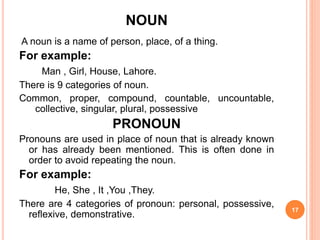
NOUN
A noun is a name of person, place, of a thing.
For example:
Man , Girl, House, Lahore.
There is 9 categories of noun.
Common, proper, compound, countable, uncountable,
collective, singular, plural, possessive
PRONOUN
Pronouns are used in place of noun that is already known
or has already been mentioned. This is often done in
order to avoid repeating the noun.
For example:
He, She , It ,You ,They.
There are 4 categories of pronoun: personal, possessive,
reflexive, demonstrative.
17
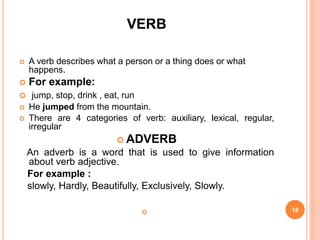
VERB
 A verb describes what a person or a thing does or what
happens.
 For example:
 jump, stop, drink , eat, run
 He jumped from the mountain.
 There are 4 categories of verb: auxiliary, lexical, regular,
irregular
 ADVERB
An adverb is a word that is used to give information
about verb adjective.
For example :
slowly, Hardly, Beautifully, Exclusively, Slowly.
 18
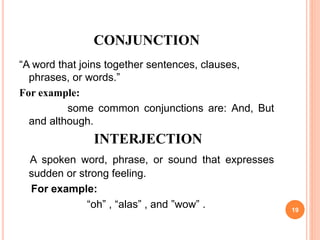
CONJUNCTION
“A word that joins together sentences, clauses,
phrases, or words.”
For example:
some common conjunctions are: And, But
and although.
INTERJECTION
A spoken word, phrase, or sound that expresses
sudden or strong feeling.
For example:
“oh” , “alas” , and ”wow” . 19
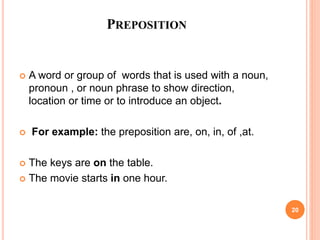
PREPOSITION
 A word or group of words that is used with a noun,
pronoun , or noun phrase to show direction,
location or time or to introduce an object.
 For example: the preposition are, on, in, of ,at.
 The keys are on the table.
 The movie starts in one hour.
20
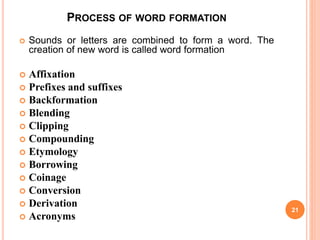
PROCESS OF WORD FORMATION
 Sounds or letters are combined to form a word. The
creation of new word is called word formation
 Affixation
 Prefixes and suffixes
 Backformation
 Blending
 Clipping
 Compounding
 Etymology
 Borrowing
 Coinage
 Conversion
 Derivation
 Acronyms
21
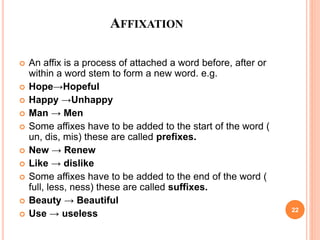
AFFIXATION
 An affix is a process of attached a word before, after or
within a word stem to form a new word. e.g.
 Hope→Hopeful
 Happy →Unhappy
 Man → Men
 Some affixes have to be added to the start of the word (
un, dis, mis) these are called prefixes.
 New → Renew
 Like → dislike
 Some affixes have to be added to the end of the word (
full, less, ness) these are called suffixes.
 Beauty → Beautiful
 Use → useless 22
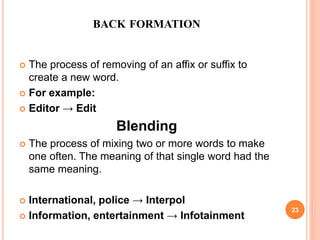
BACK FORMATION
 The process of removing of an affix or suffix to
create a new word.
 For example:
 Editor → Edit
Blending
 The process of mixing two or more words to make
one often. The meaning of that single word had the
same meaning.
 International, police → Interpol
 Information, entertainment → Infotainment
23
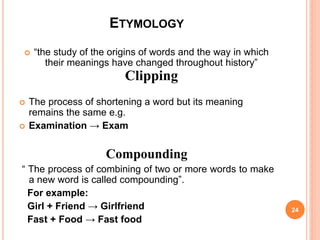
ETYMOLOGY
 “the study of the origins of words and the way in which
their meanings have changed throughout history”
Clipping
 The process of shortening a word but its meaning
remains the same e.g.
 Examination → Exam
Compounding
“ The process of combining of two or more words to make
a new word is called compounding”.
For example:
Girl + Friend → Girlfriend
Fast + Food → Fast food
24
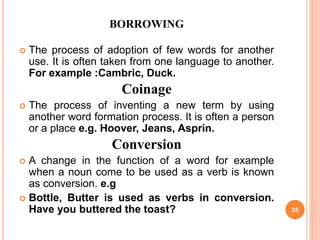
BORROWING
 The process of adoption of few words for another
use. It is often taken from one language to another.
For example :Cambric, Duck.
Coinage
 The process of inventing a new term by using
another word formation process. It is often a person
or a place e.g. Hoover, Jeans, Asprin.
Conversion
 A change in the function of a word for example
when a noun come to be used as a verb is known
as conversion. e.g
 Bottle, Butter is used as verbs in conversion.
Have you buttered the toast? 25
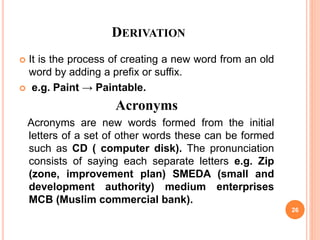
DERIVATION
 It is the process of creating a new word from an old
word by adding a prefix or suffix.
 e.g. Paint → Paintable.
Acronyms
Acronyms are new words formed from the initial
letters of a set of other words these can be formed
such as CD ( computer disk). The pronunciation
consists of saying each separate letters e.g. Zip
(zone, improvement plan) SMEDA (small and
development authority) medium enterprises
MCB (Muslim commercial bank).
26
CONCLUSION:
 To sum up the discussion , we learnt that without
this process we are unable to make any word or
sentence. This process helps us to make
grammatical structure of sentence and also makes
new words.
27
28
29

Words- morphology- syntax 2

  • 1.
  • 2.
  • 3.
  • 4.
  • 5.
    GROUP NO:4 KIRAN NAZIR AQSAA.R ANEEZA AKRAM FARWA RANA RAHEELA RANI 5
  • 6.
    DEFINITION OF WORD A single distinct meaningful element of speech or writing, used with others (or sometimes alone) to form a sentence. TYPES OF WORDS Some grammarians divide words into 2 categories. 1. Content words 2. Function words 6
  • 7.
     Content words:have clear lexical meaning → open class →new words can be added  Function words: have a functional purpose → closed class → new words cannot be added Morphology  In linguistics morphology is the study how words are formed and their relationship to other words in same language. 7
  • 8.
    MORPHEMES  In manylanguages the words are made up of a large number of elements. In linguistics from is called “elements” but technically is called “morphemes” .  Ex: peace (1 morpheme) peaceful (2 morphemes) peacefully (3 morphemes) TYPES OF MORPHEMES  There are two types of morphemes: 1:Free morphemes 2:Bound morphemes 8
  • 9.
    FREE MORPHEMES  Itis the smallest unit of language that cannot be further divided .It can stand alone.  For example: New , Close, Rose BOUND MORPHEMES  A bound morpheme is a morpheme that cannot stand alone as a word. In English bound morpheme includes prefixes and suffixes Ex: pre, un, ness, y Examples of morphemes action unchanged rainbow untrustworthy 9
  • 10.
    DIAGRAM FOR REVIEW 10 Morphemes boundfree Derivational inflectional lexical functional (Grammatical (function is function is changed) changed)
  • 11.
    TWO TYPES OFFREE MORPHEMES 1:Lexical morphemes 2:Functional morphemes TWO TYPES OF BOUND MORPHEMES 1:Derivational morphemes 2:Inflectional morphemes 11
  • 12.
    LEXICAL MORPHEMES  Itis the set of nouns, adjectives and verbs which are meaningful and convey message is called lexical morphemes.  For example: Ali, Good, Look Functional morphemes  It is the set of functional words such conjunctions, propositions and articles.  For example But, it, because, and, on, about 12
  • 13.
    DERIVATIONAL MORPHEMES  Theuse of affixes to make words of different grammatical category is called derivational morpheme.  For example: By adding Derivational morpheme “ness” in adjective “good” to noun ”goodness” INFLECTIONAL MORPHEMES  The other set of bound morphemes which is not used to create new words is called inflectional morpheme. But it is used to show grammatical function of a word if it is singular or plural, past tense or not, if it is a comparative or possessive from.  Shan’s eyes are beautiful. 13
  • 14.
    ALLOMORPHES  Allomorphs aredifferent form of morphemes in which sounds and phonetic symbols are change but meanings are same.  There are four types of allomorphs:  Additive allomorphs  Replacive allomorphs  Suppletive allomorphs  The zero allomorphs 14
  • 15.
    EXPLANATION OF TYPES oAdditive allomorphs: Some difference in meaning, Something added to a word. Adding the suffix or prefix in a word. o Replacive allomorphs: some difference meaning, a sound is replace to another sound in a word. o Suppletive allomorphs: some difference in meaning, There is a complete change in the shape of a word. o Zero allomorphs: no change in the shape of a word but have some difference in meanings. 15
  • 16.
    PARTS OF SPEECH The parts of speech indicate how the words function in meaning as well as grammatically within the sentence.  There are 8 parts of speech in English language which are listed below. 1:NOUN 2:PRONOUN 3:VERB 4:ADVERB 5:ADJECTIVE 6:CONJUNCTION 7:INTERJECTION 8:PREPOSITION 16
  • 17.
    NOUN A noun isa name of person, place, of a thing. For example: Man , Girl, House, Lahore. There is 9 categories of noun. Common, proper, compound, countable, uncountable, collective, singular, plural, possessive PRONOUN Pronouns are used in place of noun that is already known or has already been mentioned. This is often done in order to avoid repeating the noun. For example: He, She , It ,You ,They. There are 4 categories of pronoun: personal, possessive, reflexive, demonstrative. 17
  • 18.
    VERB  A verbdescribes what a person or a thing does or what happens.  For example:  jump, stop, drink , eat, run  He jumped from the mountain.  There are 4 categories of verb: auxiliary, lexical, regular, irregular  ADVERB An adverb is a word that is used to give information about verb adjective. For example : slowly, Hardly, Beautifully, Exclusively, Slowly.  18
  • 19.
    CONJUNCTION “A word thatjoins together sentences, clauses, phrases, or words.” For example: some common conjunctions are: And, But and although. INTERJECTION A spoken word, phrase, or sound that expresses sudden or strong feeling. For example: “oh” , “alas” , and ”wow” . 19
  • 20.
    PREPOSITION  A wordor group of words that is used with a noun, pronoun , or noun phrase to show direction, location or time or to introduce an object.  For example: the preposition are, on, in, of ,at.  The keys are on the table.  The movie starts in one hour. 20
  • 21.
    PROCESS OF WORDFORMATION  Sounds or letters are combined to form a word. The creation of new word is called word formation  Affixation  Prefixes and suffixes  Backformation  Blending  Clipping  Compounding  Etymology  Borrowing  Coinage  Conversion  Derivation  Acronyms 21
  • 22.
    AFFIXATION  An affixis a process of attached a word before, after or within a word stem to form a new word. e.g.  Hope→Hopeful  Happy →Unhappy  Man → Men  Some affixes have to be added to the start of the word ( un, dis, mis) these are called prefixes.  New → Renew  Like → dislike  Some affixes have to be added to the end of the word ( full, less, ness) these are called suffixes.  Beauty → Beautiful  Use → useless 22
  • 23.
    BACK FORMATION  Theprocess of removing of an affix or suffix to create a new word.  For example:  Editor → Edit Blending  The process of mixing two or more words to make one often. The meaning of that single word had the same meaning.  International, police → Interpol  Information, entertainment → Infotainment 23
  • 24.
    ETYMOLOGY  “the studyof the origins of words and the way in which their meanings have changed throughout history” Clipping  The process of shortening a word but its meaning remains the same e.g.  Examination → Exam Compounding “ The process of combining of two or more words to make a new word is called compounding”. For example: Girl + Friend → Girlfriend Fast + Food → Fast food 24
  • 25.
    BORROWING  The processof adoption of few words for another use. It is often taken from one language to another. For example :Cambric, Duck. Coinage  The process of inventing a new term by using another word formation process. It is often a person or a place e.g. Hoover, Jeans, Asprin. Conversion  A change in the function of a word for example when a noun come to be used as a verb is known as conversion. e.g  Bottle, Butter is used as verbs in conversion. Have you buttered the toast? 25
  • 26.
    DERIVATION  It isthe process of creating a new word from an old word by adding a prefix or suffix.  e.g. Paint → Paintable. Acronyms Acronyms are new words formed from the initial letters of a set of other words these can be formed such as CD ( computer disk). The pronunciation consists of saying each separate letters e.g. Zip (zone, improvement plan) SMEDA (small and development authority) medium enterprises MCB (Muslim commercial bank). 26
  • 27.
    CONCLUSION:  To sumup the discussion , we learnt that without this process we are unable to make any word or sentence. This process helps us to make grammatical structure of sentence and also makes new words. 27
  • 28.
  • 29.