Attacks and
VulnerabilitiesVulnerabilities
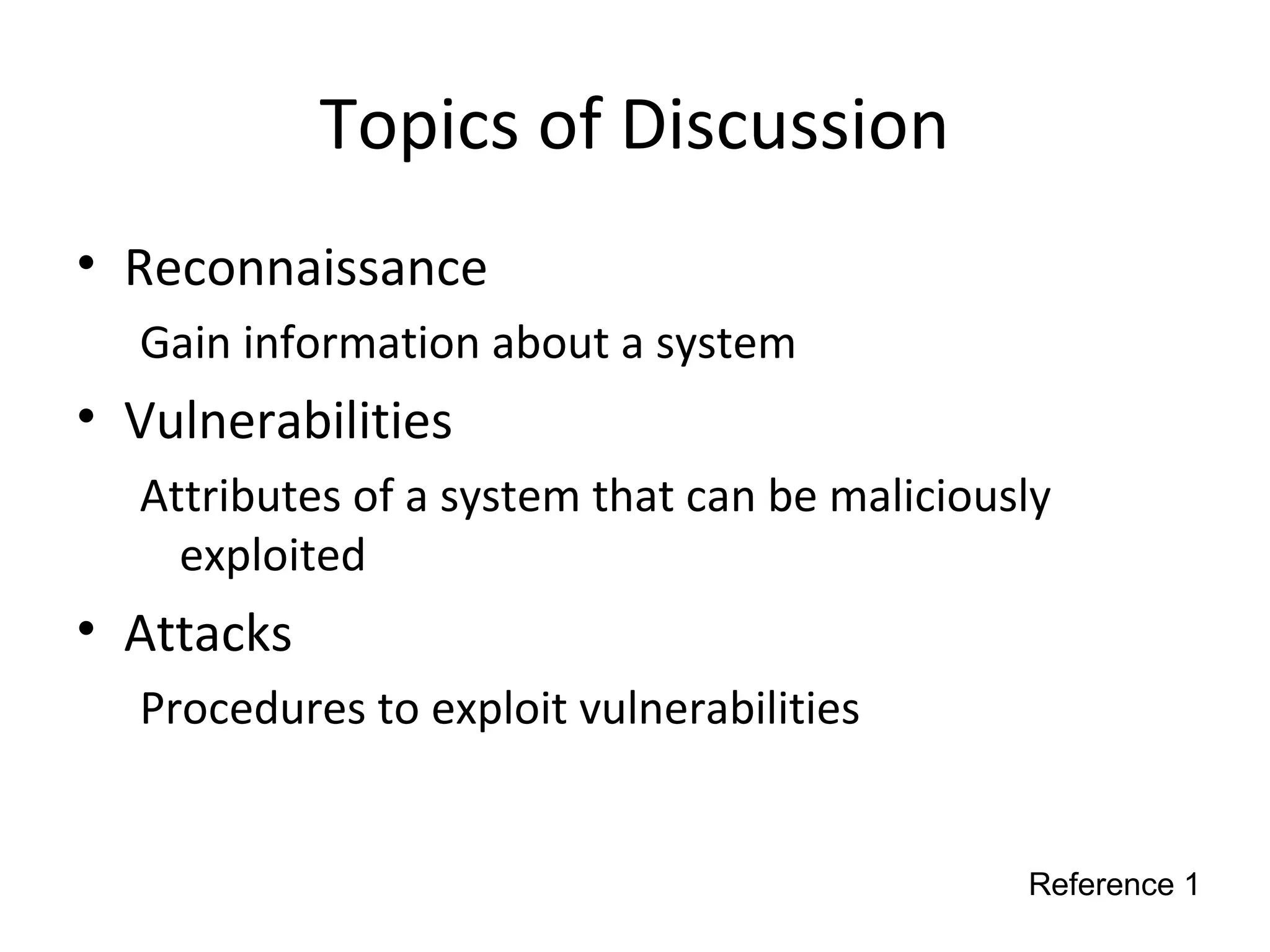
Topics of Discussion
• Reconnaissance
Gain information about a system
• Vulnerabilities
Attributes of a system that can be maliciously
exploited
• Attacks
Procedures to exploit vulnerabilities
Reference 1
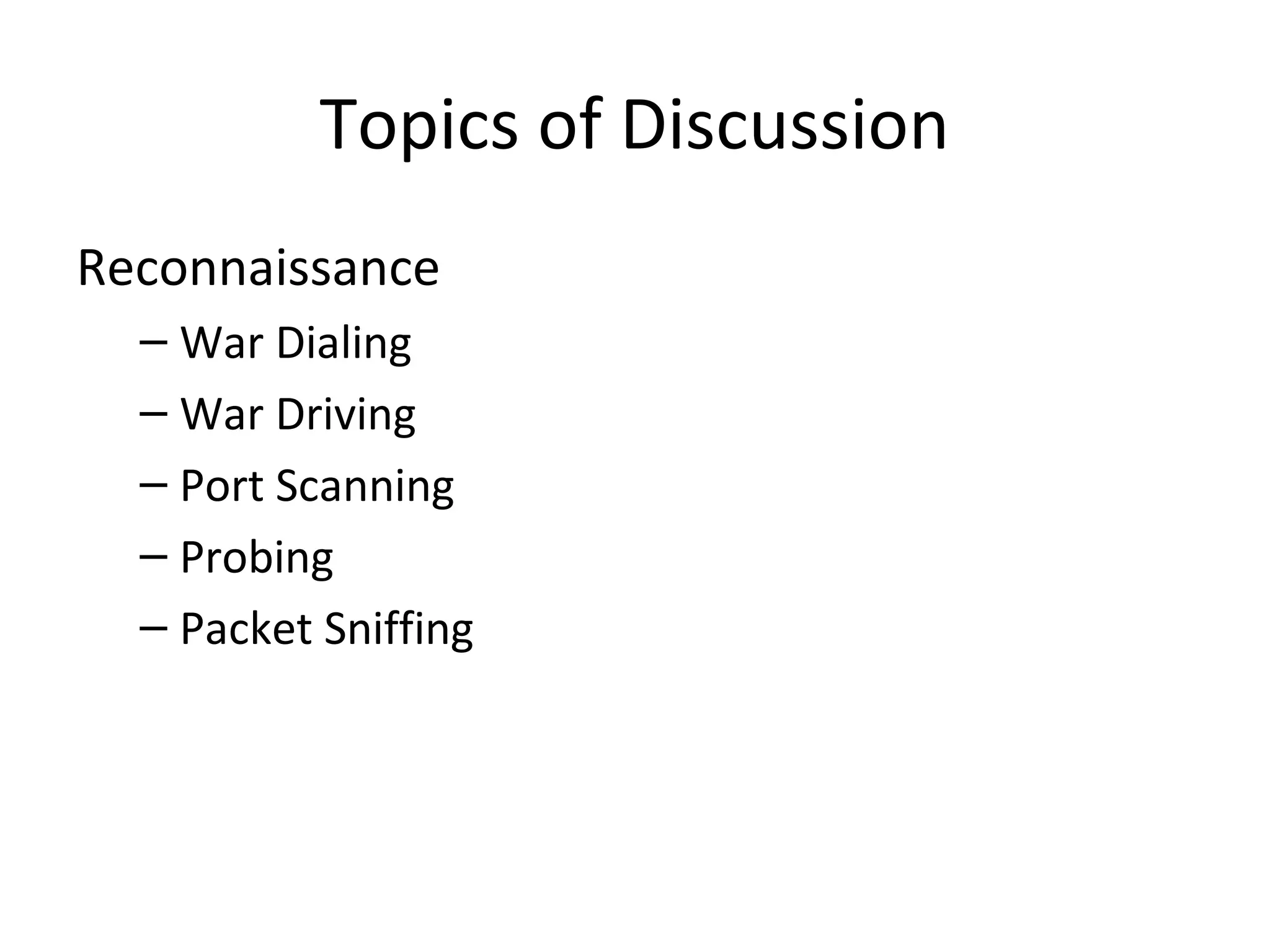
Topics of Discussion
Reconnaissance
– War Dialing
– War Driving
– Port Scanning
– Probing
– Packet Sniffing
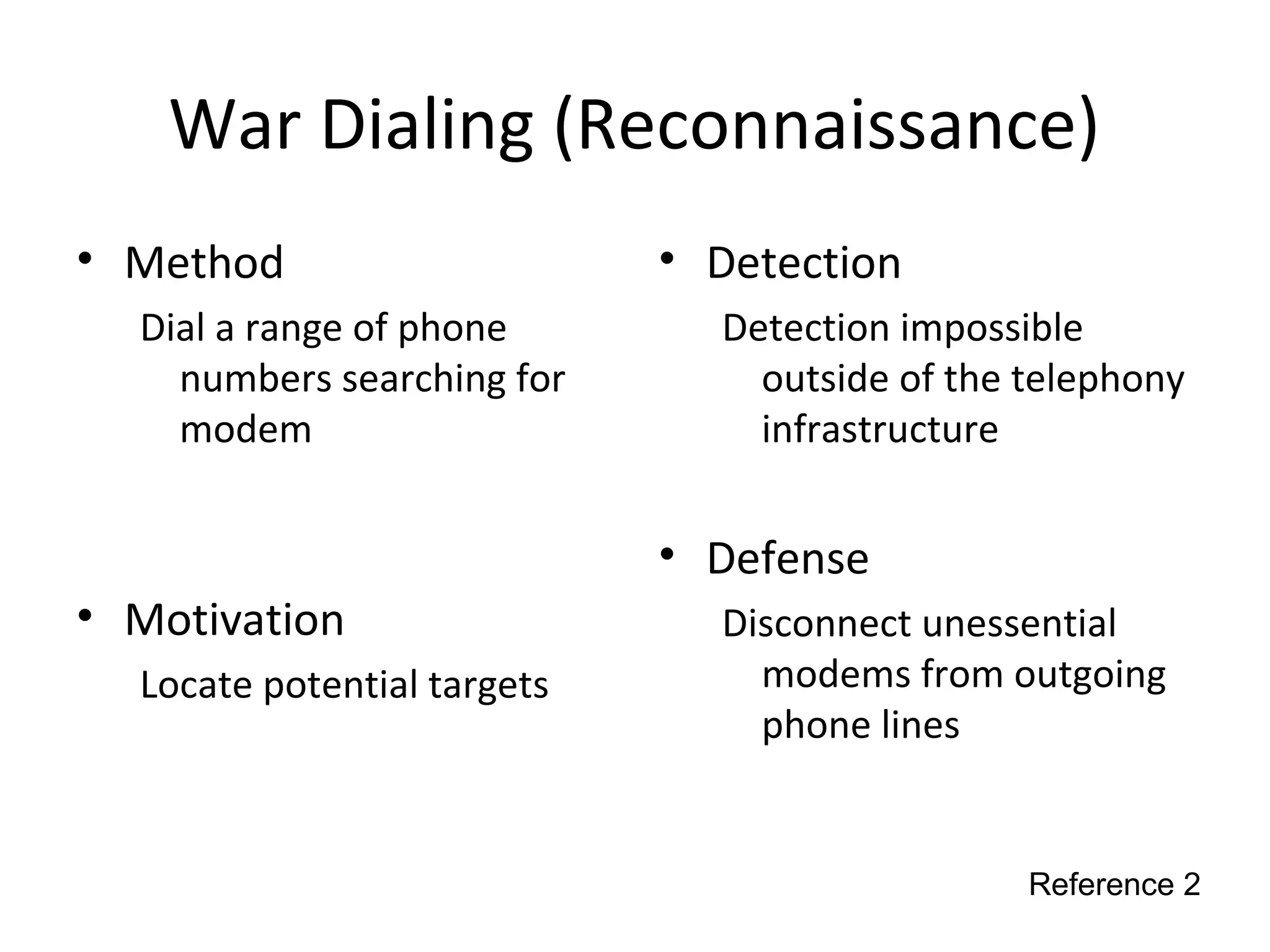
War Dialing (Reconnaissance)
• Method
Dial a range of phone
numbers searching for
modem
• Motivation
Locate potential targets
• Detection
Detection impossible
outside of the telephony
infrastructure
• Defense
Disconnect unessential
modems from outgoing
phone lines
Reference 2
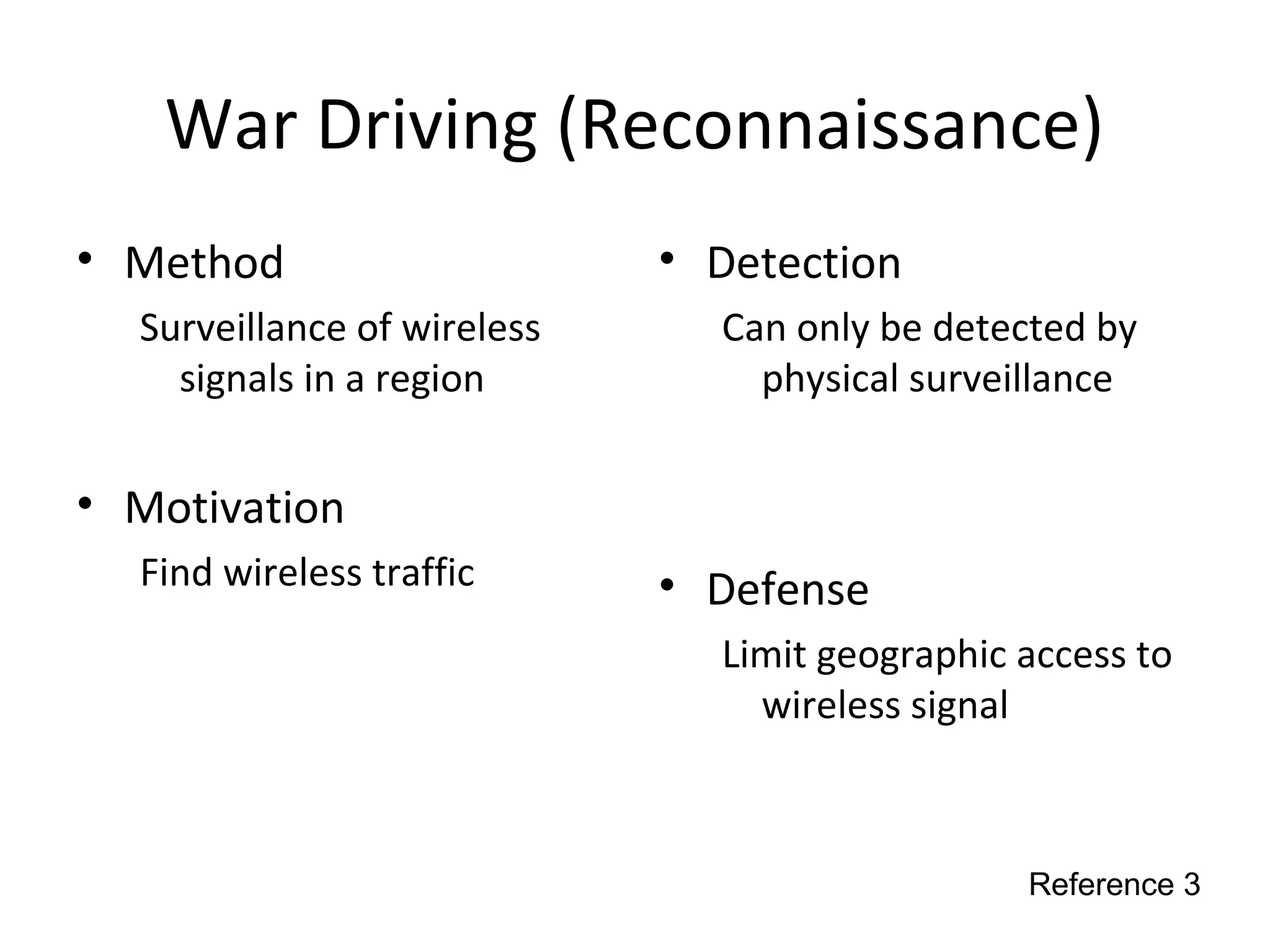
War Driving (Reconnaissance)
• Method
Surveillance of wireless
signals in a region
• Motivation
Find wireless traffic
• Detection
Can only be detected by
physical surveillance
• Defense
Limit geographic access to
wireless signal
Reference 3
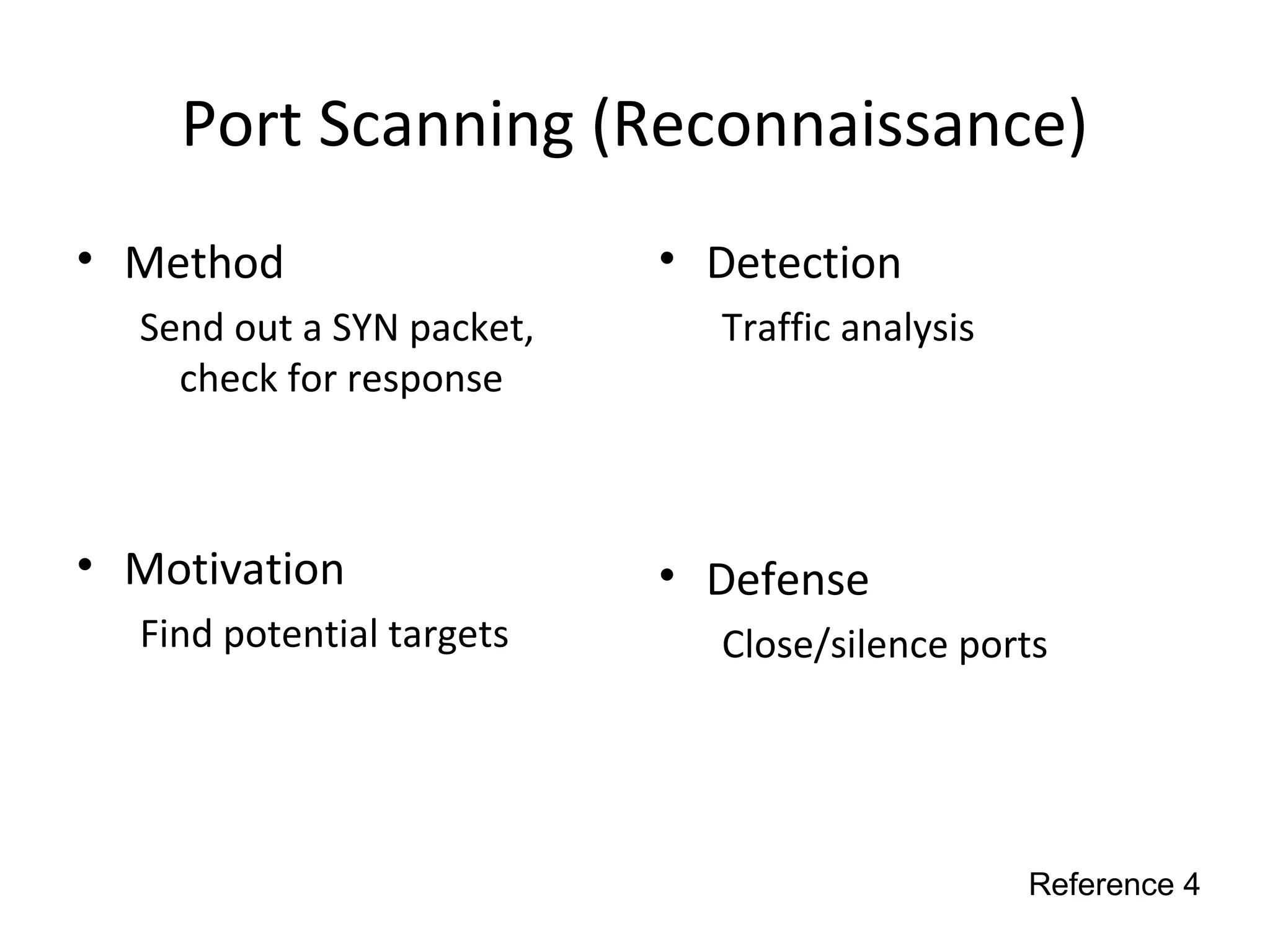
Port Scanning (Reconnaissance)
• Method
Send out a SYN packet,
check for response
• Motivation
Find potential targets
• Detection
Traffic analysis
• Defense
Close/silence ports
Reference 4
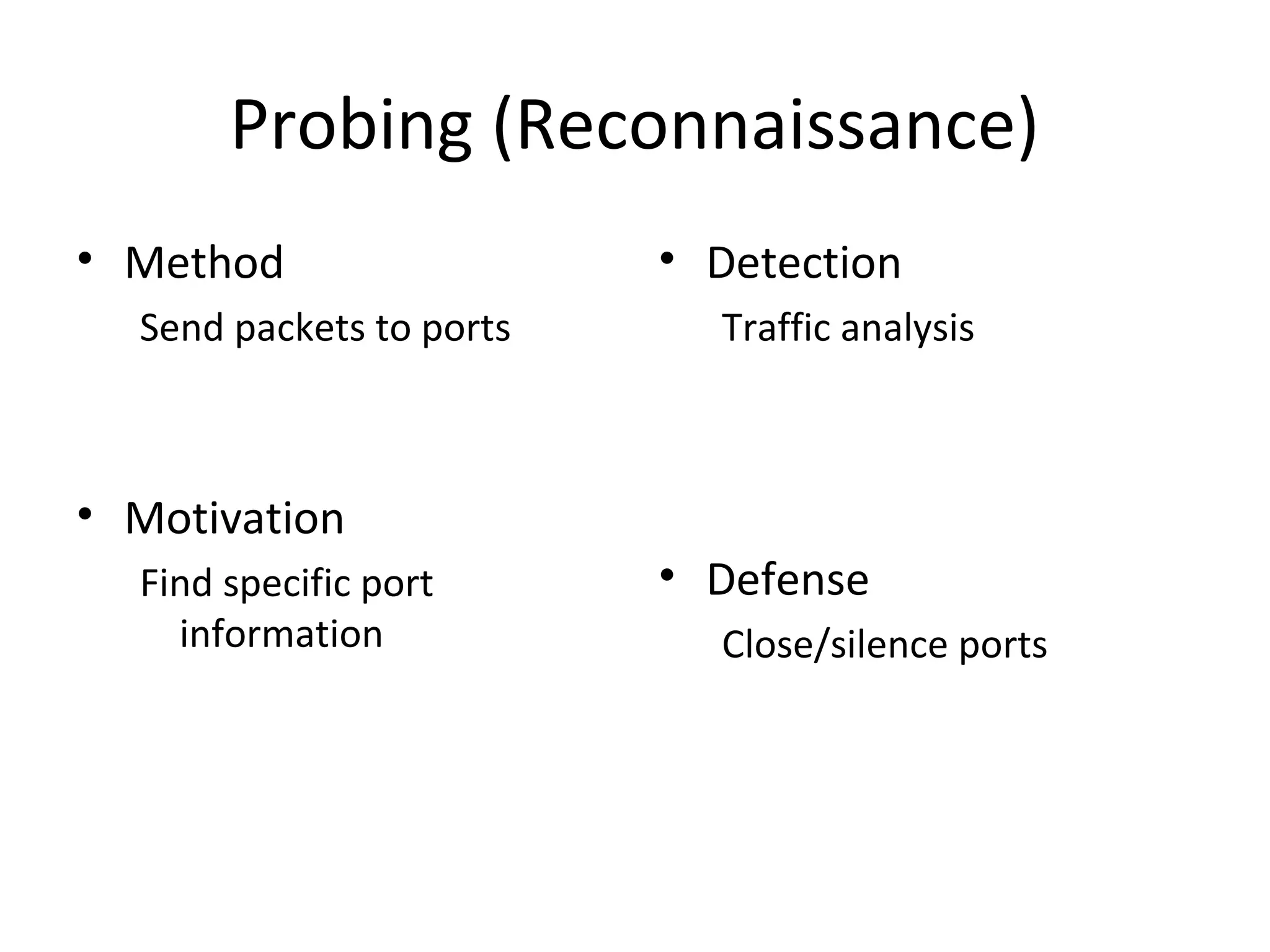
Probing (Reconnaissance)
• Method
Send packets to ports
• Motivation
Find specific port
information
• Detection
Traffic analysis
• Defense
Close/silence ports
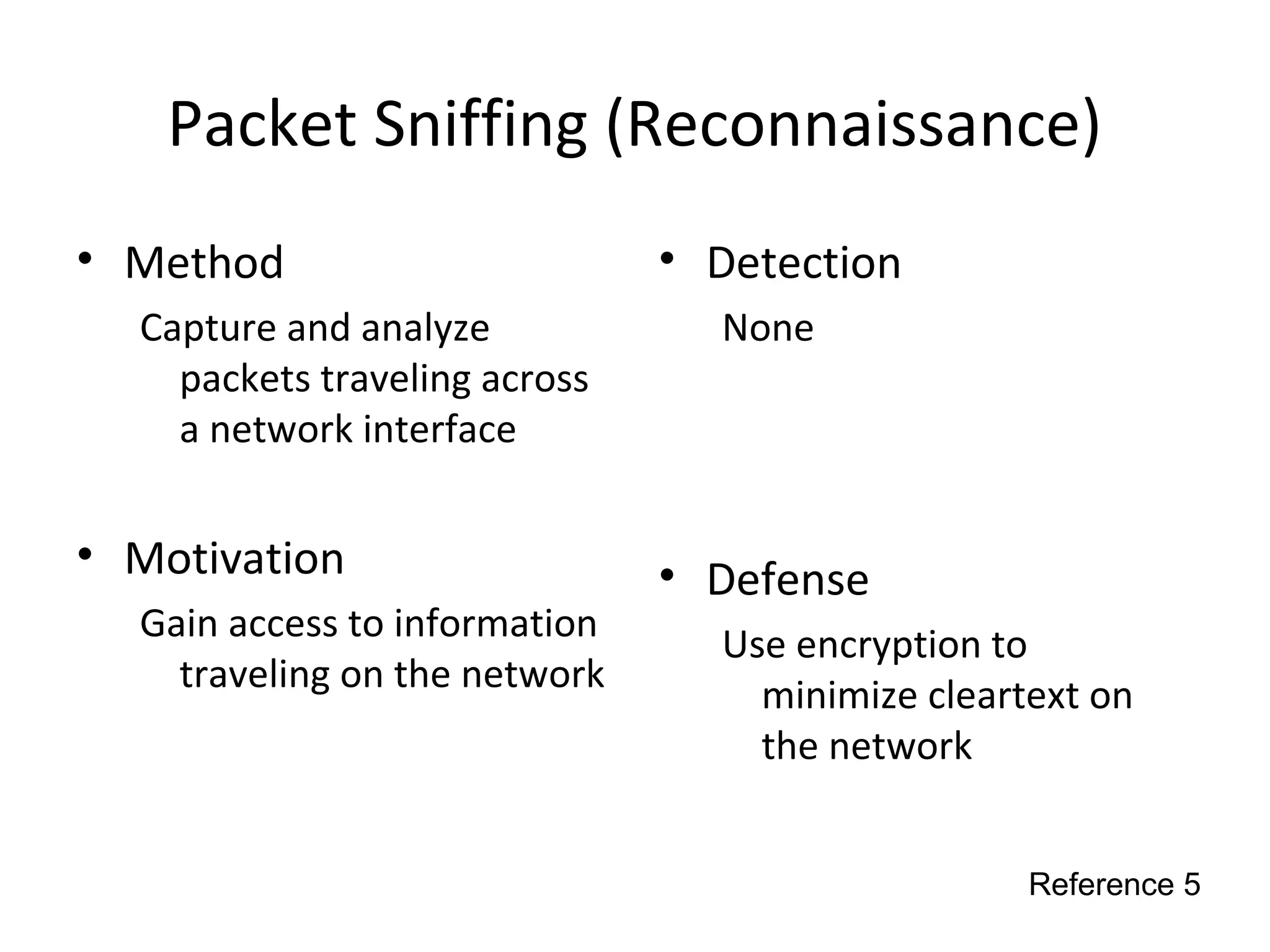
Packet Sniffing (Reconnaissance)
• Method
Capture and analyze
packets traveling across
a network interface
• Motivation
Gain access to information
traveling on the network
• Detection
None
• Defense
Use encryption to
minimize cleartext on
the network
Reference 5
Topics of Discussion
Vulnerabilities
– Backdoors
– Code Exploits
– Eavesdropping
– Indirect Attacks
– Social Engineering
Backdoors (Vulnerabilities)
• Bypass normal means of authentication
• Hidden from casual inspection
• Installed separately or integrated into
software
Reference 6
Code Exploits (Vulnerabilities)
• Use of poor coding practices left uncaught by
testing
• Defense: In depth unit and integration testing
Eavesdropping (Vulnerability)
• Data transmitted without encryption can be
captured and read by parties other than the
sender and receiver
• Defense: Use of strong cryptography to
minimize cleartext on the network
Indirect Attacks (Vulnerabilities)
• Internet users’ machines can be infected with
zombies and made to perform attacks
• The puppet master is left undetected
• Defense: Train internet users to prevent
zombies and penalize zombie owners
Social Engineering (Vulnerability)
• Manipulate the weakest link of cybersecurity
– the user – to gain access to otherwise
prohibited resources
• Defense: Train personnel to resist the tactics
of software engineering
Reference 7
Topics of Discussion
Attacks
– Password Cracks
– Web Attacks
– Physical Attacks
– Worms & Viruses
– Logic Bomb
– Buffer Overflow
– Phishing
– Bots, and Zombies
– Spyware, Adware, and Malware
– Hardware Keyloggers
– Eavesdropping & Playback attacks
– DDoS
Password Cracks: Brute Force
• Method
Trying all combinations of
legal symbols as
username/password
pairs
• Motivation
Gain access to system
• Detection
Frequent attempts to
authenticate
• Defense
Lockouts – temporary and
permanent
Reference 8
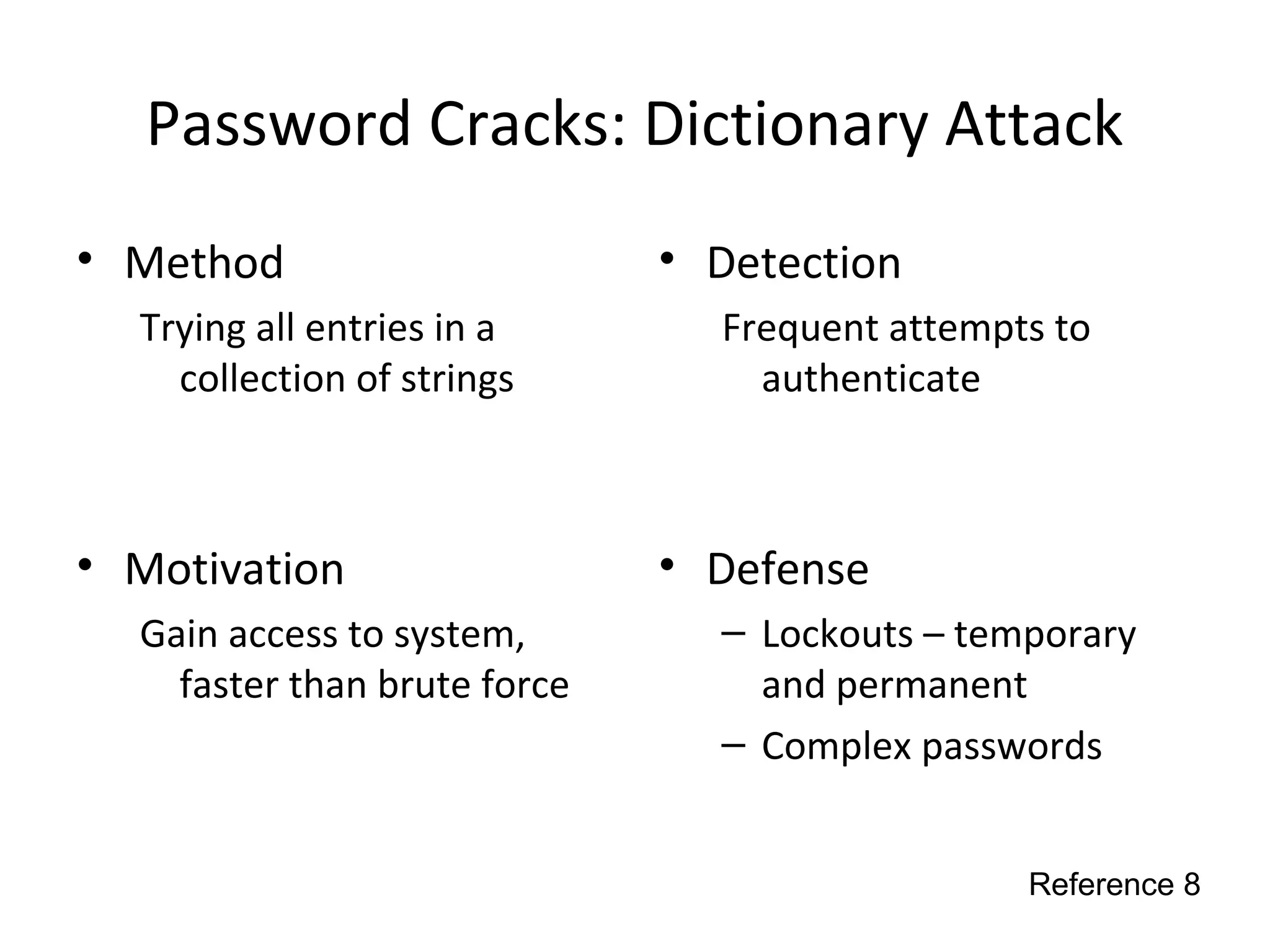
Password Cracks: Dictionary Attack
• Method
Trying all entries in a
collection of strings
• Motivation
Gain access to system,
faster than brute force
• Detection
Frequent attempts to
authenticate
• Defense
– Lockouts – temporary
and permanent
– Complex passwords
Reference 8
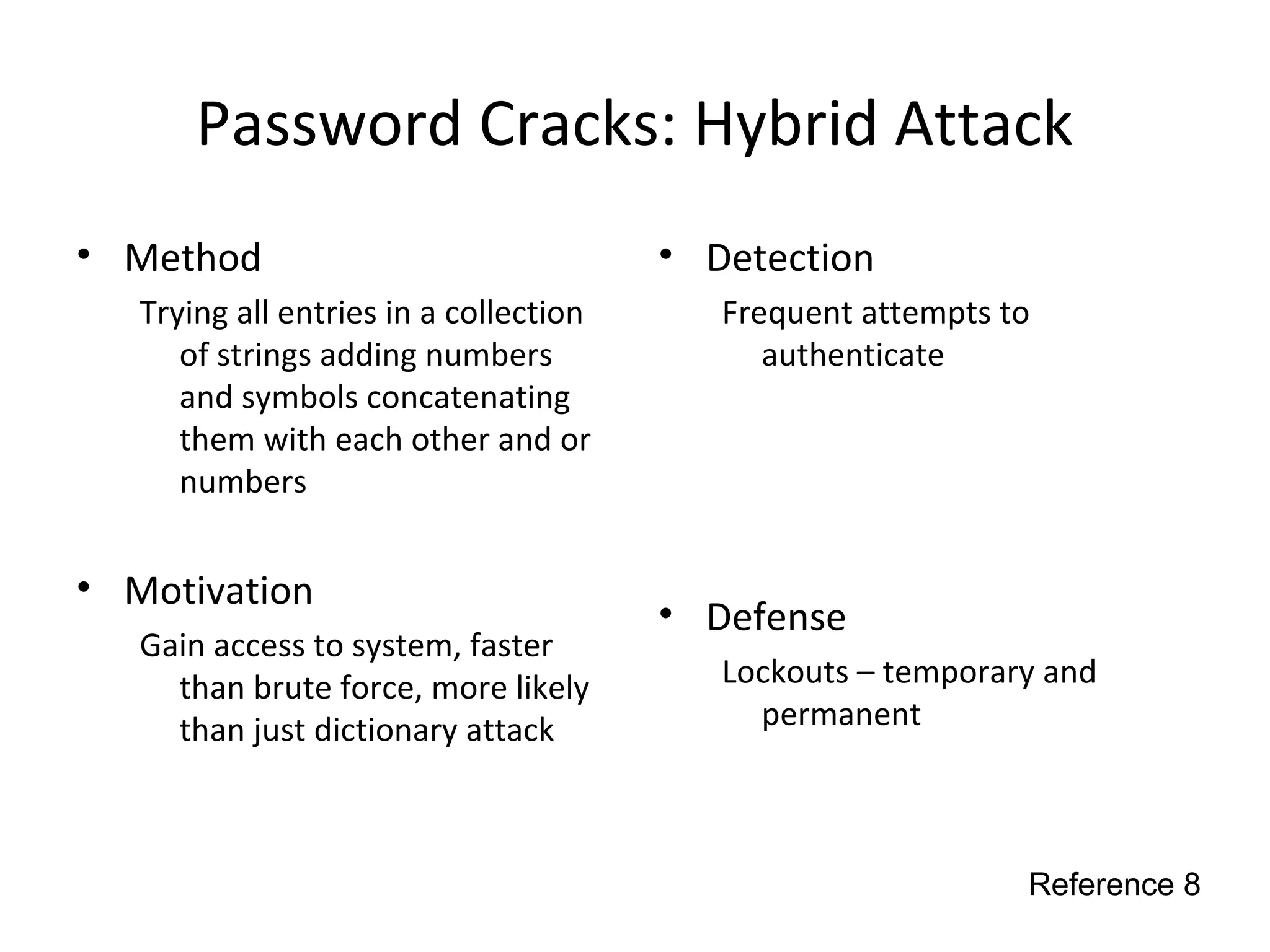
Password Cracks: Hybrid Attack
• Method
Trying all entries in a collection
of strings adding numbers
and symbols concatenating
them with each other and or
numbers
• Motivation
Gain access to system, faster
than brute force, more likely
than just dictionary attack
• Detection
Frequent attempts to
authenticate
• Defense
Lockouts – temporary and
permanent
Reference 8
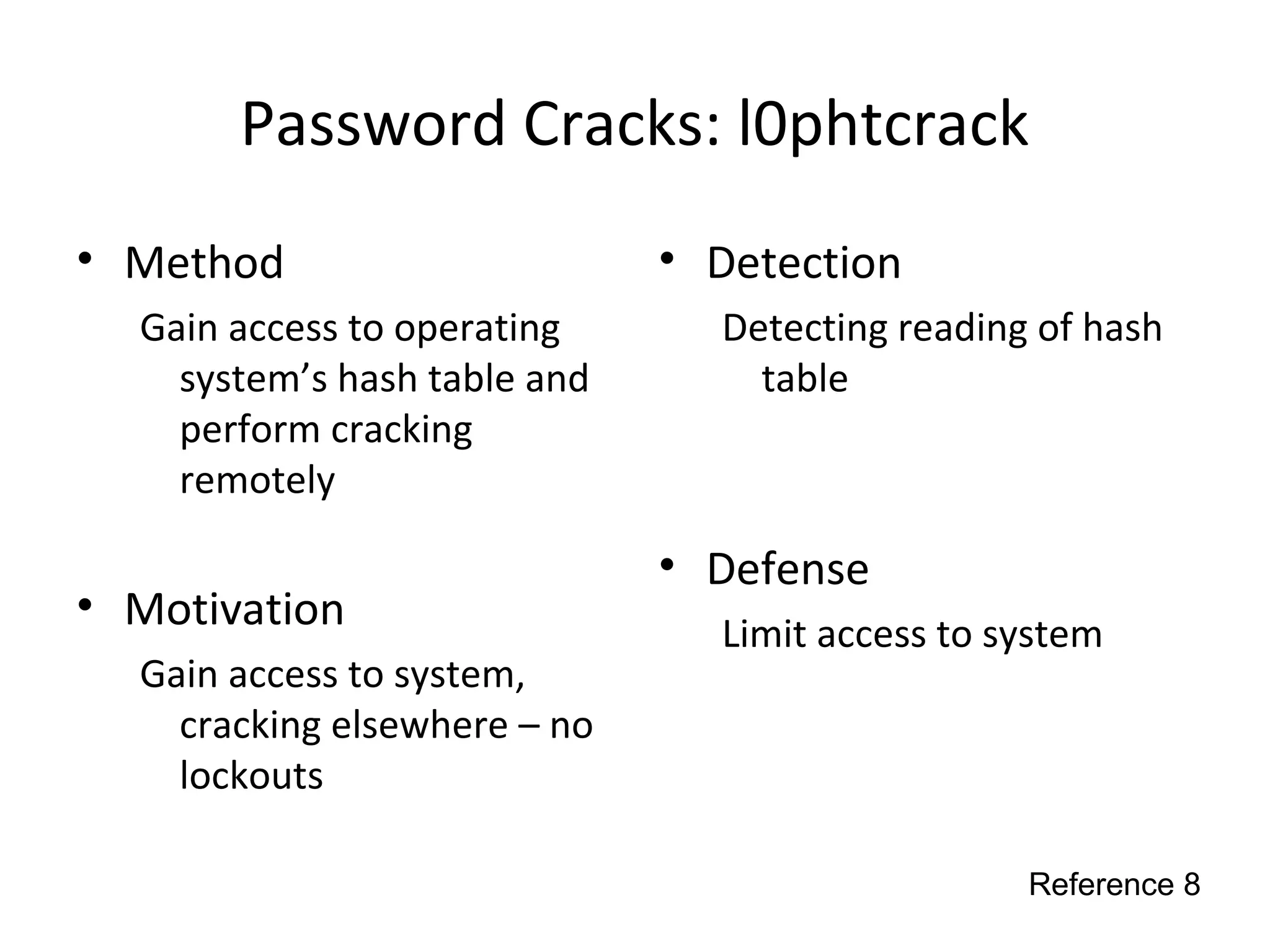
Password Cracks: l0phtcrack
• Method
Gain access to operating
system’s hash table and
perform cracking
remotely
• Motivation
Gain access to system,
cracking elsewhere – no
lockouts
• Detection
Detecting reading of hash
table
• Defense
Limit access to system
Reference 8
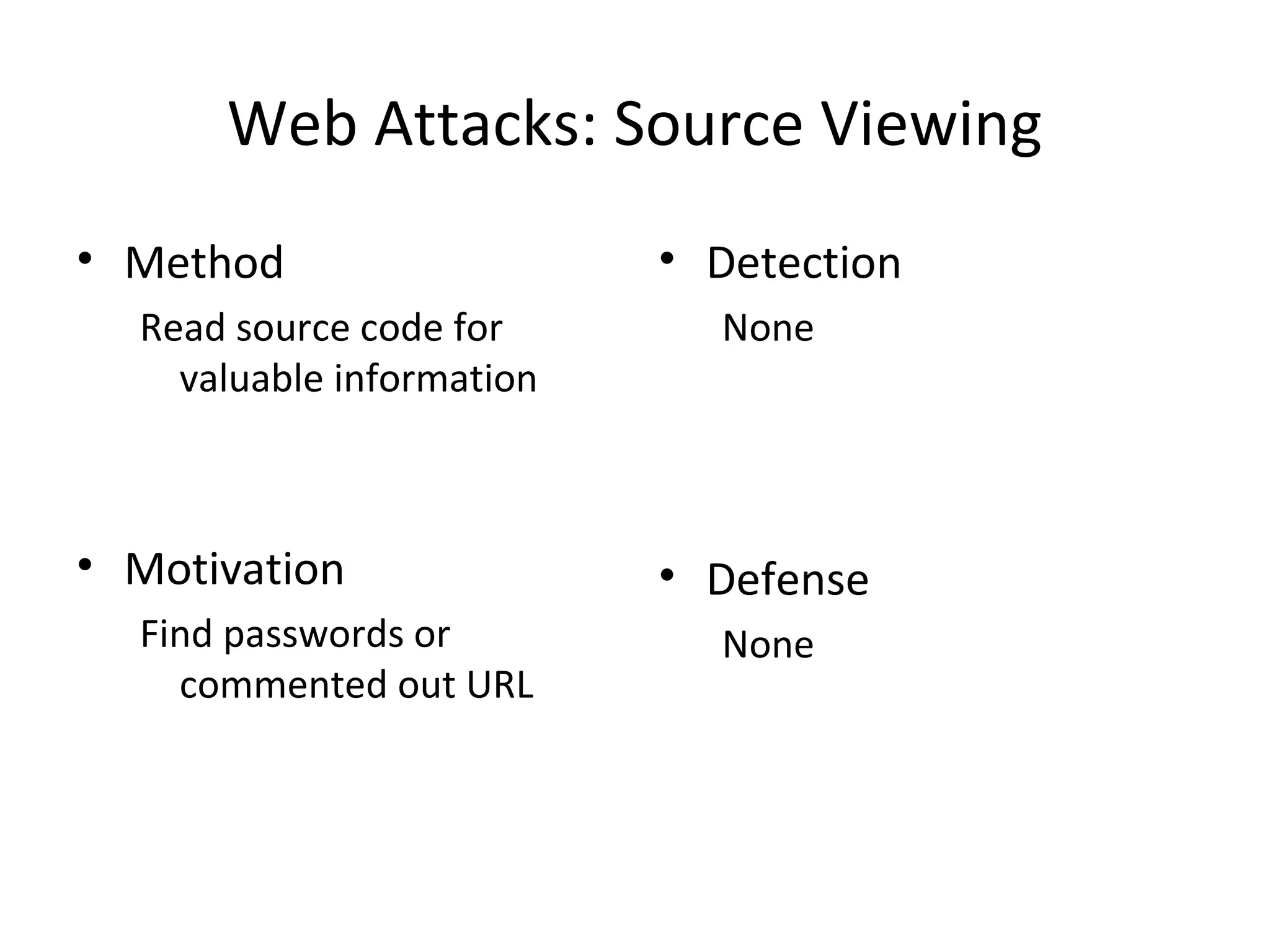
Web Attacks: Source Viewing
• Method
Read source code for
valuable information
• Motivation
Find passwords or
commented out URL
• Detection
None
• Defense
None
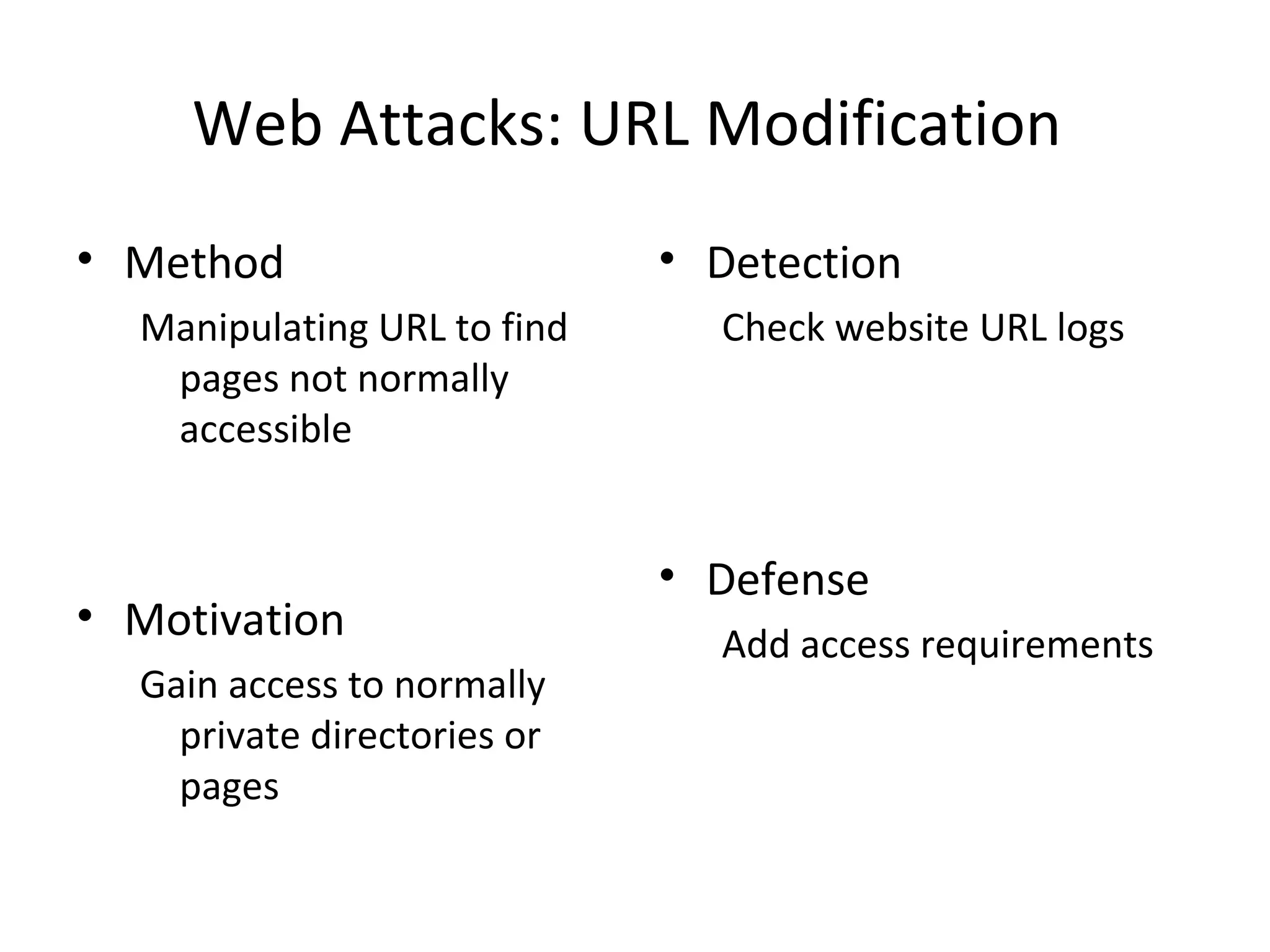
Web Attacks: URL Modification
• Method
Manipulating URL to find
pages not normally
accessible
• Motivation
Gain access to normally
private directories or
pages
• Detection
Check website URL logs
• Defense
Add access requirements
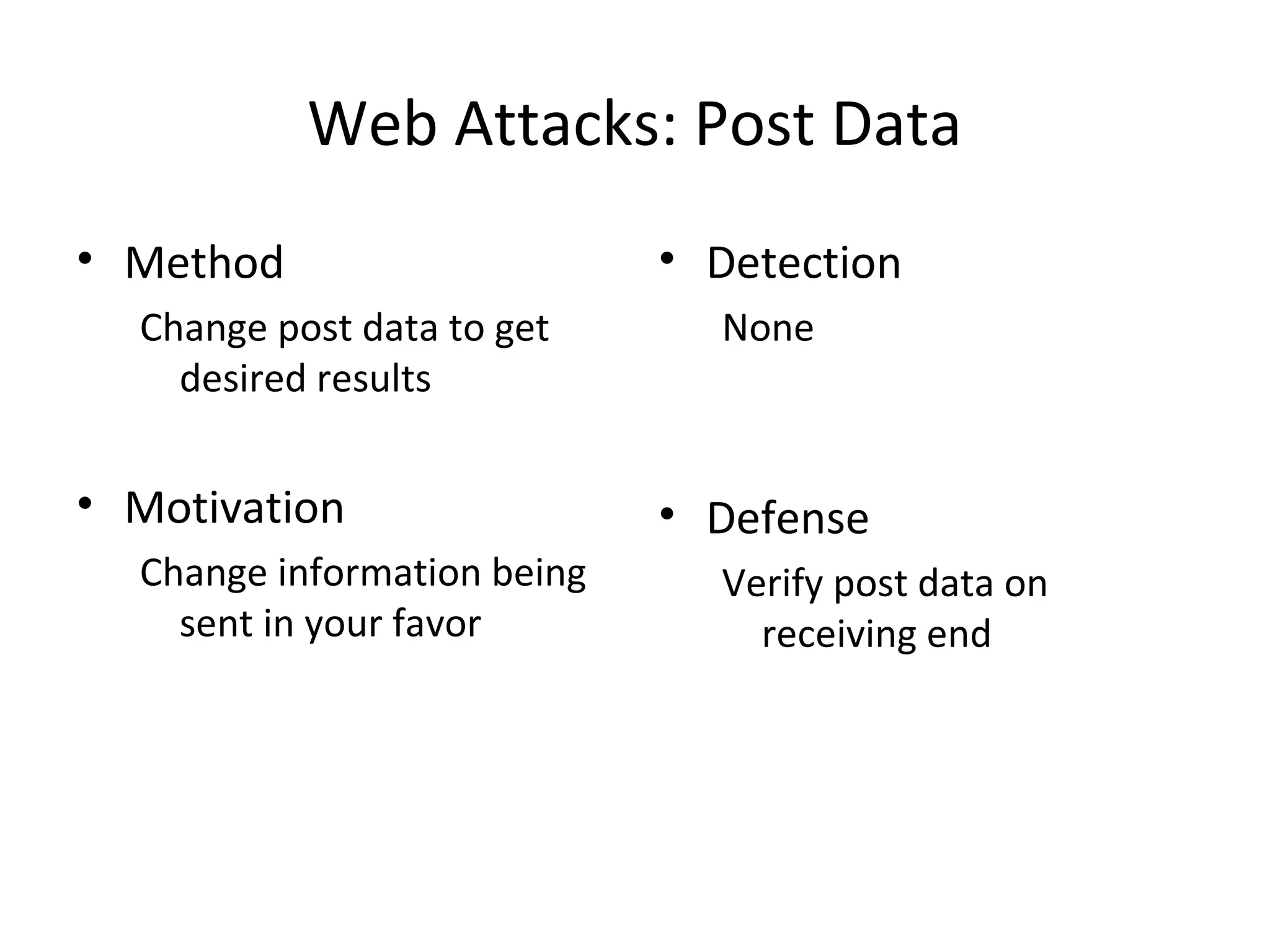
Web Attacks: Post Data
• Method
Change post data to get
desired results
• Motivation
Change information being
sent in your favor
• Detection
None
• Defense
Verify post data on
receiving end
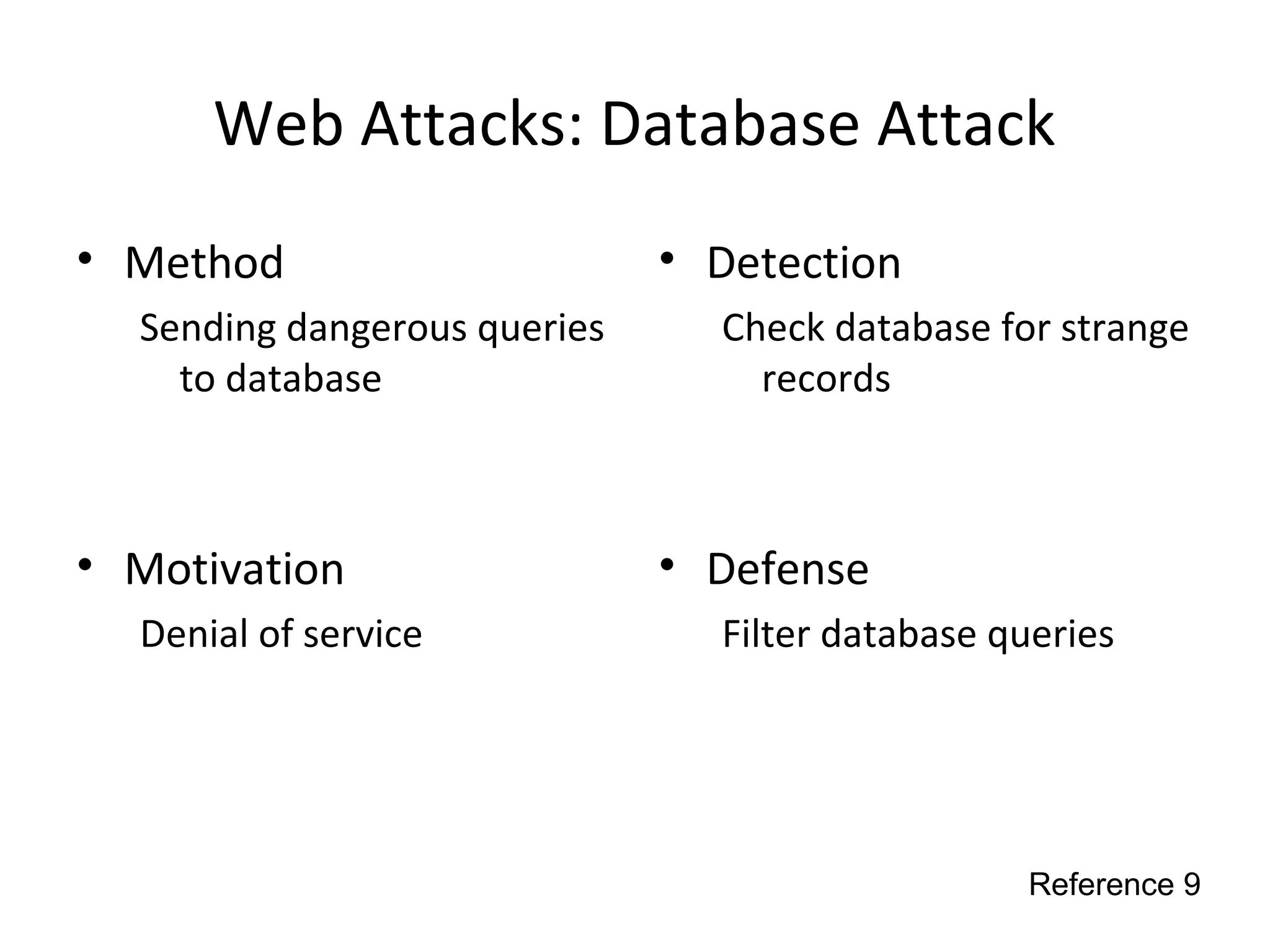
Web Attacks: Database Attack
• Method
Sending dangerous queries
to database
• Motivation
Denial of service
• Detection
Check database for strange
records
• Defense
Filter database queries
Reference 9
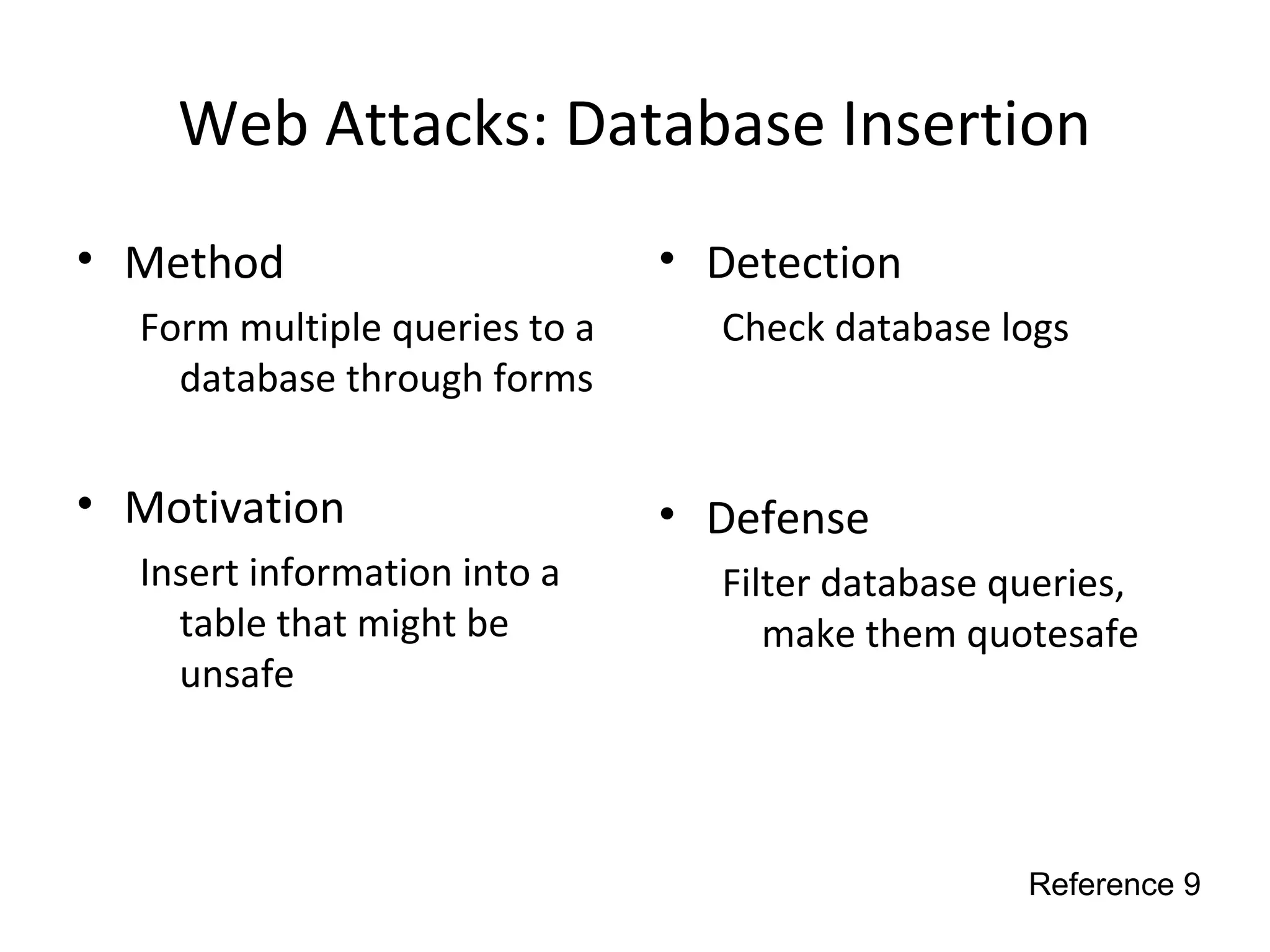
Web Attacks: Database Insertion
• Method
Form multiple queries to a
database through forms
• Motivation
Insert information into a
table that might be
unsafe
• Detection
Check database logs
• Defense
Filter database queries,
make them quotesafe
Reference 9
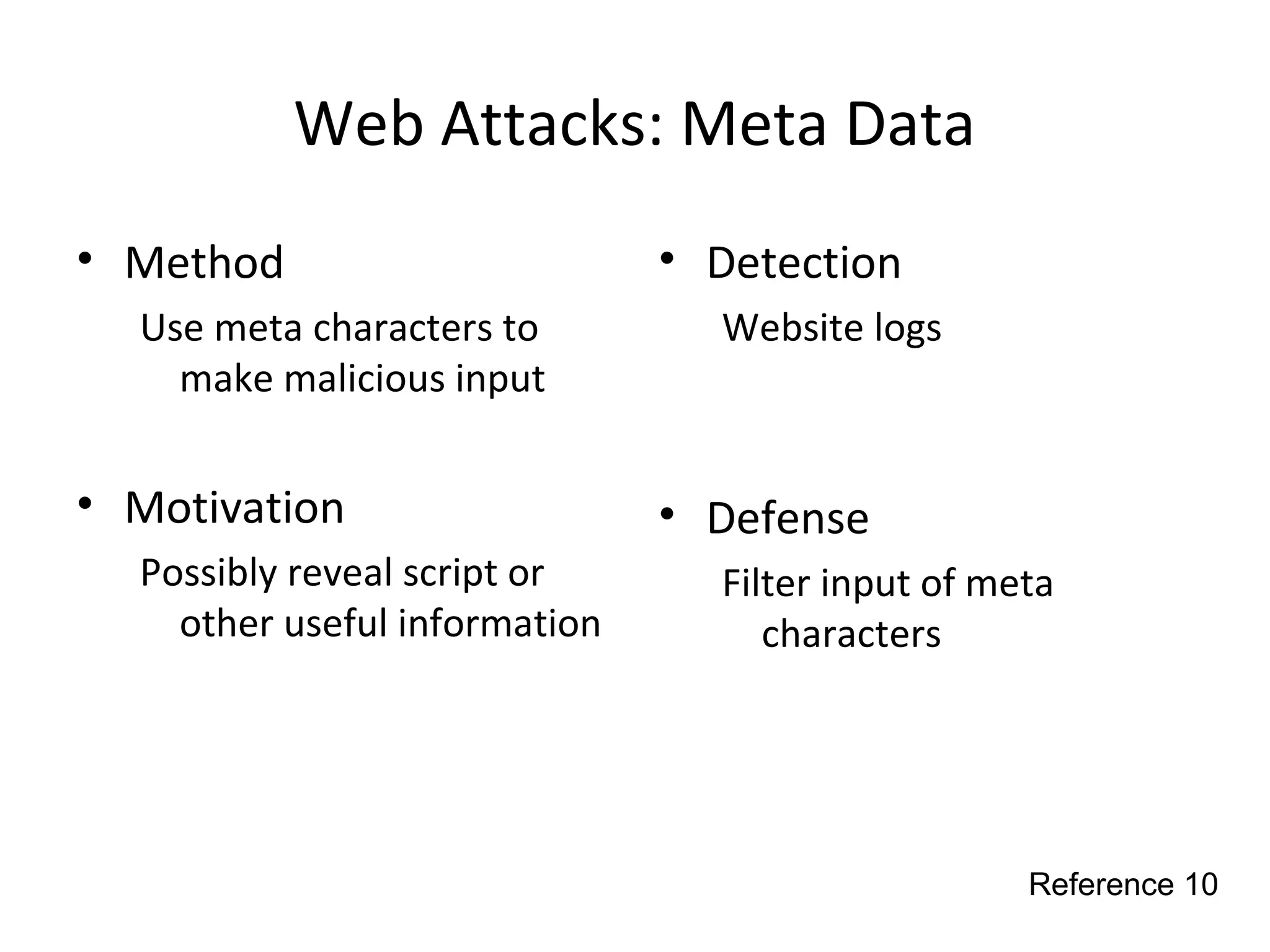
Web Attacks: Meta Data
• Method
Use meta characters to
make malicious input
• Motivation
Possibly reveal script or
other useful information
• Detection
Website logs
• Defense
Filter input of meta
characters
Reference 10
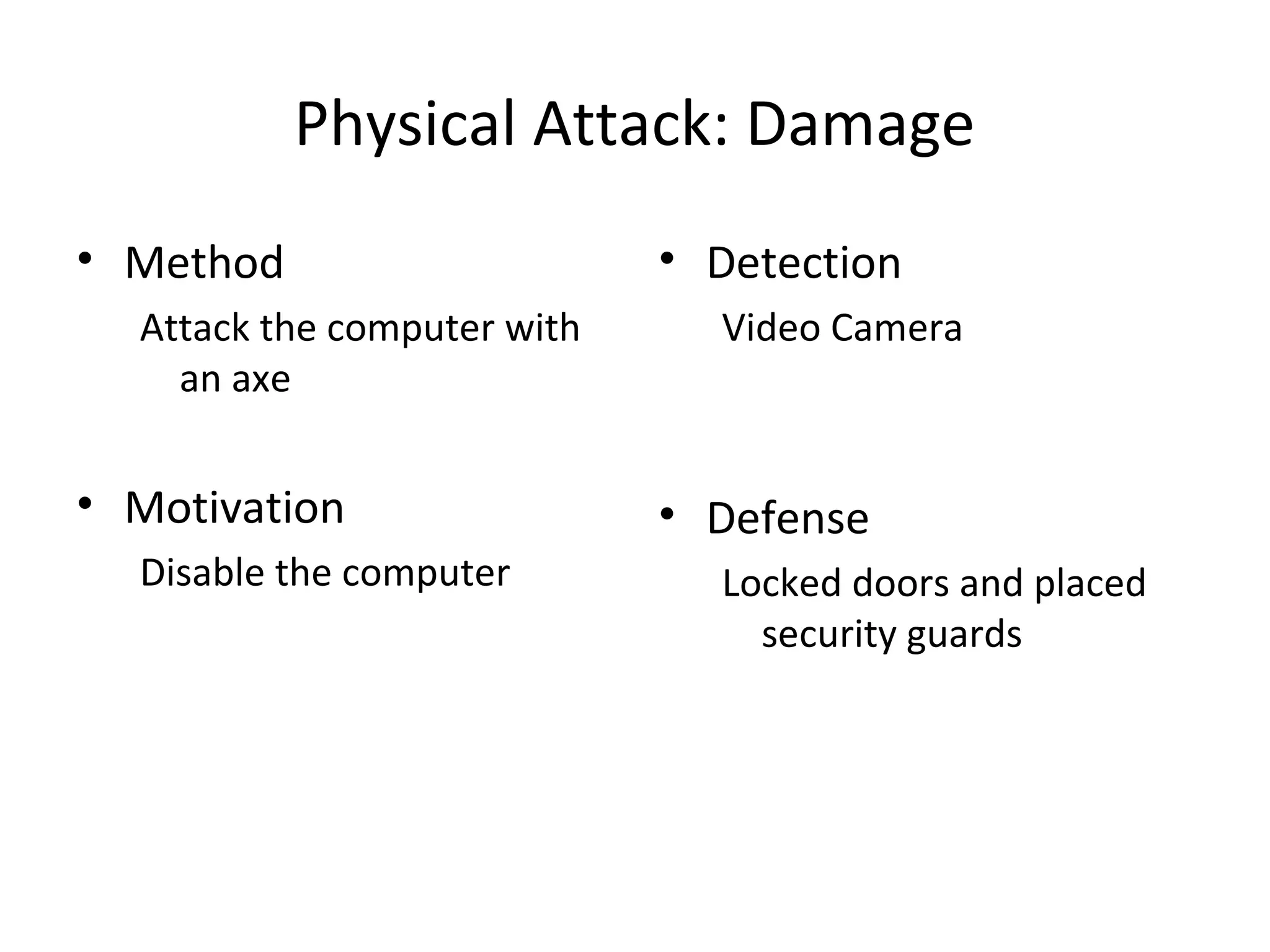
Physical Attack: Damage
• Method
Attack the computer with
an axe
• Motivation
Disable the computer
• Detection
Video Camera
• Defense
Locked doors and placed
security guards
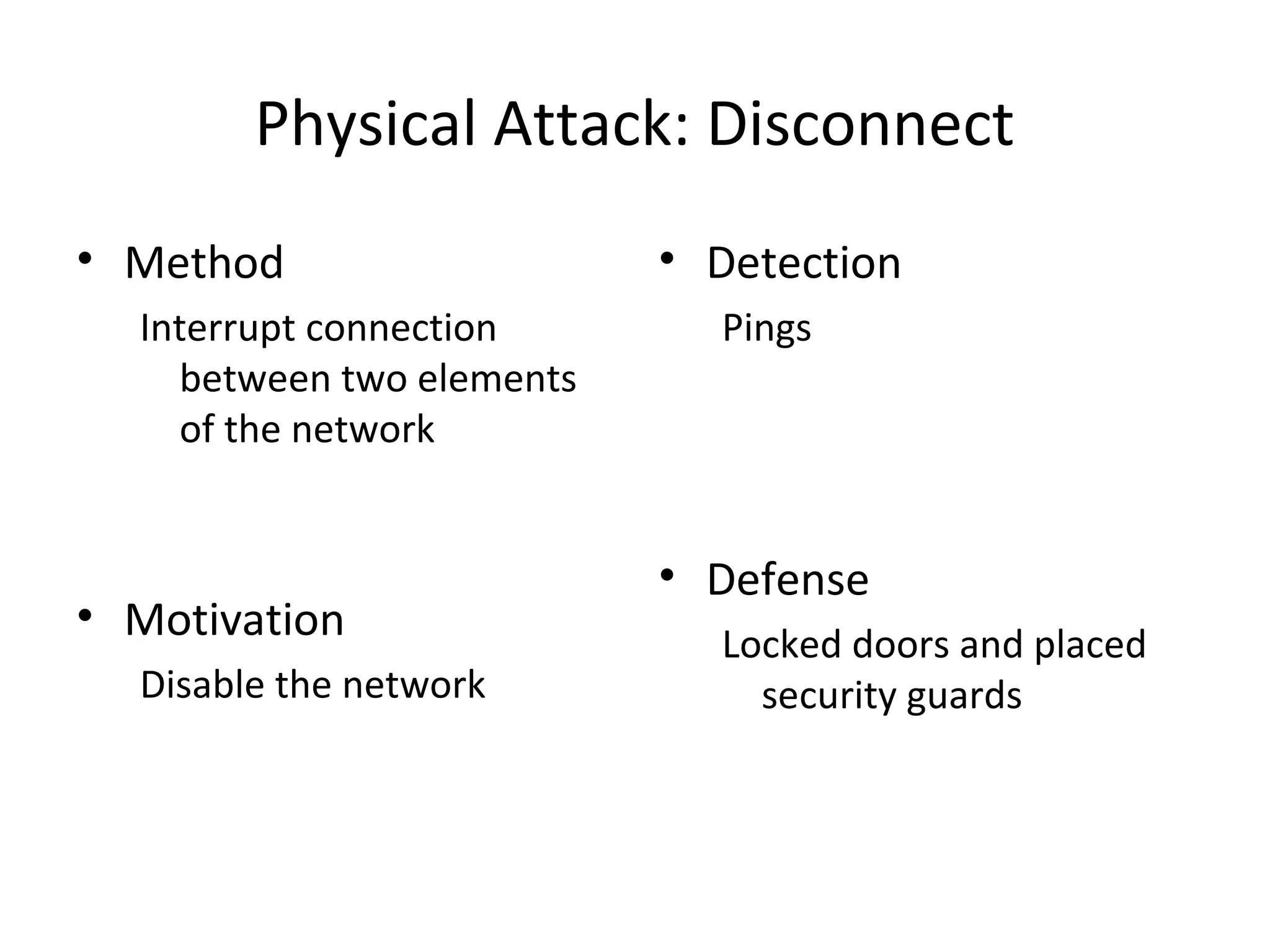
Physical Attack: Disconnect
• Method
Interrupt connection
between two elements
of the network
• Motivation
Disable the network
• Detection
Pings
• Defense
Locked doors and placed
security guards
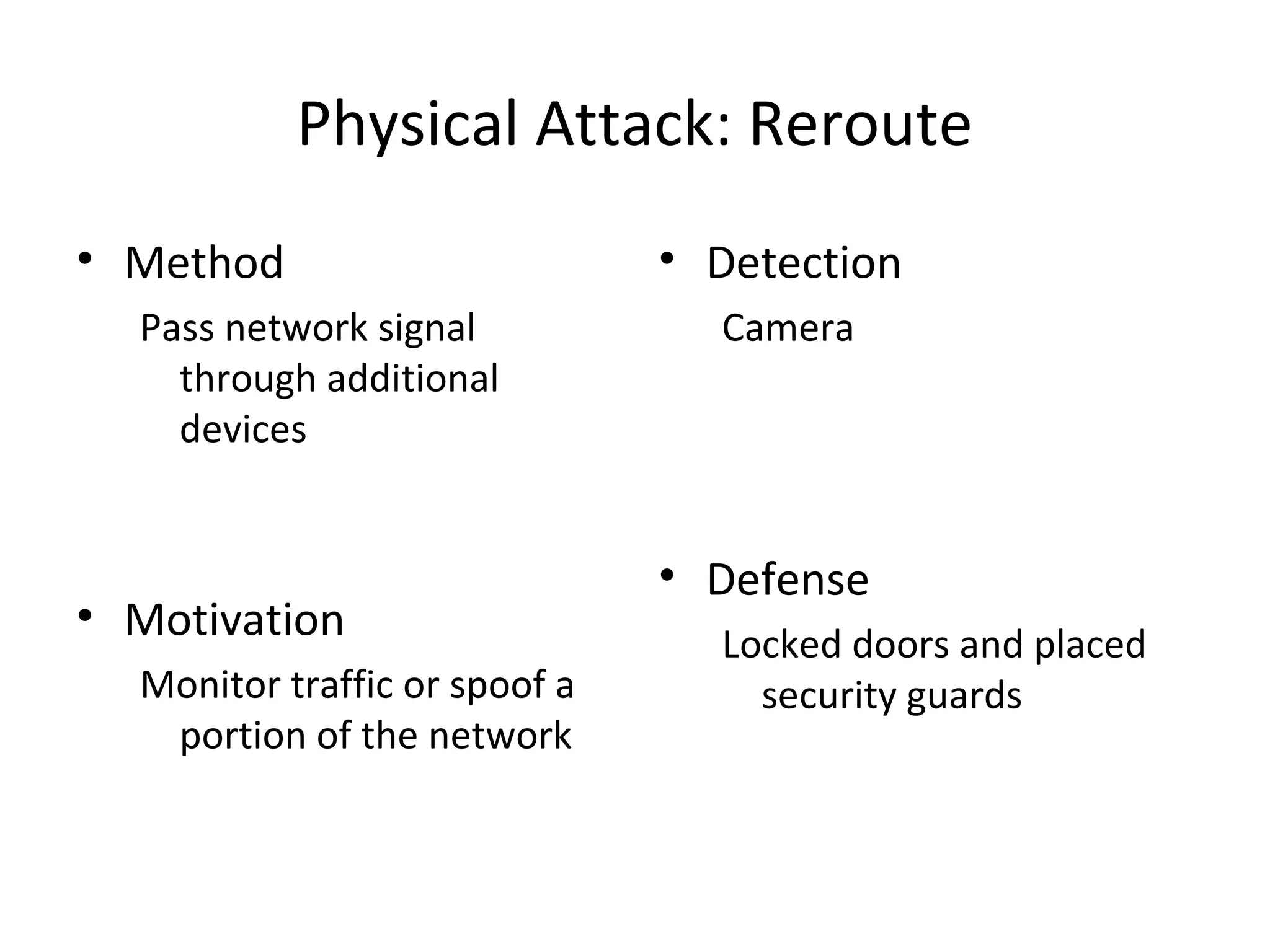
Physical Attack: Reroute
• Method
Pass network signal
through additional
devices
• Motivation
Monitor traffic or spoof a
portion of the network
• Detection
Camera
• Defense
Locked doors and placed
security guards
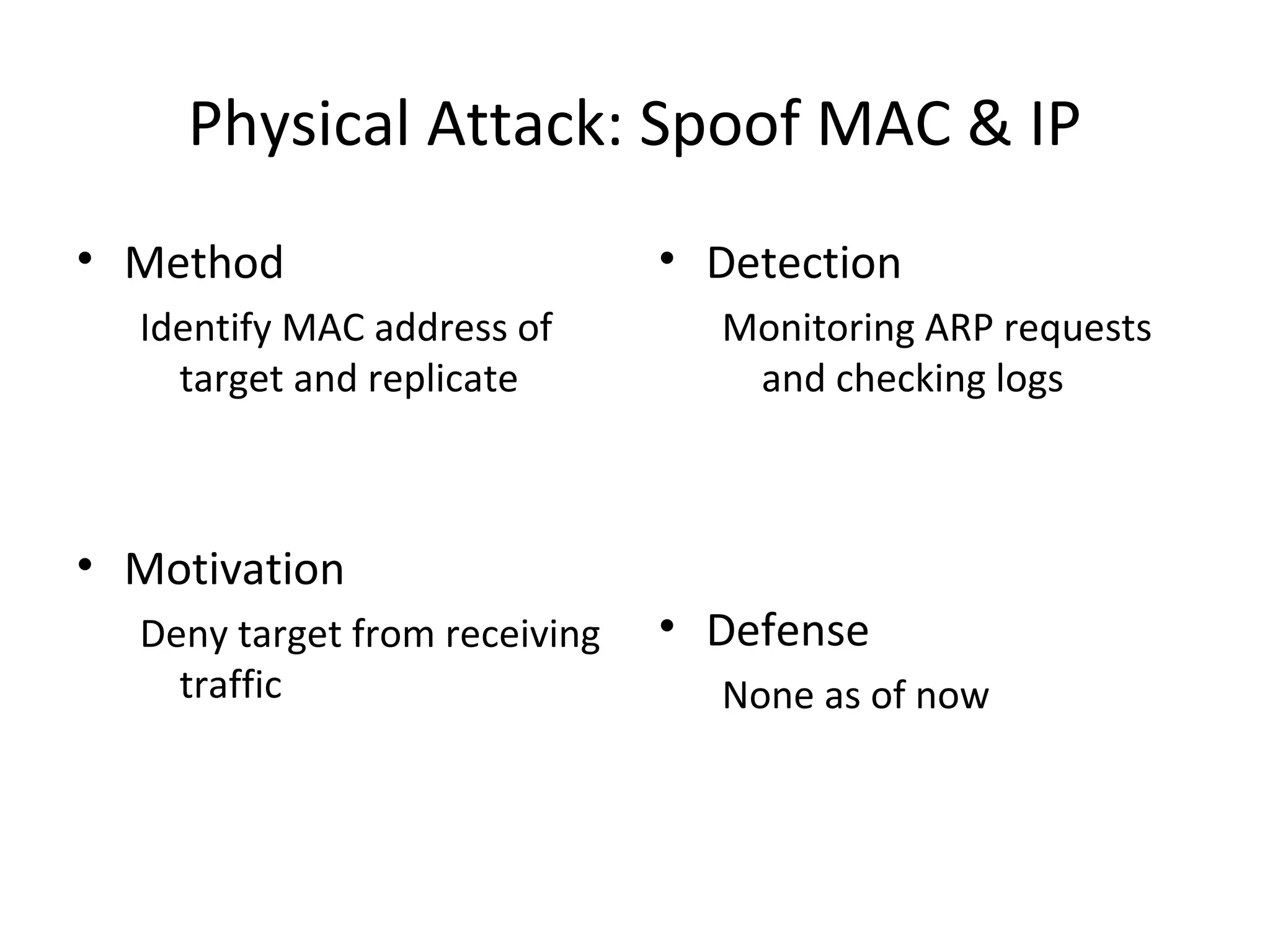
Physical Attack: Spoof MAC & IP
• Method
Identify MAC address of
target and replicate
• Motivation
Deny target from receiving
traffic
• Detection
Monitoring ARP requests
and checking logs
• Defense
None as of now
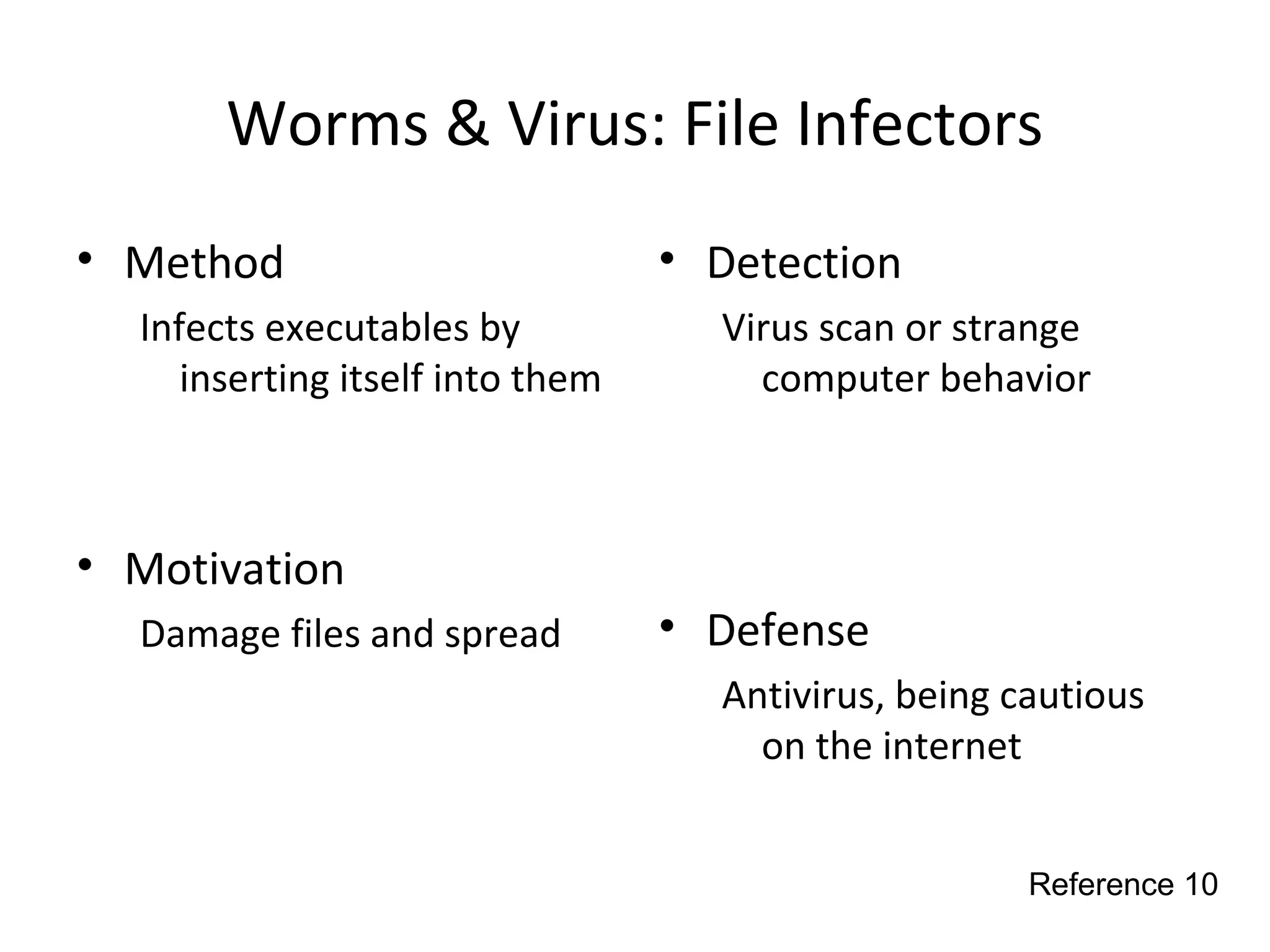
Worms & Virus: File Infectors
• Method
Infects executables by
inserting itself into them
• Motivation
Damage files and spread
• Detection
Virus scan or strange
computer behavior
• Defense
Antivirus, being cautious
on the internet
Reference 10
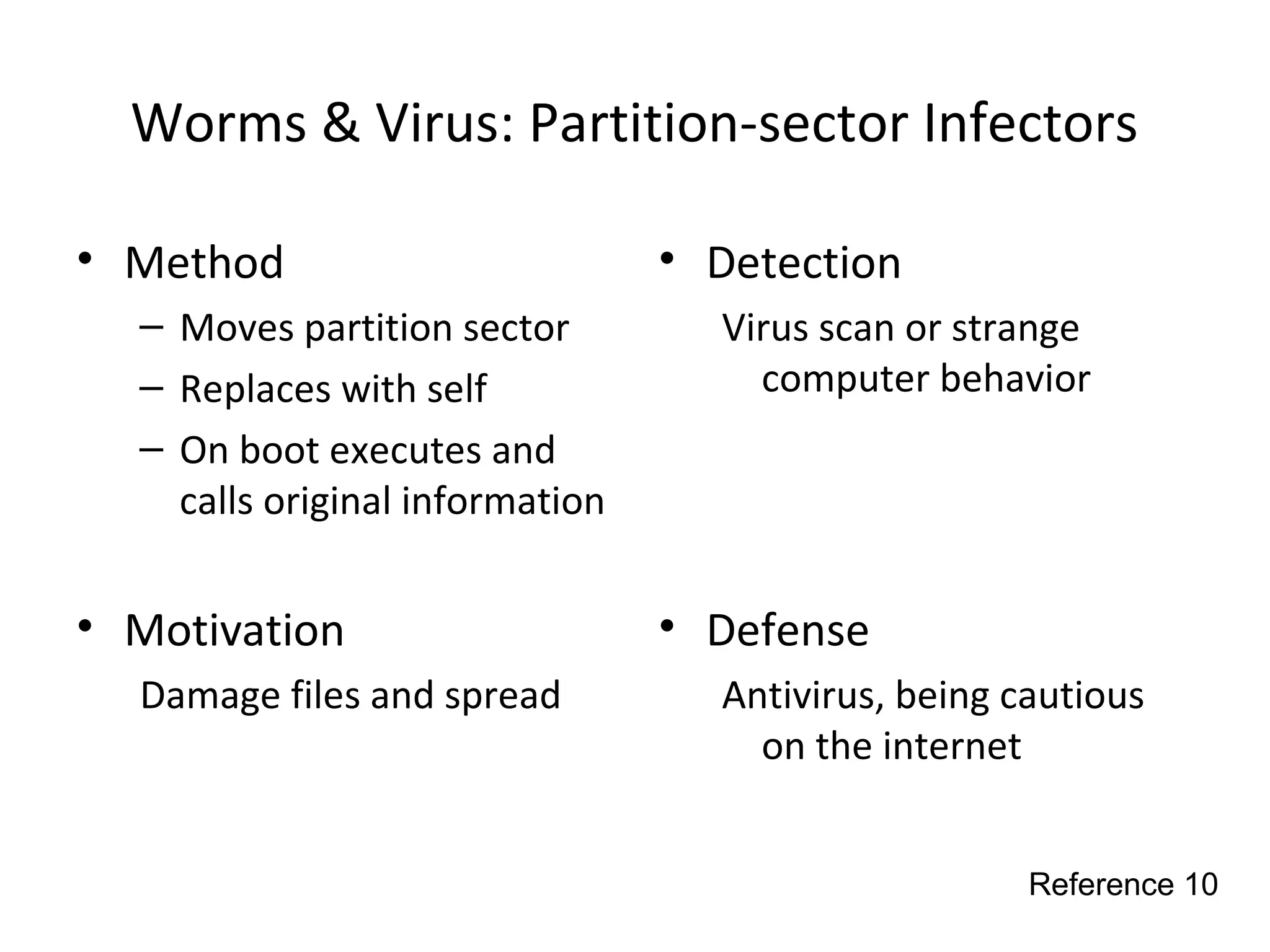
Worms & Virus: Partition-sector Infectors
• Method
– Moves partition sector
– Replaces with self
– On boot executes and
calls original information
• Motivation
Damage files and spread
• Detection
Virus scan or strange
computer behavior
• Defense
Antivirus, being cautious
on the internet
Reference 10
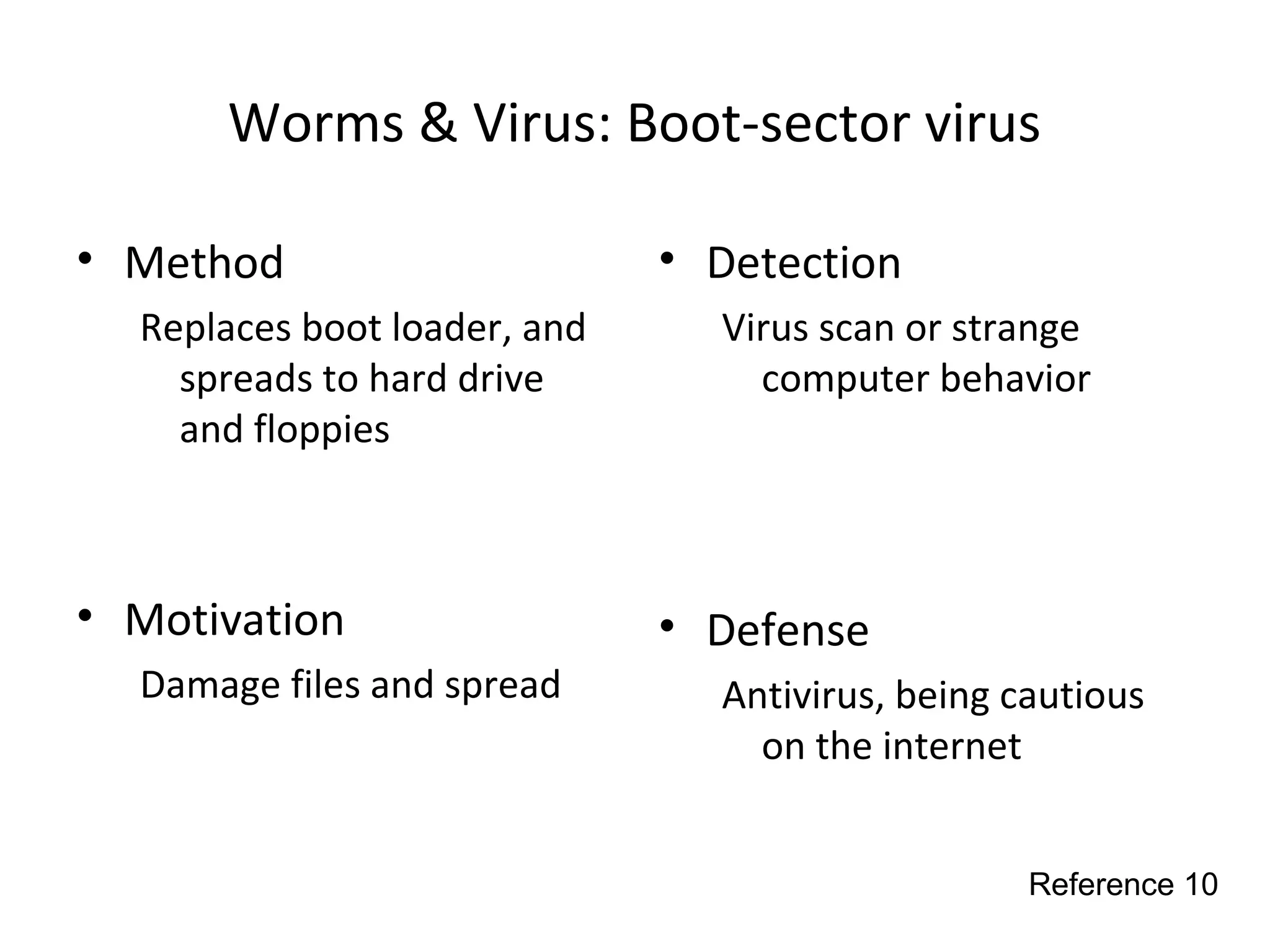
Worms & Virus: Boot-sector virus
• Method
Replaces boot loader, and
spreads to hard drive
and floppies
• Motivation
Damage files and spread
• Detection
Virus scan or strange
computer behavior
• Defense
Antivirus, being cautious
on the internet
Reference 10
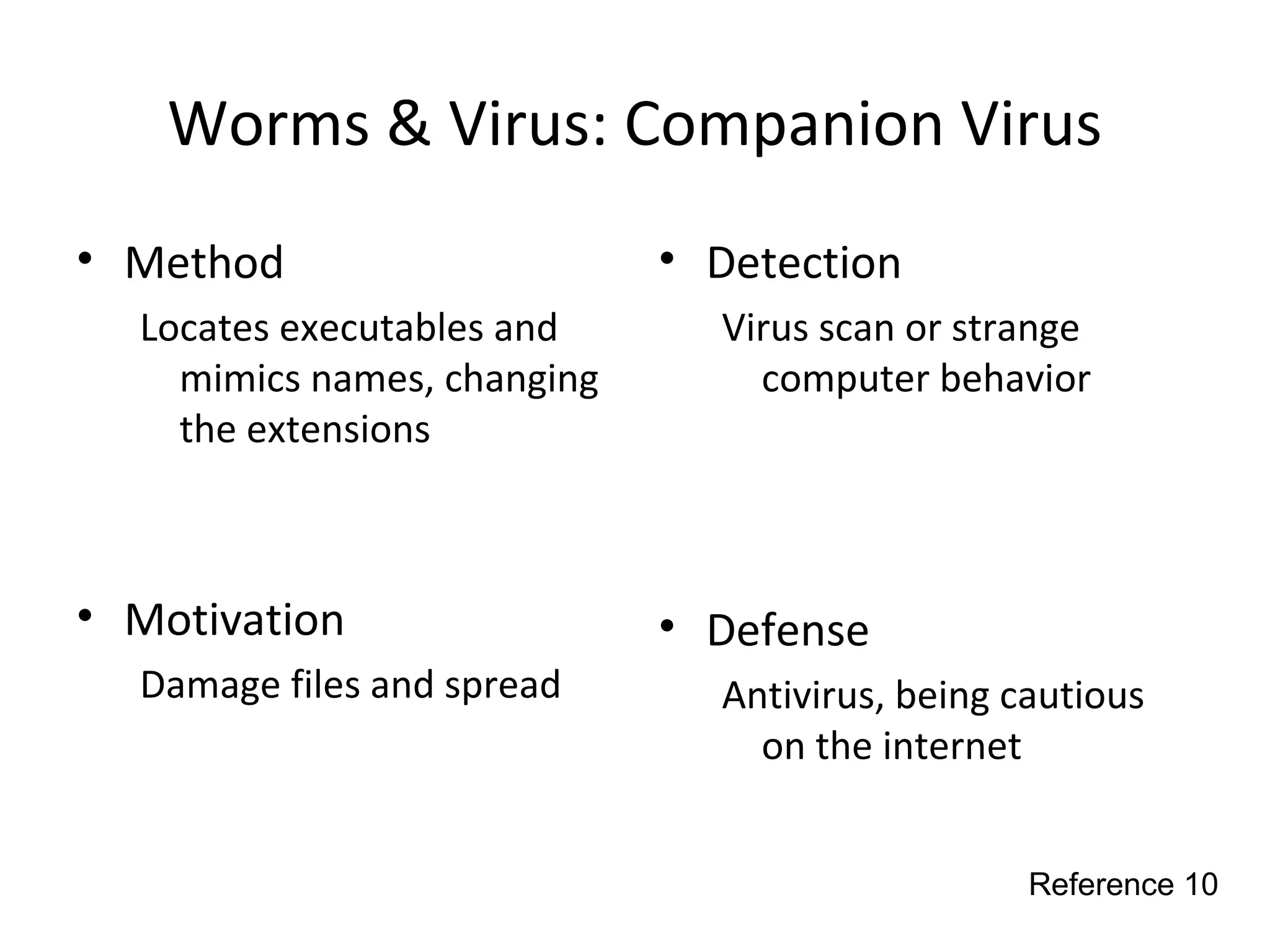
Worms & Virus: Companion Virus
• Method
Locates executables and
mimics names, changing
the extensions
• Motivation
Damage files and spread
• Detection
Virus scan or strange
computer behavior
• Defense
Antivirus, being cautious
on the internet
Reference 10
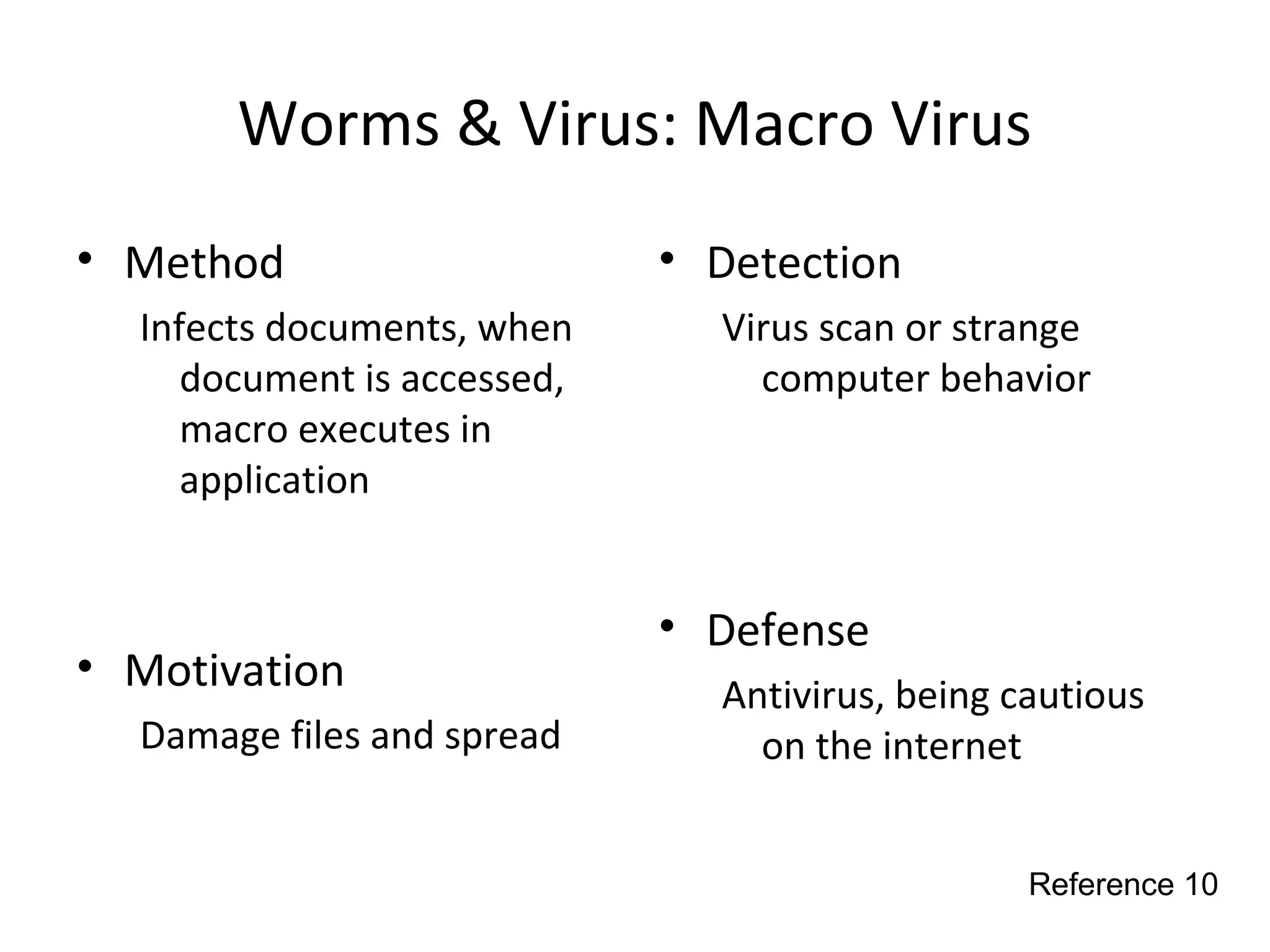
Worms & Virus: Macro Virus
• Method
Infects documents, when
document is accessed,
macro executes in
application
• Motivation
Damage files and spread
• Detection
Virus scan or strange
computer behavior
• Defense
Antivirus, being cautious
on the internet
Reference 10
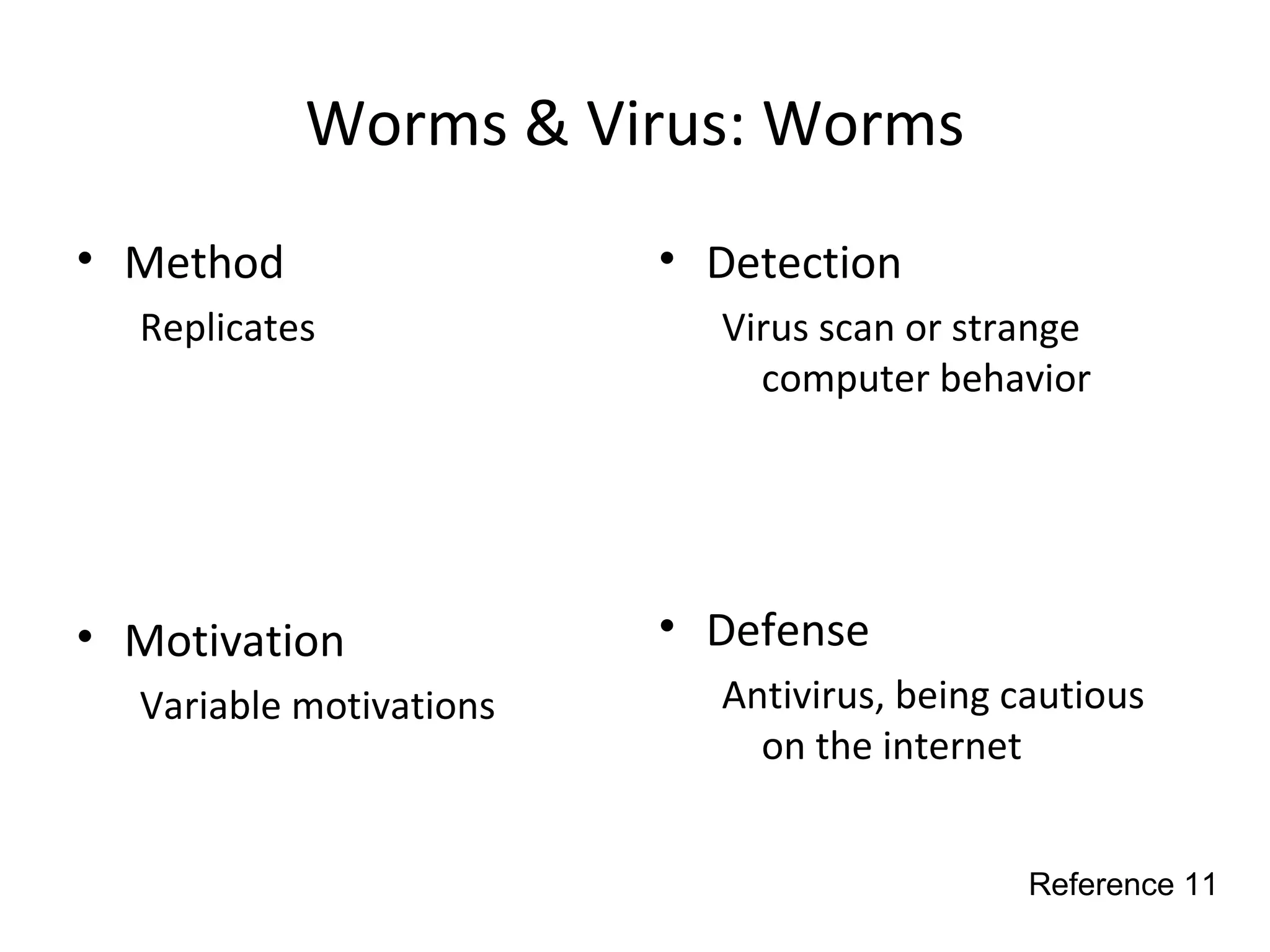
Worms & Virus: Worms
• Method
Replicates
• Motivation
Variable motivations
• Detection
Virus scan or strange
computer behavior
• Defense
Antivirus, being cautious
on the internet
Reference 11
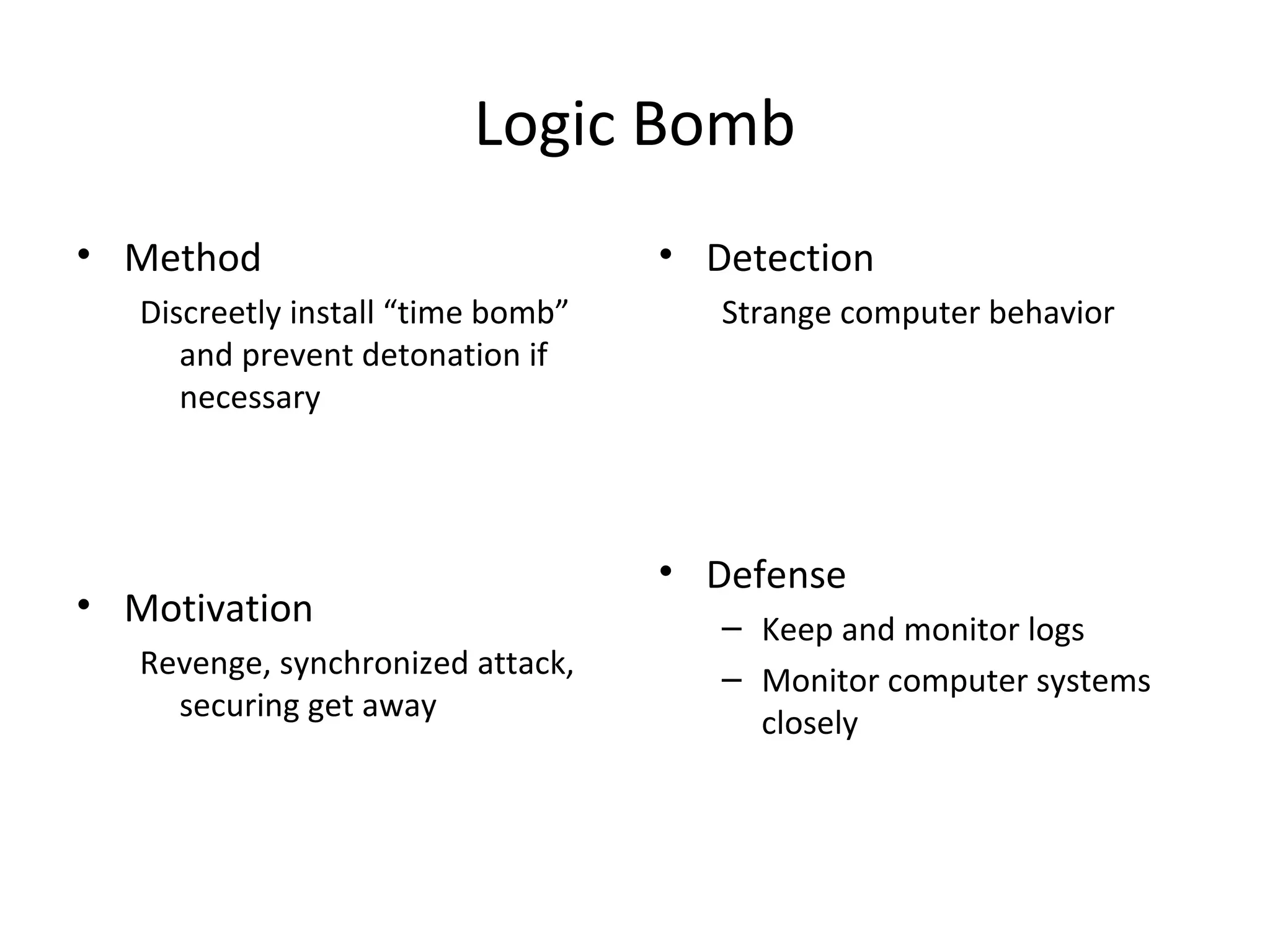
Logic Bomb
• Method
Discreetly install “time bomb”
and prevent detonation if
necessary
• Motivation
Revenge, synchronized attack,
securing get away
• Detection
Strange computer behavior
• Defense
– Keep and monitor logs
– Monitor computer systems
closely
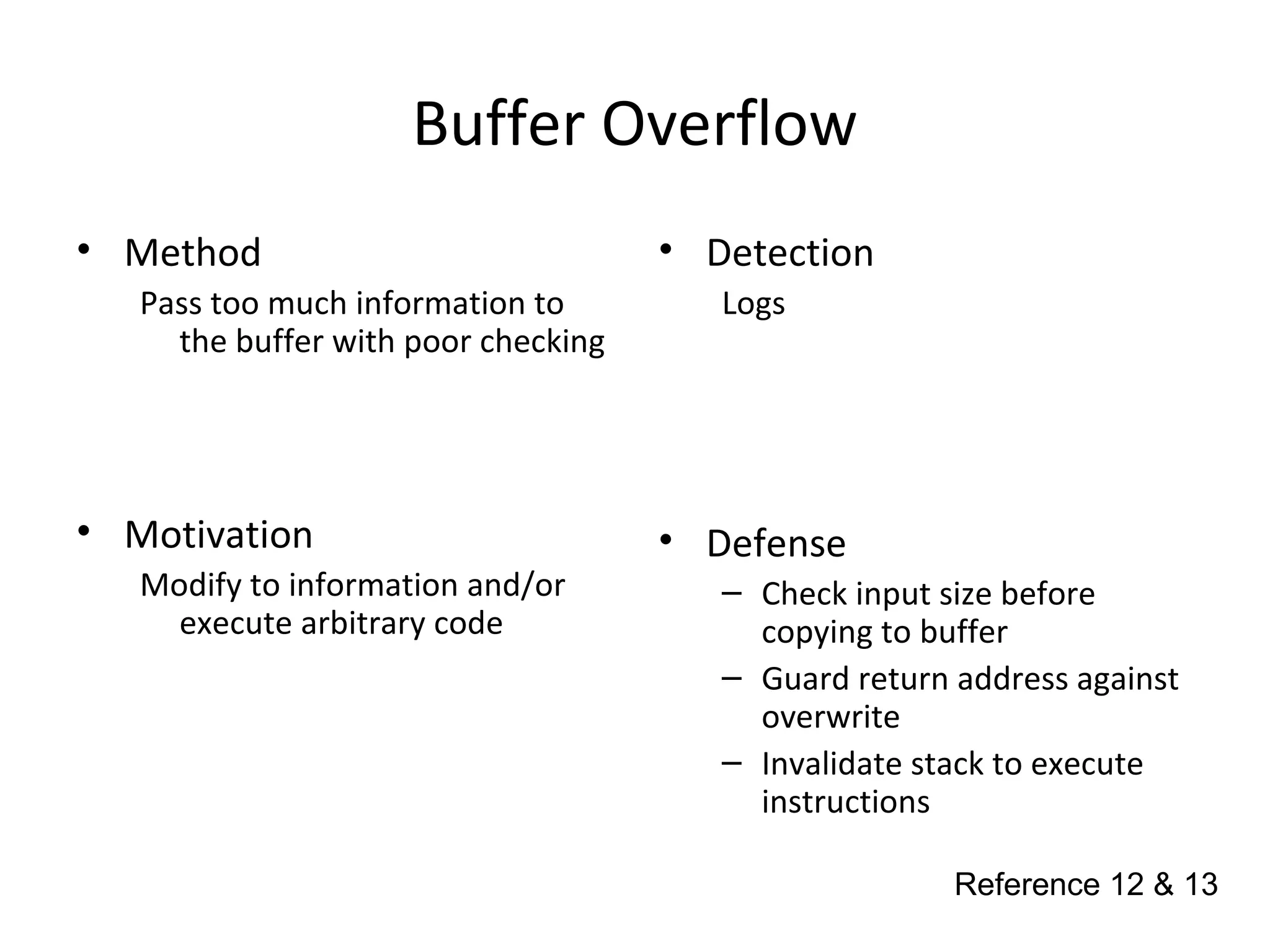
Buffer Overflow
• Method
Pass too much information to
the buffer with poor checking
• Motivation
Modify to information and/or
execute arbitrary code
• Detection
Logs
• Defense
– Check input size before
copying to buffer
– Guard return address against
overwrite
– Invalidate stack to execute
instructions
Reference 12 & 13
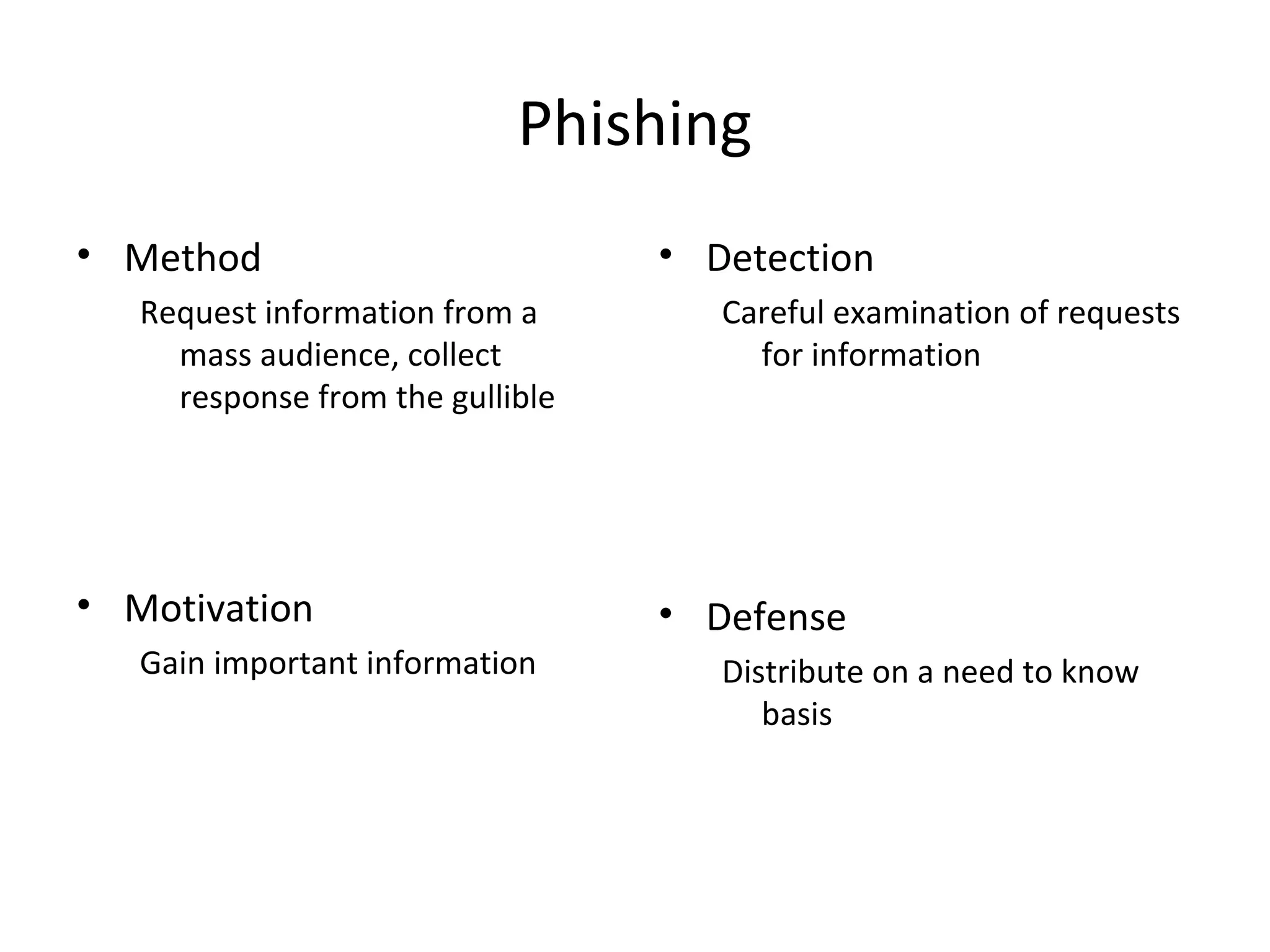
Phishing
• Method
Request information from a
mass audience, collect
response from the gullible
• Motivation
Gain important information
• Detection
Careful examination of requests
for information
• Defense
Distribute on a need to know
basis
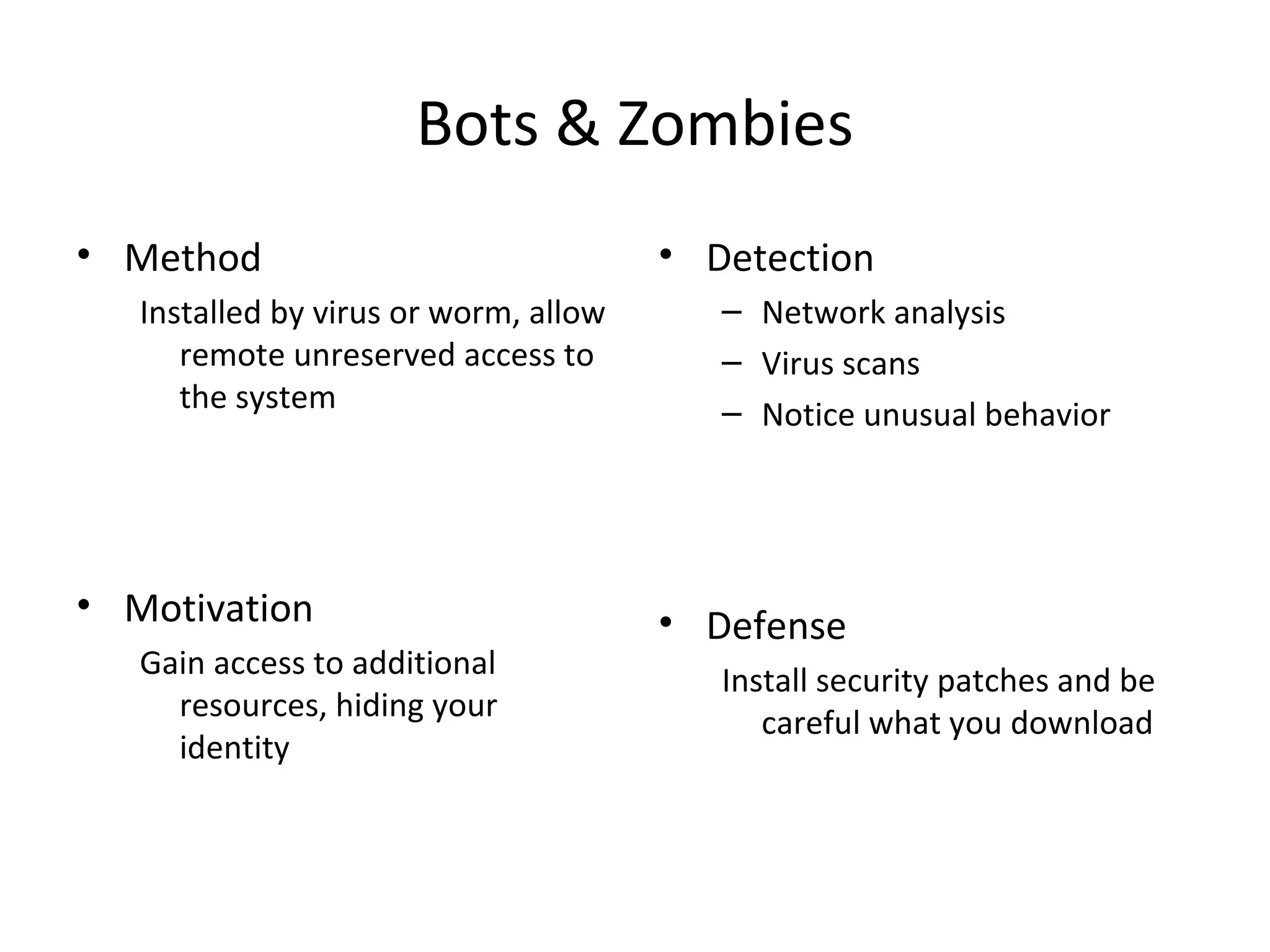
Bots & Zombies
• Method
Installed by virus or worm, allow
remote unreserved access to
the system
• Motivation
Gain access to additional
resources, hiding your
identity
• Detection
– Network analysis
– Virus scans
– Notice unusual behavior
• Defense
Install security patches and be
careful what you download
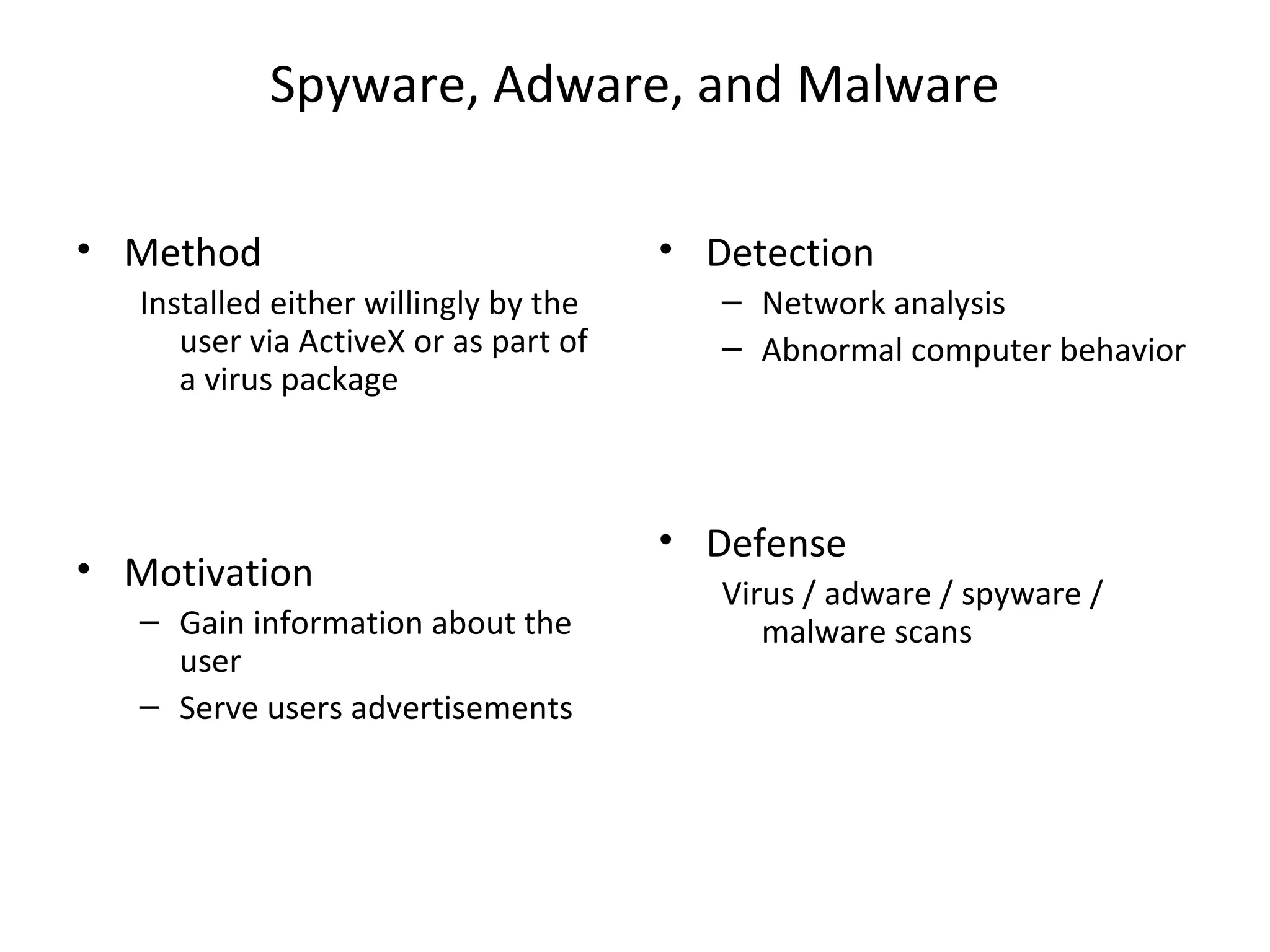
Spyware, Adware, and Malware
• Method
Installed either willingly by the
user via ActiveX or as part of
a virus package
• Motivation
– Gain information about the
user
– Serve users advertisements
• Detection
– Network analysis
– Abnormal computer behavior
• Defense
Virus / adware / spyware /
malware scans
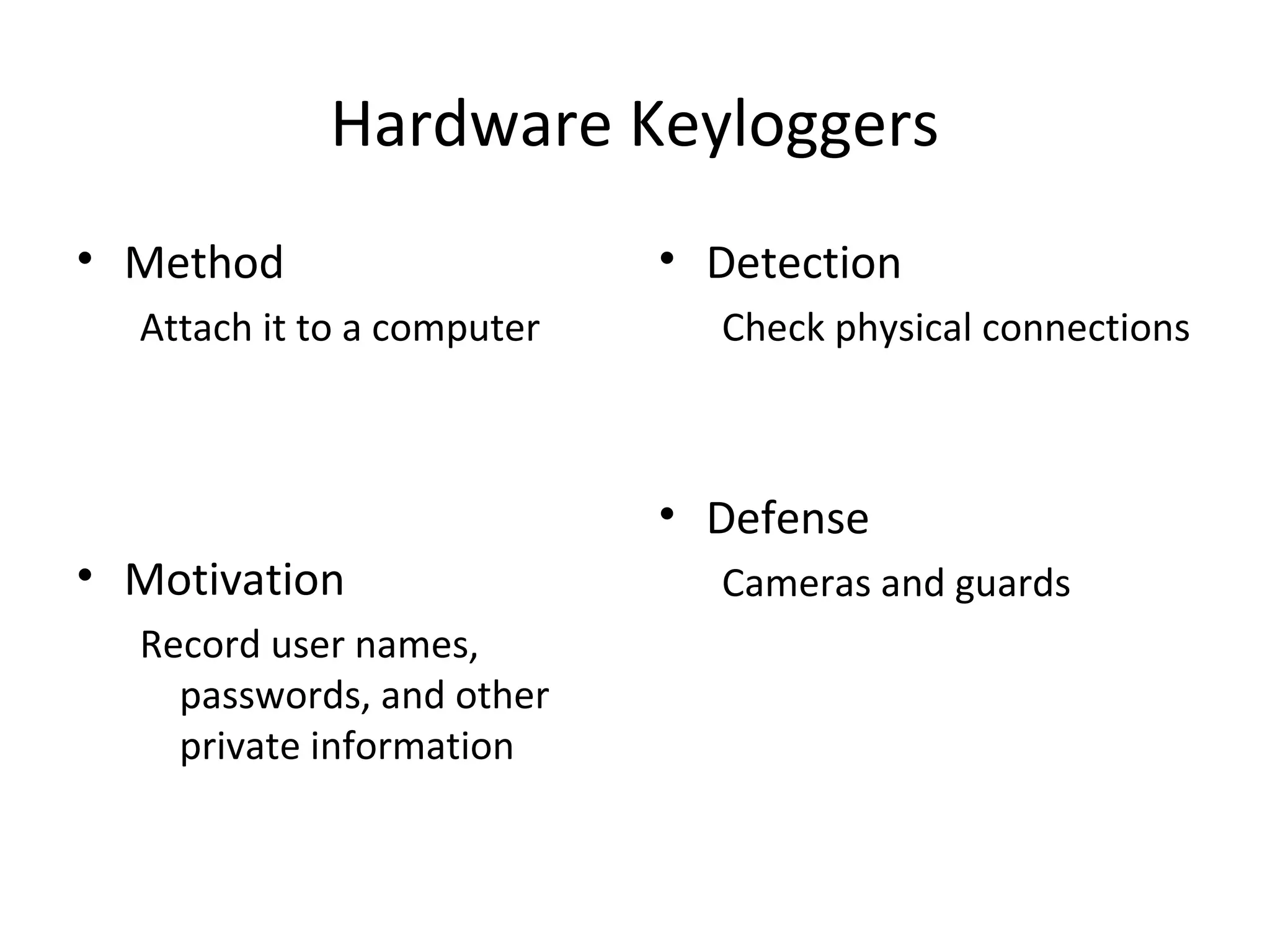
Hardware Keyloggers
• Method
Attach it to a computer
• Motivation
Record user names,
passwords, and other
private information
• Detection
Check physical connections
• Defense
Cameras and guards
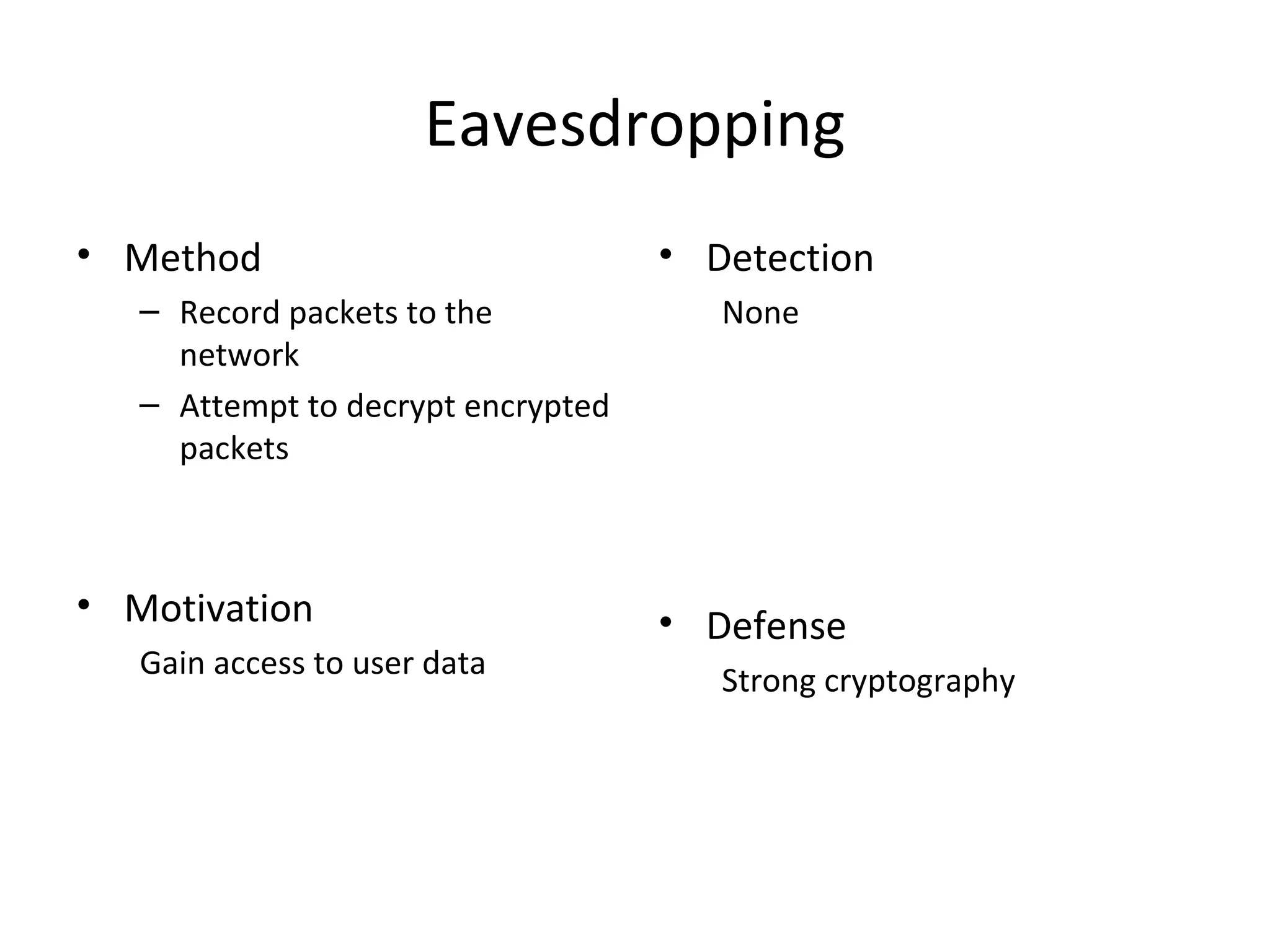
Eavesdropping
• Method
– Record packets to the
network
– Attempt to decrypt encrypted
packets
• Motivation
Gain access to user data
• Detection
None
• Defense
Strong cryptography
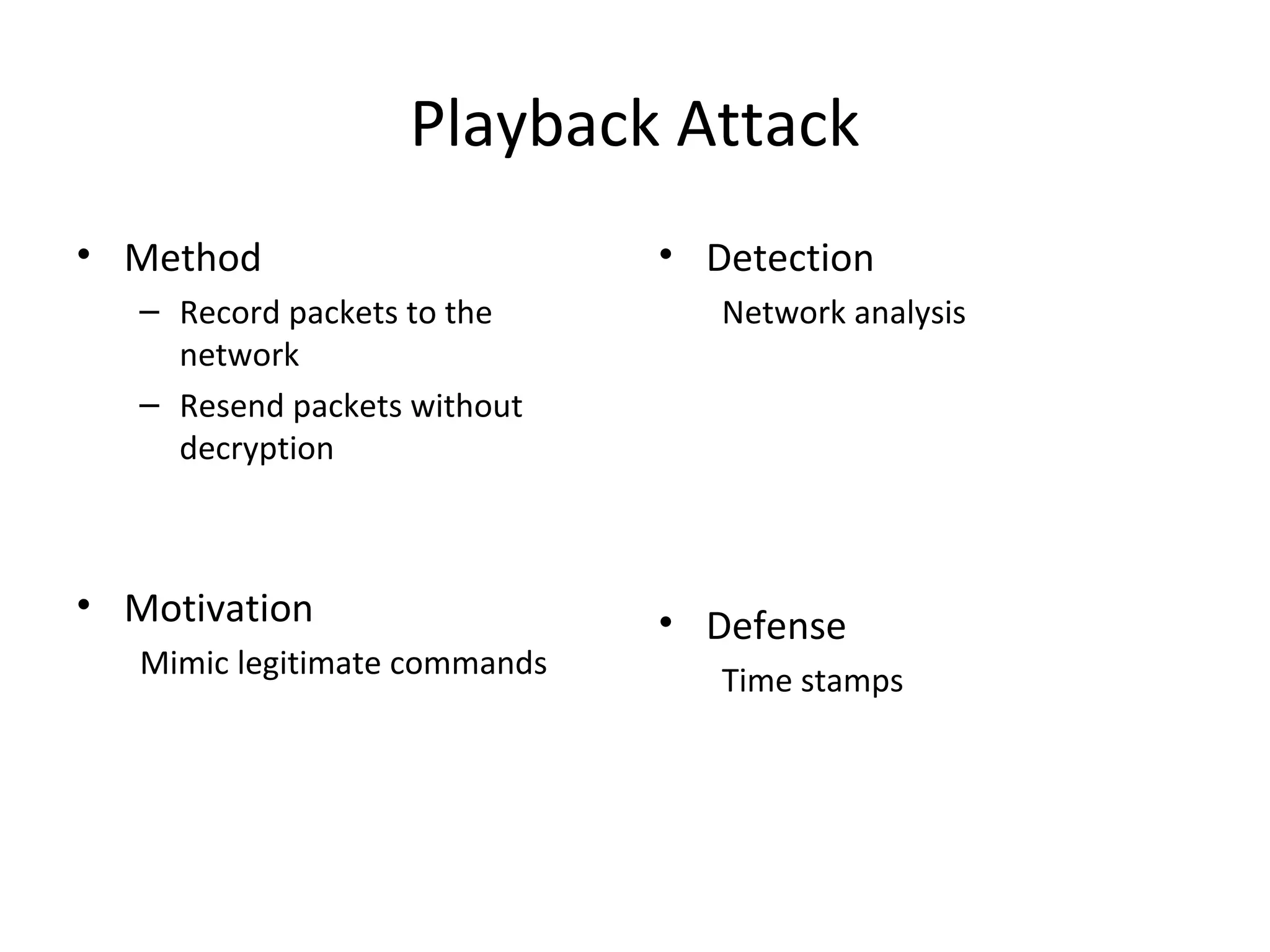
Playback Attack
• Method
– Record packets to the
network
– Resend packets without
decryption
• Motivation
Mimic legitimate commands
• Detection
Network analysis
• Defense
Time stamps
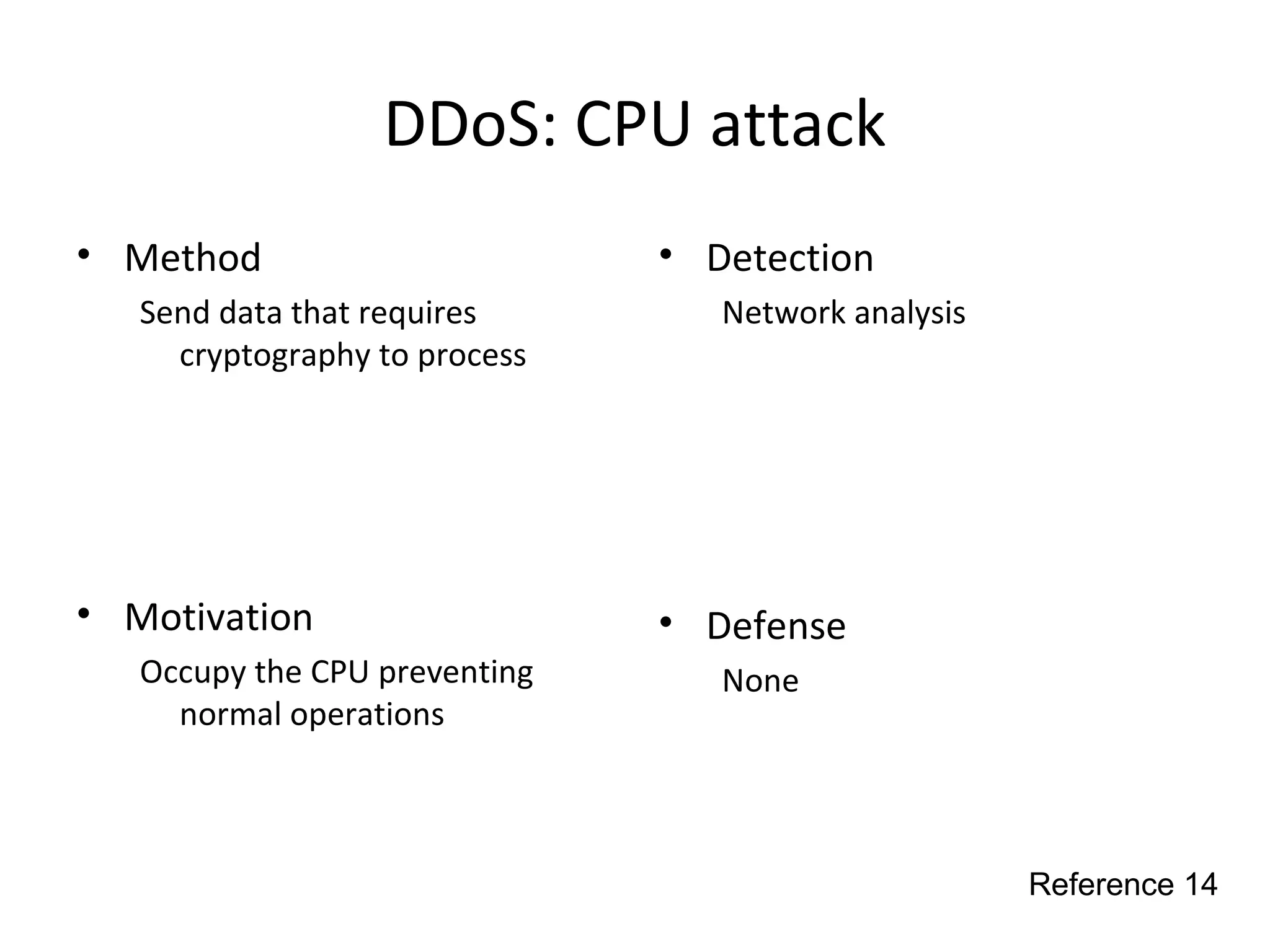
DDoS: CPU attack
• Method
Send data that requires
cryptography to process
• Motivation
Occupy the CPU preventing
normal operations
• Detection
Network analysis
• Defense
None
Reference 14
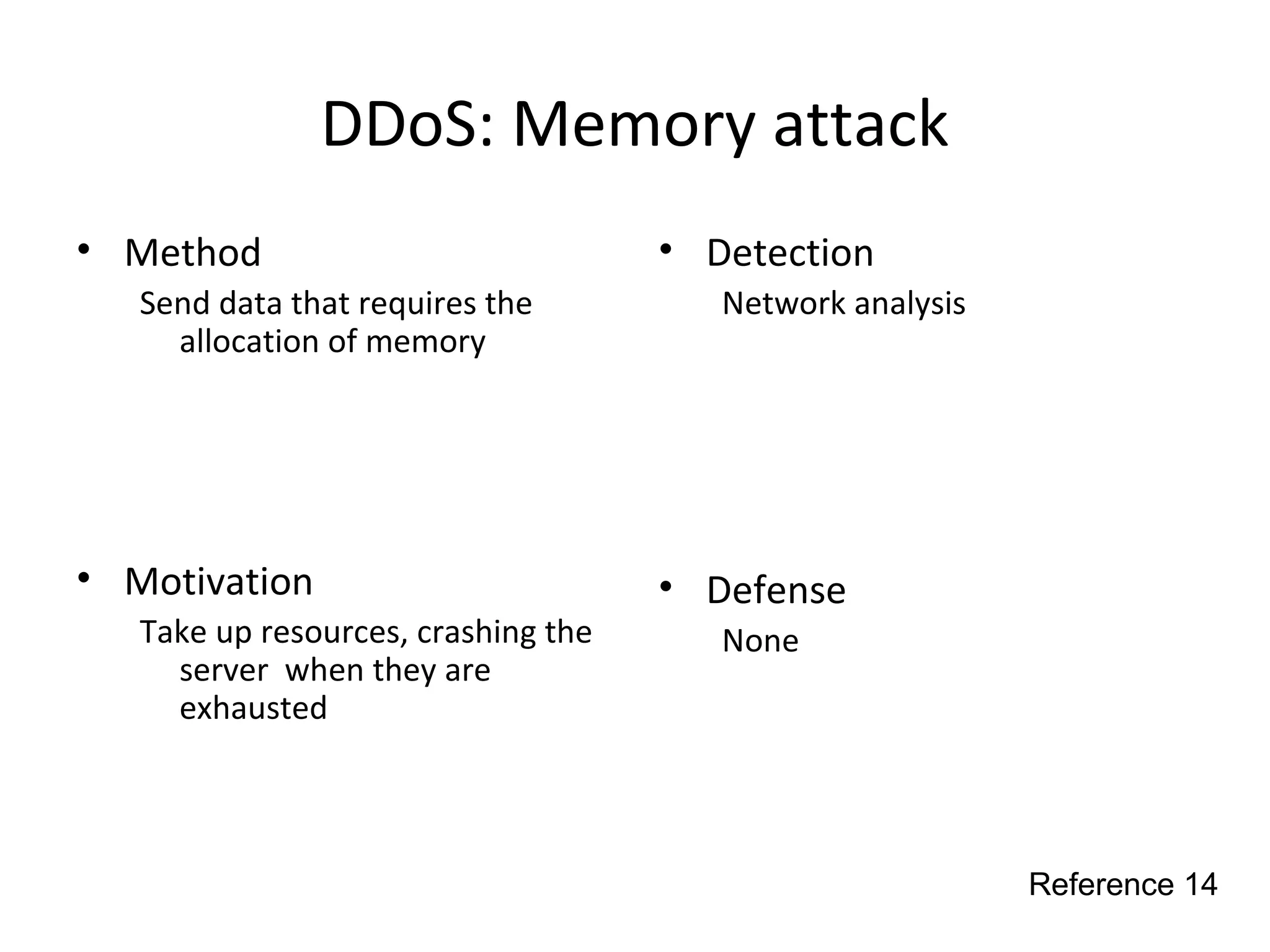
DDoS: Memory attack
• Method
Send data that requires the
allocation of memory
• Motivation
Take up resources, crashing the
server when they are
exhausted
• Detection
Network analysis
• Defense
None
Reference 14

Web attacks

  • 1.
  • 2.
    Topics of Discussion •Reconnaissance Gain information about a system • Vulnerabilities Attributes of a system that can be maliciously exploited • Attacks Procedures to exploit vulnerabilities Reference 1
  • 3.
    Topics of Discussion Reconnaissance –War Dialing – War Driving – Port Scanning – Probing – Packet Sniffing
  • 4.
    War Dialing (Reconnaissance) •Method Dial a range of phone numbers searching for modem • Motivation Locate potential targets • Detection Detection impossible outside of the telephony infrastructure • Defense Disconnect unessential modems from outgoing phone lines Reference 2
  • 5.
    War Driving (Reconnaissance) •Method Surveillance of wireless signals in a region • Motivation Find wireless traffic • Detection Can only be detected by physical surveillance • Defense Limit geographic access to wireless signal Reference 3
  • 6.
    Port Scanning (Reconnaissance) •Method Send out a SYN packet, check for response • Motivation Find potential targets • Detection Traffic analysis • Defense Close/silence ports Reference 4
  • 7.
    Probing (Reconnaissance) • Method Sendpackets to ports • Motivation Find specific port information • Detection Traffic analysis • Defense Close/silence ports
  • 8.
    Packet Sniffing (Reconnaissance) •Method Capture and analyze packets traveling across a network interface • Motivation Gain access to information traveling on the network • Detection None • Defense Use encryption to minimize cleartext on the network Reference 5
  • 9.
    Topics of Discussion Vulnerabilities –Backdoors – Code Exploits – Eavesdropping – Indirect Attacks – Social Engineering
  • 10.
    Backdoors (Vulnerabilities) • Bypassnormal means of authentication • Hidden from casual inspection • Installed separately or integrated into software Reference 6
  • 11.
    Code Exploits (Vulnerabilities) •Use of poor coding practices left uncaught by testing • Defense: In depth unit and integration testing
  • 12.
    Eavesdropping (Vulnerability) • Datatransmitted without encryption can be captured and read by parties other than the sender and receiver • Defense: Use of strong cryptography to minimize cleartext on the network
  • 13.
    Indirect Attacks (Vulnerabilities) •Internet users’ machines can be infected with zombies and made to perform attacks • The puppet master is left undetected • Defense: Train internet users to prevent zombies and penalize zombie owners
  • 14.
    Social Engineering (Vulnerability) •Manipulate the weakest link of cybersecurity – the user – to gain access to otherwise prohibited resources • Defense: Train personnel to resist the tactics of software engineering Reference 7
  • 15.
    Topics of Discussion Attacks –Password Cracks – Web Attacks – Physical Attacks – Worms & Viruses – Logic Bomb – Buffer Overflow – Phishing – Bots, and Zombies – Spyware, Adware, and Malware – Hardware Keyloggers – Eavesdropping & Playback attacks – DDoS
  • 16.
    Password Cracks: BruteForce • Method Trying all combinations of legal symbols as username/password pairs • Motivation Gain access to system • Detection Frequent attempts to authenticate • Defense Lockouts – temporary and permanent Reference 8
  • 17.
    Password Cracks: DictionaryAttack • Method Trying all entries in a collection of strings • Motivation Gain access to system, faster than brute force • Detection Frequent attempts to authenticate • Defense – Lockouts – temporary and permanent – Complex passwords Reference 8
  • 18.
    Password Cracks: HybridAttack • Method Trying all entries in a collection of strings adding numbers and symbols concatenating them with each other and or numbers • Motivation Gain access to system, faster than brute force, more likely than just dictionary attack • Detection Frequent attempts to authenticate • Defense Lockouts – temporary and permanent Reference 8
  • 19.
    Password Cracks: l0phtcrack •Method Gain access to operating system’s hash table and perform cracking remotely • Motivation Gain access to system, cracking elsewhere – no lockouts • Detection Detecting reading of hash table • Defense Limit access to system Reference 8
  • 20.
    Web Attacks: SourceViewing • Method Read source code for valuable information • Motivation Find passwords or commented out URL • Detection None • Defense None
  • 21.
    Web Attacks: URLModification • Method Manipulating URL to find pages not normally accessible • Motivation Gain access to normally private directories or pages • Detection Check website URL logs • Defense Add access requirements
  • 22.
    Web Attacks: PostData • Method Change post data to get desired results • Motivation Change information being sent in your favor • Detection None • Defense Verify post data on receiving end
  • 23.
    Web Attacks: DatabaseAttack • Method Sending dangerous queries to database • Motivation Denial of service • Detection Check database for strange records • Defense Filter database queries Reference 9
  • 24.
    Web Attacks: DatabaseInsertion • Method Form multiple queries to a database through forms • Motivation Insert information into a table that might be unsafe • Detection Check database logs • Defense Filter database queries, make them quotesafe Reference 9
  • 25.
    Web Attacks: MetaData • Method Use meta characters to make malicious input • Motivation Possibly reveal script or other useful information • Detection Website logs • Defense Filter input of meta characters Reference 10
  • 26.
    Physical Attack: Damage •Method Attack the computer with an axe • Motivation Disable the computer • Detection Video Camera • Defense Locked doors and placed security guards
  • 27.
    Physical Attack: Disconnect •Method Interrupt connection between two elements of the network • Motivation Disable the network • Detection Pings • Defense Locked doors and placed security guards
  • 28.
    Physical Attack: Reroute •Method Pass network signal through additional devices • Motivation Monitor traffic or spoof a portion of the network • Detection Camera • Defense Locked doors and placed security guards
  • 29.
    Physical Attack: SpoofMAC & IP • Method Identify MAC address of target and replicate • Motivation Deny target from receiving traffic • Detection Monitoring ARP requests and checking logs • Defense None as of now
  • 30.
    Worms & Virus:File Infectors • Method Infects executables by inserting itself into them • Motivation Damage files and spread • Detection Virus scan or strange computer behavior • Defense Antivirus, being cautious on the internet Reference 10
  • 31.
    Worms & Virus:Partition-sector Infectors • Method – Moves partition sector – Replaces with self – On boot executes and calls original information • Motivation Damage files and spread • Detection Virus scan or strange computer behavior • Defense Antivirus, being cautious on the internet Reference 10
  • 32.
    Worms & Virus:Boot-sector virus • Method Replaces boot loader, and spreads to hard drive and floppies • Motivation Damage files and spread • Detection Virus scan or strange computer behavior • Defense Antivirus, being cautious on the internet Reference 10
  • 33.
    Worms & Virus:Companion Virus • Method Locates executables and mimics names, changing the extensions • Motivation Damage files and spread • Detection Virus scan or strange computer behavior • Defense Antivirus, being cautious on the internet Reference 10
  • 34.
    Worms & Virus:Macro Virus • Method Infects documents, when document is accessed, macro executes in application • Motivation Damage files and spread • Detection Virus scan or strange computer behavior • Defense Antivirus, being cautious on the internet Reference 10
  • 35.
    Worms & Virus:Worms • Method Replicates • Motivation Variable motivations • Detection Virus scan or strange computer behavior • Defense Antivirus, being cautious on the internet Reference 11
  • 36.
    Logic Bomb • Method Discreetlyinstall “time bomb” and prevent detonation if necessary • Motivation Revenge, synchronized attack, securing get away • Detection Strange computer behavior • Defense – Keep and monitor logs – Monitor computer systems closely
  • 37.
    Buffer Overflow • Method Passtoo much information to the buffer with poor checking • Motivation Modify to information and/or execute arbitrary code • Detection Logs • Defense – Check input size before copying to buffer – Guard return address against overwrite – Invalidate stack to execute instructions Reference 12 & 13
  • 38.
    Phishing • Method Request informationfrom a mass audience, collect response from the gullible • Motivation Gain important information • Detection Careful examination of requests for information • Defense Distribute on a need to know basis
  • 39.
    Bots & Zombies •Method Installed by virus or worm, allow remote unreserved access to the system • Motivation Gain access to additional resources, hiding your identity • Detection – Network analysis – Virus scans – Notice unusual behavior • Defense Install security patches and be careful what you download
  • 40.
    Spyware, Adware, andMalware • Method Installed either willingly by the user via ActiveX or as part of a virus package • Motivation – Gain information about the user – Serve users advertisements • Detection – Network analysis – Abnormal computer behavior • Defense Virus / adware / spyware / malware scans
  • 41.
    Hardware Keyloggers • Method Attachit to a computer • Motivation Record user names, passwords, and other private information • Detection Check physical connections • Defense Cameras and guards
  • 42.
    Eavesdropping • Method – Recordpackets to the network – Attempt to decrypt encrypted packets • Motivation Gain access to user data • Detection None • Defense Strong cryptography
  • 43.
    Playback Attack • Method –Record packets to the network – Resend packets without decryption • Motivation Mimic legitimate commands • Detection Network analysis • Defense Time stamps
  • 44.
    DDoS: CPU attack •Method Send data that requires cryptography to process • Motivation Occupy the CPU preventing normal operations • Detection Network analysis • Defense None Reference 14
  • 45.
    DDoS: Memory attack •Method Send data that requires the allocation of memory • Motivation Take up resources, crashing the server when they are exhausted • Detection Network analysis • Defense None Reference 14