About Security Innovation
• Authority in Software Security
• 18+ years research on software vulnerabilities
• Security testing methodology adopted by SAP,
Symantec, Microsoft and McAfee
• Authors of 18 books
• Helping organizations minimize risk
• Assessment: Show me the gaps
• Education: Guide me to the right decisions
• Standards: Set goals and make it easy and natural
• Tech-enabled services for both breadth and depth
Simple!
Just think about…
Authentication
Authorization
Scale
DDOS
SQLi
Architecture
Data Storage
Data Transit
Passwords
Load balancing
CDNs
GDPR
Data Warehousing
Compliance
Cookie Policies
Intranet/Internet
User Education
Frameworks
Futureproofing
Browser compat
… and literally 100s of
other things
Never mind!
I’m leaving this piece of
crap app as an installer
from the 90’s
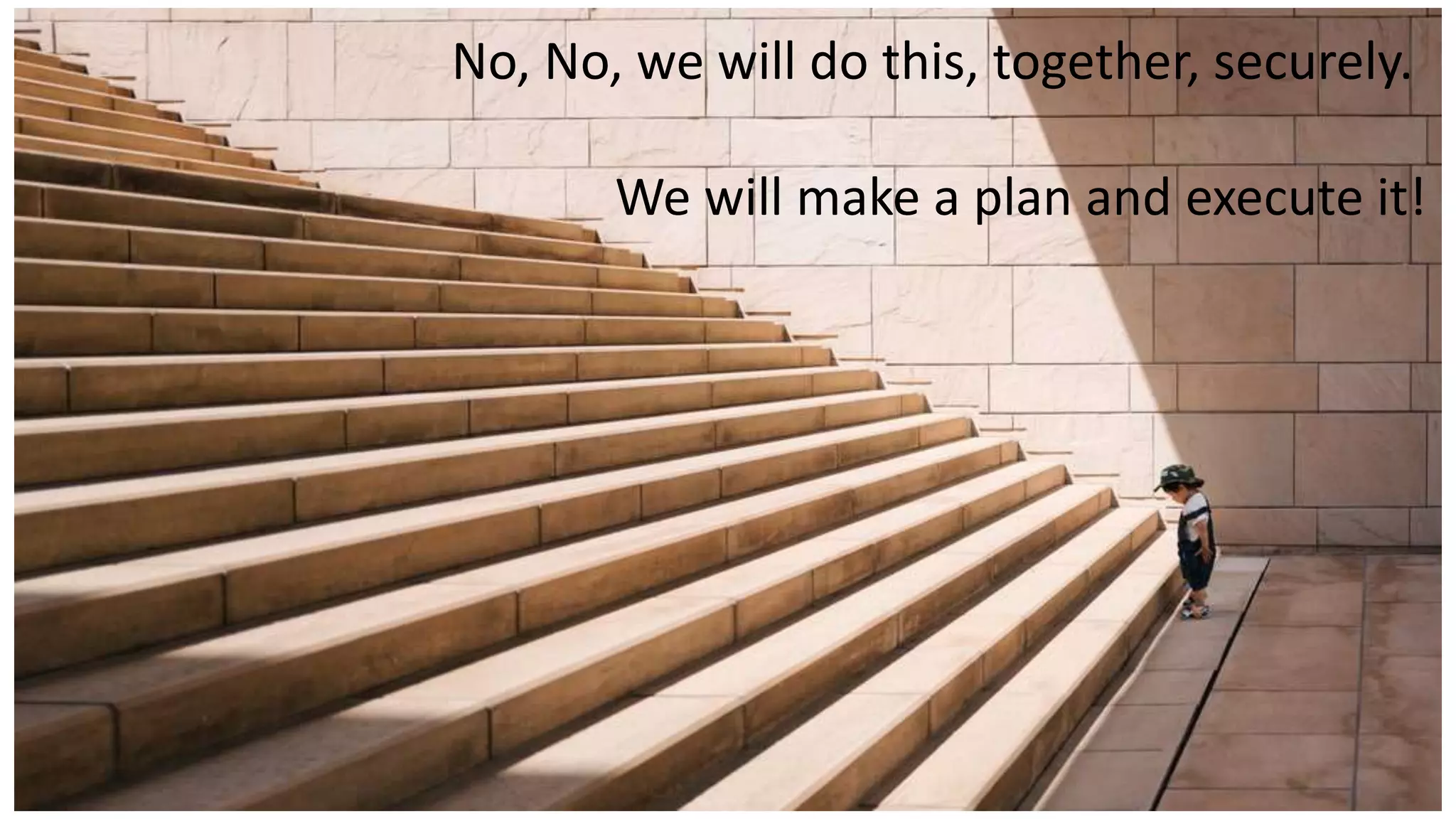
No, No, we will do this, together, securely.
We will make a plan and execute it!
Break it down
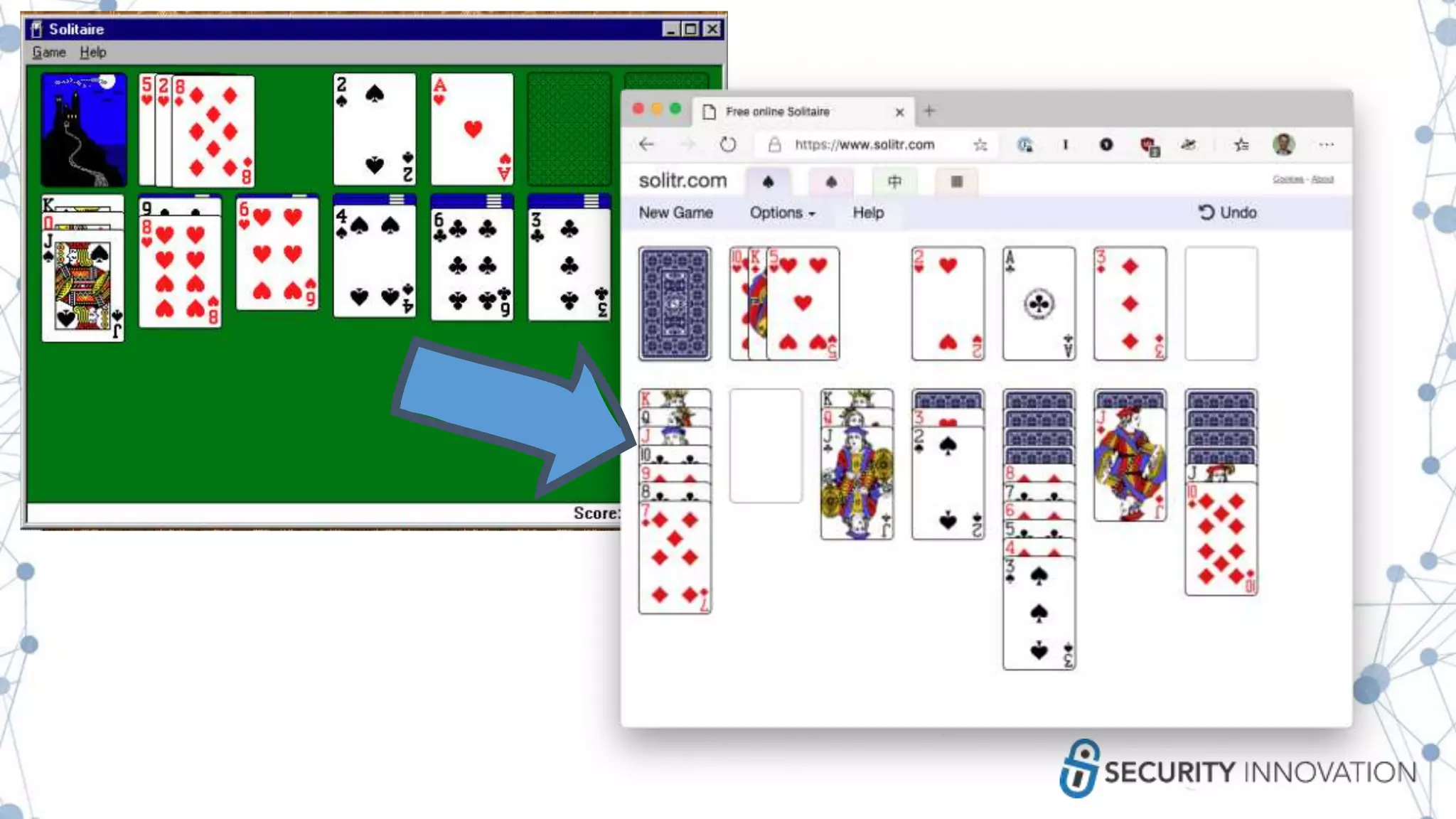
• Migrating to modern web technologies
is analogous to building from scratch
• But you get great use, abuse,
mis-use, and dis-use cases
• This gives you a great roadmap of
what you want to build
• Don’t duplicate the old app, build
something better
• Use good defaults, policies, wrappers,
guidance to build securely and quickly
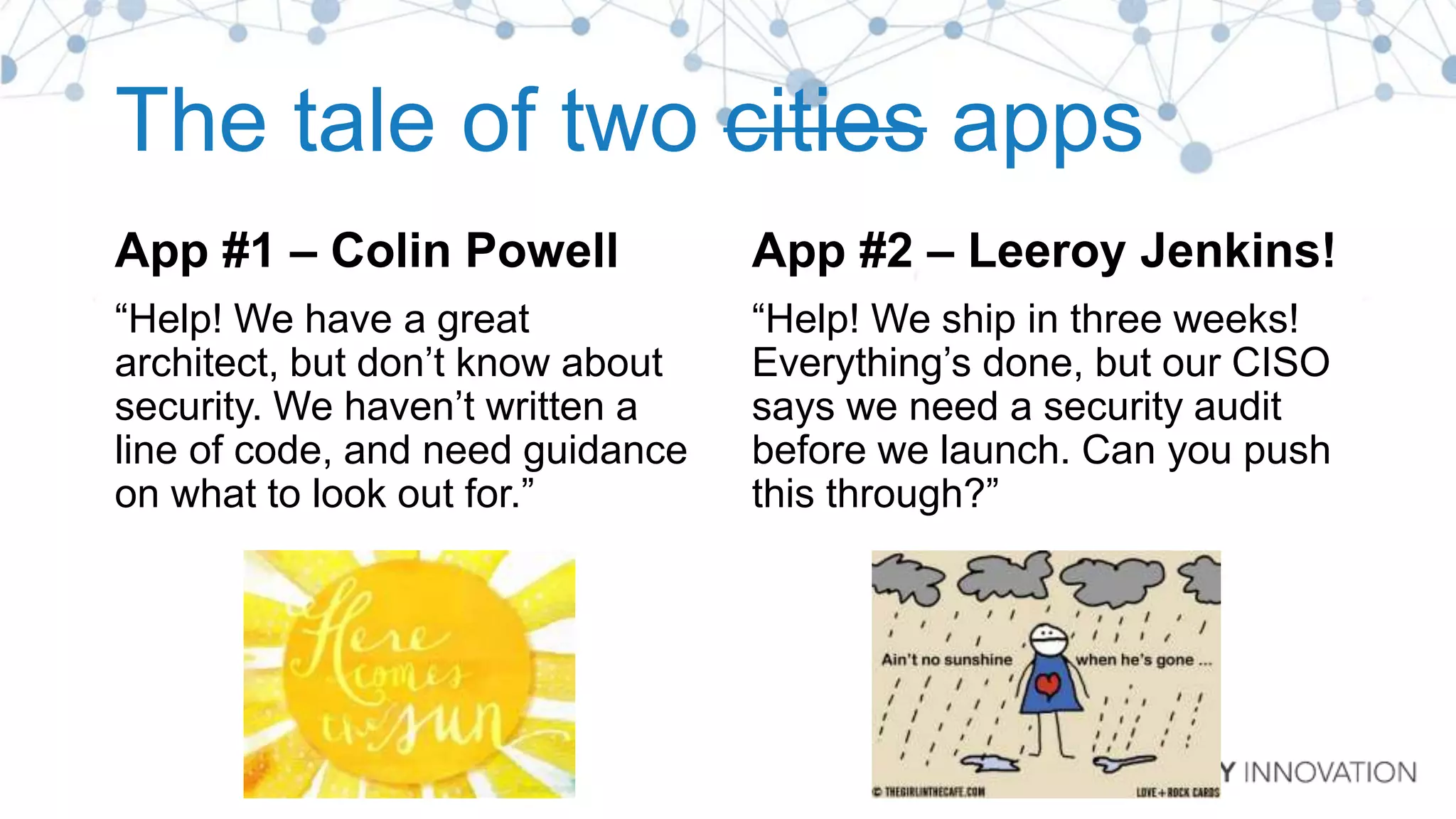
The tale of two cities apps
App #1 – Colin Powell
“Help! We have a great
architect, but don’t know about
security. We haven’t written a
line of code, and need guidance
on what to look out for.”
App #2 – Leeroy Jenkins!
“Help! We ship in three weeks!
Everything’s done, but our CISO
says we need a security audit
before we launch. Can you push
this through?”
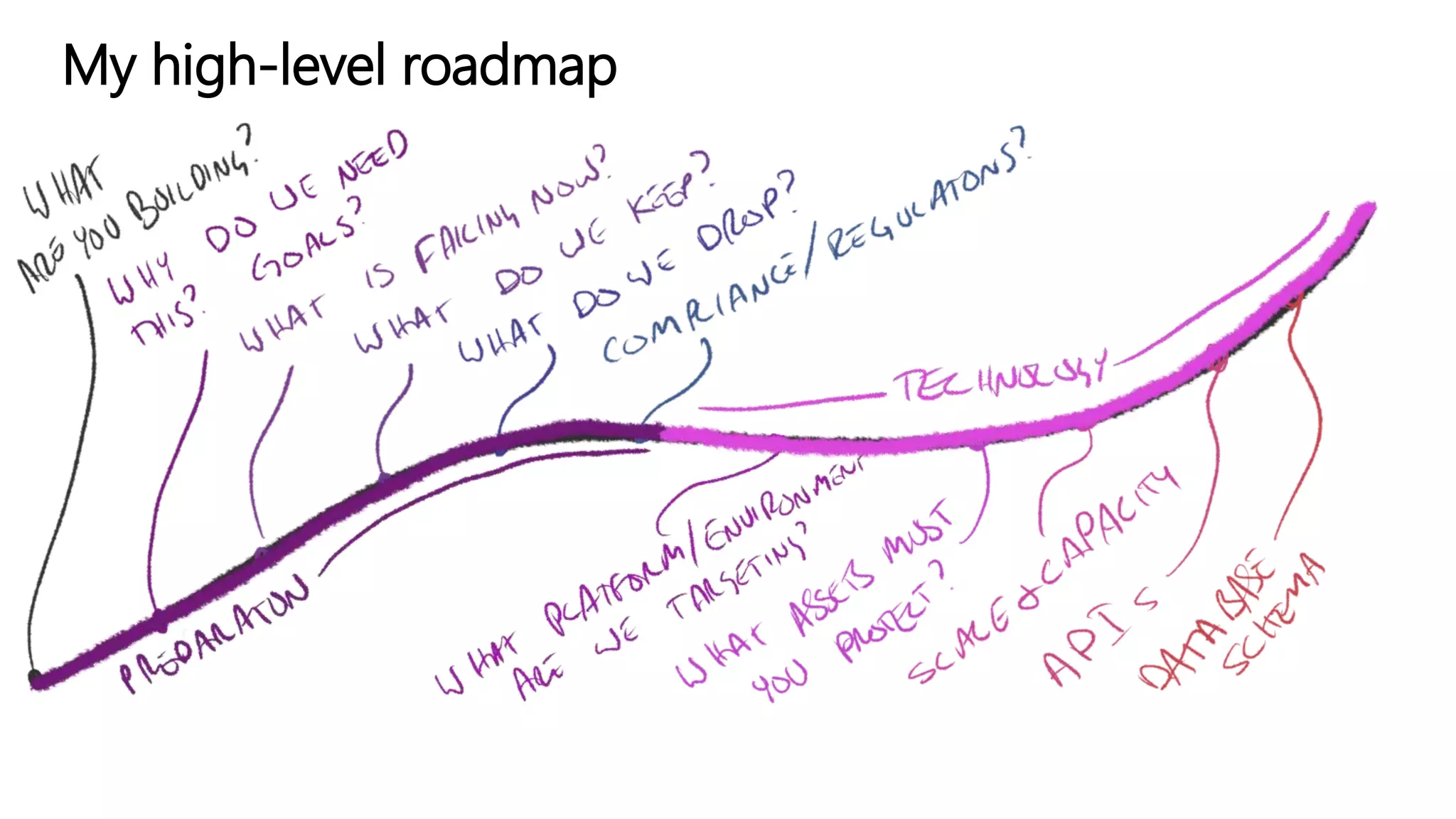
My high-level roadmap
Minimizing the risk of
a data breach
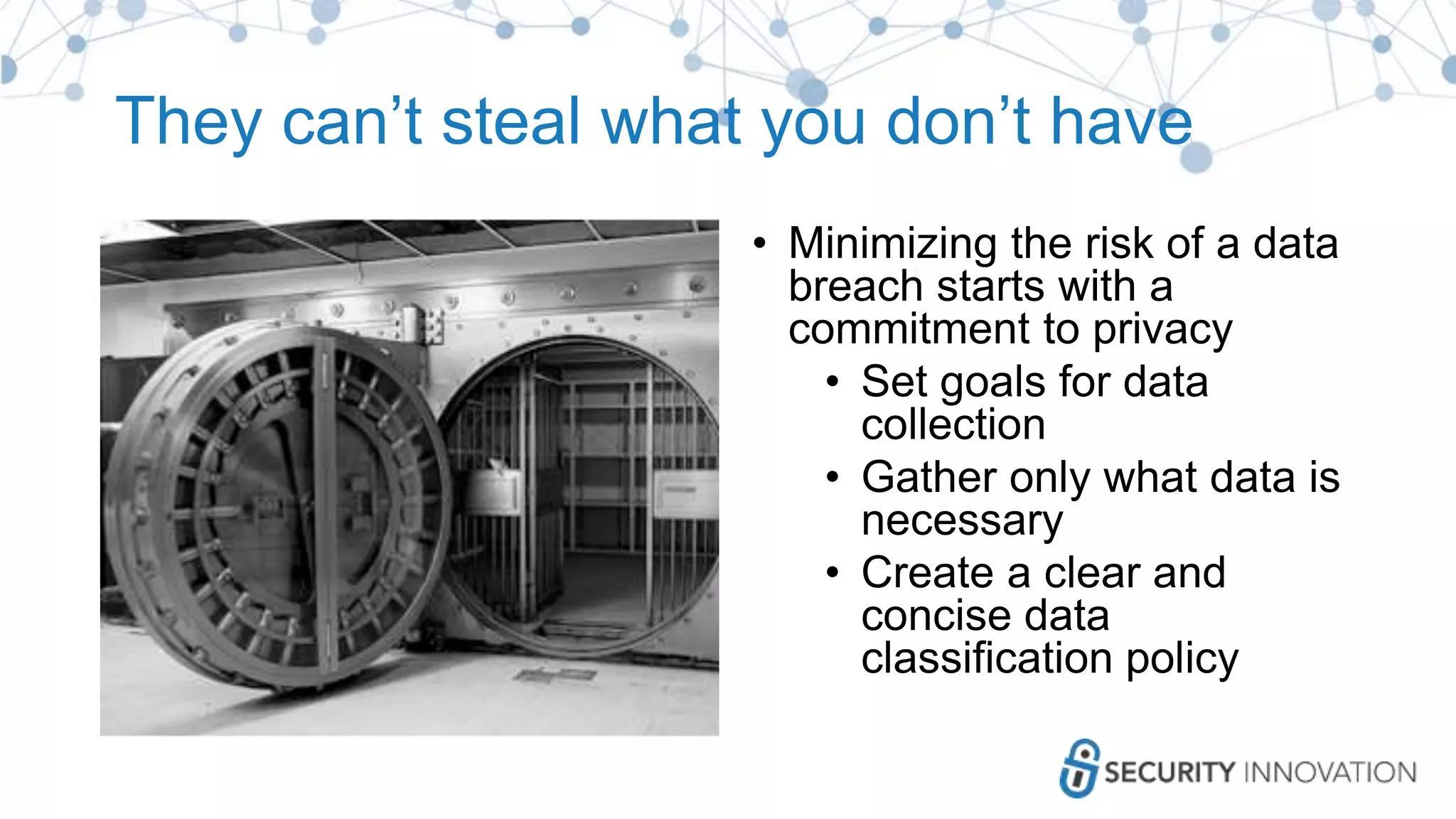
They can’t steal what you don’t have
• Minimizing the risk of a data
breach starts with a
commitment to privacy
• Set goals for data
collection
• Gather only what data is
necessary
• Create a clear and
concise data
classification policy
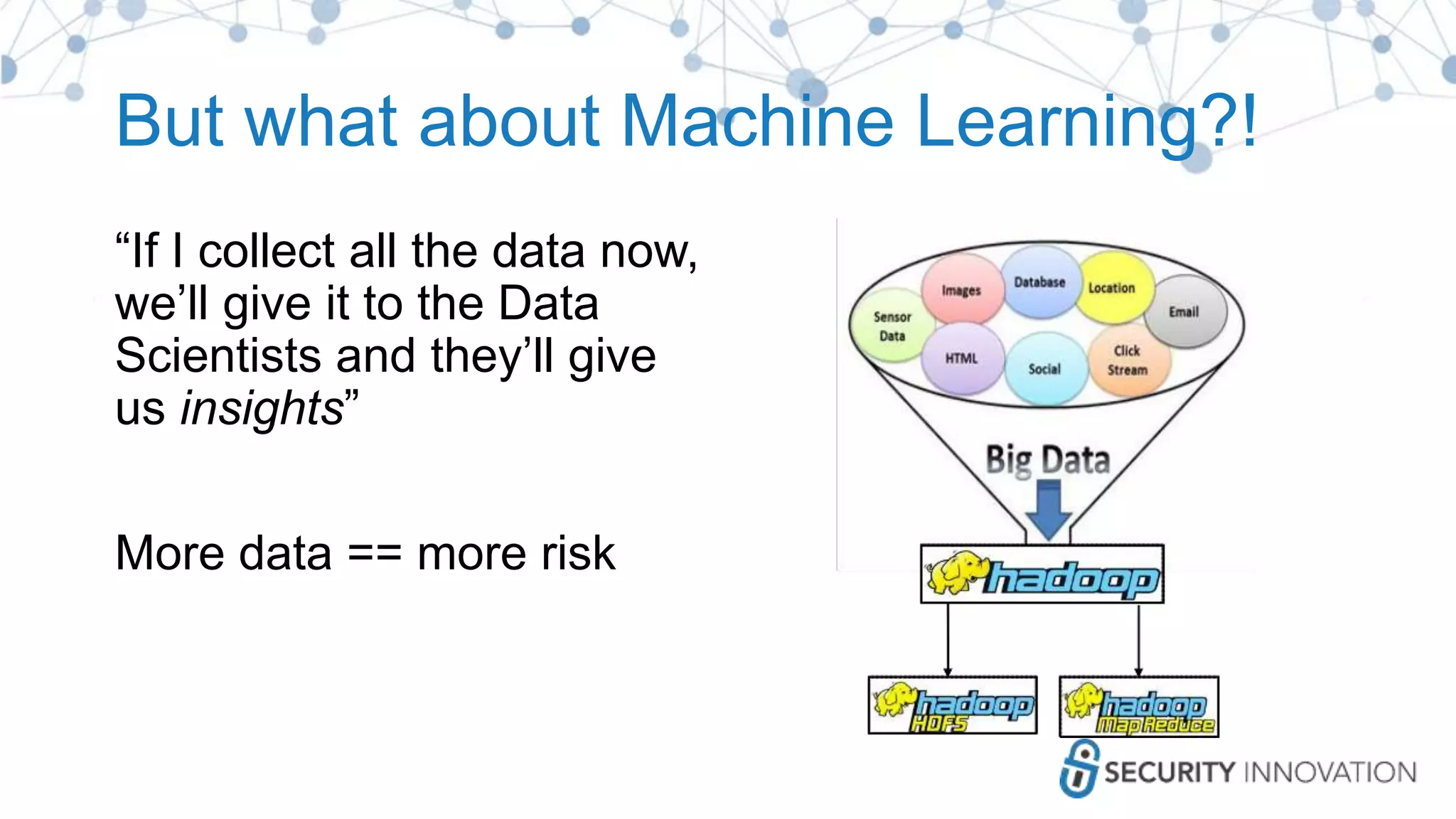
But what about Machine Learning?!
“If I collect all the data now,
we’ll give it to the Data
Scientists and they’ll give
us insights”
More data == more risk
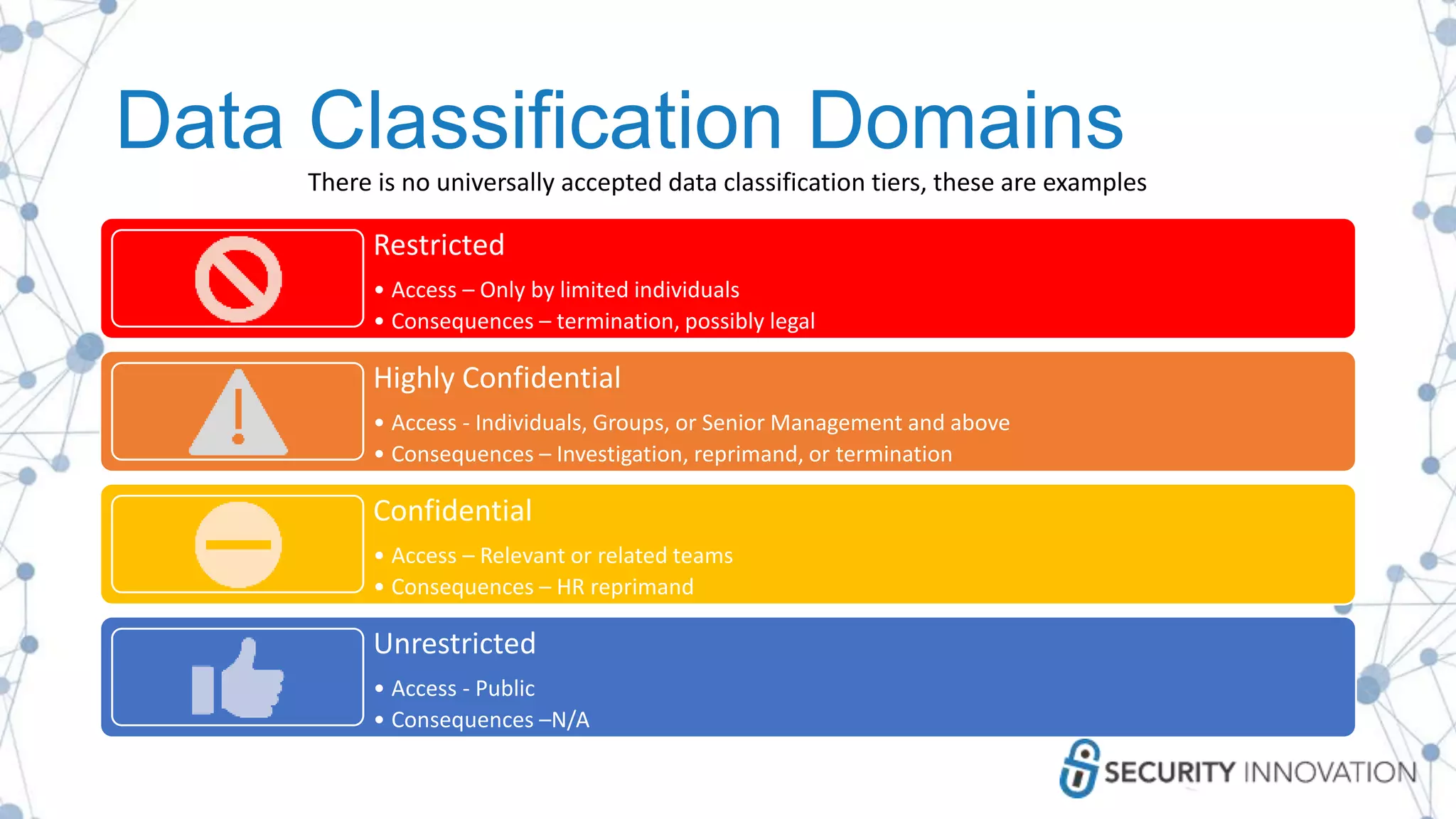
Data Classification Domains
Restricted
• Access – Only by limited individuals
• Consequences – termination, possibly legal
• Example – Financial data, Healthcare data
Highly Confidential
• Access - Individuals, Groups, or Senior Management and above
• Consequences – Investigation, reprimand, or termination
• Example – Sensitive IP, Client Lists, Billing Details
Confidential
• Access – Relevant or related teams
• Consequences – HR reprimand
• Example – Any internal company information
Unrestricted
• Access - Public
• Consequences –N/A
• Example- Public information
There is no universally accepted data classification tiers, these are examples
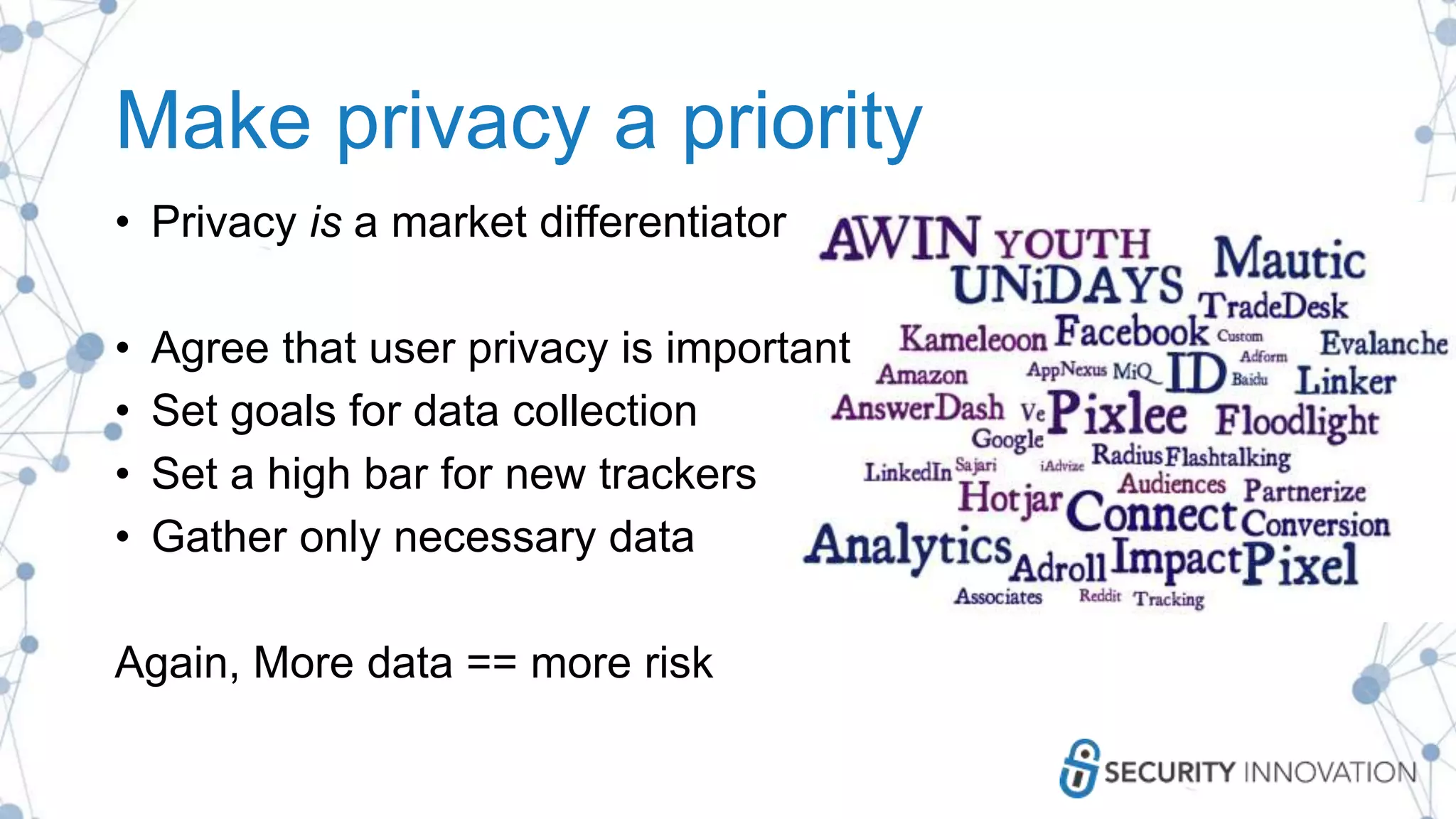
Make privacy a priority
• Privacy is a market differentiator
• Agree that user privacy is important
• Set goals for data collection
• Set a high bar for new trackers
• Gather only necessary data
Again, More data == more risk
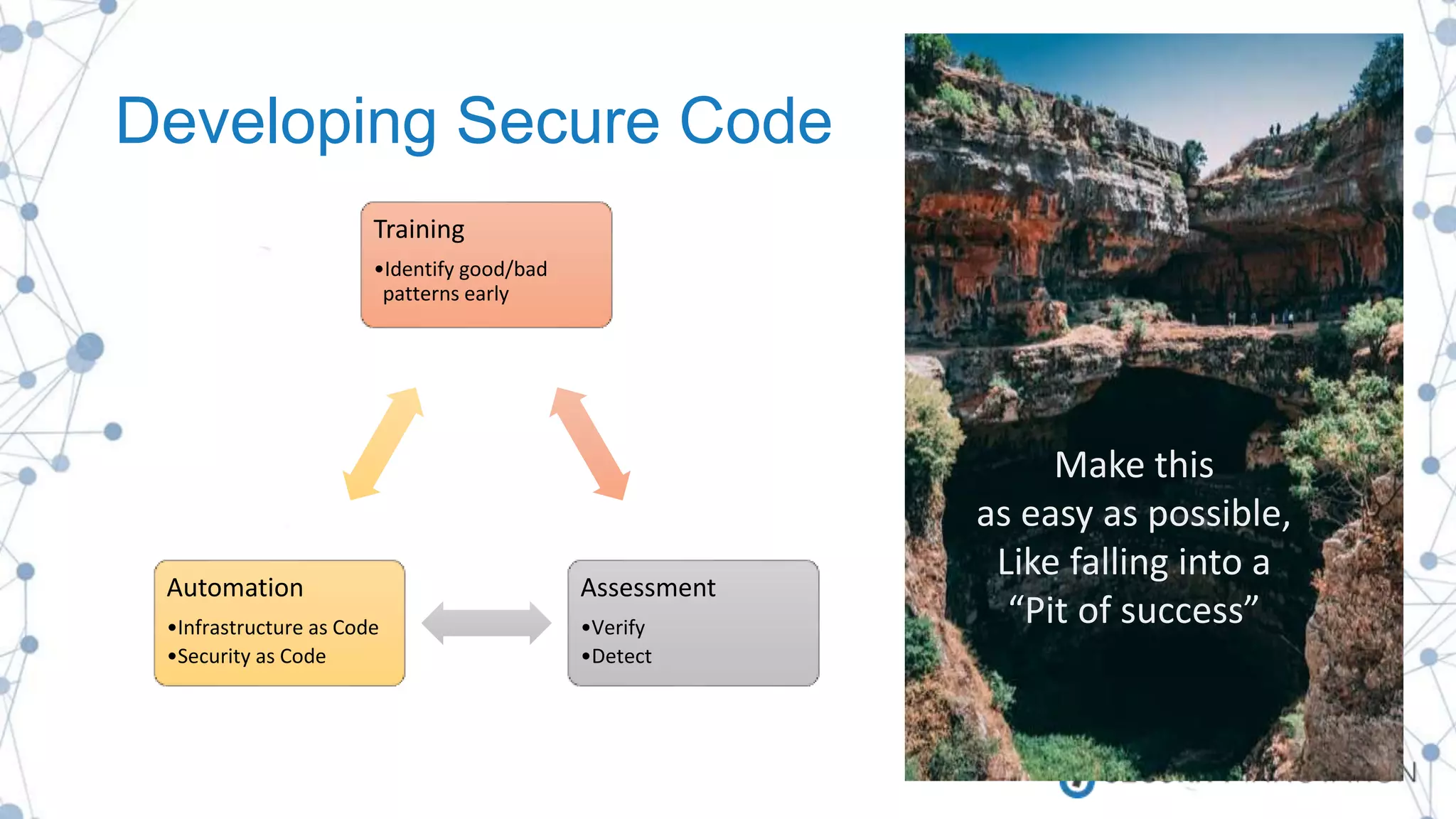
Developing Secure Code
Make this
as easy as possible,
Like falling into a
“Pit of success”
Training
•Identify good/bad
patterns early
Assessment
•Verify
•Detect
Automation
•Infrastructure as Code
•Security as Code
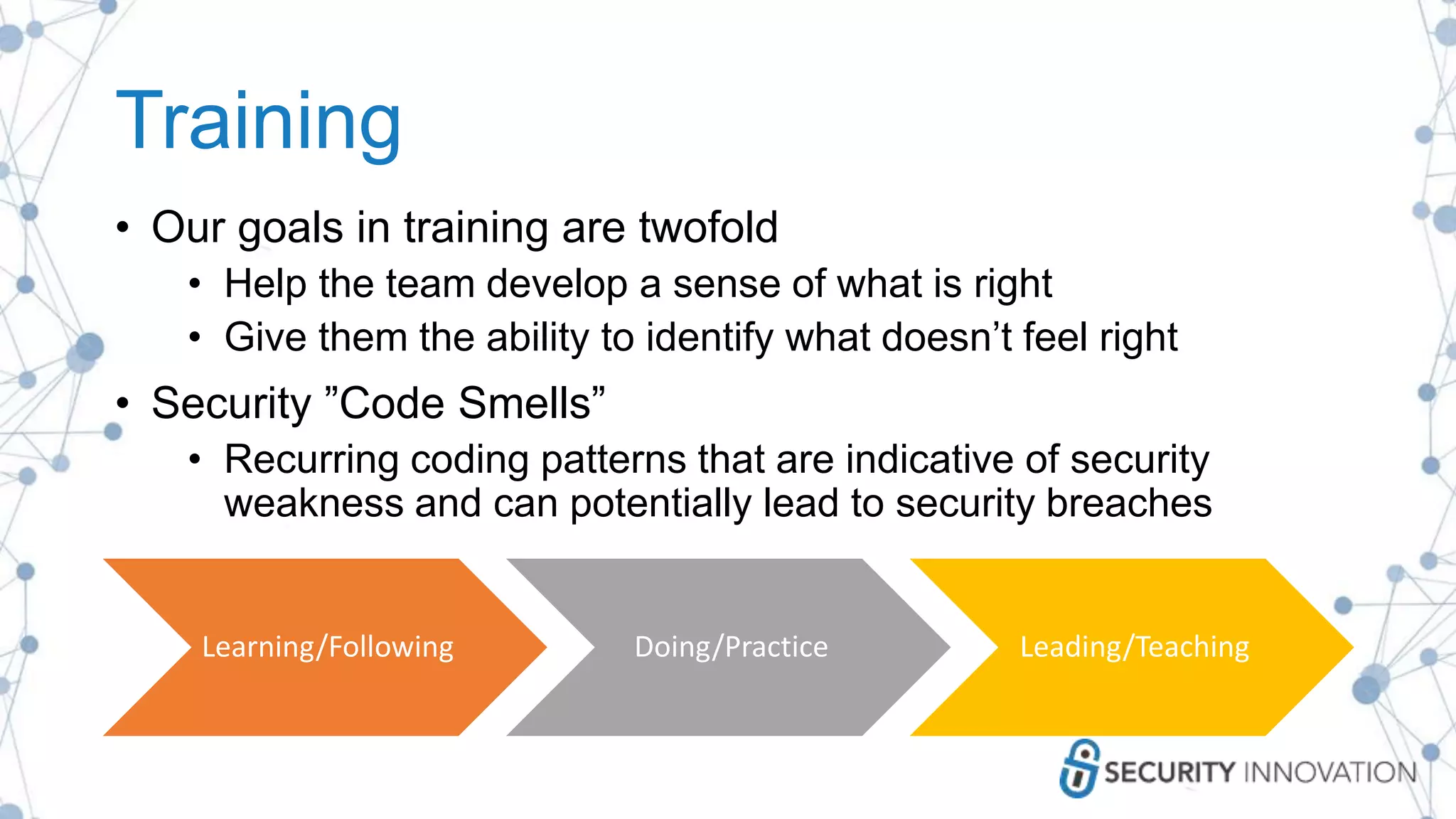
Training
• Our goals in training are twofold
• Help the team develop a sense of what is right
• Give them the ability to identify what doesn’t feel right
• Security ”Code Smells”
• Recurring coding patterns that are indicative of security
weakness and can potentially lead to security breaches
Learning/Following Doing/Practice Leading/Teaching
Automation
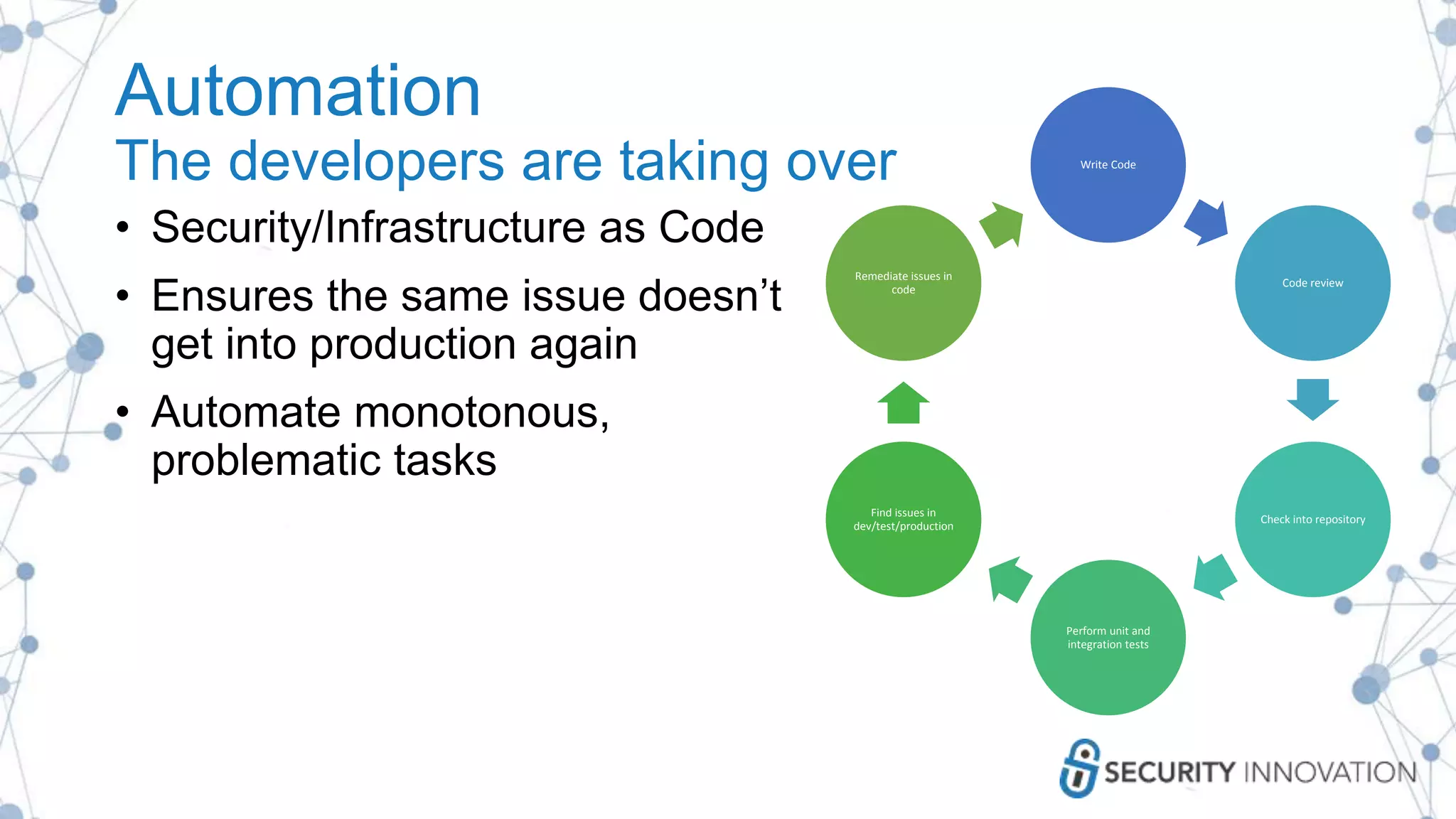
The developers are taking over
• Security/Infrastructure as Code
• Ensures the same issue doesn’t
get into production again
• Automate monotonous,
problematic tasks
Write Code
Code review
Check into repository
Perform unit and
integration tests
Find issues in
dev/test/production
Remediate issues in
code
Assessment &
Detection
• Testing is the backstop of good
training, design, and automation
• Detect when developers have
bypassed security guidance
• Rollback
• Remediate
• Train
• Vulnerabilities in…
• Deployment/Infrastructure
• Code
• Architecture
• Process
Defaults
• Creating a system in which it is difficult to
make mistakes is one of the best
investments you can make
• Provide developers:
• Libraries that protect them
• Frameworks that include security controls
• Templating engines that minimize injection
issues
• Defaults that follow best practices
• Wrappers for common libraries protect from
mistakes
Where are we and what
do we look out for?
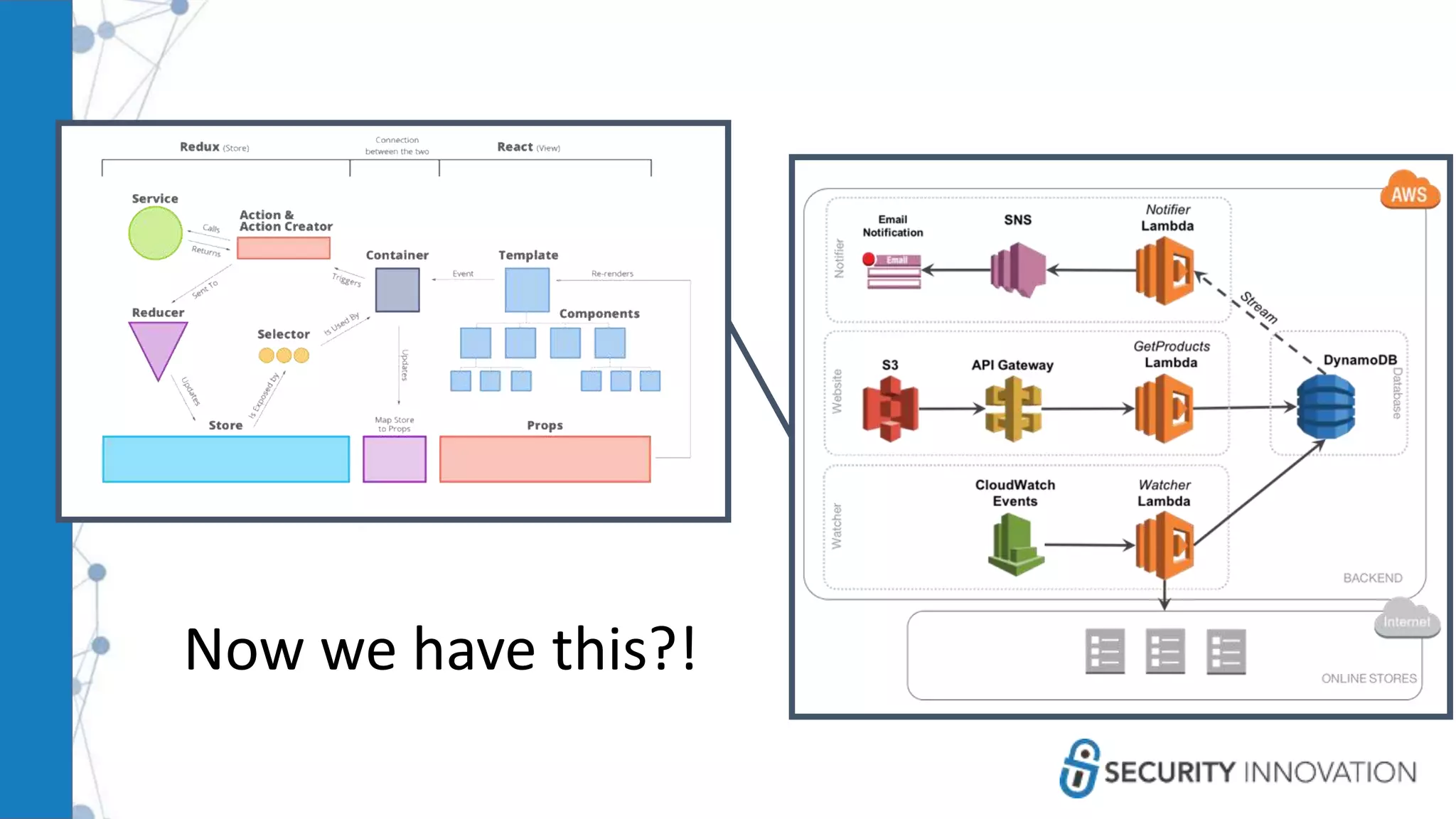
Now we have this?!
How did we get here?
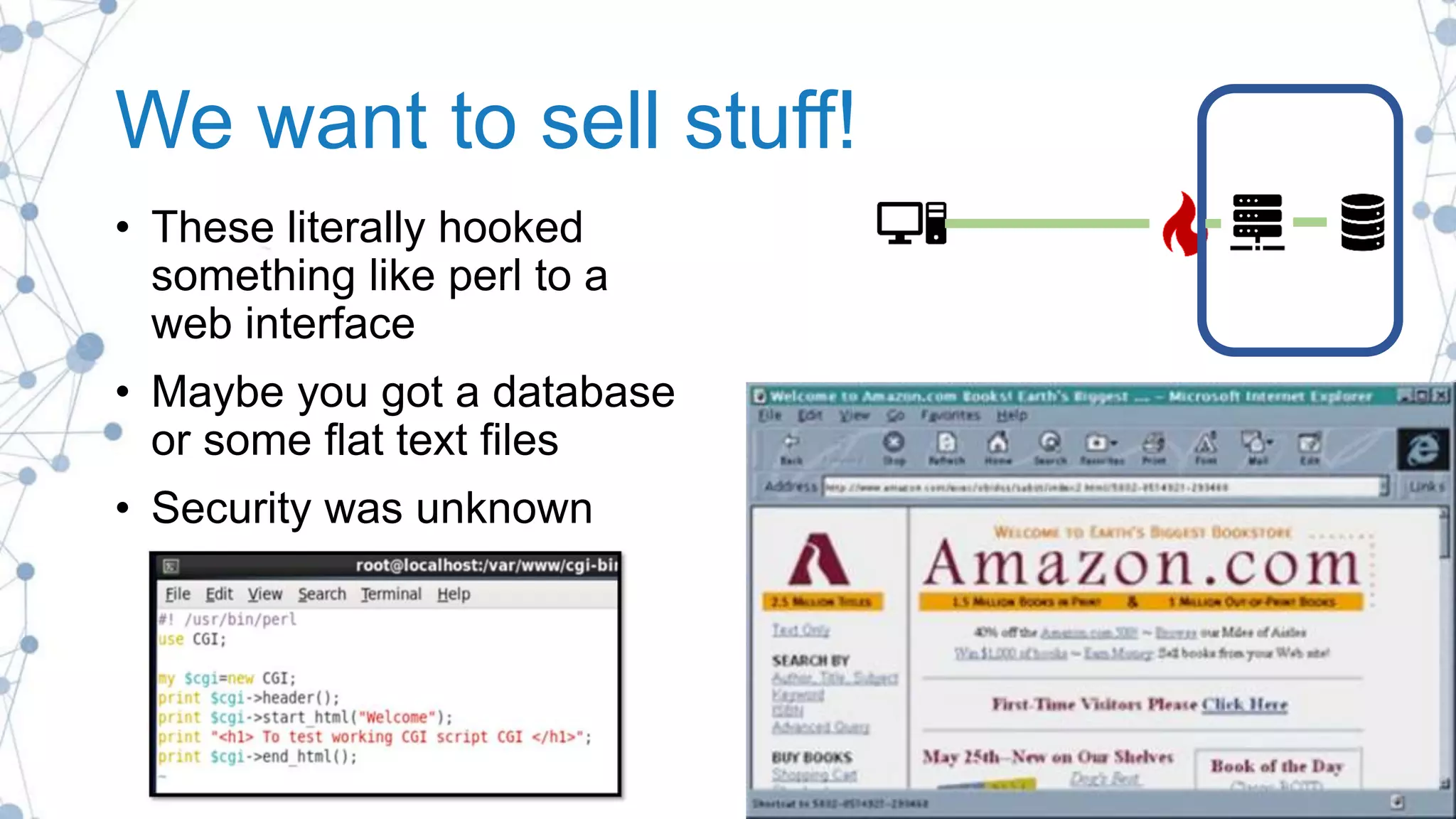
We want to sell stuff!
• These literally hooked
something like perl to a
web interface
• Maybe you got a database
or some flat text files
• Security was unknown
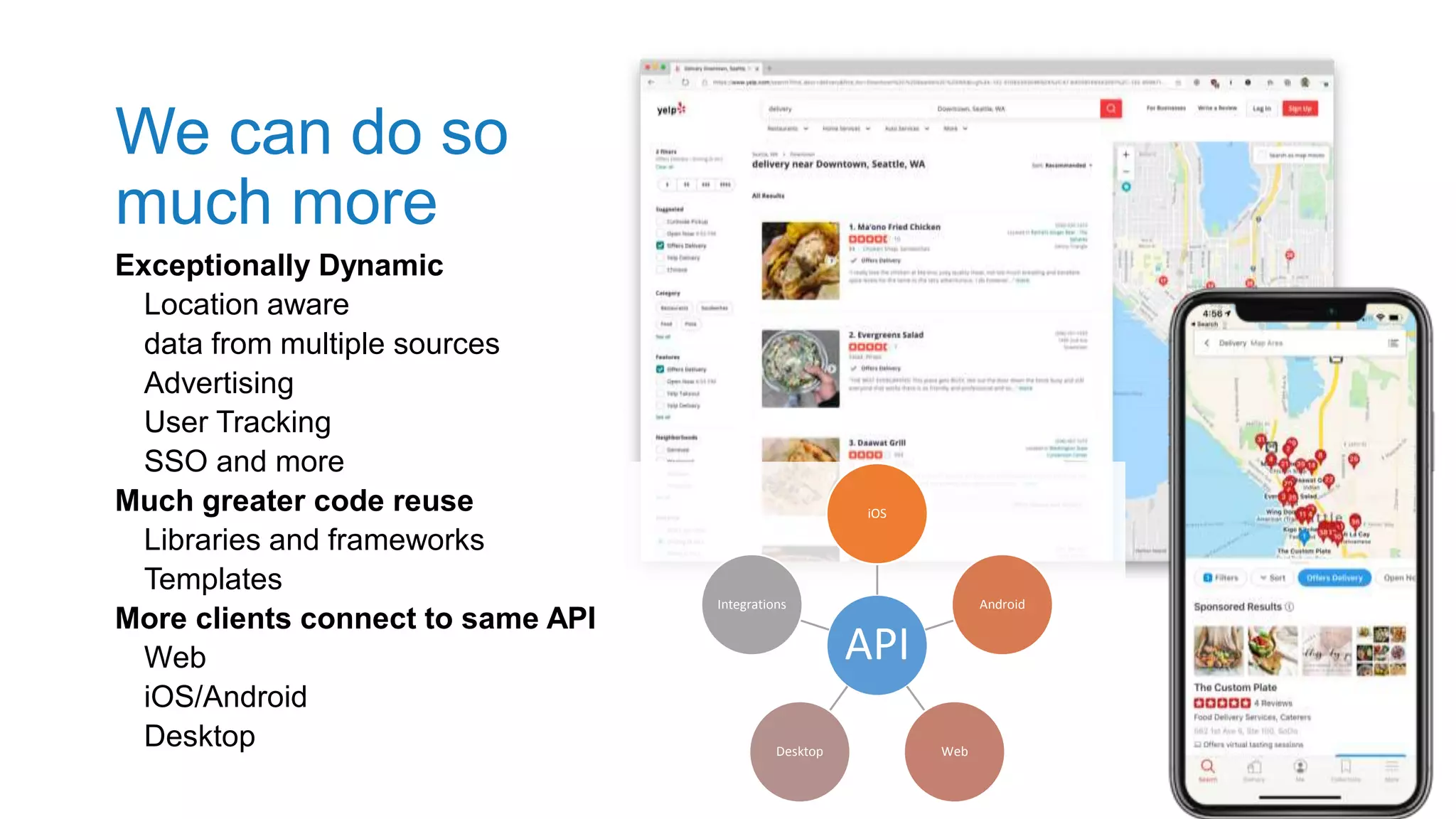
We can do so
much more
Exceptionally Dynamic
Location aware
data from multiple sources
Advertising
User Tracking
SSO and more
Much greater code reuse
Libraries and frameworks
Templates
More clients connect to same API
Web
iOS/Android
Desktop
API
iOS
Android
WebDesktop
Integrations
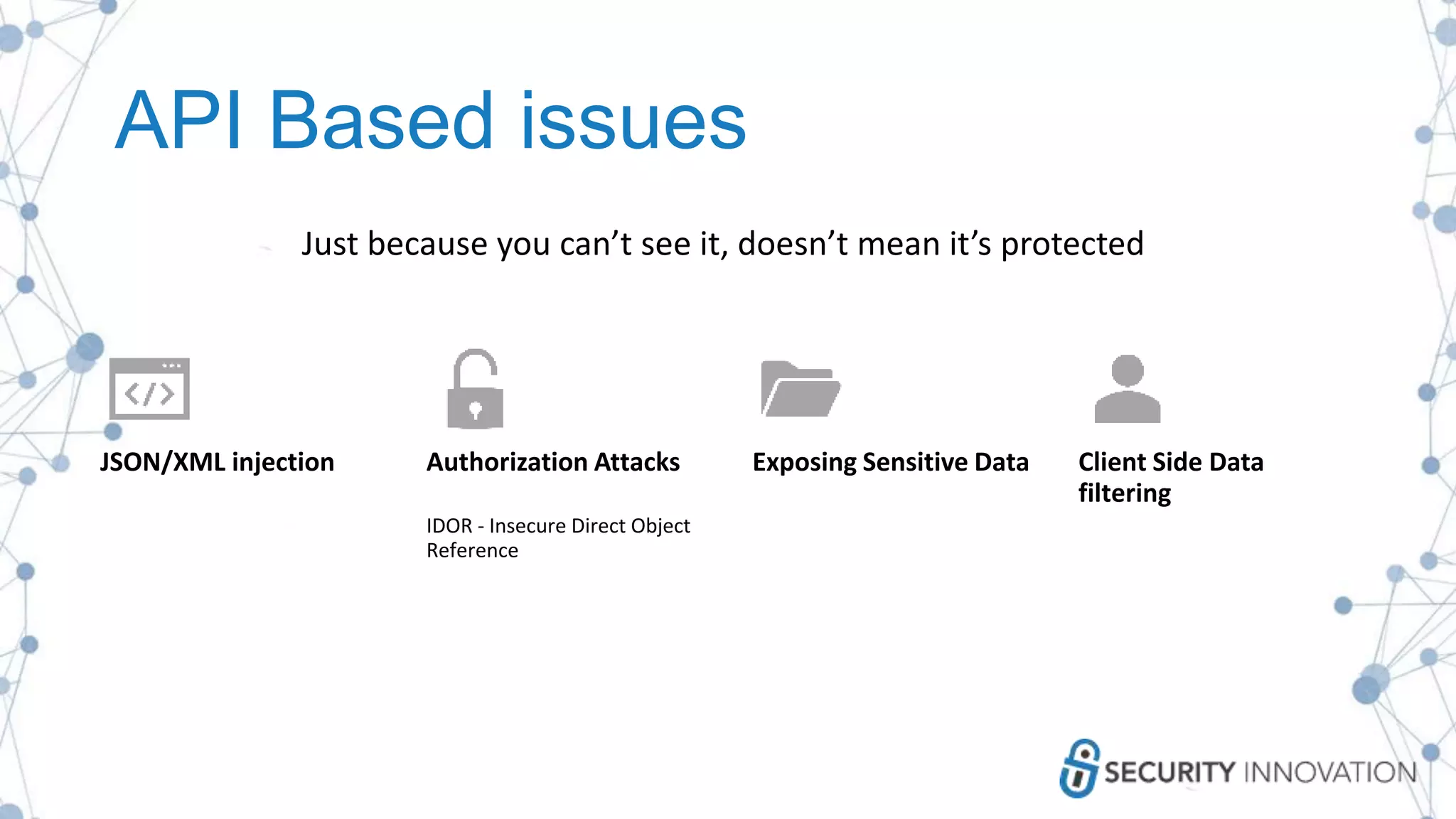
API Based issues
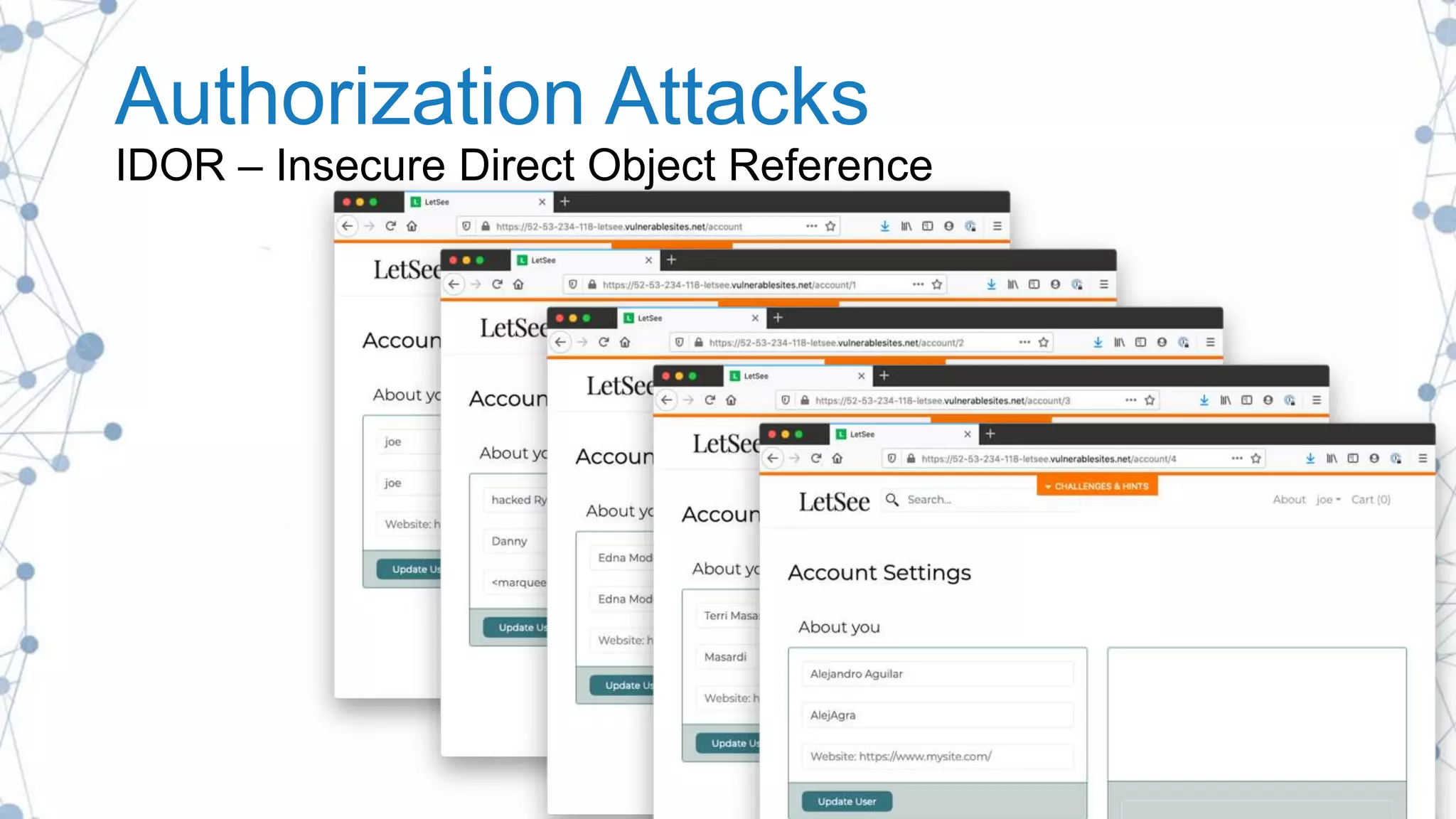
JSON/XML injection Authorization Attacks
IDOR - Insecure Direct Object
Reference
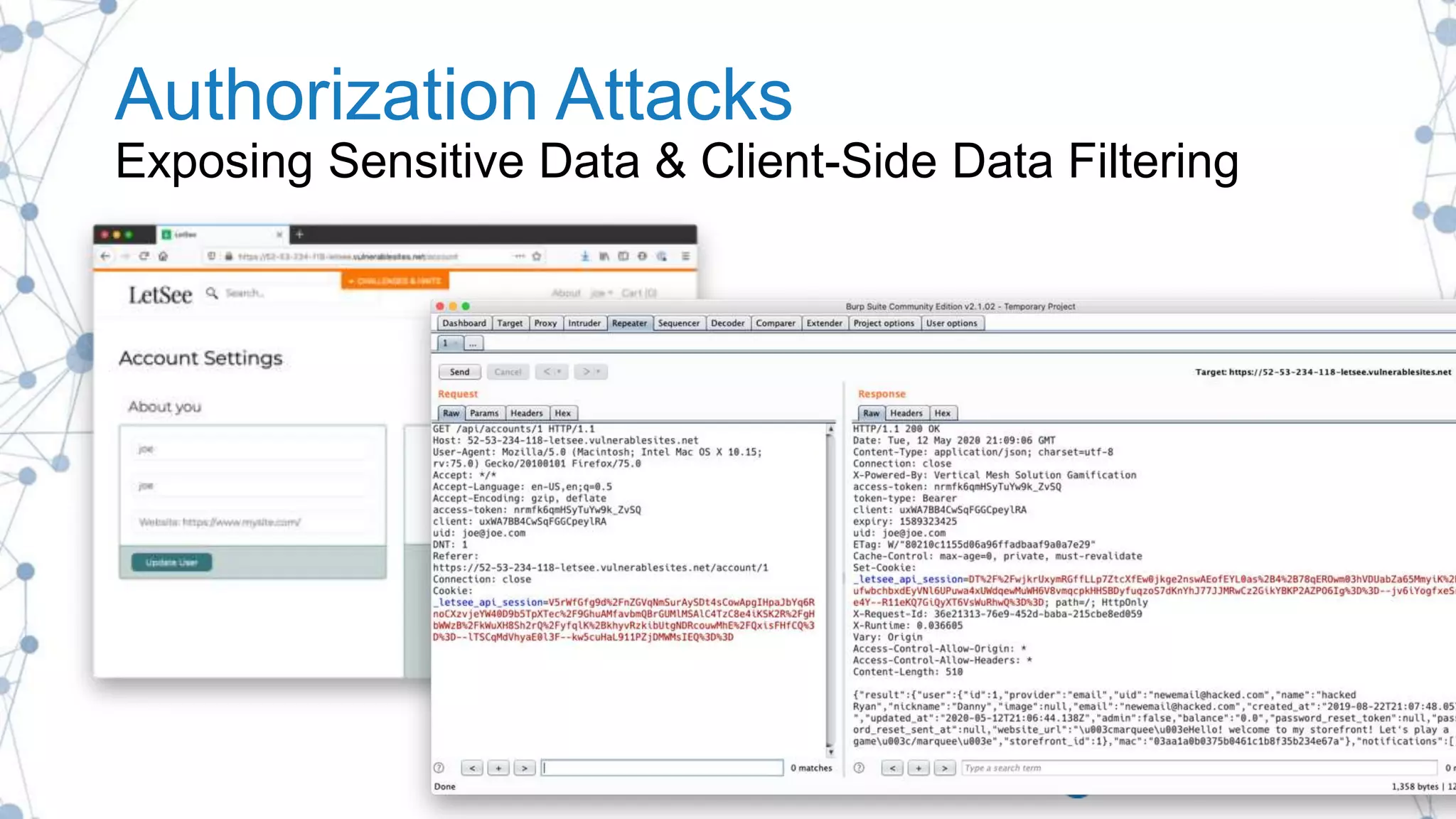
Exposing Sensitive Data Client Side Data
filtering
Just because you can’t see it, doesn’t mean it’s protected
Authorization Attacks
IDOR – Insecure Direct Object Reference
Authorization Attacks
Exposing Sensitive Data & Client-Side Data Filtering
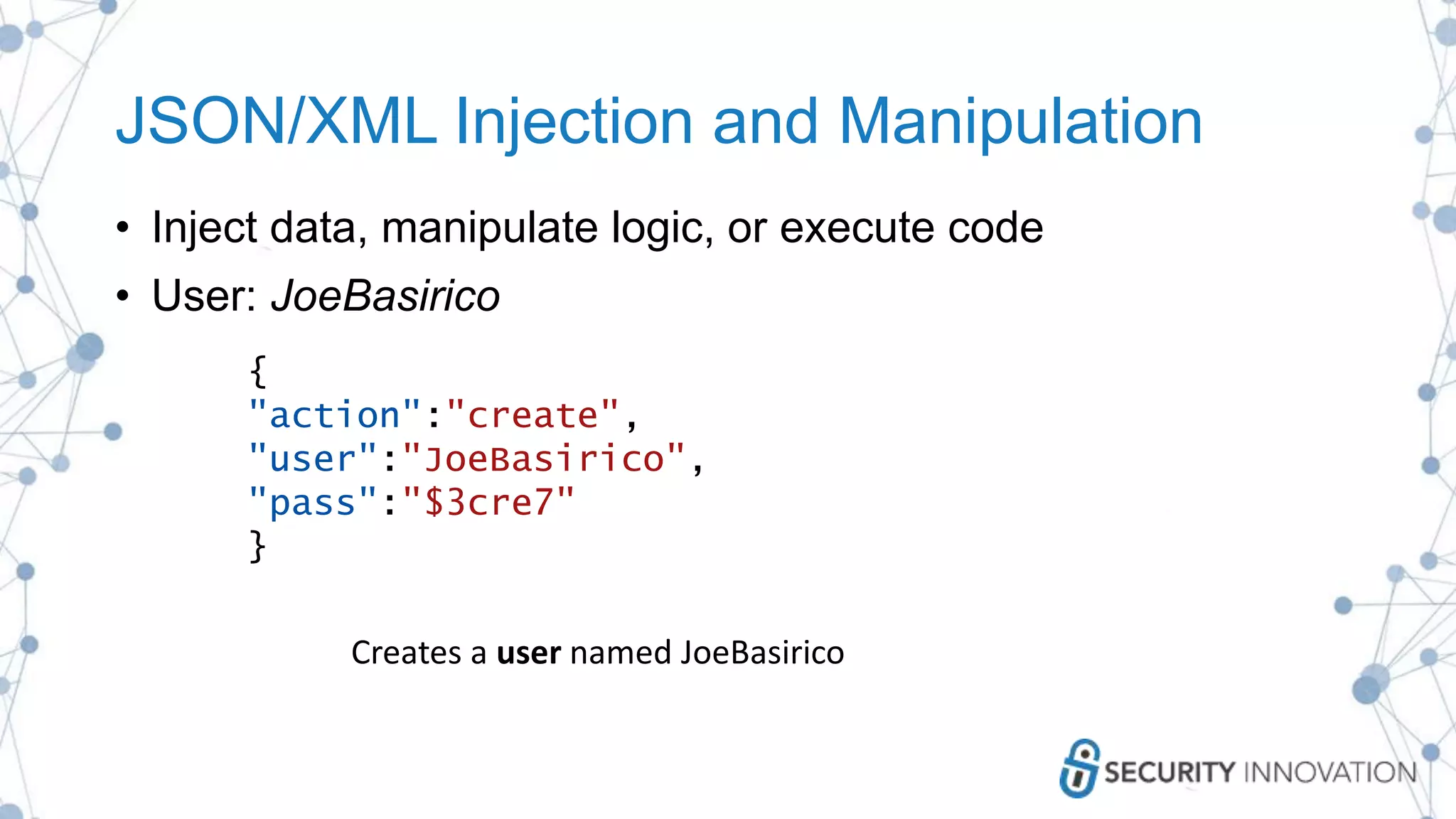
JSON/XML Injection and Manipulation
• Inject data, manipulate logic, or execute code
• User: JoeBasirico
{
"action":"create",
"user":"JoeBasirico",
"pass":"$3cre7"
}
Creates a user named JoeBasirico
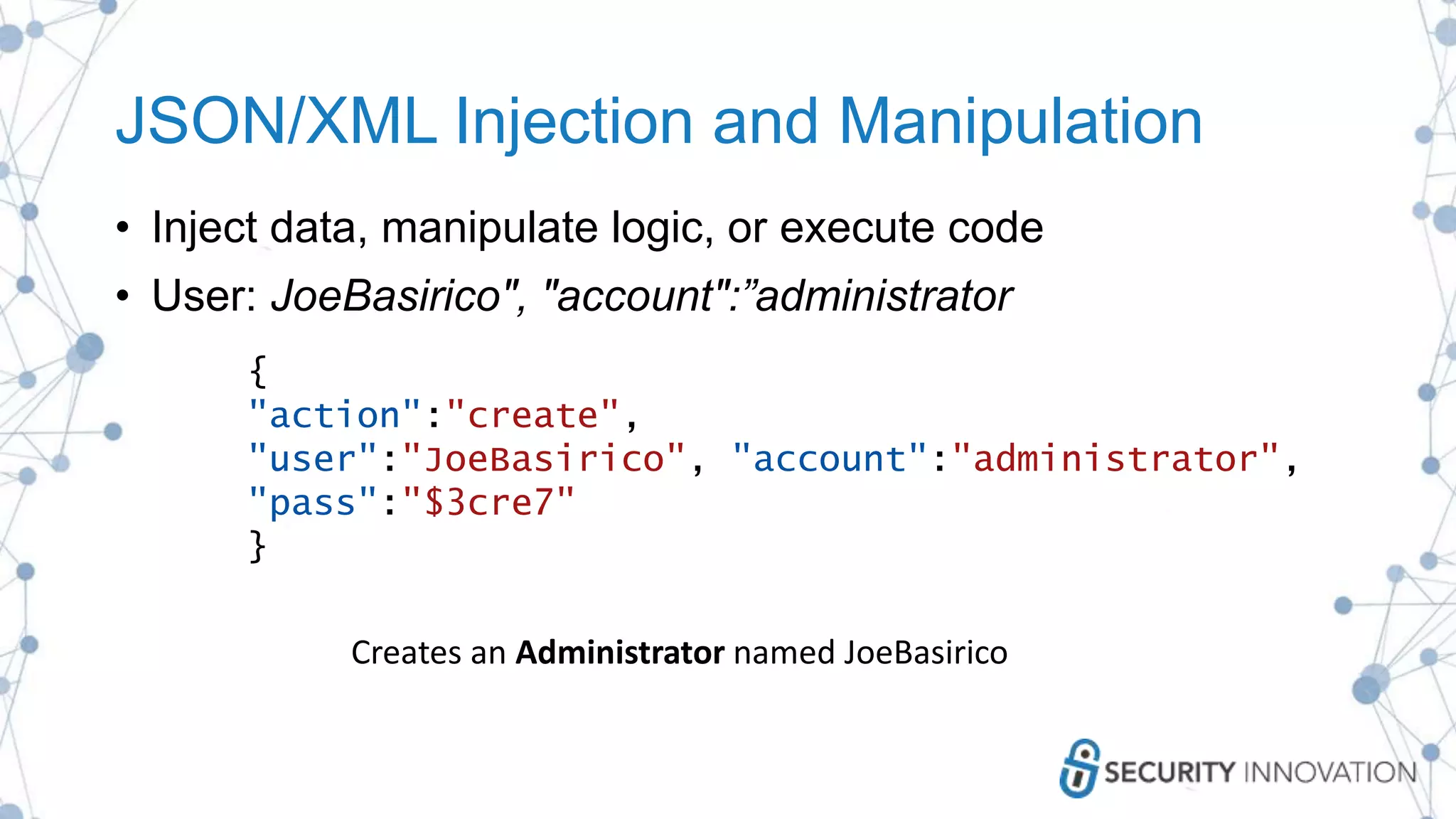
JSON/XML Injection and Manipulation
• Inject data, manipulate logic, or execute code
• User: JoeBasirico", "account":”administrator
{
"action":"create",
"user":"JoeBasirico", "account":"administrator",
"pass":"$3cre7"
}
Creates an Administrator named JoeBasirico
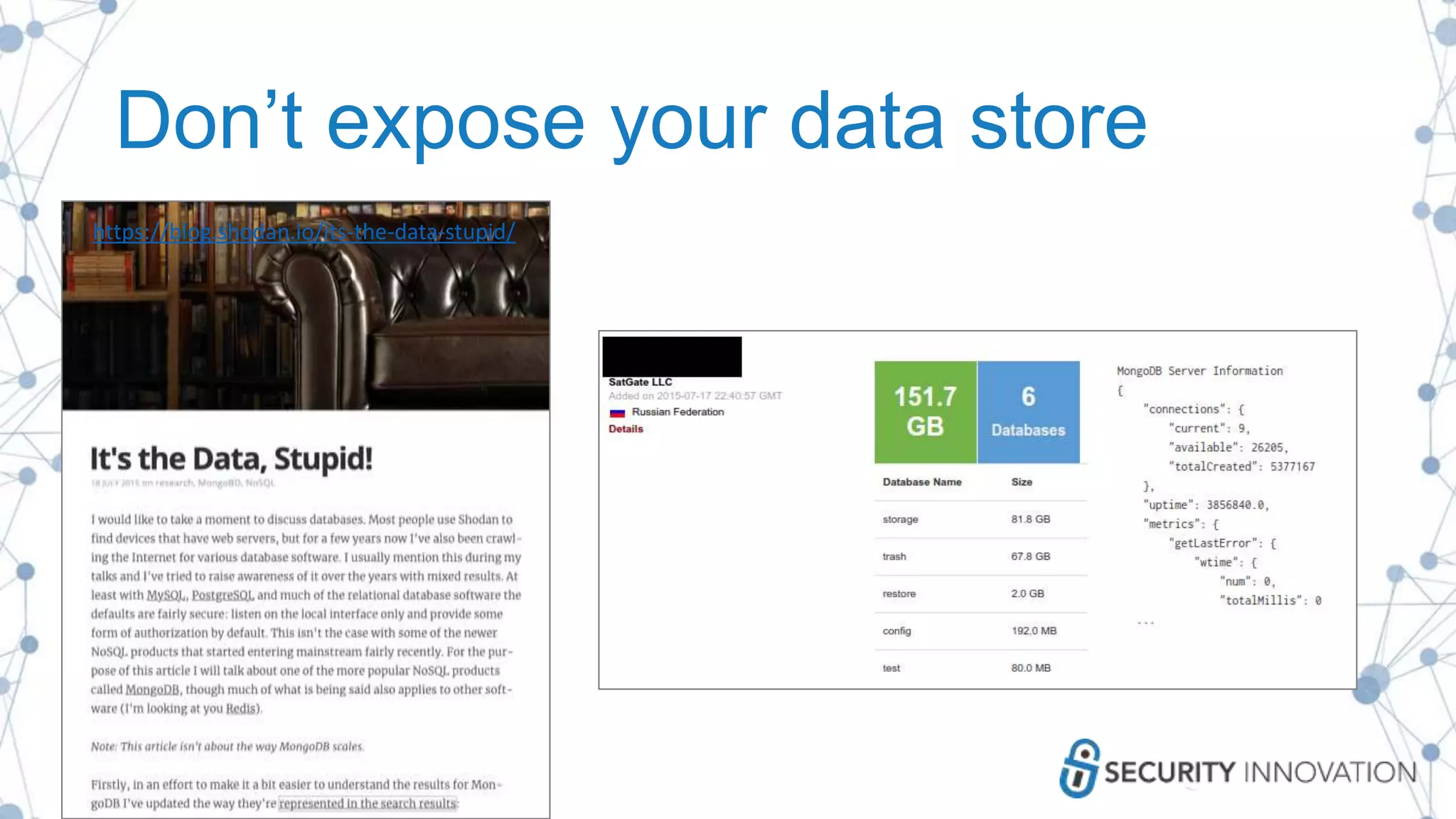
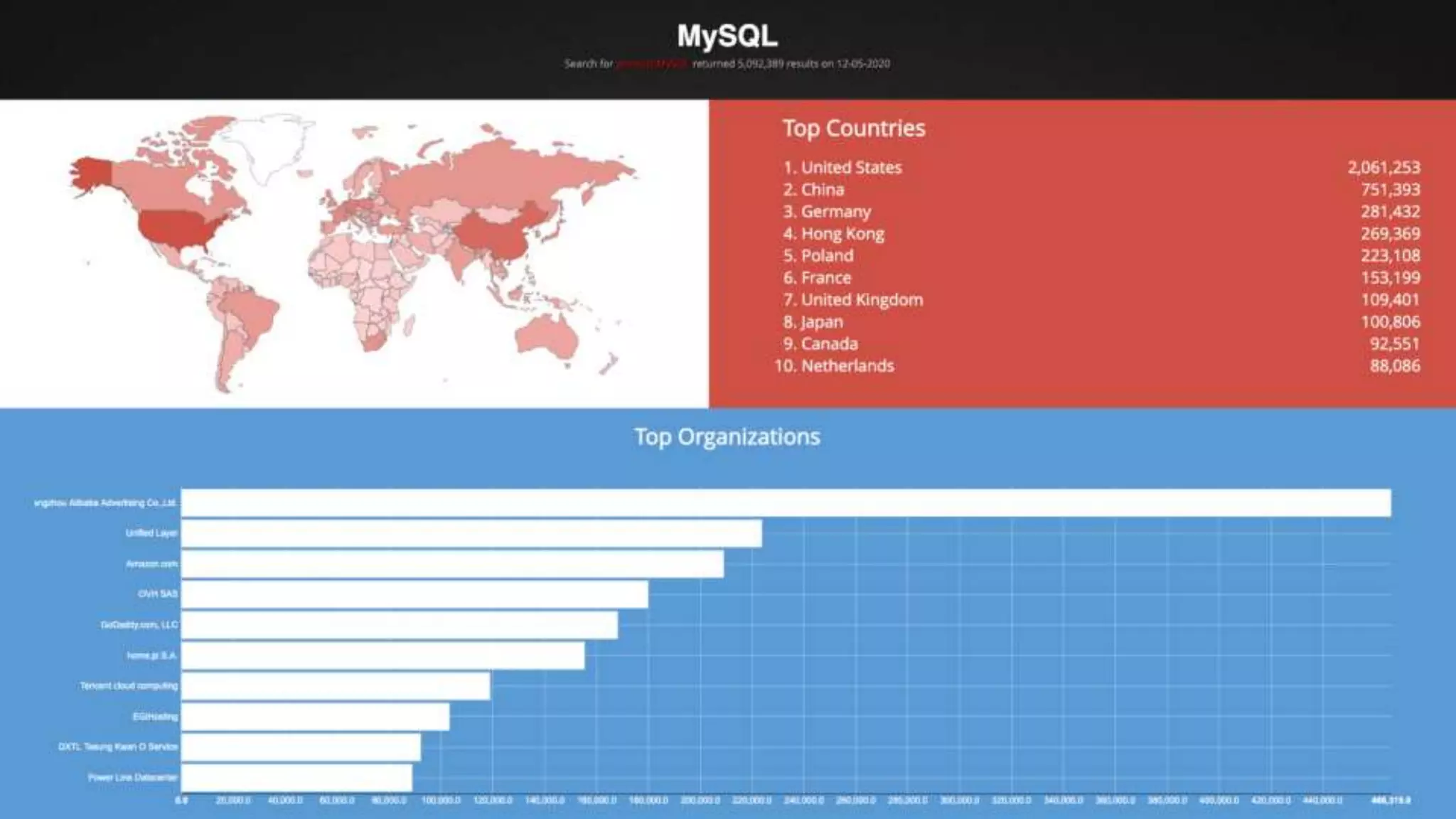
Don’t expose your data store
https://blog.shodan.io/its-the-data-stupid/
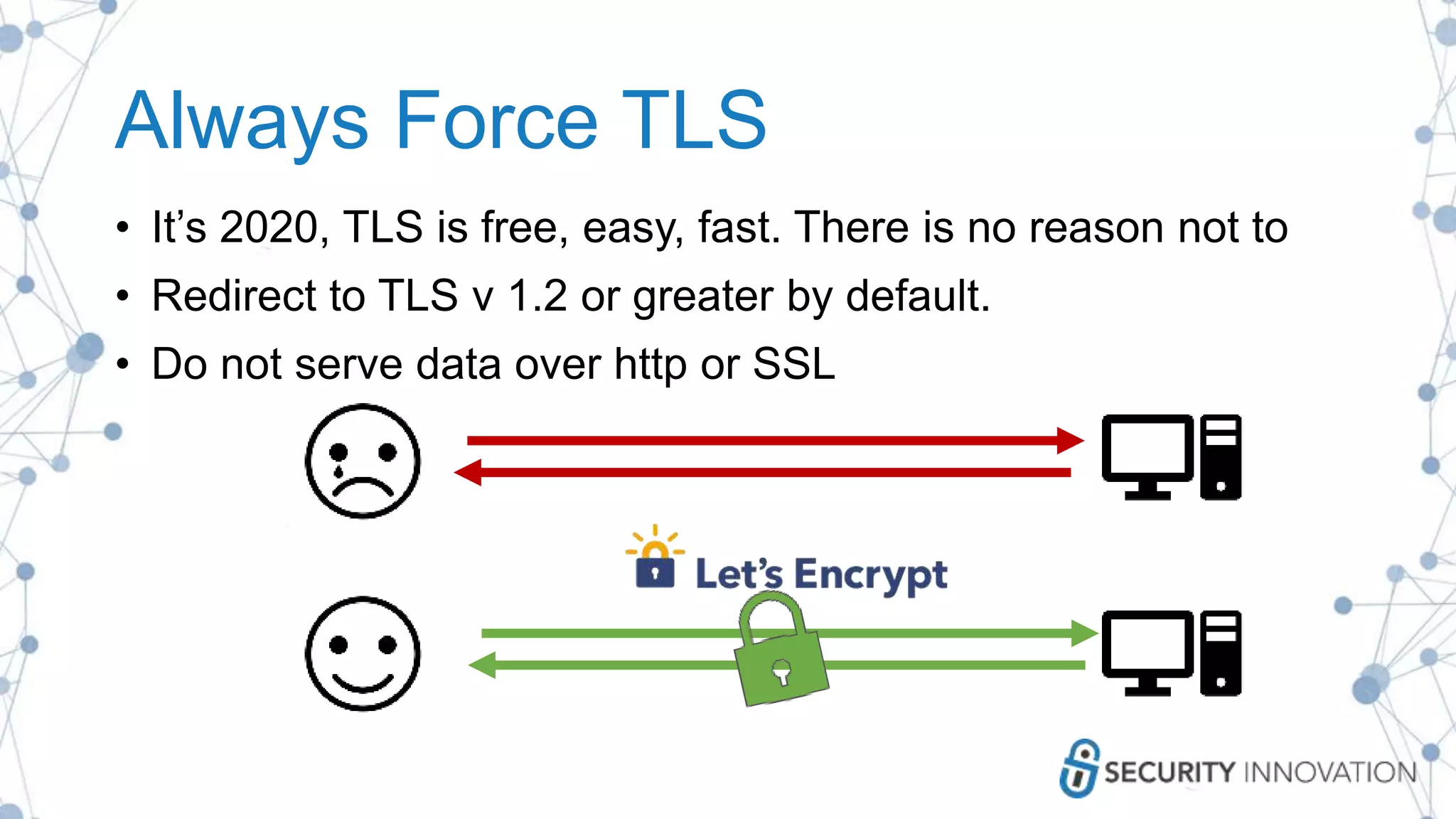
Always Force TLS
• It’s 2020, TLS is free, easy, fast. There is no reason not to
• Redirect to TLS v 1.2 or greater by default.
• Do not serve data over http or SSL
APIs and Modern WebApps are powerful!
• They can’t steal what you don’t collect
• Make an early commitment to security and privacy
• Let that drive your decision making from here on out
• Create secure defaults, libraries, wrappers and guidance for your
developers.
• Make it difficult to make decisiosn
• Make it easy to fall into a pit of success
• Use automation to ”learn” from your mistakes
• Detect when controls are bypassed, use it as a learning opportunity
SI Community - https://community.securityinnovation.com/
Questions? Thoughts?
jbasirico@securityinnovation.com
linkedin.com/in/joebasirico
twitter.com/joespikey
Joe Basirico
Security Innovation
SVP Engineering

Modernizing, Migrating & Mitigating - Moving to Modern Cloud & API Web Apps Webinar

  • 2.
    About Security Innovation •Authority in Software Security • 18+ years research on software vulnerabilities • Security testing methodology adopted by SAP, Symantec, Microsoft and McAfee • Authors of 18 books • Helping organizations minimize risk • Assessment: Show me the gaps • Education: Guide me to the right decisions • Standards: Set goals and make it easy and natural • Tech-enabled services for both breadth and depth
  • 4.
  • 5.
  • 6.
  • 7.
  • 8.
  • 9.
  • 10.
  • 11.
  • 12.
  • 13.
  • 14.
  • 15.
  • 16.
  • 17.
  • 18.
  • 19.
  • 20.
  • 21.
  • 22.
  • 23.
  • 24.
  • 25.
  • 26.
    … and literally100s of other things
  • 27.
    Never mind! I’m leavingthis piece of crap app as an installer from the 90’s
  • 28.
    No, No, wewill do this, together, securely. We will make a plan and execute it!
  • 29.
    Break it down •Migrating to modern web technologies is analogous to building from scratch • But you get great use, abuse, mis-use, and dis-use cases • This gives you a great roadmap of what you want to build • Don’t duplicate the old app, build something better • Use good defaults, policies, wrappers, guidance to build securely and quickly
  • 30.
    The tale oftwo cities apps App #1 – Colin Powell “Help! We have a great architect, but don’t know about security. We haven’t written a line of code, and need guidance on what to look out for.” App #2 – Leeroy Jenkins! “Help! We ship in three weeks! Everything’s done, but our CISO says we need a security audit before we launch. Can you push this through?”
  • 31.
  • 32.
    Minimizing the riskof a data breach
  • 33.
    They can’t stealwhat you don’t have • Minimizing the risk of a data breach starts with a commitment to privacy • Set goals for data collection • Gather only what data is necessary • Create a clear and concise data classification policy
  • 34.
    But what aboutMachine Learning?! “If I collect all the data now, we’ll give it to the Data Scientists and they’ll give us insights” More data == more risk
  • 35.
    Data Classification Domains Restricted •Access – Only by limited individuals • Consequences – termination, possibly legal • Example – Financial data, Healthcare data Highly Confidential • Access - Individuals, Groups, or Senior Management and above • Consequences – Investigation, reprimand, or termination • Example – Sensitive IP, Client Lists, Billing Details Confidential • Access – Relevant or related teams • Consequences – HR reprimand • Example – Any internal company information Unrestricted • Access - Public • Consequences –N/A • Example- Public information There is no universally accepted data classification tiers, these are examples
  • 36.
    Make privacy apriority • Privacy is a market differentiator • Agree that user privacy is important • Set goals for data collection • Set a high bar for new trackers • Gather only necessary data Again, More data == more risk
  • 37.
    Developing Secure Code Makethis as easy as possible, Like falling into a “Pit of success” Training •Identify good/bad patterns early Assessment •Verify •Detect Automation •Infrastructure as Code •Security as Code
  • 38.
    Training • Our goalsin training are twofold • Help the team develop a sense of what is right • Give them the ability to identify what doesn’t feel right • Security ”Code Smells” • Recurring coding patterns that are indicative of security weakness and can potentially lead to security breaches Learning/Following Doing/Practice Leading/Teaching
  • 39.
    Automation The developers aretaking over • Security/Infrastructure as Code • Ensures the same issue doesn’t get into production again • Automate monotonous, problematic tasks Write Code Code review Check into repository Perform unit and integration tests Find issues in dev/test/production Remediate issues in code
  • 40.
    Assessment & Detection • Testingis the backstop of good training, design, and automation • Detect when developers have bypassed security guidance • Rollback • Remediate • Train • Vulnerabilities in… • Deployment/Infrastructure • Code • Architecture • Process
  • 41.
    Defaults • Creating asystem in which it is difficult to make mistakes is one of the best investments you can make • Provide developers: • Libraries that protect them • Frameworks that include security controls • Templating engines that minimize injection issues • Defaults that follow best practices • Wrappers for common libraries protect from mistakes
  • 42.
    Where are weand what do we look out for?
  • 46.
  • 47.
    How did weget here?
  • 48.
    We want tosell stuff! • These literally hooked something like perl to a web interface • Maybe you got a database or some flat text files • Security was unknown
  • 49.
    We can doso much more Exceptionally Dynamic Location aware data from multiple sources Advertising User Tracking SSO and more Much greater code reuse Libraries and frameworks Templates More clients connect to same API Web iOS/Android Desktop API iOS Android WebDesktop Integrations
  • 50.
    API Based issues JSON/XMLinjection Authorization Attacks IDOR - Insecure Direct Object Reference Exposing Sensitive Data Client Side Data filtering Just because you can’t see it, doesn’t mean it’s protected
  • 51.
    Authorization Attacks IDOR –Insecure Direct Object Reference
  • 52.
    Authorization Attacks Exposing SensitiveData & Client-Side Data Filtering
  • 53.
    JSON/XML Injection andManipulation • Inject data, manipulate logic, or execute code • User: JoeBasirico { "action":"create", "user":"JoeBasirico", "pass":"$3cre7" } Creates a user named JoeBasirico
  • 54.
    JSON/XML Injection andManipulation • Inject data, manipulate logic, or execute code • User: JoeBasirico", "account":”administrator { "action":"create", "user":"JoeBasirico", "account":"administrator", "pass":"$3cre7" } Creates an Administrator named JoeBasirico
  • 55.
    Don’t expose yourdata store https://blog.shodan.io/its-the-data-stupid/
  • 57.
    Always Force TLS •It’s 2020, TLS is free, easy, fast. There is no reason not to • Redirect to TLS v 1.2 or greater by default. • Do not serve data over http or SSL
  • 58.
    APIs and ModernWebApps are powerful! • They can’t steal what you don’t collect • Make an early commitment to security and privacy • Let that drive your decision making from here on out • Create secure defaults, libraries, wrappers and guidance for your developers. • Make it difficult to make decisiosn • Make it easy to fall into a pit of success • Use automation to ”learn” from your mistakes • Detect when controls are bypassed, use it as a learning opportunity SI Community - https://community.securityinnovation.com/
  • 59.

Editor's Notes

  • #3 Speaking of SI, I’d be remiss if I didn’t talk a little bit about us and what we do. Security innovation is a company dedicated to helping our customers with hard application and data security problems. We’ve spent years researching security vulnerabilities, why they occur, what they look like in production code and how to find and fix them. We have experience working with some of the largest companies in a variety of industries - from software companies such as Microsoft to e-commerce companies such as amazon, financial companies and many more. We offer solutions for all phases of the SDLC including instructor led training, computer based eLearning courses, on-site consulting and security assessments as well as technology to help secure sensitive data over the network or at rest. Over the years we’ve analyzed more than 10,000 vulnerabilities both in the course of research studies and through the assessments of software for our customers We got our start as a security testing company, grew to a products and services company that focused on breaking systems (code review, pen test, etc) and then helping fix the problems through secure design and implementation. We acquired NTRU in 2009 to expand our data protection services focused on data in transit as well as data at rest with best in class, high performance cryptography.
  • #31 Colin Powell a great general and architect, does the work necessary to understand the threat landscape before jumping in.
  • #38 Assessment verifies what you’ve built Automation improves reliability. Infrastructure and Security as Code
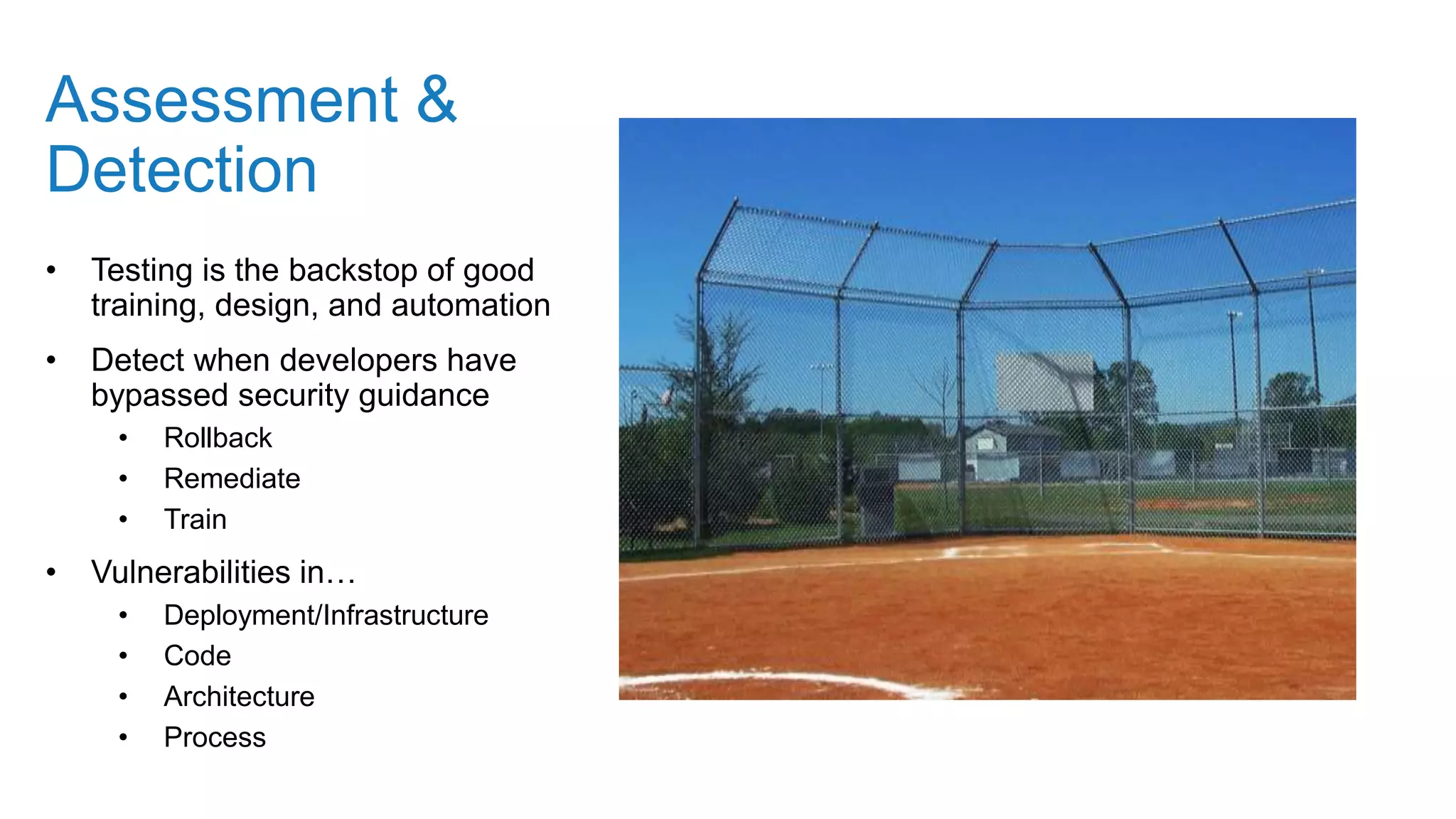
  • #41 You don’t expect the ball to hit the back stop every time. Similarly most issues should be caught much, much earlier. However, this remains a critical part of a mature security process.
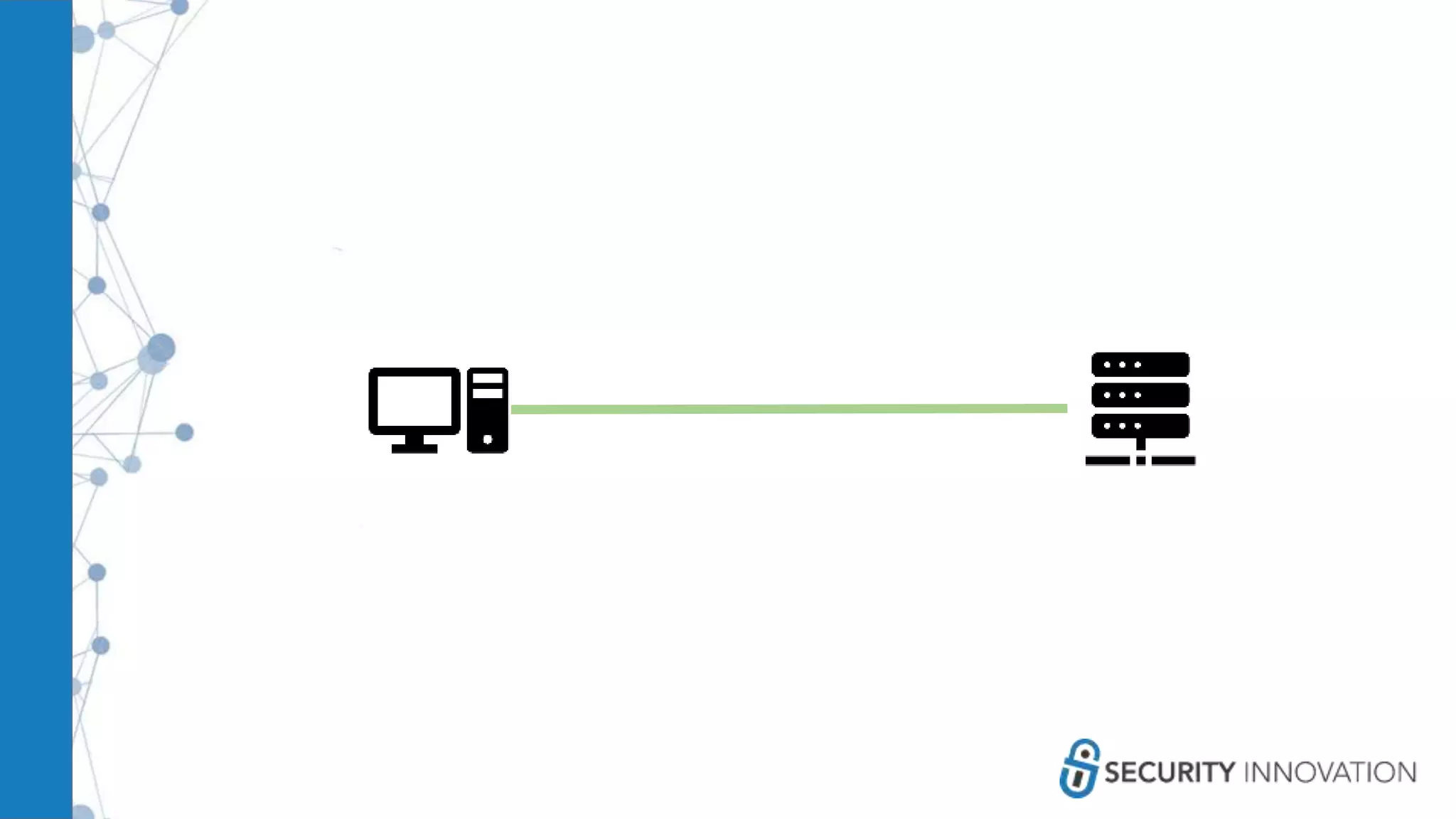
  • #44 Remember when our architecture looked like this?
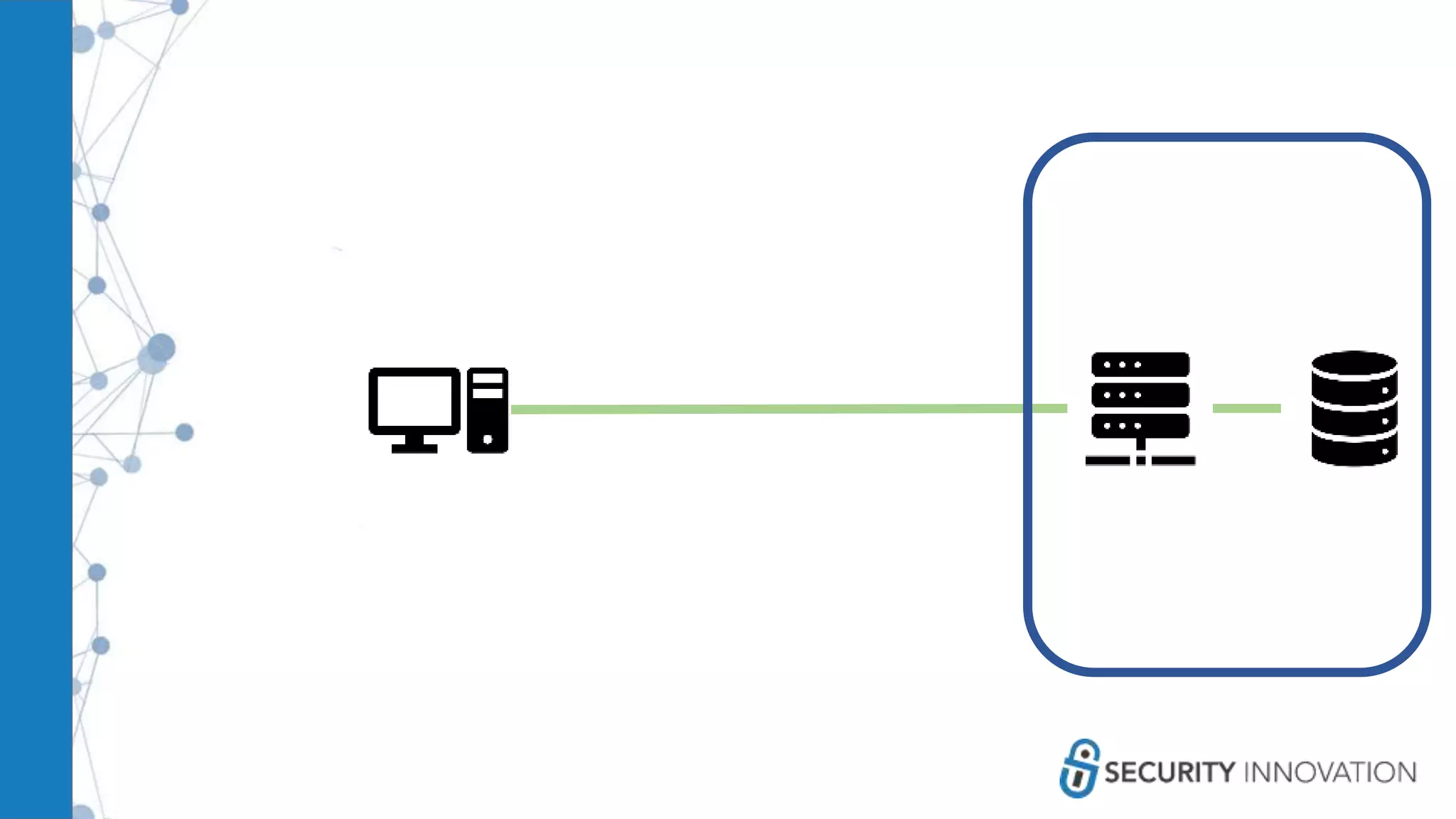
  • #45 Then we got complicated and added an application and a database
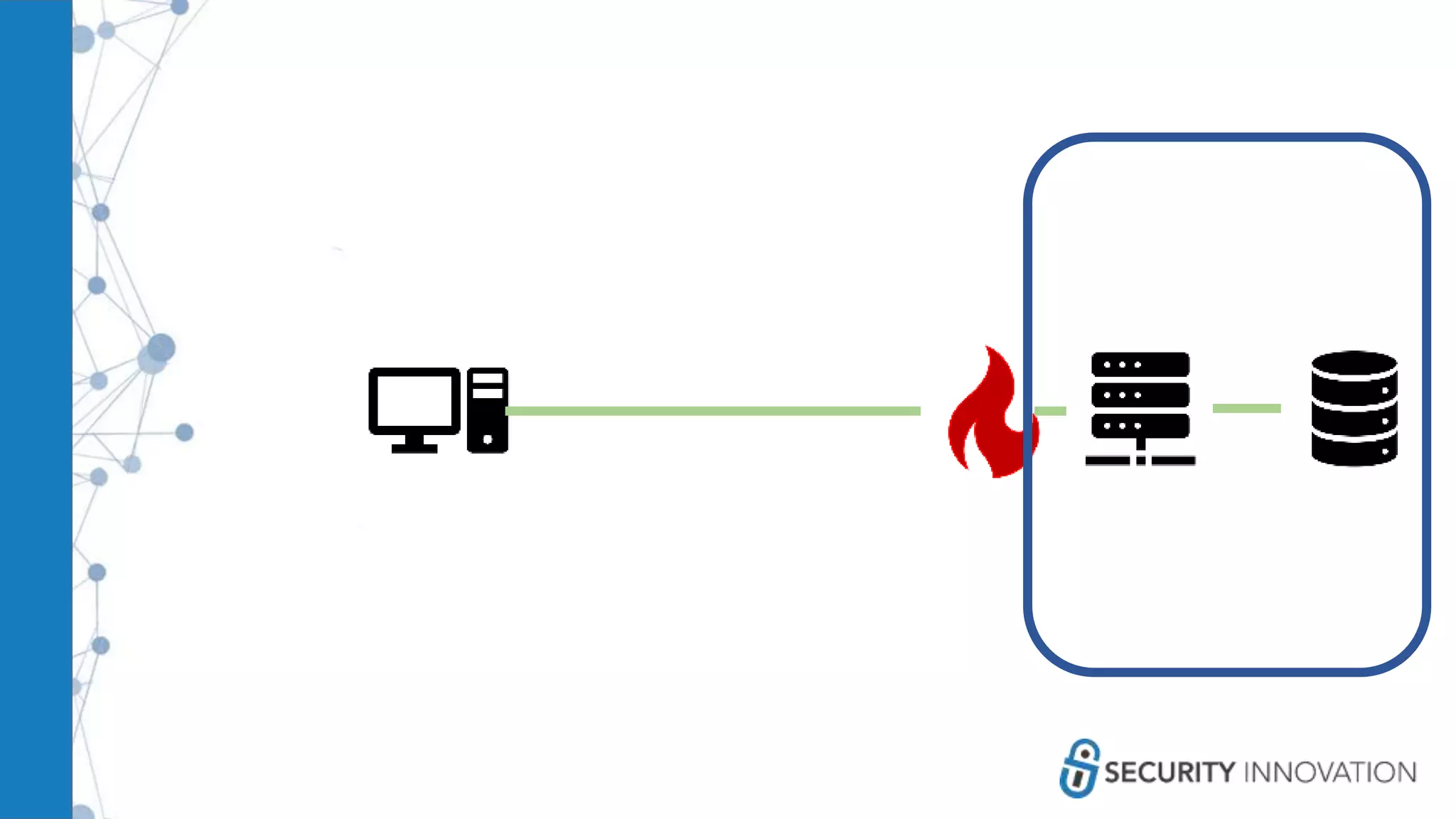
  • #46 Did somebody say security?
  • #47 Now we have this?!
  • #49 XSS in Barns and Nobel.com
  • #50 We came from https://web.archive.org/web/20031117100331/https://www.sisecure.com/ To https://yelp.com
  • #51 https://spanning.com/blog/insecure-direct-object-reference-web-based-application-security-part-6/
  • #52 https://52-53-234-118-letsee.vulnerablesites.net/account/1
  • #55 https://md5.gromweb.com/ Register View Somebody Else's Account Add an "email" field to the JSON request body with a new email address. Change the "mac" param to MD5 hash of "userX" where X is the ID of the user being edited. Forward request. 03aa1a0b0375b0461c1b8f35b234e67a
  • #56 Quick shodan demo