OWASP
Top Ten
2017
Michael Furman
Security Architect
What will we cover today?
• What is OWASP?
• OWASP Top Ten Project
• OWASP Top Ten from 2013 to 2017
• Top Ten overview
About Me
• 20+ years in software engineering
• 10+ years in application security
• 4+ years Lead Security Architect at Tufin
• www.linkedin.com/in/furmanmichael/
• ultimatesecpro@gmail.com
• Read my blog https://ultimatesecurity.pro/
• Follow me on twitter @ultimatesecpro
• I like to travel, read books and listen to music.
About Tufin
• Market Leader in Security Policy Orchestration for
firewalls and cloud
– New Tufin products integrate security into DevOps pipeline
• Established in 2005
• Used in over 2,000 enterprises, including 40 Fortune
100 companies
• We are constantly growing!
www.tufin.com/careers/
What is OWASP?
• OWASP - Open Web Application Security Project
• Worldwide not-for-profit organization
• Founded in 2001
• Mission is to make the software security visible.
OWASP Projects
• OWASP Top Ten
https://www.owasp.org/index.php/Top_10-2017_Top_10
• Opensamm - Software Assurance Maturity Model
http://www.opensamm.org/
OWASP Top Ten
• Most successful OWASP Project
• Ten most critical web application security flaws
• First released in 2004
• Released every 3 years
• 2007, 2010, 2013, 2017 (current)
Adopters of OWASP Top Ten
• Microsoft
• Part of the PCI DSS
• Vulnerability scanners
• …
OWASP Top Ten 2017
• A1 Injection
• A2 Broken Authentication
• A3 Sensitive Data Exposure
• A4 XML External Entities
• A5 Broken Access Control
• A6 Security Misconfiguration
• A7 Cross-Site Scripting (XSS)
• A8 Insecure Deserialization
• A9 Using Components with Known Vulnerabilities
• A10 Insufficient Logging & Monitoring
OWASP Top Ten 2013
• A1 Injection
• A2 Broken Authentication and Session Management
• A3 Cross-Site Scripting (XSS)
• A4 Insecure Direct Object References
• A5 Security Misconfiguration
• A6 Sensitive Data Exposure
• A7 Missing Function Level Access Control
• A8 Cross-Site Request Forgery (CSRF)
• A9 Using Components with Known Vulnerabilities
• A10 Unvalidated Redirects and Forwards
2013 to 2017 - New issues
• A4 XML External Entities
• A8 Insecure Deserialization
• A10 Insufficient Logging & Monitoring
2013 to 2017 - Retired or Merged Issues
• A4 - Insecure Direct Object References and A7 -
Missing Function Level Access Control merged into
A5 - Broken Access Control
• A8 Cross-Site Request Forgery (CSRF) – dropped
• A10 Unvalidated Redirects and Forwards – dropped
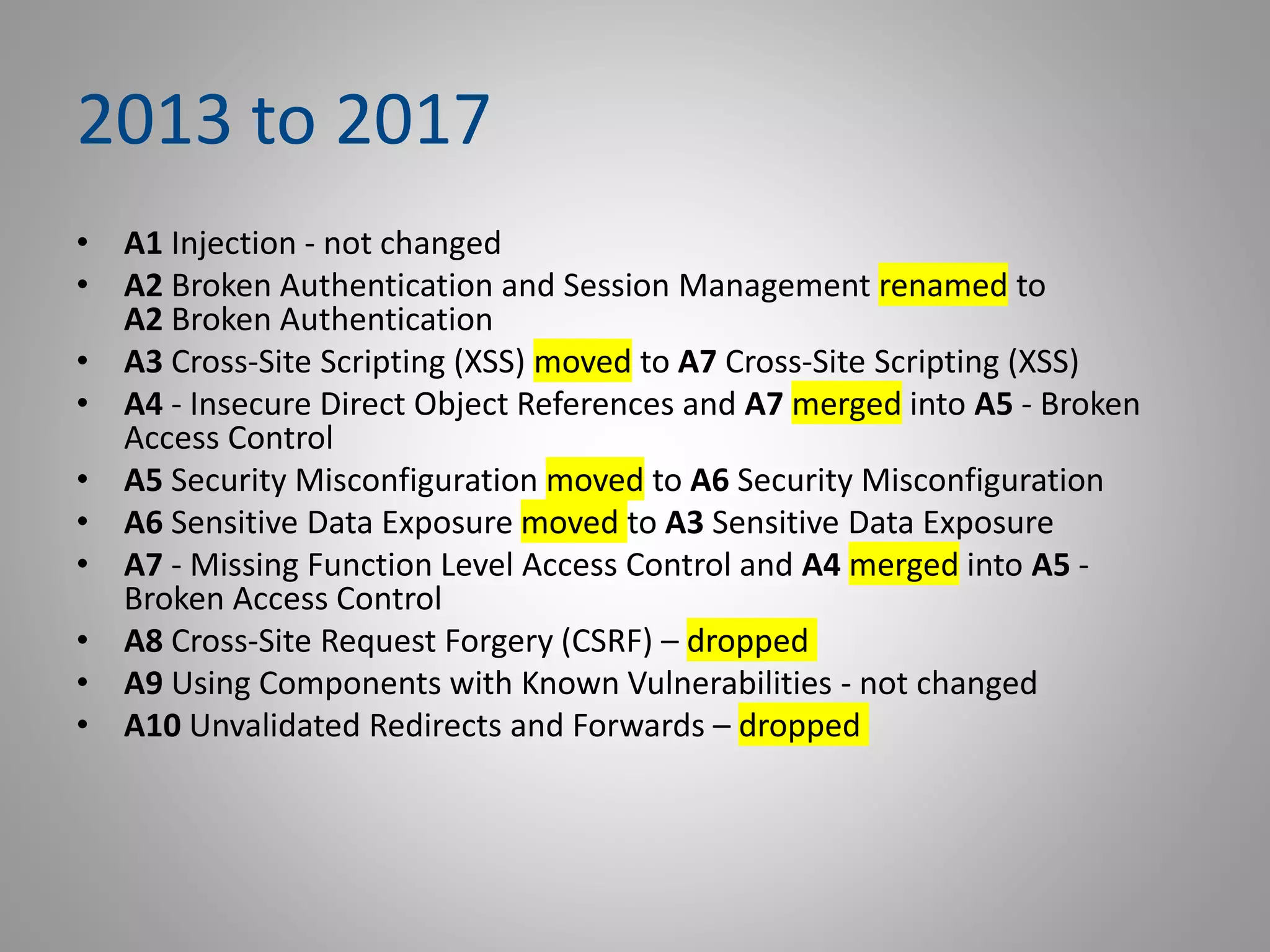
2013 to 2017
• A1 Injection - not changed
• A2 Broken Authentication and Session Management renamed to
A2 Broken Authentication
• A3 Cross-Site Scripting (XSS) moved to A7 Cross-Site Scripting (XSS)
• A4 - Insecure Direct Object References and A7 merged into A5 - Broken
Access Control
• A5 Security Misconfiguration moved to A6 Security Misconfiguration
• A6 Sensitive Data Exposure moved to A3 Sensitive Data Exposure
• A7 - Missing Function Level Access Control and A4 merged into A5 -
Broken Access Control
• A8 Cross-Site Request Forgery (CSRF) – dropped
• A9 Using Components with Known Vulnerabilities - not changed
• A10 Unvalidated Redirects and Forwards – dropped
Why it changed?
• Over the last few years, the fundamental technology
and architecture of applications has changed
significantly:
• Microservices
• Single page applications
What can I do?
A1 Injection
• A user input is concatenated with executable code
• SQL injection
• OS Command Injection
• HQL injection
A1 Injection
• Example:
String query = "SELECT * FROM accounts
WHERE custID=‘” + request.getParameter("id") + "'";
A1 - How to Prevent it
• Do not pass user input directly to executable
statements
• Prepared Statements
• Parameterized Queries
• Hibernate
A2 Broken Authentication
• Session IDs aren’t rotated after successful login
• Allow brute force or other automated attacks
• Use default, weak, or well-known passwords
A2 - How to Prevent it
• Rotate Session IDs after successful login
• Implement brute force protection
• Implement password complexity
A3 Sensitive Data Exposure
• Sensitive data is transmitted or stored in clear text
• Old or weak cryptographic algorithms are used
A3 - How to Prevent it
• Encrypt all sensitive data both at rest and in transit
• Use up-to-date and strong standard algorithms,
protocols, and keys
A4 XML External Entities
• Attackers can exploit vulnerable XML processors if
they can upload XML or include hostile content in an
XML document
<?xml version="1.0" encoding="ISO-8859-1"?>
<!DOCTYPE foo [
<!ELEMENT foo ANY >
<!ENTITY xxe SYSTEM "file:///etc/passwd" >]>
<foo>&xxe;</foo>
A4 - How to Prevent it
• Disable XML external entity and DTD processing in all
XML parsers in the application, as per the OWASP
Cheat Sheet 'XXE Prevention’.
https://www.owasp.org/index.php/XML_External_Entity_(XXE)_Preventio
n_Cheat_Sheet
• For additional details see my XXE presentation:
https://ultimatesecurity.pro/post/xxe-presentation/
A5 Broken Access Control
• AKA Privilege Escalation or Elevation of privilege
• A regular user accesses a resource with an admin
permission
A5 - How to Prevent it
• Implement access control mechanisms
A6 Security Misconfiguration
• Unnecessary features are enabled or installed
• Unnecessary ports
• Services
• Default accounts
• Default passwords
A6 - How to Prevent it
• Close unnecessary ports
• Disable unnecessary services
• Remove default accounts
• Change default passwords
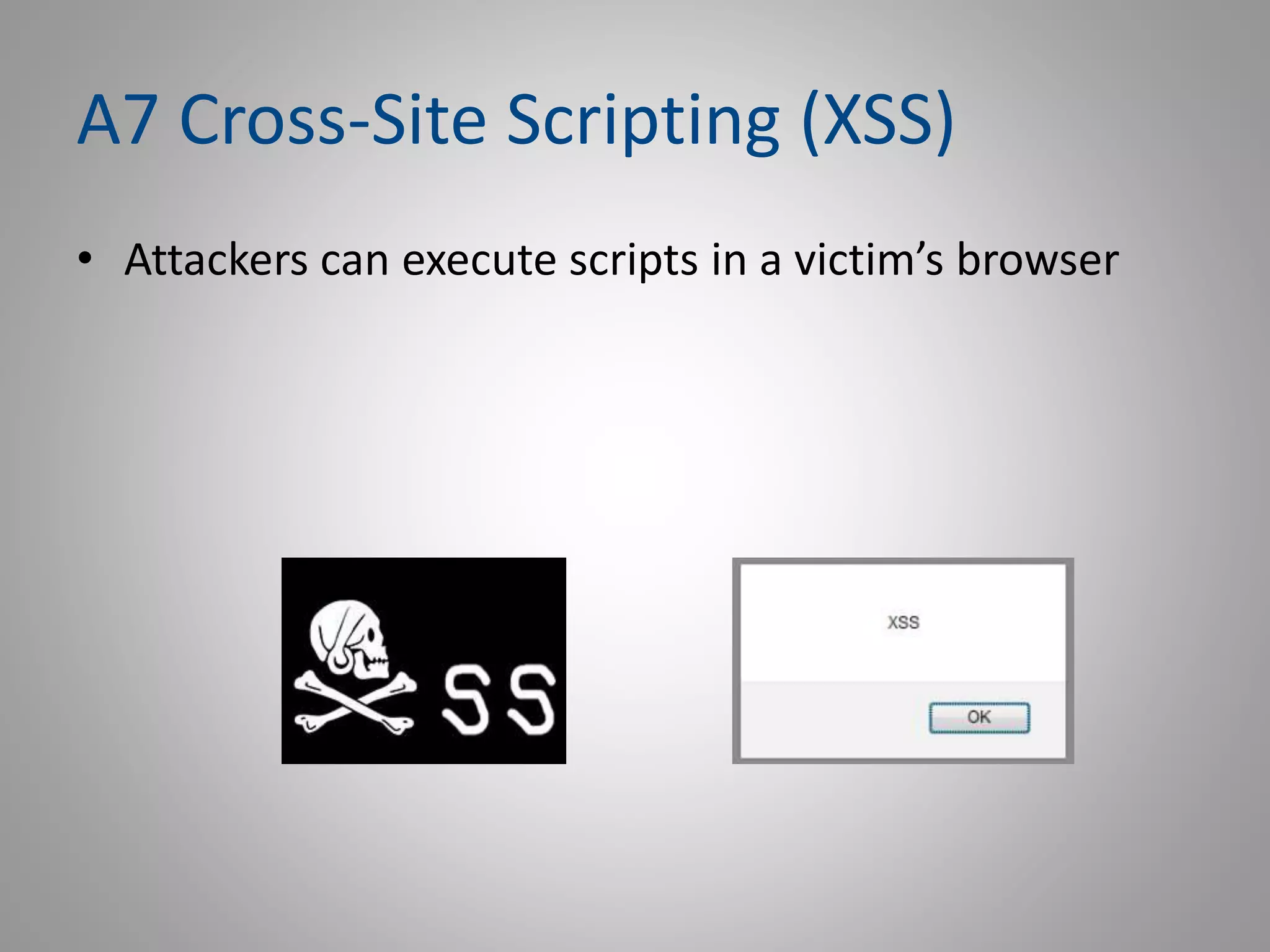
A7 Cross-Site Scripting (XSS)
• Attackers can execute scripts in a victim’s browser
A7 - How to Prevent it
• Input validation for all user input
• White list patterns. E.g. pattern for IPv6 or IPv4.
• Encode output
A8 Insecure Deserialization
• Serialization is the process of translating data
structures or object state into a format that can be
stored or transmitted and reconstructed later
(deserialization)
• Insecure Deserialization - an attacker changes the
object between serialization and deserialization
A8 Insecure Deserialization
• Example:
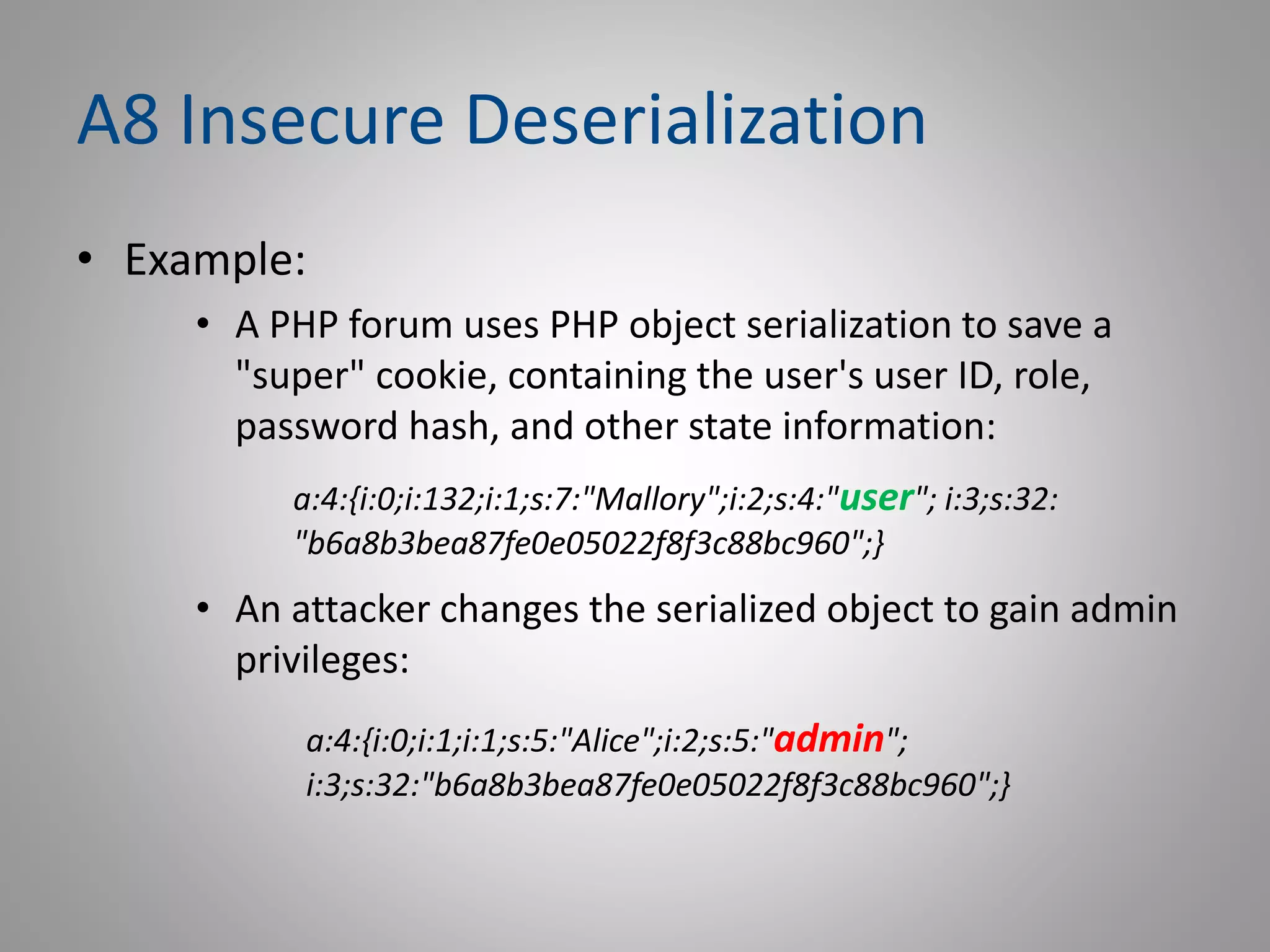
• A PHP forum uses PHP object serialization to save a
"super" cookie, containing the user's user ID, role,
password hash, and other state information:
• An attacker changes the serialized object to gain admin
privileges:
a:4:{i:0;i:132;i:1;s:7:"Mallory";i:2;s:4:"user"; i:3;s:32:
"b6a8b3bea87fe0e05022f8f3c88bc960";}
a:4:{i:0;i:1;i:1;s:5:"Alice";i:2;s:5:"admin";
i:3;s:32:"b6a8b3bea87fe0e05022f8f3c88bc960";}
A8 Insecure Deserialization
• Mark Reinhold, Oracle
Chief Architect of Java platform group
– Removing serialization is a long-term goal and is part of
project Amber
– Serialization was a “horrible mistake” made in 1997
– At least a third—maybe even half—of Java vulnerabilities
have involved serialization
A8 - How to Prevent it
• Don't accept serialized objects from untrusted
sources
A9 Using Components with
Known Vulnerabilities
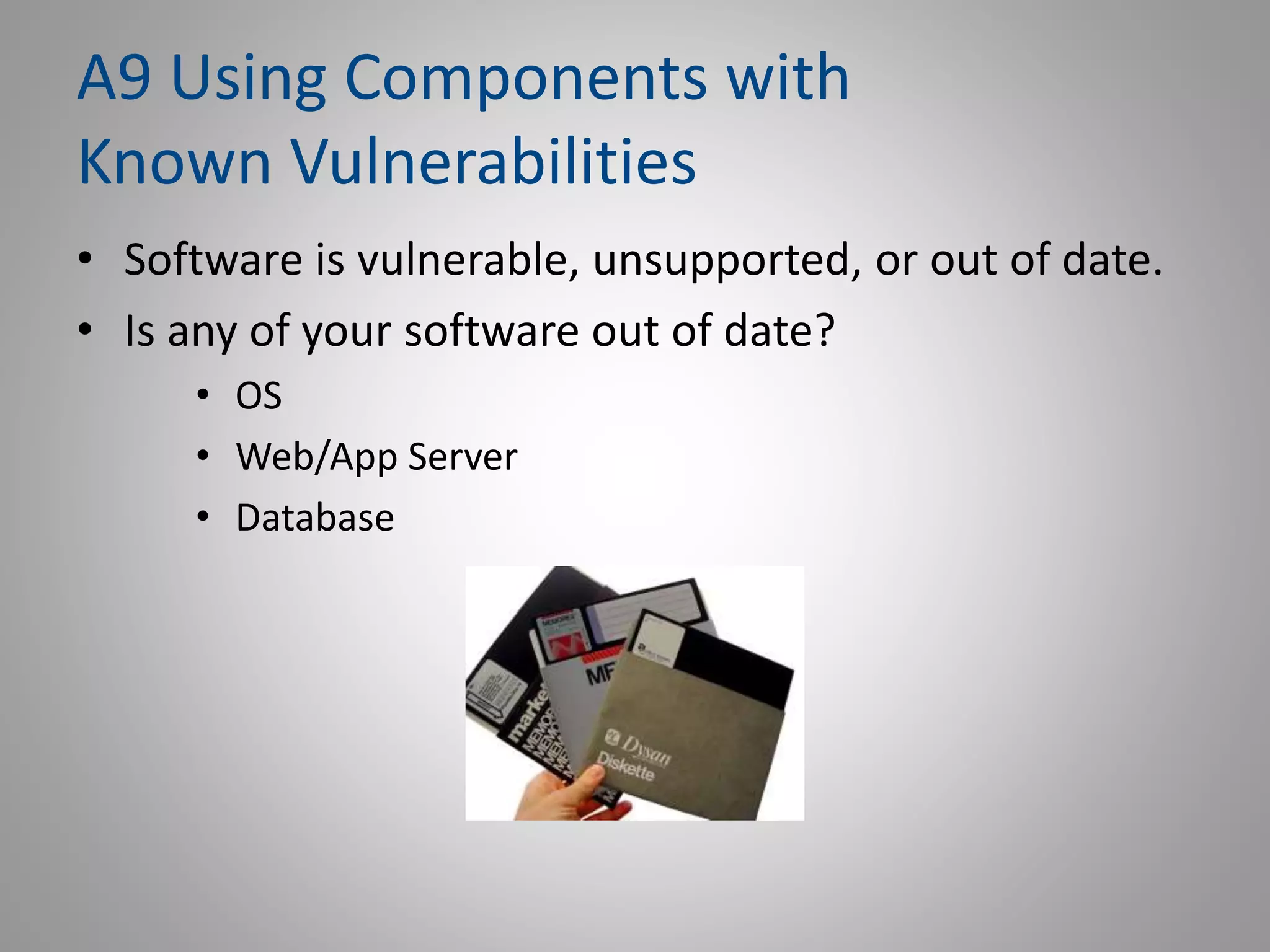
• Software is vulnerable, unsupported, or out of date.
• Is any of your software out of date?
• OS
• Web/App Server
• Database
A9 - How to Prevent it
• Update software
A10 Insufficient Logging & Monitoring
• Insufficient logging
• Logins
• Failed logins
• High-value transactions
A10 - How to Prevent it
• Log important events with sufficient user context
– Username
– Client IP
– Time
Take aways
• You understand what OWASP does
• You understand the OWASP Top Ten
Thank you!
• Contact me
– www.linkedin.com/in/furmanmichael/
– ultimatesecpro@gmail.com
– https://ultimatesecurity.pro/
– @ultimatesecpro

OWASP Top Ten 2017

  • 1.
  • 2.
    What will wecover today? • What is OWASP? • OWASP Top Ten Project • OWASP Top Ten from 2013 to 2017 • Top Ten overview
  • 3.
    About Me • 20+years in software engineering • 10+ years in application security • 4+ years Lead Security Architect at Tufin • www.linkedin.com/in/furmanmichael/ • ultimatesecpro@gmail.com • Read my blog https://ultimatesecurity.pro/ • Follow me on twitter @ultimatesecpro • I like to travel, read books and listen to music.
  • 4.
    About Tufin • MarketLeader in Security Policy Orchestration for firewalls and cloud – New Tufin products integrate security into DevOps pipeline • Established in 2005 • Used in over 2,000 enterprises, including 40 Fortune 100 companies • We are constantly growing! www.tufin.com/careers/
  • 5.
    What is OWASP? •OWASP - Open Web Application Security Project • Worldwide not-for-profit organization • Founded in 2001 • Mission is to make the software security visible.
  • 6.
    OWASP Projects • OWASPTop Ten https://www.owasp.org/index.php/Top_10-2017_Top_10 • Opensamm - Software Assurance Maturity Model http://www.opensamm.org/
  • 7.
    OWASP Top Ten •Most successful OWASP Project • Ten most critical web application security flaws • First released in 2004 • Released every 3 years • 2007, 2010, 2013, 2017 (current)
  • 8.
    Adopters of OWASPTop Ten • Microsoft • Part of the PCI DSS • Vulnerability scanners • …
  • 9.
    OWASP Top Ten2017 • A1 Injection • A2 Broken Authentication • A3 Sensitive Data Exposure • A4 XML External Entities • A5 Broken Access Control • A6 Security Misconfiguration • A7 Cross-Site Scripting (XSS) • A8 Insecure Deserialization • A9 Using Components with Known Vulnerabilities • A10 Insufficient Logging & Monitoring
  • 10.
    OWASP Top Ten2013 • A1 Injection • A2 Broken Authentication and Session Management • A3 Cross-Site Scripting (XSS) • A4 Insecure Direct Object References • A5 Security Misconfiguration • A6 Sensitive Data Exposure • A7 Missing Function Level Access Control • A8 Cross-Site Request Forgery (CSRF) • A9 Using Components with Known Vulnerabilities • A10 Unvalidated Redirects and Forwards
  • 11.
    2013 to 2017- New issues • A4 XML External Entities • A8 Insecure Deserialization • A10 Insufficient Logging & Monitoring
  • 12.
    2013 to 2017- Retired or Merged Issues • A4 - Insecure Direct Object References and A7 - Missing Function Level Access Control merged into A5 - Broken Access Control • A8 Cross-Site Request Forgery (CSRF) – dropped • A10 Unvalidated Redirects and Forwards – dropped
  • 13.
    2013 to 2017 •A1 Injection - not changed • A2 Broken Authentication and Session Management renamed to A2 Broken Authentication • A3 Cross-Site Scripting (XSS) moved to A7 Cross-Site Scripting (XSS) • A4 - Insecure Direct Object References and A7 merged into A5 - Broken Access Control • A5 Security Misconfiguration moved to A6 Security Misconfiguration • A6 Sensitive Data Exposure moved to A3 Sensitive Data Exposure • A7 - Missing Function Level Access Control and A4 merged into A5 - Broken Access Control • A8 Cross-Site Request Forgery (CSRF) – dropped • A9 Using Components with Known Vulnerabilities - not changed • A10 Unvalidated Redirects and Forwards – dropped
  • 14.
    Why it changed? •Over the last few years, the fundamental technology and architecture of applications has changed significantly: • Microservices • Single page applications
  • 15.
  • 16.
    A1 Injection • Auser input is concatenated with executable code • SQL injection • OS Command Injection • HQL injection
  • 17.
    A1 Injection • Example: Stringquery = "SELECT * FROM accounts WHERE custID=‘” + request.getParameter("id") + "'";
  • 18.
    A1 - Howto Prevent it • Do not pass user input directly to executable statements • Prepared Statements • Parameterized Queries • Hibernate
  • 19.
    A2 Broken Authentication •Session IDs aren’t rotated after successful login • Allow brute force or other automated attacks • Use default, weak, or well-known passwords
  • 20.
    A2 - Howto Prevent it • Rotate Session IDs after successful login • Implement brute force protection • Implement password complexity
  • 21.
    A3 Sensitive DataExposure • Sensitive data is transmitted or stored in clear text • Old or weak cryptographic algorithms are used
  • 22.
    A3 - Howto Prevent it • Encrypt all sensitive data both at rest and in transit • Use up-to-date and strong standard algorithms, protocols, and keys
  • 23.
    A4 XML ExternalEntities • Attackers can exploit vulnerable XML processors if they can upload XML or include hostile content in an XML document <?xml version="1.0" encoding="ISO-8859-1"?> <!DOCTYPE foo [ <!ELEMENT foo ANY > <!ENTITY xxe SYSTEM "file:///etc/passwd" >]> <foo>&xxe;</foo>
  • 24.
    A4 - Howto Prevent it • Disable XML external entity and DTD processing in all XML parsers in the application, as per the OWASP Cheat Sheet 'XXE Prevention’. https://www.owasp.org/index.php/XML_External_Entity_(XXE)_Preventio n_Cheat_Sheet • For additional details see my XXE presentation: https://ultimatesecurity.pro/post/xxe-presentation/
  • 25.
    A5 Broken AccessControl • AKA Privilege Escalation or Elevation of privilege • A regular user accesses a resource with an admin permission
  • 26.
    A5 - Howto Prevent it • Implement access control mechanisms
  • 27.
    A6 Security Misconfiguration •Unnecessary features are enabled or installed • Unnecessary ports • Services • Default accounts • Default passwords
  • 28.
    A6 - Howto Prevent it • Close unnecessary ports • Disable unnecessary services • Remove default accounts • Change default passwords
  • 29.
    A7 Cross-Site Scripting(XSS) • Attackers can execute scripts in a victim’s browser
  • 30.
    A7 - Howto Prevent it • Input validation for all user input • White list patterns. E.g. pattern for IPv6 or IPv4. • Encode output
  • 31.
    A8 Insecure Deserialization •Serialization is the process of translating data structures or object state into a format that can be stored or transmitted and reconstructed later (deserialization) • Insecure Deserialization - an attacker changes the object between serialization and deserialization
  • 32.
    A8 Insecure Deserialization •Example: • A PHP forum uses PHP object serialization to save a "super" cookie, containing the user's user ID, role, password hash, and other state information: • An attacker changes the serialized object to gain admin privileges: a:4:{i:0;i:132;i:1;s:7:"Mallory";i:2;s:4:"user"; i:3;s:32: "b6a8b3bea87fe0e05022f8f3c88bc960";} a:4:{i:0;i:1;i:1;s:5:"Alice";i:2;s:5:"admin"; i:3;s:32:"b6a8b3bea87fe0e05022f8f3c88bc960";}
  • 33.
    A8 Insecure Deserialization •Mark Reinhold, Oracle Chief Architect of Java platform group – Removing serialization is a long-term goal and is part of project Amber – Serialization was a “horrible mistake” made in 1997 – At least a third—maybe even half—of Java vulnerabilities have involved serialization
  • 34.
    A8 - Howto Prevent it • Don't accept serialized objects from untrusted sources
  • 35.
    A9 Using Componentswith Known Vulnerabilities • Software is vulnerable, unsupported, or out of date. • Is any of your software out of date? • OS • Web/App Server • Database
  • 36.
    A9 - Howto Prevent it • Update software
  • 37.
    A10 Insufficient Logging& Monitoring • Insufficient logging • Logins • Failed logins • High-value transactions
  • 38.
    A10 - Howto Prevent it • Log important events with sufficient user context – Username – Client IP – Time
  • 39.
    Take aways • Youunderstand what OWASP does • You understand the OWASP Top Ten
  • 40.
    Thank you! • Contactme – www.linkedin.com/in/furmanmichael/ – ultimatesecpro@gmail.com – https://ultimatesecurity.pro/ – @ultimatesecpro

Editor's Notes

  • #3 Hi everyone, Thank you for joining the last lecture for today. What will we see today? I will start by giving you an overview of OpenID Connect. I will describe the OpenID Connect protocol, and will show you how it compares to other protocols. Then, we will review some of OpenID Connect Implementations. Finally, I will show you one of the best OpenID Connect implementations: Keycloak.
  • #4 Before we begin, a couple of words about me and the company I work for - Tufin. I have many years of experience in software development. Like most of you here today, I particularly like application security. I started to work in this area more than 10 years ago, and enjoy each day I work on it. For the last few years, I am responsible for the application security of all Tufin products. Recently I have started to write a blog – you are more then welcomed to read it. Something personal: I like traveling, reading books and listening to music. I particularly enjoy listen to jazz.
  • #5 And now, a couple of words about Tufin. Tufin is a great company. It is already over 13 years old. We have a lot of customers. Our customers are all around the world: in Israel, USA, Europe, Asia. Some are huge companies, others are much smaller. We have customers in many industries. For example: AT&T, BMW and Visa. Recently we have started to develop products that integrate security into DevOps pipeline. You are more then welcomed to visit our booth. Tufin is always growing. When I joined the company about 5 years ago, it took up only one and half floors. Now it takes up almost 4 floors and that is only in Israel. We have also expanded abroad. We recently opened up a new main office in Boston. We are always looking for good people. We are looking for Java, C++, DevOps people. We are looking for Docker and Kubernetes gurus. You can visit our site to see our open positions in RnD, Sales, Marketing and additional areas.
  • #9 Microsoft Azure validates services using third party penetration testing based upon the OWASP Top Ten … Tufin customers ask if we use OWASP Top Ten recommendations.
  • #17 https://www.owasp.org/index.php/Top_10-2017_A1-Injection
  • #20 https://www.owasp.org/index.php/Top_10-2017_A2-Broken_Authentication - Session IDs are vulnerable to session fixation attacks
  • #22 https://www.owasp.org/index.php/Top_10-2017_A3-Sensitive_Data_Exposure
  • #24 https://www.owasp.org/index.php/Top_10-2017_A4-XML_External_Entities_(XXE) Example attempt to extract data from a server:
  • #25 my XXE presentation include examples and the libraries that can be used to prevent XXE.
  • #26 https://www.owasp.org/index.php/Top_10-2017_A5-Broken_Access_Control Bypassing access control checks by modifying the URL, internal application state, or the HTML page, or simply using a custom API attack tool.
  • #28 https://www.owasp.org/index.php/Top_10-2017_A6-Security_Misconfiguration Missing security hardening
  • #29 Do you use Tomcat? Have you disabled its shutdown port?
  • #30 https://www.owasp.org/index.php/Top_10-2017_A7-Cross-Site_Scripting_(XSS)
  • #32 https://www.owasp.org/index.php/Top_10-2017_A8-Insecure_Deserialization
  • #33 https://www.owasp.org/index.php/Top_10-2017_A8-Insecure_Deserialization
  • #36 https://www.owasp.org/index.php/Top_10-2017_A9-Using_Components_with_Known_Vulnerabilities Who use Java? How many times in a year you updates Java in production?
  • #38 https://www.owasp.org/index.php/Top_10-2017_A10-Insufficient_Logging%26Monitoring Attackers rely on the lack of monitoring and timely response to achieve their goals without being detected.
  • #41 Thank you for participating in my lecture! Please contact me if you need any additional information, or if you want to send me your resume.