In the name of Lord Most merciful most beneficent
Presentation  on  Weak Syllables  and Strong Syllables
Presented to: Mr.Sohail Falak sher Presented by:  Muhammad Asif
Syllable A syllable is a  rhythmic  unit of speech. Syllables exist to make the speech stream easier for the human mind to process. A syllable comprises one or more segments; segments are the  building blocks  for syllables.
Syllable A syllable  is a unit of organization for a sequence of  speech  sounds. For example, the word  water  is composed of two syllables:  wa  and  ter . A syllable is typically made up of a  syllable nucleus  (most often a  vowel ) with optional initial and final margins
Syllable Structure The general structure of a syllable consists of the following segments: Onset  (obligatory in some languages, optional or even restricted in others)  Rime   Nucleus  (obligatory in all languages)  Coda  (optional in some languages, highly restricted or prohibited in others)
Types of Words  according to syllables A word that consists of a single syllable (like  English   bat ) is called a  monosyllable  (such a word is monosyllabic), while a word consisting of two syllables (like  father ) is called a  disyllable  (such a word is disyllabic). A word consisting of three syllables (such as  indigent ) is called a  trisyllable  (the adjective form is trisyllabic). A word consisting of more than three syllables (such as  intelligence ) is called a  polysyllable  (and could be described as polysyllabic), although this term is often used to describe words of two syllables or more.
Affect of Syllable The domain of  suprasegmental  features is the syllable and not a specific sound, that is to say, they affect all the segments of a syllable: Stress   Tone
Weak and Strong Syllables one of the most noticeable features of English is that many syllables are weak; this is true of many other languages, but it is necessary to study how these weak syllables are pronounced and where they occur in English
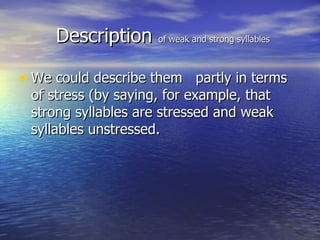
Description  of weak and strong syllables We could describe them  partly in terms of stress (by saying, for example, that strong syllables are stressed and weak syllables unstressed.
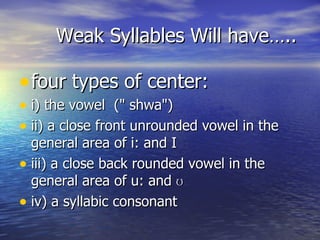
Weak Syllables Will have….. four types of center: i) the vowel  (" shwa")  ii) a close front unrounded vowel in the general area of i: and I iii) a close back rounded vowel in the general area of u: and  ʊ   iv) a syllabic consonant
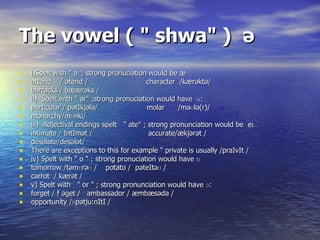
The vowel ( " shwa" )  ə i)Spelt with " a '; strong pronuciation would be  æ   attend  /  ətend  /  character  /k æ r əktə / barracks / b æærəks  /  ii)  Spelt with " ar" ;strong pronuciation would have  ɑ:  particular / p ə tIkj ə l ə /  molar  /m əʊlə(r )/ monarchy/m ɒ nki/ iii)  Adjectival endings spelt  " ate" ; strong pronunciation would be  e I  intimate / IntIm ət  /  accurate/ æ kj ərət  / desolate/des ələt /  There are exceptions to this for example " private is usually /praIvIt / iv) Spelt with " o " ; strong pronuciation would have  ɒ   tomorrow /t əmɒrəʊ  /  potato /  p əteItəʊ  / carrot  / k æ r ət  / v) Spelt with  " or " ; strong pronunciation would have ɔ:  forget / f  əget  /  ambassador /  æ mb æ s ə d ə  / opportunity / ɒ p ətju:nItI /
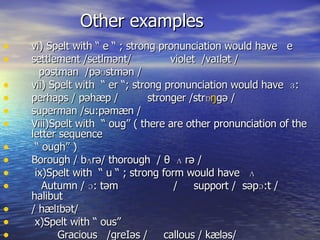
Other examples vi) Spelt with “ e “ ; strong pronunciation would have  e settlement /setlm ənt /  violet  /va I l ət  / postman  /p əʊstmən  / vii) Spelt with  “ er “; strong pronunciation would have  ɜ:  perhaps / p əhæp  /  stronger /str ɒ ŋ g ə  / superman /su:p ə m æn  / Viii)Spelt with  “ oug” ( there are other pronunciation of the letter sequence  “  ough” )  Borough / bʌr ə / thorough  / θ  ʌ r ə  / ix)Spelt with  “ u “ ; strong form would have  ʌ  Autumn / ɔ: t əm   /  support /  s əp ɔ: t  /  halibut / h æ l I b ət /  x)Spelt with “ ous”  Gracious  /greI əs  /  callous / k æ l əs /
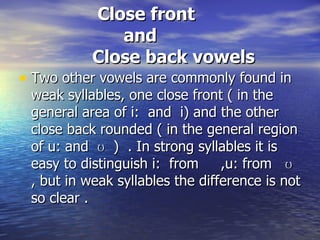
Close front    and    Close back vowels   Two other vowels are commonly found in weak syllables, one close front ( in the general area of i:  and  i) and the other close back rounded ( in the general region of u: and  ʊ  )  . In strong syllables it is easy to distinguish i:  from  ,u: from  ʊ , but in weak syllables the difference is not so clear .
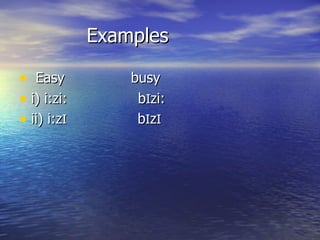
Examples Easy  busy i) i:zi:  b I zi: ii) i:z I   b I z I
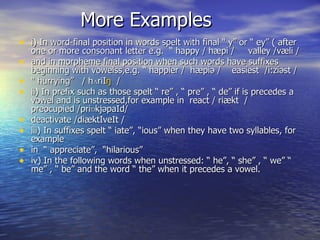
More Examples i) In word-final position in words spelt with final “ y” or “ ey” ( after one or more consonant letter e.g.  “ happy / hæpi /  valley /væli / and in morpheme final position when such words have suffixes beginning with vowelss,e.g. “ happier /  hæpiə /  easiest  /i:ziəst / “  hurrying”  / h ʌ riI ŋ   / ii) In prefix such as those spelt “ re” , “ pre” , “ de” if is precedes a vowel and is unstressed,for example in  react / riækt  /  preocupied /priɒkjəpaId/  deactivate /diæktIveIt / iii) In suffixes spelt “ iate”, “ious” when they have two syllables, for example  in  “ appreciate”,  “hilarious”  iv) In the following words when unstressed: “ he”, “ she” , “ we” “ me” , “ be” and the word “ the” when it precedes a vowel.
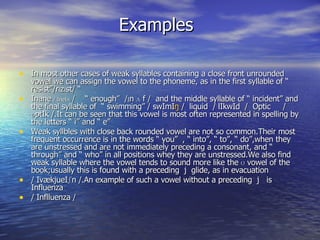
Examples In most other cases of weak syllables containing a close front unrounded vowel we can assign the vowel to the phoneme, as in the first syllable of “ resist”/r I z I st/ “  Inane  / IneIn  /  “ enough”  / I n  ʌ  f /  and the middle syllable of “ incident” and the final syllable of  “ swimming” / swImI ŋ  /  liquid  / lIkwId  /  Optic  / ɒptIk /.It can be seen that this vowel is most often represented in spelling by the letters “ i’’ and “ e”  Weak syllbles with close back rounded vowel are not so common.Their most frequent occurrence is in the words “ you”  , “ into”, “ to”, “ do”,when they are unstressed and are not immediately preceding a consonant, and “ through” and “ who” in all positions whey they are unstressed.We also find weak syllable where the vowel tends to sound more like the ʊ vowel of the book;usually this is found with a preceding  j  glide, as in evacuation / IvækjueI ʃn  /.An example of such a vowel without a preceding  j  is  Influenza / Inflluenza /
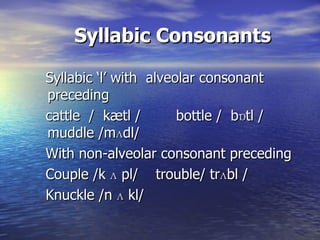
Syllabic Consonants Syllabic ‘l’ with  alveolar consonant preceding cattle  /  kætl /  bottle /  bɒtl /  muddle /m ʌ dl/ With non-alveolar consonant preceding Couple /k  ʌ  pl/  trouble/ tr ʌ bl / Knuckle /n  ʌ  kl/
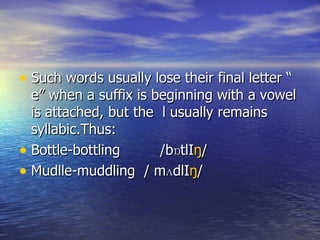
Such words usually lose their final letter “ e” when a suffix is beginning with a vowel is attached, but the  l usually remains syllabic.Thus: Bottle-bottling  /bɒtlI ŋ / Mudlle-muddling  / m ʌ dlI ŋ /
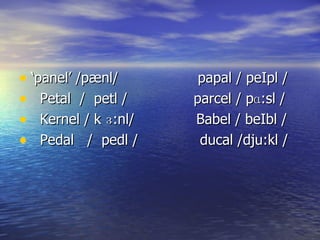
‘ panel’ /p æ nl/  papal / peIpl / Petal  /  petl /  parcel / p ɑ: sl / Kernel / k  ɜ: nl/  Babel / beIbl / Pedal  /  pedl /  ducal /dju:kl /
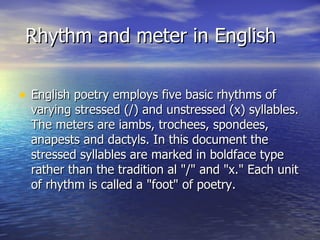
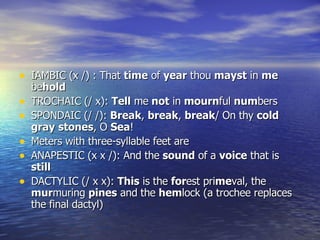
Rhythm and meter in English English poetry employs five basic rhythms of varying stressed (/) and unstressed (x) syllables. The meters are iambs, trochees, spondees, anapests and dactyls. In this document the stressed syllables are marked in boldface type rather than the tradition al "/" and "x." Each unit of rhythm is called a "foot" of poetry.
IAMBIC (x /) : That  time  of  year  thou  mayst  in  me  be hold TROCHAIC (/ x):  Tell  me  not  in  mourn ful  num bers SPONDAIC (/ /):  Break ,  break ,  break / On thy  cold   gray   stones , O  Sea !  Meters with three-syllable feet are  ANAPESTIC (x x /): And the  sound  of a  voice  that is  still DACTYLIC (/ x x):  This  is the  for est pri me val, the  mur muring  pines  and the  hem lock (a trochee replaces the final dactyl)
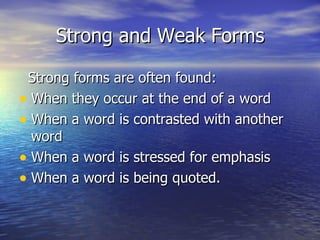
Strong and Weak Forms Strong forms are often found: When they occur at the end of a word When a word is contrasted with another word When a word is stressed for emphasis When a word is being quoted.
 
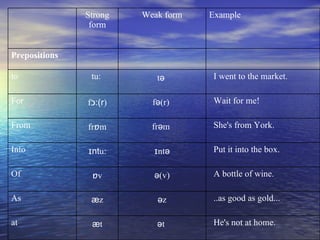
   He's not at home.  ə t   æ t at     ..as good as gold...  ə z æ z As    A bottle of wine.  ə (v) ɒ v Of    Put it into the box.  ɪ nt ə ɪ nt u: Into    She's from York.  fr ə m  fr ɒ m From    Wait for me!  f ə (r)  f ɔ :(r ) For    I went to the market.  t ə   tu:  to             Prepositions  Example   Weak form Strong form  
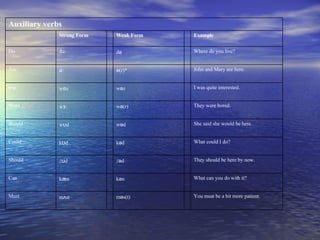
You must be a bit more patient.  m ə s(t)  m ʌ st Must What can you do with it?  k ə n  k æ n Can They should be here by now.  ʃ ə d  ʃ ʊ d Should What could I do?  k ə d  k ʊ d  Could She said she would be here.  w ə d  w ʊ d Would They were bored.  w ə (r)  w ɜ : Were I was quite interested.  w ə z  w ɒ z  was  John and Mary are here.  ə (r)*  ɑ : Are Where do you live?  d ə   du: Do Example      Weak Form   Strong Form      Auxiliary verbs
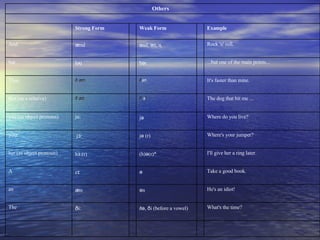
                  What's the time?  ð ə ,  ð i (before a vowel)  ð i: The He's an idiot!  ə n  æ n  an  Take a good book.  ə e ɪ   A I'll give her a ring later.   (h) ə (r)*  h ɜ : (r) her (as object pronoun) Where's your jumper?  j ə  (r)  j ɔ :   your  Where do you live?  j ə   ju:  you (as object pronoun)  The dog that bit me ...  ð  ə t ð æt that (as a relative) It's faster than mine.  ð ən ð æn Than ...but one of the main points...  b ə t  b ʌ t  but  Rock 'n' roll.  ə nd,  ə n ,  n ̩   æ nd And Example      Weak Form      Strong Form         Others  
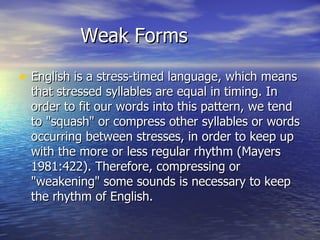
Weak Forms English is a stress-timed language, which means that stressed syllables are equal in timing. In order to fit our words into this pattern, we tend to "squash" or compress other syllables or words occurring between stresses, in order to keep up with the more or less regular rhythm (Mayers 1981:422). Therefore, compressing or "weakening" some sounds is necessary to keep the rhythm of English.
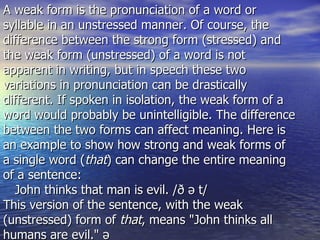
A weak form is the pronunciation of a word or syllable in an unstressed manner. Of course, the difference between the strong form (stressed) and the weak form (unstressed) of a word is not apparent in writing, but in speech these two variations in pronunciation can be drastically different. If spoken in isolation, the weak form of a word would probably be unintelligible. The difference between the two forms can affect meaning. Here is an example to show how strong and weak forms of a single word ( that ) can change the entire meaning of a sentence: John thinks that man is evil. /ð ə t/ This version of the sentence, with the weak (unstressed) form of  that , means "John thinks all humans are evil." ə
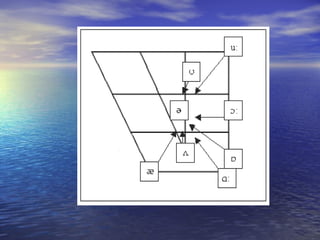
Weak forms are usually distinguished by a change in vowel quality from a border position on the vowel quadrilateral to a central position. The vowel in a weak form is usually the schwa ( ə ). Weak forms are pronounced more quickly and at lower volume in comparison to the stressed syllables. They are also not central to changes in intonation.

Weak ,Strong Syllables2a

  • 1.
    In the nameof Lord Most merciful most beneficent
  • 2.
    Presentation on Weak Syllables and Strong Syllables
  • 3.
    Presented to: Mr.SohailFalak sher Presented by: Muhammad Asif
  • 4.
    Syllable A syllableis a rhythmic unit of speech. Syllables exist to make the speech stream easier for the human mind to process. A syllable comprises one or more segments; segments are the building blocks for syllables.
  • 5.
    Syllable A syllable is a unit of organization for a sequence of speech sounds. For example, the word water is composed of two syllables: wa and ter . A syllable is typically made up of a syllable nucleus (most often a vowel ) with optional initial and final margins
  • 6.
    Syllable Structure Thegeneral structure of a syllable consists of the following segments: Onset (obligatory in some languages, optional or even restricted in others) Rime Nucleus (obligatory in all languages) Coda (optional in some languages, highly restricted or prohibited in others)
  • 7.
    Types of Words according to syllables A word that consists of a single syllable (like English bat ) is called a monosyllable (such a word is monosyllabic), while a word consisting of two syllables (like father ) is called a disyllable (such a word is disyllabic). A word consisting of three syllables (such as indigent ) is called a trisyllable (the adjective form is trisyllabic). A word consisting of more than three syllables (such as intelligence ) is called a polysyllable (and could be described as polysyllabic), although this term is often used to describe words of two syllables or more.
  • 8.
    Affect of SyllableThe domain of suprasegmental features is the syllable and not a specific sound, that is to say, they affect all the segments of a syllable: Stress Tone
  • 9.
    Weak and StrongSyllables one of the most noticeable features of English is that many syllables are weak; this is true of many other languages, but it is necessary to study how these weak syllables are pronounced and where they occur in English
  • 10.
    Description ofweak and strong syllables We could describe them partly in terms of stress (by saying, for example, that strong syllables are stressed and weak syllables unstressed.
  • 11.
    Weak Syllables Willhave….. four types of center: i) the vowel (" shwa") ii) a close front unrounded vowel in the general area of i: and I iii) a close back rounded vowel in the general area of u: and ʊ iv) a syllabic consonant
  • 12.
    The vowel (" shwa" ) ə i)Spelt with " a '; strong pronuciation would be æ attend / ətend / character /k æ r əktə / barracks / b æærəks / ii) Spelt with " ar" ;strong pronuciation would have ɑ: particular / p ə tIkj ə l ə / molar /m əʊlə(r )/ monarchy/m ɒ nki/ iii) Adjectival endings spelt " ate" ; strong pronunciation would be e I intimate / IntIm ət / accurate/ æ kj ərət / desolate/des ələt / There are exceptions to this for example " private is usually /praIvIt / iv) Spelt with " o " ; strong pronuciation would have ɒ tomorrow /t əmɒrəʊ / potato / p əteItəʊ / carrot / k æ r ət / v) Spelt with " or " ; strong pronunciation would have ɔ: forget / f əget / ambassador / æ mb æ s ə d ə / opportunity / ɒ p ətju:nItI /
  • 13.
    Other examples vi)Spelt with “ e “ ; strong pronunciation would have e settlement /setlm ənt / violet /va I l ət / postman /p əʊstmən / vii) Spelt with “ er “; strong pronunciation would have ɜ: perhaps / p əhæp / stronger /str ɒ ŋ g ə / superman /su:p ə m æn / Viii)Spelt with “ oug” ( there are other pronunciation of the letter sequence “ ough” ) Borough / bʌr ə / thorough / θ ʌ r ə / ix)Spelt with “ u “ ; strong form would have ʌ Autumn / ɔ: t əm / support / s əp ɔ: t / halibut / h æ l I b ət / x)Spelt with “ ous” Gracious /greI əs / callous / k æ l əs /
  • 14.
    Close front and Close back vowels Two other vowels are commonly found in weak syllables, one close front ( in the general area of i: and i) and the other close back rounded ( in the general region of u: and ʊ ) . In strong syllables it is easy to distinguish i: from ,u: from ʊ , but in weak syllables the difference is not so clear .
  • 15.
    Examples Easy busy i) i:zi: b I zi: ii) i:z I b I z I
  • 16.
    More Examples i)In word-final position in words spelt with final “ y” or “ ey” ( after one or more consonant letter e.g. “ happy / hæpi / valley /væli / and in morpheme final position when such words have suffixes beginning with vowelss,e.g. “ happier / hæpiə / easiest /i:ziəst / “ hurrying” / h ʌ riI ŋ / ii) In prefix such as those spelt “ re” , “ pre” , “ de” if is precedes a vowel and is unstressed,for example in react / riækt / preocupied /priɒkjəpaId/ deactivate /diæktIveIt / iii) In suffixes spelt “ iate”, “ious” when they have two syllables, for example in “ appreciate”, “hilarious” iv) In the following words when unstressed: “ he”, “ she” , “ we” “ me” , “ be” and the word “ the” when it precedes a vowel.
  • 17.
    Examples In mostother cases of weak syllables containing a close front unrounded vowel we can assign the vowel to the phoneme, as in the first syllable of “ resist”/r I z I st/ “ Inane / IneIn / “ enough” / I n ʌ f / and the middle syllable of “ incident” and the final syllable of “ swimming” / swImI ŋ / liquid / lIkwId / Optic / ɒptIk /.It can be seen that this vowel is most often represented in spelling by the letters “ i’’ and “ e” Weak syllbles with close back rounded vowel are not so common.Their most frequent occurrence is in the words “ you” , “ into”, “ to”, “ do”,when they are unstressed and are not immediately preceding a consonant, and “ through” and “ who” in all positions whey they are unstressed.We also find weak syllable where the vowel tends to sound more like the ʊ vowel of the book;usually this is found with a preceding j glide, as in evacuation / IvækjueI ʃn /.An example of such a vowel without a preceding j is Influenza / Inflluenza /
  • 18.
    Syllabic Consonants Syllabic‘l’ with alveolar consonant preceding cattle / kætl / bottle / bɒtl / muddle /m ʌ dl/ With non-alveolar consonant preceding Couple /k ʌ pl/ trouble/ tr ʌ bl / Knuckle /n ʌ kl/
  • 19.
    Such words usuallylose their final letter “ e” when a suffix is beginning with a vowel is attached, but the l usually remains syllabic.Thus: Bottle-bottling /bɒtlI ŋ / Mudlle-muddling / m ʌ dlI ŋ /
  • 20.
    ‘ panel’ /pæ nl/ papal / peIpl / Petal / petl / parcel / p ɑ: sl / Kernel / k ɜ: nl/ Babel / beIbl / Pedal / pedl / ducal /dju:kl /
  • 21.
    Rhythm and meterin English English poetry employs five basic rhythms of varying stressed (/) and unstressed (x) syllables. The meters are iambs, trochees, spondees, anapests and dactyls. In this document the stressed syllables are marked in boldface type rather than the tradition al "/" and "x." Each unit of rhythm is called a "foot" of poetry.
  • 22.
    IAMBIC (x /): That time of year thou mayst in me be hold TROCHAIC (/ x): Tell me not in mourn ful num bers SPONDAIC (/ /): Break , break , break / On thy cold gray stones , O Sea ! Meters with three-syllable feet are ANAPESTIC (x x /): And the sound of a voice that is still DACTYLIC (/ x x): This is the for est pri me val, the mur muring pines and the hem lock (a trochee replaces the final dactyl)
  • 23.
    Strong and WeakForms Strong forms are often found: When they occur at the end of a word When a word is contrasted with another word When a word is stressed for emphasis When a word is being quoted.
  • 24.
  • 25.
      He'snot at home. ə t æ t at   ..as good as gold... ə z æ z As   A bottle of wine. ə (v) ɒ v Of   Put it into the box. ɪ nt ə ɪ nt u: Into   She's from York. fr ə m fr ɒ m From   Wait for me! f ə (r) f ɔ :(r ) For   I went to the market. t ə tu: to       Prepositions Example Weak form Strong form  
  • 26.
    You must bea bit more patient. m ə s(t) m ʌ st Must What can you do with it? k ə n k æ n Can They should be here by now. ʃ ə d ʃ ʊ d Should What could I do? k ə d k ʊ d Could She said she would be here. w ə d w ʊ d Would They were bored. w ə (r) w ɜ : Were I was quite interested. w ə z w ɒ z was John and Mary are here. ə (r)* ɑ : Are Where do you live? d ə du: Do Example   Weak Form Strong Form   Auxiliary verbs
  • 27.
                What's the time? ð ə , ð i (before a vowel) ð i: The He's an idiot! ə n æ n an Take a good book. ə e ɪ A I'll give her a ring later. (h) ə (r)* h ɜ : (r) her (as object pronoun) Where's your jumper? j ə (r) j ɔ : your Where do you live? j ə ju: you (as object pronoun) The dog that bit me ... ð ə t ð æt that (as a relative) It's faster than mine. ð ən ð æn Than ...but one of the main points... b ə t b ʌ t but Rock 'n' roll. ə nd, ə n , n ̩ æ nd And Example   Weak Form   Strong Form     Others  
  • 28.
    Weak Forms Englishis a stress-timed language, which means that stressed syllables are equal in timing. In order to fit our words into this pattern, we tend to "squash" or compress other syllables or words occurring between stresses, in order to keep up with the more or less regular rhythm (Mayers 1981:422). Therefore, compressing or "weakening" some sounds is necessary to keep the rhythm of English.
  • 29.
    A weak formis the pronunciation of a word or syllable in an unstressed manner. Of course, the difference between the strong form (stressed) and the weak form (unstressed) of a word is not apparent in writing, but in speech these two variations in pronunciation can be drastically different. If spoken in isolation, the weak form of a word would probably be unintelligible. The difference between the two forms can affect meaning. Here is an example to show how strong and weak forms of a single word ( that ) can change the entire meaning of a sentence: John thinks that man is evil. /ð ə t/ This version of the sentence, with the weak (unstressed) form of that , means "John thinks all humans are evil." ə
  • 30.
    Weak forms areusually distinguished by a change in vowel quality from a border position on the vowel quadrilateral to a central position. The vowel in a weak form is usually the schwa ( ə ). Weak forms are pronounced more quickly and at lower volume in comparison to the stressed syllables. They are also not central to changes in intonation.