In The Name of Allah Most Gracious Most
Merciful
The University of Holy Koran and Islamic
Sciences
Faculty of Education
A syllable
•A syllable is a unit of
organization for a
sequence of speech
sounds. For example, the
word water consists of two
syllables: wa and ter.
A syllable
• A syllable is typically
made up of a syllable
nucleus (most often a
vowel) with optional initial
and final margins
(typically, consonants).
A syllable
•Syllables are often considered
the phonological "building
blocks" of words. They can
influence the rhythm of a
language, its prosody, its
poetic meter and its stress
patterns.
Syllable
• A word that consists of a single syllable (like English
dog) is called a monosyllable (and is said to be
monosyllabic).
• Similar terms include disyllable (and disyllabic) for a
word of two syllables;
• trisyllable (and trisyllabic) for a word of three
syllables;
• and polysyllable (and polysyllabic), which may refer
either to a word of more than three syllables or to
any word of more than one syllable.
The English Syllables
They consist of: a centre which has
no or little obstruction to the
airflow and which sounds
comparatively loud.
Before and after the centre there
will be greater obstruction to the
airflow and less loud sound.
Examples
•Minimum syllable: Single
vowel in isolation:
are / ɑ: / or / ɔ: / err /
ɜ: / m / m / sh / ʃ /
Examples
Some syllables have onset .
They have more than just a
silence preceding the
centre:
bar / bɑ: / key /ki: /
more / mɔ: /
Examples
• Some syllables have no
onset but they have coda:
am /æm / ought / ɔ:t /
ease /i:z /
Examples
• Some syllables have
onset and coda:
run /rʌn / sat /sæt
/ fill / fɪl /
The Nucleus
• nucleus is usually the vowel in the middle of a
syllable.
• Generlly, every syllable requires a nucleus
(sometimes called the peak).
• The minimal syllable consists only of a nucleus,
as in the English words "eye" or "owe".
• The syllable nucleus is usually a vowel, in the
form of a monophthong, diphthong, or
triphthong
• Sometimes there is a syllabic consonant.
• The most common syllabic consonants are like
[l], [r], [m], [n] or [ŋ]
The onset
• The onset is the consonant sound
or sounds at the beginning of a
syllable, occurring before the
nucleus. Most syllables have an
onset.
• For example, in English, onsets
such as pr-, pl- and tr- are possible
but tl- is not, and sk- is possible
but ks- is not.
The coda
• The coda comprises the consonant
sounds of a syllable that follow the
nucleus, which is usually a vowel.
• The combination of a nucleus and a
coda is called a rime(rhyme).
• Some syllables consist only of a
nucleus with no coda.
Examples
• Here are some English single-
syllable words that have both a
nucleus and a coda.
• in: /ɪn/
• cup: /kʌ p/
• tall: /tɔːl/
• milk: /mɪlk/
Examples
•tints: /tɪnts/
•fifths: /fɪfθs/
•sixths: /sɪksθs/
•twelfths: /twɛlfθs/
•strengths: /strɛŋθs/
Examples
The following single-syllable words
end in a nucleus and do not have a
coda (i.e. open syllables):
• glue, /uː/
• pie, /ʌɪ/ or /aɪ/
• though, /əʊ/ (UK) or /oʊ/ (US)
• boy, /ɔɪ/
Phonotactics
Phonotactics : The
possible phoneme
combinations of a
language.
Phonotactic constraints
• Phonotactic rules determine which
sounds are allowed or disallowed in
each part of the syllable.
• English allows very complicated
syllables; syllables may begin with up to
three consonants (as in string or splash),
and occasionally end with as many as
four (as in prompts).
Phonotactics
• We look at what can occur in
initial position:
_ A word can begin with: a
vowel or with one consonant
or two consonants or three
consonants.
Phonotactics
We look at how a word
ends: A word can end
with: a vowel or with one
or two or three
consonants.
The structure of English Syllable
• Onset :
- a word may begin with a vowel. Any
vowel except /ʊ / (zero onset).
-It may begin with one consonant. Any
consonant except / ŋ / and /ʒ/.
- It may begin with two or more
phonemes together. They are called
consonant clusters.
Initial Consonant Clusters
Initial two consonant clusters are
of 2 types
• -/ s/ followed by /t/ /m/ /w/
/j/
• - One of 15 consonants followed
by /l/ /r/ /w/ /j/ try quick
few play
Initial Consonant Clusters
Initial three consonant
clusters:-
• Two consonant cluster +
a third consonant split
stream square
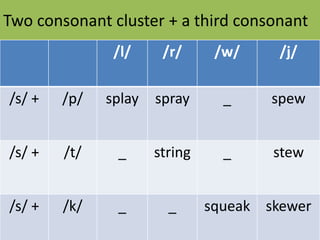
Two consonant cluster + a third consonant
/j//w//r//l/
spew_spraysplay/p//s/ +
stew_string_/t//s/ +
skewersqueak__/k//s/ +
Final consonant clusters:
• A word may end with a vowel.
(zero coda)
• It may end with one consonant. It
is called final consonant. It may be
any consonant except /h/ /r/
/w/ /j/
Final consonant clusters:
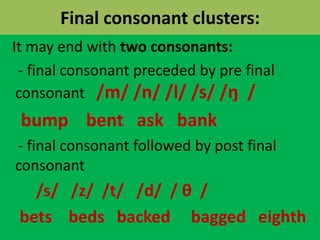
It may end with two consonants:
- final consonant preceded by pre final
consonant /m/ /n/ /l/ /s/ /ŋ /
bump bent ask bank
- final consonant followed by post final
consonant
/s/ /z/ /t/ /d/ / θ /
bets beds backed bagged eighth
Final consonant clusters:
Pre-final final Post-final
helped he l p t
banks bæ ŋ k s
bonds bɒ n d z
twelfth twe l f θ
Final consonant clusters:
Pre-final final Post
final1
post final2
fifths fɪ _ f θ s
next ne _ k s t
lapsed læ _ p s t
Final consonant clusters:
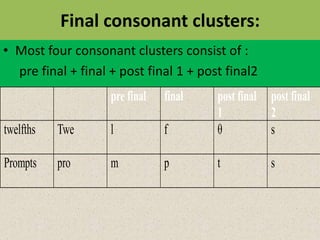
• Most four consonant clusters consist of :
pre final + final + post final 1 + post final2
pre final final post final
1
post final
2
twelfths Twe l f θ s
Prompts pro m p t s
English syllable phonological structure:
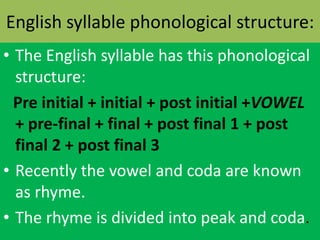
• The English syllable has this phonological
structure:
Pre initial + initial + post initial +VOWEL
+ pre-final + final + post final 1 + post
final 2 + post final 3
• Recently the vowel and coda are known
as rhyme.
• The rhyme is divided into peak and coda.
English Syllable
syllable
onset rhyme
peak coda
Strong and weak syllables
• Some English syllables are strong and some
are weak.
• Weak syllables are shorter, of lower
intensity and different in quality.
• The second syllable in the word father
/fɑ:ðə/is shorter than the first syllable, less
loud and has a vowel which does not occur in
strong syllables.
• The weak syllable in the word bottle
/bɒtl/does not contain a vowel.
Strong and weak syllables
• Strong syllables are stressed. Weak
syllables are unstressed.
• Any strong syllable has a vowel
phoneme as its peak but not /ə/,/u/
or /i /
• A weak syllable can have one of a
small number of vowels as its peak.
Strong and weak syllables
• At the end of a word weak syllable
may end with a vowel a
• The schwa/ə/ better /betə/
• The vowel /u/ which is between
/u:/and /ʊ/ thank you /θæŋk ju/
• The vowel/ i /which is between
/i:/and /ɪ/ happy /hæpi/
Strong and weak syllables
• There are weak syllables in word final
position with a coda if the vowel is /ə/
open /əʊpən/ sharpen /ʃɑ:pən/
• Inside a word these vowels /ə/,/u/
and/i/ act as peaks without a coda:
• photograph/fəʊtəgrɑ:f /
• radio/reɪdiəʊ/
• influence /ɪnfluəns
Word Stress
• In English, we do not say each
syllable with the same force or
strength. In one word, we
accentuate ONE syllable. We say
one syllable very loudly (big,
strong, important) and all the
other syllables very quietly.
Word Stress
•(emphasis given to a
particular syllable or word in
speech, typically through a
combination of relativelya
greater loudness, higher
pitch, and longer duration)
Word Stress
Let's take 3 words: photograph,
photographer and photographic.
Do they sound the same when
spoken? No. Because we
accentuate (stress) ONE syllable
in each word. And it is not always
the same syllable.
What is Word Stress?
• In English, we do not say each syllable
with the same force or strength. In
one word, we accentuate ONE
syllable. We say one syllable very
loudly (big, strong, important) and all
the other syllables very quietly.
What is Word Stress?
• Let's take 3 words: photograph, photographer
and photographic. Do they sound the same
when spoken? No. Because we accentuate
(stress) ONE syllable in each word. And it is
not always the same syllable. So the shape of
each word is different.
• PHO TO GRAPH
• PHO TO GRAPH ER
• PHO TO GRAPH IC
Rules of Word Stress in English
• One word has only one stress. (One
word cannot have two stresses. If you
hear two stresses, you hear two words.
Two stresses cannot be one word. It is
true that there can be a "secondary"
stress in some words. But a secondary
stress is much smaller than the main
[primary] stress, and is only used in long
words.)
• We can only stress vowels, not consonants.
Stress position
• Stress on first syllable:
• Most 2-syllable nouns
• PRESent, EXport, CHIna, TAble
• Most 2-syllable adjectives
• PRESent, SLENder, CLEVer, HAPpy
Stress position
•Stress on last syllable
•Most 2-syllable verbs and
prepositions
•to preSENT, to exPORT, to
deCIDE, to beGIN betWEEN
aMONG
Stress position
• There are many two-syllable words in English whose
meaning and class change with a change in stress.
The word present, for example is a two-syllable
word. If we stress the first syllable, it is a noun (gift)
or an adjective (opposite of absent). But if we
stress the second syllable, it becomes a verb (to
offer).
• More examples: the words export, import, contract
and object can all be nouns or verbs depending on
whether the stress is on the first or second syllable.
Stress position
• Stress on penultimate syllable (penultimate =
second from end)
• Words ending in –ic
• GRAPHic, geoGRAPHic, geoLOGic
• Words ending in -sion and -tion
• teleVIsion, reveLAtion
• For a few words, native English speakers don't
always "agree" on where to put the stress. For
example, some people say teleVIsion and others
say TELevision. Another example is: CONtroversy
and conTROversy
Stress position
• Stress on ante-penultimate syllable
(ante-penultimate = third from end)
• Words ending in -cy, -ty, -phy and –gy
• deMOcracy, dependaBIlity, phoTOgraphy,
geOLogy
• Words ending in –al
• CRItical, geoLOGical
Stress position
Compound words (words with two parts):
For compound nouns, the stress is on the first part
• BLACKbird, GREENhouse SEAfood ICEland
TOOTHpaste
For compound adjectives, the stress is on the
second part
bad-TEMpered, old-FASHioned
For compound verbs, the stress is on the second
part
to underSTAND, to overFLOW
Strong and weak forms
Weak and strong forms
• There are English words which has strong
form and weak form.
• I like that. /aɪ laɪk ðæt /
• I hope that she will. / aɪ hoʊp ðət ʃi: wɪl /
• It is important to learn weak forms. Why?
• Functional words have weak and strong
forms.
• They are normally used in their weak forms.
Weak and strong forms
• The strong form is used in some contexts.
• When the word of the weak form comes at
the end:
• I am fond of chips. / aɪm fɒnd əv tʃɪps /
• Chips is what I am fond of./tʃɪps ɪz wɒt aɪm
fɒnd ɒv/
• When the word of the weak form is being
contrasted with another.
• I travel to and from London a lot. /aɪ trævl tu:
ən frɒm lʌndən ə lɒt/
Weak and strong forms
• The letter’s from him not to him. /ðə letəz
frɒm ɪm nɒt tu: ɪm /
• When the word of the weak form is stressed
for the purpose of emphasis.
• You must give me more money. / ju: mʌst gɪv
mɪ mɔ: mʌnɪ/
• When the word of the weak form is cited or
quoted.
• You shouldn’t put “and” at the end of a
sentence. /ju: ʃʊdnt pʊt ænd ət ðɪ end əv ə
sentəns/
The most common weak form words
• The most common weak form words are:-
• The :
• /ðə/ before consonants;
• Shut the door. /ʃʌt ðə dɔ:/
• / ði / before vowels;
• Wait for the end /weit fə ði end /
a , an
• a , an
• ə before consonants;
• Read a book. /ri:d ə bʊk/
• ən before vowels;
• Eat an apple. /i:t ən
and
•and /ən/ sometimes n
after t d s ʃ ʒ;
• Come and see /kʌm ən
si:/
but
•but /bət/
• It’s good but
expensive.
• / ɪts gʊd bət
ɪkspensɪv
that
• Its weak form is used when it is in
relative clause.
• /ðət/ The price is the thing that
annoys me.
• /ðə praɪs ɪz ðə θɪŋ ðət ənɔɪz mi/
• When it is demonstrative it is
pronounced with the strong form.
• Give me that book /giv mi ðæt bʊk /
Than
•Than /ðən/
•Better than ever
/betə ðən evə/
his
his (when it occurs
before a noun) ɪz (hɪz
at the beginning of a
sentence)
•Take his name. /teik iz
neim/
her
• When used with possessive sense
,as an object or at the end of a
sentence.
• /ə/ before consonants;
Take her home. /teɪk ə həʊm/
• /ər/ before vowels,
Take her out /teik ər aʊt/
your
• your /jə/ before
consonants; Take your
time / teɪk jə taɪm/
• /jər/ before vowels;
On your own /ɒn jər
əʊn/
she, he, we, you:
• a) she / ʃi / Why did she read it?/
waɪ dɪd ʃi r i:d ɪt/
• b) he /i/ without h except at the
beginning of a sentence. Which did
he choose? /wɪtʃ dɪd i tʃu:z/
• He was late, wasn’t he? /hi wəz
leit wɒznt i/
we
•c) we /wi/ How can we
get there? /haʊ kən wi
get ðeə/
•d) you / ju/ What do you
think? /wɒt də ju θɪŋk/
him, her, them & us
• him ɪm Leave him alone. / li:v ɪm
ələʊn/
• her / ə/ /hə/ in initial.
• Ask her to come /ɑ:sk ə tə kʌm
• them /ðəm/
• Leave them here. /li:v ðəm hɪə/
• us / əs/
• Write us a ltter. /raɪt əs ə letə/
at
• at /ət/
I’ll see you at lunch. /aɪl si: ju
ət lʌnʃ /
• In final position/ æt/
What’s he shooting at? /wɒts i
ʃu:tɪŋ æt/
for
• for /fə/ before consonants Tea
for two /ti: fə tu:/
• /fər/before vowels
• thanks for asking /θæŋks fər
ɑ:skɪŋ/
• In final position /fɔ:/
• what’s that for? /wɒts ðæt fɔ: /
from
•from /frəm/
• I’m home from work /aɪm
həʊm frəm wɜ:k/
•In final position /frɒm/
Here’s where it came from
/hɪəz weə ɪt keɪm frɒm /

Advanced Phonology

  • 1.
    In The Nameof Allah Most Gracious Most Merciful The University of Holy Koran and Islamic Sciences Faculty of Education
  • 2.
    A syllable •A syllableis a unit of organization for a sequence of speech sounds. For example, the word water consists of two syllables: wa and ter.
  • 3.
    A syllable • Asyllable is typically made up of a syllable nucleus (most often a vowel) with optional initial and final margins (typically, consonants).
  • 4.
    A syllable •Syllables areoften considered the phonological "building blocks" of words. They can influence the rhythm of a language, its prosody, its poetic meter and its stress patterns.
  • 5.
    Syllable • A wordthat consists of a single syllable (like English dog) is called a monosyllable (and is said to be monosyllabic). • Similar terms include disyllable (and disyllabic) for a word of two syllables; • trisyllable (and trisyllabic) for a word of three syllables; • and polysyllable (and polysyllabic), which may refer either to a word of more than three syllables or to any word of more than one syllable.
  • 6.
    The English Syllables Theyconsist of: a centre which has no or little obstruction to the airflow and which sounds comparatively loud. Before and after the centre there will be greater obstruction to the airflow and less loud sound.
  • 7.
    Examples •Minimum syllable: Single vowelin isolation: are / ɑ: / or / ɔ: / err / ɜ: / m / m / sh / ʃ /
  • 8.
    Examples Some syllables haveonset . They have more than just a silence preceding the centre: bar / bɑ: / key /ki: / more / mɔ: /
  • 9.
    Examples • Some syllableshave no onset but they have coda: am /æm / ought / ɔ:t / ease /i:z /
  • 10.
    Examples • Some syllableshave onset and coda: run /rʌn / sat /sæt / fill / fɪl /
  • 11.
    The Nucleus • nucleusis usually the vowel in the middle of a syllable. • Generlly, every syllable requires a nucleus (sometimes called the peak). • The minimal syllable consists only of a nucleus, as in the English words "eye" or "owe". • The syllable nucleus is usually a vowel, in the form of a monophthong, diphthong, or triphthong • Sometimes there is a syllabic consonant. • The most common syllabic consonants are like [l], [r], [m], [n] or [ŋ]
  • 12.
    The onset • Theonset is the consonant sound or sounds at the beginning of a syllable, occurring before the nucleus. Most syllables have an onset. • For example, in English, onsets such as pr-, pl- and tr- are possible but tl- is not, and sk- is possible but ks- is not.
  • 13.
    The coda • Thecoda comprises the consonant sounds of a syllable that follow the nucleus, which is usually a vowel. • The combination of a nucleus and a coda is called a rime(rhyme). • Some syllables consist only of a nucleus with no coda.
  • 14.
    Examples • Here aresome English single- syllable words that have both a nucleus and a coda. • in: /ɪn/ • cup: /kʌ p/ • tall: /tɔːl/ • milk: /mɪlk/
  • 15.
    Examples •tints: /tɪnts/ •fifths: /fɪfθs/ •sixths:/sɪksθs/ •twelfths: /twɛlfθs/ •strengths: /strɛŋθs/
  • 16.
    Examples The following single-syllablewords end in a nucleus and do not have a coda (i.e. open syllables): • glue, /uː/ • pie, /ʌɪ/ or /aɪ/ • though, /əʊ/ (UK) or /oʊ/ (US) • boy, /ɔɪ/
  • 17.
    Phonotactics Phonotactics : The possiblephoneme combinations of a language.
  • 18.
    Phonotactic constraints • Phonotacticrules determine which sounds are allowed or disallowed in each part of the syllable. • English allows very complicated syllables; syllables may begin with up to three consonants (as in string or splash), and occasionally end with as many as four (as in prompts).
  • 19.
    Phonotactics • We lookat what can occur in initial position: _ A word can begin with: a vowel or with one consonant or two consonants or three consonants.
  • 20.
    Phonotactics We look athow a word ends: A word can end with: a vowel or with one or two or three consonants.
  • 21.
    The structure ofEnglish Syllable • Onset : - a word may begin with a vowel. Any vowel except /ʊ / (zero onset). -It may begin with one consonant. Any consonant except / ŋ / and /ʒ/. - It may begin with two or more phonemes together. They are called consonant clusters.
  • 22.
    Initial Consonant Clusters Initialtwo consonant clusters are of 2 types • -/ s/ followed by /t/ /m/ /w/ /j/ • - One of 15 consonants followed by /l/ /r/ /w/ /j/ try quick few play
  • 23.
    Initial Consonant Clusters Initialthree consonant clusters:- • Two consonant cluster + a third consonant split stream square
  • 24.
    Two consonant cluster+ a third consonant /j//w//r//l/ spew_spraysplay/p//s/ + stew_string_/t//s/ + skewersqueak__/k//s/ +
  • 25.
    Final consonant clusters: •A word may end with a vowel. (zero coda) • It may end with one consonant. It is called final consonant. It may be any consonant except /h/ /r/ /w/ /j/
  • 26.
    Final consonant clusters: Itmay end with two consonants: - final consonant preceded by pre final consonant /m/ /n/ /l/ /s/ /ŋ / bump bent ask bank - final consonant followed by post final consonant /s/ /z/ /t/ /d/ / θ / bets beds backed bagged eighth
  • 27.
    Final consonant clusters: Pre-finalfinal Post-final helped he l p t banks bæ ŋ k s bonds bɒ n d z twelfth twe l f θ
  • 28.
    Final consonant clusters: Pre-finalfinal Post final1 post final2 fifths fɪ _ f θ s next ne _ k s t lapsed læ _ p s t
  • 29.
    Final consonant clusters: •Most four consonant clusters consist of : pre final + final + post final 1 + post final2 pre final final post final 1 post final 2 twelfths Twe l f θ s Prompts pro m p t s
  • 30.
    English syllable phonologicalstructure: • The English syllable has this phonological structure: Pre initial + initial + post initial +VOWEL + pre-final + final + post final 1 + post final 2 + post final 3 • Recently the vowel and coda are known as rhyme. • The rhyme is divided into peak and coda.
  • 31.
  • 32.
    Strong and weaksyllables • Some English syllables are strong and some are weak. • Weak syllables are shorter, of lower intensity and different in quality. • The second syllable in the word father /fɑ:ðə/is shorter than the first syllable, less loud and has a vowel which does not occur in strong syllables. • The weak syllable in the word bottle /bɒtl/does not contain a vowel.
  • 33.
    Strong and weaksyllables • Strong syllables are stressed. Weak syllables are unstressed. • Any strong syllable has a vowel phoneme as its peak but not /ə/,/u/ or /i / • A weak syllable can have one of a small number of vowels as its peak.
  • 34.
    Strong and weaksyllables • At the end of a word weak syllable may end with a vowel a • The schwa/ə/ better /betə/ • The vowel /u/ which is between /u:/and /ʊ/ thank you /θæŋk ju/ • The vowel/ i /which is between /i:/and /ɪ/ happy /hæpi/
  • 35.
    Strong and weaksyllables • There are weak syllables in word final position with a coda if the vowel is /ə/ open /əʊpən/ sharpen /ʃɑ:pən/ • Inside a word these vowels /ə/,/u/ and/i/ act as peaks without a coda: • photograph/fəʊtəgrɑ:f / • radio/reɪdiəʊ/ • influence /ɪnfluəns
  • 36.
    Word Stress • InEnglish, we do not say each syllable with the same force or strength. In one word, we accentuate ONE syllable. We say one syllable very loudly (big, strong, important) and all the other syllables very quietly.
  • 37.
    Word Stress •(emphasis givento a particular syllable or word in speech, typically through a combination of relativelya greater loudness, higher pitch, and longer duration)
  • 38.
    Word Stress Let's take3 words: photograph, photographer and photographic. Do they sound the same when spoken? No. Because we accentuate (stress) ONE syllable in each word. And it is not always the same syllable.
  • 39.
    What is WordStress? • In English, we do not say each syllable with the same force or strength. In one word, we accentuate ONE syllable. We say one syllable very loudly (big, strong, important) and all the other syllables very quietly.
  • 40.
    What is WordStress? • Let's take 3 words: photograph, photographer and photographic. Do they sound the same when spoken? No. Because we accentuate (stress) ONE syllable in each word. And it is not always the same syllable. So the shape of each word is different. • PHO TO GRAPH • PHO TO GRAPH ER • PHO TO GRAPH IC
  • 41.
    Rules of WordStress in English • One word has only one stress. (One word cannot have two stresses. If you hear two stresses, you hear two words. Two stresses cannot be one word. It is true that there can be a "secondary" stress in some words. But a secondary stress is much smaller than the main [primary] stress, and is only used in long words.) • We can only stress vowels, not consonants.
  • 42.
    Stress position • Stresson first syllable: • Most 2-syllable nouns • PRESent, EXport, CHIna, TAble • Most 2-syllable adjectives • PRESent, SLENder, CLEVer, HAPpy
  • 43.
    Stress position •Stress onlast syllable •Most 2-syllable verbs and prepositions •to preSENT, to exPORT, to deCIDE, to beGIN betWEEN aMONG
  • 44.
    Stress position • Thereare many two-syllable words in English whose meaning and class change with a change in stress. The word present, for example is a two-syllable word. If we stress the first syllable, it is a noun (gift) or an adjective (opposite of absent). But if we stress the second syllable, it becomes a verb (to offer). • More examples: the words export, import, contract and object can all be nouns or verbs depending on whether the stress is on the first or second syllable.
  • 45.
    Stress position • Stresson penultimate syllable (penultimate = second from end) • Words ending in –ic • GRAPHic, geoGRAPHic, geoLOGic • Words ending in -sion and -tion • teleVIsion, reveLAtion • For a few words, native English speakers don't always "agree" on where to put the stress. For example, some people say teleVIsion and others say TELevision. Another example is: CONtroversy and conTROversy
  • 46.
    Stress position • Stresson ante-penultimate syllable (ante-penultimate = third from end) • Words ending in -cy, -ty, -phy and –gy • deMOcracy, dependaBIlity, phoTOgraphy, geOLogy • Words ending in –al • CRItical, geoLOGical
  • 47.
    Stress position Compound words(words with two parts): For compound nouns, the stress is on the first part • BLACKbird, GREENhouse SEAfood ICEland TOOTHpaste For compound adjectives, the stress is on the second part bad-TEMpered, old-FASHioned For compound verbs, the stress is on the second part to underSTAND, to overFLOW
  • 48.
    Strong and weakforms Weak and strong forms • There are English words which has strong form and weak form. • I like that. /aɪ laɪk ðæt / • I hope that she will. / aɪ hoʊp ðət ʃi: wɪl / • It is important to learn weak forms. Why? • Functional words have weak and strong forms. • They are normally used in their weak forms.
  • 49.
    Weak and strongforms • The strong form is used in some contexts. • When the word of the weak form comes at the end: • I am fond of chips. / aɪm fɒnd əv tʃɪps / • Chips is what I am fond of./tʃɪps ɪz wɒt aɪm fɒnd ɒv/ • When the word of the weak form is being contrasted with another. • I travel to and from London a lot. /aɪ trævl tu: ən frɒm lʌndən ə lɒt/
  • 50.
    Weak and strongforms • The letter’s from him not to him. /ðə letəz frɒm ɪm nɒt tu: ɪm / • When the word of the weak form is stressed for the purpose of emphasis. • You must give me more money. / ju: mʌst gɪv mɪ mɔ: mʌnɪ/ • When the word of the weak form is cited or quoted. • You shouldn’t put “and” at the end of a sentence. /ju: ʃʊdnt pʊt ænd ət ðɪ end əv ə sentəns/
  • 51.
    The most commonweak form words • The most common weak form words are:- • The : • /ðə/ before consonants; • Shut the door. /ʃʌt ðə dɔ:/ • / ði / before vowels; • Wait for the end /weit fə ði end /
  • 52.
    a , an •a , an • ə before consonants; • Read a book. /ri:d ə bʊk/ • ən before vowels; • Eat an apple. /i:t ən
  • 53.
    and •and /ən/ sometimesn after t d s ʃ ʒ; • Come and see /kʌm ən si:/
  • 54.
    but •but /bət/ • It’sgood but expensive. • / ɪts gʊd bət ɪkspensɪv
  • 55.
    that • Its weakform is used when it is in relative clause. • /ðət/ The price is the thing that annoys me. • /ðə praɪs ɪz ðə θɪŋ ðət ənɔɪz mi/ • When it is demonstrative it is pronounced with the strong form. • Give me that book /giv mi ðæt bʊk /
  • 56.
    Than •Than /ðən/ •Better thanever /betə ðən evə/
  • 57.
    his his (when itoccurs before a noun) ɪz (hɪz at the beginning of a sentence) •Take his name. /teik iz neim/
  • 58.
    her • When usedwith possessive sense ,as an object or at the end of a sentence. • /ə/ before consonants; Take her home. /teɪk ə həʊm/ • /ər/ before vowels, Take her out /teik ər aʊt/
  • 59.
    your • your /jə/before consonants; Take your time / teɪk jə taɪm/ • /jər/ before vowels; On your own /ɒn jər əʊn/
  • 60.
    she, he, we,you: • a) she / ʃi / Why did she read it?/ waɪ dɪd ʃi r i:d ɪt/ • b) he /i/ without h except at the beginning of a sentence. Which did he choose? /wɪtʃ dɪd i tʃu:z/ • He was late, wasn’t he? /hi wəz leit wɒznt i/
  • 61.
    we •c) we /wi/How can we get there? /haʊ kən wi get ðeə/ •d) you / ju/ What do you think? /wɒt də ju θɪŋk/
  • 62.
    him, her, them& us • him ɪm Leave him alone. / li:v ɪm ələʊn/ • her / ə/ /hə/ in initial. • Ask her to come /ɑ:sk ə tə kʌm • them /ðəm/ • Leave them here. /li:v ðəm hɪə/ • us / əs/ • Write us a ltter. /raɪt əs ə letə/
  • 63.
    at • at /ət/ I’llsee you at lunch. /aɪl si: ju ət lʌnʃ / • In final position/ æt/ What’s he shooting at? /wɒts i ʃu:tɪŋ æt/
  • 64.
    for • for /fə/before consonants Tea for two /ti: fə tu:/ • /fər/before vowels • thanks for asking /θæŋks fər ɑ:skɪŋ/ • In final position /fɔ:/ • what’s that for? /wɒts ðæt fɔ: /
  • 65.
    from •from /frəm/ • I’mhome from work /aɪm həʊm frəm wɜ:k/ •In final position /frɒm/ Here’s where it came from /hɪəz weə ɪt keɪm frɒm /