Stress
Stress:
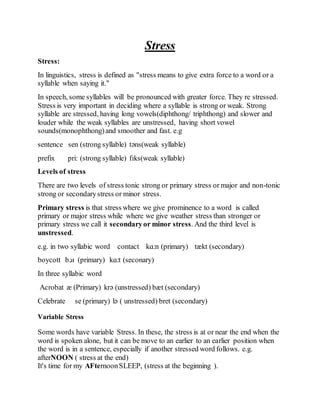
In linguistics, stress is defined as "stress means to give extra force to a word or a
syllable when saying it."
In speech, some syllables will be pronounced with greater force. They re stressed.
Stress is very important in deciding where a syllable is strong or weak. Strong
syllable are stressed, having long vowels(diphthong/ triphthong) and slower and
louder while the weak syllables are unstressed, having short vowel
sounds(monophthong)and smoother and fast. e.g
sentence sen (strong syllable) təns(weak syllable)
prefix pri: (strong syllable) fɪks(weak syllable)
Levels of stress
There are two levels of stress tonic strong or primary stress or major and non-tonic
strong or secondarystress or minor stress.
Primary stress is that stress where we give prominence to a word is called
primary or major stress while where we give weather stress than stronger or
primary stress we call it secondaryor minor stress. And the third level is
unstressed.
e.g. in two syllabic word contact kɑ:n (primary) tækt (secondary)
boycott bͻɪ (primary) kɑ:t (seconary)
In three syllabic word
Acrobat æ (Primary) krə (unstressed) bæt (secondary)
Celebrate se (primary) lə ( unstressed) bret (secondary)
Variable Stress
Some words have variable Stress. In these, the stress is at or near the end when the
word is spoken alone, but it can be move to an earlier to an earlier position when
the word is in a sentence, especially if another stressed word follows. e.g.
afterNOON ( stress at the end)
It's time for my AFternoonSLEEP, (stress at the beginning ).
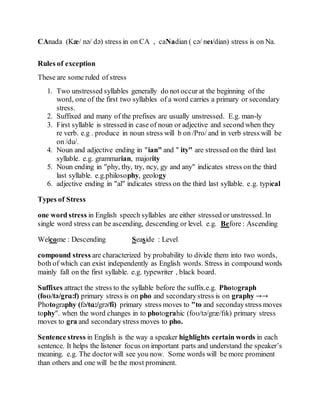
CAnada (Kæ/ nə/ də) stress in on CA , caNadian ( cə/ neɪ/dian) stress is on Na.
Rules of exception
These are some ruled of stress
1. Two unstressed syllables generally do not occur at the beginning of the
word, one of the first two syllables of a word carries a primary or secondary
stress.
2. Suffixed and many of the prefixes are usually unstressed. E.g. man-ly
3. First syllable is stressed in case of noun or adjective and second when they
re verb. e.g . produce in noun stress will b on /Pro/ and in verb stress will be
on /du/.
4. Noun and adjective ending in "ian" and " ity" are stressed on the third last
syllable. e.g. grammarian, majority
5. Noun ending in "phy, thy, try, ncy, gy and any" indicates stress on the third
last syllable. e.g.philosophy, geology
6. adjective ending in "al" indicates stress on the third last syllable. e.g. typical
Types of Stress
one word stress in English speech syllables are either stressed or unstressed. In
single word stress can be ascending, descending or level. e.g. Before : Ascending
Welcome : Descending Seaside : Level
compound stress are characterized by probability to divide them into two words,
both of which can exist independently as English words. Stress in compound words
mainly fall on the first syllable. e.g. typewriter , black board.
Suffixes attract the stress to the syllable before the suffix.e.g. Photograph
(foʊ/tə/grɑ:f) primary stress is on pho and secondarystress is on graphy →→
Photography (fə/tɑ:/grə/fi) primary stress moves to "to and secondaystress moves
tophy". when the word changes in to photograhic (foʊ/tə/græ/fɪk) primary stress
moves to gra and secondarystress moves to pho.
Sentence stress in English is the way a speaker highlights certain words in each
sentence. It helps the listener focus on important parts and understand the speaker’s
meaning. e.g. The doctorwill see you now. Some words will be more prominent
than others and one will be the most prominent.
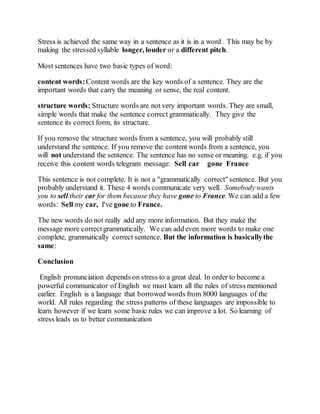
Stress is achieved the same way in a sentence as it is in a word . This may be by
making the stressed syllable longer, louder or a different pitch.
Most sentences have two basic types of word:
content words:Content words are the key words of a sentence. They are the
important words that carry the meaning or sense, the real content.
structure words: Structure words are not very important words. They are small,
simple words that make the sentence correct grammatically. They give the
sentence its correct form, its structure.
If you remove the structure words from a sentence, you will probably still
understand the sentence. If you remove the content words from a sentence, you
will not understand the sentence. The sentence has no sense or meaning. e.g. if you
receive this content words telegram message: Sell car gone France
This sentence is not complete. It is not a "grammatically correct" sentence. But you
probably understand it. These 4 words communicate very well. Somebodywants
you to sell their car for them because they have gone to France. We can add a few
words: Sell my car, I've gone to France.
The new words do not really add any more information. But they make the
message more correctgrammatically. We can add even more words to make one
complete, grammatically correct sentence. But the information is basicallythe
same:
Conclusion
English pronunciation depends on stress to a great deal. In order to become a
powerful communicator of English we must learn all the rules of stress mentioned
earlier. English is a language that borrowed words from 8000 languages of the
world. All rules regarding the stress patterns of these languages are impossible to
learn however if we learn some basic rules we can improve a lot. So learning of
stress leads us to better communication

Stress

  • 1.
    Stress Stress: In linguistics, stressis defined as "stress means to give extra force to a word or a syllable when saying it." In speech, some syllables will be pronounced with greater force. They re stressed. Stress is very important in deciding where a syllable is strong or weak. Strong syllable are stressed, having long vowels(diphthong/ triphthong) and slower and louder while the weak syllables are unstressed, having short vowel sounds(monophthong)and smoother and fast. e.g sentence sen (strong syllable) təns(weak syllable) prefix pri: (strong syllable) fɪks(weak syllable) Levels of stress There are two levels of stress tonic strong or primary stress or major and non-tonic strong or secondarystress or minor stress. Primary stress is that stress where we give prominence to a word is called primary or major stress while where we give weather stress than stronger or primary stress we call it secondaryor minor stress. And the third level is unstressed. e.g. in two syllabic word contact kɑ:n (primary) tækt (secondary) boycott bͻɪ (primary) kɑ:t (seconary) In three syllabic word Acrobat æ (Primary) krə (unstressed) bæt (secondary) Celebrate se (primary) lə ( unstressed) bret (secondary) Variable Stress Some words have variable Stress. In these, the stress is at or near the end when the word is spoken alone, but it can be move to an earlier to an earlier position when the word is in a sentence, especially if another stressed word follows. e.g. afterNOON ( stress at the end) It's time for my AFternoonSLEEP, (stress at the beginning ).
  • 2.
    CAnada (Kæ/ nə/də) stress in on CA , caNadian ( cə/ neɪ/dian) stress is on Na. Rules of exception These are some ruled of stress 1. Two unstressed syllables generally do not occur at the beginning of the word, one of the first two syllables of a word carries a primary or secondary stress. 2. Suffixed and many of the prefixes are usually unstressed. E.g. man-ly 3. First syllable is stressed in case of noun or adjective and second when they re verb. e.g . produce in noun stress will b on /Pro/ and in verb stress will be on /du/. 4. Noun and adjective ending in "ian" and " ity" are stressed on the third last syllable. e.g. grammarian, majority 5. Noun ending in "phy, thy, try, ncy, gy and any" indicates stress on the third last syllable. e.g.philosophy, geology 6. adjective ending in "al" indicates stress on the third last syllable. e.g. typical Types of Stress one word stress in English speech syllables are either stressed or unstressed. In single word stress can be ascending, descending or level. e.g. Before : Ascending Welcome : Descending Seaside : Level compound stress are characterized by probability to divide them into two words, both of which can exist independently as English words. Stress in compound words mainly fall on the first syllable. e.g. typewriter , black board. Suffixes attract the stress to the syllable before the suffix.e.g. Photograph (foʊ/tə/grɑ:f) primary stress is on pho and secondarystress is on graphy →→ Photography (fə/tɑ:/grə/fi) primary stress moves to "to and secondaystress moves tophy". when the word changes in to photograhic (foʊ/tə/græ/fɪk) primary stress moves to gra and secondarystress moves to pho. Sentence stress in English is the way a speaker highlights certain words in each sentence. It helps the listener focus on important parts and understand the speaker’s meaning. e.g. The doctorwill see you now. Some words will be more prominent than others and one will be the most prominent.
  • 3.
    Stress is achievedthe same way in a sentence as it is in a word . This may be by making the stressed syllable longer, louder or a different pitch. Most sentences have two basic types of word: content words:Content words are the key words of a sentence. They are the important words that carry the meaning or sense, the real content. structure words: Structure words are not very important words. They are small, simple words that make the sentence correct grammatically. They give the sentence its correct form, its structure. If you remove the structure words from a sentence, you will probably still understand the sentence. If you remove the content words from a sentence, you will not understand the sentence. The sentence has no sense or meaning. e.g. if you receive this content words telegram message: Sell car gone France This sentence is not complete. It is not a "grammatically correct" sentence. But you probably understand it. These 4 words communicate very well. Somebodywants you to sell their car for them because they have gone to France. We can add a few words: Sell my car, I've gone to France. The new words do not really add any more information. But they make the message more correctgrammatically. We can add even more words to make one complete, grammatically correct sentence. But the information is basicallythe same: Conclusion English pronunciation depends on stress to a great deal. In order to become a powerful communicator of English we must learn all the rules of stress mentioned earlier. English is a language that borrowed words from 8000 languages of the world. All rules regarding the stress patterns of these languages are impossible to learn however if we learn some basic rules we can improve a lot. So learning of stress leads us to better communication