



Aspects of Connected Speech  Presented to: Mr.Suhail Falak Sher. By: Ali Tahir.
Aspects of Connected Speech Weak Forms Yod coalescence Elision Assimilation Linking
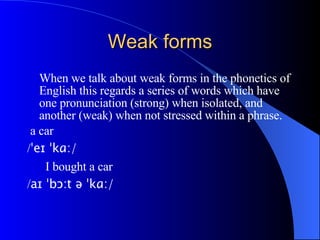
Weak forms When we talk about weak forms in the phonetics of English this regards a series of words which have one pronunciation (strong) when isolated, and another (weak) when not stressed within a phrase.  a car  / ˈeɪ ˈkɑ:/   I bought a car / aɪ ˈbɔ:t ə ˈkɑ:/
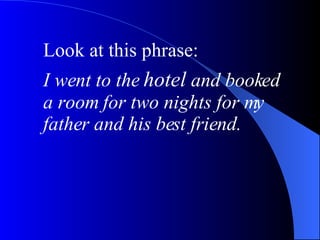
Look at this phrase: I went to the  hotel  and booked a room for two nights for my father and his best friend.
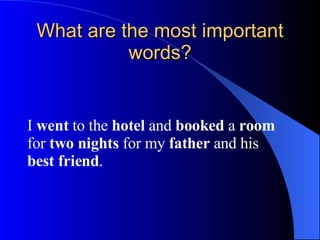
What are the most important words? I  went  to the  hotel  and  booked  a  room  for  two nights  for my  father  and his  best friend .
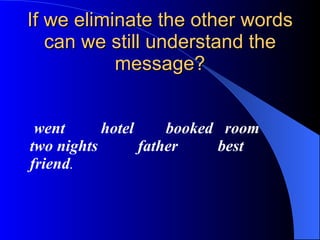
If we eliminate the other words can we still understand the message? went  hotel  booked  room  two nights  father  best  friend .
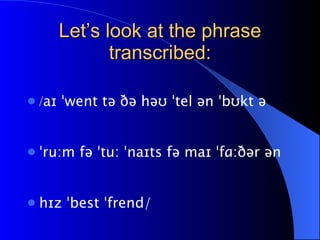
Let’s look at the phrase transcribed: / aɪ ˈwent tə ðə həʊ ˈtel ən ˈbʊkt ə  ˈru:m fə ˈtu: ˈnaɪts fə maɪ ˈfɑ:ðər ən  hɪz ˈbest ˈfrend/
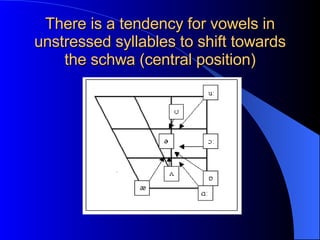
There is a tendency for vowels in unstressed syllables to shift towards the schwa (central position)
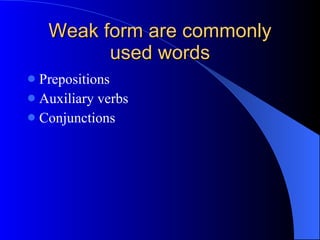
Weak form are commonly used words Prepositions Auxiliary verbs Conjunctions
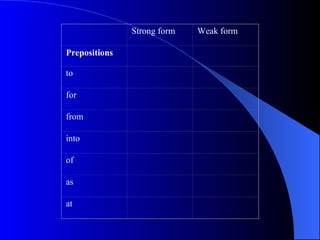
  Strong form Weak form Prepositions     to for from into of as at
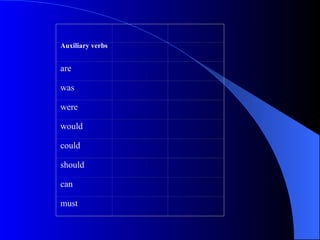
Auxiliary verbs     are was were would could should can must
Others     and but than that  you your her  a an the
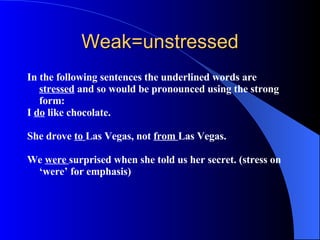
Weak=unstressed In the following sentences the underlined words are  stressed  and so would be pronounced using the strong form : I  do  like chocolate.   She drove  to  Las Vegas, not  from  Las Vegas.   We  were  surprised when she told us her secret. (stress on ‘were’ for emphasis)    
Yod coalescence In English phonetics Yod coalescence is a form of  assimilation – it is a phenomenon which takes place  when /j/ is preceded by certain consonants most  commonly /t/ and /d/:
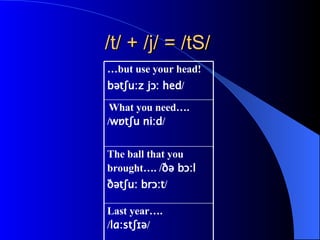
/t/ + /j/ =  /tS/   … but use your head! bətʃu:z jɔ: hed /  Last year…. / lɑ:stʃɪə /   The ball that you brought…. / ðə bɔ:l ðətʃu: brɔ:t /  What you need…. / wɒtʃu ni:d /
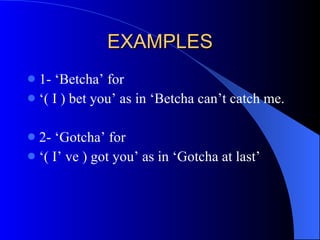
EXAMPLES 1- ‘Betcha’ for ‘ ( I ) bet you’ as in ‘Betcha can’t catch me. 2- ‘Gotcha’ for ‘ ( I’ ve ) got you’ as in ‘Gotcha at last’
/d/ + /j/ = / d Z /   Could you help me? / kʊdʒu help mi: /  She had university students… / ʃi: hædʒu:ni:vɜ:sɪti stju:dənts   Would yours work?  / wʊdʒɔ:z wɜ:k/
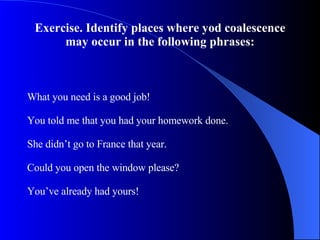
Exercise.  Identify places where yod coalescence may occur in the following phrases:   What you need is a good job!   You told me that you had your homework done.   She didn’t go to France that year.   Could you open the window please?   You’ve already had yours!
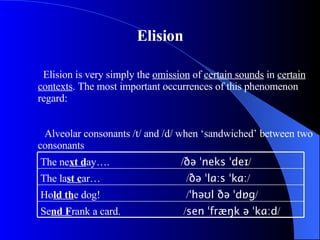
Elision   Elision is very simply the  omission  of  certain sounds  in  certain contexts . The most important occurrences of this phenomenon regard:   1       Alveolar consonants /t/ and /d/ when ‘sandwiched’ between two consonants  Se nd F rank a card.   / sen ˈfræŋk ə ˈkɑ:d /   Ho ld th e dog!   / ˈhəʊl ðə ˈdɒg /   The la st c ar…    / ðə ˈlɑ:s ˈkɑ: /   The ne xt d ay….   / ðə ˈneks ˈdeɪ /
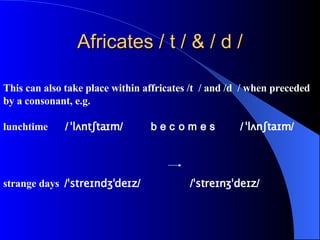
Africates / t / & / d / This can also take place within affricates /t  / and /d  / when preceded by a consonant, e.g.   lunchtime  / ˈlʌntʃtaɪm /   becomes  / ˈlʌnʃtaɪm /     strange days  / ˈstreɪndʒˈdeɪz /     / ˈstreɪnʒˈdeɪz / 
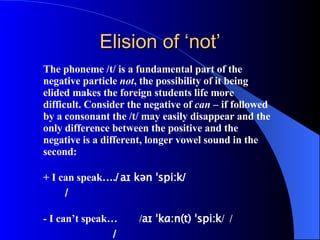
Elision of ‘not’ The phoneme /t/ is a fundamental part of the negative particle  not , the possibility of it being elided makes the foreign students life more difficult. Consider the negative of  can  – if followed by a consonant the /t/ may easily disappear and the only difference between the positive and the negative is a different, longer vowel sound in the second:   +  I can speak…. / aɪ kən ˈspi:k /   /   -  I can’t speak… / aɪ ˈkɑ:n(t) ˈspi:k /  /   /
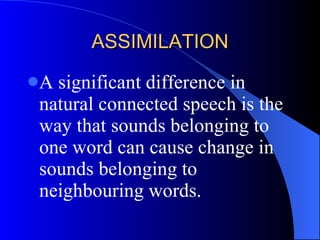
ASSIMILATION A significant difference in natural connected speech is the way that sounds belonging to one word can cause change in sounds belonging to neighbouring words.
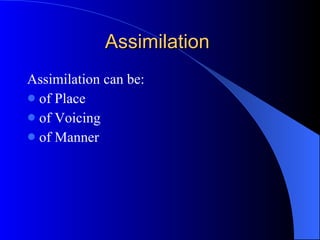
Assimilation  Assimilation can be: of Place of Voicing of Manner
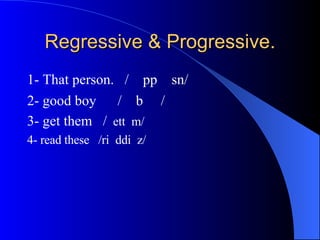
Regressive & Progressive. 1- That person.  /  pp  sn/  2- good boy  /   b   /   3- get them  /  ett  m/   4- read these  /ri  ddi  z/
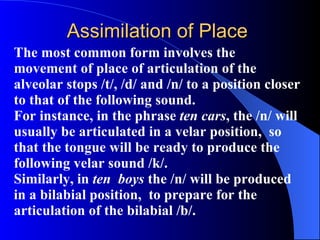
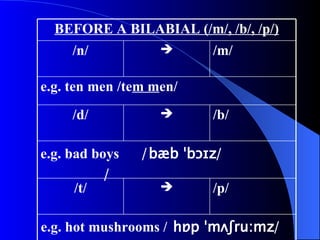
Assimilation of Place The most common form involves the movement of place of articulation of the alveolar stops /t/, /d/ and /n/ to a position closer to that of the following sound.  For instance, in the phrase  ten cars , the /n/ will usually be articulated in a velar position,  so that the  tongue will be  ready to produce the following velar sound /k/.  Similarly, in  ten  boys  the /n/ will be produced in a bilabial position,   to prepare for the articulation of the bilabial /b/.
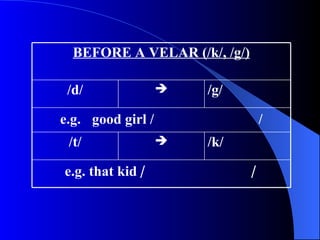
/k/  /t/ e.g. that kid  /  / e.g. good girl /   / /g/  /d/ BEFORE A VELAR (/k/, /g/)
/p/  /t/ / m /  /n/ e.g. hot mushrooms /   hɒp ˈmʌʃru:mz /  e.g. bad boys  / bæb ˈbɔɪz /   / / b /  /d/ e.g. ten men /te m m en/  BEFORE A  BILABIAL  (/ m /, / b / , /p/ )
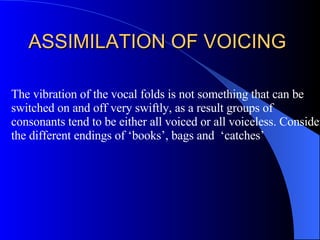
ASSIMILATION OF VOICING   The vibration of the vocal  folds  is not something that can be switched on and off very swiftly, as a result groups of consonants tend to be either all voiced or all voiceless. Consider the different endings of ‘books’, bags and  ‘catches’
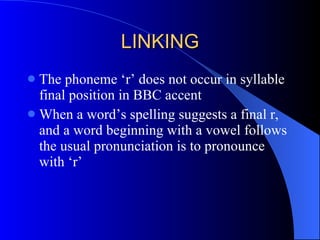
LINKING The phoneme ‘r’ does not occur in syllable final position in BBC accent When a word’s spelling suggests a final r, and a word beginning with a vowel follows the usual pronunciation is to pronounce with ‘r’
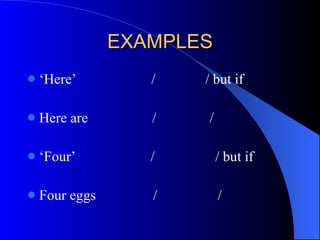
EXAMPLES ‘ Here’  /  / but if Here are  /  / ‘ Four’  /  / but if Four eggs  /  /
CONCLUSION There is a great deal of difference between words pronounced in isolation and in the context of connected speech. Learners of English must be aware of the problem they will meet in listening to colloquial connected speech.
THANK YOU FOR YOUR ATTENTION.

Connected Final Present

  • 1.
    Aspects of ConnectedSpeech Presented to: Mr.Suhail Falak Sher. By: Ali Tahir.
  • 2.
    Aspects of ConnectedSpeech Weak Forms Yod coalescence Elision Assimilation Linking
  • 3.
    Weak forms Whenwe talk about weak forms in the phonetics of English this regards a series of words which have one pronunciation (strong) when isolated, and another (weak) when not stressed within a phrase. a car / ˈeɪ ˈkɑ:/ I bought a car / aɪ ˈbɔ:t ə ˈkɑ:/
  • 4.
    Look at thisphrase: I went to the hotel and booked a room for two nights for my father and his best friend.
  • 5.
    What are themost important words? I went to the hotel and booked a room for two nights for my father and his best friend .
  • 6.
    If we eliminatethe other words can we still understand the message? went hotel booked room two nights father best friend .
  • 7.
    Let’s look atthe phrase transcribed: / aɪ ˈwent tə ðə həʊ ˈtel ən ˈbʊkt ə ˈru:m fə ˈtu: ˈnaɪts fə maɪ ˈfɑ:ðər ən hɪz ˈbest ˈfrend/
  • 8.
    There is atendency for vowels in unstressed syllables to shift towards the schwa (central position)
  • 9.
    Weak form arecommonly used words Prepositions Auxiliary verbs Conjunctions
  • 10.
      Strong formWeak form Prepositions     to for from into of as at
  • 11.
    Auxiliary verbs    are was were would could should can must
  • 12.
    Others    and but than that you your her a an the
  • 13.
    Weak=unstressed In thefollowing sentences the underlined words are stressed and so would be pronounced using the strong form : I do like chocolate.   She drove to Las Vegas, not from Las Vegas.   We were surprised when she told us her secret. (stress on ‘were’ for emphasis)  
  • 14.
    Yod coalescence InEnglish phonetics Yod coalescence is a form of assimilation – it is a phenomenon which takes place when /j/ is preceded by certain consonants most commonly /t/ and /d/:
  • 15.
    /t/ + /j/= /tS/ … but use your head! bətʃu:z jɔ: hed / Last year…. / lɑ:stʃɪə / The ball that you brought…. / ðə bɔ:l ðətʃu: brɔ:t / What you need…. / wɒtʃu ni:d /
  • 16.
    EXAMPLES 1- ‘Betcha’for ‘ ( I ) bet you’ as in ‘Betcha can’t catch me. 2- ‘Gotcha’ for ‘ ( I’ ve ) got you’ as in ‘Gotcha at last’
  • 17.
    /d/ + /j/= / d Z / Could you help me? / kʊdʒu help mi: / She had university students… / ʃi: hædʒu:ni:vɜ:sɪti stju:dənts Would yours work? / wʊdʒɔ:z wɜ:k/
  • 18.
    Exercise. Identifyplaces where yod coalescence may occur in the following phrases:   What you need is a good job!   You told me that you had your homework done.   She didn’t go to France that year.   Could you open the window please?   You’ve already had yours!
  • 19.
    Elision   Elisionis very simply the omission of certain sounds in certain contexts . The most important occurrences of this phenomenon regard:   1      Alveolar consonants /t/ and /d/ when ‘sandwiched’ between two consonants Se nd F rank a card. / sen ˈfræŋk ə ˈkɑ:d /  Ho ld th e dog! / ˈhəʊl ðə ˈdɒg / The la st c ar… / ðə ˈlɑ:s ˈkɑ: / The ne xt d ay…. / ðə ˈneks ˈdeɪ /
  • 20.
    Africates / t/ & / d / This can also take place within affricates /t  / and /d  / when preceded by a consonant, e.g.   lunchtime / ˈlʌntʃtaɪm / becomes / ˈlʌnʃtaɪm /    strange days / ˈstreɪndʒˈdeɪz / / ˈstreɪnʒˈdeɪz / 
  • 21.
    Elision of ‘not’The phoneme /t/ is a fundamental part of the negative particle not , the possibility of it being elided makes the foreign students life more difficult. Consider the negative of can – if followed by a consonant the /t/ may easily disappear and the only difference between the positive and the negative is a different, longer vowel sound in the second:   + I can speak…. / aɪ kən ˈspi:k /  /   - I can’t speak… / aɪ ˈkɑ:n(t) ˈspi:k /  / /
  • 22.
    ASSIMILATION A significantdifference in natural connected speech is the way that sounds belonging to one word can cause change in sounds belonging to neighbouring words.
  • 23.
    Assimilation Assimilationcan be: of Place of Voicing of Manner
  • 24.
    Regressive & Progressive.1- That person. /  pp  sn/ 2- good boy /   b  / 3- get them /  ett  m/ 4- read these /ri  ddi  z/
  • 25.
    Assimilation of PlaceThe most common form involves the movement of place of articulation of the alveolar stops /t/, /d/ and /n/ to a position closer to that of the following sound. For instance, in the phrase ten cars , the /n/ will usually be articulated in a velar position, so that the tongue will be ready to produce the following velar sound /k/. Similarly, in ten boys the /n/ will be produced in a bilabial position, to prepare for the articulation of the bilabial /b/.
  • 26.
    /k/  /t/e.g. that kid / / e.g. good girl / / /g/  /d/ BEFORE A VELAR (/k/, /g/)
  • 27.
    /p/  /t// m /  /n/ e.g. hot mushrooms / hɒp ˈmʌʃru:mz / e.g. bad boys / bæb ˈbɔɪz / / / b /  /d/ e.g. ten men /te m m en/ BEFORE A BILABIAL (/ m /, / b / , /p/ )
  • 28.
    ASSIMILATION OF VOICING The vibration of the vocal folds is not something that can be switched on and off very swiftly, as a result groups of consonants tend to be either all voiced or all voiceless. Consider the different endings of ‘books’, bags and ‘catches’
  • 29.
    LINKING The phoneme‘r’ does not occur in syllable final position in BBC accent When a word’s spelling suggests a final r, and a word beginning with a vowel follows the usual pronunciation is to pronounce with ‘r’
  • 30.
    EXAMPLES ‘ Here’ / / but if Here are / / ‘ Four’ / / but if Four eggs / /
  • 31.
    CONCLUSION There isa great deal of difference between words pronounced in isolation and in the context of connected speech. Learners of English must be aware of the problem they will meet in listening to colloquial connected speech.
  • 32.
    THANK YOU FORYOUR ATTENTION.