English Syllables (I)
Aisha Aslam
M.Phil. Applied Linguistics
Spring 2018, Semester 1
University of Lahore, Paksitan
• What are syllables?
• Syllabification
• Types of Syllables
• Parts of Syllables
• Phonotactics Restrictions
Syllable
• Hard to define
• “Each syllable involves one burst of muscular
energy.” ( Davenport & Hannahs, 2005)
• “one burst of muscular energy”:
1 chest pulse
1 beat
entertaining
• en.ter.tain.ing
4 beats
Why not : ent.er.trai.ning ??
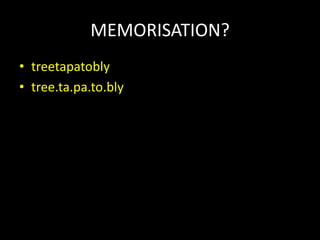
MEMORISATION?
• treetapatobly
• tree.ta.pa.to.bly
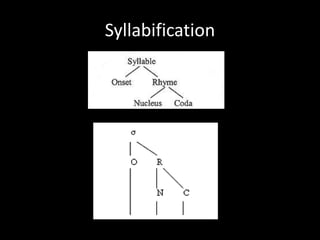
Syllabification
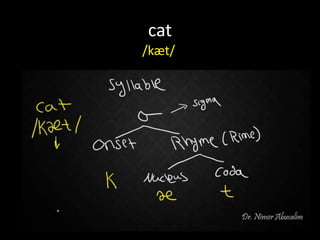
cat
/kæt/
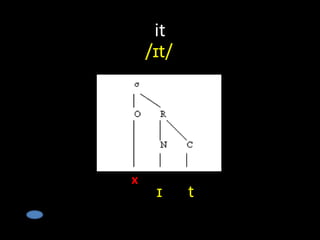
it
/ɪt/
ɪ t
x
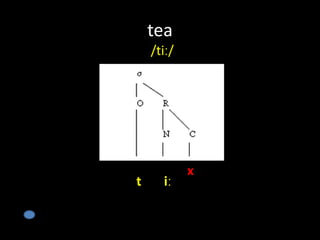
tea
/tiː/
iːt
x
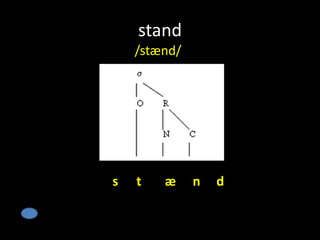
stand
/stænd/
t æs n d
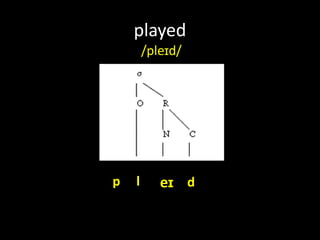
played
/pleɪd/
eɪlp d
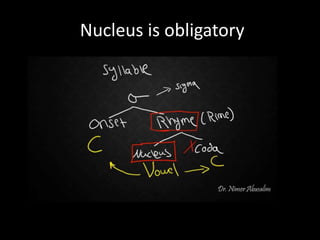
Nucleus is obligatory
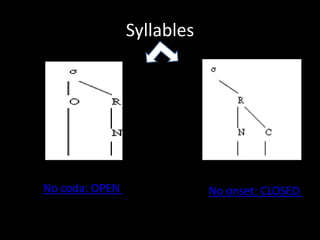
Syllables
No onset: CLOSEDNo coda: OPEN
Syllables
• Syllable may even have ONLY a nucleus.
e.g. ‘eye’ /aɪ/
• Syllables may have both onset and coda
before and after a nucleus respectively. ( most
English words fall into this category.)
e.g. ‘cat’ /kæt/
Nucleus and Sonority
• “The nature of the syllabic nucleus, and
indeed the order of segments within the
syllable as a whole, is in part governed by the
notion of sonority.”
( Davenport & Hannahs, 2005)
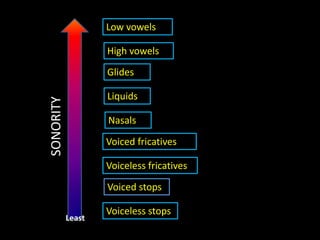
Sonority
• The degree of sonority of a speech sound;
i. loudness in relation to other sounds
ii. the extent to which it can be prolonged
iii. the degree of stricture in the vocal tract.
Voiceless stops
Voiced stops
Voiceless fricatives
Voiced fricatives
Nasals
Liquids
Glides
High vowels
Low vowels
SONORITY
Least
Sonority (cont.)
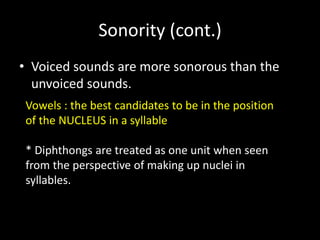
• Voiced sounds are more sonorous than the
unvoiced sounds.
Vowels : the best candidates to be in the position
of the NUCLEUS in a syllable
* Diphthongs are treated as one unit when seen
from the perspective of making up nuclei in
syllables.
• Consonants [m], [n], [l], [r] and [ŋ]can also act
like the nuclei, hence these are also called
‘syllabic consonants’.
• Syllabic Consonants replace the vowel [ə] in a
syllable. They make it possible to make some
short syllables shorter and simpler.
e.g. button /ˈbʌtn/, bottle /ˈbɒtl/
Sonority (cont.)
* A syllabic consonant and corresponding non-syllabic consonant
cannot usually distinguish meaning or distinguish words, which means
that they must be regarded as allophones of the same phoneme.
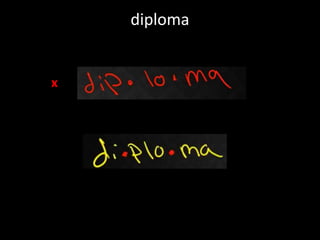
diploma
x
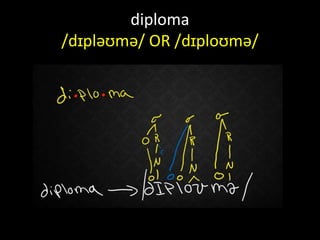
diploma
/dɪpləʊmə/ OR /dɪploʊmə/
Principle of Onset Maximisation;
OR
Onset Maximisation Prinicple;
“a principle that suggests that consonants that are intervocalic
are maximally assigned to the onset, so long as they conform
with universal and language-specific conditions”
“medial clusters can only be assigned to onsets to the extent
that such sequences are possible word-initially in the language in
question ”
There are some consonant clusters that are allowed in English
while some others are not allowed. e.g. ;
[st] : possible word initial cluster in English
[nt] : not possible initial cluster in English
Preference of CV over VC
CV : Basic Structure
• 1. Children: [ma ] or [ba] [ma-ma] [ba-ba]
• 2. codas are not very stable: car /ka:/
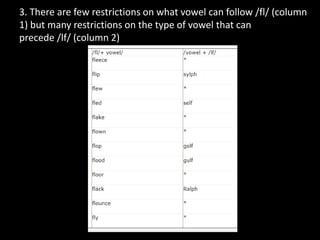
3. There are few restrictions on what vowel can follow /fl/ (column
1) but many restrictions on the type of vowel that can
precede /lf/ (column 2)
[pl] possible word initial: should be added to onset
Phonotactics Constraints
• Language-specific rules governing the possible
positions and combinations of phonemes are
the phonotactics constraints.
ONSET Constraints in English
If onset consists of three consonants ( consonant
cluster), it will always be constructed as follows;
i. first element: /s/,
ii. second : one of the three fortis plosives /p,t,k/
iii. third: one of the four frictionless continuants
/l,r,j,w/.
Hence the only possible combinations for English
onsets are: /spl, spr, spj, str, stj, skl, skr, skj, skw/
Phonotactics Constraints
• If onset is formed of 2 elements, it will always
be constructed as such:
• /pl, pr, pj, bl, bj, tr, tj, tw, dr, dj, dw, kl, kr, kw,
gl, gr, mj, nj, fl, fr, fj, vj, θr, θw, sp, st, sk, sm,
sn, sf, sl, sj, sw, ʃr, hj, lj/
• Some unusual combinations are: /vr/ in vroom
or /sr/ as in ‘syringe’ /srɪndʒ/
ONSET Constraints in English
• If onset is formed of one consonant , it can be
any consonant except /ŋ/ ( /ʒ/ is also a rare
word-initial.)
ONSET Constraints in English
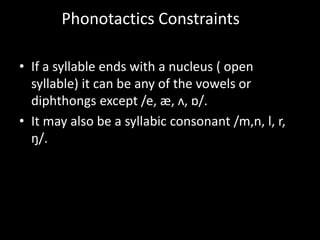
• If a syllable ends with a nucleus ( open
syllable) it can be any of the vowels or
diphthongs except /e, æ, ʌ, ɒ/.
• It may also be a syllabic consonant /m,n, l, r,
ŋ/.
Phonotactics Constraints
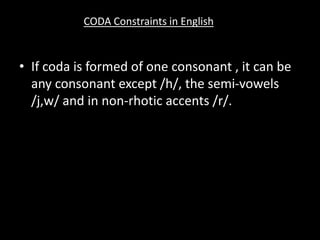
• If coda is formed of one consonant , it can be
any consonant except /h/, the semi-vowels
/j,w/ and in non-rhotic accents /r/.
CODA Constraints in English
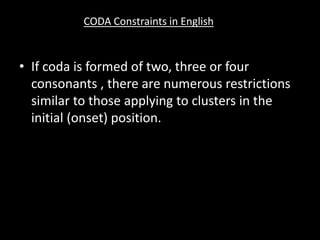
• If coda is formed of two, three or four
consonants , there are numerous restrictions
similar to those applying to clusters in the
initial (onset) position.
CODA Constraints in English
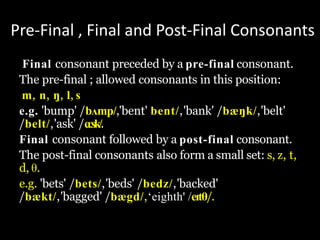
Pre-Final , Final and Post-Final Consonants
Final consonant preceded by a pre-final consonant.
The pre-final ; allowed consonants in this position:
m, n, ŋ, l, s
e.g. 'bump' /bʌmp/,'bent' bent/,'bank' /bæŋk/,'belt'
/belt/,'ask' /ɑːsk/.
Final consonant followed by a post-final consonant.
The post-final consonants also form a small set: s, z, t,
d, θ.
e.g. 'bets' /bets/,'beds' /bedz/,'backed'
/bækt/,'bagged' /bægd/,‘eighth' /eɪtθ/.
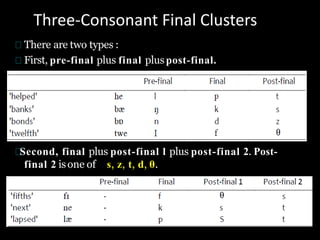
Three-Consonant Final Clusters
Second, final plus post-final l plus post-final 2. Post-
final 2 isone of s, z, t, d, θ.
There are two types :
First, pre-final plus final pluspost-final.
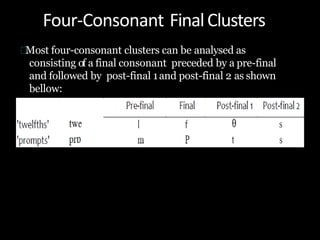
Four-Consonant FinalClusters
Most four-consonant clusters can be analysed as
consisting of a final consonant preceded by a pre-final
and followed by post-final 1and post-final 2 as shown
bellow:
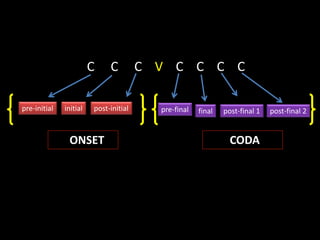
C C C V C C C C
initialpre-initial post-initial pre-final final post-final 1 post-final 2
ONSET CODA
• There can be 16 different combinations of syllable
structures in English.
• Maximal English Syllabic Structure: C0-3 V C0-4
or (CCCVCCCC)
Hence, in English language, onset can never
exceed 3 consonants and coda can never be
more than 4 consonants.
Phonotactics Constraints
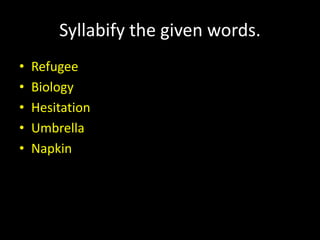
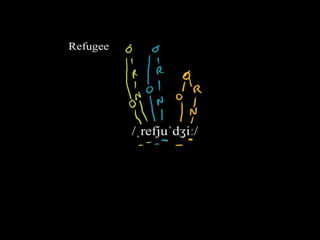
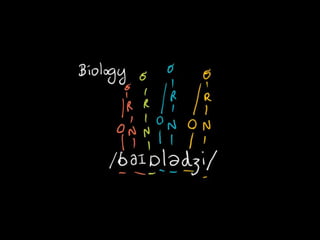
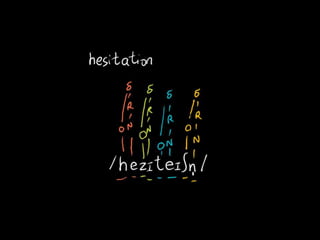
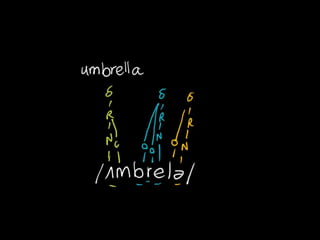
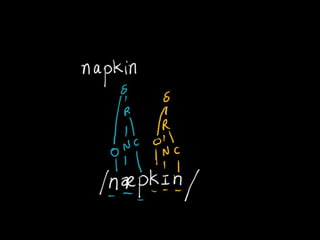
Syllabify the given words.
• Refugee
• Biology
• Hesitation
• Umbrella
• Napkin
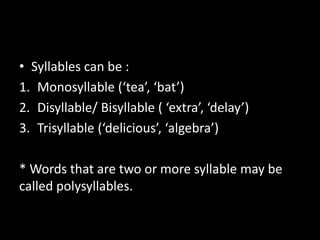
• Syllables can be :
1. Monosyllable (‘tea’, ‘bat’)
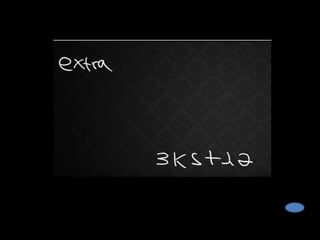
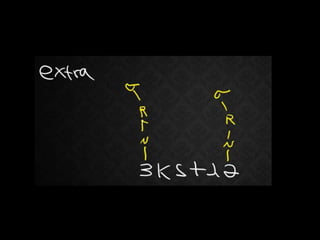
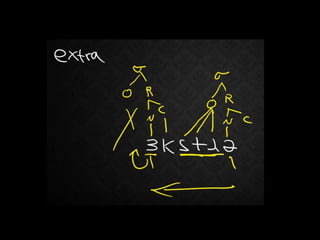
2. Disyllable/ Bisyllable ( ‘extra’, ‘delay’)
3. Trisyllable (‘delicious’, ‘algebra’)
* Words that are two or more syllable may be
called polysyllables.
References
• Davenport.M.,&Hannahs.S.J.(2013).Introducin
g Phonetics and Phonology. New York.
Routledge.
• https://www.youtube.com/watch?v=MfH0Ojlo
m accessed 31ST March, 2018.
• http://clas.mq.edu.au/speech/phonetics/phon
ology/syllable/syll_structure.html accessed
31st March, 2018.

English syllables

  • 1.
    English Syllables (I) AishaAslam M.Phil. Applied Linguistics Spring 2018, Semester 1 University of Lahore, Paksitan
  • 2.
    • What aresyllables? • Syllabification • Types of Syllables • Parts of Syllables • Phonotactics Restrictions
  • 3.
    Syllable • Hard todefine • “Each syllable involves one burst of muscular energy.” ( Davenport & Hannahs, 2005) • “one burst of muscular energy”: 1 chest pulse 1 beat
  • 4.
  • 5.
  • 6.
  • 7.
  • 8.
  • 9.
  • 10.
  • 11.
  • 12.
  • 13.
  • 14.
    Syllables • Syllable mayeven have ONLY a nucleus. e.g. ‘eye’ /aɪ/ • Syllables may have both onset and coda before and after a nucleus respectively. ( most English words fall into this category.) e.g. ‘cat’ /kæt/
  • 15.
    Nucleus and Sonority •“The nature of the syllabic nucleus, and indeed the order of segments within the syllable as a whole, is in part governed by the notion of sonority.” ( Davenport & Hannahs, 2005)
  • 16.
    Sonority • The degreeof sonority of a speech sound; i. loudness in relation to other sounds ii. the extent to which it can be prolonged iii. the degree of stricture in the vocal tract.
  • 17.
    Voiceless stops Voiced stops Voicelessfricatives Voiced fricatives Nasals Liquids Glides High vowels Low vowels SONORITY Least
  • 18.
    Sonority (cont.) • Voicedsounds are more sonorous than the unvoiced sounds. Vowels : the best candidates to be in the position of the NUCLEUS in a syllable * Diphthongs are treated as one unit when seen from the perspective of making up nuclei in syllables.
  • 19.
    • Consonants [m],[n], [l], [r] and [ŋ]can also act like the nuclei, hence these are also called ‘syllabic consonants’. • Syllabic Consonants replace the vowel [ə] in a syllable. They make it possible to make some short syllables shorter and simpler. e.g. button /ˈbʌtn/, bottle /ˈbɒtl/ Sonority (cont.) * A syllabic consonant and corresponding non-syllabic consonant cannot usually distinguish meaning or distinguish words, which means that they must be regarded as allophones of the same phoneme.
  • 20.
  • 21.
  • 22.
    Principle of OnsetMaximisation; OR Onset Maximisation Prinicple; “a principle that suggests that consonants that are intervocalic are maximally assigned to the onset, so long as they conform with universal and language-specific conditions” “medial clusters can only be assigned to onsets to the extent that such sequences are possible word-initially in the language in question ” There are some consonant clusters that are allowed in English while some others are not allowed. e.g. ; [st] : possible word initial cluster in English [nt] : not possible initial cluster in English Preference of CV over VC
  • 23.
    CV : BasicStructure • 1. Children: [ma ] or [ba] [ma-ma] [ba-ba] • 2. codas are not very stable: car /ka:/
  • 24.
    3. There arefew restrictions on what vowel can follow /fl/ (column 1) but many restrictions on the type of vowel that can precede /lf/ (column 2)
  • 25.
    [pl] possible wordinitial: should be added to onset
  • 29.
    Phonotactics Constraints • Language-specificrules governing the possible positions and combinations of phonemes are the phonotactics constraints.
  • 30.
    ONSET Constraints inEnglish If onset consists of three consonants ( consonant cluster), it will always be constructed as follows; i. first element: /s/, ii. second : one of the three fortis plosives /p,t,k/ iii. third: one of the four frictionless continuants /l,r,j,w/. Hence the only possible combinations for English onsets are: /spl, spr, spj, str, stj, skl, skr, skj, skw/ Phonotactics Constraints
  • 31.
    • If onsetis formed of 2 elements, it will always be constructed as such: • /pl, pr, pj, bl, bj, tr, tj, tw, dr, dj, dw, kl, kr, kw, gl, gr, mj, nj, fl, fr, fj, vj, θr, θw, sp, st, sk, sm, sn, sf, sl, sj, sw, ʃr, hj, lj/ • Some unusual combinations are: /vr/ in vroom or /sr/ as in ‘syringe’ /srɪndʒ/ ONSET Constraints in English
  • 32.
    • If onsetis formed of one consonant , it can be any consonant except /ŋ/ ( /ʒ/ is also a rare word-initial.) ONSET Constraints in English
  • 33.
    • If asyllable ends with a nucleus ( open syllable) it can be any of the vowels or diphthongs except /e, æ, ʌ, ɒ/. • It may also be a syllabic consonant /m,n, l, r, ŋ/. Phonotactics Constraints
  • 34.
    • If codais formed of one consonant , it can be any consonant except /h/, the semi-vowels /j,w/ and in non-rhotic accents /r/. CODA Constraints in English
  • 35.
    • If codais formed of two, three or four consonants , there are numerous restrictions similar to those applying to clusters in the initial (onset) position. CODA Constraints in English
  • 36.
    Pre-Final , Finaland Post-Final Consonants Final consonant preceded by a pre-final consonant. The pre-final ; allowed consonants in this position: m, n, ŋ, l, s e.g. 'bump' /bʌmp/,'bent' bent/,'bank' /bæŋk/,'belt' /belt/,'ask' /ɑːsk/. Final consonant followed by a post-final consonant. The post-final consonants also form a small set: s, z, t, d, θ. e.g. 'bets' /bets/,'beds' /bedz/,'backed' /bækt/,'bagged' /bægd/,‘eighth' /eɪtθ/.
  • 37.
    Three-Consonant Final Clusters Second,final plus post-final l plus post-final 2. Post- final 2 isone of s, z, t, d, θ. There are two types : First, pre-final plus final pluspost-final.
  • 38.
    Four-Consonant FinalClusters Most four-consonantclusters can be analysed as consisting of a final consonant preceded by a pre-final and followed by post-final 1and post-final 2 as shown bellow:
  • 39.
    C C CV C C C C initialpre-initial post-initial pre-final final post-final 1 post-final 2 ONSET CODA
  • 40.
    • There canbe 16 different combinations of syllable structures in English. • Maximal English Syllabic Structure: C0-3 V C0-4 or (CCCVCCCC) Hence, in English language, onset can never exceed 3 consonants and coda can never be more than 4 consonants. Phonotactics Constraints
  • 41.
    Syllabify the givenwords. • Refugee • Biology • Hesitation • Umbrella • Napkin
  • 47.
    • Syllables canbe : 1. Monosyllable (‘tea’, ‘bat’) 2. Disyllable/ Bisyllable ( ‘extra’, ‘delay’) 3. Trisyllable (‘delicious’, ‘algebra’) * Words that are two or more syllable may be called polysyllables.
  • 48.
    References • Davenport.M.,&Hannahs.S.J.(2013).Introducin g Phoneticsand Phonology. New York. Routledge. • https://www.youtube.com/watch?v=MfH0Ojlo m accessed 31ST March, 2018. • http://clas.mq.edu.au/speech/phonetics/phon ology/syllable/syll_structure.html accessed 31st March, 2018.

Editor's Notes

  • #17 "Degree of stricture" means how narrow the gap is between the active articulator and the passive articulator at the narrowest point in the vocal tract. We shall distinguish three degrees of constriction: i) complete closure, ii) close approximation, iii) open approximation. "Complete closure" is self-explanatory. "Close approximation" means "so close together that it causes audible friction". "Open approximation" means that the oral tract is somewhat more open than in "close approximation", so that there is no friction. Consequently, the three degrees of stricture are associated with different kinds of consonants and vowels: 1. Complete closure - stops (plosives, implosives), nasals, trills, taps and flaps;2. Close approximation - fricatives; 3. Open approximation - approximants (liquids and semivowels) and vowels. Of these, English provides examples of stops [p], [b], [t], [d], [k] and [ɡ]; nasals [m], [ɱ], [n] and [ŋ]; fricatives [f], [v], [θ], [ð], [s], [z], [ʃ], [ʒ] and [h]; and approximants [ɹ], [l], [j] and [w]. Apart from uvular and pharyngeal consonants, the remaining IPA stops and fricatives are made at the same set of places of articulation and with the same range of degrees of stricture as in English, but in different combinations.