Content VS Secondary Analysis
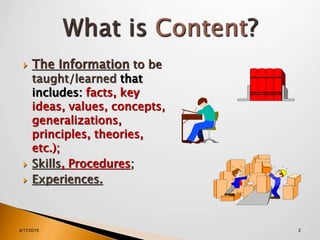
 The Information to be
taught/learned that
includes: facts, key
ideas, values, concepts,
generalizations,
principles, theories,
etc.);
 Skills, Procedures;
 Experiences.
4/17/2015 2
 The process of breaking down a whole into
pieces, parts, elements, or components.
CONTENT ANALYSIS
is a process of breaking down, structuring
the kind of learning experience that the
teacher expects the students to know how
to perform.
4/17/2015 3
Different Approaches for
Data Collection/Data Analysis
• Experiment
• Survey
• Quasi-Experiment
• Secondary Data Analysis
• Content Analysis
• Historical Comparative
Methods (Archival
Analysis )
• Participant Observation
• Ethnography
• Individual Qualitative
Interview
• Textual Analysis
• Focus Group Discussion
• Del-Phi Method
Secondary Data Analysis
• A type of research in which data collected by others are
reanalyzed.
Primary Data Analysis
• Original analysis of the data collected in a study.
Meta-Analysis
• “Analysis of analysis”
• Quantitative procedure for summarizing or integrating the
findings obtained from a literature.
• Uses the results of individual research projects on the
same topic as data points for a statistical study of the
topic.
Secondary Data Analysis
Advantage
• Saves cost for data collection.
• Saves time required for data collection.
• May obtain data otherwise impossible.
Disadvantage
• Data collected may not be suitable for the researcher’s purposes.
(Validity)
• All necessary data may not be available in existing data.
• Requires time to search for the data set.
• Original data set may not be accurate.
• Existing data sets may contain more variables than what the
researchers need. Need time to sort out the data.
Content Analysis
General usage of the term
• Refers to any of several research techniques used to
analyze the content of written, spoken, or pictorial
communication such as books, newspapers, television
programs, or interview transcripts.
Specific usage of the term
• Refers to a quantitative technique that attempts to
quantify the meaning of the content of the written, spoken
or pictorial communication.
Content Analysis
1. Determine “Unit of Analysis”
2. Determine “Indicators”
3. “Code” the data
Example
Research Question: What values and beliefs were expressed
by advocacy coalition about Social Security?
Unit of Analysis: Congressional testimony on Social
Security reform from 1983 to 2004.
Indicators: Values---Statement on what they like.
Beliefs---Statement on what things should be.
Content Analysis
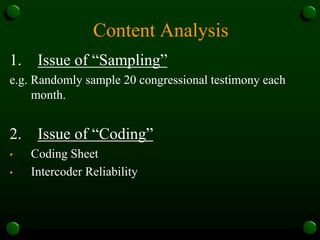
1. Issue of “Sampling”
e.g. Randomly sample 20 congressional testimony each
month.
2. Issue of “Coding”
• Coding Sheet
• Intercoder Reliability

Content Analysis vs secondary analysis

  • 1.
  • 2.
     The Informationto be taught/learned that includes: facts, key ideas, values, concepts, generalizations, principles, theories, etc.);  Skills, Procedures;  Experiences. 4/17/2015 2
  • 3.
     The processof breaking down a whole into pieces, parts, elements, or components. CONTENT ANALYSIS is a process of breaking down, structuring the kind of learning experience that the teacher expects the students to know how to perform. 4/17/2015 3
  • 4.
    Different Approaches for DataCollection/Data Analysis • Experiment • Survey • Quasi-Experiment • Secondary Data Analysis • Content Analysis • Historical Comparative Methods (Archival Analysis ) • Participant Observation • Ethnography • Individual Qualitative Interview • Textual Analysis • Focus Group Discussion • Del-Phi Method
  • 5.
    Secondary Data Analysis SecondaryData Analysis • A type of research in which data collected by others are reanalyzed. Primary Data Analysis • Original analysis of the data collected in a study. Meta-Analysis • “Analysis of analysis” • Quantitative procedure for summarizing or integrating the findings obtained from a literature. • Uses the results of individual research projects on the same topic as data points for a statistical study of the topic.
  • 6.
    Secondary Data Analysis Advantage •Saves cost for data collection. • Saves time required for data collection. • May obtain data otherwise impossible. Disadvantage • Data collected may not be suitable for the researcher’s purposes. (Validity) • All necessary data may not be available in existing data. • Requires time to search for the data set. • Original data set may not be accurate. • Existing data sets may contain more variables than what the researchers need. Need time to sort out the data.
  • 7.
    Content Analysis General usageof the term • Refers to any of several research techniques used to analyze the content of written, spoken, or pictorial communication such as books, newspapers, television programs, or interview transcripts. Specific usage of the term • Refers to a quantitative technique that attempts to quantify the meaning of the content of the written, spoken or pictorial communication.
  • 8.
    Content Analysis 1. Determine“Unit of Analysis” 2. Determine “Indicators” 3. “Code” the data Example Research Question: What values and beliefs were expressed by advocacy coalition about Social Security? Unit of Analysis: Congressional testimony on Social Security reform from 1983 to 2004. Indicators: Values---Statement on what they like. Beliefs---Statement on what things should be.
  • 9.
    Content Analysis 1. Issueof “Sampling” e.g. Randomly sample 20 congressional testimony each month. 2. Issue of “Coding” • Coding Sheet • Intercoder Reliability