Phonetics and Phonology
Vowels
Received Pronunciation (RP)
Received Pronunciation, or the Queen's/King's
English, is the accent traditionally regarded as
the standard for British English. Popular terms
for this accent, such ‘Oxford English’ or ‘BBC
English’ are all a little misleading. The Queen,
for instance, speaks an almost unique form of
English, while the English we hear at Oxford
University or on the BBC is no longer restricted
to one type of accent. RP is an accent, not
a dialect, since all RP speakers speak Standard
English
Vowels of RP
Vowels are sounds produced without any
obstruction in the oral passage of air. There are
20 vowels in English which can be divided as
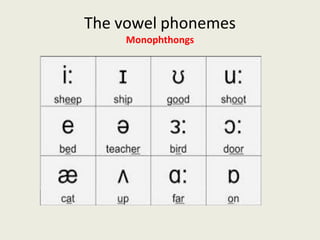
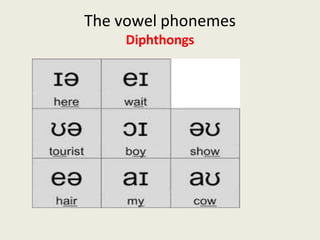
monophthongs and diphthongs. There are 12
monophthongs and 8 diphthongs.
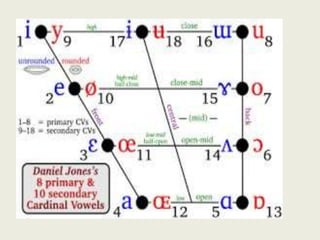
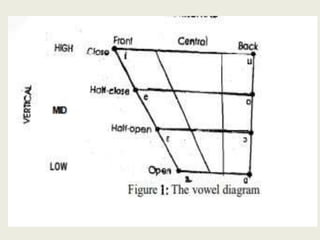
Cardinal Vowels
Cardinal vowels are a set of
reference vowels used by phoneticians in
describing the sounds of languages. They are
classified depending on the position of the
tongue relative to the roof of the mouth, how
far forward or back is the highest point of the
tongue and the position of the lips, either
rounded or unrounded.
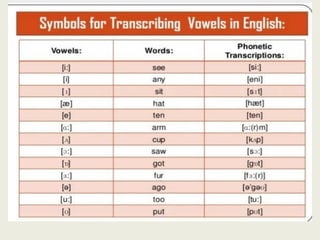
The vowel phonemes
Monophthongs
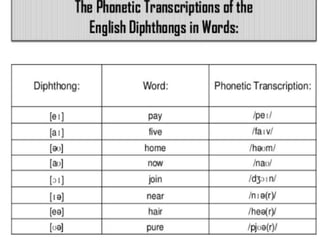
The vowel phonemes
Diphthongs
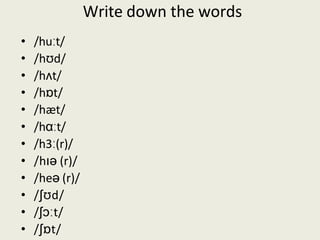
Write down the words
• /huːt/
• /hʊd/
• /hʌt/
• /hɒt/
• /hæt/
• /hɑːt/
• /h3ː(r)/
• /hɪə (r)/
• /heə (r)/
• /ʃʊd/
• /ʃɔːt/
• /ʃɒt/
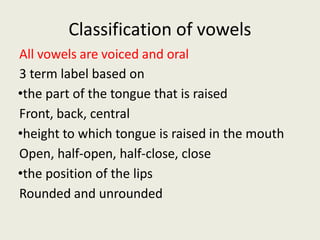
Classification of vowels
All vowels are voiced and oral
3 term label based on
•the part of the tongue that is raised
Front, back, central
•height to which tongue is raised in the mouth
Open, half-open, half-close, close
•the position of the lips
Rounded and unrounded
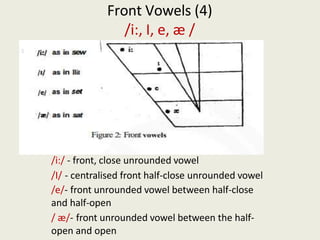
Front Vowels (4)
/i:, I, e, æ /
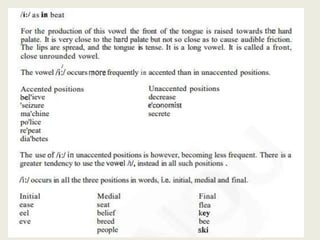
/i:/ - front, close unrounded vowel
/I/ - centralised front half-close unrounded vowel
/e/- front unrounded vowel between half-close
and half-open
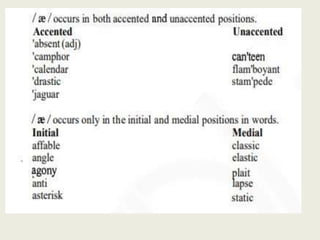
/ æ/- front unrounded vowel between the half-
open and open
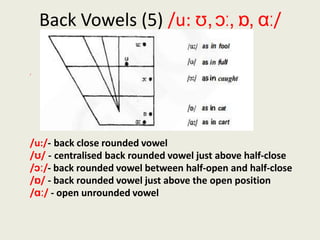
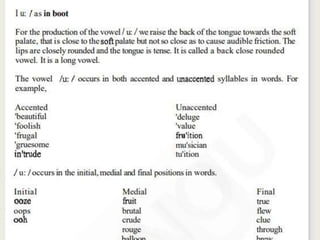
Back Vowels (5) /u: ʊ,ɔː, ɒ, ɑː/
/
/u:/- back close rounded vowel
/ʊ/ - centralised back rounded vowel just above half-close
/ɔː/- back rounded vowel between half-open and half-close
/ɒ/ - back rounded vowel just above the open position
/ɑː/ - open unrounded vowel
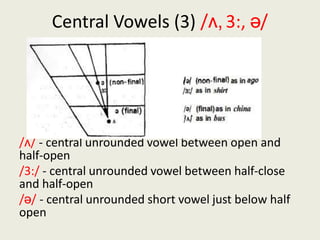
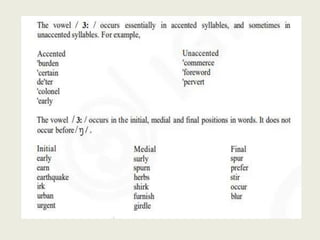
Central Vowels (3) /ʌ,3:, ə/
/ʌ/ - central unrounded vowel between open and
half-open
/3:/ - central unrounded vowel between half-close
and half-open
/ə/ - central unrounded short vowel just below half
open
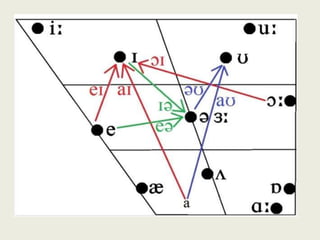
Diphthongs
A diphthong is a vowel glide in the production
of which the tongue moves from one position in
the mouth towards another position. The
phonetic symbols for each diphthong is a
combination of the two vowels - one in which
the tongue is in position initially and the other
towards which the tongue moves. There are 8
diphthongs in RP
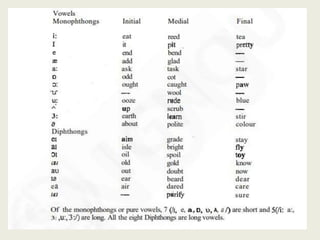
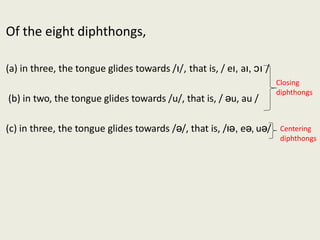
Of the eight diphthongs,
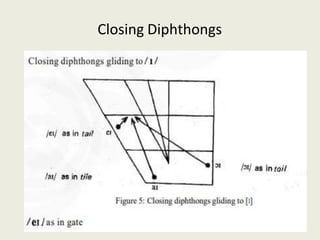
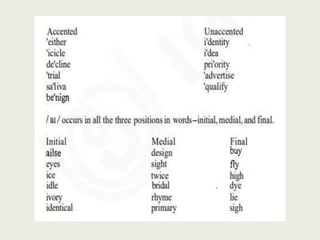
(a) in three, the tongue glides towards /ɪ/, that is, / eɪ, aɪ, ɔɪ /
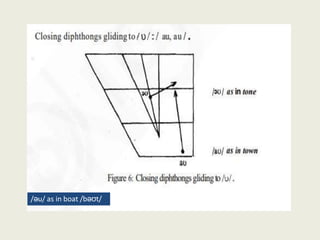
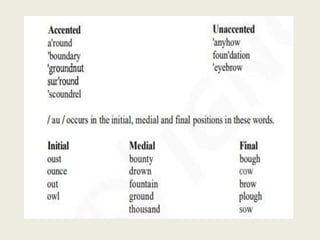
(b) in two, the tongue glides towards /u/, that is, / əu, au /
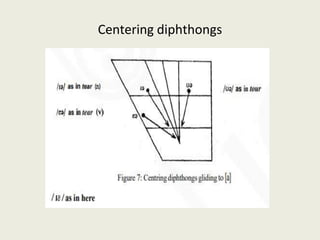
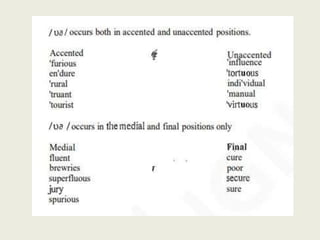
(c) in three, the tongue glides towards /ə/, that is, /ɪə, eə, uə/
Closing
diphthongs
Centering
diphthongs
Closing Diphthongs
/əu/ as in boat /bəʊt/
Centering diphthongs
Suprasegmental features
Specific features that are superimposed on the
utterance of the speech are known as supra-
segmental features. Common supra-segmental
features are the stress, tone, and duration in
the syllable or word for a continuous speech
sequence. Sometimes even harmony and
nasalization are also included under this
category. Supra-segmental or prosodic features
are often used in the context of speech to make
it more meaningful and effective.
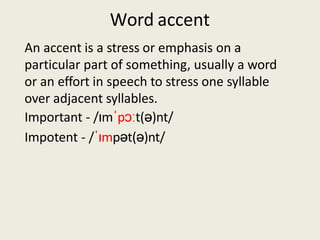
Word accent
An accent is a stress or emphasis on a
particular part of something, usually a word
or an effort in speech to stress one syllable
over adjacent syllables.
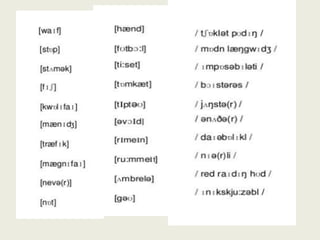
Important - /ɪmˈpɔːt(ə)nt/
Impotent - /ˈɪmpət(ə)nt/
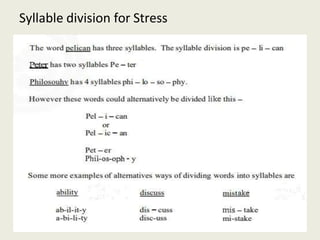
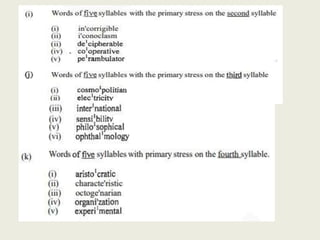
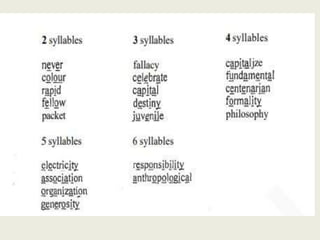
Syllable division for Stress
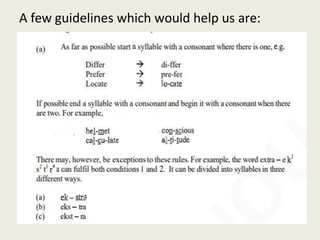
A few guidelines which would help us are:
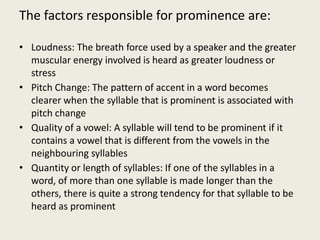
The factors responsible for prominence are:
• Loudness: The breath force used by a speaker and the greater
muscular energy involved is heard as greater loudness or
stress
• Pitch Change: The pattern of accent in a word becomes
clearer when the syllable that is prominent is associated with
pitch change
• Quality of a vowel: A syllable will tend to be prominent if it
contains a vowel that is different from the vowels in the
neighbouring syllables
• Quantity or length of syllables: If one of the syllables in a
word, of more than one syllable is made longer than the
others, there is quite a strong tendency for that syllable to be
heard as prominent
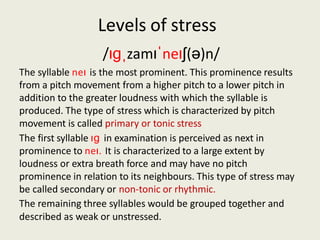
Levels of stress
/ɪɡˌzamɪˈneɪʃ(ə)n/
The syllable neɪ is the most prominent. This prominence results
from a pitch movement from a higher pitch to a lower pitch in
addition to the greater loudness with which the syllable is
produced. The type of stress which is characterized by pitch
movement is called primary or tonic stress
The first syllable ɪɡ in examination is perceived as next in
prominence to neɪ. It is characterized to a large extent by
loudness or extra breath force and may have no pitch
prominence in relation to its neighbours. This type of stress may
be called secondary or non-tonic or rhythmic.
The remaining three syllables would be grouped together and
described as weak or unstressed.
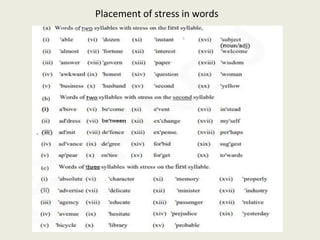
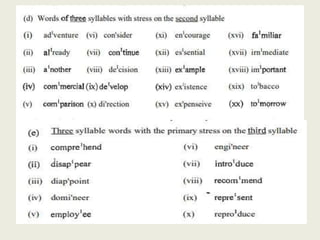
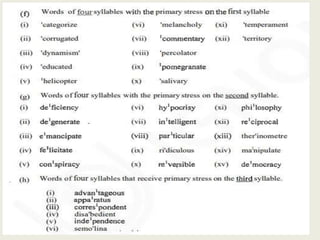
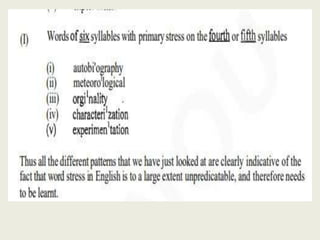
Placement of stress in words
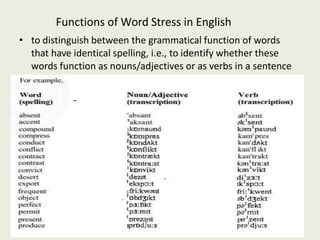
Functions of Word Stress in English
• to distinguish between the grammatical function of words
that have identical spelling, i.e., to identify whether these
words function as nouns/adjectives or as verbs in a sentence
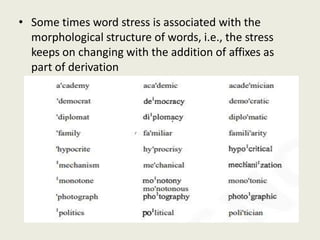
• Some times word stress is associated with the
morphological structure of words, i.e., the stress
keeps on changing with the addition of affixes as
part of derivation
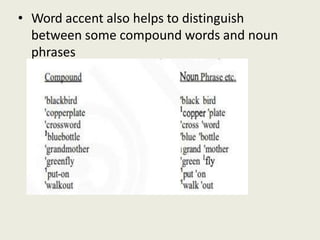
• Word accent also helps to distinguish
between some compound words and noun
phrases
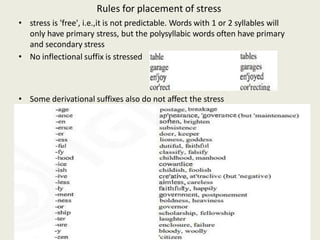
Rules for placement of stress
• stress is 'free', i.e.,it is not predictable. Words with 1 or 2 syllables will
only have primary stress, but the polysyllabic words often have primary
and secondary stress
• No inflectional suffix is stressed
• Some derivational suffixes also do not affect the stress
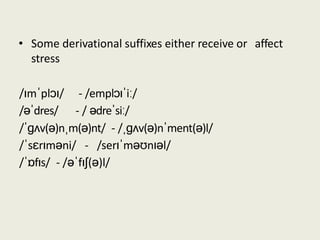
• Some derivational suffixes either receive or affect
stress
/ɪmˈplɔɪ/
/əˈdres/
- /emplɔɪˈiː/
- / ədreˈsiː/
/ˈɡʌv(ə)nˌm(ə)nt/ - /ˌɡʌv(ə)nˈment(ə)l/
/ˈsɛrɪməni/ - /serɪˈməʊnɪəl/
/ˈɒfɪs/ - /əˈfɪʃ(ə)l/
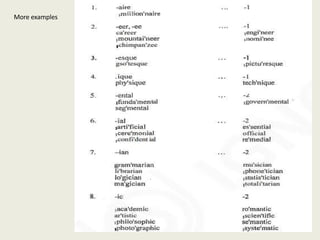
More examples
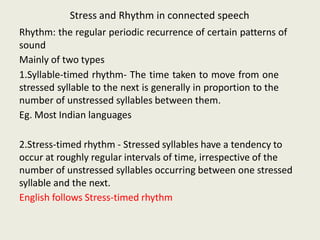
Stress and Rhythm in connected speech
Rhythm: the regular periodic recurrence of certain patterns of
sound
Mainly of two types
1.Syllable-timed rhythm- The time taken to move from one
stressed syllable to the next is generally in proportion to the
number of unstressed syllables between them.
Eg. Most Indian languages
2.Stress-timed rhythm - Stressed syllables have a tendency to
occur at roughly regular intervals of time, irrespective of the
number of unstressed syllables occurring between one stressed
syllable and the next.
English follows Stress-timed rhythm
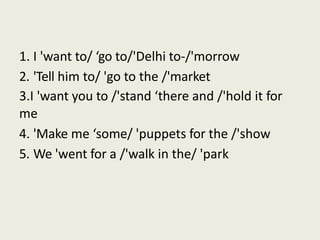
1. I 'want to/ ‘go to/'Delhi to-/'morrow
2. 'Tell him to/ 'go to the /'market
3.I 'want you to /'stand ‘there and /'hold it for
me
4. 'Make me ‘some/ 'puppets for the /'show
5. We 'went for a /'walk in the/ 'park
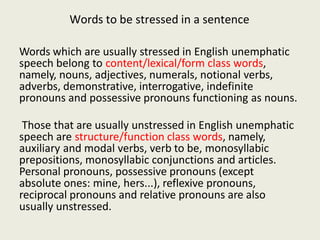
Words to be stressed in a sentence
Words which are usually stressed in English unemphatic
speech belong to content/lexical/form class words,
namely, nouns, adjectives, numerals, notional verbs,
adverbs, demonstrative, interrogative, indefinite
pronouns and possessive pronouns functioning as nouns.
Those that are usually unstressed in English unemphatic
speech are structure/function class words, namely,
auxiliary and modal verbs, verb to be, monosyllabic
prepositions, monosyllabic conjunctions and articles.
Personal pronouns, possessive pronouns (except
absolute ones: mine, hers...), reflexive pronouns,
reciprocal pronouns and relative pronouns are also
usually unstressed.
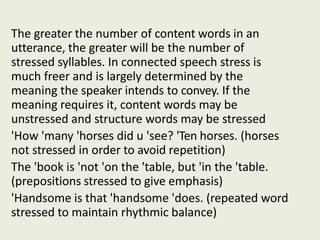
The greater the number of content words in an
utterance, the greater will be the number of
stressed syllables. In connected speech stress is
much freer and is largely determined by the
meaning the speaker intends to convey. If the
meaning requires it, content words may be
unstressed and structure words may be stressed
'How 'many 'horses did u 'see? 'Ten horses. (horses
not stressed in order to avoid repetition)
The 'book is 'not 'on the 'table, but 'in the 'table.
(prepositions stressed to give emphasis)
'Handsome is that 'handsome 'does. (repeated word
stressed to maintain rhythmic balance)
Weak forms
Structure words are not usually stressed. There are
roughly 45 function class words which have two or more
pronunciations - one strong pronunciation and one or
more than one weak pronunciation or weak form.
Articles
a - /eɪ/- SF
/ə/ - WF
an - /æ/ -SF
/ən/ or /n/ - WF
the - /ðiː/ - SF
/ ðə/ (before consonants) or /ðɪ/ (before vowels) -
WF
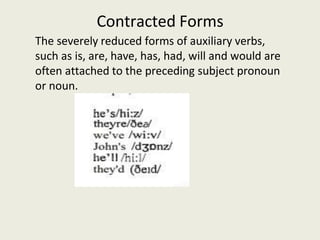
Contracted Forms
The severely reduced forms of auxiliary verbs,
such as is, are, have, has, had, will and would are
often attached to the preceding subject pronoun
or noun.
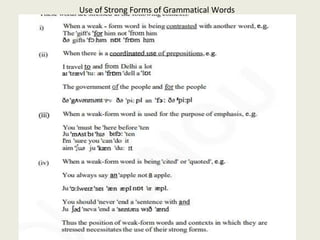
Use of Strong Forms of Grammatical Words
Intonation
Intonation is the rise and fall of the pitch of voice.
Languages in which tones bring about a change
in the meaning of an utterance are known as
intonation languages. There can be two basic
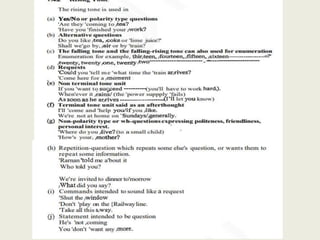
tones, rising and falling and then a number of
tones which are combinations of these two
tones, for example falling-rising or rising-falling.
The Tone Unit
It is a stretch of speech over which one pattern
of pitch variations extends.
The factors that help us in determining tone groups:
• Grammatical considerations with punctuation as guide
If you are leaving,/ please close the door
• On the basis of grammatical considerations
Without Stopping to think/he rushed forward with his arms out/
to try and help her
• For bringing an effect
I cannot imagine/what induced him/ to speak in that manner
• Non deliberate reasons or for the ease of taking breath
All of those little fellows/in standard one/ kept their heads/ and
behaved spendidly when the fire alarm went of.
Tonic syllable
It is the syllable which initiates a change in pitch direction. In a
tone unit that has more than one syllable, one of the stressed
syllables is more prominent than the others.
Neutral - Well I 'think I'll 'go back a'gain to'morrow (normal
case- the last content word is the tonic syllable)
Marked –
Case 1. He's 'taken the 'train to 'Delhi. (not the plane) (the word
which implies contrast is the tonic syllable)
Case 2. 'His 'wife is 'pretty?’ Yes, she is 'very 'pretty ( the word
which introduces additional or new information is the tonic
syllable)
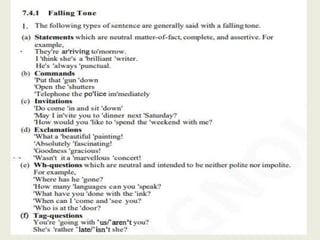
Falling tone
The pitch of the voice falls from high to low, the
change starting from the tonic syllable. This tone
could be said to give an impression of finality.
/ai ‘wͻznt ↘redi/
/ai ‘dəunt ‘θiŋk ∫i: ↘nəuz/
/mai ‘frend ‘nəuz ‘lͻts əv ‘intristiŋ ↘men/
/ ‘ri: d ðə ‘f3: st ↘pærəgrɑ: f/
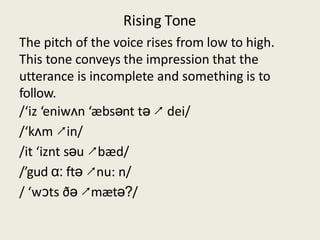
Rising Tone
The pitch of the voice rises from low to high.
This tone conveys the impression that the
utterance is incomplete and something is to
follow.
/‘iz ‘eniwʌn ‘æbsənt tə ↗ dei/
/‘kʌm ↗in/
/it ‘iznt səu ↗bæd/
/’gud ɑ: ftə ↗nu: n/
/ ‘wͻts ðə ↗mætə?/
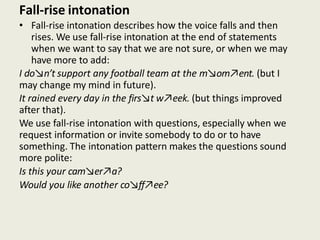
Fall-rise intonation
• Fall-rise intonation describes how the voice falls and then
rises. We use fall-rise intonation at the end of statements
when we want to say that we are not sure, or when we may
have more to add:
I do↘n’t support any football team at the m↘om↗ent. (but I
may change my mind in future).
It rained every day in the firs↘t w↗eek. (but things improved
after that).
We use fall-rise intonation with questions, especially when we
request information or invite somebody to do or to have
something. The intonation pattern makes the questions sound
more polite:
Is this your cam↘er↗a?
Would you like another co↘ff↗ee?
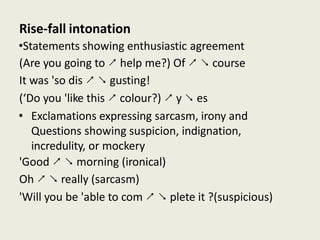
Rise-fall intonation
•Statements showing enthusiastic agreement
(Are you going to ↗ help me?) Of ↗ ↘ course
It was 'so dis ↗ ↘ gusting!
(‘Do you 'like this ↗ colour?) ↗ y ↘ es
• Exclamations expressing sarcasm, irony and
Questions showing suspicion, indignation,
incredulity, or mockery
'Good ↗ ↘ morning (ironical)
Oh ↗ ↘ really (sarcasm)
'Will you be 'able to com ↗ ↘ plete it ?(suspicious)
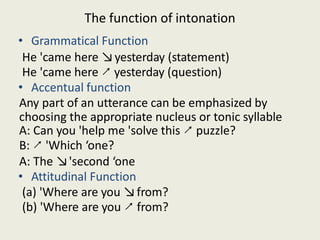
The function of intonation
• Grammatical Function
He 'came here ↘yesterday (statement)
He 'came here ↗ yesterday (question)
• Accentual function
Any part of an utterance can be emphasized by
choosing the appropriate nucleus or tonic syllable
A: Can you 'help me 'solve this ↗ puzzle?
B: ↗ 'Which ‘one?
A: The ↘'second ‘one
• Attitudinal Function
(a) 'Where are you ↘from?
(b) 'Where are you ↗ from?
Phonetics and phonology, Tones, Dipthongs

Phonetics and phonology, Tones, Dipthongs

  • 1.
  • 2.
    Received Pronunciation (RP) ReceivedPronunciation, or the Queen's/King's English, is the accent traditionally regarded as the standard for British English. Popular terms for this accent, such ‘Oxford English’ or ‘BBC English’ are all a little misleading. The Queen, for instance, speaks an almost unique form of English, while the English we hear at Oxford University or on the BBC is no longer restricted to one type of accent. RP is an accent, not a dialect, since all RP speakers speak Standard English
  • 3.
    Vowels of RP Vowelsare sounds produced without any obstruction in the oral passage of air. There are 20 vowels in English which can be divided as monophthongs and diphthongs. There are 12 monophthongs and 8 diphthongs.
  • 4.
    Cardinal Vowels Cardinal vowelsare a set of reference vowels used by phoneticians in describing the sounds of languages. They are classified depending on the position of the tongue relative to the roof of the mouth, how far forward or back is the highest point of the tongue and the position of the lips, either rounded or unrounded.
  • 6.
  • 7.
  • 11.
    Write down thewords • /huːt/ • /hʊd/ • /hʌt/ • /hɒt/ • /hæt/ • /hɑːt/ • /h3ː(r)/ • /hɪə (r)/ • /heə (r)/ • /ʃʊd/ • /ʃɔːt/ • /ʃɒt/
  • 15.
    Classification of vowels Allvowels are voiced and oral 3 term label based on •the part of the tongue that is raised Front, back, central •height to which tongue is raised in the mouth Open, half-open, half-close, close •the position of the lips Rounded and unrounded
  • 17.
    Front Vowels (4) /i:,I, e, æ / /i:/ - front, close unrounded vowel /I/ - centralised front half-close unrounded vowel /e/- front unrounded vowel between half-close and half-open / æ/- front unrounded vowel between the half- open and open
  • 20.
    Back Vowels (5)/u: ʊ,ɔː, ɒ, ɑː/ / /u:/- back close rounded vowel /ʊ/ - centralised back rounded vowel just above half-close /ɔː/- back rounded vowel between half-open and half-close /ɒ/ - back rounded vowel just above the open position /ɑː/ - open unrounded vowel
  • 22.
    Central Vowels (3)/ʌ,3:, ə/ /ʌ/ - central unrounded vowel between open and half-open /3:/ - central unrounded vowel between half-close and half-open /ə/ - central unrounded short vowel just below half open
  • 24.
    Diphthongs A diphthong isa vowel glide in the production of which the tongue moves from one position in the mouth towards another position. The phonetic symbols for each diphthong is a combination of the two vowels - one in which the tongue is in position initially and the other towards which the tongue moves. There are 8 diphthongs in RP
  • 25.
    Of the eightdiphthongs, (a) in three, the tongue glides towards /ɪ/, that is, / eɪ, aɪ, ɔɪ / (b) in two, the tongue glides towards /u/, that is, / əu, au / (c) in three, the tongue glides towards /ə/, that is, /ɪə, eə, uə/ Closing diphthongs Centering diphthongs
  • 27.
  • 29.
    /əu/ as inboat /bəʊt/
  • 31.
  • 33.
    Suprasegmental features Specific featuresthat are superimposed on the utterance of the speech are known as supra- segmental features. Common supra-segmental features are the stress, tone, and duration in the syllable or word for a continuous speech sequence. Sometimes even harmony and nasalization are also included under this category. Supra-segmental or prosodic features are often used in the context of speech to make it more meaningful and effective.
  • 34.
    Word accent An accentis a stress or emphasis on a particular part of something, usually a word or an effort in speech to stress one syllable over adjacent syllables. Important - /ɪmˈpɔːt(ə)nt/ Impotent - /ˈɪmpət(ə)nt/
  • 35.
  • 36.
    A few guidelineswhich would help us are:
  • 38.
    The factors responsiblefor prominence are: • Loudness: The breath force used by a speaker and the greater muscular energy involved is heard as greater loudness or stress • Pitch Change: The pattern of accent in a word becomes clearer when the syllable that is prominent is associated with pitch change • Quality of a vowel: A syllable will tend to be prominent if it contains a vowel that is different from the vowels in the neighbouring syllables • Quantity or length of syllables: If one of the syllables in a word, of more than one syllable is made longer than the others, there is quite a strong tendency for that syllable to be heard as prominent
  • 39.
    Levels of stress /ɪɡˌzamɪˈneɪʃ(ə)n/ Thesyllable neɪ is the most prominent. This prominence results from a pitch movement from a higher pitch to a lower pitch in addition to the greater loudness with which the syllable is produced. The type of stress which is characterized by pitch movement is called primary or tonic stress The first syllable ɪɡ in examination is perceived as next in prominence to neɪ. It is characterized to a large extent by loudness or extra breath force and may have no pitch prominence in relation to its neighbours. This type of stress may be called secondary or non-tonic or rhythmic. The remaining three syllables would be grouped together and described as weak or unstressed.
  • 40.
  • 45.
    Functions of WordStress in English • to distinguish between the grammatical function of words that have identical spelling, i.e., to identify whether these words function as nouns/adjectives or as verbs in a sentence
  • 46.
    • Some timesword stress is associated with the morphological structure of words, i.e., the stress keeps on changing with the addition of affixes as part of derivation
  • 47.
    • Word accentalso helps to distinguish between some compound words and noun phrases
  • 48.
    Rules for placementof stress • stress is 'free', i.e.,it is not predictable. Words with 1 or 2 syllables will only have primary stress, but the polysyllabic words often have primary and secondary stress • No inflectional suffix is stressed • Some derivational suffixes also do not affect the stress
  • 49.
    • Some derivationalsuffixes either receive or affect stress /ɪmˈplɔɪ/ /əˈdres/ - /emplɔɪˈiː/ - / ədreˈsiː/ /ˈɡʌv(ə)nˌm(ə)nt/ - /ˌɡʌv(ə)nˈment(ə)l/ /ˈsɛrɪməni/ - /serɪˈməʊnɪəl/ /ˈɒfɪs/ - /əˈfɪʃ(ə)l/
  • 50.
  • 51.
    Stress and Rhythmin connected speech Rhythm: the regular periodic recurrence of certain patterns of sound Mainly of two types 1.Syllable-timed rhythm- The time taken to move from one stressed syllable to the next is generally in proportion to the number of unstressed syllables between them. Eg. Most Indian languages 2.Stress-timed rhythm - Stressed syllables have a tendency to occur at roughly regular intervals of time, irrespective of the number of unstressed syllables occurring between one stressed syllable and the next. English follows Stress-timed rhythm
  • 52.
    1. I 'wantto/ ‘go to/'Delhi to-/'morrow 2. 'Tell him to/ 'go to the /'market 3.I 'want you to /'stand ‘there and /'hold it for me 4. 'Make me ‘some/ 'puppets for the /'show 5. We 'went for a /'walk in the/ 'park
  • 53.
    Words to bestressed in a sentence Words which are usually stressed in English unemphatic speech belong to content/lexical/form class words, namely, nouns, adjectives, numerals, notional verbs, adverbs, demonstrative, interrogative, indefinite pronouns and possessive pronouns functioning as nouns. Those that are usually unstressed in English unemphatic speech are structure/function class words, namely, auxiliary and modal verbs, verb to be, monosyllabic prepositions, monosyllabic conjunctions and articles. Personal pronouns, possessive pronouns (except absolute ones: mine, hers...), reflexive pronouns, reciprocal pronouns and relative pronouns are also usually unstressed.
  • 54.
    The greater thenumber of content words in an utterance, the greater will be the number of stressed syllables. In connected speech stress is much freer and is largely determined by the meaning the speaker intends to convey. If the meaning requires it, content words may be unstressed and structure words may be stressed 'How 'many 'horses did u 'see? 'Ten horses. (horses not stressed in order to avoid repetition) The 'book is 'not 'on the 'table, but 'in the 'table. (prepositions stressed to give emphasis) 'Handsome is that 'handsome 'does. (repeated word stressed to maintain rhythmic balance)
  • 55.
    Weak forms Structure wordsare not usually stressed. There are roughly 45 function class words which have two or more pronunciations - one strong pronunciation and one or more than one weak pronunciation or weak form. Articles a - /eɪ/- SF /ə/ - WF an - /æ/ -SF /ən/ or /n/ - WF the - /ðiː/ - SF / ðə/ (before consonants) or /ðɪ/ (before vowels) - WF
  • 56.
    Contracted Forms The severelyreduced forms of auxiliary verbs, such as is, are, have, has, had, will and would are often attached to the preceding subject pronoun or noun.
  • 57.
    Use of StrongForms of Grammatical Words
  • 58.
    Intonation Intonation is therise and fall of the pitch of voice. Languages in which tones bring about a change in the meaning of an utterance are known as intonation languages. There can be two basic tones, rising and falling and then a number of tones which are combinations of these two tones, for example falling-rising or rising-falling.
  • 59.
    The Tone Unit Itis a stretch of speech over which one pattern of pitch variations extends. The factors that help us in determining tone groups: • Grammatical considerations with punctuation as guide If you are leaving,/ please close the door • On the basis of grammatical considerations Without Stopping to think/he rushed forward with his arms out/ to try and help her • For bringing an effect I cannot imagine/what induced him/ to speak in that manner • Non deliberate reasons or for the ease of taking breath All of those little fellows/in standard one/ kept their heads/ and behaved spendidly when the fire alarm went of.
  • 60.
    Tonic syllable It isthe syllable which initiates a change in pitch direction. In a tone unit that has more than one syllable, one of the stressed syllables is more prominent than the others. Neutral - Well I 'think I'll 'go back a'gain to'morrow (normal case- the last content word is the tonic syllable) Marked – Case 1. He's 'taken the 'train to 'Delhi. (not the plane) (the word which implies contrast is the tonic syllable) Case 2. 'His 'wife is 'pretty?’ Yes, she is 'very 'pretty ( the word which introduces additional or new information is the tonic syllable)
  • 61.
    Falling tone The pitchof the voice falls from high to low, the change starting from the tonic syllable. This tone could be said to give an impression of finality. /ai ‘wͻznt ↘redi/ /ai ‘dəunt ‘θiŋk ∫i: ↘nəuz/ /mai ‘frend ‘nəuz ‘lͻts əv ‘intristiŋ ↘men/ / ‘ri: d ðə ‘f3: st ↘pærəgrɑ: f/
  • 63.
    Rising Tone The pitchof the voice rises from low to high. This tone conveys the impression that the utterance is incomplete and something is to follow. /‘iz ‘eniwʌn ‘æbsənt tə ↗ dei/ /‘kʌm ↗in/ /it ‘iznt səu ↗bæd/ /’gud ɑ: ftə ↗nu: n/ / ‘wͻts ðə ↗mætə?/
  • 65.
    Fall-rise intonation • Fall-riseintonation describes how the voice falls and then rises. We use fall-rise intonation at the end of statements when we want to say that we are not sure, or when we may have more to add: I do↘n’t support any football team at the m↘om↗ent. (but I may change my mind in future). It rained every day in the firs↘t w↗eek. (but things improved after that). We use fall-rise intonation with questions, especially when we request information or invite somebody to do or to have something. The intonation pattern makes the questions sound more polite: Is this your cam↘er↗a? Would you like another co↘ff↗ee?
  • 66.
    Rise-fall intonation •Statements showingenthusiastic agreement (Are you going to ↗ help me?) Of ↗ ↘ course It was 'so dis ↗ ↘ gusting! (‘Do you 'like this ↗ colour?) ↗ y ↘ es • Exclamations expressing sarcasm, irony and Questions showing suspicion, indignation, incredulity, or mockery 'Good ↗ ↘ morning (ironical) Oh ↗ ↘ really (sarcasm) 'Will you be 'able to com ↗ ↘ plete it ?(suspicious)
  • 67.
    The function ofintonation • Grammatical Function He 'came here ↘yesterday (statement) He 'came here ↗ yesterday (question) • Accentual function Any part of an utterance can be emphasized by choosing the appropriate nucleus or tonic syllable A: Can you 'help me 'solve this ↗ puzzle? B: ↗ 'Which ‘one? A: The ↘'second ‘one • Attitudinal Function (a) 'Where are you ↘from? (b) 'Where are you ↗ from?