Introduction to Linguistics
Session 8: Phonology
Edi Brata
http://edibrata.com

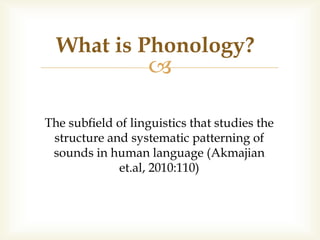
The subfield of linguistics that studies the
structure and systematic patterning of
sounds in human language (Akmajian
et.al, 2010:110)
What is Phonology?

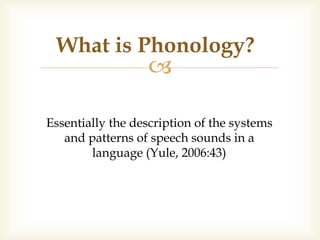
Essentially the description of the systems
and patterns of speech sounds in a
language (Yule, 2006:43)
What is Phonology?

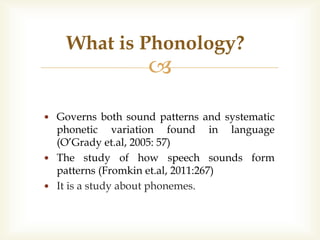
 Governs both sound patterns and systematic
phonetic variation found in language
(O’Grady et.al, 2005: 57)
 The study of how speech sounds form
patterns (Fromkin et.al, 2011:267)
 It is a study about phonemes.
What is Phonology?

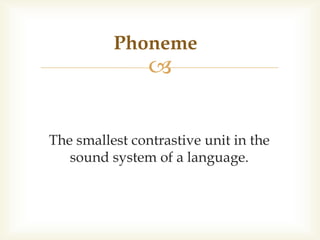
The smallest contrastive unit in the
sound system of a language.
Phoneme

Phone Vs. Phoneme
Phone Phoneme
One of many possible sounds in the
languages of the world.
A contrastive unit in the sound
system of a particular language.
The smallest identifiable unit found
in a stream of speech.
A minimal unit that serves to
distinguish between meanings of
words.
Pronounced in a defined way.
Pronounced in one or more ways,
depending on the number of
allophones.
Represented between brackets by
convention.
Represented between slashes by
convention
[b], [j], [o] /b/, /j/, /o/

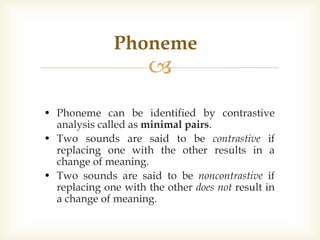
• Phoneme can be identified by contrastive
analysis called as minimal pairs.
• Two sounds are said to be contrastive if
replacing one with the other results in a
change of meaning.
• Two sounds are said to be noncontrastive if
replacing one with the other does not result in
a change of meaning.
Phoneme

• A minimal pair consists of two forms with
distinct meanings that differ by only one
segment found in the same position in each
form.
• Which one(s) of these pairs are minimal
pairs?
a. [ ] and [ ]
b. [ ] and [ ]
c. [ ] and [ ]
Minimal Pairs
/ / and / / are phonemes

• Within a given language, some sounds are
considered to be the same sound, even though
they are phonetically distinct.
• Same or different?
pool [phul] spool [spul]
• phonetically different (aspirated vs. unaspirated)
• native speakers perceive the same sound
• It is called as allophones.
Same Sound or Different Sound?

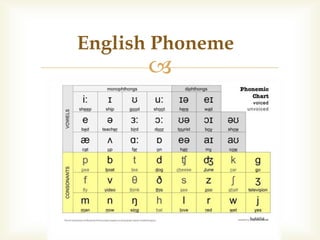
English Phoneme

• One of a set of non-distinctive
realizations of the same phoneme.
• Corresponds to something physical
produced by a speaker.
• It is variants of a phoneme.
Allophone
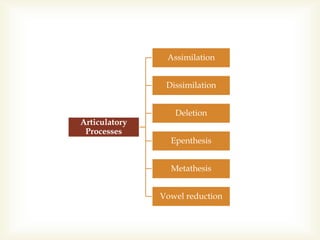
Articulatory Processes
Articulatory
Processes
Assimilation
Dissimilation
Deletion
Epenthesis
Metathesis
Vowel reduction
Assimilation:
Two sounds becoming more alike
o Regressive Assimilation
• Assimilation in which a sound influences the
preceding segment.
• E.g. indefinite, impossible, incomplete
o Progressive Assimilation
• Assimilation in which a sound influences the
following segment.
• E.g. books, bags
[-z] or [-s]
1. Bananas
2. Grapes
3. Lemons
4. Cookies
5. Cakes
6. Tarts
7. Potatoes
8. Carrots
1. [-z]
2. [-s]
3. [-z]
4. [-z]
5. [-s]
6. [-s]
7. [-z]
8. [-s]
[-d], [-t], or [-id]
1. Studied
2. Kicked
3. Eliminated
4. Erased
5. Looked
6. Typed
7. Measured
8. Surrounded
1. [-d]
2. [-t]
3. [-id]
4. [-d]
5. [-t]
6. [-t]
7. [-d]
8. [-id]
Dissimilation:
Two Sounds Becoming Less Alike
o Fifths: [f f s]  [f f t s]
o Three fricatives  fricative+stop+fricative
Deletion
o A process that removes a segment from
certain phonetic context.
o In English, a schwa [ ] is often deleted
when the next vowel in the word is
stressed.
suppose: [s p z]  [sp z]
Epenthesis
o A process that inserts a segment into a
particular environment.
o For example:
(in careful speech) something is
pronounced
[s mp ] instead of [s m ]
Metathesis
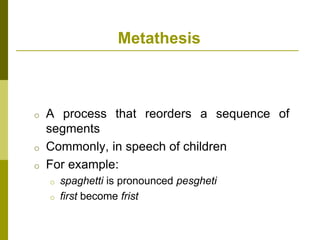
o A process that reorders a sequence of
segments
o Commonly, in speech of children
o For example:
o spaghetti is pronounced pesgheti
o first become frist
Vowel Reduction
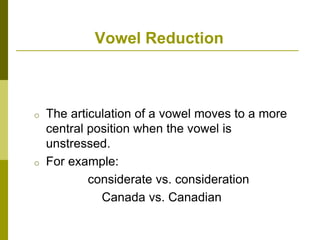
o The articulation of a vowel moves to a more
central position when the vowel is
unstressed.
o For example:
considerate vs. consideration
Canada vs. Canadian


Intro. to Linguistics_8 Phonology

  • 1.
    Introduction to Linguistics Session8: Phonology Edi Brata http://edibrata.com
  • 2.
     The subfield oflinguistics that studies the structure and systematic patterning of sounds in human language (Akmajian et.al, 2010:110) What is Phonology?
  • 3.
     Essentially the descriptionof the systems and patterns of speech sounds in a language (Yule, 2006:43) What is Phonology?
  • 4.
      Governs bothsound patterns and systematic phonetic variation found in language (O’Grady et.al, 2005: 57)  The study of how speech sounds form patterns (Fromkin et.al, 2011:267)  It is a study about phonemes. What is Phonology?
  • 5.
     The smallest contrastiveunit in the sound system of a language. Phoneme
  • 6.
     Phone Vs. Phoneme PhonePhoneme One of many possible sounds in the languages of the world. A contrastive unit in the sound system of a particular language. The smallest identifiable unit found in a stream of speech. A minimal unit that serves to distinguish between meanings of words. Pronounced in a defined way. Pronounced in one or more ways, depending on the number of allophones. Represented between brackets by convention. Represented between slashes by convention [b], [j], [o] /b/, /j/, /o/
  • 7.
     • Phoneme canbe identified by contrastive analysis called as minimal pairs. • Two sounds are said to be contrastive if replacing one with the other results in a change of meaning. • Two sounds are said to be noncontrastive if replacing one with the other does not result in a change of meaning. Phoneme
  • 8.
     • A minimalpair consists of two forms with distinct meanings that differ by only one segment found in the same position in each form. • Which one(s) of these pairs are minimal pairs? a. [ ] and [ ] b. [ ] and [ ] c. [ ] and [ ] Minimal Pairs / / and / / are phonemes
  • 9.
     • Within agiven language, some sounds are considered to be the same sound, even though they are phonetically distinct. • Same or different? pool [phul] spool [spul] • phonetically different (aspirated vs. unaspirated) • native speakers perceive the same sound • It is called as allophones. Same Sound or Different Sound?
  • 10.
  • 11.
     • One ofa set of non-distinctive realizations of the same phoneme. • Corresponds to something physical produced by a speaker. • It is variants of a phoneme. Allophone
  • 12.
  • 13.
  • 14.
    Assimilation: Two sounds becomingmore alike o Regressive Assimilation • Assimilation in which a sound influences the preceding segment. • E.g. indefinite, impossible, incomplete o Progressive Assimilation • Assimilation in which a sound influences the following segment. • E.g. books, bags
  • 15.
    [-z] or [-s] 1.Bananas 2. Grapes 3. Lemons 4. Cookies 5. Cakes 6. Tarts 7. Potatoes 8. Carrots 1. [-z] 2. [-s] 3. [-z] 4. [-z] 5. [-s] 6. [-s] 7. [-z] 8. [-s]
  • 16.
    [-d], [-t], or[-id] 1. Studied 2. Kicked 3. Eliminated 4. Erased 5. Looked 6. Typed 7. Measured 8. Surrounded 1. [-d] 2. [-t] 3. [-id] 4. [-d] 5. [-t] 6. [-t] 7. [-d] 8. [-id]
  • 17.
    Dissimilation: Two Sounds BecomingLess Alike o Fifths: [f f s]  [f f t s] o Three fricatives  fricative+stop+fricative
  • 18.
    Deletion o A processthat removes a segment from certain phonetic context. o In English, a schwa [ ] is often deleted when the next vowel in the word is stressed. suppose: [s p z]  [sp z]
  • 19.
    Epenthesis o A processthat inserts a segment into a particular environment. o For example: (in careful speech) something is pronounced [s mp ] instead of [s m ]
  • 20.
    Metathesis o A processthat reorders a sequence of segments o Commonly, in speech of children o For example: o spaghetti is pronounced pesgheti o first become frist
  • 21.
    Vowel Reduction o Thearticulation of a vowel moves to a more central position when the vowel is unstressed. o For example: considerate vs. consideration Canada vs. Canadian
  • 22.