E n t i t y – R e l a t i o n s h i p M o d e l
 Entity Sets
 Relationship Sets
 Design Issues
 Mapping Constraints
 Keys
 E-R Diagram
 Extended E-R Features
 Design of an E-R Database Schema
 Reduction of an E-R Schema to
Tables
Copyright @ www.bcanotes.com
E n t i t y S e t s
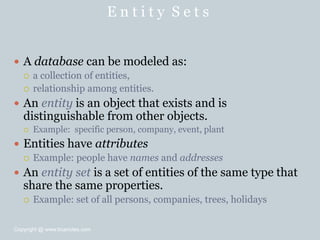
 A database can be modeled as:
 a collection of entities,
 relationship among entities.
 An entity is an object that exists and is
distinguishable from other objects.
 Example: specific person, company, event, plant
 Entities have attributes
 Example: people have names and addresses
 An entity set is a set of entities of the same type that
share the same properties.
 Example: set of all persons, companies, trees, holidays
Copyright @ www.bcanotes.com
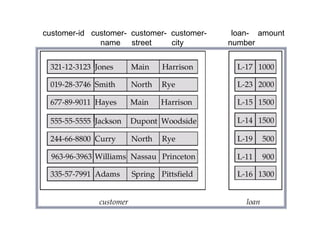
E n t i t y S e t s c u s t o m e r a n d l o a n
customer-id customer- customer- customer- loan- amount
name street city number
Copyright @ www.bcanotes.com
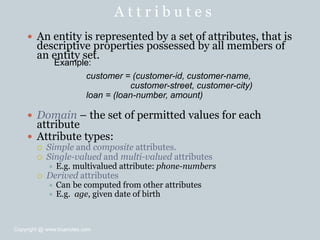
A t t r i b u t e s
 An entity is represented by a set of attributes, that is
descriptive properties possessed by all members of
an entity set.
 Domain – the set of permitted values for each
attribute
 Attribute types:
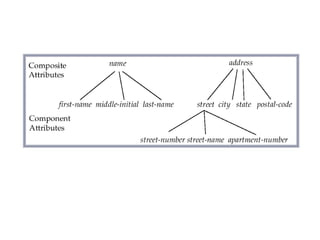
 Simple and composite attributes.
 Single-valued and multi-valued attributes
 E.g. multivalued attribute: phone-numbers
 Derived attributes
 Can be computed from other attributes
 E.g. age, given date of birth
Example:
customer = (customer-id, customer-name,
customer-street, customer-city)
loan = (loan-number, amount)
Copyright @ www.bcanotes.com
C o m p o s i t e A t t r i b u t e s
Copyright @ www.bcanotes.com
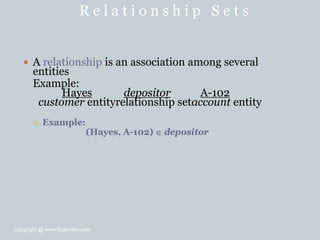
R e l a t i o n s h i p S e t s
 A relationship is an association among several
entities
Example:
Hayes depositor A-102
customer entityrelationship setaccount entity
 Example:
(Hayes, A-102)  depositor
Copyright @ www.bcanotes.com
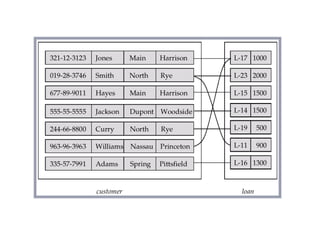
Relationship Set borrower
Copyright @ www.bcanotes.com
Relationship Sets (Cont.)
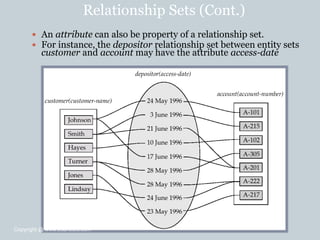
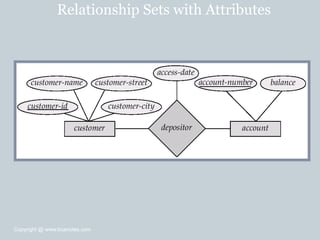
 An attribute can also be property of a relationship set.
 For instance, the depositor relationship set between entity sets
customer and account may have the attribute access-date
Copyright @ www.bcanotes.com
Degree of a Relationship Set
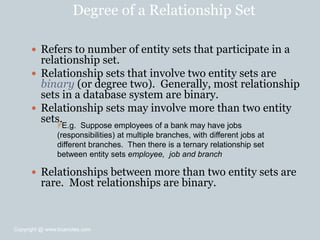
 Refers to number of entity sets that participate in a
relationship set.
 Relationship sets that involve two entity sets are
binary (or degree two). Generally, most relationship
sets in a database system are binary.
 Relationship sets may involve more than two entity
sets.
 Relationships between more than two entity sets are
rare. Most relationships are binary.
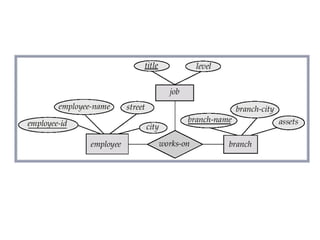
E.g. Suppose employees of a bank may have jobs
(responsibilities) at multiple branches, with different jobs at
different branches. Then there is a ternary relationship set
between entity sets employee, job and branch
Copyright @ www.bcanotes.com
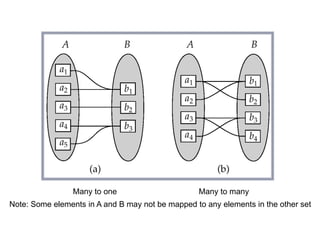
Mapping Cardinalities …
 Express the number of entities to which another
entity can be associated via a relationship set.
 Most useful in describing binary relationship sets.
 For a binary relationship set the mapping
cardinality must be one of the following types:
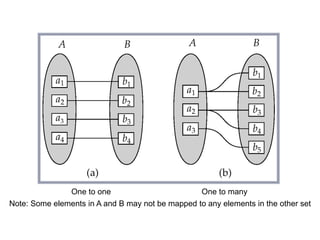
 One to one
 One to many
 Many to one
 Many to many
Copyright @ www.bcanotes.com
Mapping Cardinalities …
One to one One to many
Note: Some elements in A and B may not be mapped to any elements in the other set
Copyright @ www.bcanotes.com
Mapping Cardinalities ...
Many to one Many to many
Note: Some elements in A and B may not be mapped to any elements in the other set
Copyright @ www.bcanotes.com
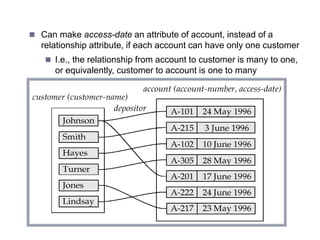
Mapping Cardinalities affect ER Design
 Can make access-date an attribute of account, instead of a
relationship attribute, if each account can have only one customer
 I.e., the relationship from account to customer is many to one,
or equivalently, customer to account is one to many
Copyright @ www.bcanotes.com
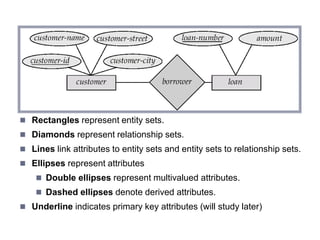
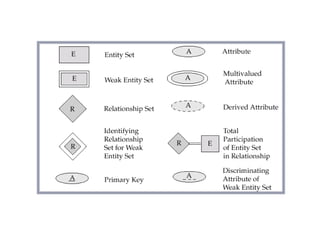
E - R D i a g r a m s
 Rectangles represent entity sets.
 Diamonds represent relationship sets.
 Lines link attributes to entity sets and entity sets to relationship sets.
 Ellipses represent attributes
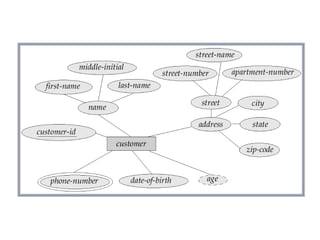
 Double ellipses represent multivalued attributes.
 Dashed ellipses denote derived attributes.
 Underline indicates primary key attributes (will study later)
Copyright @ www.bcanotes.com
E-R Diagram With Composite, Multivalued, and Derived
Attributes
Copyright @ www.bcanotes.com
Relationship Sets with Attributes
Copyright @ www.bcanotes.com
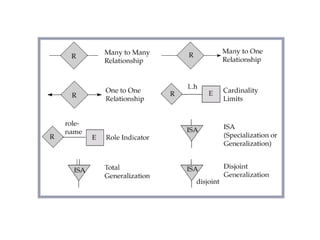
Roles
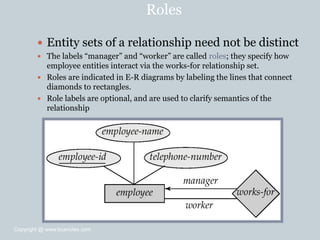
 Entity sets of a relationship need not be distinct
 The labels ―manager‖ and ―worker‖ are called roles; they specify how
employee entities interact via the works-for relationship set.
 Roles are indicated in E-R diagrams by labeling the lines that connect
diamonds to rectangles.
 Role labels are optional, and are used to clarify semantics of the
relationship
Copyright @ www.bcanotes.com
Cardinality Constraints
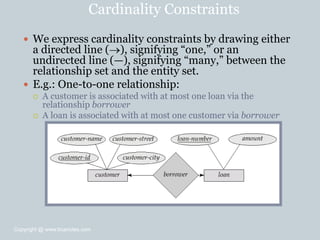
 We express cardinality constraints by drawing either
a directed line (), signifying ―one,‖ or an
undirected line (—), signifying ―many,‖ between the
relationship set and the entity set.
 E.g.: One-to-one relationship:
 A customer is associated with at most one loan via the
relationship borrower
 A loan is associated with at most one customer via borrower
Copyright @ www.bcanotes.com
One-To-Many Relationship
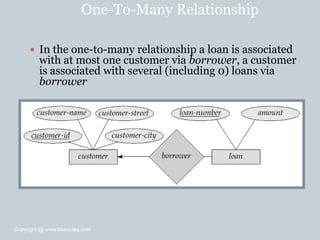
 In the one-to-many relationship a loan is associated
with at most one customer via borrower, a customer
is associated with several (including 0) loans via
borrower
Copyright @ www.bcanotes.com
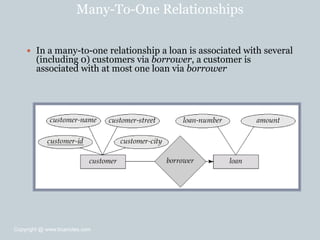
Many-To-One Relationships
 In a many-to-one relationship a loan is associated with several
(including 0) customers via borrower, a customer is
associated with at most one loan via borrower
Copyright @ www.bcanotes.com
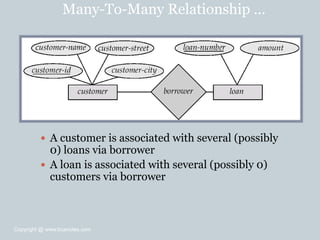
Many-To-Many Relationship …
 A customer is associated with several (possibly
0) loans via borrower
 A loan is associated with several (possibly 0)
customers via borrower
Copyright @ www.bcanotes.com
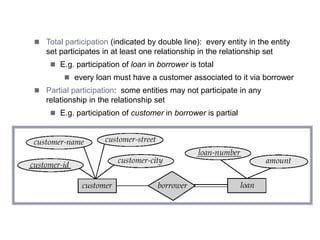
Participation of an Entity Set in a Relationship Set
 Total participation (indicated by double line): every entity in the entity
set participates in at least one relationship in the relationship set
 E.g. participation of loan in borrower is total
 every loan must have a customer associated to it via borrower
 Partial participation: some entities may not participate in any
relationship in the relationship set
 E.g. participation of customer in borrower is partial
Copyright @ www.bcanotes.com
K e y s
 A super key of an entity set is a set of one or more
attributes whose values uniquely determine each entity.
 A candidate key of an entity set is a minimal super key
 Customer-id is candidate key of customer
 account-number is candidate key of account
 Although several candidate keys may exist, one of the
candidate keys is selected to be the primary key.
Copyright @ www.bcanotes.com
Keys for Relationship Sets
 The combination of primary keys of the participating
entity sets forms a super key of a relationship set.
 (customer-id, account-number) is the super key of depositor
 NOTE: this means a pair of entity sets can have at most one
relationship in a particular relationship set.
 E.g. if we wish to track all access-dates to each account by each
customer, we cannot assume a relationship for each access. We can use
a multivalued attribute though
 Must consider the mapping cardinality of the
relationship set when deciding the what are the
candidate keys
 Need to consider semantics of relationship set in
selecting the primary key in case of more than one
candidate key
Copyright @ www.bcanotes.com
E-R Diagram with a Ternary Relationship
Copyright @ www.bcanotes.com
Cardinality Constraints on Ternary Relationship
 We allow at most one arrow out of a ternary (or greater
degree) relationship to indicate a cardinality constraint
 E.g. an arrow from works-on to job indicates each
employee works on at most one job at any branch.
 If there is more than one arrow, there are two ways of
defining the meaning.
 E.g a ternary relationship R between A, B and C with arrows to B
and C could mean
 1. each A entity is associated with a unique entity from B and C or
 2. each pair of entities from (A, B) is associated with a unique C
entity, and each pair (A, C) is associated with a unique B
 Each alternative has been used in different formalisms
 To avoid confusion we outlaw more than one arrow
Copyright @ www.bcanotes.com
Design Issues
 Use of entity sets vs. attributes
Choice mainly depends on the structure of the enterprise
being modeled, and on the semantics associated with the
attribute in question.
 Use of entity sets vs. relationship sets
Possible guideline is to designate a relationship set to
describe an action that occurs between entities
 Binary versus n-ary relationship sets
Although it is possible to replace any nonbinary (n-ary, for
n > 2) relationship set by a number of distinct binary
relationship sets, a n-ary relationship set shows more
clearly that several entities participate in a single
relationship.
 Placement of relationship attributes
Copyright @ www.bcanotes.com
Weak Entity Sets
 An entity set that does not have a primary key is referred
to as a weak entity set.
 The existence of a weak entity set depends on the
existence of a identifying entity set
 it must relate to the identifying entity set via a total, one-to-many
relationship set from the identifying to the weak entity set
 Identifying relationship depicted using a double diamond
 The discriminator (or partial key) of a weak entity set is
the set of attributes that distinguishes among all the
entities of a weak entity set.
 The primary key of a weak entity set is formed by the
primary key of the strong entity set on which the weak
entity set is existence dependent, plus the weak entity
set’s discriminator.
Copyright @ www.bcanotes.com
Weak Entity Sets (Cont.)
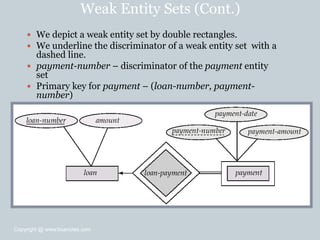
 We depict a weak entity set by double rectangles.
 We underline the discriminator of a weak entity set with a
dashed line.
 payment-number – discriminator of the payment entity
set
 Primary key for payment – (loan-number, payment-
number)
Copyright @ www.bcanotes.com
Weak Entity Sets (Cont.)
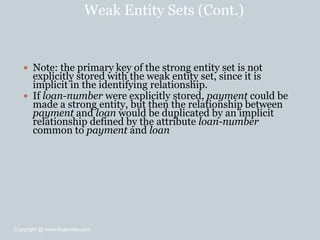
 Note: the primary key of the strong entity set is not
explicitly stored with the weak entity set, since it is
implicit in the identifying relationship.
 If loan-number were explicitly stored, payment could be
made a strong entity, but then the relationship between
payment and loan would be duplicated by an implicit
relationship defined by the attribute loan-number
common to payment and loan
Copyright @ www.bcanotes.com
More Weak Entity Set Examples
 In a university, a course is a strong entity and a
course-offering can be modeled as a weak entity
 The discriminator of course-offering would be
semester (including year) and section-number (if
there is more than one section)
 If we model course-offering as a strong entity we
would model course-number as an attribute.
Then the relationship with course would be implicit
in the course-number attribute
Copyright @ www.bcanotes.com
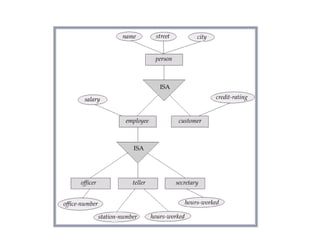
Specialization
 Top-down design process; we designate subgroupings
within an entity set that are distinctive from other entities
in the set.
 These subgroupings become lower-level entity sets that
have attributes or participate in relationships that do not
apply to the higher-level entity set.
 Depicted by a triangle component labeled ISA (E.g.
customer ―is a‖ person).
 Attribute inheritance – a lower-level entity set inherits
all the attributes and relationship participation of the
higher-level entity set to which it is linked.
Copyright @ www.bcanotes.com
Specialization Example
Copyright @ www.bcanotes.com
Generalization
 A bottom-up design process – combine a number of entity sets
that share the same features into a higher-level entity set.
 Specialization and generalization are simple inversions of each
other; they are represented in an E-R diagram in the same
way.
 The terms specialization and generalization are used
interchangeably.
Copyright @ www.bcanotes.com
Specialization and Generalization…
 Can have multiple specializations of an entity set
based on different features.
 E.g. permanent-employee vs. temporary-employee,
in addition to officer vs. secretary vs. teller
 Each particular employee would be
 a member of one of permanent-employee or temporary-
employee,
 and also a member of one of officer, secretary, or teller
 The ISA relationship also referred to as superclass -
subclass relationship
Copyright @ www.bcanotes.com
Design Constraints on a Specialization/ Generalization
 Constraint on which entities can be members of a
given lower-level entity set.
 condition-defined
 E.g. all customers over 65 years are members of senior-
citizen entity set; senior-citizen ISA person.
 user-defined
 Constraint on whether or not entities may belong
to more than one lower-level entity set within a
single generalization.
 Disjoint
 an entity can belong to only one lower-level entity set
 Noted in E-R diagram by writing disjoint next to the ISA
triangle
 Overlapping
 an entity can belong to more than one lower-level entity set
Copyright @ www.bcanotes.com
Design Constraints on a Specialization/ Generalization
…
 Completeness constraint -- specifies whether or not
an entity in the higher-level entity set must belong to
at least one of the lower-level entity sets within a
generalization.
 total : an entity must belong to one of the lower-level entity
sets
 partial: an entity need not belong to one of the lower-level
entity sets
Copyright @ www.bcanotes.com
Aggregation
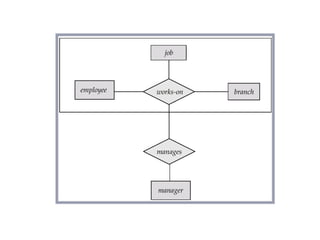
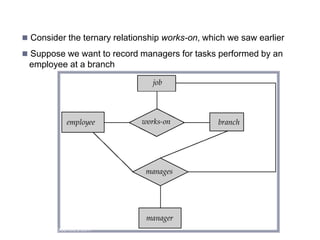
 Consider the ternary relationship works-on, which we saw earlier
 Suppose we want to record managers for tasks performed by an
employee at a branch
Copyright @ www.bcanotes.com
Aggregation (Cont.)
 Relationship sets works-on and manages represent
overlapping information
 Every manages relationship corresponds to a works-on relationship
 However, some works-on relationships may not correspond to any
manages relationships
 So we can’t discard the works-on relationship
 Eliminate this redundancy via aggregation
 Treat relationship as an abstract entity
 Allows relationships between relationships
 Abstraction of relationship into new entity
 Without introducing redundancy, the following diagram
represents:
 An employee works on a particular job at a particular branch
 An employee, branch, job combination may have an associated
manager
Copyright @ www.bcanotes.com
E-R Diagram With Aggregation
Copyright @ www.bcanotes.com
E-R Design Decisions
 The use of an attribute or entity set to represent an
object.
 Whether a real-world concept is best expressed by an
entity set or a relationship set.
 The use of a ternary relationship versus a pair of binary
relationships.
 The use of a strong or weak entity set.
 The use of specialization/generalization – contributes to
modularity in the design.
 The use of aggregation – can treat the aggregate entity
set as a single unit without concern for the details of its
internal structure.
Copyright @ www.bcanotes.com
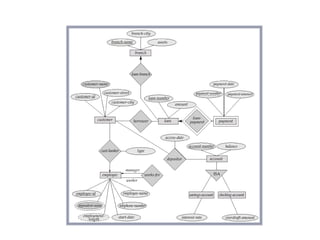
E-R Diagram for a Banking Enterprise
Copyright @ www.bcanotes.com
Summary of Symbols Used in E-R Notation
Copyright @ www.bcanotes.com
Summary of Symbols (Cont.)
Copyright @ www.bcanotes.com
Alternative E-R Notations
Copyright @ www.bcanotes.com
Reduction of an E-R Schema to Tables
 Primary keys allow entity sets and relationship sets to
be expressed uniformly as tables which represent the
contents of the database.
 A database which conforms to an E-R diagram can be
represented by a collection of tables.
 For each entity set and relationship set there is a
unique table which is assigned the name of the
corresponding entity set or relationship set.
 Each table has a number of columns (generally
corresponding to attributes), which have unique
names.
 Converting an E-R diagram to a table format is the
basis for deriving a relational database design from an
E-R diagram.
Copyright @ www.bcanotes.com
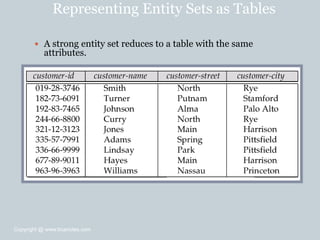
Representing Entity Sets as Tables
 A strong entity set reduces to a table with the same
attributes.
Copyright @ www.bcanotes.com
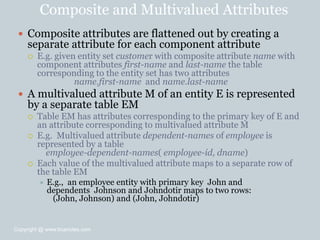
Composite and Multivalued Attributes
 Composite attributes are flattened out by creating a
separate attribute for each component attribute
 E.g. given entity set customer with composite attribute name with
component attributes first-name and last-name the table
corresponding to the entity set has two attributes
name.first-name and name.last-name
 A multivalued attribute M of an entity E is represented
by a separate table EM
 Table EM has attributes corresponding to the primary key of E and
an attribute corresponding to multivalued attribute M
 E.g. Multivalued attribute dependent-names of employee is
represented by a table
employee-dependent-names( employee-id, dname)
 Each value of the multivalued attribute maps to a separate row of
the table EM
 E.g., an employee entity with primary key John and
dependents Johnson and Johndotir maps to two rows:
(John, Johnson) and (John, Johndotir)
Copyright @ www.bcanotes.com
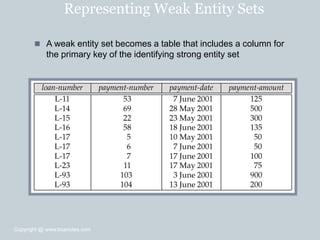
Representing Weak Entity Sets
 A weak entity set becomes a table that includes a column for
the primary key of the identifying strong entity set
Copyright @ www.bcanotes.com
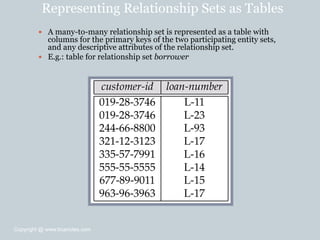
Representing Relationship Sets as Tables
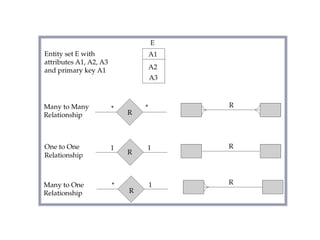
 A many-to-many relationship set is represented as a table with
columns for the primary keys of the two participating entity sets,
and any descriptive attributes of the relationship set.
 E.g.: table for relationship set borrower
Copyright @ www.bcanotes.com
Redundancy of Tables
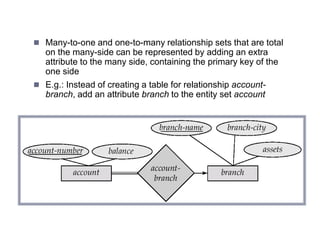
 Many-to-one and one-to-many relationship sets that are total
on the many-side can be represented by adding an extra
attribute to the many side, containing the primary key of the
one side
 E.g.: Instead of creating a table for relationship account-
branch, add an attribute branch to the entity set account
Copyright @ www.bcanotes.com
Redundancy of Tables (Cont.)
 For one-to-one relationship sets, either side can be
chosen to act as the ―many‖ side
 That is, extra attribute can be added to either of the tables
corresponding to the two entity sets
 If participation is partial on the many side,
replacing a table by an extra attribute in the relation
corresponding to the ―many‖ side could result in null
values
 The table corresponding to a relationship set linking
a weak entity set to its identifying strong entity set is
redundant.
 E.g. The payment table already contains the information that
would appear in the loan-payment table (i.e., the columns
loan-number and payment-number).
Copyright @ www.bcanotes.com
Representing Specialization as Tables
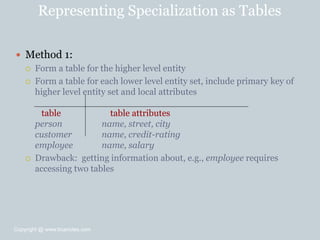
 Method 1:
 Form a table for the higher level entity
 Form a table for each lower level entity set, include primary key of
higher level entity set and local attributes
table table attributes
person name, street, city
customer name, credit-rating
employee name, salary
 Drawback: getting information about, e.g., employee requires
accessing two tables
Copyright @ www.bcanotes.com
Representing Specialization as Tables…
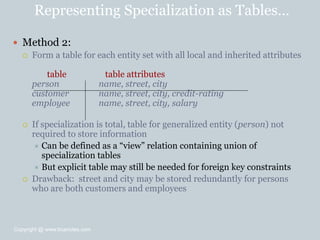
 Method 2:
 Form a table for each entity set with all local and inherited attributes
table table attributes
person name, street, city
customer name, street, city, credit-rating
employee name, street, city, salary
 If specialization is total, table for generalized entity (person) not
required to store information
 Can be defined as a ―view‖ relation containing union of
specialization tables
 But explicit table may still be needed for foreign key constraints
 Drawback: street and city may be stored redundantly for persons
who are both customers and employees
Copyright @ www.bcanotes.com
Relations Corresponding to Aggregation
 To represent aggregation, create a table containing
 primary key of the aggregated relationship,
 the primary key of the associated entity set
 Any descriptive attributes
Copyright @ www.bcanotes.com
Relations Corresponding to Aggregation…
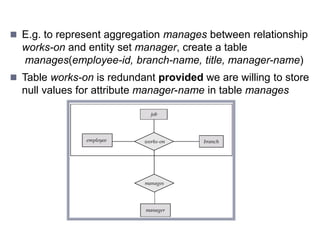
 E.g. to represent aggregation manages between relationship
works-on and entity set manager, create a table
manages(employee-id, branch-name, title, manager-name)
 Table works-on is redundant provided we are willing to store
null values for attribute manager-name in table manages
Copyright @ www.bcanotes.com

abuukarE r model

  • 1.
    E n ti t y – R e l a t i o n s h i p M o d e l  Entity Sets  Relationship Sets  Design Issues  Mapping Constraints  Keys  E-R Diagram  Extended E-R Features  Design of an E-R Database Schema  Reduction of an E-R Schema to Tables Copyright @ www.bcanotes.com
  • 2.
    E n ti t y S e t s  A database can be modeled as:  a collection of entities,  relationship among entities.  An entity is an object that exists and is distinguishable from other objects.  Example: specific person, company, event, plant  Entities have attributes  Example: people have names and addresses  An entity set is a set of entities of the same type that share the same properties.  Example: set of all persons, companies, trees, holidays Copyright @ www.bcanotes.com
  • 3.
    E n ti t y S e t s c u s t o m e r a n d l o a n customer-id customer- customer- customer- loan- amount name street city number Copyright @ www.bcanotes.com
  • 4.
    A t tr i b u t e s  An entity is represented by a set of attributes, that is descriptive properties possessed by all members of an entity set.  Domain – the set of permitted values for each attribute  Attribute types:  Simple and composite attributes.  Single-valued and multi-valued attributes  E.g. multivalued attribute: phone-numbers  Derived attributes  Can be computed from other attributes  E.g. age, given date of birth Example: customer = (customer-id, customer-name, customer-street, customer-city) loan = (loan-number, amount) Copyright @ www.bcanotes.com
  • 5.
    C o mp o s i t e A t t r i b u t e s Copyright @ www.bcanotes.com
  • 6.
    R e la t i o n s h i p S e t s  A relationship is an association among several entities Example: Hayes depositor A-102 customer entityrelationship setaccount entity  Example: (Hayes, A-102)  depositor Copyright @ www.bcanotes.com
  • 7.
  • 8.
    Relationship Sets (Cont.) An attribute can also be property of a relationship set.  For instance, the depositor relationship set between entity sets customer and account may have the attribute access-date Copyright @ www.bcanotes.com
  • 9.
    Degree of aRelationship Set  Refers to number of entity sets that participate in a relationship set.  Relationship sets that involve two entity sets are binary (or degree two). Generally, most relationship sets in a database system are binary.  Relationship sets may involve more than two entity sets.  Relationships between more than two entity sets are rare. Most relationships are binary. E.g. Suppose employees of a bank may have jobs (responsibilities) at multiple branches, with different jobs at different branches. Then there is a ternary relationship set between entity sets employee, job and branch Copyright @ www.bcanotes.com
  • 10.
    Mapping Cardinalities … Express the number of entities to which another entity can be associated via a relationship set.  Most useful in describing binary relationship sets.  For a binary relationship set the mapping cardinality must be one of the following types:  One to one  One to many  Many to one  Many to many Copyright @ www.bcanotes.com
  • 11.
    Mapping Cardinalities … Oneto one One to many Note: Some elements in A and B may not be mapped to any elements in the other set Copyright @ www.bcanotes.com
  • 12.
    Mapping Cardinalities ... Manyto one Many to many Note: Some elements in A and B may not be mapped to any elements in the other set Copyright @ www.bcanotes.com
  • 13.
    Mapping Cardinalities affectER Design  Can make access-date an attribute of account, instead of a relationship attribute, if each account can have only one customer  I.e., the relationship from account to customer is many to one, or equivalently, customer to account is one to many Copyright @ www.bcanotes.com
  • 14.
    E - RD i a g r a m s  Rectangles represent entity sets.  Diamonds represent relationship sets.  Lines link attributes to entity sets and entity sets to relationship sets.  Ellipses represent attributes  Double ellipses represent multivalued attributes.  Dashed ellipses denote derived attributes.  Underline indicates primary key attributes (will study later) Copyright @ www.bcanotes.com
  • 15.
    E-R Diagram WithComposite, Multivalued, and Derived Attributes Copyright @ www.bcanotes.com
  • 16.
    Relationship Sets withAttributes Copyright @ www.bcanotes.com
  • 17.
    Roles  Entity setsof a relationship need not be distinct  The labels ―manager‖ and ―worker‖ are called roles; they specify how employee entities interact via the works-for relationship set.  Roles are indicated in E-R diagrams by labeling the lines that connect diamonds to rectangles.  Role labels are optional, and are used to clarify semantics of the relationship Copyright @ www.bcanotes.com
  • 18.
    Cardinality Constraints  Weexpress cardinality constraints by drawing either a directed line (), signifying ―one,‖ or an undirected line (—), signifying ―many,‖ between the relationship set and the entity set.  E.g.: One-to-one relationship:  A customer is associated with at most one loan via the relationship borrower  A loan is associated with at most one customer via borrower Copyright @ www.bcanotes.com
  • 19.
    One-To-Many Relationship  Inthe one-to-many relationship a loan is associated with at most one customer via borrower, a customer is associated with several (including 0) loans via borrower Copyright @ www.bcanotes.com
  • 20.
    Many-To-One Relationships  Ina many-to-one relationship a loan is associated with several (including 0) customers via borrower, a customer is associated with at most one loan via borrower Copyright @ www.bcanotes.com
  • 21.
    Many-To-Many Relationship … A customer is associated with several (possibly 0) loans via borrower  A loan is associated with several (possibly 0) customers via borrower Copyright @ www.bcanotes.com
  • 22.
    Participation of anEntity Set in a Relationship Set  Total participation (indicated by double line): every entity in the entity set participates in at least one relationship in the relationship set  E.g. participation of loan in borrower is total  every loan must have a customer associated to it via borrower  Partial participation: some entities may not participate in any relationship in the relationship set  E.g. participation of customer in borrower is partial Copyright @ www.bcanotes.com
  • 23.
    K e ys  A super key of an entity set is a set of one or more attributes whose values uniquely determine each entity.  A candidate key of an entity set is a minimal super key  Customer-id is candidate key of customer  account-number is candidate key of account  Although several candidate keys may exist, one of the candidate keys is selected to be the primary key. Copyright @ www.bcanotes.com
  • 24.
    Keys for RelationshipSets  The combination of primary keys of the participating entity sets forms a super key of a relationship set.  (customer-id, account-number) is the super key of depositor  NOTE: this means a pair of entity sets can have at most one relationship in a particular relationship set.  E.g. if we wish to track all access-dates to each account by each customer, we cannot assume a relationship for each access. We can use a multivalued attribute though  Must consider the mapping cardinality of the relationship set when deciding the what are the candidate keys  Need to consider semantics of relationship set in selecting the primary key in case of more than one candidate key Copyright @ www.bcanotes.com
  • 25.
    E-R Diagram witha Ternary Relationship Copyright @ www.bcanotes.com
  • 26.
    Cardinality Constraints onTernary Relationship  We allow at most one arrow out of a ternary (or greater degree) relationship to indicate a cardinality constraint  E.g. an arrow from works-on to job indicates each employee works on at most one job at any branch.  If there is more than one arrow, there are two ways of defining the meaning.  E.g a ternary relationship R between A, B and C with arrows to B and C could mean  1. each A entity is associated with a unique entity from B and C or  2. each pair of entities from (A, B) is associated with a unique C entity, and each pair (A, C) is associated with a unique B  Each alternative has been used in different formalisms  To avoid confusion we outlaw more than one arrow Copyright @ www.bcanotes.com
  • 27.
    Design Issues  Useof entity sets vs. attributes Choice mainly depends on the structure of the enterprise being modeled, and on the semantics associated with the attribute in question.  Use of entity sets vs. relationship sets Possible guideline is to designate a relationship set to describe an action that occurs between entities  Binary versus n-ary relationship sets Although it is possible to replace any nonbinary (n-ary, for n > 2) relationship set by a number of distinct binary relationship sets, a n-ary relationship set shows more clearly that several entities participate in a single relationship.  Placement of relationship attributes Copyright @ www.bcanotes.com
  • 28.
    Weak Entity Sets An entity set that does not have a primary key is referred to as a weak entity set.  The existence of a weak entity set depends on the existence of a identifying entity set  it must relate to the identifying entity set via a total, one-to-many relationship set from the identifying to the weak entity set  Identifying relationship depicted using a double diamond  The discriminator (or partial key) of a weak entity set is the set of attributes that distinguishes among all the entities of a weak entity set.  The primary key of a weak entity set is formed by the primary key of the strong entity set on which the weak entity set is existence dependent, plus the weak entity set’s discriminator. Copyright @ www.bcanotes.com
  • 29.
    Weak Entity Sets(Cont.)  We depict a weak entity set by double rectangles.  We underline the discriminator of a weak entity set with a dashed line.  payment-number – discriminator of the payment entity set  Primary key for payment – (loan-number, payment- number) Copyright @ www.bcanotes.com
  • 30.
    Weak Entity Sets(Cont.)  Note: the primary key of the strong entity set is not explicitly stored with the weak entity set, since it is implicit in the identifying relationship.  If loan-number were explicitly stored, payment could be made a strong entity, but then the relationship between payment and loan would be duplicated by an implicit relationship defined by the attribute loan-number common to payment and loan Copyright @ www.bcanotes.com
  • 31.
    More Weak EntitySet Examples  In a university, a course is a strong entity and a course-offering can be modeled as a weak entity  The discriminator of course-offering would be semester (including year) and section-number (if there is more than one section)  If we model course-offering as a strong entity we would model course-number as an attribute. Then the relationship with course would be implicit in the course-number attribute Copyright @ www.bcanotes.com
  • 32.
    Specialization  Top-down designprocess; we designate subgroupings within an entity set that are distinctive from other entities in the set.  These subgroupings become lower-level entity sets that have attributes or participate in relationships that do not apply to the higher-level entity set.  Depicted by a triangle component labeled ISA (E.g. customer ―is a‖ person).  Attribute inheritance – a lower-level entity set inherits all the attributes and relationship participation of the higher-level entity set to which it is linked. Copyright @ www.bcanotes.com
  • 33.
  • 34.
    Generalization  A bottom-updesign process – combine a number of entity sets that share the same features into a higher-level entity set.  Specialization and generalization are simple inversions of each other; they are represented in an E-R diagram in the same way.  The terms specialization and generalization are used interchangeably. Copyright @ www.bcanotes.com
  • 35.
    Specialization and Generalization… Can have multiple specializations of an entity set based on different features.  E.g. permanent-employee vs. temporary-employee, in addition to officer vs. secretary vs. teller  Each particular employee would be  a member of one of permanent-employee or temporary- employee,  and also a member of one of officer, secretary, or teller  The ISA relationship also referred to as superclass - subclass relationship Copyright @ www.bcanotes.com
  • 36.
    Design Constraints ona Specialization/ Generalization  Constraint on which entities can be members of a given lower-level entity set.  condition-defined  E.g. all customers over 65 years are members of senior- citizen entity set; senior-citizen ISA person.  user-defined  Constraint on whether or not entities may belong to more than one lower-level entity set within a single generalization.  Disjoint  an entity can belong to only one lower-level entity set  Noted in E-R diagram by writing disjoint next to the ISA triangle  Overlapping  an entity can belong to more than one lower-level entity set Copyright @ www.bcanotes.com
  • 37.
    Design Constraints ona Specialization/ Generalization …  Completeness constraint -- specifies whether or not an entity in the higher-level entity set must belong to at least one of the lower-level entity sets within a generalization.  total : an entity must belong to one of the lower-level entity sets  partial: an entity need not belong to one of the lower-level entity sets Copyright @ www.bcanotes.com
  • 38.
    Aggregation  Consider theternary relationship works-on, which we saw earlier  Suppose we want to record managers for tasks performed by an employee at a branch Copyright @ www.bcanotes.com
  • 39.
    Aggregation (Cont.)  Relationshipsets works-on and manages represent overlapping information  Every manages relationship corresponds to a works-on relationship  However, some works-on relationships may not correspond to any manages relationships  So we can’t discard the works-on relationship  Eliminate this redundancy via aggregation  Treat relationship as an abstract entity  Allows relationships between relationships  Abstraction of relationship into new entity  Without introducing redundancy, the following diagram represents:  An employee works on a particular job at a particular branch  An employee, branch, job combination may have an associated manager Copyright @ www.bcanotes.com
  • 40.
    E-R Diagram WithAggregation Copyright @ www.bcanotes.com
  • 41.
    E-R Design Decisions The use of an attribute or entity set to represent an object.  Whether a real-world concept is best expressed by an entity set or a relationship set.  The use of a ternary relationship versus a pair of binary relationships.  The use of a strong or weak entity set.  The use of specialization/generalization – contributes to modularity in the design.  The use of aggregation – can treat the aggregate entity set as a single unit without concern for the details of its internal structure. Copyright @ www.bcanotes.com
  • 42.
    E-R Diagram fora Banking Enterprise Copyright @ www.bcanotes.com
  • 43.
    Summary of SymbolsUsed in E-R Notation Copyright @ www.bcanotes.com
  • 44.
    Summary of Symbols(Cont.) Copyright @ www.bcanotes.com
  • 45.
  • 46.
    Reduction of anE-R Schema to Tables  Primary keys allow entity sets and relationship sets to be expressed uniformly as tables which represent the contents of the database.  A database which conforms to an E-R diagram can be represented by a collection of tables.  For each entity set and relationship set there is a unique table which is assigned the name of the corresponding entity set or relationship set.  Each table has a number of columns (generally corresponding to attributes), which have unique names.  Converting an E-R diagram to a table format is the basis for deriving a relational database design from an E-R diagram. Copyright @ www.bcanotes.com
  • 47.
    Representing Entity Setsas Tables  A strong entity set reduces to a table with the same attributes. Copyright @ www.bcanotes.com
  • 48.
    Composite and MultivaluedAttributes  Composite attributes are flattened out by creating a separate attribute for each component attribute  E.g. given entity set customer with composite attribute name with component attributes first-name and last-name the table corresponding to the entity set has two attributes name.first-name and name.last-name  A multivalued attribute M of an entity E is represented by a separate table EM  Table EM has attributes corresponding to the primary key of E and an attribute corresponding to multivalued attribute M  E.g. Multivalued attribute dependent-names of employee is represented by a table employee-dependent-names( employee-id, dname)  Each value of the multivalued attribute maps to a separate row of the table EM  E.g., an employee entity with primary key John and dependents Johnson and Johndotir maps to two rows: (John, Johnson) and (John, Johndotir) Copyright @ www.bcanotes.com
  • 49.
    Representing Weak EntitySets  A weak entity set becomes a table that includes a column for the primary key of the identifying strong entity set Copyright @ www.bcanotes.com
  • 50.
    Representing Relationship Setsas Tables  A many-to-many relationship set is represented as a table with columns for the primary keys of the two participating entity sets, and any descriptive attributes of the relationship set.  E.g.: table for relationship set borrower Copyright @ www.bcanotes.com
  • 51.
    Redundancy of Tables Many-to-one and one-to-many relationship sets that are total on the many-side can be represented by adding an extra attribute to the many side, containing the primary key of the one side  E.g.: Instead of creating a table for relationship account- branch, add an attribute branch to the entity set account Copyright @ www.bcanotes.com
  • 52.
    Redundancy of Tables(Cont.)  For one-to-one relationship sets, either side can be chosen to act as the ―many‖ side  That is, extra attribute can be added to either of the tables corresponding to the two entity sets  If participation is partial on the many side, replacing a table by an extra attribute in the relation corresponding to the ―many‖ side could result in null values  The table corresponding to a relationship set linking a weak entity set to its identifying strong entity set is redundant.  E.g. The payment table already contains the information that would appear in the loan-payment table (i.e., the columns loan-number and payment-number). Copyright @ www.bcanotes.com
  • 53.
    Representing Specialization asTables  Method 1:  Form a table for the higher level entity  Form a table for each lower level entity set, include primary key of higher level entity set and local attributes table table attributes person name, street, city customer name, credit-rating employee name, salary  Drawback: getting information about, e.g., employee requires accessing two tables Copyright @ www.bcanotes.com
  • 54.
    Representing Specialization asTables…  Method 2:  Form a table for each entity set with all local and inherited attributes table table attributes person name, street, city customer name, street, city, credit-rating employee name, street, city, salary  If specialization is total, table for generalized entity (person) not required to store information  Can be defined as a ―view‖ relation containing union of specialization tables  But explicit table may still be needed for foreign key constraints  Drawback: street and city may be stored redundantly for persons who are both customers and employees Copyright @ www.bcanotes.com
  • 55.
    Relations Corresponding toAggregation  To represent aggregation, create a table containing  primary key of the aggregated relationship,  the primary key of the associated entity set  Any descriptive attributes Copyright @ www.bcanotes.com
  • 56.
    Relations Corresponding toAggregation…  E.g. to represent aggregation manages between relationship works-on and entity set manager, create a table manages(employee-id, branch-name, title, manager-name)  Table works-on is redundant provided we are willing to store null values for attribute manager-name in table manages Copyright @ www.bcanotes.com