This document discusses various English vowel sounds, including:
- The quality of a vowel is determined by tongue position, lip shape, and mouth/pharynx size and shape. Vowels are classified as close/open, high/low, front/back, and rounded/spread.
- It describes several short vowel sounds represented by letters like "i", "e", and "a" and discusses where they are commonly found in words.
- It also discusses some long vowel sounds like those represented by "oo", "ou", and "o" and notes they can have different pronunciations in different contexts or dialects.


![This is just a softer [ɪ]. It is mostly represented by
“ea”, single “e”, final “y” and others. It is
syllable and short when it is not, but not necessarily.](https://image.slidesharecdn.com/usingtheappropriatesegmentalspeech-200918050620/85/Using-the-appropriate-segmental-speech-4-320.jpg)
![In writing, this sound is most commonly represented by “i” in a
unstressed “a”, “e”, or “i” is often pronounced as [ɪ]. If you
word in which you can clearly hear [ɪ] (or conversely), don’t
are interchangeable.](https://image.slidesharecdn.com/usingtheappropriatesegmentalspeech-200918050620/85/Using-the-appropriate-segmental-speech-5-320.jpg)
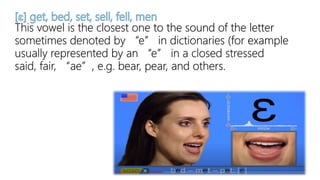
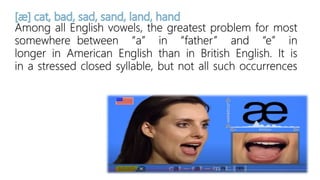
![This vowel is the closest one to the sound of the letter
such is also denoted [a] in some dictionaries. There is no
would tell you when “a” is pronounced as [ɑː] instead of](https://image.slidesharecdn.com/usingtheappropriatesegmentalspeech-200918050620/85/Using-the-appropriate-segmental-speech-8-320.jpg)
![[ʊ] would sound strange if it were long, so when there is a
pronounced somewhat “darker” than [ʊ]. It is most
but there is no way to tell when “oo” is pronounced as
learned by heart).](https://image.slidesharecdn.com/usingtheappropriatesegmentalspeech-200918050620/85/Using-the-appropriate-segmental-speech-9-320.jpg)
![The sound most similar to the sound of “u” in many
“u” in a closed stressed syllable (when it is not [ʌ]), but
groups.](https://image.slidesharecdn.com/usingtheappropriatesegmentalspeech-200918050620/85/Using-the-appropriate-segmental-speech-10-320.jpg)
![A similar sound to the British [ɒ], but somewhat
“aw”, “al” or “au”.](https://image.slidesharecdn.com/usingtheappropriatesegmentalspeech-200918050620/85/Using-the-appropriate-segmental-speech-11-320.jpg)
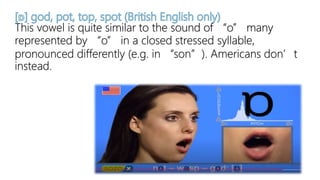
![This vowel very similar to [ɑː], but it’s never pronounced
represented by “u” in a stressed closed syllable, or by
pronounced also in a different way.](https://image.slidesharecdn.com/usingtheappropriatesegmentalspeech-200918050620/85/Using-the-appropriate-segmental-speech-13-320.jpg)
![Most learners of English learn very fast how to pronounce “a” when it
pronunciation of [ə]. It can be represented by any vowel (a, e, i, o, u) in an
above. When represented by “a” or “i”, it is often freely interchangeable
pronounced either /ˈtɛrəbl/, or /ˈtɛrɪbl/.](https://image.slidesharecdn.com/usingtheappropriatesegmentalspeech-200918050620/85/Using-the-appropriate-segmental-speech-14-320.jpg)
![Don’t confuse the symbol with [ɛ]. [ɜː] is pronounced the
while it is slightly “darker” in others, and many
simply [əː]. The difference between [ɜː] and [ɝː] is the same](https://image.slidesharecdn.com/usingtheappropriatesegmentalspeech-200918050620/85/Using-the-appropriate-segmental-speech-15-320.jpg)
![This vowel is formed by saying [ə] and at the same time
position as if you were saying the English “r” (listen to
some dictionaries, which is not completely precise, it is
where it is used (most notably “-er” at the end of a](https://image.slidesharecdn.com/usingtheappropriatesegmentalspeech-200918050620/85/Using-the-appropriate-segmental-speech-16-320.jpg)


