CS589-04 Digital ImageProcessing
CS589-04 Digital Image Processing
Lecture 9. Wavelet Transform
Lecture 9. Wavelet Transform
Spring 2008
Spring 2008
New Mexico Tech
New Mexico Tech
2.
08/18/25 2
Wavelet Definition
WaveletDefinition
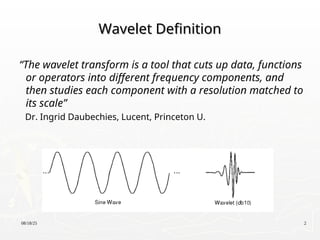
“The wavelet transform is a tool that cuts up data, functions
or operators into different frequency components, and
then studies each component with a resolution matched to
its scale”
Dr. Ingrid Daubechies, Lucent, Princeton U.
3.
08/18/25 3
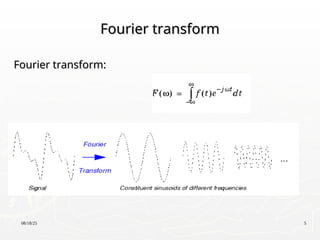
Fourier vs.Wavelet
Fourier vs. Wavelet
► FFT, basis functions: sinusoids
► Wavelet transforms: small waves, called wavelet
► FFT can only offer frequency information
► Wavelet: frequency + temporal information
► Fourier analysis doesn’t work well on discontinuous,
“bursty” data
music, video, power, earthquakes,…
4.
08/18/25 4
Fourier vs.Wavelet
Fourier vs. Wavelet
► Fourier
Loses time (location) coordinate completely
Analyses the whole signal
Short pieces lose “frequency” meaning
► Wavelets
Localized time-frequency analysis
Short signal pieces also have significance
Scale = Frequency band
08/18/25 7
Scaling--
Scaling-- valueof “stretch”
value of “stretch”
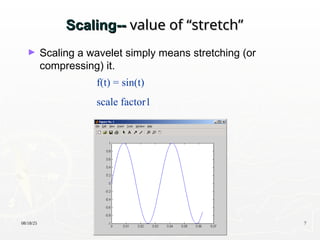
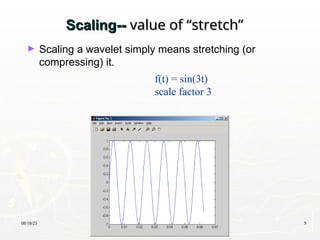
► Scaling a wavelet simply means stretching (or
compressing) it.
f(t) = sin(t)
scale factor1
8.
08/18/25 8
Scaling--
Scaling-- valueof “stretch”
value of “stretch”
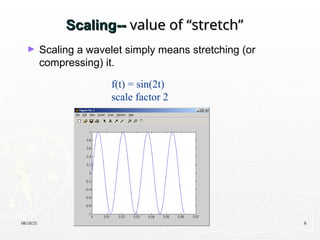
► Scaling a wavelet simply means stretching (or
compressing) it.
f(t) = sin(2t)
scale factor 2
9.
08/18/25 9
Scaling--
Scaling-- valueof “stretch”
value of “stretch”
► Scaling a wavelet simply means stretching (or
compressing) it.
f(t) = sin(3t)
scale factor 3
10.
08/18/25 10
More onscaling
More on scaling
► It lets you either narrow down the frequency band of interest, or
determine the frequency content in a narrower time interval
► Scaling = frequency band
► Good for non-stationary data
► Low scalea Compressed wavelet Rapidly changing detailsHigh
frequency
► High scale a Stretched wavelet Slowly changing, coarse features
Low frequency
11.
08/18/25 11
Scale is(sort of) like frequency
Scale is (sort of) like frequency
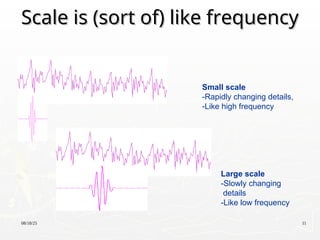
Small scale
-Rapidly changing details,
-Like high frequency
Large scale
-Slowly changing
details
-Like low frequency
12.
08/18/25 12
Scale is(sort of) like frequency
Scale is (sort of) like frequency
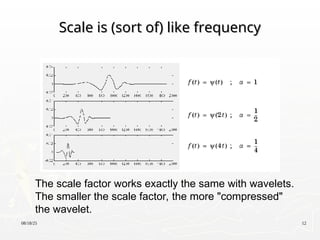
The scale factor works exactly the same with wavelets.
The smaller the scale factor, the more "compressed"
the wavelet.
13.
08/18/25 13
Shifting
Shifting
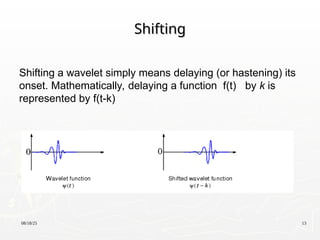
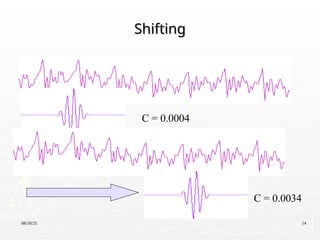
Shifting awavelet simply means delaying (or hastening) its
onset. Mathematically, delaying a function f(t) by k is
represented by f(t-k)
08/18/25 15
Five EasySteps to a Continuous Wavelet
Five Easy Steps to a Continuous Wavelet
Transform
Transform
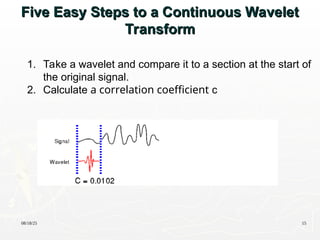
1. Take a wavelet and compare it to a section at the start of
the original signal.
2. Calculate a correlation coefficient c
16.
08/18/25 16
Five EasySteps to a Continuous Wavelet
Five Easy Steps to a Continuous Wavelet
Transform
Transform
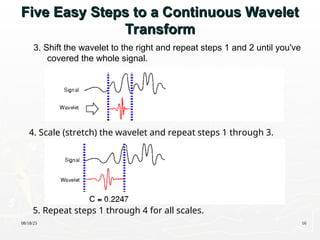
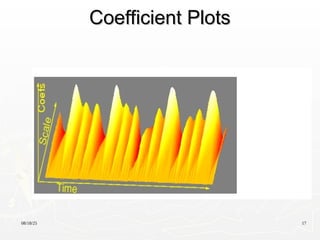
3. Shift the wavelet to the right and repeat steps 1 and 2 until you've
covered the whole signal.
4. Scale (stretch) the wavelet and repeat steps 1 through 3.
5. Repeat steps 1 through 4 for all scales.
08/18/25 18
Discrete WaveletTransform
Discrete Wavelet Transform
► “Subset” of scale and position based on power of two
rather than every “possible” set of scale and position
in continuous wavelet transform
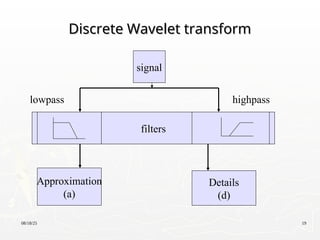
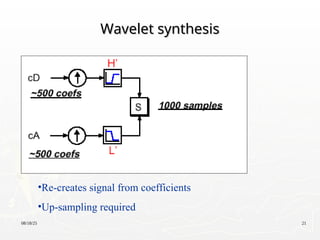
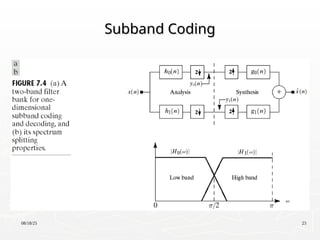
► Behaves like a filter bank: signal in, coefficients out
► Down-sampling necessary
(twice as much data as original signal)
08/18/25 20
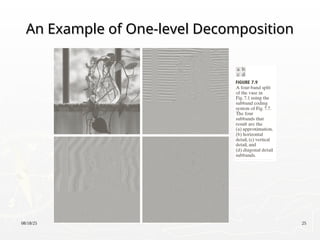
Results ofwavelet transform
Results of wavelet transform
—
— approximation and details
approximation and details
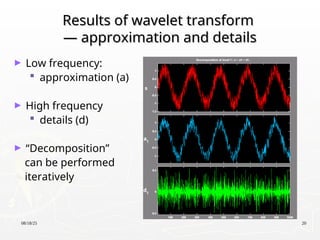
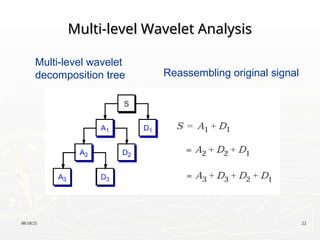
► Low frequency:
approximation (a)
► High frequency
details (d)
► “Decomposition”
can be performed
iteratively
08/18/25 26
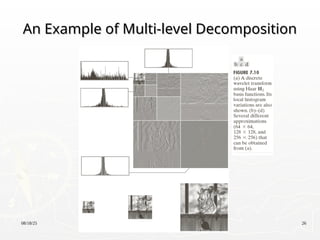
An Exampleof Multi-level Decomposition
An Example of Multi-level Decomposition
27.
08/18/25 27
Wavelet SeriesExpansions
Wavelet Series Expansions
0 0
0
0
2
, ,
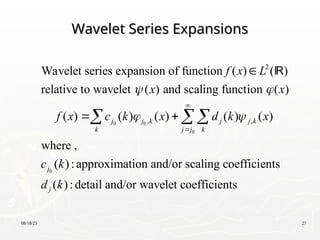
Wavelet series expansion of function ( ) ( )
relative to wavelet ( ) and scaling function ( )
( ) ( ) ( ) ( ) ( )
where ,
( ):approximation and/or scaling coefficients
j j k j j k
k j j k
j
f x L
x x
f x c k x d k x
c k
d
( ):detail and/or wavelet coefficients
j k
28.
08/18/25 28
Wavelet SeriesExpansions
Wavelet Series Expansions
0 0 0
, ,
, ,
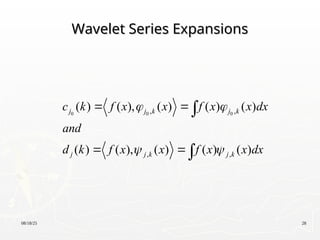
( ) ( ), ( ) ( ) ( )
( ) ( ), ( ) ( ) ( )
j j k j k
j j k j k
c k f x x f x x dx
and
d k f x x f x x dx
29.
08/18/25 29
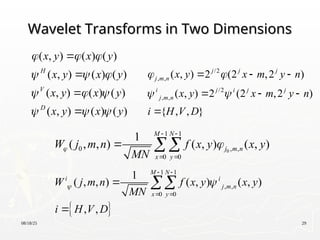
Wavelet Transformsin Two Dimensions
Wavelet Transforms in Two Dimensions
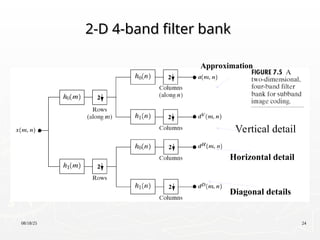
( , ) ( ) ( )
( , ) ( ) ( )
( , ) ( ) ( )
( , ) ( ) ( )
H
V
D
x y x y
x y x y
x y x y
x y x y
/2
, ,
/2
, ,
( , ) 2 (2 ,2 )
( , ) 2 (2 ,2 )
{ , , }
j j j
j m n
i j i j j
j m n
x y x m y n
x y x m y n
i H V D
0
1 1
0 , ,
0 0
1
( , , ) ( , ) ( , )
M N
j m n
x y
W j m n f x y x y
MN
1 1
, ,
0 0
1
( , , ) ( , ) ( , )
, ,
M N
i i
j m n
x y
W j m n f x y x y
MN
i H V D
30.
08/18/25 30
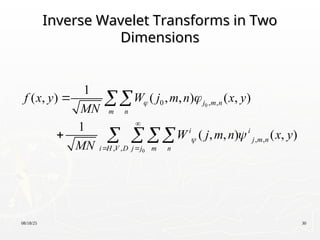
Inverse WaveletTransforms in Two
Inverse Wavelet Transforms in Two
Dimensions
Dimensions
0
0
0 , ,
, ,
, ,
1
( , ) ( , , ) ( , )
1
( , , ) ( , )
j m n
m n
i i
j m n
i H V D j j m n
f x y W j m n x y
MN
W j m n x y
MN


![[DSC Europe 25] Bojan Djuricic - Predictive Design Process.pdf](https://cdn.slidesharecdn.com/ss_thumbnails/5awdrbedqdek3gqu2ezy-4-the-predictive-design-bojan-djuricic-260120105856-6c399e9b-thumbnail.jpg?width=640&height=640&fit=bounds)

![[DSC Europe 25] Danilo Djukanovic - From Vibes to KPIs: Turning Culture Into ...](https://cdn.slidesharecdn.com/ss_thumbnails/inqestws5wf0cik2glgv-3-danilo-djukanovic-from-vibes-to-kpis-presentation-260114111931-dacff81f-thumbnail.jpg?width=640&height=640&fit=bounds)


![[DSC Europe 25] Elena Menshikova - AI-Powered Operational Excellence: Revolut...](https://cdn.slidesharecdn.com/ss_thumbnails/es6nholbqy3zaao2c2yd-2-elena-menshikova-data-ai-in-decision-making-260115093812-4fba8b38-thumbnail.jpg?width=640&height=640&fit=bounds)


![[DSC Europe 25] Mijat Kustudic - Building Financial Intelligence with AI Agen...](https://cdn.slidesharecdn.com/ss_thumbnails/38y2lb5lse6wstegtvas-3-mijat-kustudic-building-financial-intelligence-with-ai-agents-260114111931-1a4783ce-thumbnail.jpg?width=640&height=640&fit=bounds)
![[DSC Europe 25] Ivan Lukovic & Marija Djukic - From Data to Value: Why Maturi...](https://cdn.slidesharecdn.com/ss_thumbnails/ahrfps8xr6knowwhacxh-1-ivan-marija-dsc-2025-ld-v1-presentation-260115093812-be21adfc-thumbnail.jpg?width=640&height=640&fit=bounds)