Downloaded 3,124 times
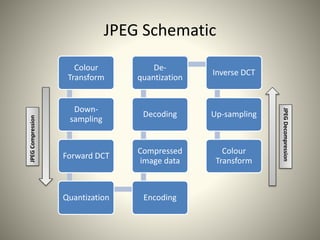
![Algorithm
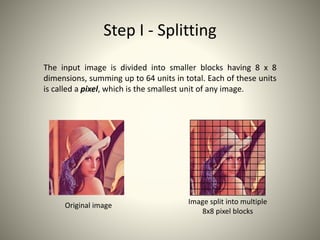
• Splitting: Split the image into 8 x 8 non-overlapping pixel blocks. If the
image cannot be divided into 8-by-8 blocks, then you can add in empty
pixels around the edges, essentially zero-padding the image.
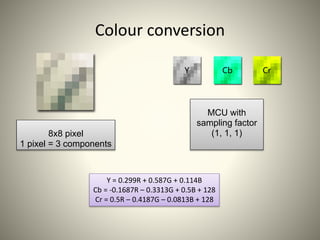
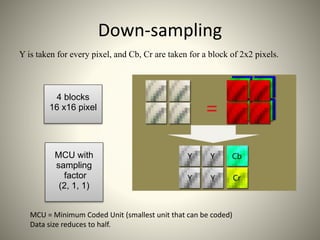
• Colour Space Transform from [R,G,B] to [Y,Cb,Cr] & Subsampling.
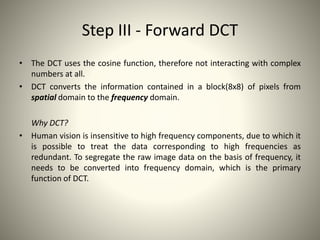
• DCT: Take the Discrete Cosine Transform (DCT) of each 8-by-8 block.
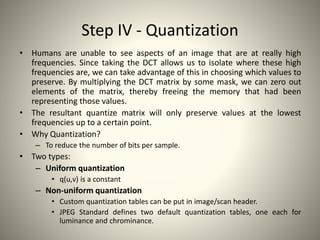
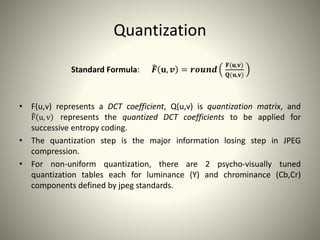
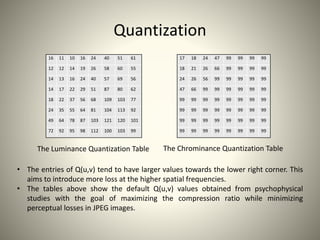
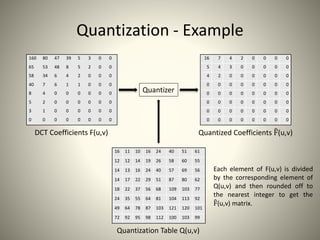
• Quantization: quantize the DCT coefficients according to psycho-visually
tuned quantization tables.
• Serialization: by zigzag scanning pattern to exploit redundancy.
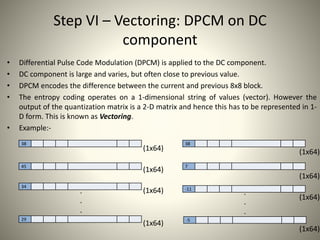
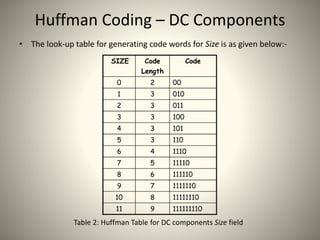
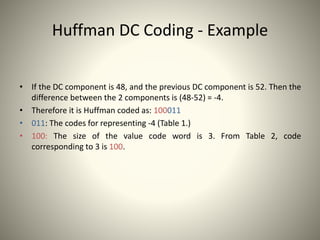
• Vectoring: Differential Pulse Code Modulation (DPCM) on DC components
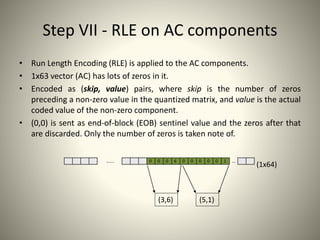
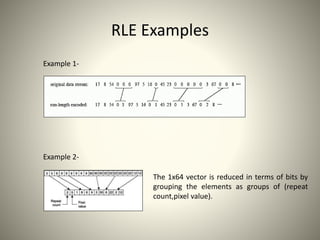
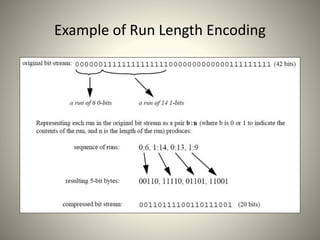
• Run Length Encoding (RLE) on AC components
• Entropy Coding:
– Run Length Coding
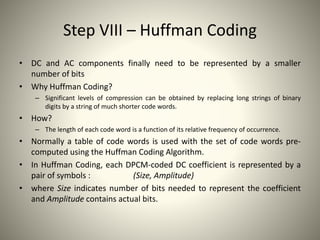
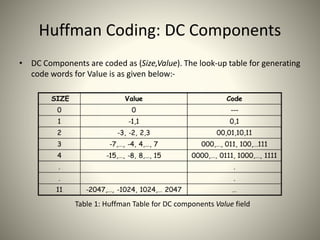
– Huffman Coding or Arithmetic Coding](https://image.slidesharecdn.com/jpegaish-160111065623/85/JPEG-Image-Compression-8-320.jpg)
![Step II - RGB to YCbCr conversion
• JPEG makes use of [Y,Cb,Cr] model instead of [R,G,B] model.
• The precision of colors suffer less (for a human eye) than the precision of
contours (based on luminance)
Simple color space model: [R,G,B] per pixel
JPEG uses [Y, Cb, Cr] Model
Y = Brightness
Cb = Color blueness
Cr = Color redness](https://image.slidesharecdn.com/jpegaish-160111065623/85/JPEG-Image-Compression-10-320.jpg)

![DC and AC components
2-D DCT
P(x,y) F(u,v)
(8x8)(8x8)
F(0,0) is called the DC component
and the rest of P(x,y) are called AC
components.
• For u = v = 0 the two cosine terms are 0 and hence the value in the location F[0,0]
of the transformed matrix is simply a function of the summation of all the values
in the input matrix.
• This is the mean of all 64 values in the matrix and is known as the DC coefficient.
• Since the values in all the other locations of the transformed matrix have a
frequency coefficient associated with them they are known as AC coefficients.](https://image.slidesharecdn.com/jpegaish-160111065623/85/JPEG-Image-Compression-15-320.jpg)

![Huffman Coding: AC Components
• AC components are coded in two parts:
– Part1: (RunLength/SIZE)
• RunLength: The length of the consecutive zero values [0..15]
• SIZE: The number of bits needed to code the next nonzero AC component’s value. [0-A]
• (0,0) is the End Of Block (EOB) for the 8x8 block.
• Part1 is Huffman coded (see Table 3)
– Part2: (Value)
• Value: Is the actual value of the AC component.(Table 1)
Table 3(a) Table 3(b)](https://image.slidesharecdn.com/jpegaish-160111065623/85/JPEG-Image-Compression-28-320.jpg)
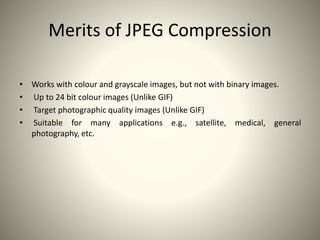

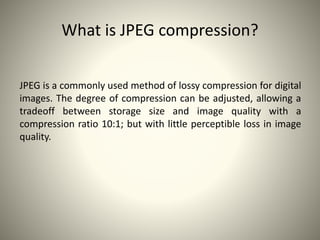
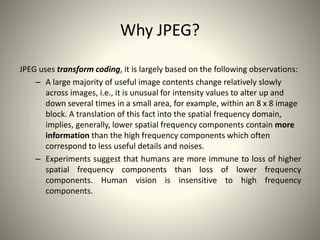
The document provides an overview of JPEG image compression. It discusses that JPEG is a commonly used lossy compression method that allows adjusting the degree of compression for a tradeoff between file size and image quality. The JPEG compression process involves splitting the image into 8x8 blocks, converting color space, applying discrete cosine transform (DCT), quantization, zigzag scanning, differential pulse-code modulation (DPCM) on DC coefficients, run length encoding on AC coefficients, and Huffman coding for entropy encoding. Quantization is the main lossy step that discards high frequency data imperceptible to human vision to achieve higher compression ratios.


