Waste Management - India
August 2009
2WASTE MANAGEMENT – INDIA.PPT
SAMPLE
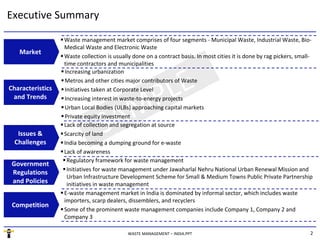
Executive Summary
Market
Issues &
Challenges
Competition
Waste management market comprises of four segments - Municipal Waste, Industrial Waste, Bio-
Medical Waste and Electronic Waste
Waste collection is usually done on a contract basis. In most cities it is done by rag pickers, small-
time contractors and municipalities
E-waste management market in India is dominated by informal sector, which includes waste
importers, scarp dealers, dissemblers, and recyclers
Some of the prominent waste management companies include Company 1, Company 2 and
Company 3
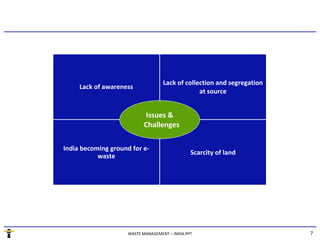
Lack of collection and segregation at source
Scarcity of land
India becoming a dumping ground for e-waste
Lack of awareness
Characteristics
and Trends
Increasing urbanization
Metros and other cities major contributors of Waste
Initiatives taken at Corporate Level
Increasing interest in waste-to-energy projects
Urban Local Bodies (ULBs) approaching capital markets
Private equity investment
Government
Regulations
and Policies
Regulatory framework for waste management
Initiatives for waste management under Jawaharlal Nehru National Urban Renewal Mission and
Urban Infrastructure Development Scheme for Small & Medium Towns Public Private Partnership
initiatives in waste management
3WASTE MANAGEMENT – INDIA.PPT
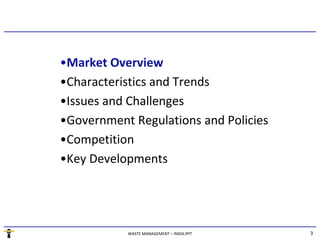
•Market Overview
•Characteristics and Trends
•Issues and Challenges
•Government Regulations and Policies
•Competition
•Key Developments
4WASTE MANAGEMENT – INDIA.PPT
SAMPLE
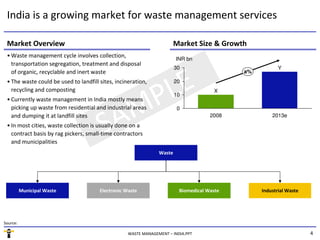
India is a growing market for waste management services
Market Size & Growth
• Waste management cycle involves collection,
transportation segregation, treatment and disposal
of organic, recyclable and inert waste
• The waste could be used to landfill sites, incineration,
recycling and composting
• Currently waste management in India mostly means
picking up waste from residential and industrial areas
and dumping it at landfill sites
• In most cities, waste collection is usually done on a
contract basis by rag pickers, small-time contractors
and municipalities
Market Overview
Source:
0
10
20
30
INR bn
2008
Y
a%
X
2013e
Waste
Municipal Waste Industrial WasteElectronic Waste Biomedical Waste
5WASTE MANAGEMENT – INDIA.PPT
SAMPLE
India is becoming an outsourcing hub for e-waste management
Market Size & Growth
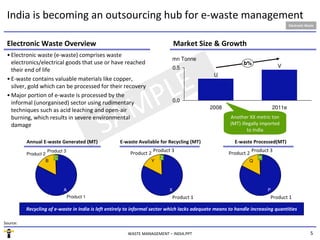
• Electronic waste (e-waste) comprises waste
electronics/electrical goods that use or have reached
their end of life
• E-waste contains valuable materials like copper,
silver, gold which can be processed for their recovery
• Major portion of e-waste is processed by the
informal (unorganised) sector using rudimentary
techniques such as acid leaching and open-air
burning, which results in severe environmental
damage
Electronic Waste Overview
Source:
Recycling of e-waste in India is left entirely to informal sector which lacks adequate means to handle increasing quantities
Electronic Waste
A
Product 1
B
Product 2
C
Product 3
X
Product 1
Y
Product 2
Z
Product 3
P
Product 1
Q
Product 2
R
Product 3
Annual E-waste Generated (MT) E-waste Available for Recycling (MT) E-waste Processed(MT)
0.0
0.5
U
2008
V
2011e
b%
mn Tonne
Another XX metric ton
(MT) illegally imported
to India
6WASTE MANAGEMENT – INDIA.PPT
SAMPLE
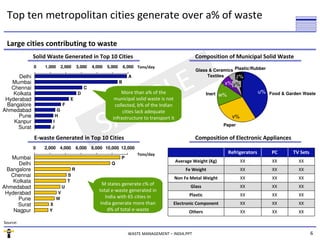
Top ten metropolitan cities generate over a% of waste
Source:
Large cities contributing to waste
0 1,000 2,000 3,000 4,000 5,000 6,000
Ahmedabad
HPune
IKanpur
JSurat
ADelhi
BMumbai
CChennai
DKolkata
EHyderabad
FBangalore
G
Solid Waste Generated in Top 10 Cities
4,000 8,0006,000
Bangalore
SChennai
TKolkata
UAhmedabad
VHyderabad
WPune
XSurat
YNagpur
0 10,000 12,0002,000
PMumbai
QDelhi
R
E-waste Generated in Top 10 Cities
Food & Garden Wasteu%
Paper
v%
Inert w%
Textiles
x%y%
Glass & Ceramics
z%
Plastic/Rubber
XXXXXXElectronic Component
XXXXXXGlass
XXXXXXNon Fe Metal Weight
XXXXXXPlastic
XX
XX
XX
Refrigerators
Others
Fe Weight
Average Weight (Kg)
XXXX
XX
XX
PC TV Sets
XX
XX
Composition of Electronic Appliances
Composition of Municipal Solid Waste
M states generate c% of
total e-waste generated in
India with 65 cities in
India generate more than
d% of total e-waste
More than a% of the
municipal solid waste is not
collected, b% of the Indian
cities lack adequate
infrastructure to transport it
Tons/day
Tons/day
7WASTE MANAGEMENT – INDIA.PPT
Scarcity of land
India becoming ground for e-
waste
Lack of collection and segregation
at source
Lack of awareness
Issues &
Challenges
8WASTE MANAGEMENT – INDIA.PPT
SAMPLE
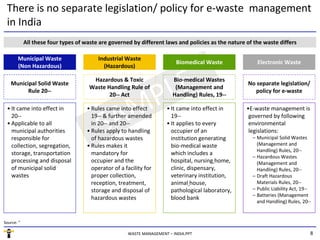
There is no separate legislation/ policy for e-waste management
in India
Source: ”
All these four types of waste are governed by different laws and policies as the nature of the waste differs
Municipal Waste
(Non Hazardous)
Electronic Waste
Industrial Waste
(Hazardous)
Biomedical Waste
Municipal Solid Waste
Rule 20--
Hazardous & Toxic
Waste Handling Rule of
20-- Act
Bio-medical Wastes
(Management and
Handling) Rules, 19--
No separate legislation/
policy for e-waste
• It came into effect in
20--
• Applicable to all
municipal authorities
responsible for
collection, segregation,
storage, transportation
processing and disposal
of municipal solid
wastes
• Rules came into effect
19-- & further amended
in 20-- and 20--
• Rules apply to handling
of hazardous wastes
• Rules makes it
mandatory for
occupier and the
operator of a facility for
proper collection,
reception, treatment,
storage and disposal of
hazardous wastes
• It came into effect in
19--
• It applies to every
occupier of an
institution generating
bio-medical waste
which includes a
hospital, nursing home,
clinic, dispensary,
veterinary institution,
animal house,
pathological laboratory,
blood bank
•E-waste management is
governed by following
environmental
legislations:
– Municipal Solid Wastes
(Management and
Handling) Rules, 20--
– Hazardous Wastes
(Management and
Handling) Rules, 20--
– Draft Hazardous
Materials Rules, 20--
– Public Liability Act, 19--
– Batteries (Management
and Handling) Rules, 20--
9WASTE MANAGEMENT – INDIA.PPT
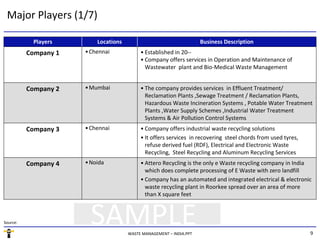
Major Players (1/7)
Source:
• The company provides services in Effluent Treatment/
Reclamation Plants ,Sewage Treatment / Reclamation Plants,
Hazardous Waste Incineration Systems , Potable Water Treatment
Plants ,Water Supply Schemes ,Industrial Water Treatment
Systems & Air Pollution Control Systems
•MumbaiCompany 2
• Established in 20--
• Company offers services in Operation and Maintenance of
Wastewater plant and Bio-Medical Waste Management
•ChennaiCompany 1
• Company offers industrial waste recycling solutions
• It offers services in recovering steel chords from used tyres,
refuse derived fuel (RDF), Electrical and Electronic Waste
Recycling, Steel Recycling and Aluminum Recycling Services
•ChennaiCompany 3
Players Locations Business Description
Company 4 •Noida • Attero Recycling is the only e Waste recycling company in India
which does complete processing of E Waste with zero landfill
• Company has an automated and integrated electrical & electronic
waste recycling plant in Roorkee spread over an area of more
than X square feet
SAMPLE

Waste management india-sample

  • 1.
    Waste Management -India August 2009
  • 2.
    2WASTE MANAGEMENT –INDIA.PPT SAMPLE Executive Summary Market Issues & Challenges Competition Waste management market comprises of four segments - Municipal Waste, Industrial Waste, Bio- Medical Waste and Electronic Waste Waste collection is usually done on a contract basis. In most cities it is done by rag pickers, small- time contractors and municipalities E-waste management market in India is dominated by informal sector, which includes waste importers, scarp dealers, dissemblers, and recyclers Some of the prominent waste management companies include Company 1, Company 2 and Company 3 Lack of collection and segregation at source Scarcity of land India becoming a dumping ground for e-waste Lack of awareness Characteristics and Trends Increasing urbanization Metros and other cities major contributors of Waste Initiatives taken at Corporate Level Increasing interest in waste-to-energy projects Urban Local Bodies (ULBs) approaching capital markets Private equity investment Government Regulations and Policies Regulatory framework for waste management Initiatives for waste management under Jawaharlal Nehru National Urban Renewal Mission and Urban Infrastructure Development Scheme for Small & Medium Towns Public Private Partnership initiatives in waste management
  • 3.
    3WASTE MANAGEMENT –INDIA.PPT •Market Overview •Characteristics and Trends •Issues and Challenges •Government Regulations and Policies •Competition •Key Developments
  • 4.
    4WASTE MANAGEMENT –INDIA.PPT SAMPLE India is a growing market for waste management services Market Size & Growth • Waste management cycle involves collection, transportation segregation, treatment and disposal of organic, recyclable and inert waste • The waste could be used to landfill sites, incineration, recycling and composting • Currently waste management in India mostly means picking up waste from residential and industrial areas and dumping it at landfill sites • In most cities, waste collection is usually done on a contract basis by rag pickers, small-time contractors and municipalities Market Overview Source: 0 10 20 30 INR bn 2008 Y a% X 2013e Waste Municipal Waste Industrial WasteElectronic Waste Biomedical Waste
  • 5.
    5WASTE MANAGEMENT –INDIA.PPT SAMPLE India is becoming an outsourcing hub for e-waste management Market Size & Growth • Electronic waste (e-waste) comprises waste electronics/electrical goods that use or have reached their end of life • E-waste contains valuable materials like copper, silver, gold which can be processed for their recovery • Major portion of e-waste is processed by the informal (unorganised) sector using rudimentary techniques such as acid leaching and open-air burning, which results in severe environmental damage Electronic Waste Overview Source: Recycling of e-waste in India is left entirely to informal sector which lacks adequate means to handle increasing quantities Electronic Waste A Product 1 B Product 2 C Product 3 X Product 1 Y Product 2 Z Product 3 P Product 1 Q Product 2 R Product 3 Annual E-waste Generated (MT) E-waste Available for Recycling (MT) E-waste Processed(MT) 0.0 0.5 U 2008 V 2011e b% mn Tonne Another XX metric ton (MT) illegally imported to India
  • 6.
    6WASTE MANAGEMENT –INDIA.PPT SAMPLE Top ten metropolitan cities generate over a% of waste Source: Large cities contributing to waste 0 1,000 2,000 3,000 4,000 5,000 6,000 Ahmedabad HPune IKanpur JSurat ADelhi BMumbai CChennai DKolkata EHyderabad FBangalore G Solid Waste Generated in Top 10 Cities 4,000 8,0006,000 Bangalore SChennai TKolkata UAhmedabad VHyderabad WPune XSurat YNagpur 0 10,000 12,0002,000 PMumbai QDelhi R E-waste Generated in Top 10 Cities Food & Garden Wasteu% Paper v% Inert w% Textiles x%y% Glass & Ceramics z% Plastic/Rubber XXXXXXElectronic Component XXXXXXGlass XXXXXXNon Fe Metal Weight XXXXXXPlastic XX XX XX Refrigerators Others Fe Weight Average Weight (Kg) XXXX XX XX PC TV Sets XX XX Composition of Electronic Appliances Composition of Municipal Solid Waste M states generate c% of total e-waste generated in India with 65 cities in India generate more than d% of total e-waste More than a% of the municipal solid waste is not collected, b% of the Indian cities lack adequate infrastructure to transport it Tons/day Tons/day
  • 7.
    7WASTE MANAGEMENT –INDIA.PPT Scarcity of land India becoming ground for e- waste Lack of collection and segregation at source Lack of awareness Issues & Challenges
  • 8.
    8WASTE MANAGEMENT –INDIA.PPT SAMPLE There is no separate legislation/ policy for e-waste management in India Source: ” All these four types of waste are governed by different laws and policies as the nature of the waste differs Municipal Waste (Non Hazardous) Electronic Waste Industrial Waste (Hazardous) Biomedical Waste Municipal Solid Waste Rule 20-- Hazardous & Toxic Waste Handling Rule of 20-- Act Bio-medical Wastes (Management and Handling) Rules, 19-- No separate legislation/ policy for e-waste • It came into effect in 20-- • Applicable to all municipal authorities responsible for collection, segregation, storage, transportation processing and disposal of municipal solid wastes • Rules came into effect 19-- & further amended in 20-- and 20-- • Rules apply to handling of hazardous wastes • Rules makes it mandatory for occupier and the operator of a facility for proper collection, reception, treatment, storage and disposal of hazardous wastes • It came into effect in 19-- • It applies to every occupier of an institution generating bio-medical waste which includes a hospital, nursing home, clinic, dispensary, veterinary institution, animal house, pathological laboratory, blood bank •E-waste management is governed by following environmental legislations: – Municipal Solid Wastes (Management and Handling) Rules, 20-- – Hazardous Wastes (Management and Handling) Rules, 20-- – Draft Hazardous Materials Rules, 20-- – Public Liability Act, 19-- – Batteries (Management and Handling) Rules, 20--
  • 9.
    9WASTE MANAGEMENT –INDIA.PPT Major Players (1/7) Source: • The company provides services in Effluent Treatment/ Reclamation Plants ,Sewage Treatment / Reclamation Plants, Hazardous Waste Incineration Systems , Potable Water Treatment Plants ,Water Supply Schemes ,Industrial Water Treatment Systems & Air Pollution Control Systems •MumbaiCompany 2 • Established in 20-- • Company offers services in Operation and Maintenance of Wastewater plant and Bio-Medical Waste Management •ChennaiCompany 1 • Company offers industrial waste recycling solutions • It offers services in recovering steel chords from used tyres, refuse derived fuel (RDF), Electrical and Electronic Waste Recycling, Steel Recycling and Aluminum Recycling Services •ChennaiCompany 3 Players Locations Business Description Company 4 •Noida • Attero Recycling is the only e Waste recycling company in India which does complete processing of E Waste with zero landfill • Company has an automated and integrated electrical & electronic waste recycling plant in Roorkee spread over an area of more than X square feet SAMPLE