NitiAayog–CentreForPolicyResearchOpenSeminar Series	
  
“Conceptualising Zero-Waste in India under Swachh Bharat:
Possibilities & Challenges”	
  
Monday,29th June 2015,15:00–16:30 hrs	
  
Room 122 Niti Aayog,Sansad Marg,New Delhi 110001	
  
 
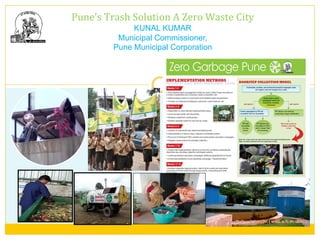
Pune’s	
  Trash	
  Solution	
  A	
  Zero	
  Waste	
  City	
  
KUNAL KUMAR
Municipal Commissioner,
Pune Municipal Corporation 	
  
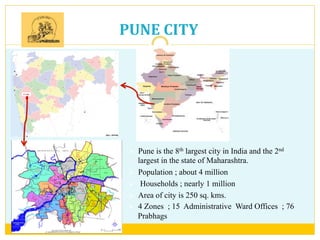
PUNE	
  CITY	
  
Ø  Pune is the 8th largest city in India and the 2nd
largest in the state of Maharashtra.
Ø  Population ; about 4 million
Ø  Households ; nearly 1 million
Ø  Area of city is 250 sq. kms.
Ø  4 Zones ; 15 Administrative Ward Offices ; 76
Prabhags 	
  
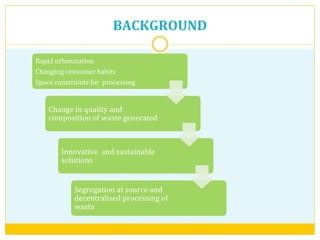
BACKGROUND	


Rapid	
  urbanization	
  
Changing	
  consumer	
  habits	
  
Space	
  constraints	
  for	
  	
  processing	


Change	
  in	
  quality	
  and	
  
composition	
  of	
  waste	
  generated	
  
Innovative	
  	
  and	
  sustainable	
  
solutions	
  
Segregation	
  at	
  source	
  and	
  
decentralised	
  processing	
  of	
  
waste	
  
-­‐5-­‐	
  
6%
5%
3%
5%
33%
1%
25%
22%
Paper
Plastic
Metal
Glass
Organic
Leather	
  /	
  Rubber
Inert	
  Materials
Miscellaneous
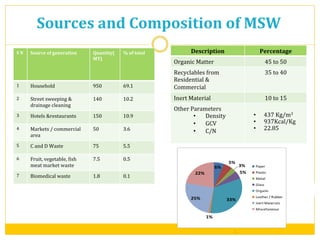
S	
  N	
   Source	
  of	
  generation	
   Quantity(
MT)	
  
%	
  of	
  total	
  
1	
   Household	
   950	
   69.1	
  
2	
   Street	
  sweeping	
  &	
  
drainage	
  cleaning	
  
140	
   10.2	
  
3	
   Hotels	
  &restaurants	
   150	
   10.9	
  
4	
   Markets	
  /	
  commercial	
  
area	
  
50	
   3.6	
  
5	
   C	
  and	
  D	
  Waste	
   75	
   5.5	
  
6	
   Fruit,	
  vegetable,	
  Vish	
  
meat	
  market	
  waste	
  
7.5	
   0.5	
  
7	
   Biomedical	
  waste	
   1.8	
   0.1	
  
Sources	
  and	
  Composition	
  of	
  MSW	
  
Description	
   Percentage	
  
Organic	
  Matter	
  	
   45	
  to	
  50	
  
Recyclables	
  from	
  
Residential	
  &	
  
Commercial	
  	
  
35	
  to	
  40	
  
Inert	
  Material	
  	
   10	
  to	
  15	
  
Other	
  Parameters	
  
•  	
   Density	
  
•  	
   GCV	
  
•  	
   C/N	


•  437	
  Kg/m3	
  
•  937Kcal/Kg	
  
•  22.85	
  
INTEGRATED	
  SOLID	
  WASTE	
  MANAGEMENT	
  
Nos.	
  
Tipper	
  Trucks	
   158	
  
Compactors	
   12	
  
Hotel	
  Trucks	
   23	
  
Tractors	
   10	
  
Dumper	
  Placers	
   89	
  
Bulk	
  Refuse	
  Carrier	
  (B.R.C.)	
   65	
  
Year	
   Population	
  	
   Waste	
  Generation	
  
(TPD)	
  
2011	
   3,115,431	
   1374	
  
2021	
   4,487,573	
   2677	
  
2031	
   6,211,404	
   4125	
  
2041	
   8,597,417	
   6071	
  
OVERVIEW	
  OF	
  WASTE	
  MANAGEMENT	
  
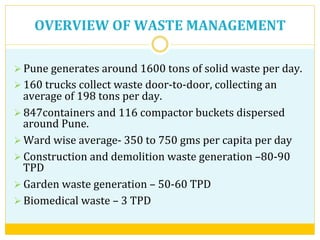
Ø Pune	
  generates	
  around	
  1600	
  tons	
  of	
  solid	
  waste	
  per	
  day.	
  
Ø 160	
  trucks	
  collect	
  waste	
  door-­‐to-­‐door,	
  collecting	
  an	
  
average	
  of	
  198	
  tons	
  per	
  day.	
  
Ø 847containers	
  and	
  116	
  compactor	
  buckets	
  dispersed	
  
around	
  Pune.	
  
Ø Ward	
  wise	
  average-­‐	
  350	
  to	
  750	
  gms	
  per	
  capita	
  per	
  day	
  
Ø Construction	
  and	
  demolition	
  waste	
  generation	
  –80-­‐90	
  
TPD	
  
Ø Garden	
  waste	
  generation	
  –	
  50-­‐60	
  TPD	
  
Ø Biomedical	
  waste	
  –	
  3	
  TPD	
  
Service	
  Level	
  
Benchmarking	
  
-­‐8-­‐	
  Source:	
  SWM	
  	
  Department	
  Pune	
  Municipal	
  Corporation	
  
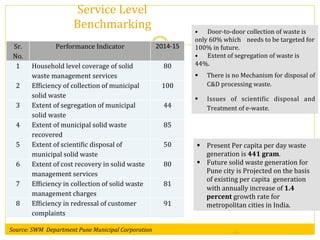
•  Door-­‐to-­‐door	
  collection	
  of	
  waste	
  is	
  
only	
  60%	
  which	


  needs	
  to	
  be	
  targeted	
  for	
  
100%	
  in	
  future.	
  
•  Extent	
  of	
  segregation	
  of	
  waste	
  is	
  
44%.	
  
§  There	
  is	
  no	
  Mechanism	
  for	
  disposal	
  of	
  
C&D	
  processing	
  waste.	


§  Issues	
   of	
   scientiVic	
   disposal	
   and	
  
Treatment	
  of	
  e-­‐waste.	
  	
  
§  Present	
  Per	
  capita	
  per	
  day	
  waste	
  
generation	
  is	
  441	
  gram.	
  
§  Future	
  solid	
  waste	
  generation	
  for	
  
Pune	
  city	
  is	
  Projected	
  on	
  the	
  basis	
  
of	
  existing	
  per	
  capita	
  	
  generation	
  	
  
with	
  annually	
  increase	
  of	
  1.4	
  
percent	
  growth	
  rate	
  for	
  	
  
metropolitan	
  cities	
  in	
  India.	
  	
  
Sr.	
  
No.	
  
Performance	
  Indicator	
   2014-­‐15	
  
1	
   Household	
  level	
  coverage	
  of	
  solid	
  
waste	
  management	
  services	
  
80	
  
2	
   EfViciency	
  of	
  collection	
  of	
  municipal	
  
solid	
  waste	
  
100	
  
3	
   Extent	
  of	
  segregation	
  of	
  municipal	
  
solid	
  waste	
  
44	
  
4	
   Extent	
  of	
  municipal	
  solid	
  waste	
  
recovered	
  
85	
  
5	
   Extent	
  of	
  scientiVic	
  disposal	
  of	
  
municipal	
  solid	
  waste	
  
50	
  
6	
   Extent	
  of	
  cost	
  recovery	
  in	
  solid	
  waste	
  
management	
  services	
  
80	
  
7	
   EfViciency	
  in	
  collection	
  of	
  solid	
  waste	
  
management	
  charges	
  
81	
  
8	
   EfViciency	
  in	
  redressal	
  of	
  customer	
  
complaints	
  
91	
  
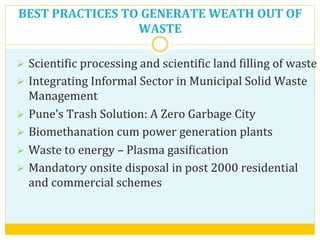
BEST	
  PRACTICES	
  TO	
  GENERATE	
  WEATH	
  OUT	
  OF	
  
WASTE	
  	
  
Ø  ScientiVic	
  processing	
  and	
  scientiVic	
  land	
  Villing	
  of	
  waste	
  	
  
Ø  Integrating	
  Informal	
  Sector	
  in	
  Municipal	
  Solid	
  Waste	
  
Management	
  
Ø  Pune’s	
  Trash	
  Solution:	
  A	
  Zero	
  Garbage	
  City	
  
Ø  Biomethanation	
  cum	
  power	
  generation	
  plants	
  
Ø  Waste	
  to	
  energy	
  –	
  Plasma	
  gasiVication	
  	
  
Ø  Mandatory	
  onsite	
  disposal	
  in	
  post	
  2000	
  residential	
  	
  
and	
  commercial	
  schemes	
  
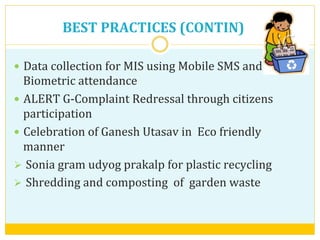
—  Data	
  collection	
  for	
  MIS	
  using	
  Mobile	
  SMS	
  and	
  
Biometric	
  attendance	
  	
  
—  ALERT	
  G-­‐Complaint	
  Redressal	
  through	
  citizens	
  
participation	
  
—  Celebration	
  of	
  Ganesh	
  Utasav	
  in	
  	
  Eco	
  friendly	
  	
  
manner	
  
Ø  Sonia	
  gram	
  udyog	
  prakalp	
  for	
  plastic	
  recycling	
  	
  
Ø  Shredding	
  and	
  composting	
  	
  of	
  	
  garden	
  waste	
  	
  
BEST	
  PRACTICES	
  (CONTIN)	
  
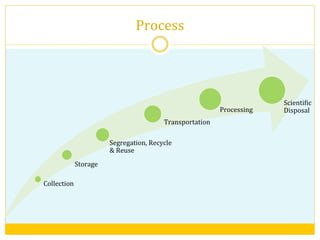
Process	
  
Collection	
  
Storage	
  
Segregation,	
  Recycle	
  
&	
  Reuse	
  
Transportation	
  
Processing	
  
ScientiVic	
  
Disposal	
  
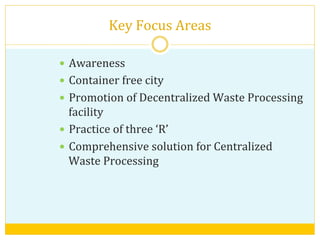
Key	
  Focus	
  Areas	
  
—  Awareness	
  	
  
—  Container	
  free	
  city	
  
—  Promotion	
  of	
  Decentralized	
  Waste	
  Processing	
  
facility	
  
—  Practice	
  of	
  three	
  ‘R’	
  	
  
—  Comprehensive	
  solution	
  for	
  Centralized	
  
Waste	
  Processing	


Services	
  Provided	
  
—  Primary	
  and	
  secondary	
  collection	
  of	
  waste	
  
—  Segregation	
  and	
  storage	
  and	
  waste	
  reduction	
  
at	
  source	
  
—  Transportation	
  
—  Processing	
  and	
  disposal	
  
—  Estimate	
  and	
  analysis	
  of	
  waste	
  
—  Waste	
  minimization	
  
—  Public	
  awareness	
  and	
  enforcement	
  
—  Resource	
  management	
  
—  Prohibition	
  of	
  littering	
  
Integrating	
  Informal	
  Sector	
  –	
  SWaCH	
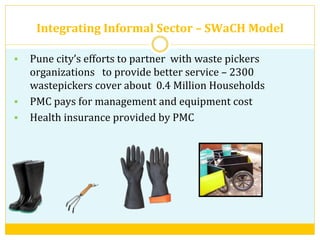
  Model	
  	
  
§  Pune	
  city’s	
  efforts	
  to	
  partner	
  	
  with	
  waste	
  pickers	
  
organizations	
  	
  	
  to	
  provide	
  better	
  service	
  –	
  2300	
  
wastepickers	
  cover	
  about	
  	
  0.4	
  Million	
  Households	
  
§  PMC	
  pays	
  for	
  management	
  and	
  equipment	
  cost	
  
§  Health	
  insurance	
  provided	
  by	
  PMC	


PMC	
  -­‐	
  SWaCH	
  MODEL	
  
Segregation	
  by	
  citizens	
  and	
  user	
  fee	
  
based	
  model	
  
Better	
  conditions	
  of	
  work	
  for	
  waste	
  
pickers	
  
Cleaner	
  waste	
  for	
  recycling	
  industry	
  
Reduction	
  in	
  municipal	
  expenses	
  for	
  
waste	
  management	
  
Compliance	
  of	
  MSW	
  2000	
  rules	
  	
  
Decentralized	
  waste	
  management	
  and	
  
processing	
  
Climate	
  change	
  mitigation	
  
Poverty	
  Alleviation	
  
Public	
  Private	
  Partnership	
  
Better	
  waste	
  	
  management	


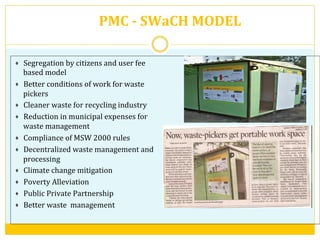
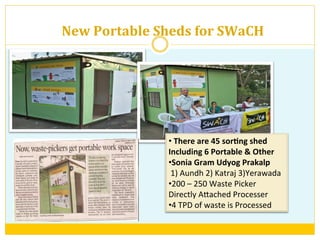
New	
  Portable	
  Sheds	
  for	
  SWaCH	
  
• 	
  There	
  are	
  45	
  sor+ng	
  shed	
  
Including	
  6	
  Portable	
  &	
  Other	
  
• Sonia	
  Gram	
  Udyog	
  Prakalp	
  
	
  1)	
  Aundh	
  2)	
  Katraj	
  3)Yerawada	
  
• 200	
  –	
  250	
  Waste	
  Picker	
  
Directly	
  AAached	
  Processer	
  	
  
• 4	
  TPD	
  of	
  waste	
  is	
  Processed	
  
What	
  is	
  Zero	
  Waste?	
  
—  “Zero	
  waste”	
  means	
  that	
  garbage	
  should	
  be	
  reused	
  
locally	
  to	
  avoid	
  sending	
  the	
  trash	
  to	
  landVills.	
  
¡  Alleviates	
  both	
  environmental	
  issues	
  related	
  to	
  landVills	
  as	
  well	
  
as	
  city	
  maintenance	
  costs.	
  
—  How	
  to	
  reuse:	
  Enhanced	
  recycling	
  of	
  plastic,	
  glass,	
  
metal	
  and	
  paper	
  and	
  harness	
  potential	
  of	
  organic	
  
waste	
  through	
  investment	
  in	
  biogas,	
  composting	
  and	
  
other	
  technologies.	
  
¡  Ultimate	
  goal:	
  Create	
  value	
  out	
  of	
  waste	
  to	
  produce	
  a	
  paradigm	
  
shift	
  from	
  garbage	
  as	
  disposable	
  to	
  garbage	
  as	
  a	
  renewable	
  
resource.	
  
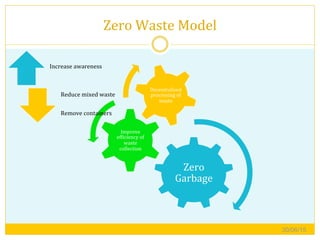
Zero	
  Waste	
  Model	
  
30/06/15
Zero	
  
Garbage	
  
Improve	
  
efViciency	
  of	
  
waste	
  
collection	
  
Decentralised	
  
processing	
  of	
  
waste	
  
Increase	
  awareness	
  
Reduce	
  mixed	
  waste	


Remove	
  containers	
  
Zero Waste ward
v PMC	
  initiated	
  “Zero	
  Waste	
  Ward”	
  model	
  pilot	
  
project	
  in	
  PMC’s	
  Katraj	
  ward	
  in	
  2010	
  
v Till	
  date,	
  the	
  Zero	
  Waste	
  model	
  has	
  been	
  rolled	
  out	
  to	
  
20	
  Prabhags	
  covering	
  almost	
  2.61	
  Lacs	
  properties	
  
and	
  roughly	
  8.5	
  lacs	
  residents	
  
Based	
  on	
  its	
  success,	
  the	
  model	
  is	
  being	
  rolled	
  out	
  in	
  Pune	
  
Municipal	
  Corporation	
  in	
  a	
  phased	
  manner.	
  
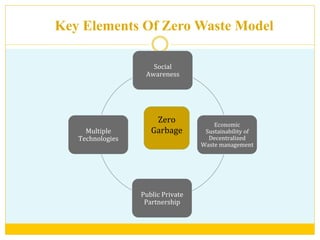
Key Elements Of Zero Waste Model
Social	
  
Awareness	
  
Economic	
  
Sustainability	
  of	


Decentralized	
  
Waste	
  management	
  	
  
Public	
  Private	
  
Partnership	
  
Multiple	
  
Technologies	
  
Zero	
  
Garbage	


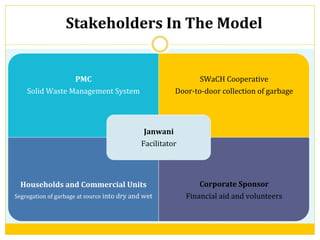
PMC	
  
Solid	
  Waste	
  Management	
  System	
  
SWaCH	
  Cooperative	
  	
  
Door-­‐to-­‐door	
  collection	
  of	
  garbage	
  
Households	
  and	
  Commercial	
  Units	
  
Segregation	
  of	
  garbage	
  at	
  source	
  into	
  dry	
  and	
  wet	
  
Corporate	
  Sponsor	
  
Financial	
  aid	
  and	
  volunteers	
  
Janwani	
  	
  
Facilitator	
  
Stakeholders	
  In	
  The	
  Model	
  
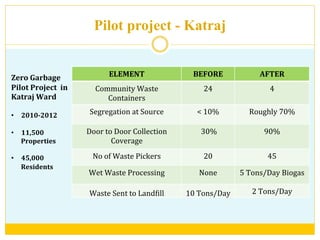
Pilot project - Katraj	


Zero	
  Garbage	
  
Pilot	
  Project	
  	
  in	
  
Katraj	
  Ward	


•  2010-­‐2012	
  
•  11,500	
  
Properties	
  
•  45,000	
  
Residents	
  
ELEMENT	
   BEFORE	
   AFTER	
  
Community	
  Waste	
  
Containers	
  
24	
   4	
  
Segregation	
  at	
  Source	
   <	
  10%	
   Roughly	
  70%	
  
Door	
  to	
  Door	
  Collection	
  
Coverage	
  
	
  30%	
  	
   90%	
  	
  
No	
  of	
  Waste	
  Pickers	
   20	
   45	
  
Wet	
  Waste	
  Processing	
   None	
   5	
  Tons/Day	
  Biogas	
  
Waste	
  Sent	
  to	
  LandVill	
   10	
  Tons/Day	
   2	
  Tons/Day	
  
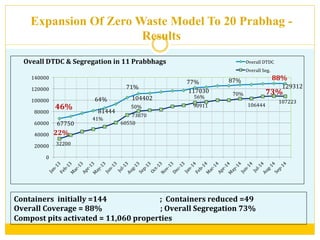
Containers	
  	
  initially	
  =144	


  ;	
  	
  Containers	
  reduced	
  =49	
  
Overall	
  Coverage	
  =	
  88%	


  ;	
  Overall	
  Segregation	
  73%	
  
Compost	
  pits	
  activated	
  =	
  11,060	
  properties	
  
67750	
  
46%	
  
81444	
  
64%	
   104402	
  
71%	
  
117030	
  
77%	
   87%	
   88%	
  
129312	
  
32200	
  
22%	
  
41%	
  
60550	
  
73870	
  
50%	
   90911	
  
56%	
  
70%	
   73%	
  
106444	
  
107223	
  
0	
  
20000	
  
40000	
  
60000	
  
80000	
  
100000	
  
120000	
  
140000	
  
Oveall	
  DTDC	
  &	
  Segregation	
  in	
  11	
  Prabbhags	
   Overall	
  DTDC	
  
Overall	
  Seg.	
  
Expansion Of Zero Waste Model To 20 Prabhag -
Results	
  
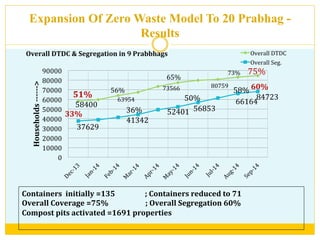
58400	
  
51%	
   63954	
  
56%	
   73566	
  
65%	
  
73%	
  
80759	
  
75%	
  
84723	
  
37629	
  
33%	
  
41342	
  
36%	
   52401	
  
50%	
  
56853	
  
58%	
  
66164	
  
60%	
  
0	
  
10000	
  
20000	
  
30000	
  
40000	
  
50000	
  
60000	
  
70000	
  
80000	
  
90000	
  
Households	
  -­‐-­‐-­‐-­‐-­‐-­‐>	
  
Overall	
  DTDC	
  &	
  Segregation	
  in	
  9	
  Prabbhags	
   Overall	
  DTDC	
  
Overall	
  Seg.	
  
Containers	
  	
  initially	
  =135	


  ;	
  Containers	
  reduced	
  to	
  71	
  
Overall	
  Coverage	
  =75%	


  ;	
  Overall	
  Segregation	
  60%	
  
Compost	
  pits	
  activated	
  =1691	
  properties	


Expansion Of Zero Waste Model To 20 Prabhag -
Results	


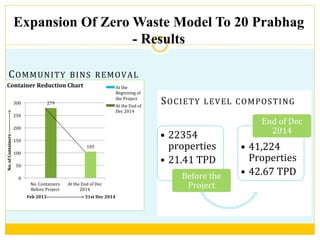
•  22354	
  
properties	
  	
  
•  21.41	
  TPD	
  
Before	
  the	
  
Project	
  	
  
•  41,224	
  
Properties	
  
•  42.67	
  TPD	
  
End	
  of	
  Dec	
  
2014	
  
COMMUNITY	
  BINS	
  REMOVAL	
  	
  
279	
  
105	
  
0	
  
50	
  
100	
  
150	
  
200	
  
250	
  
300	
  
No.	
  Containers	
  
Before	
  Project	
  
At	
  the	
  End	
  of	
  Dec	
  
2014	
  
No.	
  of	
  Containers	
  -­‐-­‐-­‐-­‐-­‐-­‐-­‐-­‐-­‐-­‐-­‐-­‐-­‐>	
  
Feb	
  2013-­‐-­‐-­‐-­‐-­‐-­‐-­‐-­‐-­‐-­‐-­‐-­‐-­‐-­‐-­‐-­‐-­‐-­‐-­‐-­‐-­‐-­‐>	
  31st	
  Dec	
  2014	
  
Container	
  Reduction	
  Chart	
   At	
  the	
  
Beginning	
  of	
  
the	
  Project	
  
At	
  the	
  End	
  of	
  
Dec	
  2014	
  
SOCIETY	
  LEVEL	
  COMPOSTING	
  
Expansion Of Zero Waste Model To 20 Prabhag
- Results	
  
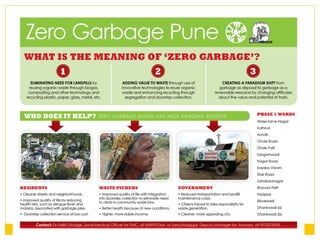
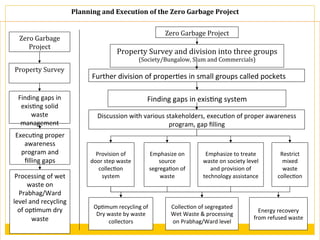
Zero	
  Garbage	
  
Project
Zero	
  Garbage	
  Project
Property	
  Survey	
  and	
  division	
  into	
  three	
  groups
(Society/Bungalow,	
  Slum	
  and	
  Commercials)
Property	
  Survey
Finding	
  gaps	
  in	
  
exisIng	
  solid	
  
waste	
  
management	
  
system
ExecuIng	
  proper	
  
awareness	
  
program	
  and	
  
filling	
  gaps
Finding	
  gaps	
  in	
  exisIng	
  system
Further	
  division	
  of	
  properIes	
  in	
  small	
  groups	
  called	
  pockets
Discussion	
  with	
  various	
  stakeholders,	
  execuIon	
  of	
  proper	
  awareness	
  
program,	
  gap	
  filling
Provision	
  of	
  
door	
  step	
  waste	
  
collecIon	
  
system
Emphasize	
  on	
  
source	
  
segregaIon	
  of	
  
waste
Restrict	
  
mixed	
  
waste	
  
collecIon
Emphasize	
  to	
  treate	
  
waste	
  on	
  society	
  level	
  
and	
  provision	
  of	
  
technology	
  assistance
OpImum	
  recycling	
  of	
  
Dry	
  waste	
  by	
  waste	
  
collectors
CollecIon	
  of	
  segregated	
  
Wet	
  Waste	
  &	
  processing	
  
on	
  Prabhag/Ward	
  level
Energy	
  recovery	
  
from	
  refused	
  waste
Processing	
  of	
  wet	
  
waste	
  on	
  
Prabhag/Ward	
  
level	
  and	
  recycling	
  
of	
  opImum	
  dry	
  
waste
Planning	
  and	
  Execution	
  of	
  the	
  Zero	
  Garbage	
  Project
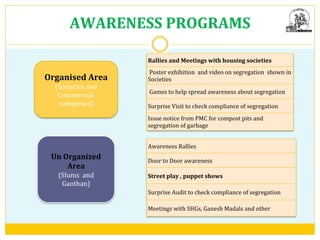
AWARENESS	
  PROGRAMS	
  
Rallies	
  and	
  Meetings	
  with	
  housing	
  societies	
  
	
  Poster	
  exhibition	
  	
  and	
  video	
  on	
  segregation	
  	
  shown	
  in	
  
Societies	
  
	
  Games	
  to	
  help	
  spread	
  awareness	
  about	
  segregation	
  
Surprise	
  Visit	
  to	
  check	
  compliance	
  of	
  segregation	
  
Issue	
  notice	
  from	
  PMC	
  for	
  compost	
  pits	
  and	
  
segregation	
  of	
  garbage	
  
Awareness	
  Rallies	
  	
  
Door	
  to	
  Door	
  awareness	
  
Street	
  play	
  ,	
  puppet	
  shows	
  
Surprise	
  Audit	
  to	
  check	
  compliance	
  of	
  segregation	
  
Meetings	
  with	
  SHGs,	
  Ganesh	
  Madals	
  and	
  other	
  	
  
Organised	
  Area	
  
(Societies	
  and	
  
Commercial	
  
complexes)	
  
Un	
  Organized	
  
Area	
  
(Slums	
  	
  and	
  
Gaothan)	
  
Segregation-­‐	
  Approach	
  
—  PPP-­‐	
  with	
  help	
  of	
  NGOs	
  and	
  waste	
  picker’s	
  Organization	
  (like	
  
SWaCH).	
  
—  Pune	
  Trash	
  Solution	
  –	
  Zero	
  Garbage	
  Ward	
  project	
  
—  Awareness-­‐	
  Through	
  IEC.	
  
—  Incentives-­‐	
  Distribution	
  of	
  dry	
  and	
  wet	
  waste	
  bins	
  to	
  
households	
  and	
  tax	
  rebate	
  for	
  practicing	
  ecofriendly	
  methods	
  
—  Bell	
  ringing	
  vehicles	
  –	
  160	
  nos	
  for	
  separate	
  collection	
  of	
  waste	
  
—  Establishment	
  	
  of	
  Separate	
  system	
  for	
  Garden	
  Cutting	
  	
  and	
  8	
  	
  
Shredder	
  Machines	
  Vixed	
  at	
  various	
  location	
  for	
  garden	
  waste	
  
processing	
  
—  Separate	
  system	
  for	
  hotel	
  waste	
  collection	
  through	
  23	
  trucks	
  
—  Post	
  2000	
  constructions	
  have	
  compulsion	
  of	
  insitu	
  wet	
  waste	
  
management	
  
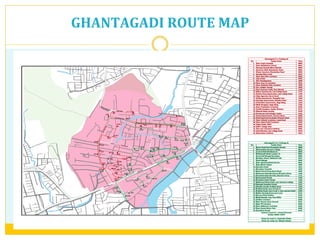
GHANTAGADI	
  ROUTE	
  MAP	


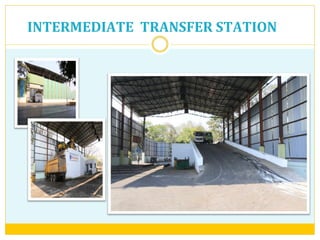
INTERMEDIATE	
  	
  TRANSFER	
  STATION	
  
CURRENT	
  PROCESSING	
  OF	
  WASTE	
  
—  Since	
  June	
  2010;	
  scientiVic	
  processing	
  and	
  scientiVic	
  landVilling.	
  
—  Decentralized	
  waste	
  processing	
  plants	
  operational	
  at	
  institutional	
  
and	
  society	
  level.	
  
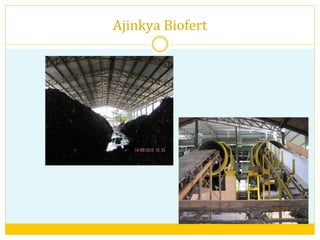
• 200	
  TPD;	
  Vermi-­‐	
  compost	
  and	
  compost	
  
• Hadapsar	
  Ramp	
  Ajinkya	
  Biofert	
  
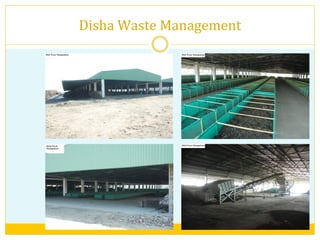
• 100	
  TPD;	
  Vermi-­‐	
  compost	
  and	
  compost	
  
• Ram	
  Tekdi	
  Industrial	
  Estate	
  
Disha	
  Waste	
  
Management	
  
• 100	
  TPD;	
  Electricity	
  and	
  Compost	
  
• 22	
  Decentralized	
  Plants	
  
Biogas	
  and	
  Mechanical	
  
Compost	
  
• 700	
  TPD;	
  Electricity	
  
• Ram	
  Tekdi,	
  Hadapsar	
  
Rochem	
  Separation	
  
Systems	
  
Ajinkya	
  Biofert	
  
Disha	
  Waste	
  Management	
  
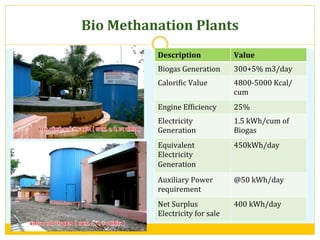
Bio	
  Methanation	
  Plants	
  
Description	
   Value	
  
Biogas	
  Generation	
   300+5%	
  m3/day	
  
CaloriVic	
  Value	
   4800-­‐5000	
  Kcal/
cum	
  
Engine	
  EfViciency	
   25%	
  
Electricity	
  
Generation	
  
1.5	
  kWh/cum	
  of	
  
Biogas	
  
Equivalent	
  
Electricity	
  	
  
Generation	
  
450kWh/day	
  
Auxiliary	
  Power	
  
requirement	
  
@50	
  kWh/day	
  
Net	
  Surplus	
  
Electricity	
  for	
  sale	
  
400	
  kWh/day	
  
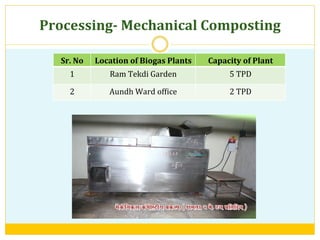
Processing-­‐	
  Mechanical	
  Composting	
  
Sr.	
  No	
   Location	
  of	
  Biogas	
  Plants	
   Capacity	
  of	
  Plant	
  
1	
   Ram	
  Tekdi	
  Garden	
   5	
  TPD	
  
2	
   Aundh	
  Ward	
  ofVice	
   2	
  TPD	
  
ScientiVic	
  Closure	
  of	
  MSW	
  Dump	
  Site	
  
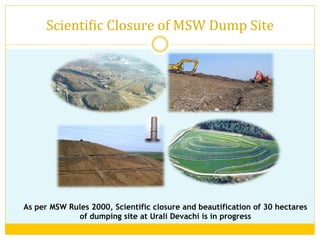
As per MSW Rules 2000, Scientific closure and beautification of 30 hectares
of dumping site at Urali Devachi is in progress


  Reducing	
  Carbon	
  Emissions	
  with	
  Eco	
  friendly	
  
technologies	
  
—  The	
  total	
  CO2	
  equivalent	
  emissions	
  could	
  have	
  been	
  5.58	
  
times	
  the	
  current	
  emissions	
  in	
  case	
  PMC	
  had	
  not	
  installed	
  
the	
  scientiVic	
  technologies	
  to	
  process	
  MSW	
  in	
  Pune	
  city	
  
Zone	
  
No	
  
Vermicomp
osting	
  Pits	
  
Bio-­‐
Sanitisers	
  
Bio-­‐
Methanisa
tion	
  
Organic	
  
Waste	
  
Converter	
  
Total	
  
Nos	
   Kgs	
   Nos	
   Kgs	
   Nos	
   Kgs	
   Nos	
   Kgs	
   No
s	
  
Kgs	
  
Zone-­‐1	
  
775	
   12754	
   223	
   2522	
   14	
   5636	
   21	
   4490	
   1033	
   22880	
  
Zone-­‐2	
  
12	
   330	
   100	
   2878	
   1	
   185	
   7	
   3120	
   121	
   6568	
  
Zone-­‐3	
  
63	
   934.5	
   396	
   3273	
   4	
   111	
   10	
   2430	
   473	
   6748.5	
  
Zone-­‐4	
  
139	
   1878	
   86	
   726	
   6	
   4200	
   4	
   1300	
   235	
   7378.3	
  
Total	
   989	
   15896.5	
   803	
   9334	
   25	
   10132	
   42	
   11340	
   1862	
   43574	
  
Decentralised	
  Wet	
  Waste	
  Processing	
  Units	
  
PPP	
  Approach	
  
Tax	
  rebate	
  given	
  by	
  PMC	
  for	
  eco-­‐friendly	
  
measures	
  practiced	
  by	
  citizen.	
  
DETAILS	
   No.	
  of	
  Properties	
  
Solar	
   4075	
  
Vermiculture	
   10429	
  
Solar	
  &	
  Vermiculture	
   7254	
  
Vermiculture	
  &	
  Rain	
  HarvesIng	
   1024	
  
TOTAL	
   22782	
  
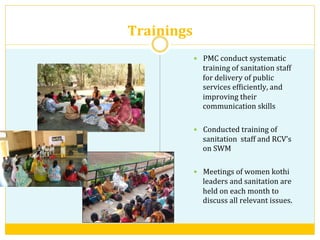
Trainings	
  	
  
—  PMC	
  conduct	
  systematic	
  
training	
  of	
  sanitation	
  staff	
  
for	
  delivery	
  of	
  public	
  
services	
  efViciently,	
  and	
  
improving	
  their	
  
communication	
  skills	
  
—  Conducted	
  training	
  of	
  	
  
sanitation	
  	
  staff	
  and	
  RCV’s	
  	
  
on	
  SWM	
  
—  Meetings	
  of	
  women	
  kothi	
  
leaders	
  and	
  sanitation	
  are	
  
held	
  on	
  each	
  month	
  to	
  
discuss	
  all	
  relevant	
  issues.	
  
Monitoring	
  mechanism	
  
—  Third	
  party	
  auditing	
  
¡  Indicators	
  deVined	
  for	
  auditing	
  
¡  Based	
  on	
  these	
  an	
  independent	
  body	
  
ensure	
  procedures	
  	
  are	
  followed	


—  Mohalla	
  Committee	
  	
  
—  Swachhta	
  mitra	
  
¡  Local	
  residents	
  become	
  involved	
  with	
  
the	
  project	
  
¡  Ensures	
  sustainability	
  of	
  the	
  project	
  
—  Reporting	
  System	
  
¡  Weekly	
  report	
  format.	
  
¡  SI	
  &	
  N.D.Squard	
  Vine	
  
collection	
  report.	
  
¡  Notices	
  to	
  Societies	
  for	
  non	
  
segregation.	
  
—  Notices	
  &	
  Vine	
  to	
  plastic	
  bag	
  
sellers.(<50	
  microns)	
  
—  Legal	
  action.	
  
—  Publication	
  of	
  Ghata	
  trucks	
  route	
  
maps	


ACHIEVMENT	
  @	
  A	
  GLANCE	
  
—  SWaCH	
  model	
  :	
  	
  
¡  Saved	
  more	
  than	
  Rs.	
  15	
  crores	
  per	
  annum	
  in	
  waste	
  handling	
  costs	
  
¡  Collect	
  recyclable	
  materials	
  that	
  amount	
  to	
  2o%	
  	
  of	
  municipal	
  solid	
  waste	
  	
  
¡  They	
  save	
  Greenhouse	
  Gas	
  Emissions	
  of	
  2,94,316	
  Metric	
  Tonnes	
  of	
  Carbon	
  Dioxide	
  Equivalent	
  (mtCO2-­‐eq)	
  per	
  
annum	
  (2006)	
  
—  Zero	
  Garbage	
  Ward	
  
¡  Improved	
  service	
  delivery	
  of	
  DTDC	
  and	
  segregation	
  of	
  waste	
  and	
  reduced	
  transportation	
  cost.	
  
¡  ISO	
  CertiVication	
  for	
  	
  Decentralized	
  Solid	
  Waste	
  Management	
  System:	
  Easy	
  to	
  transfer	
  and	
  replicate	
  
—  Energy	
  generation	
  :	
  About	
  1	
  MW	
  energy	
  from	
  100	
  tons	
  of	
  organic	
  waste	
  
using	
  biogas	
  (Pay	
  back	
  period	
  5-­‐6Years)	
  
—  About	
  2.5	
  MW	
  of	
  energy	
  from	
  	
  250	
  Tons	
  of	
  waste	
  by	
  using	
  plasma	
  
pyrolysis	
  technology	


  Less	
  space	
  required,	
  no	
  capital	
  cost,	
  and	
  share	
  in	
  Carbon	
  credits.	
  
—  100	
  percent	
  scientiVic	
  disposal	
  since	
  2010	
  and	
  no	
  open	
  Dumping	
  -­‐	
  ScientiHic	
  
land	
  Hilling	
  &	
  Capping	


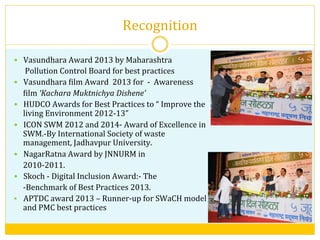
Recognition	
  	
  
—  Vasundhara	
  Award	
  2013	
  by	
  Maharashtra	


  Pollution	
  Control	
  Board	
  for	
  best	
  practices	
  	
  
—  Vasundhara	
  Vilm	
  Award	
  	
  2013	
  for	
  	
  -­‐	
  	
  Awareness	


  Vilm	
  ‘Kachara	
  Muktnichya	
  Dishene’	
  
—  HUDCO	
  Awards	
  for	
  Best	
  Practices	
  to	
  “	
  Improve	
  the	
  
living	
  Environment	
  2012-­‐13”	
  
—  ICON	
  SWM	
  2012	
  and	
  2014-­‐	
  Award	
  of	
  Excellence	
  in	
  
SWM.-­‐By	
  International	
  Society	
  of	
  waste	
  
management,	
  Jadhavpur	
  University.	
  	
  
—  NagarRatna	
  Award	
  by	
  JNNURM	
  in	


  2010-­‐2011.	
  
—  Skoch	
  -­‐	
  Digital	
  Inclusion	
  Award:-­‐	
  The	


  -­‐Benchmark	
  of	
  Best	
  Practices	
  2013.	
  
§  APTDC	
  award	
  2013	
  –	
  Runner-­‐up	
  for	
  SWaCH	
  model	
  
and	
  PMC	
  best	
  practices	


CONCLUSION	
  
Pune	
  Municipal	
  Corporation	
  has	
  a	
  head	
  start	
  in	
  MSWM	
  over	
  other	
  
ULBs	
  in	
  India.	
  
The	
   ethos	
   and	
   working	
   culture	
   of	
   the	
   MSWM	
   staff	
   at	
   all	
   levels	
   is	
  
conducive	
   to	
   up-­‐gradation	
   of	
   the	
   existing	
   treatment	
   and	
   disposal	
  
options.	
  
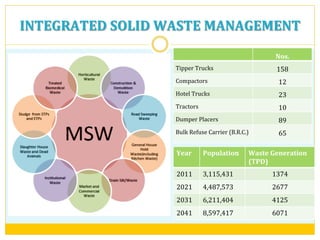
The	
   2043	
   horizon	
   will	
   require	
   management	
   of	
   about	
   6000	
   TPD	
  
waste	
  with	
  state	
  of	
  the	
  art	
  reduction	
  technologies	
  for	
  resource	
  &	
  
energy	
  recovery.	
  
Higher	
   degree	
   of	
   mechanization	
   and	
   enhanced	
   monitoring	
  
techniques	
  will	
  need	
  to	
  be	
  employed.	
  
Emphasis	
   will	
   also	
   shift	
   to	
   full	
   consumption	
   of	
   treated	
   waste	
  
products	
  within	
  the	
  city	
  limits.	


Emphasis	
  will	
  also	
  be	
  on	
  reduction	
  of	
  residues	
  to	
  go	
  into	
  landVill.	
  
CONCLUSION	
  
—  The	
  city	
  has	
  taken	
  multi	
  dimensional	
  approach	
  to	
  
overcome	
  the	
  challenges	
  of	
  urbanization.	
  
—  The	
  solution	
  lies	
  in	
  using	
  different	
  technologies	
  tailor	
  
made	
  to	
  solve	
  the	
  speciVic	
  needs	
  of	
  the	
  problems	
  at	
  
local	
  level.	
  
—  Citizen	
  and	
  Governance	
  have	
  come	
  together	
  and	
  
mutually	
  agreed	
  to	
  execute	
  solutions.	
  
—  Pune-­‐	
  An	
  Emerging	
  ECO-­‐Friendly	
  City.	


Thank You for patiently listening…

Pune’s Trash Solution: A Zero Waste City (by Kunal Kumar, Municipal Commissioner, Pune Municipal Corporation)

  • 1.
    NitiAayog–CentreForPolicyResearchOpenSeminar Series   “ConceptualisingZero-Waste in India under Swachh Bharat: Possibilities & Challenges”   Monday,29th June 2015,15:00–16:30 hrs   Room 122 Niti Aayog,Sansad Marg,New Delhi 110001  
  • 2.
      Pune’s  Trash  Solution  A  Zero  Waste  City   KUNAL KUMAR Municipal Commissioner, Pune Municipal Corporation  
  • 3.
    PUNE  CITY   Ø Pune is the 8th largest city in India and the 2nd largest in the state of Maharashtra. Ø  Population ; about 4 million Ø  Households ; nearly 1 million Ø  Area of city is 250 sq. kms. Ø  4 Zones ; 15 Administrative Ward Offices ; 76 Prabhags  
  • 4.
    BACKGROUND     Rapid  urbanization   Changing  consumer  habits   Space  constraints  for    processing       Change  in  quality  and   composition  of  waste  generated   Innovative    and  sustainable   solutions   Segregation  at  source  and   decentralised  processing  of   waste  
  • 5.
    -­‐5-­‐   6% 5% 3% 5% 33% 1% 25% 22% Paper Plastic Metal Glass Organic Leather  /  Rubber Inert  Materials Miscellaneous S  N   Source  of  generation   Quantity( MT)   %  of  total   1   Household   950   69.1   2   Street  sweeping  &   drainage  cleaning   140   10.2   3   Hotels  &restaurants   150   10.9   4   Markets  /  commercial   area   50   3.6   5   C  and  D  Waste   75   5.5   6   Fruit,  vegetable,  Vish   meat  market  waste   7.5   0.5   7   Biomedical  waste   1.8   0.1   Sources  and  Composition  of  MSW   Description   Percentage   Organic  Matter     45  to  50   Recyclables  from   Residential  &   Commercial     35  to  40   Inert  Material     10  to  15   Other  Parameters   •    Density   •    GCV   •    C/N       •  437  Kg/m3   •  937Kcal/Kg   •  22.85  
  • 6.
    INTEGRATED  SOLID  WASTE  MANAGEMENT   Nos.   Tipper  Trucks   158   Compactors   12   Hotel  Trucks   23   Tractors   10   Dumper  Placers   89   Bulk  Refuse  Carrier  (B.R.C.)   65   Year   Population     Waste  Generation   (TPD)   2011   3,115,431   1374   2021   4,487,573   2677   2031   6,211,404   4125   2041   8,597,417   6071  
  • 7.
    OVERVIEW  OF  WASTE  MANAGEMENT   Ø Pune  generates  around  1600  tons  of  solid  waste  per  day.   Ø 160  trucks  collect  waste  door-­‐to-­‐door,  collecting  an   average  of  198  tons  per  day.   Ø 847containers  and  116  compactor  buckets  dispersed   around  Pune.   Ø Ward  wise  average-­‐  350  to  750  gms  per  capita  per  day   Ø Construction  and  demolition  waste  generation  –80-­‐90   TPD   Ø Garden  waste  generation  –  50-­‐60  TPD   Ø Biomedical  waste  –  3  TPD  
  • 8.
    Service  Level   Benchmarking   -­‐8-­‐  Source:  SWM    Department  Pune  Municipal  Corporation   •  Door-­‐to-­‐door  collection  of  waste  is   only  60%  which        needs  to  be  targeted  for   100%  in  future.   •  Extent  of  segregation  of  waste  is   44%.   §  There  is  no  Mechanism  for  disposal  of   C&D  processing  waste.       §  Issues   of   scientiVic   disposal   and   Treatment  of  e-­‐waste.     §  Present  Per  capita  per  day  waste   generation  is  441  gram.   §  Future  solid  waste  generation  for   Pune  city  is  Projected  on  the  basis   of  existing  per  capita    generation     with  annually  increase  of  1.4   percent  growth  rate  for     metropolitan  cities  in  India.     Sr.   No.   Performance  Indicator   2014-­‐15   1   Household  level  coverage  of  solid   waste  management  services   80   2   EfViciency  of  collection  of  municipal   solid  waste   100   3   Extent  of  segregation  of  municipal   solid  waste   44   4   Extent  of  municipal  solid  waste   recovered   85   5   Extent  of  scientiVic  disposal  of   municipal  solid  waste   50   6   Extent  of  cost  recovery  in  solid  waste   management  services   80   7   EfViciency  in  collection  of  solid  waste   management  charges   81   8   EfViciency  in  redressal  of  customer   complaints   91  
  • 9.
    BEST  PRACTICES  TO  GENERATE  WEATH  OUT  OF   WASTE     Ø  ScientiVic  processing  and  scientiVic  land  Villing  of  waste     Ø  Integrating  Informal  Sector  in  Municipal  Solid  Waste   Management   Ø  Pune’s  Trash  Solution:  A  Zero  Garbage  City   Ø  Biomethanation  cum  power  generation  plants   Ø  Waste  to  energy  –  Plasma  gasiVication     Ø  Mandatory  onsite  disposal  in  post  2000  residential     and  commercial  schemes  
  • 10.
    —  Data  collection  for  MIS  using  Mobile  SMS  and   Biometric  attendance     —  ALERT  G-­‐Complaint  Redressal  through  citizens   participation   —  Celebration  of  Ganesh  Utasav  in    Eco  friendly     manner   Ø  Sonia  gram  udyog  prakalp  for  plastic  recycling     Ø  Shredding  and  composting    of    garden  waste     BEST  PRACTICES  (CONTIN)  
  • 11.
    Process   Collection   Storage   Segregation,  Recycle   &  Reuse   Transportation   Processing   ScientiVic   Disposal  
  • 12.
    Key  Focus  Areas   —  Awareness     —  Container  free  city   —  Promotion  of  Decentralized  Waste  Processing   facility   —  Practice  of  three  ‘R’     —  Comprehensive  solution  for  Centralized   Waste  Processing      
  • 13.
    Services  Provided   — Primary  and  secondary  collection  of  waste   —  Segregation  and  storage  and  waste  reduction   at  source   —  Transportation   —  Processing  and  disposal   —  Estimate  and  analysis  of  waste   —  Waste  minimization   —  Public  awareness  and  enforcement   —  Resource  management   —  Prohibition  of  littering  
  • 14.
    Integrating  Informal  Sector  –  SWaCH  Model     §  Pune  city’s  efforts  to  partner    with  waste  pickers   organizations      to  provide  better  service  –  2300   wastepickers  cover  about    0.4  Million  Households   §  PMC  pays  for  management  and  equipment  cost   §  Health  insurance  provided  by  PMC      
  • 15.
    PMC  -­‐  SWaCH  MODEL   Segregation  by  citizens  and  user  fee   based  model   Better  conditions  of  work  for  waste   pickers   Cleaner  waste  for  recycling  industry   Reduction  in  municipal  expenses  for   waste  management   Compliance  of  MSW  2000  rules     Decentralized  waste  management  and   processing   Climate  change  mitigation   Poverty  Alleviation   Public  Private  Partnership   Better  waste    management    
  • 16.
    New  Portable  Sheds  for  SWaCH   •   There  are  45  sor+ng  shed   Including  6  Portable  &  Other   • Sonia  Gram  Udyog  Prakalp    1)  Aundh  2)  Katraj  3)Yerawada   • 200  –  250  Waste  Picker   Directly  AAached  Processer     • 4  TPD  of  waste  is  Processed  
  • 17.
    What  is  Zero  Waste?   —  “Zero  waste”  means  that  garbage  should  be  reused   locally  to  avoid  sending  the  trash  to  landVills.   ¡  Alleviates  both  environmental  issues  related  to  landVills  as  well   as  city  maintenance  costs.   —  How  to  reuse:  Enhanced  recycling  of  plastic,  glass,   metal  and  paper  and  harness  potential  of  organic   waste  through  investment  in  biogas,  composting  and   other  technologies.   ¡  Ultimate  goal:  Create  value  out  of  waste  to  produce  a  paradigm   shift  from  garbage  as  disposable  to  garbage  as  a  renewable   resource.  
  • 18.
    Zero  Waste  Model   30/06/15 Zero   Garbage   Improve   efViciency  of   waste   collection   Decentralised   processing  of   waste   Increase  awareness   Reduce  mixed  waste     Remove  containers  
  • 20.
    Zero Waste ward v PMC  initiated  “Zero  Waste  Ward”  model  pilot   project  in  PMC’s  Katraj  ward  in  2010   v Till  date,  the  Zero  Waste  model  has  been  rolled  out  to   20  Prabhags  covering  almost  2.61  Lacs  properties   and  roughly  8.5  lacs  residents   Based  on  its  success,  the  model  is  being  rolled  out  in  Pune   Municipal  Corporation  in  a  phased  manner.  
  • 21.
    Key Elements OfZero Waste Model Social   Awareness   Economic   Sustainability  of       Decentralized   Waste  management     Public  Private   Partnership   Multiple   Technologies   Zero   Garbage      
  • 22.
    PMC   Solid  Waste  Management  System   SWaCH  Cooperative     Door-­‐to-­‐door  collection  of  garbage   Households  and  Commercial  Units   Segregation  of  garbage  at  source  into  dry  and  wet   Corporate  Sponsor   Financial  aid  and  volunteers   Janwani     Facilitator   Stakeholders  In  The  Model  
  • 23.
    Pilot project -Katraj       Zero  Garbage   Pilot  Project    in   Katraj  Ward                                                   •  2010-­‐2012   •  11,500   Properties   •  45,000   Residents   ELEMENT   BEFORE   AFTER   Community  Waste   Containers   24   4   Segregation  at  Source   <  10%   Roughly  70%   Door  to  Door  Collection   Coverage    30%     90%     No  of  Waste  Pickers   20   45   Wet  Waste  Processing   None   5  Tons/Day  Biogas   Waste  Sent  to  LandVill   10  Tons/Day   2  Tons/Day  
  • 24.
    Containers    initially  =144                                                            ;    Containers  reduced  =49   Overall  Coverage  =  88%                                                                  ;  Overall  Segregation  73%   Compost  pits  activated  =  11,060  properties   67750   46%   81444   64%   104402   71%   117030   77%   87%   88%   129312   32200   22%   41%   60550   73870   50%   90911   56%   70%   73%   106444   107223   0   20000   40000   60000   80000   100000   120000   140000   Oveall  DTDC  &  Segregation  in  11  Prabbhags   Overall  DTDC   Overall  Seg.   Expansion Of Zero Waste Model To 20 Prabhag - Results  
  • 25.
    58400   51%  63954   56%   73566   65%   73%   80759   75%   84723   37629   33%   41342   36%   52401   50%   56853   58%   66164   60%   0   10000   20000   30000   40000   50000   60000   70000   80000   90000   Households  -­‐-­‐-­‐-­‐-­‐-­‐>   Overall  DTDC  &  Segregation  in  9  Prabbhags   Overall  DTDC   Overall  Seg.   Containers    initially  =135                                  ;  Containers  reduced  to  71   Overall  Coverage  =75%                                          ;  Overall  Segregation  60%   Compost  pits  activated  =1691  properties     Expansion Of Zero Waste Model To 20 Prabhag - Results  
  • 26.
        •  22354   properties     •  21.41  TPD   Before  the   Project     •  41,224   Properties   •  42.67  TPD   End  of  Dec   2014   COMMUNITY  BINS  REMOVAL     279   105   0   50   100   150   200   250   300   No.  Containers   Before  Project   At  the  End  of  Dec   2014   No.  of  Containers  -­‐-­‐-­‐-­‐-­‐-­‐-­‐-­‐-­‐-­‐-­‐-­‐-­‐>   Feb  2013-­‐-­‐-­‐-­‐-­‐-­‐-­‐-­‐-­‐-­‐-­‐-­‐-­‐-­‐-­‐-­‐-­‐-­‐-­‐-­‐-­‐-­‐>  31st  Dec  2014   Container  Reduction  Chart   At  the   Beginning  of   the  Project   At  the  End  of   Dec  2014   SOCIETY  LEVEL  COMPOSTING   Expansion Of Zero Waste Model To 20 Prabhag - Results  
  • 27.
    Zero  Garbage   Project Zero  Garbage  Project Property  Survey  and  division  into  three  groups (Society/Bungalow,  Slum  and  Commercials) Property  Survey Finding  gaps  in   exisIng  solid   waste   management   system ExecuIng  proper   awareness   program  and   filling  gaps Finding  gaps  in  exisIng  system Further  division  of  properIes  in  small  groups  called  pockets Discussion  with  various  stakeholders,  execuIon  of  proper  awareness   program,  gap  filling Provision  of   door  step  waste   collecIon   system Emphasize  on   source   segregaIon  of   waste Restrict   mixed   waste   collecIon Emphasize  to  treate   waste  on  society  level   and  provision  of   technology  assistance OpImum  recycling  of   Dry  waste  by  waste   collectors CollecIon  of  segregated   Wet  Waste  &  processing   on  Prabhag/Ward  level Energy  recovery   from  refused  waste Processing  of  wet   waste  on   Prabhag/Ward   level  and  recycling   of  opImum  dry   waste Planning  and  Execution  of  the  Zero  Garbage  Project
  • 28.
    AWARENESS  PROGRAMS   Rallies  and  Meetings  with  housing  societies    Poster  exhibition    and  video  on  segregation    shown  in   Societies    Games  to  help  spread  awareness  about  segregation   Surprise  Visit  to  check  compliance  of  segregation   Issue  notice  from  PMC  for  compost  pits  and   segregation  of  garbage   Awareness  Rallies     Door  to  Door  awareness   Street  play  ,  puppet  shows   Surprise  Audit  to  check  compliance  of  segregation   Meetings  with  SHGs,  Ganesh  Madals  and  other     Organised  Area   (Societies  and   Commercial   complexes)   Un  Organized   Area   (Slums    and   Gaothan)  
  • 29.
    Segregation-­‐  Approach   — PPP-­‐  with  help  of  NGOs  and  waste  picker’s  Organization  (like   SWaCH).   —  Pune  Trash  Solution  –  Zero  Garbage  Ward  project   —  Awareness-­‐  Through  IEC.   —  Incentives-­‐  Distribution  of  dry  and  wet  waste  bins  to   households  and  tax  rebate  for  practicing  ecofriendly  methods   —  Bell  ringing  vehicles  –  160  nos  for  separate  collection  of  waste   —  Establishment    of  Separate  system  for  Garden  Cutting    and  8     Shredder  Machines  Vixed  at  various  location  for  garden  waste   processing   —  Separate  system  for  hotel  waste  collection  through  23  trucks   —  Post  2000  constructions  have  compulsion  of  insitu  wet  waste   management  
  • 30.
  • 31.
  • 32.
    CURRENT  PROCESSING  OF  WASTE   —  Since  June  2010;  scientiVic  processing  and  scientiVic  landVilling.   —  Decentralized  waste  processing  plants  operational  at  institutional   and  society  level.   • 200  TPD;  Vermi-­‐  compost  and  compost   • Hadapsar  Ramp  Ajinkya  Biofert   • 100  TPD;  Vermi-­‐  compost  and  compost   • Ram  Tekdi  Industrial  Estate   Disha  Waste   Management   • 100  TPD;  Electricity  and  Compost   • 22  Decentralized  Plants   Biogas  and  Mechanical   Compost   • 700  TPD;  Electricity   • Ram  Tekdi,  Hadapsar   Rochem  Separation   Systems  
  • 33.
  • 34.
  • 35.
    Bio  Methanation  Plants   Description   Value   Biogas  Generation   300+5%  m3/day   CaloriVic  Value   4800-­‐5000  Kcal/ cum   Engine  EfViciency   25%   Electricity   Generation   1.5  kWh/cum  of   Biogas   Equivalent   Electricity     Generation   450kWh/day   Auxiliary  Power   requirement   @50  kWh/day   Net  Surplus   Electricity  for  sale   400  kWh/day  
  • 36.
    Processing-­‐  Mechanical  Composting   Sr.  No   Location  of  Biogas  Plants   Capacity  of  Plant   1   Ram  Tekdi  Garden   5  TPD   2   Aundh  Ward  ofVice   2  TPD  
  • 37.
    ScientiVic  Closure  of  MSW  Dump  Site   As per MSW Rules 2000, Scientific closure and beautification of 30 hectares of dumping site at Urali Devachi is in progress
  • 38.
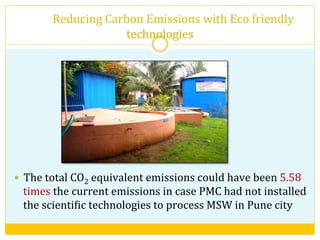
                     Reducing  Carbon  Emissions  with  Eco  friendly   technologies   —  The  total  CO2  equivalent  emissions  could  have  been  5.58   times  the  current  emissions  in  case  PMC  had  not  installed   the  scientiVic  technologies  to  process  MSW  in  Pune  city  
  • 39.
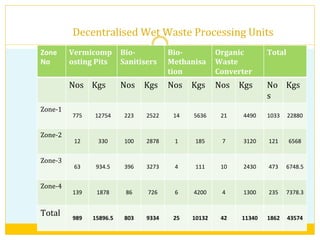
    Zone   No   Vermicomp osting  Pits   Bio-­‐ Sanitisers   Bio-­‐ Methanisa tion   Organic   Waste   Converter   Total   Nos   Kgs   Nos   Kgs   Nos   Kgs   Nos   Kgs   No s   Kgs   Zone-­‐1   775   12754   223   2522   14   5636   21   4490   1033   22880   Zone-­‐2   12   330   100   2878   1   185   7   3120   121   6568   Zone-­‐3   63   934.5   396   3273   4   111   10   2430   473   6748.5   Zone-­‐4   139   1878   86   726   6   4200   4   1300   235   7378.3   Total   989   15896.5   803   9334   25   10132   42   11340   1862   43574   Decentralised  Wet  Waste  Processing  Units  
  • 40.
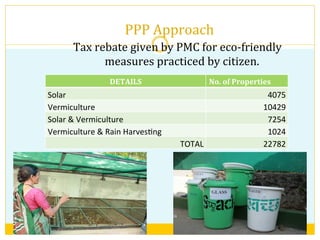
    PPP  Approach   Tax  rebate  given  by  PMC  for  eco-­‐friendly   measures  practiced  by  citizen.   DETAILS   No.  of  Properties   Solar   4075   Vermiculture   10429   Solar  &  Vermiculture   7254   Vermiculture  &  Rain  HarvesIng   1024   TOTAL   22782  
  • 41.
    Trainings     — PMC  conduct  systematic   training  of  sanitation  staff   for  delivery  of  public   services  efViciently,  and   improving  their   communication  skills   —  Conducted  training  of     sanitation    staff  and  RCV’s     on  SWM   —  Meetings  of  women  kothi   leaders  and  sanitation  are   held  on  each  month  to   discuss  all  relevant  issues.  
  • 42.
    Monitoring  mechanism   — Third  party  auditing   ¡  Indicators  deVined  for  auditing   ¡  Based  on  these  an  independent  body   ensure  procedures    are  followed     —  Mohalla  Committee     —  Swachhta  mitra   ¡  Local  residents  become  involved  with   the  project   ¡  Ensures  sustainability  of  the  project   —  Reporting  System   ¡  Weekly  report  format.   ¡  SI  &  N.D.Squard  Vine   collection  report.   ¡  Notices  to  Societies  for  non   segregation.   —  Notices  &  Vine  to  plastic  bag   sellers.(<50  microns)   —  Legal  action.   —  Publication  of  Ghata  trucks  route   maps    
  • 43.
    ACHIEVMENT  @  A  GLANCE   —  SWaCH  model  :     ¡  Saved  more  than  Rs.  15  crores  per  annum  in  waste  handling  costs   ¡  Collect  recyclable  materials  that  amount  to  2o%    of  municipal  solid  waste     ¡  They  save  Greenhouse  Gas  Emissions  of  2,94,316  Metric  Tonnes  of  Carbon  Dioxide  Equivalent  (mtCO2-­‐eq)  per   annum  (2006)   —  Zero  Garbage  Ward   ¡  Improved  service  delivery  of  DTDC  and  segregation  of  waste  and  reduced  transportation  cost.   ¡  ISO  CertiVication  for    Decentralized  Solid  Waste  Management  System:  Easy  to  transfer  and  replicate   —  Energy  generation  :  About  1  MW  energy  from  100  tons  of  organic  waste   using  biogas  (Pay  back  period  5-­‐6Years)   —  About  2.5  MW  of  energy  from    250  Tons  of  waste  by  using  plasma   pyrolysis  technology              Less  space  required,  no  capital  cost,  and  share  in  Carbon  credits.   —  100  percent  scientiVic  disposal  since  2010  and  no  open  Dumping  -­‐  ScientiHic   land  Hilling  &  Capping      
  • 44.
    Recognition     — Vasundhara  Award  2013  by  Maharashtra                Pollution  Control  Board  for  best  practices     —  Vasundhara  Vilm  Award    2013  for    -­‐    Awareness                Vilm  ‘Kachara  Muktnichya  Dishene’   —  HUDCO  Awards  for  Best  Practices  to  “  Improve  the   living  Environment  2012-­‐13”   —  ICON  SWM  2012  and  2014-­‐  Award  of  Excellence  in   SWM.-­‐By  International  Society  of  waste   management,  Jadhavpur  University.     —  NagarRatna  Award  by  JNNURM  in              2010-­‐2011.   —  Skoch  -­‐  Digital  Inclusion  Award:-­‐  The              -­‐Benchmark  of  Best  Practices  2013.   §  APTDC  award  2013  –  Runner-­‐up  for  SWaCH  model   and  PMC  best  practices    
  • 45.
    CONCLUSION   Pune  Municipal  Corporation  has  a  head  start  in  MSWM  over  other   ULBs  in  India.   The   ethos   and   working   culture   of   the   MSWM   staff   at   all   levels   is   conducive   to   up-­‐gradation   of   the   existing   treatment   and   disposal   options.   The   2043   horizon   will   require   management   of   about   6000   TPD   waste  with  state  of  the  art  reduction  technologies  for  resource  &   energy  recovery.   Higher   degree   of   mechanization   and   enhanced   monitoring   techniques  will  need  to  be  employed.   Emphasis   will   also   shift   to   full   consumption   of   treated   waste   products  within  the  city  limits.         Emphasis  will  also  be  on  reduction  of  residues  to  go  into  landVill.  
  • 46.
    CONCLUSION   —  The  city  has  taken  multi  dimensional  approach  to   overcome  the  challenges  of  urbanization.   —  The  solution  lies  in  using  different  technologies  tailor   made  to  solve  the  speciVic  needs  of  the  problems  at   local  level.   —  Citizen  and  Governance  have  come  together  and   mutually  agreed  to  execute  solutions.   —  Pune-­‐  An  Emerging  ECO-­‐Friendly  City.      
  • 47.
    Thank You forpatiently listening…