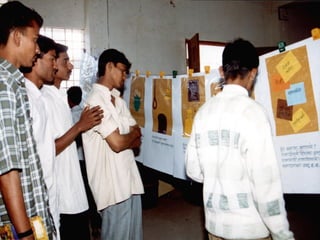
STREE MUKTI SANGHATANA
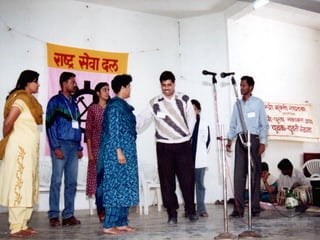
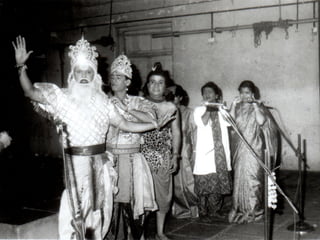
A LEADING WOMEN’S ORGANISATION
ESTD. IN 1975 IN MUMBAI
FOR THE UPLIFTMENT OF
SOCIETY IN GENERALAND
WOMEN IN PARTICULAR
ACCREDITATION WITH
ECOSOC ( UN)
Parisar Vikas
Human Face of Solid Waste
Management
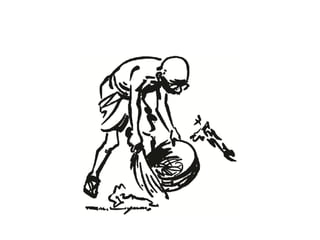
Who is waste picker?
• Women or children engaged in ‘illegal’
work
• Migrants from traditionally backward
caste in some regions (Mahar, neo-
Buddhists, Matang,Chambhar from
Marathwada ,Tamilnadu and Karnataka)
• known only by her sack and rod in hand
to pick up her dry waste and to protect
herself from animals like rats, dogs and
……
• Looked down as thief or nuisance by
Municipal workers and Citizens
• Migrant women who tend towards this
low-paying, low investment work
• No fixed hours, N0 investment
• Anonymous,
• lack of documents and lack of
awareness of processes.
• Most difficult to organise
.
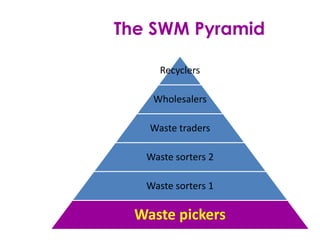
The SWM Pyramid
Recyclers
Wholesalers
Waste traders
Waste sorters 2
Waste sorters 1
Waste pickers
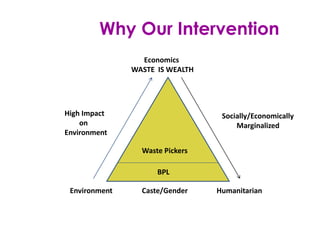
Why Our Intervention
High Impact
on
Environment
Socially/Economically
Marginalized
Caste/Gender Humanitarian
Economics
WASTE IS WEALTH
Environment
Waste Pickers
BPL
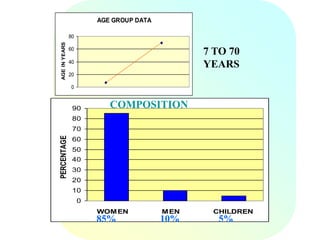
AGE GROUP DATA
0
20
40
60
80
AGEINYEARS
7 TO 70
YEARS
0
10
20
30
40
50
60
70
80
90
WOMEN MEN CHILDREN
PERCENTAGE
85% 10% 5%
COMPOSITION
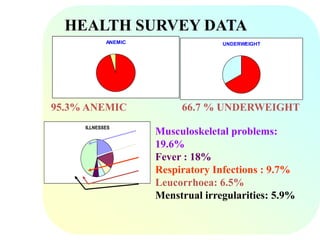
ANEMIC UNDERWEIGHT
ILLNESSES
HEALTH SURVEY DATA
95.3% ANEMIC 66.7 % UNDERWEIGHT
Musculoskeletal problems:
19.6%
Fever : 18%
Respiratory Infections : 9.7%
Leucorrhoea: 6.5%
Menstrual irregularities: 5.9%
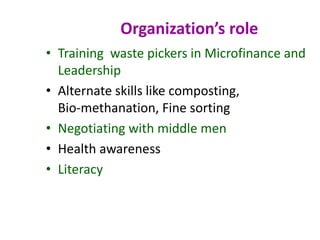
• Training waste pickers in Microfinance and
Leadership
• Alternate skills like composting,
Bio-methanation, Fine sorting
• Negotiating with middle men
• Health awareness
• Literacy
Organization’s role
• 5000 women are organized in 5 cities
in 500 self help groups.
• Self help groups are bound into
federations
• Parisar Bhagini Vikas Sangha
• 10 cooperatives have been formed
( 30-50 women each) to secure contracts
Organizational structure
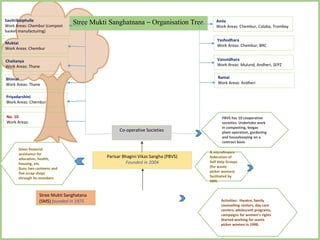
​Parisar Bhagini Vikas Sangha (PBVS)
Founded in 2004
Stree Mukti Sanghatnana – Organisation Tree
Stree Mukti Sanghatana
(SMS) founded in 1975
Co-operative Societies
Activities: theatre, family
counselling centers, day care
centers, adolescent programs,
campaigns for women’s rights
Started working for waste
picker women in 1998.
A microfinance
federation of
Self Help Groups
(for waste
picker women)
facilitated by
SMS.
Gives financial
assistance for
education, health,
housing, etc.
Runs two canteens and
five scrap shops
through its members
PBVS has 10 cooperative
societies. Undertake work
in composting, biogas
plant operation, gardening
and housekeeping on a
contract basis
Amla
Work Areas: Chembur, Colaba, Trombay
Yashodhara
Work Areas: Chembur, BRC
Vasundhara
Work Areas: Mulund, Andheri, SEPZ
Ramai
Work Areas: Andheri
Bhimai
Work Areas: Thane
Muktai
Work Areas: Chembur
Chaitanya
Work Areas: Thane
Savitribaiphulle
Work Areas: Chembur (compost
basket manufacturing)
Priyadarshini
Work Areas: Chembur
No. 10
Work Areas:
• Securing of work contracts
• Running of scrap shops
Providing
• Educational and Health facilities for
them and their children
• Group Insurance
• Inclusion of waste pickers as special
group in PDS (antyoday)
Organization’s role
Organization’s role
• Interface with Municipal Corporations
Access to resources
• Household survey of these women for BPL
status and their inclusion (200 groups and
2000 women so far) under SJSRY
Permission for issuing of identity cards
• Grant of Rs.10,000/- to each group as
running capital to start their micro
enterprises
Organization’s role
• Formation of federation of groups known
as Parisar Bhagini Vikas Sangha (PBVS).
Registration of the federation under
Charitable Trusts Act and recognition of the
PBVS as a Community Development
Society.
• Provision of a tempo-vehicles for
collection of dry waste and inclusion of
Parisar Bhaginis in such schemes in five-
municipal wards
• Recognition to SMS as the training Institute
for waste pickers
Organization’s role
• Vocational training of women under SJSRY
• Under infrastructure development of SJSRY,
sanction to construct sheds in five wards
for storage of dry waste which will operate
on Cooperative basis under the aegis of
PBVS
• Approval of design submitted by SMS for
the composting of wet waste in pits
measuring 5’x 3’x 2’
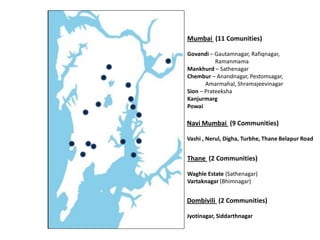
Mumbai (11 Comunities)
Govandi – Gautamnagar, Rafiqnagar,
Ramanmama
Mankhurd – Sathenagar
Chembur – Anandnagar, Pestomsagar,
Amarmahal, Shramajeevinagar
Sion – Prateeksha
Kanjurmarg
Powai
Navi Mumbai (9 Communities)
Vashi , Nerul, Digha, Turbhe, Thane Belapur Road
Thane (2 Communities)
Waghle Estate (Sathenagar)
Vartaknagar (Bhimnagar)
Dombivili (2 Communities)
Jyotinagar, Siddarthnagar
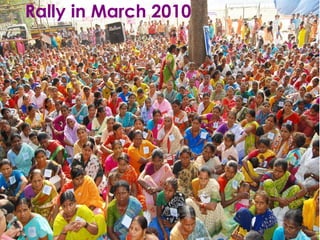
Rally in March 2010
AIW efforts : Policy
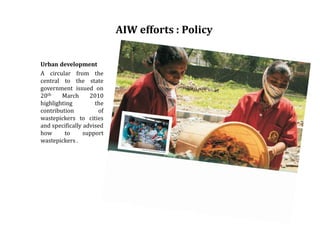
Urban development
A circular from the
central to the state
government issued on
20th March 2010
highlighting the
contribution of
wastepickers to cities
and specifically advised
how to support
wastepickers .
AIW efforts : Policy
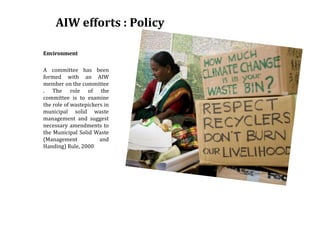
Environment
A committee has been
formed with an AIW
member on the committee
. The role of the
committee is to examine
the role of wastepickers in
municipal solid waste
management and suggest
necessary amendments to
the Municipal Solid Waste
(Management and
Handing) Rule, 2000
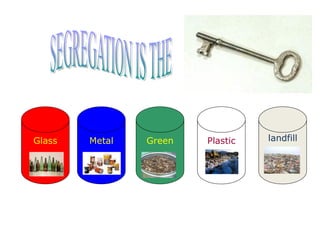
Glass Metal Green Plastic landfill
Contribution of waste pickers to the
city
Reduction in Waste Handling
Reduction in transport costs
Supply of raw material to
Recycling factories
Saving space at Dumping Ground
Resource recovery in form of
valuable compost
Conservation of environment
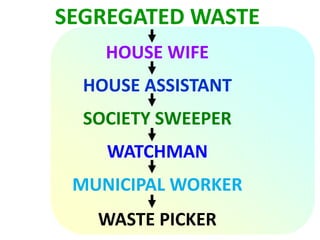
SEGREGATED WASTE
HOUSE WIFE
HOUSE ASSISTANT
SOCIETY SWEEPER
WATCHMAN
MUNICIPAL WORKER
WASTE PICKER
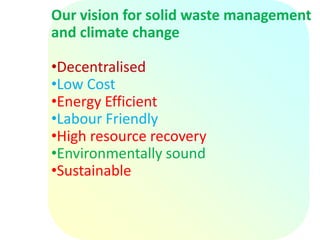
Our vision for solid waste management
and climate change
•Decentralised
•Low Cost
•Energy Efficient
•Labour Friendly
•High resource recovery
•Environmentally sound
•Sustainable
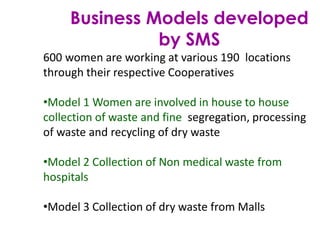
Business Models developed
by SMS
600 women are working at various 190 locations
through their respective Cooperatives
•Model 1 Women are involved in house to house
collection of waste and fine segregation, processing
of waste and recycling of dry waste
•Model 2 Collection of Non medical waste from
hospitals
•Model 3 Collection of dry waste from Malls
• Lack of awareness amongst general public
• Apathy towards poor
• Not in my back yard (NIMBY) attitude
• Out of site out of mind
• Reluctance for segregation at source
• Promotion of wastepicking?
The Hurdles at the Societal
Level
Business Models developed
by SMS
•Model 4 Maintenance of Biogas plants
Model 5 Collection of Post consumer tetra Pak
Cartons and sending them to recycler
Model 6 Collection of dry waste from
Special Economic zone and disposal
Business Models developed
By SMS
Model 7 Collection of dry waste from
Corporates and providing them recycled paper
Model 8 Collection of dry waste with Municipal
vehicle
Model 9 Collection of waste from school and college
campuses
• Independent Self Employed
Workers to service providers.
• Steady Income
• Fixed Hours Health Care
• Compulsory Saving
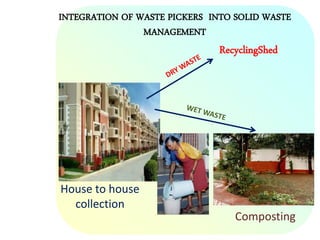
INTEGRATION OF WASTE PICKERS INTO SOLID WASTE
MANAGEMENT
RecyclingShed
House to house
collection
Composting
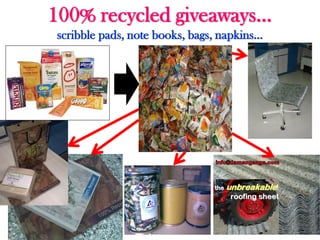
100% recycled giveaways…
scribble pads, note books, bags, napkins…
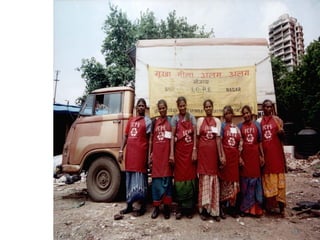
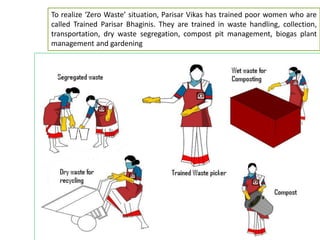
To realize ‘Zero Waste’ situation, Parisar Vikas has trained poor women who are
called Trained Parisar Bhaginis. They are trained in waste handling, collection,
transportation, dry waste segregation, compost pit management, biogas plant
management and gardening
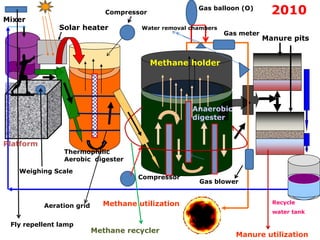
Anaerobic
digester
Thermophilic
Aerobic digester
Recycle
water tank
Methane utilization
Methane holder
Manure pits
Platform
Mixer
Solar heater
Compressor
Compressor
Gas blower
Gas meter
Weighing Scale
Fly repellent lamp
Gas balloon (O)
Water removal chambers
Manure utilization
Methane recycler
2010
Aeration grid
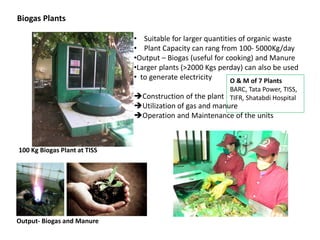
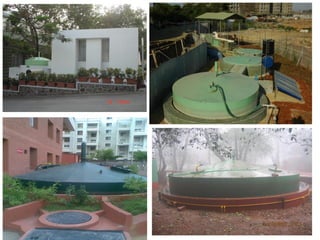
Biogas Plants
Output- Biogas and Manure
• Suitable for larger quantities of organic waste
• Plant Capacity can rang from 100- 5000Kg/day
•Output – Biogas (useful for cooking) and Manure
•Larger plants (>2000 Kgs perday) can also be used
• to generate electricity
Construction of the plant
Utilization of gas and manure
Operation and Maintenance of the units
O & M of 7 Plants
BARC, Tata Power, TISS,
TIFR, Shatabdi Hospital
100 Kg Biogas Plant at TISS
• Illiteracy
• Poverty-double duty
• Lack of work culture
• Distance between home and work
place
• Availability of waste on the streets
• Low income
• Gender bias and gender stereo types
within the recycling industry
The Hurdles at the waste
picker level
• Vested interests in transport of waste
• Threat from privatization of waste
management.
• Preference for Centralized Waste
Management – high on technological
solutions while ignoring human interest
• Promotion of highly hazardous and
environmentally-unfriendly incineration
technologies
The Macro Hurdle at the
Policy Level
Future Plans
• Greater visibility within the urban poor and
informal workers sector
• Social security for the aged and vulnerable
waste pickers and their family
• Accessing benefits under various existing
schemes for Pension, education, health
etc., schemes for the migrant, illiterate
citizens of the city
• School admissions under RTE
• Benefits at private and
Government hospitals
• Social security schemes for the
aged, disabled, widows.
• Empower waste pickers’ federation
and cooperatives to become
economically independent and self-
sustaining
• Restriction of the role of SMS as
trainer, advisor and facilitator
• The constant Endeavour would be to
mainstream waste pickers into the
larger SWM cycle
Thanks
Jyoti Mhapsekar
Stree Mukti Sanghatana
Parisar Vikas
smsmum@gmail.com
www.streemuktisanghatana.org

Stree Mukti Sanghatana

  • 1.
    STREE MUKTI SANGHATANA ALEADING WOMEN’S ORGANISATION ESTD. IN 1975 IN MUMBAI FOR THE UPLIFTMENT OF SOCIETY IN GENERALAND WOMEN IN PARTICULAR ACCREDITATION WITH ECOSOC ( UN)
  • 10.
    Parisar Vikas Human Faceof Solid Waste Management
  • 11.
    Who is wastepicker? • Women or children engaged in ‘illegal’ work • Migrants from traditionally backward caste in some regions (Mahar, neo- Buddhists, Matang,Chambhar from Marathwada ,Tamilnadu and Karnataka)
  • 12.
    • known onlyby her sack and rod in hand to pick up her dry waste and to protect herself from animals like rats, dogs and …… • Looked down as thief or nuisance by Municipal workers and Citizens • Migrant women who tend towards this low-paying, low investment work
  • 13.
    • No fixedhours, N0 investment • Anonymous, • lack of documents and lack of awareness of processes. • Most difficult to organise .
  • 15.
    The SWM Pyramid Recyclers Wholesalers Wastetraders Waste sorters 2 Waste sorters 1 Waste pickers
  • 16.
    Why Our Intervention HighImpact on Environment Socially/Economically Marginalized Caste/Gender Humanitarian Economics WASTE IS WEALTH Environment Waste Pickers BPL
  • 17.
    AGE GROUP DATA 0 20 40 60 80 AGEINYEARS 7TO 70 YEARS 0 10 20 30 40 50 60 70 80 90 WOMEN MEN CHILDREN PERCENTAGE 85% 10% 5% COMPOSITION
  • 18.
    ANEMIC UNDERWEIGHT ILLNESSES HEALTH SURVEYDATA 95.3% ANEMIC 66.7 % UNDERWEIGHT Musculoskeletal problems: 19.6% Fever : 18% Respiratory Infections : 9.7% Leucorrhoea: 6.5% Menstrual irregularities: 5.9%
  • 19.
    • Training wastepickers in Microfinance and Leadership • Alternate skills like composting, Bio-methanation, Fine sorting • Negotiating with middle men • Health awareness • Literacy Organization’s role
  • 20.
    • 5000 womenare organized in 5 cities in 500 self help groups. • Self help groups are bound into federations • Parisar Bhagini Vikas Sangha • 10 cooperatives have been formed ( 30-50 women each) to secure contracts Organizational structure
  • 21.
    ​Parisar Bhagini VikasSangha (PBVS) Founded in 2004 Stree Mukti Sanghatnana – Organisation Tree Stree Mukti Sanghatana (SMS) founded in 1975 Co-operative Societies Activities: theatre, family counselling centers, day care centers, adolescent programs, campaigns for women’s rights Started working for waste picker women in 1998. A microfinance federation of Self Help Groups (for waste picker women) facilitated by SMS. Gives financial assistance for education, health, housing, etc. Runs two canteens and five scrap shops through its members PBVS has 10 cooperative societies. Undertake work in composting, biogas plant operation, gardening and housekeeping on a contract basis Amla Work Areas: Chembur, Colaba, Trombay Yashodhara Work Areas: Chembur, BRC Vasundhara Work Areas: Mulund, Andheri, SEPZ Ramai Work Areas: Andheri Bhimai Work Areas: Thane Muktai Work Areas: Chembur Chaitanya Work Areas: Thane Savitribaiphulle Work Areas: Chembur (compost basket manufacturing) Priyadarshini Work Areas: Chembur No. 10 Work Areas:
  • 22.
    • Securing ofwork contracts • Running of scrap shops Providing • Educational and Health facilities for them and their children • Group Insurance • Inclusion of waste pickers as special group in PDS (antyoday) Organization’s role
  • 23.
    Organization’s role • Interfacewith Municipal Corporations Access to resources • Household survey of these women for BPL status and their inclusion (200 groups and 2000 women so far) under SJSRY Permission for issuing of identity cards • Grant of Rs.10,000/- to each group as running capital to start their micro enterprises
  • 24.
    Organization’s role • Formationof federation of groups known as Parisar Bhagini Vikas Sangha (PBVS). Registration of the federation under Charitable Trusts Act and recognition of the PBVS as a Community Development Society. • Provision of a tempo-vehicles for collection of dry waste and inclusion of Parisar Bhaginis in such schemes in five- municipal wards • Recognition to SMS as the training Institute for waste pickers
  • 25.
    Organization’s role • Vocationaltraining of women under SJSRY • Under infrastructure development of SJSRY, sanction to construct sheds in five wards for storage of dry waste which will operate on Cooperative basis under the aegis of PBVS • Approval of design submitted by SMS for the composting of wet waste in pits measuring 5’x 3’x 2’
  • 26.
    Mumbai (11 Comunities) Govandi– Gautamnagar, Rafiqnagar, Ramanmama Mankhurd – Sathenagar Chembur – Anandnagar, Pestomsagar, Amarmahal, Shramajeevinagar Sion – Prateeksha Kanjurmarg Powai Navi Mumbai (9 Communities) Vashi , Nerul, Digha, Turbhe, Thane Belapur Road Thane (2 Communities) Waghle Estate (Sathenagar) Vartaknagar (Bhimnagar) Dombivili (2 Communities) Jyotinagar, Siddarthnagar
  • 27.
  • 28.
    AIW efforts :Policy Urban development A circular from the central to the state government issued on 20th March 2010 highlighting the contribution of wastepickers to cities and specifically advised how to support wastepickers .
  • 29.
    AIW efforts :Policy Environment A committee has been formed with an AIW member on the committee . The role of the committee is to examine the role of wastepickers in municipal solid waste management and suggest necessary amendments to the Municipal Solid Waste (Management and Handing) Rule, 2000
  • 30.
    Glass Metal GreenPlastic landfill
  • 31.
    Contribution of wastepickers to the city Reduction in Waste Handling Reduction in transport costs Supply of raw material to Recycling factories Saving space at Dumping Ground Resource recovery in form of valuable compost Conservation of environment
  • 32.
    SEGREGATED WASTE HOUSE WIFE HOUSEASSISTANT SOCIETY SWEEPER WATCHMAN MUNICIPAL WORKER WASTE PICKER
  • 33.
    Our vision forsolid waste management and climate change •Decentralised •Low Cost •Energy Efficient •Labour Friendly •High resource recovery •Environmentally sound •Sustainable
  • 35.
    Business Models developed bySMS 600 women are working at various 190 locations through their respective Cooperatives •Model 1 Women are involved in house to house collection of waste and fine segregation, processing of waste and recycling of dry waste •Model 2 Collection of Non medical waste from hospitals •Model 3 Collection of dry waste from Malls
  • 36.
    • Lack ofawareness amongst general public • Apathy towards poor • Not in my back yard (NIMBY) attitude • Out of site out of mind • Reluctance for segregation at source • Promotion of wastepicking? The Hurdles at the Societal Level
  • 37.
    Business Models developed bySMS •Model 4 Maintenance of Biogas plants Model 5 Collection of Post consumer tetra Pak Cartons and sending them to recycler Model 6 Collection of dry waste from Special Economic zone and disposal
  • 38.
    Business Models developed BySMS Model 7 Collection of dry waste from Corporates and providing them recycled paper Model 8 Collection of dry waste with Municipal vehicle Model 9 Collection of waste from school and college campuses
  • 39.
    • Independent SelfEmployed Workers to service providers. • Steady Income • Fixed Hours Health Care • Compulsory Saving
  • 40.
    INTEGRATION OF WASTEPICKERS INTO SOLID WASTE MANAGEMENT RecyclingShed House to house collection Composting
  • 43.
    100% recycled giveaways… scribblepads, note books, bags, napkins…
  • 44.
    To realize ‘ZeroWaste’ situation, Parisar Vikas has trained poor women who are called Trained Parisar Bhaginis. They are trained in waste handling, collection, transportation, dry waste segregation, compost pit management, biogas plant management and gardening
  • 47.
    Anaerobic digester Thermophilic Aerobic digester Recycle water tank Methaneutilization Methane holder Manure pits Platform Mixer Solar heater Compressor Compressor Gas blower Gas meter Weighing Scale Fly repellent lamp Gas balloon (O) Water removal chambers Manure utilization Methane recycler 2010 Aeration grid
  • 48.
    Biogas Plants Output- Biogasand Manure • Suitable for larger quantities of organic waste • Plant Capacity can rang from 100- 5000Kg/day •Output – Biogas (useful for cooking) and Manure •Larger plants (>2000 Kgs perday) can also be used • to generate electricity Construction of the plant Utilization of gas and manure Operation and Maintenance of the units O & M of 7 Plants BARC, Tata Power, TISS, TIFR, Shatabdi Hospital 100 Kg Biogas Plant at TISS
  • 50.
    • Illiteracy • Poverty-doubleduty • Lack of work culture • Distance between home and work place • Availability of waste on the streets • Low income • Gender bias and gender stereo types within the recycling industry The Hurdles at the waste picker level
  • 51.
    • Vested interestsin transport of waste • Threat from privatization of waste management. • Preference for Centralized Waste Management – high on technological solutions while ignoring human interest • Promotion of highly hazardous and environmentally-unfriendly incineration technologies The Macro Hurdle at the Policy Level
  • 52.
    Future Plans • Greatervisibility within the urban poor and informal workers sector • Social security for the aged and vulnerable waste pickers and their family • Accessing benefits under various existing schemes for Pension, education, health etc., schemes for the migrant, illiterate citizens of the city
  • 53.
    • School admissionsunder RTE • Benefits at private and Government hospitals • Social security schemes for the aged, disabled, widows.
  • 54.
    • Empower wastepickers’ federation and cooperatives to become economically independent and self- sustaining • Restriction of the role of SMS as trainer, advisor and facilitator • The constant Endeavour would be to mainstream waste pickers into the larger SWM cycle
  • 55.
    Thanks Jyoti Mhapsekar Stree MuktiSanghatana Parisar Vikas smsmum@gmail.com www.streemuktisanghatana.org