Members:
20BCY10223
Tuhin Bose
01
20BCE11027
Aviral Shrivastava 02
20BCG10113
Shivam Singhal 03
Shibam Karmakar
20MEI10042 04
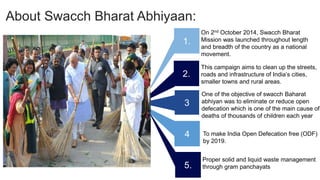
About Swacch Bharat Abhiyaan:
Proper solid and liquid waste management
through gram panchayats
On 2nd October 2014, Swacch Bharat
Mission was launched throughout length
and breadth of the country as a national
movement.
This campaign aims to clean up the streets,
roads and infrastructure of India’s cities,
smaller towns and rural areas.
One of the objective of swacch Baharat
abhiyan was to eliminate or reduce open
defecation which is one of the main cause of
deaths of thousands of children each year
To make India Open Defecation free (ODF)
by 2019.
4
3
2.
5.
1.
E- Waste
E- Waste
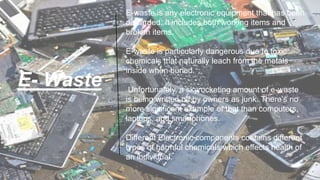
E-waste is any electronic equipment that has been
discarded. It includes both working items and
broken items.
E-waste is particularly dangerous due to toxic
chemicals that naturally leach from the metals
inside when buried.
Unfortunately, a skyrocketing amount of e-waste
is being written off by owners as junk. There’s no
more significant example of that than computers,
laptops, and smartphones.
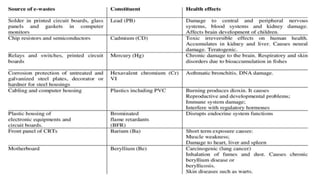
Different Electronic components contains different
types of harmful chemicals which effects health of
an individual.
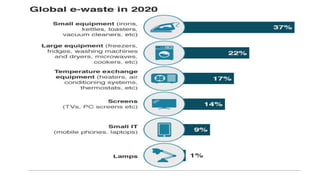
• Globally, 44.7 million tones were generated in 2016 and reached to nearly 50 million tonnes in 2018.
• Only one-fifth of the total global e-waste is collected and recycled through formal channels. The rest is dumped in
landfills or incinerated without any formal control. This results in the release of toxic chemicals such as mercury,
lead, and dioxins into the environment, as well as significant loss of valuable resources in e-waste such as gold,
copper, platinum and high-quality plastics that can be recovered, reused, and recycled.
• India is the 5th largest generator of e-waste in the world, contributing almost 2 million metric tones to the global total
in 2016. Its major cities are the largest producers, with Mumbai being the leader (120,000 metric tones/ year),
followed by Delhi (NCR), Bangalore, Chennai and Kolkata.
• Government and industry sectors generate more than 70% of e-waste, while households contribute around15%.
Delhi functions as the country’s biggest market for e-waste recycling, channeling between 30 and 40% of the total
volume.
• The major challenge for India’s policy makers is to improve the effectiveness of e-waste management and reduce
associated environmental and health risks in cities and communities. his requires finding ways to increase the
responsible disposal of e-waste by producers and users, improve recycling practices and methods of informal sector
processors, and enable technologies that are cost effective and have capacity to process large volumes of waste.
Problems
Associated with
E-Waste
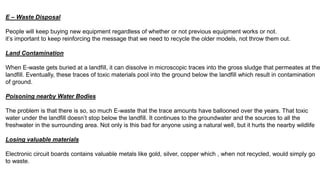
E – Waste Disposal
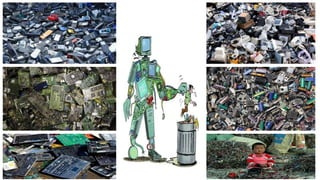
People will keep buying new equipment regardless of whether or not previous equipment works or not.
it’s important to keep reinforcing the message that we need to recycle the older models, not throw them out.
Land Contamination
When E-waste gets buried at a landfill, it can dissolve in microscopic traces into the gross sludge that permeates at the
landfill. Eventually, these traces of toxic materials pool into the ground below the landfill which result in contamination
of ground.
Poisoning nearby Water Bodies
The problem is that there is so, so much E-waste that the trace amounts have ballooned over the years. That toxic
water under the landfill doesn’t stop below the landfill. It continues to the groundwater and the sources to all the
freshwater in the surrounding area. Not only is this bad for anyone using a natural well, but it hurts the nearby wildlife
Losing valuable materials
Electronic circuit boards contains valuable metals like gold, silver, copper which , when not recycled, would simply go
to waste.
E-Waste
Regulations in
India
• The first policy effort towards addressing e-waste was the 2008 Guidelines for environmentally sound management
of e-waste, which provided information about various types of e-waste components, methods for assessing their
hazardousness, and appropriate technologies for processing or managing them.
• The second major policy introduced in 2008 was the Hazardous Wastes (Management, Handling and
Transboundary Movement) Rules, which banned the importation of e-waste to India for disposal
• In 2011, the Indian government established the E-Waste (Handling and Management) Rules, which was replaced by
the revised E-waste (Management) Rules of 2016. These rules provide the most comprehensive information
regarding the responsibilities of various players in e-waste management.
• The 2016 E-waste Rules outline the procedures for producers/manufacturers, dealers, recyclers, and dismantlers to
obtain authorization from relevant government agencies and administrative bodies to manage e-waste. They also
identify the responsibilities of collection centers, refurbishers, individual and bulk consumers for handling e-waste.
All electrical and electronic equipment and their components are classified and assigned unique e-waste codes.
Producers are prescribed recycling targets based on the amount of e-waste they generate.
E – Waste Management
E- Waste Management:
As the name says, E-waste management is literally managing E-waste.
It includes the following activities:
a) Collection of E-Waste
b) Sorting of E-waste
c) Processing of E-waste
d) Repairing of E-waste
e) Recycling
f) Dismantling
g) Component recovery from E-waste
h) Residual Disposal of E-waste
Improving E – Waste Management
Providing information about E-Waste prices
A consolidated price list updated on a weekly basis would be a powerful market signal for consumers who sell their e-
waste to kabadiwalas. The price list should cover all components of e-waste, starting from bulk e-waste to various
metals, glass, plastic, ceramics, and batteries
Deploying better recycling techniques
The Indian government should promote joint ventures between international and domestic companies for setting up
large industrial e-waste recovery plants
The composition of e-waste is changing rapidly as new electrical and electronics devices enter the market. This
requires significant investment in research and development for innovative recycling methods and technologies for
future-proofing India’s e-waste policies and management.
Upskilling informal sector players
The majority of the informal e-waste recycling workforce needs upskilling, particularly for handling and dismantling
hazardous materials, ensuring environmental and occupational health and safety of their work, and linking supply to
formal sector processors.
GreenGov
https://greene.gov.in/
• Website under Ministry of Electronics and Information Technology
• Aims to spread awareness about E-Waste and bring together the triad of public, government and industry to adopt
responsible measures for Sustainable electronics that is responsive to environmental needs.
• It conducts different activities across India
Primary Objective
The primary focus of the project is to create awareness among different stakeholders in order to reduce the adverse
impact on environment and health due to improper disposal of e-waste. MietY has played a key role in dissemination
of knowledge on e-waste rules in the past and wishes to engage all key stakeholders during this exercise.
Expected outcomes
• Recycling recovers valuable materials from old electronics that can be used to make new products. As a result, we
save energy, reduce pollution, reduce greenhouse gas emissions, and save resources by extracting fewer raw
materials from the earth.
• Recycling will create jobs for professional recyclers and refurbishers and creates new markets for the valuable
components that are dismantled.
And many more….
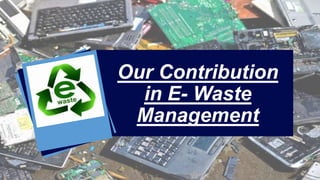
Our Contribution
in E- Waste
Management
• E-Waste Awareness campaign
We will hold E- Waste awareness campaigns to inform targeted
audience about E-waste, its harmful effects and the process of its
management.
Targeted audience would be Children, Adults of both urban and
rural areas.
Poster creation on E- waste as part of additional awareness
program.
• E – Waste collection drive
We will have a E- Waste collection drive in our locality.
We will sort through collected E-waste and treat it / recycle it
respectively.
22
THANK YOU

Swacch bharat

  • 2.
    Members: 20BCY10223 Tuhin Bose 01 20BCE11027 Aviral Shrivastava02 20BCG10113 Shivam Singhal 03 Shibam Karmakar 20MEI10042 04
  • 3.
    About Swacch BharatAbhiyaan: Proper solid and liquid waste management through gram panchayats On 2nd October 2014, Swacch Bharat Mission was launched throughout length and breadth of the country as a national movement. This campaign aims to clean up the streets, roads and infrastructure of India’s cities, smaller towns and rural areas. One of the objective of swacch Baharat abhiyan was to eliminate or reduce open defecation which is one of the main cause of deaths of thousands of children each year To make India Open Defecation free (ODF) by 2019. 4 3 2. 5. 1.
  • 4.
  • 5.
    E- Waste E-waste isany electronic equipment that has been discarded. It includes both working items and broken items. E-waste is particularly dangerous due to toxic chemicals that naturally leach from the metals inside when buried. Unfortunately, a skyrocketing amount of e-waste is being written off by owners as junk. There’s no more significant example of that than computers, laptops, and smartphones. Different Electronic components contains different types of harmful chemicals which effects health of an individual.
  • 6.
    • Globally, 44.7million tones were generated in 2016 and reached to nearly 50 million tonnes in 2018. • Only one-fifth of the total global e-waste is collected and recycled through formal channels. The rest is dumped in landfills or incinerated without any formal control. This results in the release of toxic chemicals such as mercury, lead, and dioxins into the environment, as well as significant loss of valuable resources in e-waste such as gold, copper, platinum and high-quality plastics that can be recovered, reused, and recycled. • India is the 5th largest generator of e-waste in the world, contributing almost 2 million metric tones to the global total in 2016. Its major cities are the largest producers, with Mumbai being the leader (120,000 metric tones/ year), followed by Delhi (NCR), Bangalore, Chennai and Kolkata. • Government and industry sectors generate more than 70% of e-waste, while households contribute around15%. Delhi functions as the country’s biggest market for e-waste recycling, channeling between 30 and 40% of the total volume. • The major challenge for India’s policy makers is to improve the effectiveness of e-waste management and reduce associated environmental and health risks in cities and communities. his requires finding ways to increase the responsible disposal of e-waste by producers and users, improve recycling practices and methods of informal sector processors, and enable technologies that are cost effective and have capacity to process large volumes of waste.
  • 11.
  • 12.
    E – WasteDisposal People will keep buying new equipment regardless of whether or not previous equipment works or not. it’s important to keep reinforcing the message that we need to recycle the older models, not throw them out. Land Contamination When E-waste gets buried at a landfill, it can dissolve in microscopic traces into the gross sludge that permeates at the landfill. Eventually, these traces of toxic materials pool into the ground below the landfill which result in contamination of ground. Poisoning nearby Water Bodies The problem is that there is so, so much E-waste that the trace amounts have ballooned over the years. That toxic water under the landfill doesn’t stop below the landfill. It continues to the groundwater and the sources to all the freshwater in the surrounding area. Not only is this bad for anyone using a natural well, but it hurts the nearby wildlife Losing valuable materials Electronic circuit boards contains valuable metals like gold, silver, copper which , when not recycled, would simply go to waste.
  • 13.
  • 14.
    • The firstpolicy effort towards addressing e-waste was the 2008 Guidelines for environmentally sound management of e-waste, which provided information about various types of e-waste components, methods for assessing their hazardousness, and appropriate technologies for processing or managing them. • The second major policy introduced in 2008 was the Hazardous Wastes (Management, Handling and Transboundary Movement) Rules, which banned the importation of e-waste to India for disposal • In 2011, the Indian government established the E-Waste (Handling and Management) Rules, which was replaced by the revised E-waste (Management) Rules of 2016. These rules provide the most comprehensive information regarding the responsibilities of various players in e-waste management. • The 2016 E-waste Rules outline the procedures for producers/manufacturers, dealers, recyclers, and dismantlers to obtain authorization from relevant government agencies and administrative bodies to manage e-waste. They also identify the responsibilities of collection centers, refurbishers, individual and bulk consumers for handling e-waste. All electrical and electronic equipment and their components are classified and assigned unique e-waste codes. Producers are prescribed recycling targets based on the amount of e-waste they generate.
  • 15.
    E – WasteManagement
  • 16.
    E- Waste Management: Asthe name says, E-waste management is literally managing E-waste. It includes the following activities: a) Collection of E-Waste b) Sorting of E-waste c) Processing of E-waste d) Repairing of E-waste e) Recycling f) Dismantling g) Component recovery from E-waste h) Residual Disposal of E-waste
  • 17.
    Improving E –Waste Management
  • 18.
    Providing information aboutE-Waste prices A consolidated price list updated on a weekly basis would be a powerful market signal for consumers who sell their e- waste to kabadiwalas. The price list should cover all components of e-waste, starting from bulk e-waste to various metals, glass, plastic, ceramics, and batteries Deploying better recycling techniques The Indian government should promote joint ventures between international and domestic companies for setting up large industrial e-waste recovery plants The composition of e-waste is changing rapidly as new electrical and electronics devices enter the market. This requires significant investment in research and development for innovative recycling methods and technologies for future-proofing India’s e-waste policies and management. Upskilling informal sector players The majority of the informal e-waste recycling workforce needs upskilling, particularly for handling and dismantling hazardous materials, ensuring environmental and occupational health and safety of their work, and linking supply to formal sector processors.
  • 19.
  • 20.
    https://greene.gov.in/ • Website underMinistry of Electronics and Information Technology • Aims to spread awareness about E-Waste and bring together the triad of public, government and industry to adopt responsible measures for Sustainable electronics that is responsive to environmental needs. • It conducts different activities across India Primary Objective The primary focus of the project is to create awareness among different stakeholders in order to reduce the adverse impact on environment and health due to improper disposal of e-waste. MietY has played a key role in dissemination of knowledge on e-waste rules in the past and wishes to engage all key stakeholders during this exercise. Expected outcomes • Recycling recovers valuable materials from old electronics that can be used to make new products. As a result, we save energy, reduce pollution, reduce greenhouse gas emissions, and save resources by extracting fewer raw materials from the earth. • Recycling will create jobs for professional recyclers and refurbishers and creates new markets for the valuable components that are dismantled. And many more….
  • 21.
    Our Contribution in E-Waste Management
  • 22.
    • E-Waste Awarenesscampaign We will hold E- Waste awareness campaigns to inform targeted audience about E-waste, its harmful effects and the process of its management. Targeted audience would be Children, Adults of both urban and rural areas. Poster creation on E- waste as part of additional awareness program. • E – Waste collection drive We will have a E- Waste collection drive in our locality. We will sort through collected E-waste and treat it / recycle it respectively. 22
  • 23.