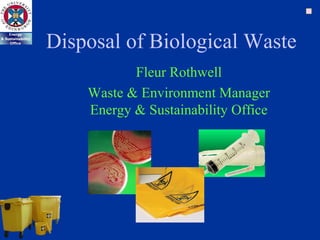
Disposal of Biological Waste
Fleur Rothwell
Waste & Environment Manager
Energy & Sustainability Office
Training Outline
• What is it?
– Waste. Clinical? Animal? Special? Other?
• How do you deal with it?
– Containers
– Always Render Safe
– Disposal Procedure
– Health & Safety
• Further information
What is it?
Firstly, it is “WASTE”
• The Environmental Protection (Duty of Care)
Regulations 1991 apply:
– Responsibility of anyone discarding any items to ensure that
it:
• It is stored and disposed of responsibly;
• It is only handled or dealt with by authorised / registered
individuals or businesses; and
• A record is kept of all waste received or transferred
through a system of signed Waste Transfer Notes (WTN).
– Responsibility of the Producer to make an assessment of
each item, to segregate and dispose of it safely and retain
records relating to this disposal.
– Producer, and contractor should sign and date the WTN and
Producer should retain a copy of the completed Transfer
Note for three years.
What is it?
• Biological, but… no legal definition so:
– Clinical (= Healthcare) or
– Animal By-Product
– May also be Special (= Hazardous)
– Or may be Radioactive
• Or, if “rendered safe”, it may be non-
clinical i.e. general waste
What is it?
• Clinical Waste is…
– “any waste which consists wholly or partly of:
• human or animal tissue;
• blood / body fluids, excretions;
• drugs or other pharmaceutical products;
• swabs or dressings;
• syringes, needles or other sharp instruments;
…which, unless rendered safe, may prove
hazardous…; and
– any other waste arising from medical,… veterinary,
pharmaceutical… care, teaching or research…
which may cause infection to any person coming
into contact with it ”
Extract from the Controlled Waste Regulations (S.I. 1992/588)
What is it?
• Special Waste
– Defined by European, UK and Scottish
regulations
– Includes:
• Infectious or potentially infectious material
• Cytotoxic and cytostatic drugs (and clinical
material treated with them)
• Many drugs / chemicals, otherwise hazardous
– If Special Waste is to be produced, both WEM
and Safety Advisor must be notified
What is it?
• Radioactive Waste
– If both clinical and radioactive then both sets of
legislation may apply
– Separate registration with H&S and ESO
– Barcodes & containers
• None of the above
– In many instances, if treated appropriately,
waste might no longer be “clinical”
– But… make sure not “offensive”
Containers – Type
• Container type
– Must be appropriate to contents & regulations
• Bags – NO sharps, medicines or liquids
• Sharps bins – sharps ONLY
• Other Rigid Bins – various e.g.
– High liquid-content Clinical
– Combustible Radioactive
– Special & Clinical (e.g. Cytotoxic)
– Waste medicines
Containers – Colour
• Container colour
– Tells other staff what is in the container
– Tells the contractor what to do with the waste
– Can apply to both sacks and rigid containers
Safe for Disposal to
General Waste
Lab plastics
Carcass, anatomical
Sharps
Cytotoxic
Always Render Safe
Remember, University procedure
is to always render waste safe
before it leaves the lab
(e.g. autoclave or disinfect)
to ensure that waste is
“non-infectious” at point of
disposal (including cultures &
GM)
Disposal Procedure – Carcass
• Carcass or anatomical material
– Small / medium carcasses or obvious body parts
– Render safe first
– Yellow bags or containers
– Freeze prior to collection or keep refrigerated
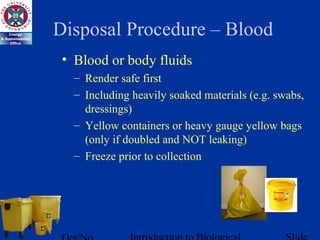
Disposal Procedure – Blood
• Blood or body fluids
– Render safe first
– Including heavily soaked materials (e.g. swabs,
dressings)
– Yellow containers or heavy gauge yellow bags
(only if doubled and NOT leaking)
– Freeze prior to collection
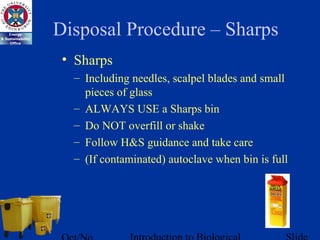
Disposal Procedure – Sharps
• Sharps
– Including needles, scalpel blades and small
pieces of glass
– ALWAYS USE a Sharps bin
– Do NOT overfill or shake
– Follow H&S guidance and take care
– (If contaminated) autoclave when bin is full
Disposal Procedure – Plastics
• Laboratory plastics
– Render safe first
– If non-identifiable following autoclave then non-
clinical disposal [Black Bag and label “Safe for
Disposal”]
– If identifiable still then possibly “offensive” -
Orange Bag and label as for Clinical Waste
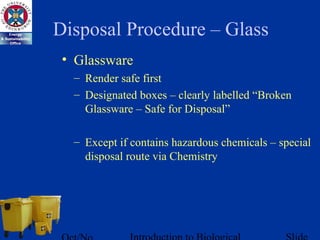
Disposal Procedure – Glass
• Glassware
– Render safe first
– Designated boxes – clearly labelled “Broken
Glassware – Safe for Disposal”
– Except if contains hazardous chemicals – special
disposal route via Chemistry
Disposal Procedure – Medicines
• Medicines
– Designated medicine bins only (usually Blue
Rigid container)
– Do not use containers intended for other uses
(e.g. sharps bins)
– Do not pour down the drain
– Some medicines are considered to be Special
Waste
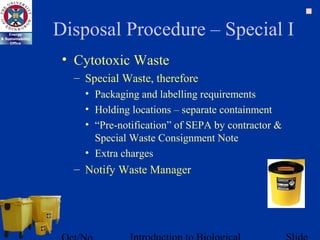
Disposal Procedure – Special I
• Cytotoxic Waste
– Special Waste, therefore
• Packaging and labelling requirements
• Holding locations – separate containment
• “Pre-notification” of SEPA by contractor &
Special Waste Consignment Note
• Extra charges
– Notify Waste Manager
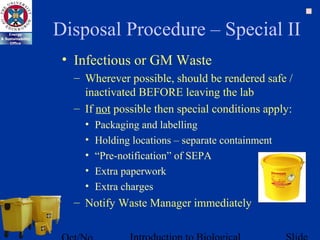
Disposal Procedure – Special II
• Infectious or GM Waste
– Wherever possible, should be rendered safe /
inactivated BEFORE leaving the lab
– If not possible then special conditions apply:
• Packaging and labelling
• Holding locations – separate containment
• “Pre-notification” of SEPA
• Extra paperwork
• Extra charges
– Notify Waste Manager immediately
Disposal Procedure – Overview
• (Where necessary) autoclave / disinfect
• Place in appropriate bag / bin
• Seal bag / bin
• Complete Label Record Sheet and apply
Barcode Label – don’t forget to circle
category on label (e.g. sharps, plastics, carcass)
• Place bag in designated store / holding
location
Disposal Procedure – Labels I
• Barcode Labels MUST be used and
information recorded
Disposal Procedure – Labels II
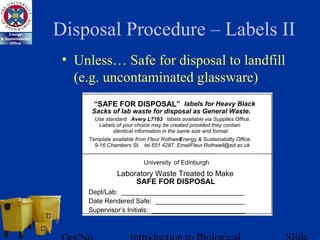
• Unless… Safe for disposal to landfill
(e.g. uncontaminated glassware)
“SAFE FOR DISPOSAL” labels for Heavy Black
Sacks of lab waste for disposal as General Waste.
Use standard Avery L7163 labels available via Supplies Office.
Labels of your choice may be created provided they contain
identical information in the same size and format.
Template available from Fleur RothwellEnergy & Sustainability Office,
9-16 Chambers St. tel 651 4287, EmailFleur.Rothwell@ed.ac.uk
University of Edinburgh
Laboratory Waste Treated to Make
SAFE FOR DISPOSAL
Dept/Lab: _________________________________
Date Rendered Safe: ________________________
Supervisor’s Initials: _________________________
Disposal Procedure - Reminder
• Key points to remember:
– Never fill sacks more than ¾ full
– Never overfill sharps bins
– Do NOT use anything that leaks
– Secure sacks with a plastic tie / seal bins before
removing from lab
– Always use a Barcode Label and complete your
Label Record Sheet
– Know if it is “Special Waste” & act accordingly
– Place in approved Holding Location – in freezer
if necessary
Disposal Procedure – Locations
Monday
• Hospital for Small Animals
• Swann Building
• Ashworth Labs
• Medical Building (new
store)
• Summerhall
Wednesday
•Hospital for Small Animals
•Easter Bush Vet Centre
•Chancellor’s Building
•Queen’s Medical Research Institute
•Ann Walker Building
•Swann Building
•Agriculture
•Medical Quad - Doorway 4
•Summerhall
Friday
•Easter Bush Vet Centre
•Hospital for Small Animals
•Chancellor’s Building
•QMRI
•Ashworth Labs
•Swann Building
•Roger Land Building
•Medical Building (new store)
•Summerhall
Health & Safety
• As with H&S considerations, you must:
– make full and proper use of any control measure
or facility provided
– familiarise yourself with University and School
Waste Disposal Policies
– carry out your work safely and in accordance
with these policies using all measures specified
– ask if you are unsure
– report any concerns
– know what to do if you have an accident
Further Information
• University guidance
– Clinical Waste Code of Practice
(current version is 2002 – currently being updated)
– Hazardous Waste Code of Practice
(current version is 1998 – to be updated in 2005-06)
– Waste Reduction Policy 2005
– Role of School Waste Coordinators
• School / laboratory guidance
Further Information
http://www.eso.ed.ac.uk
Further Information
Energy & Sustainability Office website:
http://www.eso.ed.ac.uk
Waste Section: http://www.eso.ed.ac.uk/waste/
Policies & Reports Section:
http://www.eso.ed.ac.uk/PoliciesAndReports/
Biosafety section on H&S website:
http://www.safety.ed.ac.uk/resources/
bio_safety.shtm
Further Information
Fleur Rothwell
Waste & Environment Manager
Email: Fleur.Rothwell@ed.ac.uk
Tel: 651 4287

Waste disposal

  • 1.
    Disposal of BiologicalWaste Fleur Rothwell Waste & Environment Manager Energy & Sustainability Office
  • 2.
    Training Outline • Whatis it? – Waste. Clinical? Animal? Special? Other? • How do you deal with it? – Containers – Always Render Safe – Disposal Procedure – Health & Safety • Further information
  • 3.
    What is it? Firstly,it is “WASTE” • The Environmental Protection (Duty of Care) Regulations 1991 apply: – Responsibility of anyone discarding any items to ensure that it: • It is stored and disposed of responsibly; • It is only handled or dealt with by authorised / registered individuals or businesses; and • A record is kept of all waste received or transferred through a system of signed Waste Transfer Notes (WTN). – Responsibility of the Producer to make an assessment of each item, to segregate and dispose of it safely and retain records relating to this disposal. – Producer, and contractor should sign and date the WTN and Producer should retain a copy of the completed Transfer Note for three years.
  • 4.
    What is it? •Biological, but… no legal definition so: – Clinical (= Healthcare) or – Animal By-Product – May also be Special (= Hazardous) – Or may be Radioactive • Or, if “rendered safe”, it may be non- clinical i.e. general waste
  • 5.
    What is it? •Clinical Waste is… – “any waste which consists wholly or partly of: • human or animal tissue; • blood / body fluids, excretions; • drugs or other pharmaceutical products; • swabs or dressings; • syringes, needles or other sharp instruments; …which, unless rendered safe, may prove hazardous…; and – any other waste arising from medical,… veterinary, pharmaceutical… care, teaching or research… which may cause infection to any person coming into contact with it ” Extract from the Controlled Waste Regulations (S.I. 1992/588)
  • 6.
    What is it? •Special Waste – Defined by European, UK and Scottish regulations – Includes: • Infectious or potentially infectious material • Cytotoxic and cytostatic drugs (and clinical material treated with them) • Many drugs / chemicals, otherwise hazardous – If Special Waste is to be produced, both WEM and Safety Advisor must be notified
  • 7.
    What is it? •Radioactive Waste – If both clinical and radioactive then both sets of legislation may apply – Separate registration with H&S and ESO – Barcodes & containers • None of the above – In many instances, if treated appropriately, waste might no longer be “clinical” – But… make sure not “offensive”
  • 8.
    Containers – Type •Container type – Must be appropriate to contents & regulations • Bags – NO sharps, medicines or liquids • Sharps bins – sharps ONLY • Other Rigid Bins – various e.g. – High liquid-content Clinical – Combustible Radioactive – Special & Clinical (e.g. Cytotoxic) – Waste medicines
  • 9.
    Containers – Colour •Container colour – Tells other staff what is in the container – Tells the contractor what to do with the waste – Can apply to both sacks and rigid containers Safe for Disposal to General Waste Lab plastics Carcass, anatomical Sharps Cytotoxic
  • 10.
    Always Render Safe Remember,University procedure is to always render waste safe before it leaves the lab (e.g. autoclave or disinfect) to ensure that waste is “non-infectious” at point of disposal (including cultures & GM)
  • 11.
    Disposal Procedure –Carcass • Carcass or anatomical material – Small / medium carcasses or obvious body parts – Render safe first – Yellow bags or containers – Freeze prior to collection or keep refrigerated
  • 12.
    Disposal Procedure –Blood • Blood or body fluids – Render safe first – Including heavily soaked materials (e.g. swabs, dressings) – Yellow containers or heavy gauge yellow bags (only if doubled and NOT leaking) – Freeze prior to collection
  • 13.
    Disposal Procedure –Sharps • Sharps – Including needles, scalpel blades and small pieces of glass – ALWAYS USE a Sharps bin – Do NOT overfill or shake – Follow H&S guidance and take care – (If contaminated) autoclave when bin is full
  • 14.
    Disposal Procedure –Plastics • Laboratory plastics – Render safe first – If non-identifiable following autoclave then non- clinical disposal [Black Bag and label “Safe for Disposal”] – If identifiable still then possibly “offensive” - Orange Bag and label as for Clinical Waste
  • 15.
    Disposal Procedure –Glass • Glassware – Render safe first – Designated boxes – clearly labelled “Broken Glassware – Safe for Disposal” – Except if contains hazardous chemicals – special disposal route via Chemistry
  • 16.
    Disposal Procedure –Medicines • Medicines – Designated medicine bins only (usually Blue Rigid container) – Do not use containers intended for other uses (e.g. sharps bins) – Do not pour down the drain – Some medicines are considered to be Special Waste
  • 17.
    Disposal Procedure –Special I • Cytotoxic Waste – Special Waste, therefore • Packaging and labelling requirements • Holding locations – separate containment • “Pre-notification” of SEPA by contractor & Special Waste Consignment Note • Extra charges – Notify Waste Manager
  • 18.
    Disposal Procedure –Special II • Infectious or GM Waste – Wherever possible, should be rendered safe / inactivated BEFORE leaving the lab – If not possible then special conditions apply: • Packaging and labelling • Holding locations – separate containment • “Pre-notification” of SEPA • Extra paperwork • Extra charges – Notify Waste Manager immediately
  • 19.
    Disposal Procedure –Overview • (Where necessary) autoclave / disinfect • Place in appropriate bag / bin • Seal bag / bin • Complete Label Record Sheet and apply Barcode Label – don’t forget to circle category on label (e.g. sharps, plastics, carcass) • Place bag in designated store / holding location
  • 20.
    Disposal Procedure –Labels I • Barcode Labels MUST be used and information recorded
  • 21.
    Disposal Procedure –Labels II • Unless… Safe for disposal to landfill (e.g. uncontaminated glassware) “SAFE FOR DISPOSAL” labels for Heavy Black Sacks of lab waste for disposal as General Waste. Use standard Avery L7163 labels available via Supplies Office. Labels of your choice may be created provided they contain identical information in the same size and format. Template available from Fleur RothwellEnergy & Sustainability Office, 9-16 Chambers St. tel 651 4287, EmailFleur.Rothwell@ed.ac.uk University of Edinburgh Laboratory Waste Treated to Make SAFE FOR DISPOSAL Dept/Lab: _________________________________ Date Rendered Safe: ________________________ Supervisor’s Initials: _________________________
  • 22.
    Disposal Procedure -Reminder • Key points to remember: – Never fill sacks more than ¾ full – Never overfill sharps bins – Do NOT use anything that leaks – Secure sacks with a plastic tie / seal bins before removing from lab – Always use a Barcode Label and complete your Label Record Sheet – Know if it is “Special Waste” & act accordingly – Place in approved Holding Location – in freezer if necessary
  • 23.
    Disposal Procedure –Locations Monday • Hospital for Small Animals • Swann Building • Ashworth Labs • Medical Building (new store) • Summerhall Wednesday •Hospital for Small Animals •Easter Bush Vet Centre •Chancellor’s Building •Queen’s Medical Research Institute •Ann Walker Building •Swann Building •Agriculture •Medical Quad - Doorway 4 •Summerhall Friday •Easter Bush Vet Centre •Hospital for Small Animals •Chancellor’s Building •QMRI •Ashworth Labs •Swann Building •Roger Land Building •Medical Building (new store) •Summerhall
  • 24.
    Health & Safety •As with H&S considerations, you must: – make full and proper use of any control measure or facility provided – familiarise yourself with University and School Waste Disposal Policies – carry out your work safely and in accordance with these policies using all measures specified – ask if you are unsure – report any concerns – know what to do if you have an accident
  • 25.
    Further Information • Universityguidance – Clinical Waste Code of Practice (current version is 2002 – currently being updated) – Hazardous Waste Code of Practice (current version is 1998 – to be updated in 2005-06) – Waste Reduction Policy 2005 – Role of School Waste Coordinators • School / laboratory guidance
  • 26.
  • 27.
    Further Information Energy &Sustainability Office website: http://www.eso.ed.ac.uk Waste Section: http://www.eso.ed.ac.uk/waste/ Policies & Reports Section: http://www.eso.ed.ac.uk/PoliciesAndReports/ Biosafety section on H&S website: http://www.safety.ed.ac.uk/resources/ bio_safety.shtm
  • 28.
    Further Information Fleur Rothwell Waste& Environment Manager Email: Fleur.Rothwell@ed.ac.uk Tel: 651 4287

Editor's Notes

  • #2 Good morning / afternoon. Thank you all for coming along to this workshop on the Disposal of Biological Waste. My name is Fleur Rothwell and I am the University’s Waste & Environment Manager. I am based in a division within Estates and Buildings which is part of the Corporate Support Group along with other members of the Energy & Sustainability Office. My role at the University is to coordinate, develop and monitor Waste Management activities within the University. This session has been devised to fit in with Joanna Marshall’s Biosafety training and I would like to thank her for allowing me to hold this workshop as an addition to her normal series.
  • #4 First off, it is waste. This means that the Duty of Care applies. This term is defined by the Environmental Protection Act 1990 and it apples to the University and all of it’s members. What the Duty of Care code does is to place a duty on all staff and students to ensure that all waste produced by University activities is managed properly and recovered or disposed of safely. This applies to all controlled wastes, including clinical waste.
  • #5 So, what exactly is Biological Waste? Biological waste is often used as a catch all to encompass clinical (or Healthcare) waste, animal by-product waste and other wastes arising from biological laboratories. Clinical Waste is defined by the Controlled Waste Regulations and waste that is deemed to be clinical must be disposed of in a particular way. I will define this in the next slide. The term Animal By-Product is used to define waste that is specifically composed of animal by-products ‘not intended for human consumption’. The Animal By-Products (Scotland) 2003 regulations cover our slightly varied responsibilities when storing, transporting and disposing of animal carcasses and some bedding material. Waste arising from biological work might also be Special or Hazardous or it might be Radioactive. Each of these types of waste have specific and legally binding definitions with regulations attached. I hope that you will bear with me whilst I highlight what these are – understanding the difference between them will allow you to segregate and subsequently dispose of your waste properly. --------- ONLY IF QUESTIONED Healthcare waste is a term that is generally used, as it suggests, in the healthcare sector. It is a broader term than clinical waste and tends to include all waste arising out of the medical treatment of humans. Its relevance comes in with the Transport of Dangerous Goods regs which mention “Healthcare Risk Waste”.
  • #6 So, what is Clinical Waste? The Controlled Waste Regulations 1992, provide a two-part definition for Clinical Waste. It is firstly: Any waste which consists wholly or partly of: xxx …which, unless rendered safe, may prove hazardous to any person coming into contact with it. Waste arising from medical, nursing, dental, veterinary, pharmaceutical or similar practice, investigation, treatment, care, teaching or research or the collection of blood for transfusion, which may cause infection to any person coming into contact with it is also defined as Clinical. It is easy to misunderstand the second part of the definition to mean that all waste arising from the listed establishments and practices is clinical. However this is not what it means. Waste coming from these establishments or practices is only clinical IF it is INFECTIOUS OR POTENTIALLY INFECTIOUS. If the items of waste have been treated to ensure that they are non-infectious before they leave the laboratory (e.g. by disinfection or autoclaving as appropriate) and the waste item is not specified in the list in part one (e.g. human or animal tissue) then the waste is not necessarily CLINICAL. This distinction relates to your general laboratory plastics or gloves and I will come back to this shortly.
  • #7 It is crucial that you know whether your work or your laboratory is producing Special Waste. Essentially, it is Controlled waste that, because of its properties, requires special treatment and control. There is no easy definition of special/hazardous waste as account needs to be taken of the properties of each substance which may or may not be a function of its concentration. There are a few things which are automatically deemed to be Special Waste due to their hazardous properties. These include Infectious Waste, waste Cytotoxic or Cytostatic medicines and certain waste chemicals. Infectious is defined in the Hazardous Waste Directive as: “Substances containing viable micro-organisms or their toxins which are known or reliably believed to cause disease in man or other living organisms”. Normal practice should always be to ensure that waste leaving the laboratory or practice has been rendered NON-INFECTIOUS. If you cannot do this for some reason, then it must be classified as Special Waste. If you are dealing with cytotoxic or cytostatic medicines (for example chemotherapy drugs) then both the waste medicine and any waste from animals or humans treated with these drugs or laboratory items contaminated with them are deemed to be Special Waste.
  • #8 I will not be going into Radioactive Waste in this presentation. The only thing to say on this subject is that if you are an authorised producer of radioactive waste, you should know what the correct procedure for disposal of this kind of waste is. If you are in any doubt, please come and talk to me afterwards or contact your RPA. But, what if your waste has not been contaminated with any hazardous drugs or agents and does not consist of obvious carcass material, sharps or blood products…? This might for example include lab plastics. In some cases, this waste might be considered to be NON-clinical. In these instances, the waste will probably be black bagged and sent to landfill.
  • #9 UN approvals relate to minimum standards for containing clinical waste in order to store and transport them safely. At this University, you might use both bags and rigid plastic containers for different types of waste. Read through…
  • #10 With clinical waste, the colour of the container can help to identify the type of waste within. Here are some of the container types / colours that you will come across at the University. Black bags should only ever be used for uncontaminated or decontaminated, non-offensive waste. For example, in some areas they are used for autoclaved laboratory plastics. Otherwise, lab plastics will go in orange bags. Carcass / anatomical material will only ever be placed in a yellow container, etc. Other coloured containers or lids may be in use in your laboratory or area. If they are, be certain that you know what they are for.
  • #18 If you are dealing with cytotoxic or cytostatic medicines (for example chemotherapy drugs) then both the waste medicine and any waste from animals or humans treated with these drugs or laboratory items contaminated with them are deemed to be Special Waste. Special Waste must be kept separately from other clinical waste (sealable rigid plastic containers could be used here), stored in a locked holding location and tracked from producer to disposer due to their hazardous nature. As such, a 5-part Special Waste Consignment Note will need to be completed and SEPA (the Regulators) will need to be pre-notified that we are going to be moving this kind of waste.
  • #19 Infectious is defined in the Hazardous Waste Directive as: “Substances containing viable micro-organisms or their toxins which are known or reliably believed to cause disease in man or other living organisms”. Normal practice should always be to ensure that waste leaving the laboratory or practice has been rendered NON-INFECTIOUS. If you cannot do this for some reason, then it must be classified as Special Waste. I will reiterate what I have said a couple of times already, in all normal activity using infectious agents, it is crucial to completely denature the agents – either through autoclaving or disinfection as appropriate – BEFORE they leave the laboratory.
  • #20 If the waste is not presented properly - the waste handler has the authority to not uplift the waste. Keep Record Sheets for 1 year plus
  • #21 BAR CODE LABELS:- go through Tracking of waste Identifies the disposal route Monitoring amount and type of waste generated Provides re-charging record Linked to Waste Producer location Barcode electronically scanned
  • #22 <number>
  • #24 Weekly waste collection timetable
  • #26 As I’ve mentioned, it is your job – via your laboratory or centre, and ultimately your school to comply with relevant waste-related legislation. However, part of my job is to make it easier for you by producing key guidance material and acting in an advisory capacity when needed. Key documents that you should be aware of are the Clinical and Hazardous Waste Codes of Practice. These are available on the ESO website – a web address will be provided on the last slide. Please do note however that due to changes in legislation since these documents were produced, they will be updated during the course of this academic year. Other useful documents are listed here. The University’s “Waste Reduction Policy” has recently been updated to include waste reduction and recycling targets and it also formalises the role of the School Waste Coordinator and Clinical or Radioactive Waste Responsible Persons. There is further information on these roles in the “Role of School Waste Coordinators” document. These are all available in the Policies and Reports Section of the Energy & Sustainability Office website. Finally, and most importantly, you should be aware of any laboratory or school waste management procedures. If you have not been shown any yet, please ask your supervisor for them. They should be available and should cover any aspects of waste management that are specific to your work.