Biomedical Waste
Management (BMW)
Ms Tissymol Thomas
Definition
Waste generated during laboratory diagnosis,
treatment or immunization of human being or in
research activity pertaining there to, or in production
of biologicals
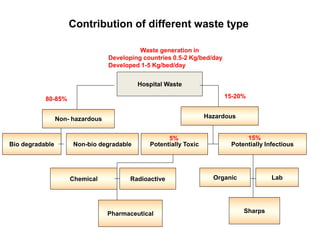
Contribution of different waste type
Hospital Waste
Non- hazardous Hazardous
Bio degradable Non-bio degradable Potentially Toxic Potentially Infectious
Chemical Radioactive Organic Lab
Pharmaceutical Sharps
80-85% 15-20%
Waste generation in
Developing countries 0.5-2 Kg/bed/day
Developed 1-5 Kg/bed/day
15%
5%
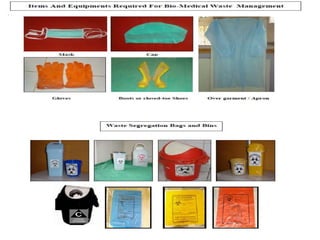
4 category of waste:
• Yellow
• Red
• Blue
• White (Translucent)
• Black (General Waste)
Biomedical wastes categories and their
segregation, collection, treatment, processing
and disposal options (Schedule 1)
Category Type of waste Container to be
used
Yellow Soiled Waste (Items contaminated with
blood, body fluids):
• Dressings, Bandage, Gauze, Linen (Soiled)
• Plaster casts,
• Cotton swabs
• Bed Protection pads
• Bags containing residual or discarded
blood and blood components including
blood set tubing’s
• Diapers, Napkins
• Discarded linen, mattresses, beddings
Yellow coloured
non-chlorinated
plastic bags
common Bio-
medical Waste
treatment facility
Biomedical wastes categories and their
segregation, collection, treatment, processing
and disposal options (Schedule 1)
Category Type of waste Container to be
used
Yellow Human Anatomical Waste: Human tissues,
organs, body parts and fetus below the
viability period (as per MTP act)
[copy of official MTP certificate from
Obstetrician or the MS of hospital or
healthcare establishment must be given]
Yellow coloured
non-chlorinated
plastic bags
common Bio-
medical Waste
treatment facility
Biomedical wastes categories and their
segregation, collection, treatment, processing
and disposal options (Schedule 1)
Category Type of waste Container to be
used
Yellow Animal Anatomical Waste:
Experimental animal carcasses, body parts,
organs, tissues, including the waste
generated from animals used in
experiments or testing in animal houses
Yellow coloured
non-chlorinated
plastic bags
common Bio-
medical Waste
treatment facility
Expired or Discarded Medicines (Except
cytotoxic drugs)
Pharmaceutical waste like antibiotics
Biomedical wastes categories and their
segregation, collection, treatment, processing
and disposal options (Schedule 1)
Category Type of waste Container to be
used
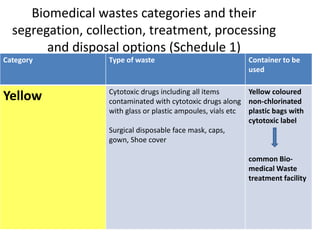
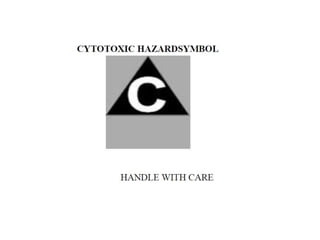
Yellow Cytotoxic drugs including all items
contaminated with cytotoxic drugs along
with glass or plastic ampoules, vials etc
Surgical disposable face mask, caps,
gown, Shoe cover
Yellow coloured
non-chlorinated
plastic bags with
cytotoxic label
common Bio-
medical Waste
treatment facility
Biomedical wastes categories and their
segregation, collection, treatment, processing
and disposal options (Schedule 1)
Category Type of waste Container to be
used
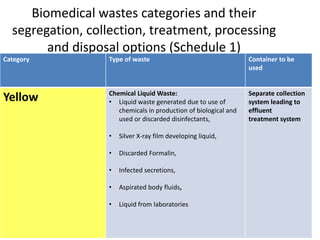
Yellow Chemical Liquid Waste:
• Liquid waste generated due to use of
chemicals in production of biological and
used or discarded disinfectants,
• Silver X-ray film developing liquid,
• Discarded Formalin,
• Infected secretions,
• Aspirated body fluids,
• Liquid from laboratories
Separate collection
system leading to
effluent
treatment system
Biomedical wastes categories and their
segregation, collection, treatment, processing
and disposal options (Schedule 1)
Category Type of waste Container to be
used
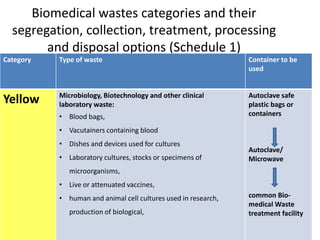
Yellow Microbiology, Biotechnology and other clinical
laboratory waste:
• Blood bags,
• Vacutainers containing blood
• Dishes and devices used for cultures
• Laboratory cultures, stocks or specimens of
microorganisms,
• Live or attenuated vaccines,
• human and animal cell cultures used in research,
production of biological,
Autoclave safe
plastic bags or
containers
Autoclave/
Microwave
common Bio-
medical Waste
treatment facility
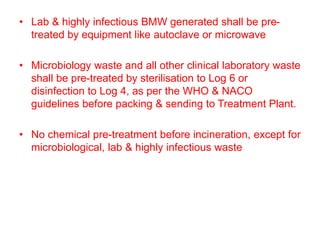
• Lab & highly infectious BMW generated shall be pre-
treated by equipment like autoclave or microwave
• Microbiology waste and all other clinical laboratory waste
shall be pre-treated by sterilisation to Log 6 or
disinfection to Log 4, as per the WHO & NACO
guidelines before packing & sending to Treatment Plant.
• No chemical pre-treatment before incineration, except for
microbiological, lab & highly infectious waste
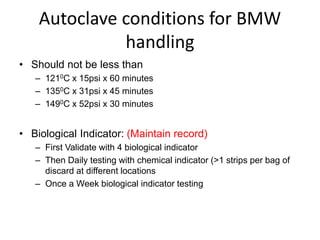
Autoclave conditions for BMW
handling
• Should not be less than
– 1210C x 15psi x 60 minutes
– 1350C x 31psi x 45 minutes
– 1490C x 52psi x 30 minutes
• Biological Indicator: (Maintain record)
– First Validate with 4 biological indicator
– Then Daily testing with chemical indicator (>1 strips per bag of
discard at different locations
– Once a Week biological indicator testing
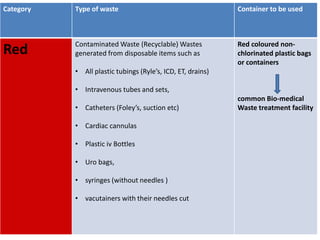
Category Type of waste Container to be used
Red Contaminated Waste (Recyclable) Wastes
generated from disposable items such as
• All plastic tubings (Ryle’s, ICD, ET, drains)
• Intravenous tubes and sets,
• Catheters (Foley’s, suction etc)
• Cardiac cannulas
• Plastic iv Bottles
• Uro bags,
• syringes (without needles )
• vacutainers with their needles cut
Red coloured non-
chlorinated plastic bags
or containers
common Bio-medical
Waste treatment facility
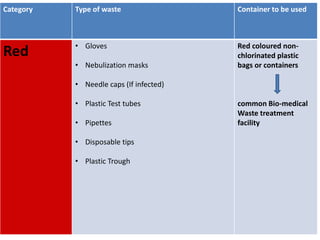
Category Type of waste Container to be used
Red • Gloves
• Nebulization masks
• Needle caps (If infected)
• Plastic Test tubes
• Pipettes
• Disposable tips
• Plastic Trough
Red coloured non-
chlorinated plastic
bags or containers
common Bio-medical
Waste treatment
facility
Category Type of waste Container to be used
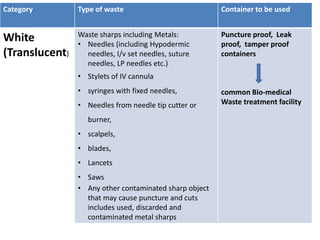
White
(Translucent)
Waste sharps including Metals:
• Needles (including Hypodermic
needles, I/v set needles, suture
needles, LP needles etc.)
• Stylets of IV cannula
• syringes with fixed needles,
• Needles from needle tip cutter or
burner,
• scalpels,
• blades,
• Lancets
• Saws
• Any other contaminated sharp object
that may cause puncture and cuts
includes used, discarded and
contaminated metal sharps
Puncture proof, Leak
proof, tamper proof
containers
common Bio-medical
Waste treatment facility
Category Type of waste Container to be used
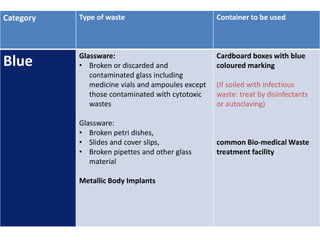
Blue Glassware:
• Broken or discarded and
contaminated glass including
medicine vials and ampoules except
those contaminated with cytotoxic
wastes
Glassware:
• Broken petri dishes,
• Slides and cover slips,
• Broken pipettes and other glass
material
Metallic Body Implants
Cardboard boxes with blue
coloured marking
(If soiled with infectious
waste: treat by disinfectants
or autoclaving)
common Bio-medical Waste
treatment facility
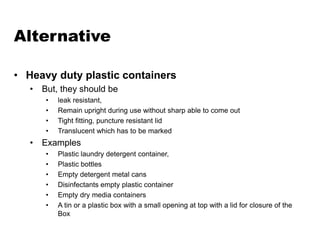
Alternative
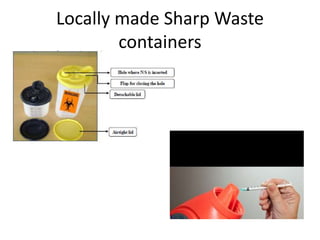
• Heavy duty plastic containers
• But, they should be
• leak resistant,
• Remain upright during use without sharp able to come out
• Tight fitting, puncture resistant lid
• Translucent which has to be marked
• Examples
• Plastic laundry detergent container,
• Plastic bottles
• Empty detergent metal cans
• Disinfectants empty plastic container
• Empty dry media containers
• A tin or a plastic box with a small opening at top with a lid for closure of the
Box
Alternative
• Clearly labelled “Sharp Metallic waste” with “biohazard symbol”
• A line should be drawn on the box to mark ¾ of the volume
• Needles should be filled only till this line
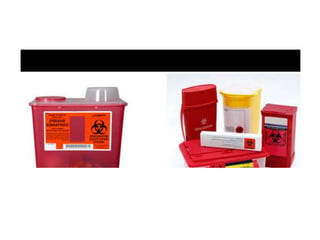
Locally made Sharp Waste
containers
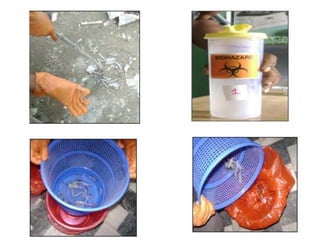
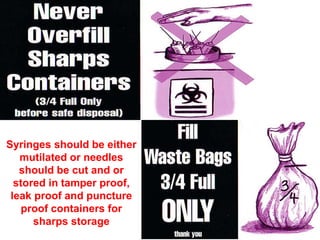
Syringes should be either
mutilated or needles
should be cut and or
stored in tamper proof,
leak proof and puncture
proof containers for
sharps storage
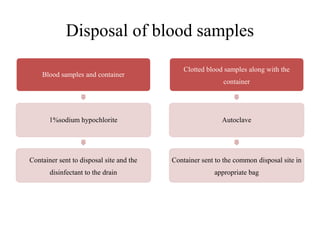
Disposal of blood samples
Blood samples and container
1%sodium hypochlorite
Container sent to disposal site and the
disinfectant to the drain
Clotted blood samples along with the
container
Autoclave
Container sent to the common disposal site in
appropriate bag
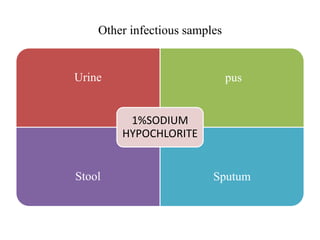
Other infectious samples
Urine pus
Stool Sputum
1%SODIUM
HYPOCHLORITE
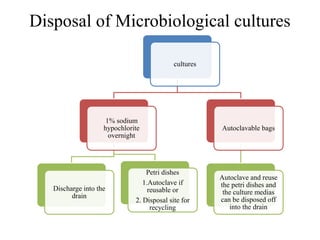
Disposal of Microbiological cultures
cultures
1% sodium
hypochlorite
overnight
Discharge into the
drain
Petri dishes
1.Autoclave if
reusable or
2. Disposal site for
recycling
Autoclavable bags
Autoclave and reuse
the petri dishes and
the culture medias
can be disposed off
into the drain
Transportation
• Always collect waste in a covered bin/bags
• Dispose bags every day or whenever ¾ filled
• Handover waste to dedicated waste collection team
• Collection team should tie properly labelled bag, weight,
record particular in waste collection register
• Then collection team should keep the waste
bag/container in transportation trolley/container
• Transportation should be done safely without spillage &
leakage
Transportation
• Collection container should then be cleaned with
soap and water/disinfectant by housekeeping staff
and new suitable bag/ container will be applied and
to be checked by staff nurse or technician (OT,
Laboratory) of respective area
• No waste to be stored >24 hours at point of segregation
• Collection team then transport waste in closed container
to storage area in a pre-defined path of least crowding
• Waste in common storage area will be delivered to the
authorised person from common biomedical treatment
facility
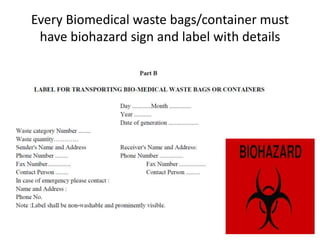
Every Biomedical waste bags/container must
have biohazard sign and label with details
Do’s FOR WASTE M/M
• Generate waste when essential
• Segregate waste at source into specified categories of waste
with biohazard logo
• Mutilate waste at source if possible to prevent unauthorized
reuse
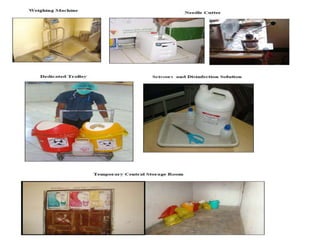
• Destroy needle by using needle cutter
• Keep the needles in puncture proof, translucent container
• Clean the bins regularly with soap & water and disinfect the
bins regularly.
• All liquid chemical waste should be drained out in to ETP
(EFFLUENT TREATMENT PLANT)
Don’ts
• Do not generate waste unnecessary (e.g. avoid injection by
prescribing oral medicines)
• Never mix infectious & non- infectious waste
• Never mix chlorinated wastes with such wastes those which
have designated for incineration.
• Never overfill the bins.
• Never store waste beyond 48 hrs.
• There should not be any spillage on the way of transport.
Don’ts
• Avoid transport of waste through crowded areas
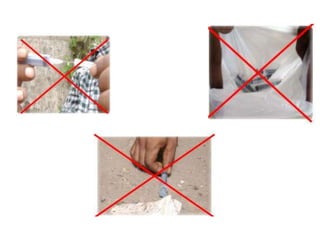
• Do not throw infectious waste into general waste without any
pre- treatment and mutilation
• Don’t dispose the solid waste (plastic) and sharp waste without
mutilation
References
• Biomedical Waste Management Rule 2018
• Safe management of wastes from health-care activities. WHO 2nd
Edition
• 1st Edition of Essential of Medical Microbiology by Apruba Shankar
Sastry & Santhiya Bhat K.
• 5th Edition of Texbook of Microbiology by Dr CP Bhaveja
• NACO Manuals
Ms Tissymol Thomas
Nursing Superintendent
Ford Hospital & Research Centre Pvt Ltd
Founder: SKILLVERSITY

BMW Training PPT -1.ppt

  • 1.
  • 2.
    Definition Waste generated duringlaboratory diagnosis, treatment or immunization of human being or in research activity pertaining there to, or in production of biologicals
  • 3.
    Contribution of differentwaste type Hospital Waste Non- hazardous Hazardous Bio degradable Non-bio degradable Potentially Toxic Potentially Infectious Chemical Radioactive Organic Lab Pharmaceutical Sharps 80-85% 15-20% Waste generation in Developing countries 0.5-2 Kg/bed/day Developed 1-5 Kg/bed/day 15% 5%
  • 6.
    4 category ofwaste: • Yellow • Red • Blue • White (Translucent) • Black (General Waste)
  • 7.
    Biomedical wastes categoriesand their segregation, collection, treatment, processing and disposal options (Schedule 1) Category Type of waste Container to be used Yellow Soiled Waste (Items contaminated with blood, body fluids): • Dressings, Bandage, Gauze, Linen (Soiled) • Plaster casts, • Cotton swabs • Bed Protection pads • Bags containing residual or discarded blood and blood components including blood set tubing’s • Diapers, Napkins • Discarded linen, mattresses, beddings Yellow coloured non-chlorinated plastic bags common Bio- medical Waste treatment facility
  • 8.
    Biomedical wastes categoriesand their segregation, collection, treatment, processing and disposal options (Schedule 1) Category Type of waste Container to be used Yellow Human Anatomical Waste: Human tissues, organs, body parts and fetus below the viability period (as per MTP act) [copy of official MTP certificate from Obstetrician or the MS of hospital or healthcare establishment must be given] Yellow coloured non-chlorinated plastic bags common Bio- medical Waste treatment facility
  • 9.
    Biomedical wastes categoriesand their segregation, collection, treatment, processing and disposal options (Schedule 1) Category Type of waste Container to be used Yellow Animal Anatomical Waste: Experimental animal carcasses, body parts, organs, tissues, including the waste generated from animals used in experiments or testing in animal houses Yellow coloured non-chlorinated plastic bags common Bio- medical Waste treatment facility Expired or Discarded Medicines (Except cytotoxic drugs) Pharmaceutical waste like antibiotics
  • 10.
    Biomedical wastes categoriesand their segregation, collection, treatment, processing and disposal options (Schedule 1) Category Type of waste Container to be used Yellow Cytotoxic drugs including all items contaminated with cytotoxic drugs along with glass or plastic ampoules, vials etc Surgical disposable face mask, caps, gown, Shoe cover Yellow coloured non-chlorinated plastic bags with cytotoxic label common Bio- medical Waste treatment facility
  • 12.
    Biomedical wastes categoriesand their segregation, collection, treatment, processing and disposal options (Schedule 1) Category Type of waste Container to be used Yellow Chemical Liquid Waste: • Liquid waste generated due to use of chemicals in production of biological and used or discarded disinfectants, • Silver X-ray film developing liquid, • Discarded Formalin, • Infected secretions, • Aspirated body fluids, • Liquid from laboratories Separate collection system leading to effluent treatment system
  • 13.
    Biomedical wastes categoriesand their segregation, collection, treatment, processing and disposal options (Schedule 1) Category Type of waste Container to be used Yellow Microbiology, Biotechnology and other clinical laboratory waste: • Blood bags, • Vacutainers containing blood • Dishes and devices used for cultures • Laboratory cultures, stocks or specimens of microorganisms, • Live or attenuated vaccines, • human and animal cell cultures used in research, production of biological, Autoclave safe plastic bags or containers Autoclave/ Microwave common Bio- medical Waste treatment facility
  • 14.
    • Lab &highly infectious BMW generated shall be pre- treated by equipment like autoclave or microwave • Microbiology waste and all other clinical laboratory waste shall be pre-treated by sterilisation to Log 6 or disinfection to Log 4, as per the WHO & NACO guidelines before packing & sending to Treatment Plant. • No chemical pre-treatment before incineration, except for microbiological, lab & highly infectious waste
  • 15.
    Autoclave conditions forBMW handling • Should not be less than – 1210C x 15psi x 60 minutes – 1350C x 31psi x 45 minutes – 1490C x 52psi x 30 minutes • Biological Indicator: (Maintain record) – First Validate with 4 biological indicator – Then Daily testing with chemical indicator (>1 strips per bag of discard at different locations – Once a Week biological indicator testing
  • 16.
    Category Type ofwaste Container to be used Red Contaminated Waste (Recyclable) Wastes generated from disposable items such as • All plastic tubings (Ryle’s, ICD, ET, drains) • Intravenous tubes and sets, • Catheters (Foley’s, suction etc) • Cardiac cannulas • Plastic iv Bottles • Uro bags, • syringes (without needles ) • vacutainers with their needles cut Red coloured non- chlorinated plastic bags or containers common Bio-medical Waste treatment facility
  • 17.
    Category Type ofwaste Container to be used Red • Gloves • Nebulization masks • Needle caps (If infected) • Plastic Test tubes • Pipettes • Disposable tips • Plastic Trough Red coloured non- chlorinated plastic bags or containers common Bio-medical Waste treatment facility
  • 18.
    Category Type ofwaste Container to be used White (Translucent) Waste sharps including Metals: • Needles (including Hypodermic needles, I/v set needles, suture needles, LP needles etc.) • Stylets of IV cannula • syringes with fixed needles, • Needles from needle tip cutter or burner, • scalpels, • blades, • Lancets • Saws • Any other contaminated sharp object that may cause puncture and cuts includes used, discarded and contaminated metal sharps Puncture proof, Leak proof, tamper proof containers common Bio-medical Waste treatment facility
  • 19.
    Category Type ofwaste Container to be used Blue Glassware: • Broken or discarded and contaminated glass including medicine vials and ampoules except those contaminated with cytotoxic wastes Glassware: • Broken petri dishes, • Slides and cover slips, • Broken pipettes and other glass material Metallic Body Implants Cardboard boxes with blue coloured marking (If soiled with infectious waste: treat by disinfectants or autoclaving) common Bio-medical Waste treatment facility
  • 21.
    Alternative • Heavy dutyplastic containers • But, they should be • leak resistant, • Remain upright during use without sharp able to come out • Tight fitting, puncture resistant lid • Translucent which has to be marked • Examples • Plastic laundry detergent container, • Plastic bottles • Empty detergent metal cans • Disinfectants empty plastic container • Empty dry media containers • A tin or a plastic box with a small opening at top with a lid for closure of the Box
  • 22.
    Alternative • Clearly labelled“Sharp Metallic waste” with “biohazard symbol” • A line should be drawn on the box to mark ¾ of the volume • Needles should be filled only till this line
  • 23.
    Locally made SharpWaste containers
  • 26.
    Syringes should beeither mutilated or needles should be cut and or stored in tamper proof, leak proof and puncture proof containers for sharps storage
  • 27.
    Disposal of bloodsamples Blood samples and container 1%sodium hypochlorite Container sent to disposal site and the disinfectant to the drain Clotted blood samples along with the container Autoclave Container sent to the common disposal site in appropriate bag
  • 28.
    Other infectious samples Urinepus Stool Sputum 1%SODIUM HYPOCHLORITE
  • 29.
    Disposal of Microbiologicalcultures cultures 1% sodium hypochlorite overnight Discharge into the drain Petri dishes 1.Autoclave if reusable or 2. Disposal site for recycling Autoclavable bags Autoclave and reuse the petri dishes and the culture medias can be disposed off into the drain
  • 30.
    Transportation • Always collectwaste in a covered bin/bags • Dispose bags every day or whenever ¾ filled • Handover waste to dedicated waste collection team • Collection team should tie properly labelled bag, weight, record particular in waste collection register • Then collection team should keep the waste bag/container in transportation trolley/container • Transportation should be done safely without spillage & leakage
  • 31.
    Transportation • Collection containershould then be cleaned with soap and water/disinfectant by housekeeping staff and new suitable bag/ container will be applied and to be checked by staff nurse or technician (OT, Laboratory) of respective area • No waste to be stored >24 hours at point of segregation • Collection team then transport waste in closed container to storage area in a pre-defined path of least crowding • Waste in common storage area will be delivered to the authorised person from common biomedical treatment facility
  • 32.
    Every Biomedical wastebags/container must have biohazard sign and label with details
  • 33.
    Do’s FOR WASTEM/M • Generate waste when essential • Segregate waste at source into specified categories of waste with biohazard logo • Mutilate waste at source if possible to prevent unauthorized reuse • Destroy needle by using needle cutter • Keep the needles in puncture proof, translucent container • Clean the bins regularly with soap & water and disinfect the bins regularly. • All liquid chemical waste should be drained out in to ETP (EFFLUENT TREATMENT PLANT)
  • 34.
    Don’ts • Do notgenerate waste unnecessary (e.g. avoid injection by prescribing oral medicines) • Never mix infectious & non- infectious waste • Never mix chlorinated wastes with such wastes those which have designated for incineration. • Never overfill the bins. • Never store waste beyond 48 hrs. • There should not be any spillage on the way of transport.
  • 35.
    Don’ts • Avoid transportof waste through crowded areas • Do not throw infectious waste into general waste without any pre- treatment and mutilation • Don’t dispose the solid waste (plastic) and sharp waste without mutilation
  • 37.
    References • Biomedical WasteManagement Rule 2018 • Safe management of wastes from health-care activities. WHO 2nd Edition • 1st Edition of Essential of Medical Microbiology by Apruba Shankar Sastry & Santhiya Bhat K. • 5th Edition of Texbook of Microbiology by Dr CP Bhaveja • NACO Manuals Ms Tissymol Thomas Nursing Superintendent Ford Hospital & Research Centre Pvt Ltd Founder: SKILLVERSITY